TWELVE FROM THE
LAST 12 MONTHS
WHAT IS IT?
• A library of 200 books
• A blog
• A series of printed books
• A pair of apps
• One-page summaries
• One-sentence summaries
• Training programmes and
speeches
• A fertile source of new ideas
THE BIG THEMES
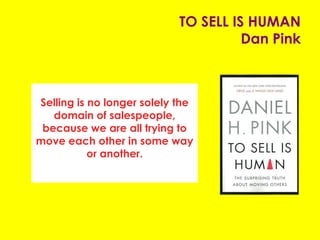
TO SELL IS HUMAN
Dan Pink
Selling is no longer solely the
domain of salespeople,
because we are all trying to
move each other in some way
or another.
TO SELL IS HUMAN
Dan Pink
 We are all in sales now - trying to ‘move’ the
other’s point of view
 We spend 40% of our time ‘Non-sales selling’. The
forces behind it are:
Entrepreneurship
Elasticity(flexible skills)
Ed-Med (the two fastest-growing industries)
 The rules now are:
Attunement: being in harmony with people
Buoyancy: a resilient outlook
Clarity: making sense of murky problems and
solving them
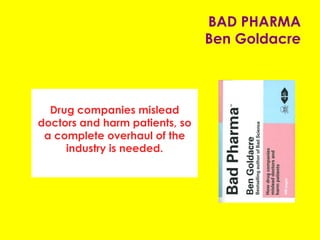
BAD PHARMA
Ben Goldacre
Drug companies mislead
doctors and harm patients, so
a complete overhaul of the
industry is needed.
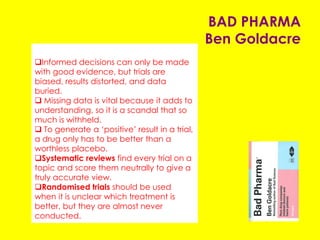
BAD PHARMA
Ben Goldacre
Informed decisions can only be made with
good evidence, but trials are biased, results
distorted, and data buried.
 Missing data is vital because it adds to
understanding, so it is a scandal that so much is
withheld.
 To generate a ‘positive’ result in a trial, a drug
only has to be better than a worthless placebo.
Systematic reviews find every trial on a topic
and score them neutrally to give a truly accurate
view.
Randomised trials should be used when it is
unclear which treatment is better, but they are
almost never conducted.
ANTIFRAGILE
Nassim Nicholas Taleb
Antifragile things get stronger
when subjected to stress and
tension, whereas fragile things
break and robust ones simply
stay the same.
ANTIFRAGILE
Nassim Nicholas Taleb
 Procrustean bed: retrofitting causes
 Fragilistas: cause fragility by thinking they
understand
 Barbell strategy: safe and speculative extremes
 Ludic fallacy: mistake experiments with real world
 Turkeys and inverse turkeys
 Green lumber fallacy: unnecessary knowledge
 Extremistan: impact of a single observation
 Iatrogenics: harm done by the healer
 Agency problem: manager is not true owner
 Black swan errors: what you know now may not be
all there is
BUSINESS STRATEGY
BUSINESS IS BEAUTIFUL
Danet et al.
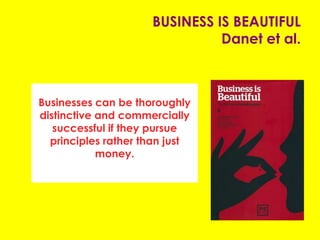
Businesses can be thoroughly
distinctive and commercially
successful if they pursue
principles rather than just
money.
BUSINESS IS BEAUTIFUL
Danet et al.
 Business doesn’t have to be cold and unforgiving.
 Businesses are made up of people who come
together to achieve more than individuals can on
their own.
 The five hallmarks of beautiful businesses are:
1. Integrity: a clear sense of purpose
2. Curiosity: they don’t stand still
3. Elegance: they are pleasurably simple
4. Craft: apply consideration to every last detail
5. Prosperity: all this leads to a strong sense of value
creation
 There are 20 sub-facets and case histories to
illustrate this thesis.
TELL THE TRUTH
Unerman & Salem Baskin
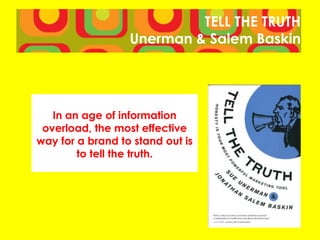
In an age of information
overload, the most effective
way for a brand to stand out is
to tell the truth.
TELL THE TRUTH
Unerman& Salem Baskin
Content:
 Acknowledge reality
 Deliver real change to services and company
structure
 Take consumers on the brand truth journey
 Enlist third-party advocates
Context:
 Be close
 Find a Truth Turning Point
 Use point-of-action media
 Leverage routine
CONSUMER BEHAVIOUR
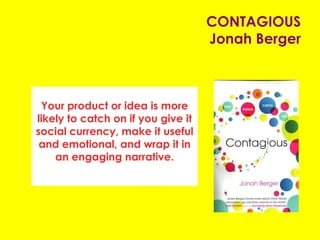
CONTAGIOUS
Jonah Berger
Your product or idea is more
likely to catch on if you give it
social currency, make it useful
and emotional, and wrap it in
an engaging narrative.
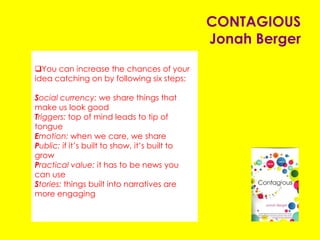
CONTAGIOUS
Jonah Berger
You can increase the chances of your idea catching
on by following six steps:
Social currency: we share things that make us look good
Triggers: top of mind leads to tip of tongue
Emotion: when we care, we share
Public: if it’s built to show, it’s built to grow
Practical value: it has to be news you can use
Stories: things built into narratives are more engaging
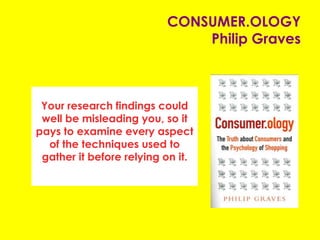
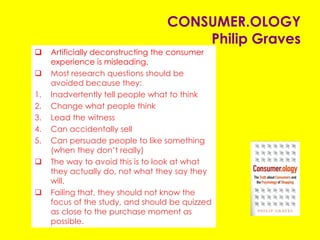
CONSUMER.OLOGY
Philip Graves
Your research findings could
well be misleading you, so it
pays to examine every aspect
of the techniques used to
gather it before relying on it.
CONSUMER.OLOGY
Philip Graves
 Artificially deconstructing the consumer
experience is misleading.
 Most research questions should be avoided
because they:
1. Inadvertently tell people what to think
2. Change what people think
3. Lead the witness
4. Can accidentally sell
5. Can persuade people to like something (when
they don’t really)
 The way to avoid this is to look at what they
actually do, not what they say they will.
 Failing that, they should not know the focus of the
study, and should be quizzed as close to the
purchase moment as possible.
CREATIVITY
CREATIVE MISCHIEF
Dave Trott
If you want to be creative, you
have to be curious and
contrary.
CREATIVE MISCHIEF
Dave Trott
 Here’s the world’s simplest binary brief:
WHO should buy it? Trialists or current
users? You can’t have both. If it’s current
users, explain why they should buy more.
WHY should they buy it? Product or
brand? Rational or emotional?
WHAT should they buy it instead of?
Brand share or market growth? All
product use is good if you are brand
leader.
IMAGINE
Jonah Lehrer
Ideas come from sheer
persistence, but only when we
relax, so if you work hard
enough on something, and
focus on not being focused,
there will eventually be an
unconcealing.
IMAGINE
Jonah Lehrer
 Muses, higher powers and creative ‘types’ are
myths
 Creativity is not a ‘gift’ that only some possess – it’s
a catch-all for distinct thought processes that we
can all learn to use more effectively.
 It’s only after we’ve stopped searching for an
answer that it arrives.
 Breakthroughs follow a ‘stumped phase’.
 Trying to force insights can often prevent them–
ideas arrive when the mind is distracted or relaxed.
 Focus on not being focused.
 Ideas occur best in ‘third places’ – neither the
home nor the office.
INSANELY SIMPLE
Ken Segall
Work as hard as you can to
make everything as simple as
it can possibly be.
INSANELY SIMPLE
Ken Segall
 Think brutal
 Think small: small groups get more done
 Think minimal: just communicate one thing
 Think motion: momentum is crucial to projects
 Think iconic: essence in a conceptual image
 Think phrasal: use short simple words
 Think casual: no big company thinking and process
 Think human: be true to your feelings
 Think sceptic: expect negative first reactions of
 Think war: extreme times call for extreme measures
MOTIVATION
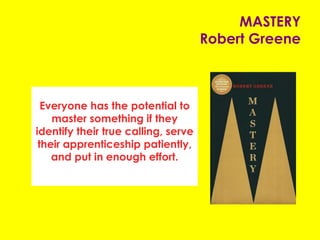
MASTERY
Robert Greene
Everyone has the potential to
master something if they
identify their true calling, serve
their apprenticeship patiently,
and put in enough effort.
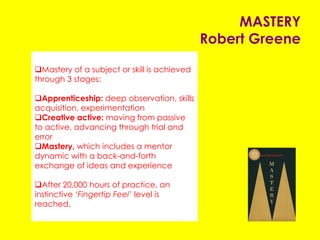
MASTERY
Robert Greene
Mastery of a subject or skill is achieved through
three stages:
Apprenticeship: deep observation, skills
acquisition, experimentation
Creative active: moving from passive to active,
advancing through trial and error
Mastery, which includes a mentor dynamic with a
back-and-forth exchange of ideas and experience
After 20,000 hours of practice, an instinctive
‘Fingertip Feel’ level is reached.
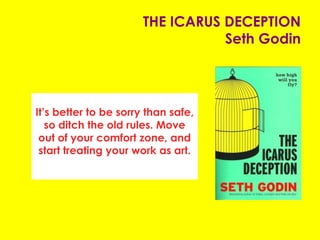
THE ICARUS DECEPTION
Seth Godin
It’s better to be sorry than safe,
so ditch the old rules. Move
out of your comfort zone, and
start treating your work as art.
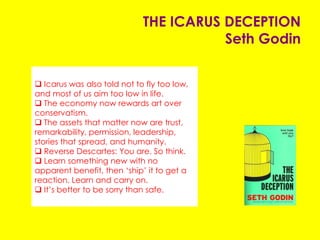
THE ICARUS DECEPTION
Seth Godin
 Icarus was also told not to fly too low, and
most of us aim too low in life.
 The economy now rewards art over
conservatism.
 The assets that matter now are trust,
remarkability, permission, leadership, stories
that spread, and humanity.
 Reverse Descartes: You are. So think.
 Learn something new with no apparent
benefit, then ‘ship’ it to get a reaction. Learn
and carry on.
 It’s better to be sorry than safe.
HOW TO USE
• Be inquisitive
• Make the time
• Understand the lines of argument
• Take a view
• Inform your work
• Enjoy the debate
• Ask Kevin to speak or train
KEVIN DUNCAN
More detail at:
www.greatesthitsblog.com
Ask Kevin to speak or train:
07979 808770
kevinduncan@expertadvice.co.uk
Twitter: @kevinduncan

GREATEST HITS MAY 2013

  • 1.
  • 2.
    WHAT IS IT? •A library of 200 books • A blog • A series of printed books • A pair of apps • One-page summaries • One-sentence summaries • Training programmes and speeches • A fertile source of new ideas
  • 3.
  • 4.
    TO SELL ISHUMAN Dan Pink Selling is no longer solely the domain of salespeople, because we are all trying to move each other in some way or another.
  • 5.
    TO SELL ISHUMAN Dan Pink  We are all in sales now - trying to ‘move’ the other’s point of view  We spend 40% of our time ‘Non-sales selling’. The forces behind it are: Entrepreneurship Elasticity(flexible skills) Ed-Med (the two fastest-growing industries)  The rules now are: Attunement: being in harmony with people Buoyancy: a resilient outlook Clarity: making sense of murky problems and solving them
  • 6.
    BAD PHARMA Ben Goldacre Drugcompanies mislead doctors and harm patients, so a complete overhaul of the industry is needed.
  • 7.
    BAD PHARMA Ben Goldacre Informeddecisions can only be made with good evidence, but trials are biased, results distorted, and data buried.  Missing data is vital because it adds to understanding, so it is a scandal that so much is withheld.  To generate a ‘positive’ result in a trial, a drug only has to be better than a worthless placebo. Systematic reviews find every trial on a topic and score them neutrally to give a truly accurate view. Randomised trials should be used when it is unclear which treatment is better, but they are almost never conducted.
  • 8.
    ANTIFRAGILE Nassim Nicholas Taleb Antifragilethings get stronger when subjected to stress and tension, whereas fragile things break and robust ones simply stay the same.
  • 9.
    ANTIFRAGILE Nassim Nicholas Taleb Procrustean bed: retrofitting causes  Fragilistas: cause fragility by thinking they understand  Barbell strategy: safe and speculative extremes  Ludic fallacy: mistake experiments with real world  Turkeys and inverse turkeys  Green lumber fallacy: unnecessary knowledge  Extremistan: impact of a single observation  Iatrogenics: harm done by the healer  Agency problem: manager is not true owner  Black swan errors: what you know now may not be all there is
  • 10.
  • 11.
    BUSINESS IS BEAUTIFUL Danetet al. Businesses can be thoroughly distinctive and commercially successful if they pursue principles rather than just money.
  • 12.
    BUSINESS IS BEAUTIFUL Danetet al.  Business doesn’t have to be cold and unforgiving.  Businesses are made up of people who come together to achieve more than individuals can on their own.  The five hallmarks of beautiful businesses are: 1. Integrity: a clear sense of purpose 2. Curiosity: they don’t stand still 3. Elegance: they are pleasurably simple 4. Craft: apply consideration to every last detail 5. Prosperity: all this leads to a strong sense of value creation  There are 20 sub-facets and case histories to illustrate this thesis.
  • 13.
    TELL THE TRUTH Unerman& Salem Baskin In an age of information overload, the most effective way for a brand to stand out is to tell the truth.
  • 14.
    TELL THE TRUTH Unerman&Salem Baskin Content:  Acknowledge reality  Deliver real change to services and company structure  Take consumers on the brand truth journey  Enlist third-party advocates Context:  Be close  Find a Truth Turning Point  Use point-of-action media  Leverage routine
  • 15.
  • 16.
    CONTAGIOUS Jonah Berger Your productor idea is more likely to catch on if you give it social currency, make it useful and emotional, and wrap it in an engaging narrative.
  • 17.
    CONTAGIOUS Jonah Berger You canincrease the chances of your idea catching on by following six steps: Social currency: we share things that make us look good Triggers: top of mind leads to tip of tongue Emotion: when we care, we share Public: if it’s built to show, it’s built to grow Practical value: it has to be news you can use Stories: things built into narratives are more engaging
  • 18.
    CONSUMER.OLOGY Philip Graves Your researchfindings could well be misleading you, so it pays to examine every aspect of the techniques used to gather it before relying on it.
  • 19.
    CONSUMER.OLOGY Philip Graves  Artificiallydeconstructing the consumer experience is misleading.  Most research questions should be avoided because they: 1. Inadvertently tell people what to think 2. Change what people think 3. Lead the witness 4. Can accidentally sell 5. Can persuade people to like something (when they don’t really)  The way to avoid this is to look at what they actually do, not what they say they will.  Failing that, they should not know the focus of the study, and should be quizzed as close to the purchase moment as possible.
  • 20.
  • 21.
    CREATIVE MISCHIEF Dave Trott Ifyou want to be creative, you have to be curious and contrary.
  • 22.
    CREATIVE MISCHIEF Dave Trott Here’s the world’s simplest binary brief: WHO should buy it? Trialists or current users? You can’t have both. If it’s current users, explain why they should buy more. WHY should they buy it? Product or brand? Rational or emotional? WHAT should they buy it instead of? Brand share or market growth? All product use is good if you are brand leader.
  • 23.
    IMAGINE Jonah Lehrer Ideas comefrom sheer persistence, but only when we relax, so if you work hard enough on something, and focus on not being focused, there will eventually be an unconcealing.
  • 24.
    IMAGINE Jonah Lehrer  Muses,higher powers and creative ‘types’ are myths  Creativity is not a ‘gift’ that only some possess – it’s a catch-all for distinct thought processes that we can all learn to use more effectively.  It’s only after we’ve stopped searching for an answer that it arrives.  Breakthroughs follow a ‘stumped phase’.  Trying to force insights can often prevent them– ideas arrive when the mind is distracted or relaxed.  Focus on not being focused.  Ideas occur best in ‘third places’ – neither the home nor the office.
  • 25.
    INSANELY SIMPLE Ken Segall Workas hard as you can to make everything as simple as it can possibly be.
  • 26.
    INSANELY SIMPLE Ken Segall Think brutal  Think small: small groups get more done  Think minimal: just communicate one thing  Think motion: momentum is crucial to projects  Think iconic: essence in a conceptual image  Think phrasal: use short simple words  Think casual: no big company thinking and process  Think human: be true to your feelings  Think sceptic: expect negative first reactions of  Think war: extreme times call for extreme measures
  • 27.
  • 28.
    MASTERY Robert Greene Everyone hasthe potential to master something if they identify their true calling, serve their apprenticeship patiently, and put in enough effort.
  • 29.
    MASTERY Robert Greene Mastery ofa subject or skill is achieved through three stages: Apprenticeship: deep observation, skills acquisition, experimentation Creative active: moving from passive to active, advancing through trial and error Mastery, which includes a mentor dynamic with a back-and-forth exchange of ideas and experience After 20,000 hours of practice, an instinctive ‘Fingertip Feel’ level is reached.
  • 30.
    THE ICARUS DECEPTION SethGodin It’s better to be sorry than safe, so ditch the old rules. Move out of your comfort zone, and start treating your work as art.
  • 31.
    THE ICARUS DECEPTION SethGodin  Icarus was also told not to fly too low, and most of us aim too low in life.  The economy now rewards art over conservatism.  The assets that matter now are trust, remarkability, permission, leadership, stories that spread, and humanity.  Reverse Descartes: You are. So think.  Learn something new with no apparent benefit, then ‘ship’ it to get a reaction. Learn and carry on.  It’s better to be sorry than safe.
  • 32.
    HOW TO USE •Be inquisitive • Make the time • Understand the lines of argument • Take a view • Inform your work • Enjoy the debate • Ask Kevin to speak or train
  • 33.
    KEVIN DUNCAN More detailat: www.greatesthitsblog.com Ask Kevin to speak or train: 07979 808770 kevinduncan@expertadvice.co.uk Twitter: @kevinduncan