The Simple Past
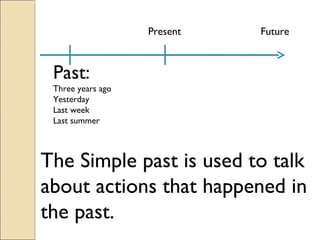
Present Future Past: Three years ago Yesterday Last week Last summer The Simple past is used to talk about actions that happened in the past.
To be
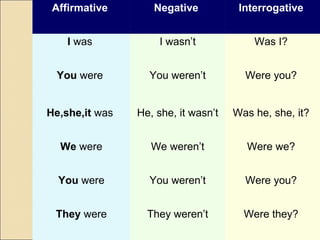
Affirmative   Negative  Interrogative  I  was  I wasn’t Was I?  You  were  You weren’t Were you?  He,she,it  was  He, she, it wasn’t Was he, she, it?  We  were We weren’t Were we?  You  were You weren’t Were you?  They  were They weren’t Were they?
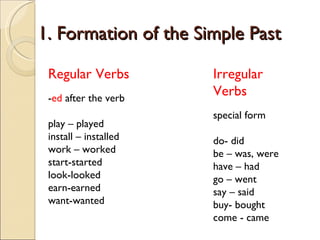
1. Formation of the Simple Past Regular Verbs - ed  after the verb play – played install – installed work – worked start-started look-looked earn-earned want-wanted Irregular Verbs special form do- did be – was, were have – had go – went say – said buy- bought come - came
Regular Verbs
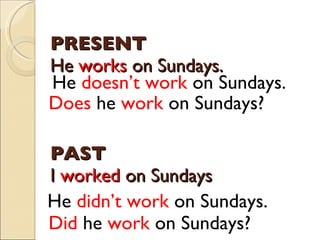
PRESENT He  works  on Sundays. PAST I  worked  on Sundays He  doesn’t work  on Sundays. Does  he  work  on Sundays? He  didn’t work  on Sundays. Did  he  work  on Sundays?
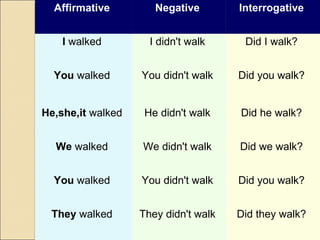
Affirmative   Negative  Interrogative  I  walked  I didn't walk  Did I walk?  You  walked  You didn't walk  Did you walk?  He,she,it  walked  He didn't walk  Did he walk?  We  walked  We didn't walk  Did we walk?  You  walked  You didn't walk  Did you walk?  They  walked  They didn't walk  Did they walk?
Irregular verbs
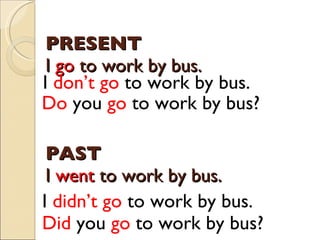
PRESENT I  go  to work by bus. PAST I  went  to work by bus. I  don’t go  to work by bus. Do  you  go  to work by bus? I  didn’t go  to work by bus. Did  you  go  to work by bus?
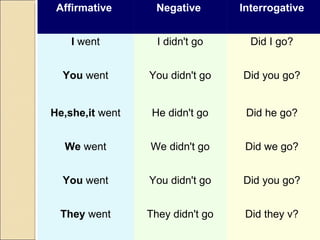
Affirmative   Negative  Interrogative  I  went I didn't go Did I go?  You  went You didn't go Did you go?  He,she,it  went He didn't go Did he go?  We  went We didn't go Did we go?  You  went You didn't go Did you go?  They  went They didn't go Did they v?
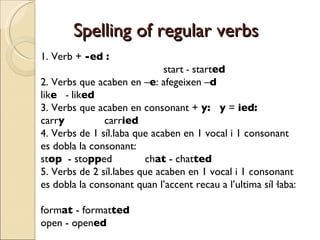
Spelling of regular verbs 1. Verb +  -ed :    start  -  start ed 2. Verbs que acaben en – e : afegeixen – d lik e   -  lik ed 3. Verbs que acaben en consonant +  y:  y  =  ied:  carr y  carr ied 4. Verbs de 1 síl.laba que acaben en 1 vocal i 1 consonant  es dobla la consonant:  st op   - sto pp ed  ch at  - chat ted 5. Verbs de 2 síl.labes que acaben en 1 vocal i 1 consonant   es dobla la consonant quan l’accent recau a l’ultima síl·laba:   form at  - format ted open - open ed
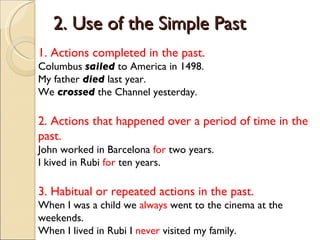
2. Use of the Simple Past 1. Actions completed in the past. Columbus  sailed   to America in 1498. My father  died  last year. We  crossed  the Channel yesterday. 2. Actions that happened over a period of time in the past. John worked in Barcelona  for  two years. I kived in Rubi  for  ten years. 3. Habitual or repeated actions in the past. When I was a child we  always  went to the cinema at the weekends. When I lived in Rubi I  never  visited my family.
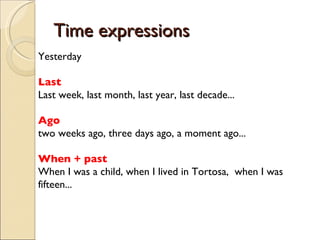
Time expressions Yesterday Last Last week, last month, last year, last decade... Ago two weeks ago, three days ago, a moment ago... When + past When I was a child, when I lived in Tortosa,  when I was fifteen...
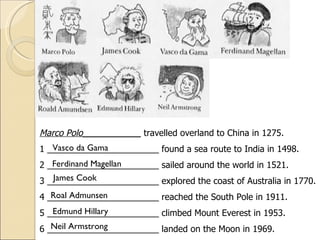
Marco Polo____________   travelled overland to China in 1275. 1 _______________________ found a sea route to India in 1498. 2 _______________________ sailed around the world in 1521.  3 _______________________ explored the coast of Australia in 1770. 4 _______________________ reached the South Pole in 1911. 5 _______________________ climbed Mount Everest in 1953. 6 _______________________ landed on the Moon in 1969. Vasco da Gama Ferdinand Magellan James Cook Edmund Hillary Roal Admunsen Neil Armstrong
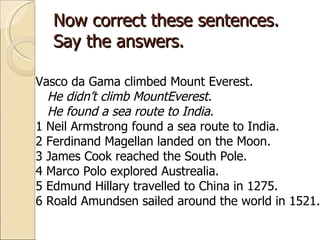
Now correct these sentences. Say the answers. Vasco da Gama climbed Mount Everest.  He didn’t climb MountEverest. He found a sea route to India. 1 Neil Armstrong found a sea route to India. 2 Ferdinand Magellan landed on the Moon. 3 James Cook reached the South Pole. 4 Marco Polo explored Austrealia. 5 Edmund Hillary travelled to China in 1275. 6 Roald Amundsen sailed around the world in 1521.
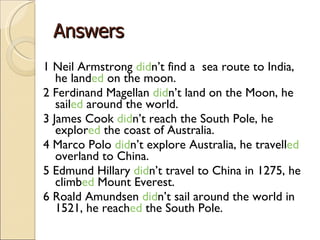
Answers 1 Neil Armstrong  did n’t find a  sea route to India, he land ed  on the moon. 2 Ferdinand Magellan  did n’t land on the Moon, he sail ed  around the world.  3 James Cook  did n’t reach the South Pole, he explor ed  the coast of Australia. 4 Marco Polo  did n’t  explore Australia, he travell ed  overland to China. 5 Edmund Hillary  did n’t travel to China in 1275, he climb ed  Mount Everest. 6 Roald Amundsen  did n’t sail around the world in 1521, he reach ed  the South Pole.

The Simple Past Presentation

  • 1.
  • 2.
    Present Future Past:Three years ago Yesterday Last week Last summer The Simple past is used to talk about actions that happened in the past.
  • 3.
  • 4.
    Affirmative Negative Interrogative I was I wasn’t Was I? You were You weren’t Were you? He,she,it was He, she, it wasn’t Was he, she, it? We were We weren’t Were we? You were You weren’t Were you? They were They weren’t Were they?
  • 5.
    1. Formation ofthe Simple Past Regular Verbs - ed after the verb play – played install – installed work – worked start-started look-looked earn-earned want-wanted Irregular Verbs special form do- did be – was, were have – had go – went say – said buy- bought come - came
  • 6.
  • 7.
    PRESENT He works on Sundays. PAST I worked on Sundays He doesn’t work on Sundays. Does he work on Sundays? He didn’t work on Sundays. Did he work on Sundays?
  • 8.
    Affirmative Negative Interrogative I walked I didn't walk Did I walk? You walked You didn't walk Did you walk? He,she,it walked He didn't walk Did he walk? We walked We didn't walk Did we walk? You walked You didn't walk Did you walk? They walked They didn't walk Did they walk?
  • 9.
  • 10.
    PRESENT I go to work by bus. PAST I went to work by bus. I don’t go to work by bus. Do you go to work by bus? I didn’t go to work by bus. Did you go to work by bus?
  • 11.
    Affirmative Negative Interrogative I went I didn't go Did I go? You went You didn't go Did you go? He,she,it went He didn't go Did he go? We went We didn't go Did we go? You went You didn't go Did you go? They went They didn't go Did they v?
  • 12.
    Spelling of regularverbs 1. Verb + -ed : start - start ed 2. Verbs que acaben en – e : afegeixen – d lik e - lik ed 3. Verbs que acaben en consonant + y: y = ied: carr y carr ied 4. Verbs de 1 síl.laba que acaben en 1 vocal i 1 consonant es dobla la consonant: st op - sto pp ed ch at - chat ted 5. Verbs de 2 síl.labes que acaben en 1 vocal i 1 consonant es dobla la consonant quan l’accent recau a l’ultima síl·laba: form at - format ted open - open ed
  • 13.
    2. Use ofthe Simple Past 1. Actions completed in the past. Columbus sailed to America in 1498. My father died last year. We crossed the Channel yesterday. 2. Actions that happened over a period of time in the past. John worked in Barcelona for two years. I kived in Rubi for ten years. 3. Habitual or repeated actions in the past. When I was a child we always went to the cinema at the weekends. When I lived in Rubi I never visited my family.
  • 14.
    Time expressions YesterdayLast Last week, last month, last year, last decade... Ago two weeks ago, three days ago, a moment ago... When + past When I was a child, when I lived in Tortosa, when I was fifteen...
  • 15.
    Marco Polo____________ travelled overland to China in 1275. 1 _______________________ found a sea route to India in 1498. 2 _______________________ sailed around the world in 1521. 3 _______________________ explored the coast of Australia in 1770. 4 _______________________ reached the South Pole in 1911. 5 _______________________ climbed Mount Everest in 1953. 6 _______________________ landed on the Moon in 1969. Vasco da Gama Ferdinand Magellan James Cook Edmund Hillary Roal Admunsen Neil Armstrong
  • 16.
    Now correct thesesentences. Say the answers. Vasco da Gama climbed Mount Everest. He didn’t climb MountEverest. He found a sea route to India. 1 Neil Armstrong found a sea route to India. 2 Ferdinand Magellan landed on the Moon. 3 James Cook reached the South Pole. 4 Marco Polo explored Austrealia. 5 Edmund Hillary travelled to China in 1275. 6 Roald Amundsen sailed around the world in 1521.
  • 17.
    Answers 1 NeilArmstrong did n’t find a sea route to India, he land ed on the moon. 2 Ferdinand Magellan did n’t land on the Moon, he sail ed around the world. 3 James Cook did n’t reach the South Pole, he explor ed the coast of Australia. 4 Marco Polo did n’t explore Australia, he travell ed overland to China. 5 Edmund Hillary did n’t travel to China in 1275, he climb ed Mount Everest. 6 Roald Amundsen did n’t sail around the world in 1521, he reach ed the South Pole.