CONTENTS

1-1
1-2
1-3
1-4
1-5
1-6
1-7

Preview
The simple present and the present progressive
Forms of the simple present and the present…
Frequency adverbs
Singular / Plural
Spelling of final -s/-es
Non-action verbs
Present verbs: short answers to yes/no…
CHAPTER 1: PREVIEW

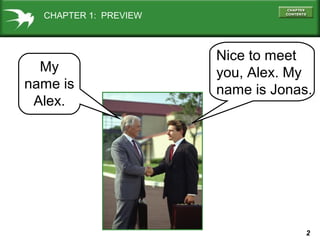
My
name is
Alex.

Nice to meet
you, Alex. My
name is Jonas.

2
CHAPTER 1: PREVIEW

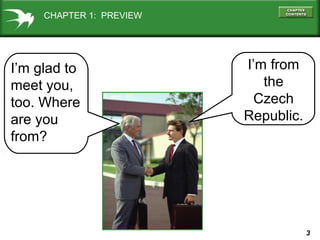
I’m glad to
meet you,
too. Where
are you
from?

I’m from
the
Czech
Republic.

3
CHAPTER 1: PREVIEW

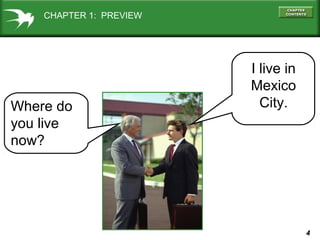
Where do
you live
now?

I live in
Mexico
City.

4
CHAPTER 1: PREVIEW

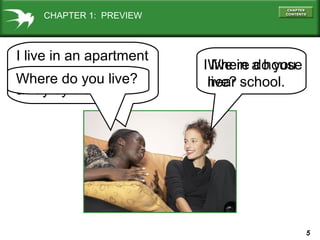
I live in an apartment
about do you live?
Whereten minutes
away by bicycle.

IWhere a house
live in do you
near school.
live?

5
1-1 THE SIMPLE PRESENT AND THE PRESENT
PROGRESSIVE

We shop every Monday.

6
1-1 THE SIMPLE PRESENT AND THE PRESENT
PROGRESSIVE

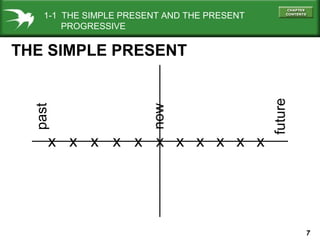
x x x x x x x x x x x

future

now

past

THE SIMPLE PRESENT

7
1-1 THE SIMPLE PRESENT AND THE PRESENT
PROGRESSIVE

THE SIMPLE PRESENT
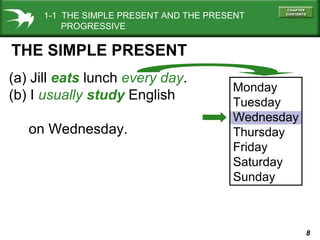
(a) Jill eats lunch every day.
(b) I usually study English
on Wednesday.

Monday
Tuesday
Wednesday
Thursday
Friday
Saturday
Sunday

8
1-1 THE SIMPLE PRESENT AND THE PRESENT
PROGRESSIVE

THE SIMPLE PRESENT
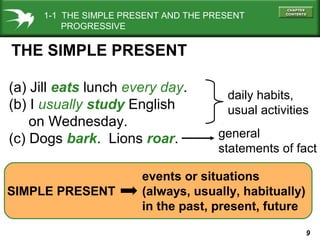
(a) Jill eats lunch every day.
(b) I usually study English
on Wednesday.
(c) Dogs bark. Lions roar.

SIMPLE PRESENT

daily habits,
usual activities
general
statements of fact

events or situations
(always, usually, habitually)
in the past, present, future
9
1-1 THE SIMPLE PRESENT AND THE PRESENT
PROGRESSIVE

THE SIMPLE PRESENT
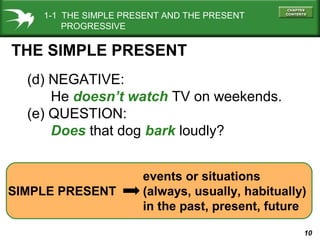
(d) NEGATIVE:
He doesn’t watch TV on weekends.
(e) QUESTION:
Does that dog bark loudly?

SIMPLE PRESENT

events or situations
(always, usually, habitually)
in the past, present, future
10
1-1 THE SIMPLE PRESENT AND THE PRESENT
PROGRESSIVE

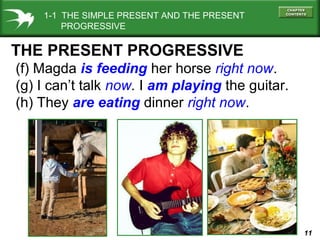
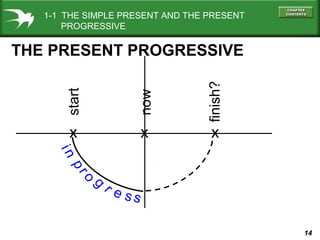
THE PRESENT PROGRESSIVE
(f) Magda is feeding her horse right now.
(g) I can’t talk now. I am playing the guitar.
(h) They are eating dinner right now.

11
1-1 THE SIMPLE PRESENT AND THE PRESENT
PROGRESSIVE

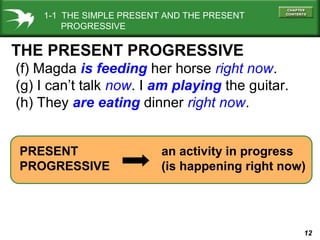
THE PRESENT PROGRESSIVE
(f) Magda is feeding her horse right now.
(g) I can’t talk now. I am playing the guitar.
(h) They are eating dinner right now.
PRESENT
PROGRESSIVE

an activity in progress
(is happening right now)

12
1-1 THE SIMPLE PRESENT AND THE PRESENT
PROGRESSIVE

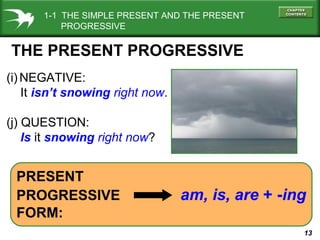
THE PRESENT PROGRESSIVE
(i) NEGATIVE:
It isn’t snowing right now.
(j) QUESTION:
Is it snowing right now?

PRESENT
PROGRESSIVE
FORM:

am, is, are + -ing
13
1-1 THE SIMPLE PRESENT AND THE PRESENT
PROGRESSIVE

start

now

finish?

THE PRESENT PROGRESSIVE

x

x

x

in
pr

g
o

r

e ss
14
1-2 FORMS OF THE SIMPLE PRESENT AND
THE PRESENT PROGRESSIVE

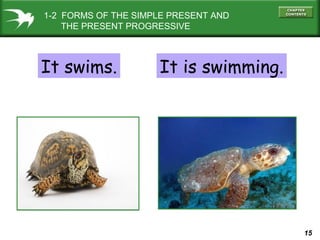
It swims.

It is swimming.

15
1-2 FORMS OF THE SIMPLE PRESENT AND
THE PRESENT PROGRESSIVE

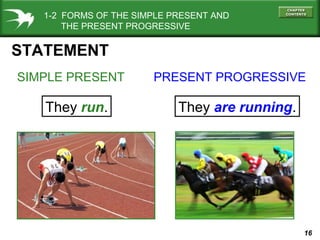
STATEMENT
SIMPLE PRESENT

They run.

PRESENT PROGRESSIVE

They are running.

people in
running clothes –
but not running.

16
1-2 FORMS OF THE SIMPLE PRESENT AND
THE PRESENT PROGRESSIVE

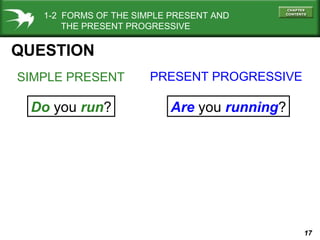
QUESTION
SIMPLE PRESENT

PRESENT PROGRESSIVE

Do you run?

Are you running?

17
1-2 FORMS OF THE SIMPLE PRESENT AND
THE PRESENT PROGRESSIVE

CONTRACTIONS
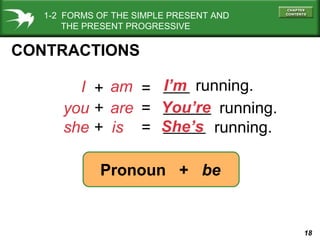
I + am = I’m running.
you + are = You’re running.
she + is = She’s running.
Pronoun + be

18
1-2 FORMS OF THE SIMPLE PRESENT AND
THE PRESENT PROGRESSIVE

CONTRACTIONS
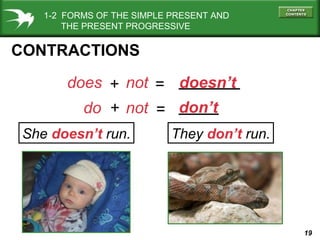
does + not = doesn’t
do + not = don’t
She doesn’t run.

They don’t run.

19
1-2 FORMS OF THE SIMPLE PRESENT AND
THE PRESENT PROGRESSIVE

CONTRACTIONS
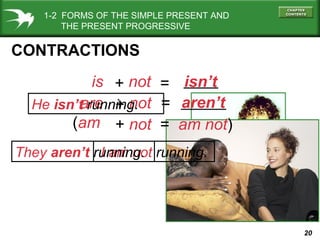
is + not = isn’t
are + not = aren’t
He isn’t running.
(am + not = am not)
They aren’t running. running.
I am not

20
1-1 / 1-2 LET’S PRACTICE

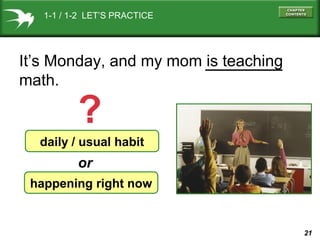
It’s Monday, and my mom is teaching
math.
?

daily / usual habit

or
happening right now

21
1-1 / 1-2 LET’S PRACTICE

She doesn’t usually teach on Monday.
?
daily / usual habit

or
happening right now

22
1-1 / 1-2 LET’S PRACTICE

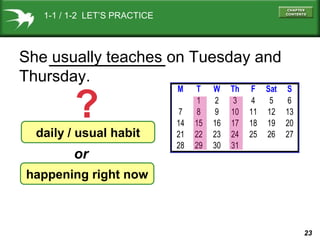
She usually teaches on Tuesday and
Thursday.

?

daily / usual habit

or

M

7
14
21
28

T
1
8
15
22
29

W
2
9
16
23
30

Th
3
10
17
24
31

F Sat S
4
5
6
11 12 13
18 19 20
25 26 27

happening right now

23
1-1 / 1-2 LET’S PRACTICE

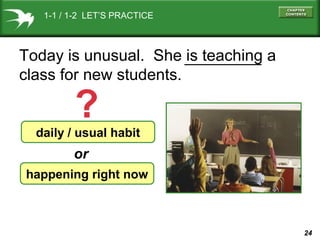
Today is unusual. She is teaching a
class for new students.

?

daily / usual habit

or
happening right now

24
1-1 / 1-2 LET’S PRACTICE

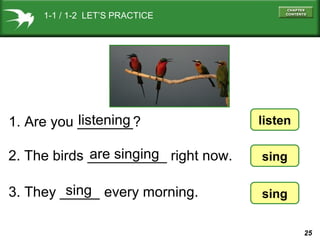
listening
1. Are you _______?

listen

are singing
2. The birds __________ right now.

sing

sing
3. They _____ every morning.

sing
25
1-1 / 1-2 LET’S PRACTICE

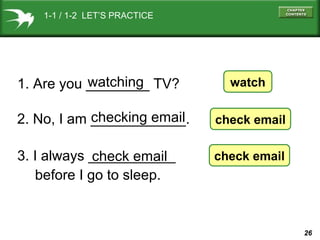
watching
1. Are you ________ TV?

watch

checking email
2. No, I am ____________.

check email

3. I always ___________
check email
before I go to sleep.

check email

26
1-3 FREQUENCY ADVERBS

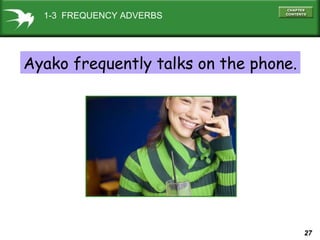
always

Ayako frequently talks on the phone.

27
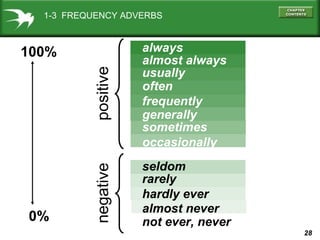
positive

always
almost always
usually
often
frequently
generally
sometimes
occasionally

negative

1-3 FREQUENCY ADVERBS

seldom
rarely
hardly ever
almost never
not ever, never

100%

0%

28
1-3 FREQUENCY ADVERBS

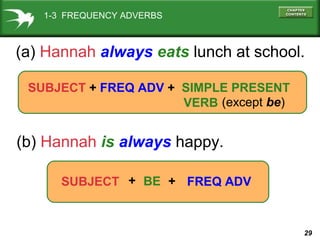
(a) Hannah always eats lunch at school.
SUBJECT + FREQ ADV + SIMPLE PRESENT
VERB (except be)

(b) Hannah is always happy.
SUBJECT + BE + FREQ ADV

29
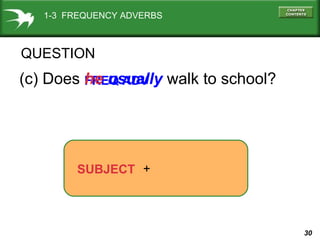
1-3 FREQUENCY ADVERBS

QUESTION

(c) Does he usually walk to school?
FREQ ADV

SUBJECT +

30
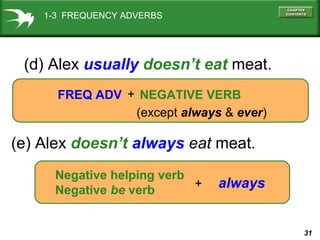
1-3 FREQUENCY ADVERBS

(d) Alex usually doesn’t eat meat.
FREQ ADV + NEGATIVE VERB
(except always & ever)

(e) Alex doesn’t always eat meat.
Negative helping verb
+
Negative be verb

always

31
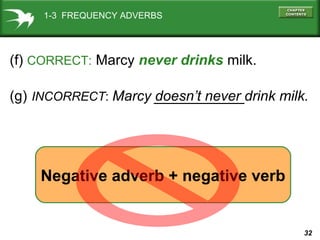
1-3 FREQUENCY ADVERBS

(f) CORRECT: Marcy never drinks milk.
(g) INCORRECT: Marcy doesn’t never drink milk.

Negative adverb + negative verb

32
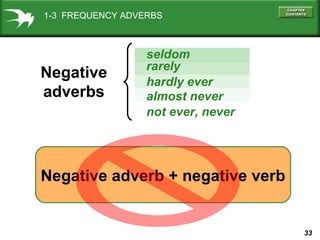
1-3 FREQUENCY ADVERBS

Negative
adverbs

seldom
rarely
hardly ever
almost never
not ever, never

Negative adverb + negative verb

33
1-3 FREQUENCY ADVERBS

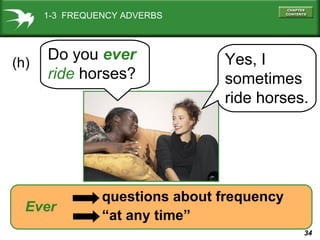
(h)

Do you ever
ride horses?

Ever

Yes, I
sometimes
ride horses.

questions about frequency
“at any time”
34
1-3 FREQUENCY ADVERBS

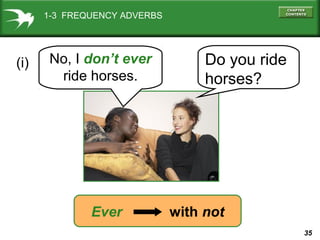
(i)

No, I don’t ever
ride horses.

Ever

Do you ride
horses?

with not
35
1-3 FREQUENCY ADVERBS

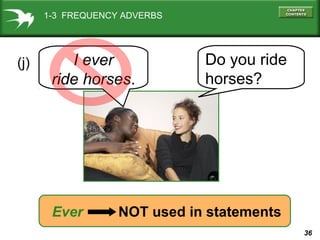
(j)

I ever
ride horses.

Ever

Do you ride
horses?

NOT used in statements
36
1-3 LET’S PRACTICE

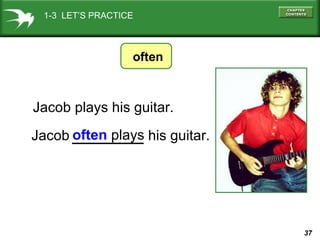
often

Jacob plays his guitar.
Jacob often plays his guitar.

37
1-3 LET’S PRACTICE

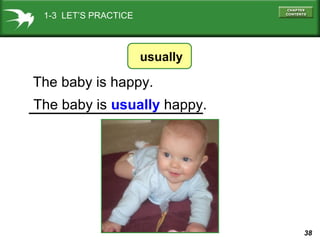
usually

The baby is happy.
The baby is usually happy.

38
1-3 LET’S PRACTICE

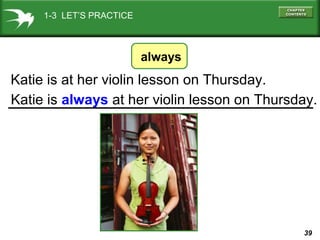
always

Katie is at her violin lesson on Thursday.
Katie is always at her violin lesson on Thursday.

39
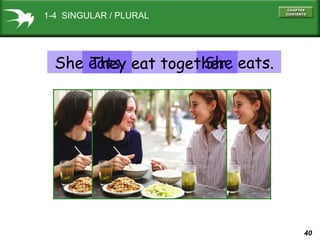
1-4 SINGULAR / PLURAL

She
She eats. eat together. eats.
They

40
1-4 SINGULAR / PLURAL

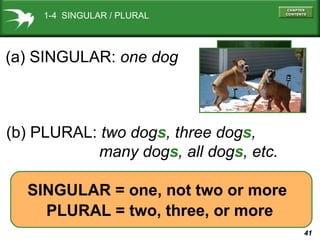
(a) SINGULAR: one dog

(b) PLURAL: two dogs, three dogs,
many dogs, all dogs, etc.
SINGULAR = one, not two or more
PLURAL = two, three, or more
41
1-4 SINGULAR / PLURAL

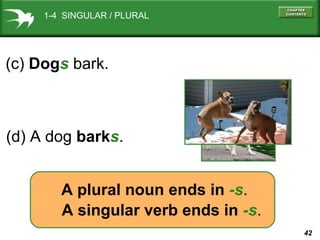
(c) Dogs bark.

(d) A dog barks.
A plural noun ends in -s.
A singular verb ends in -s.
42
1-4 SINGULAR / PLURAL

(e) A cat
It
Zoe
She
Tyler
He

plays
plays
plays
plays
plays
plays

with the ball.
in the basement.
with her toys.
happily.
with his toy trucks.
every day.

a singular subject + a singular verb
43
1-4 LET’S PRACTICE

Justin has two children.
singular verb

singular
noun
or
or

verb
plural

?
44
1-4 LET’S PRACTICE

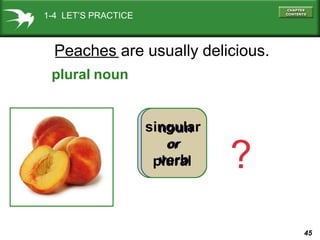
Peaches are usually delicious.
plural noun

singular
noun
or
or

verb
plural

?
45
1-4 LET’S PRACTICE

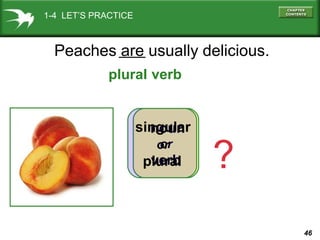
Peaches are usually delicious.
plural verb

singular
noun
or
or

verb
plural

?
46
1-4 LET’S PRACTICE

My mom teaches at the university.
singular verb

singular
noun
or
or

verb
plural

?
47
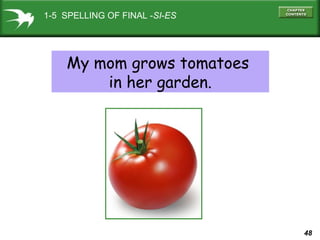
1-5 SPELLING OF FINAL -SI-ES

My mom grows tomatoes
in her garden.

48
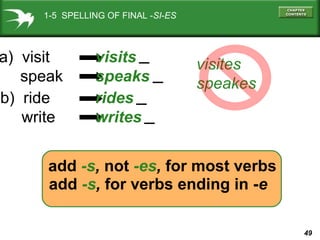
1-5 SPELLING OF FINAL -SI-ES

a) visit
speak
(b) ride
write

visits
speaks
rides
writes

visites
speakes

add -s, not -es, for most verbs
add -s, for verbs ending in -e
49
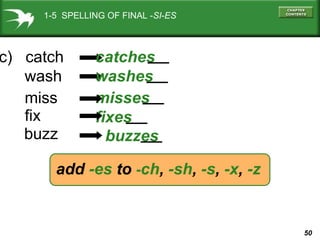
1-5 SPELLING OF FINAL -SI-ES

c) catch
wash
miss
fix
buzz

catches
washes
misses
fixes
buzzes

add -es to -ch, -sh, -s, -x, -z

50
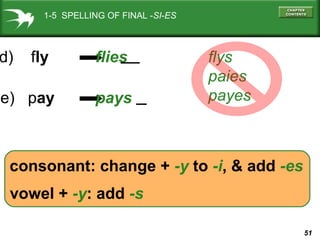
1-5 SPELLING OF FINAL -SI-ES

d)

fly

(e) pay

flies
pays

flys
paies
payes

consonant: change + -y to -i, & add -es
vowel + -y: add -s
51
1-5 SPELLING OF FINAL -SI-ES

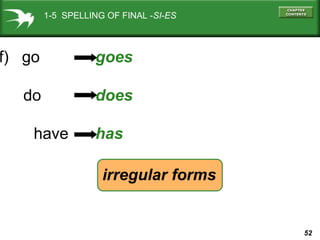
f) go

goes

do

does

have

has
irregular forms

52
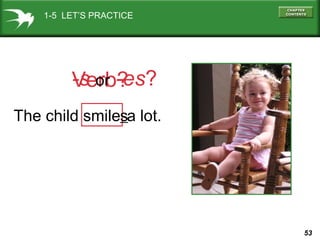
1-5 LET’S PRACTICE

-s or -es?
Verb?
The child smilesa lot.

53
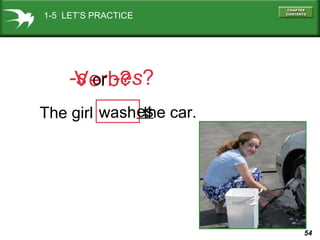
1-5 LET’S PRACTICE

-s or -es?
Verb?
the
The girl washes car.

54
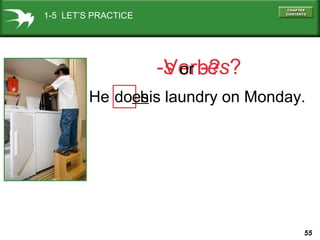
1-5 LET’S PRACTICE

-s or -es?
Verb?
He does laundry on Monday.
his

55
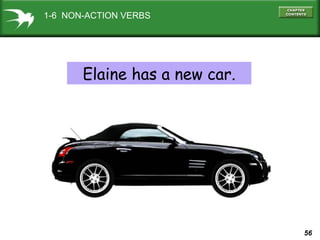
1-6 NON-ACTION VERBS

Elaine has a new car.

56
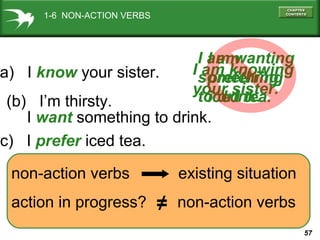
1-6 NON-ACTION VERBS

I am wanting
I am
I something
am knowing
a) I know your sister.
preferring
your sister.
to drink.
iced tea.
(b) I’m thirsty.
I want something to drink.
(c) I prefer iced tea.
non-action verbs
action in progress?

existing situation

≠ non-action verbs
57
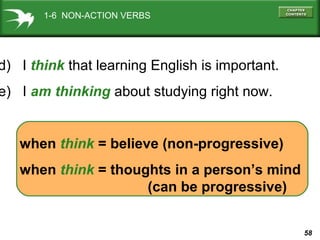
1-6 NON-ACTION VERBS

d) I think that learning English is important.

e) I am thinking about studying right now.

when think = believe (non-progressive)
when think = thoughts in a person’s mind
(can be progressive)
58
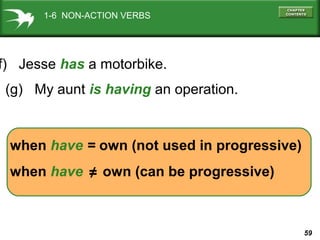
1-6 NON-ACTION VERBS

f) Jesse has a motorbike.
(g) My aunt is having an operation.

when have = own (not used in progressive)
when have ≠ own (can be progressive)

59
1-6 LET’S PRACTICE

PROGRESSIVE VERBS or NON-ACTION VERBS
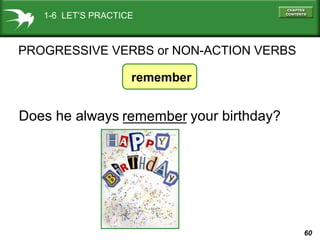
remember

Does he always remember your birthday?
________

60
1-6 LET’S PRACTICE

PROGRESSIVE VERBS or NON-ACTION VERBS
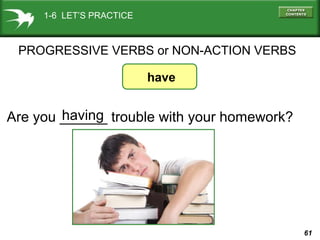
have

having
Are you ______ trouble with your homework?

61
1-6 LET’S PRACTICE

PROGRESSIVE VERBS or NON-ACTION VERBS
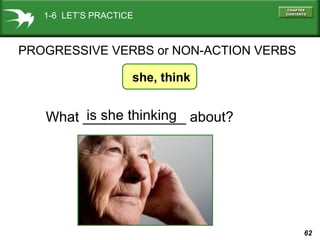
she, think

is she thinking
What _____________ about?

62
1-7 PRESENT VERBS: SHORT ANSWERS TO
YES/NO QUESTIONS

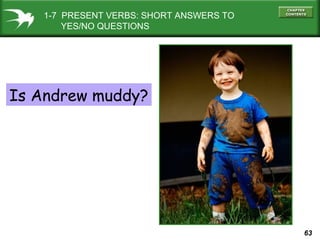
Is Andrew muddy?

63
1-7 PRESENT VERBS: SHORT ANSWERS TO
YES/NO QUESTIONS

QUESTIONS WITH DO / DOES
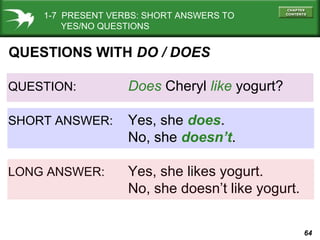
QUESTION:

Does Cheryl like yogurt?

SHORT ANSWER:

Yes, she does.
No, she doesn’t.

LONG ANSWER:

Yes, she likes yogurt.
No, she doesn’t like yogurt.
64
1-7 PRESENT VERBS: SHORT ANSWERS TO
YES/NO QUESTIONS

QUESTIONS WITH DO / DOES
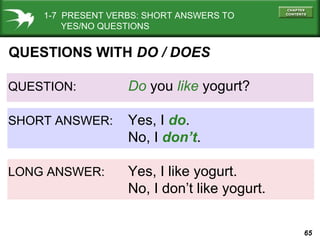
QUESTION:

Do you like yogurt?

SHORT ANSWER:

Yes, I do.
No, I don’t.

LONG ANSWER:

Yes, I like yogurt.
No, I don’t like yogurt.
65
1-7 PRESENT VERBS: SHORT ANSWERS TO
YES/NO QUESTIONS

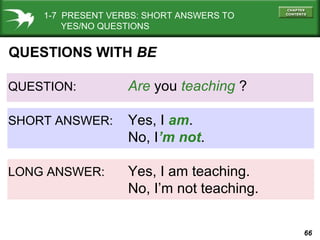
QUESTIONS WITH BE
QUESTION:

Are you teaching ?

SHORT ANSWER:

Yes, I am.
No, I’m not.

LONG ANSWER:

Yes, I am teaching.
No, I’m not teaching.
66
1-7 PRESENT VERBS: SHORT ANSWERS TO
YES/NO QUESTIONS

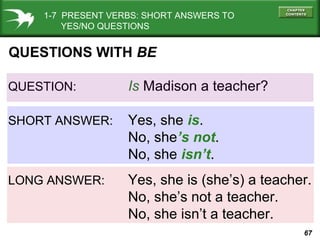
QUESTIONS WITH BE
QUESTION:

Is Madison a teacher?

SHORT ANSWER:

Yes, she is.
No, she’s not.
No, she isn’t.

LONG ANSWER:

Yes, she is (she’s) a teacher.
No, she’s not a teacher.
No, she isn’t a teacher.
67
1-7 PRESENT VERBS: SHORT ANSWERS TO
YES/NO QUESTIONS

QUESTIONS WITH BE
QUESTION:

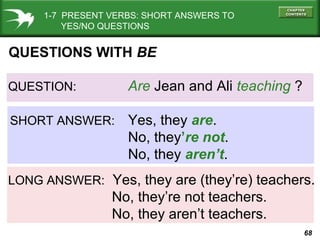
Are Jean and Ali teaching ?

SHORT ANSWER:

Yes, they are.
No, they’re not.
No, they aren’t.

LONG ANSWER: Yes, they are (they’re) teachers.

No, they’re not teachers.
No, they aren’t teachers.
68
1-7 QUESTIONS WITH DO/DOES

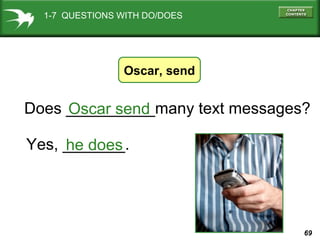
Oscar, send

Does __________many text messages?
Oscar send
Yes, _______.
he does

69
1-7 QUESTIONS WITH DO/DOES

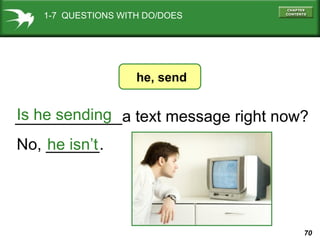
he, send

Is he sending
____________a text message right now?
No, ______.
he isn’t

70
1-7 LET’S PRACTICE

you, like
Do you like
_________ scary movies?
Yes, ___.
I do
your sister, like
Does your sister like
__________________ scary movies, too?
No, ___________.
she doesn’t
71
PHOTO CREDITS

Copyright © 2008 Pearson Education and
its licensors. All rights reserved.
Images used under license from:
• Shutterstock, Inc.
• Clipart, Inc.

72

Present tense powerpoint

  • 1.
    CONTENTS 1-1 1-2 1-3 1-4 1-5 1-6 1-7 Preview The simple presentand the present progressive Forms of the simple present and the present… Frequency adverbs Singular / Plural Spelling of final -s/-es Non-action verbs Present verbs: short answers to yes/no…
  • 2.
    CHAPTER 1: PREVIEW My nameis Alex. Nice to meet you, Alex. My name is Jonas. 2
  • 3.
    CHAPTER 1: PREVIEW I’mglad to meet you, too. Where are you from? I’m from the Czech Republic. 3
  • 4.
    CHAPTER 1: PREVIEW Wheredo you live now? I live in Mexico City. 4
  • 5.
    CHAPTER 1: PREVIEW Ilive in an apartment about do you live? Whereten minutes away by bicycle. IWhere a house live in do you near school. live? 5
  • 6.
    1-1 THE SIMPLEPRESENT AND THE PRESENT PROGRESSIVE We shop every Monday. 6
  • 7.
    1-1 THE SIMPLEPRESENT AND THE PRESENT PROGRESSIVE x x x x x x x x x x x future now past THE SIMPLE PRESENT 7
  • 8.
    1-1 THE SIMPLEPRESENT AND THE PRESENT PROGRESSIVE THE SIMPLE PRESENT (a) Jill eats lunch every day. (b) I usually study English on Wednesday. Monday Tuesday Wednesday Thursday Friday Saturday Sunday 8
  • 9.
    1-1 THE SIMPLEPRESENT AND THE PRESENT PROGRESSIVE THE SIMPLE PRESENT (a) Jill eats lunch every day. (b) I usually study English on Wednesday. (c) Dogs bark. Lions roar. SIMPLE PRESENT daily habits, usual activities general statements of fact events or situations (always, usually, habitually) in the past, present, future 9
  • 10.
    1-1 THE SIMPLEPRESENT AND THE PRESENT PROGRESSIVE THE SIMPLE PRESENT (d) NEGATIVE: He doesn’t watch TV on weekends. (e) QUESTION: Does that dog bark loudly? SIMPLE PRESENT events or situations (always, usually, habitually) in the past, present, future 10
  • 11.
    1-1 THE SIMPLEPRESENT AND THE PRESENT PROGRESSIVE THE PRESENT PROGRESSIVE (f) Magda is feeding her horse right now. (g) I can’t talk now. I am playing the guitar. (h) They are eating dinner right now. 11
  • 12.
    1-1 THE SIMPLEPRESENT AND THE PRESENT PROGRESSIVE THE PRESENT PROGRESSIVE (f) Magda is feeding her horse right now. (g) I can’t talk now. I am playing the guitar. (h) They are eating dinner right now. PRESENT PROGRESSIVE an activity in progress (is happening right now) 12
  • 13.
    1-1 THE SIMPLEPRESENT AND THE PRESENT PROGRESSIVE THE PRESENT PROGRESSIVE (i) NEGATIVE: It isn’t snowing right now. (j) QUESTION: Is it snowing right now? PRESENT PROGRESSIVE FORM: am, is, are + -ing 13
  • 14.
    1-1 THE SIMPLEPRESENT AND THE PRESENT PROGRESSIVE start now finish? THE PRESENT PROGRESSIVE x x x in pr g o r e ss 14
  • 15.
    1-2 FORMS OFTHE SIMPLE PRESENT AND THE PRESENT PROGRESSIVE It swims. It is swimming. 15
  • 16.
    1-2 FORMS OFTHE SIMPLE PRESENT AND THE PRESENT PROGRESSIVE STATEMENT SIMPLE PRESENT They run. PRESENT PROGRESSIVE They are running. people in running clothes – but not running. 16
  • 17.
    1-2 FORMS OFTHE SIMPLE PRESENT AND THE PRESENT PROGRESSIVE QUESTION SIMPLE PRESENT PRESENT PROGRESSIVE Do you run? Are you running? 17
  • 18.
    1-2 FORMS OFTHE SIMPLE PRESENT AND THE PRESENT PROGRESSIVE CONTRACTIONS I + am = I’m running. you + are = You’re running. she + is = She’s running. Pronoun + be 18
  • 19.
    1-2 FORMS OFTHE SIMPLE PRESENT AND THE PRESENT PROGRESSIVE CONTRACTIONS does + not = doesn’t do + not = don’t She doesn’t run. They don’t run. 19
  • 20.
    1-2 FORMS OFTHE SIMPLE PRESENT AND THE PRESENT PROGRESSIVE CONTRACTIONS is + not = isn’t are + not = aren’t He isn’t running. (am + not = am not) They aren’t running. running. I am not 20
  • 21.
    1-1 / 1-2LET’S PRACTICE It’s Monday, and my mom is teaching math. ? daily / usual habit or happening right now 21
  • 22.
    1-1 / 1-2LET’S PRACTICE She doesn’t usually teach on Monday. ? daily / usual habit or happening right now 22
  • 23.
    1-1 / 1-2LET’S PRACTICE She usually teaches on Tuesday and Thursday. ? daily / usual habit or M 7 14 21 28 T 1 8 15 22 29 W 2 9 16 23 30 Th 3 10 17 24 31 F Sat S 4 5 6 11 12 13 18 19 20 25 26 27 happening right now 23
  • 24.
    1-1 / 1-2LET’S PRACTICE Today is unusual. She is teaching a class for new students. ? daily / usual habit or happening right now 24
  • 25.
    1-1 / 1-2LET’S PRACTICE listening 1. Are you _______? listen are singing 2. The birds __________ right now. sing sing 3. They _____ every morning. sing 25
  • 26.
    1-1 / 1-2LET’S PRACTICE watching 1. Are you ________ TV? watch checking email 2. No, I am ____________. check email 3. I always ___________ check email before I go to sleep. check email 26
  • 27.
    1-3 FREQUENCY ADVERBS always Ayakofrequently talks on the phone. 27
  • 28.
    positive always almost always usually often frequently generally sometimes occasionally negative 1-3 FREQUENCYADVERBS seldom rarely hardly ever almost never not ever, never 100% 0% 28
  • 29.
    1-3 FREQUENCY ADVERBS (a)Hannah always eats lunch at school. SUBJECT + FREQ ADV + SIMPLE PRESENT VERB (except be) (b) Hannah is always happy. SUBJECT + BE + FREQ ADV 29
  • 30.
    1-3 FREQUENCY ADVERBS QUESTION (c)Does he usually walk to school? FREQ ADV SUBJECT + 30
  • 31.
    1-3 FREQUENCY ADVERBS (d)Alex usually doesn’t eat meat. FREQ ADV + NEGATIVE VERB (except always & ever) (e) Alex doesn’t always eat meat. Negative helping verb + Negative be verb always 31
  • 32.
    1-3 FREQUENCY ADVERBS (f)CORRECT: Marcy never drinks milk. (g) INCORRECT: Marcy doesn’t never drink milk. Negative adverb + negative verb 32
  • 33.
    1-3 FREQUENCY ADVERBS Negative adverbs seldom rarely hardlyever almost never not ever, never Negative adverb + negative verb 33
  • 34.
    1-3 FREQUENCY ADVERBS (h) Doyou ever ride horses? Ever Yes, I sometimes ride horses. questions about frequency “at any time” 34
  • 35.
    1-3 FREQUENCY ADVERBS (i) No,I don’t ever ride horses. Ever Do you ride horses? with not 35
  • 36.
    1-3 FREQUENCY ADVERBS (j) Iever ride horses. Ever Do you ride horses? NOT used in statements 36
  • 37.
    1-3 LET’S PRACTICE often Jacobplays his guitar. Jacob often plays his guitar. 37
  • 38.
    1-3 LET’S PRACTICE usually Thebaby is happy. The baby is usually happy. 38
  • 39.
    1-3 LET’S PRACTICE always Katieis at her violin lesson on Thursday. Katie is always at her violin lesson on Thursday. 39
  • 40.
    1-4 SINGULAR /PLURAL She She eats. eat together. eats. They 40
  • 41.
    1-4 SINGULAR /PLURAL (a) SINGULAR: one dog (b) PLURAL: two dogs, three dogs, many dogs, all dogs, etc. SINGULAR = one, not two or more PLURAL = two, three, or more 41
  • 42.
    1-4 SINGULAR /PLURAL (c) Dogs bark. (d) A dog barks. A plural noun ends in -s. A singular verb ends in -s. 42
  • 43.
    1-4 SINGULAR /PLURAL (e) A cat It Zoe She Tyler He plays plays plays plays plays plays with the ball. in the basement. with her toys. happily. with his toy trucks. every day. a singular subject + a singular verb 43
  • 44.
    1-4 LET’S PRACTICE Justinhas two children. singular verb singular noun or or verb plural ? 44
  • 45.
    1-4 LET’S PRACTICE Peachesare usually delicious. plural noun singular noun or or verb plural ? 45
  • 46.
    1-4 LET’S PRACTICE Peachesare usually delicious. plural verb singular noun or or verb plural ? 46
  • 47.
    1-4 LET’S PRACTICE Mymom teaches at the university. singular verb singular noun or or verb plural ? 47
  • 48.
    1-5 SPELLING OFFINAL -SI-ES My mom grows tomatoes in her garden. 48
  • 49.
    1-5 SPELLING OFFINAL -SI-ES a) visit speak (b) ride write visits speaks rides writes visites speakes add -s, not -es, for most verbs add -s, for verbs ending in -e 49
  • 50.
    1-5 SPELLING OFFINAL -SI-ES c) catch wash miss fix buzz catches washes misses fixes buzzes add -es to -ch, -sh, -s, -x, -z 50
  • 51.
    1-5 SPELLING OFFINAL -SI-ES d) fly (e) pay flies pays flys paies payes consonant: change + -y to -i, & add -es vowel + -y: add -s 51
  • 52.
    1-5 SPELLING OFFINAL -SI-ES f) go goes do does have has irregular forms 52
  • 53.
    1-5 LET’S PRACTICE -sor -es? Verb? The child smilesa lot. 53
  • 54.
    1-5 LET’S PRACTICE -sor -es? Verb? the The girl washes car. 54
  • 55.
    1-5 LET’S PRACTICE -sor -es? Verb? He does laundry on Monday. his 55
  • 56.
    1-6 NON-ACTION VERBS Elainehas a new car. 56
  • 57.
    1-6 NON-ACTION VERBS Iam wanting I am I something am knowing a) I know your sister. preferring your sister. to drink. iced tea. (b) I’m thirsty. I want something to drink. (c) I prefer iced tea. non-action verbs action in progress? existing situation ≠ non-action verbs 57
  • 58.
    1-6 NON-ACTION VERBS d)I think that learning English is important. e) I am thinking about studying right now. when think = believe (non-progressive) when think = thoughts in a person’s mind (can be progressive) 58
  • 59.
    1-6 NON-ACTION VERBS f)Jesse has a motorbike. (g) My aunt is having an operation. when have = own (not used in progressive) when have ≠ own (can be progressive) 59
  • 60.
    1-6 LET’S PRACTICE PROGRESSIVEVERBS or NON-ACTION VERBS remember Does he always remember your birthday? ________ 60
  • 61.
    1-6 LET’S PRACTICE PROGRESSIVEVERBS or NON-ACTION VERBS have having Are you ______ trouble with your homework? 61
  • 62.
    1-6 LET’S PRACTICE PROGRESSIVEVERBS or NON-ACTION VERBS she, think is she thinking What _____________ about? 62
  • 63.
    1-7 PRESENT VERBS:SHORT ANSWERS TO YES/NO QUESTIONS Is Andrew muddy? 63
  • 64.
    1-7 PRESENT VERBS:SHORT ANSWERS TO YES/NO QUESTIONS QUESTIONS WITH DO / DOES QUESTION: Does Cheryl like yogurt? SHORT ANSWER: Yes, she does. No, she doesn’t. LONG ANSWER: Yes, she likes yogurt. No, she doesn’t like yogurt. 64
  • 65.
    1-7 PRESENT VERBS:SHORT ANSWERS TO YES/NO QUESTIONS QUESTIONS WITH DO / DOES QUESTION: Do you like yogurt? SHORT ANSWER: Yes, I do. No, I don’t. LONG ANSWER: Yes, I like yogurt. No, I don’t like yogurt. 65
  • 66.
    1-7 PRESENT VERBS:SHORT ANSWERS TO YES/NO QUESTIONS QUESTIONS WITH BE QUESTION: Are you teaching ? SHORT ANSWER: Yes, I am. No, I’m not. LONG ANSWER: Yes, I am teaching. No, I’m not teaching. 66
  • 67.
    1-7 PRESENT VERBS:SHORT ANSWERS TO YES/NO QUESTIONS QUESTIONS WITH BE QUESTION: Is Madison a teacher? SHORT ANSWER: Yes, she is. No, she’s not. No, she isn’t. LONG ANSWER: Yes, she is (she’s) a teacher. No, she’s not a teacher. No, she isn’t a teacher. 67
  • 68.
    1-7 PRESENT VERBS:SHORT ANSWERS TO YES/NO QUESTIONS QUESTIONS WITH BE QUESTION: Are Jean and Ali teaching ? SHORT ANSWER: Yes, they are. No, they’re not. No, they aren’t. LONG ANSWER: Yes, they are (they’re) teachers. No, they’re not teachers. No, they aren’t teachers. 68
  • 69.
    1-7 QUESTIONS WITHDO/DOES Oscar, send Does __________many text messages? Oscar send Yes, _______. he does 69
  • 70.
    1-7 QUESTIONS WITHDO/DOES he, send Is he sending ____________a text message right now? No, ______. he isn’t 70
  • 71.
    1-7 LET’S PRACTICE you,like Do you like _________ scary movies? Yes, ___. I do your sister, like Does your sister like __________________ scary movies, too? No, ___________. she doesn’t 71
  • 72.
    PHOTO CREDITS Copyright ©2008 Pearson Education and its licensors. All rights reserved. Images used under license from: • Shutterstock, Inc. • Clipart, Inc. 72