Fun with Idioms,
Collocations & Phrasal
Verbs
************
David Burns
ULICORI – Santa Cruz
18 June 2015
David Burns
Facebook: English on the Move
www.facebook.com/EnglishOnTheMove
‘Like’ my Facebook page for updates and links to
TEFL topics, lesson plans, photos, ideas, and
more!
Email: EnglishOnTheMove@gmail.com
Cel: 8416 2367
Figurative vs. Literal Language
• Figurative Language:
• Similes and Analogies
• Metaphors and Allegories
• Personification
• Hyperbole
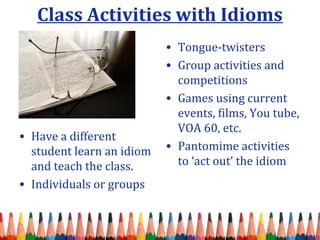
Class Activities with Idioms
• Have a different
student learn an idiom
and teach the class.
• Individuals or groups
• Tongue-twisters
• Group activities and
competitions
• Games using current
events, films, You tube,
VOA 60, etc.
• Pantomime activities

to ‘act out’ the idiom
Use News Articles
• Have students scan articles for idioms,
collocations and phrasal verbs.
• For English articles: even those with complex
vocabulary can be modified.
• Simplify the language;
shorten the article.
• Teaches current, local
and international
events.
More Useful Activities
• Vocabulary
• Reading / Writing
• Poetry / Games
• Speaking/Role
Play
• Translation
• Current Events
• Videos/PBL
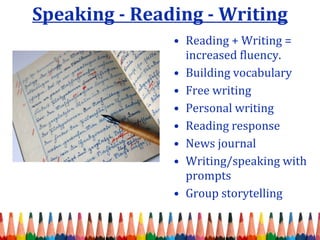
Speaking - Reading - Writing
• Reading + Writing =
increased fluency.
• Building vocabulary
• Free writing
• Personal writing
• Reading response
• News journal
• Writing/speaking with
prompts
• Group storytelling
Poetry
• Ask students to create a poem using idioms, etc.
• Higher level: The content of the poem must
accurately represent the content/meaning of the
idiom.
• Mid level: use key
words to make
poem.
• Lower level: acrostic
poem.
• All levels: Haiku
What is an idiom?
• An idiom is a phrase where the words
together have a meaning that is different
from the dictionary definitions of the
individual words.
• This makes it difficult for ESL learners to
understand and master their proper use.
• Can you think of some examples?
Idiomatic Expressions
• To bet the farm
• Don’t count your chickens before they
hatch
• A bird in hand is better than two in the
bush.
• The pot calling the kettle black.
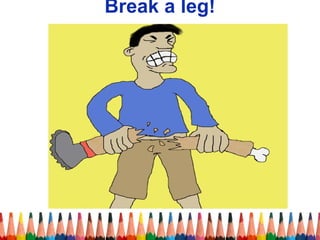
Class activity with idioms:
• You can use this activity after teaching or
reviewing ‘human body vocabulary’.
• It’s a good warmer exercise or a break in
between lessons.
• Have students stand up and elicit body
parts (adjusted for level).
• Then put your students in groups for the
activity.
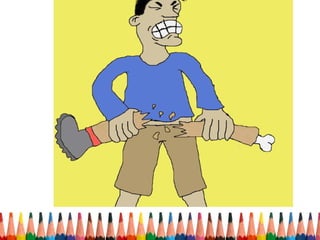
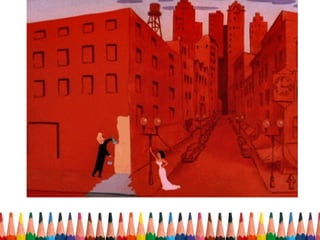
Break a leg!
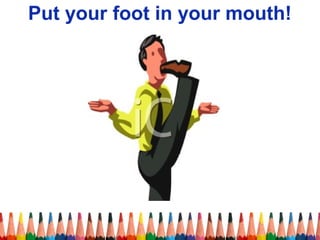
Put your foot in your mouth!
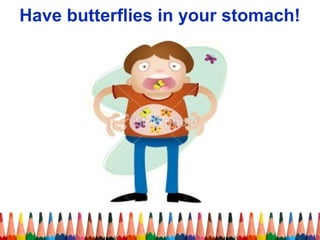
Have butterflies in your stomach!
Idioms with Body Parts
• turn up one’s nose
• get out of hand
• catch someone red-handed
• go in one ear and out the other
• fall on deaf ears
• joined at the hip
• loose lips sink ships
• stick your nose in everything
• have a chip on your shoulder
• put your foot in your mouth
• have your finger in many pies
• a slap on the wrist
• beauty is in the eye of the beholder
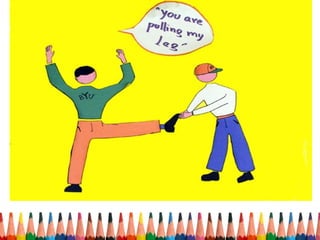
• pulling your leg
• keep an eye on something
More Idioms with Body Parts
• to turn a blind eye
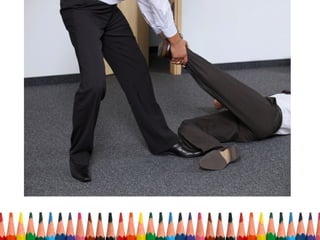
• to put one’s foot down
• to dig in your heels
• to kick up your heels
• to let your hair down
• break a leg
• bury one’s head in the sand
• blood is thicker than water
• Have butterflies in your stomach
• Use elbow grease
• To go belly up
• To have elbow room
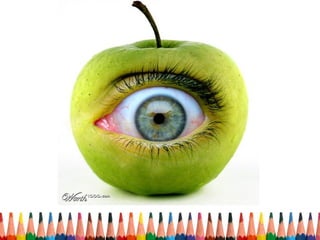
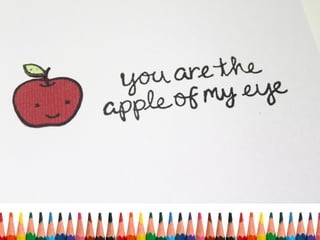
• The apple of my eye
• Keep your chin up
Itsy-Bitsy Spider
• Itsy-bitsy spider
went up the water spout.
Down came the rain
and washed the spider out.
Out came the sun
and dried up all the rain.
Itsy-bitsy spider
went up the spout again!
What are collocations?
• Collocations are a group of words that
are commonly used together.
• Rush hour, catch a cold, soft drinks, etc.
Class activity
• After a vocabulary lesson on food, have
students think of common collocations for
those food items.
• Fast food, fresh fruit, junk food, self-serve,
take out.
• Try to think of some collocations with
eggs
‘Eggs’ collocations
• Hard-boiled, soft-boiled eggs
• Sunny-side up eggs
• Over-easy eggs
• Scrambled eggs
• Eggs Benedict
• Egg whites
• Crack an egg; beat an egg
• Runny yolk, solid yolk
What are phrasal verbs?
• A phrasal verb is a verb + a preposition
or adverb or particle (usually 2 or 3 word
combinations). The word combination
changes the original meaning of the verb.
• Break away, break down, break up, break
in, break into, break out, break out of, etc.
HANG
• Hang + up (+ on)
• Hang + out
• Hang + in + there
• Hang + on
• Hang + over
• Hang + onto
• Hang + around
• Hang + about
Class activity: Directions
• After reviewing vocabulary ‘giving
directions’ (left, right, up, down, straight,
back, forward, across, etc).
• Use one of the directions to show how it
can be used with a verb to make a phrasal
verb (particle verb) or collocation.
• Left out, left behind, straight ahead, be
right back, in front of, across from; etc.
What about the direction UP?
• This is a great word to give your
students an (exaggerated, yet real)
idea of the complexity of the English
language.
• First, divide them in groups and ask
them to ‘come up’ with as many word
combinations as they can using UP.
• Can you think of some?
It's easy to understand UP, meaning toward the sky…
…but when we awaken in the morning, why do we wake UP?
At a meeting, why does a topic come UP? Why do we speak UP, and
why are the candidates UP for election, and why do bad businesses go
belly UP?
Why is it UP to the secretary to write UP a report? We call UP our
friends, brighten UP a room, polish UP the silver, warm UP the
leftovers and clean UP the kitchen and put UP with things we don’t like.
We lock UP the house and fix UP the old car while giving a thumbs UP
to something we like.
People stir UP trouble, line UP to buy tickets, work UP an appetite, and
think UP excuses. A thief sticks UP a bank….
UP
To be dressed is one thing, but to be dressed UP is special!
A drain must be opened UP because it is stopped UP. We open UP a
store in the morning but then we close it UP at night. We seem to be
pretty mixed UP about the word UP!
When it threatens to rain, we say it is clouding UP. When the sun
comes out we say it is clearing UP. When it rains, the earth soaks it
UP. When it does not rain for awhile, things dry UP.
If you are UP to it, you and your students might try building UP a list of
the many ways UP is used. It will take UP a lot of your time, but if you
don't give UP, you may wind UP with a hundred or more.
One could go on & on, but I'll wrap this UP for now because my time is
UP!
GREAT online resources!
• http://www.idiomsite.com/
•http://www.englishgateway.com/esl-vocabulary-exercises
•http://idioms.thefreedictionary.com/
•http://www.usingenglish.com/reference/idioms/
•http://www.speakenglish.biz/idioms.html
•http://www.learn-english-today.com/phrasal-verbs/phrasal-verb-
list.htm
•http://www.eslcafe.com/pv/
•http://www.englishclub.com/vocabulary/collocations.htm
•http://www.better-english.com/strongcoll.htm
•http://www.eslflow.com/collocationsandphrasalvebs.html
• https://www.facebook.com/VOA60

Fun with Idioms, Collocations & Phrasal Verbs

  • 1.
    Fun with Idioms, Collocations& Phrasal Verbs ************ David Burns ULICORI – Santa Cruz 18 June 2015
  • 2.
    David Burns Facebook: Englishon the Move www.facebook.com/EnglishOnTheMove ‘Like’ my Facebook page for updates and links to TEFL topics, lesson plans, photos, ideas, and more! Email: EnglishOnTheMove@gmail.com Cel: 8416 2367
  • 3.
    Figurative vs. LiteralLanguage • Figurative Language: • Similes and Analogies • Metaphors and Allegories • Personification • Hyperbole
  • 4.
    Class Activities withIdioms • Have a different student learn an idiom and teach the class. • Individuals or groups • Tongue-twisters • Group activities and competitions • Games using current events, films, You tube, VOA 60, etc. • Pantomime activities to ‘act out’ the idiom
  • 5.
    Use News Articles •Have students scan articles for idioms, collocations and phrasal verbs. • For English articles: even those with complex vocabulary can be modified. • Simplify the language; shorten the article. • Teaches current, local and international events.
  • 6.
    More Useful Activities •Vocabulary • Reading / Writing • Poetry / Games • Speaking/Role Play • Translation • Current Events • Videos/PBL
  • 7.
    Speaking - Reading- Writing • Reading + Writing = increased fluency. • Building vocabulary • Free writing • Personal writing • Reading response • News journal • Writing/speaking with prompts • Group storytelling
  • 8.
    Poetry • Ask studentsto create a poem using idioms, etc. • Higher level: The content of the poem must accurately represent the content/meaning of the idiom. • Mid level: use key words to make poem. • Lower level: acrostic poem. • All levels: Haiku
  • 9.
    What is anidiom? • An idiom is a phrase where the words together have a meaning that is different from the dictionary definitions of the individual words. • This makes it difficult for ESL learners to understand and master their proper use. • Can you think of some examples?
  • 10.
    Idiomatic Expressions • Tobet the farm • Don’t count your chickens before they hatch • A bird in hand is better than two in the bush. • The pot calling the kettle black.
  • 11.
    Class activity withidioms: • You can use this activity after teaching or reviewing ‘human body vocabulary’. • It’s a good warmer exercise or a break in between lessons. • Have students stand up and elicit body parts (adjusted for level). • Then put your students in groups for the activity.
  • 13.
  • 15.
    Put your footin your mouth!
  • 17.
    Have butterflies inyour stomach!
  • 22.
    Idioms with BodyParts • turn up one’s nose • get out of hand • catch someone red-handed • go in one ear and out the other • fall on deaf ears • joined at the hip • loose lips sink ships • stick your nose in everything • have a chip on your shoulder • put your foot in your mouth • have your finger in many pies • a slap on the wrist • beauty is in the eye of the beholder • pulling your leg • keep an eye on something
  • 23.
    More Idioms withBody Parts • to turn a blind eye • to put one’s foot down • to dig in your heels • to kick up your heels • to let your hair down • break a leg • bury one’s head in the sand • blood is thicker than water • Have butterflies in your stomach • Use elbow grease • To go belly up • To have elbow room • The apple of my eye • Keep your chin up
  • 33.
    Itsy-Bitsy Spider • Itsy-bitsyspider went up the water spout. Down came the rain and washed the spider out. Out came the sun and dried up all the rain. Itsy-bitsy spider went up the spout again!
  • 34.
    What are collocations? •Collocations are a group of words that are commonly used together. • Rush hour, catch a cold, soft drinks, etc.
  • 35.
    Class activity • Aftera vocabulary lesson on food, have students think of common collocations for those food items. • Fast food, fresh fruit, junk food, self-serve, take out. • Try to think of some collocations with eggs
  • 36.
    ‘Eggs’ collocations • Hard-boiled,soft-boiled eggs • Sunny-side up eggs • Over-easy eggs • Scrambled eggs • Eggs Benedict • Egg whites • Crack an egg; beat an egg • Runny yolk, solid yolk
  • 37.
    What are phrasalverbs? • A phrasal verb is a verb + a preposition or adverb or particle (usually 2 or 3 word combinations). The word combination changes the original meaning of the verb. • Break away, break down, break up, break in, break into, break out, break out of, etc.
  • 39.
    HANG • Hang +up (+ on) • Hang + out • Hang + in + there • Hang + on • Hang + over • Hang + onto • Hang + around • Hang + about
  • 40.
    Class activity: Directions •After reviewing vocabulary ‘giving directions’ (left, right, up, down, straight, back, forward, across, etc). • Use one of the directions to show how it can be used with a verb to make a phrasal verb (particle verb) or collocation. • Left out, left behind, straight ahead, be right back, in front of, across from; etc.
  • 41.
    What about thedirection UP? • This is a great word to give your students an (exaggerated, yet real) idea of the complexity of the English language. • First, divide them in groups and ask them to ‘come up’ with as many word combinations as they can using UP. • Can you think of some?
  • 42.
    It's easy tounderstand UP, meaning toward the sky… …but when we awaken in the morning, why do we wake UP? At a meeting, why does a topic come UP? Why do we speak UP, and why are the candidates UP for election, and why do bad businesses go belly UP? Why is it UP to the secretary to write UP a report? We call UP our friends, brighten UP a room, polish UP the silver, warm UP the leftovers and clean UP the kitchen and put UP with things we don’t like. We lock UP the house and fix UP the old car while giving a thumbs UP to something we like. People stir UP trouble, line UP to buy tickets, work UP an appetite, and think UP excuses. A thief sticks UP a bank….
  • 43.
    UP To be dressedis one thing, but to be dressed UP is special! A drain must be opened UP because it is stopped UP. We open UP a store in the morning but then we close it UP at night. We seem to be pretty mixed UP about the word UP! When it threatens to rain, we say it is clouding UP. When the sun comes out we say it is clearing UP. When it rains, the earth soaks it UP. When it does not rain for awhile, things dry UP. If you are UP to it, you and your students might try building UP a list of the many ways UP is used. It will take UP a lot of your time, but if you don't give UP, you may wind UP with a hundred or more. One could go on & on, but I'll wrap this UP for now because my time is UP!
  • 44.
    GREAT online resources! •http://www.idiomsite.com/ •http://www.englishgateway.com/esl-vocabulary-exercises •http://idioms.thefreedictionary.com/ •http://www.usingenglish.com/reference/idioms/ •http://www.speakenglish.biz/idioms.html •http://www.learn-english-today.com/phrasal-verbs/phrasal-verb- list.htm •http://www.eslcafe.com/pv/ •http://www.englishclub.com/vocabulary/collocations.htm •http://www.better-english.com/strongcoll.htm •http://www.eslflow.com/collocationsandphrasalvebs.html • https://www.facebook.com/VOA60