PRESENT SIMPLE &
CONTINUOUS
p. 132
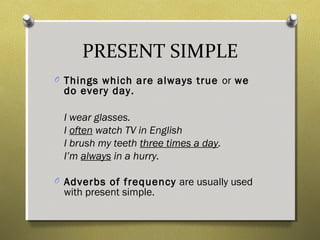
PRESENT SIMPLE
O Things which are always true or we
do every day.
I wear glasses.
I often watch TV in English
I brush my teeth three times a day.
I’m always in a hurry.
O Adverbs of frequency are usually used
with present simple.
WORD ORDER IN
QUESTIONS
O ASI (Auxiliary + Subject + Infinitive)
Do you study English every day?
Does your sister drive a car to work?
O QASI (Question word + Auxiliary + Subject +
Infinitive)
How often do you play sports?
Where do you live?
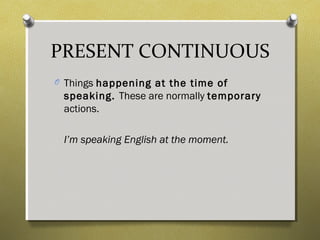
PRESENT CONTINUOUS
O Things happening at the time of
speaking. These are normally temporary
actions.
I’m speaking English at the moment.
NON-ACTION VERBS.
O Some verbs cannot be used in the present
continuos.
O We call them non-action verbs: agree, be,
believe, belong, like, etc. (see page 132 and
class blog).
NON-ACTION VERBS.
O Some verbs cannot be used in the present
continuos.
O We call them non-action verbs: agree, be,
believe, belong, like, etc. (see page 132 and
class blog).

Present simple & continuos

  • 1.
  • 2.
    PRESENT SIMPLE O Thingswhich are always true or we do every day. I wear glasses. I often watch TV in English I brush my teeth three times a day. I’m always in a hurry. O Adverbs of frequency are usually used with present simple.
  • 3.
    WORD ORDER IN QUESTIONS OASI (Auxiliary + Subject + Infinitive) Do you study English every day? Does your sister drive a car to work? O QASI (Question word + Auxiliary + Subject + Infinitive) How often do you play sports? Where do you live?
  • 4.
    PRESENT CONTINUOUS O Thingshappening at the time of speaking. These are normally temporary actions. I’m speaking English at the moment.
  • 5.
    NON-ACTION VERBS. O Someverbs cannot be used in the present continuos. O We call them non-action verbs: agree, be, believe, belong, like, etc. (see page 132 and class blog).
  • 6.
    NON-ACTION VERBS. O Someverbs cannot be used in the present continuos. O We call them non-action verbs: agree, be, believe, belong, like, etc. (see page 132 and class blog).