The Present perfect Tense
Present perfect and its usage:

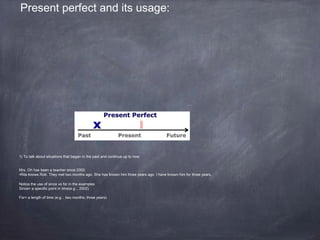
1) To talk about situations that began in the past and continue up to now
Mrs. Oh has been a teacher since 2002.
•Rita knows Rob. They met two months ago. She has known him three years ago. I have known him for three years.
Notice the use of since vs for in the examples
Since+ a specific point in time(e.g. , 2002)
For+ a length of time (e.g. , two months, three years).
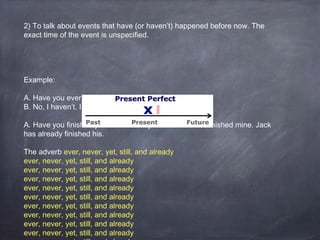
2) To talk about events that have (or haven’t) happened before now. The
exact time of the event is unspecified.

Example:
A. Have you ever seen snow?
B. No, I haven’t. I have never seen snow.
A. Have you finished your homework yet? I still haven’t finished mine. Jack
has already finished his.
The adverb ever, never, yet, still, and already
ever, never, yet, still, and already
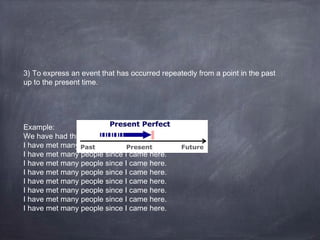
3) To express an event that has occurred repeatedly from a point in the past
up to the present time.

Example:
We have had three test so far this term.
I have met many people since I came here.
Affirmative statement
To make an Affirmative future progressive statement, simply follow this pattern:
Subject+has/have +Past participle
past participle:
- regular verbs: main verb in base form + -ed
- irregular verbs: 3rd form of the verb
Example:
Regular verb:
•I/we/you/they have opened the window.
•He/she/it has opened the window.
Irregular Verb:
•I/we/you/they have gone to the supermarket.
•He/she/it has gone to the supermarket.
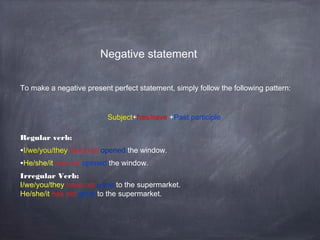
Negative statement
To make a negative present perfect statement, simply follow the following pattern:

Subject+has/have +Past participle
Regular verb:

•I/we/you/they have not opened the window.
•He/she/it has not opened the window.
Irregular Verb:
I/we/you/they have not gone to the supermarket.
He/she/it has not gone to the supermarket.
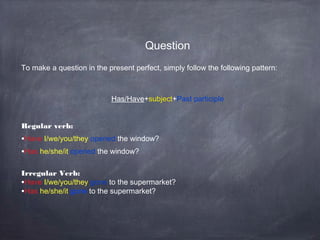
Question
To make a question in the present perfect, simply follow the following pattern:

Has/Have+subject+Past participle
Regular verb:

•Have I/we/you/they opened the window?
•Has he/she/it opened the window?
Irregular Verb:
•Have I/we/you/they gone to the supermarket?
•Has he/she/it gone to the supermarket?
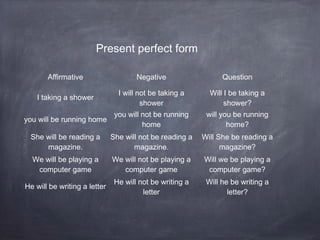
Present perfect form
Affirmative

Negative

Question

I taking a shower

I will not be taking a
shower

Will I be taking a
shower?

you will not be running
you will be running home
home

will you be running
home?

She will be reading a
magazine.

She will not be reading a
magazine.

Will She be reading a
magazine?

We will be playing a
computer game

We will not be playing a
computer game

Will we be playing a
computer game?

He will be writing a letter

He will not be writing a
letter

Will he be writing a
letter?
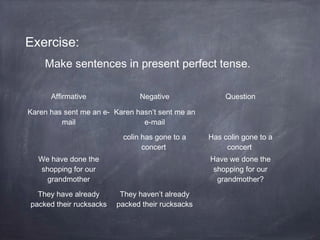
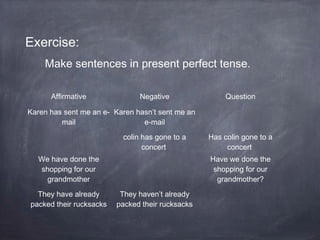
Exercise:
Make sentences in present perfect tense.
Affirmative

Negative

Question

Karen has sent me an e- Karen hasn’t sent me an
mail
e-mail
colin has gone to a
concert
We have done the
shopping for our
grandmother
They have already
packed their rucksacks

Has colin gone to a
concert
Have we done the
shopping for our
grandmother?

They haven’t already
packed their rucksacks
Exercise:
Make sentences in present perfect tense.
Affirmative

Negative

Question

Karen has sent me an e- Karen hasn’t sent me an
mail
e-mail
colin has gone to a
concert
We have done the
shopping for our
grandmother
They have already
packed their rucksacks

Has colin gone to a
concert
Have we done the
shopping for our
grandmother?

They haven’t already
packed their rucksacks

Present perfect tense

  • 1.
  • 2.
    Present perfect andits usage: 1) To talk about situations that began in the past and continue up to now Mrs. Oh has been a teacher since 2002. •Rita knows Rob. They met two months ago. She has known him three years ago. I have known him for three years. Notice the use of since vs for in the examples Since+ a specific point in time(e.g. , 2002) For+ a length of time (e.g. , two months, three years).
  • 3.
    2) To talkabout events that have (or haven’t) happened before now. The exact time of the event is unspecified. Example: A. Have you ever seen snow? B. No, I haven’t. I have never seen snow. A. Have you finished your homework yet? I still haven’t finished mine. Jack has already finished his. The adverb ever, never, yet, still, and already ever, never, yet, still, and already ever, never, yet, still, and already ever, never, yet, still, and already ever, never, yet, still, and already ever, never, yet, still, and already ever, never, yet, still, and already ever, never, yet, still, and already ever, never, yet, still, and already ever, never, yet, still, and already
  • 4.
    3) To expressan event that has occurred repeatedly from a point in the past up to the present time. Example: We have had three test so far this term. I have met many people since I came here. I have met many people since I came here. I have met many people since I came here. I have met many people since I came here. I have met many people since I came here. I have met many people since I came here. I have met many people since I came here. I have met many people since I came here.
  • 5.
    Affirmative statement To makean Affirmative future progressive statement, simply follow this pattern: Subject+has/have +Past participle past participle: - regular verbs: main verb in base form + -ed - irregular verbs: 3rd form of the verb Example: Regular verb: •I/we/you/they have opened the window. •He/she/it has opened the window. Irregular Verb: •I/we/you/they have gone to the supermarket. •He/she/it has gone to the supermarket.
  • 6.
    Negative statement To makea negative present perfect statement, simply follow the following pattern: Subject+has/have +Past participle Regular verb: •I/we/you/they have not opened the window. •He/she/it has not opened the window. Irregular Verb: I/we/you/they have not gone to the supermarket. He/she/it has not gone to the supermarket.
  • 7.
    Question To make aquestion in the present perfect, simply follow the following pattern: Has/Have+subject+Past participle Regular verb: •Have I/we/you/they opened the window? •Has he/she/it opened the window? Irregular Verb: •Have I/we/you/they gone to the supermarket? •Has he/she/it gone to the supermarket?
  • 8.
    Present perfect form Affirmative Negative Question Itaking a shower I will not be taking a shower Will I be taking a shower? you will not be running you will be running home home will you be running home? She will be reading a magazine. She will not be reading a magazine. Will She be reading a magazine? We will be playing a computer game We will not be playing a computer game Will we be playing a computer game? He will be writing a letter He will not be writing a letter Will he be writing a letter?
  • 9.
    Exercise: Make sentences inpresent perfect tense. Affirmative Negative Question Karen has sent me an e- Karen hasn’t sent me an mail e-mail colin has gone to a concert We have done the shopping for our grandmother They have already packed their rucksacks Has colin gone to a concert Have we done the shopping for our grandmother? They haven’t already packed their rucksacks
  • 10.
    Exercise: Make sentences inpresent perfect tense. Affirmative Negative Question Karen has sent me an e- Karen hasn’t sent me an mail e-mail colin has gone to a concert We have done the shopping for our grandmother They have already packed their rucksacks Has colin gone to a concert Have we done the shopping for our grandmother? They haven’t already packed their rucksacks