Present Perfect Tense Spring  has  already  arrived
Present Perfect Tense FORM: have / has + past participle Affirmative :   I  have seen  the film before. She  has seen  the film before. Interrogative :   Have  you  seen  the film before? Has  she  seen  the film before? Negative :  They  have n’t  seen  the film before. He  has n’t  seen  the film before.
1-  Recent events : It is used to describe  recent events without a definite time . We use  just  in positive sentences to say that something happened very recently. Present Perfect Tense Uses of the present perfect Why are they so happy? They have  just  won a prize so  they are really pleased.
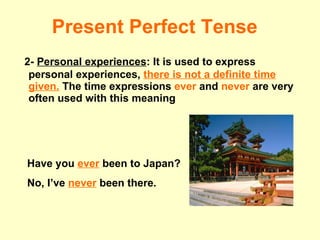
Present Perfect Tense 2-   Personal experiences : It is used to express personal experiences,  there is not a definite time given.   The time expressions  ever  and  never  are very often used with this meaning Have you  ever  been to Japan?  No, I’ve  never  been there.
Present Perfect Tense 3- It is used to express actions which  started in the past and are still continuing in the present , the time period is not finished.  I  have lost  my keys. (And I  haven’t found  them yet.)
Present Perfect Tense We often use the present perfect tense with  already  and  yet . Already : Something happened before now or earlier than expected You can use already in  positive sentences . Put already  before the main verb. Yet : Until now. You can use yet in  negative sentences  and  questions . Yet is usually  at the end . Example : A) Have you done your homework yet? B) No, I haven’t done it yet. / Yes, I’ve already done it.
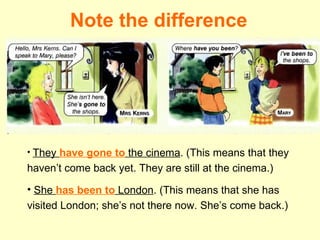
Note the difference They  have gone to  the cinema . (This means that they haven’t come back yet. They are still at the cinema.) She  has been to  London . (This means that she has visited London; she’s not there now. She’s come back.)
Contrast between Present Perfect and  Past Simple We use definite expressions with the Past simple tense:  yesterday, last week, … ago, etc,  while we don’t use definite time expressions with the Present perfect tense. I  have been  to France three times. When  did   you  go   there?  I  went   there  last Summer.
Look at this conversation: A:  Have you ever been  to the USA? B: Yes, I have. A: When  did you go  there? B: I  went  to New York in 1996. Now ask and answer questions as in the example: plant a tree (Where)  meet a politician (Who) travel by boat (When)
Present Perfect +  Superlatives We often use a superlative with the present perfect. That is the  smallest  house I  have ever seen . Make sentences as in the example. It / noisy city / I be to He / interesting person / meet It / bad book / I / read

Present Perfect

  • 1.
    Present Perfect TenseSpring has already arrived
  • 2.
    Present Perfect TenseFORM: have / has + past participle Affirmative : I have seen the film before. She has seen the film before. Interrogative : Have you seen the film before? Has she seen the film before? Negative : They have n’t seen the film before. He has n’t seen the film before.
  • 3.
    1- Recentevents : It is used to describe recent events without a definite time . We use just in positive sentences to say that something happened very recently. Present Perfect Tense Uses of the present perfect Why are they so happy? They have just won a prize so they are really pleased.
  • 4.
    Present Perfect Tense2- Personal experiences : It is used to express personal experiences, there is not a definite time given. The time expressions ever and never are very often used with this meaning Have you ever been to Japan? No, I’ve never been there.
  • 5.
    Present Perfect Tense3- It is used to express actions which started in the past and are still continuing in the present , the time period is not finished. I have lost my keys. (And I haven’t found them yet.)
  • 6.
    Present Perfect TenseWe often use the present perfect tense with already and yet . Already : Something happened before now or earlier than expected You can use already in positive sentences . Put already before the main verb. Yet : Until now. You can use yet in negative sentences and questions . Yet is usually at the end . Example : A) Have you done your homework yet? B) No, I haven’t done it yet. / Yes, I’ve already done it.
  • 7.
    Note the differenceThey have gone to the cinema . (This means that they haven’t come back yet. They are still at the cinema.) She has been to London . (This means that she has visited London; she’s not there now. She’s come back.)
  • 8.
    Contrast between PresentPerfect and Past Simple We use definite expressions with the Past simple tense: yesterday, last week, … ago, etc, while we don’t use definite time expressions with the Present perfect tense. I have been to France three times. When did you go there? I went there last Summer.
  • 9.
    Look at thisconversation: A: Have you ever been to the USA? B: Yes, I have. A: When did you go there? B: I went to New York in 1996. Now ask and answer questions as in the example: plant a tree (Where) meet a politician (Who) travel by boat (When)
  • 10.
    Present Perfect + Superlatives We often use a superlative with the present perfect. That is the smallest house I have ever seen . Make sentences as in the example. It / noisy city / I be to He / interesting person / meet It / bad book / I / read