PRESENT
Perfect Tenses
GROUPS MEMBERS
Aleem Ahmad
Omer Shabbir Bhatti
Hamza nadeem
CONTENT
• Present perfect tense
• identification
• Present perfect Structure
• Use of For and Since
• Present perfect uses
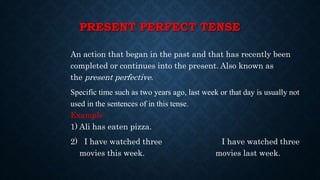
PRESENT PERFECT TENSE
An action that began in the past and that has recently been
completed or continues into the present. Also known as
the present perfective.
Specific time such as two years ago, last week or that day is usually not
used in the sentences of in this tense.
Example
1) Ali has eaten pizza.
2) I have watched three I have watched three
movies this week. movies last week.
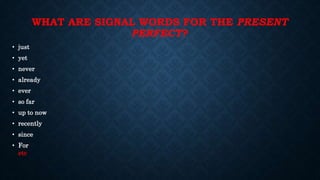
WHAT ARE SIGNAL WORDS FOR THE PRESENT
PERFECT?
• just
• yet
• never
• already
• ever
• so far
• up to now
• recently
• since
• For
etc
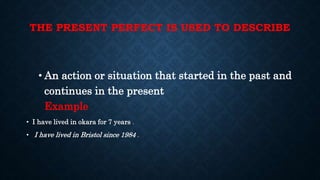
THE PRESENT PERFECT IS USED TO DESCRIBE
• An action or situation that started in the past and
continues in the present
Example
• I have lived in okara for 7 years .
• I have lived in Bristol since 1984 .
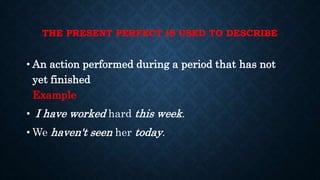
THE PRESENT PERFECT IS USED TO DESCRIBE
• An action performed during a period that has not
yet finished
Example
• I have worked hard this week.
• We haven't seen her today.
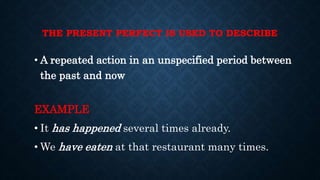
THE PRESENT PERFECT IS USED TO DESCRIBE
• A repeated action in an unspecified period between
the past and now
EXAMPLE
• It has happened several times already.
• We have eaten at that restaurant many times.
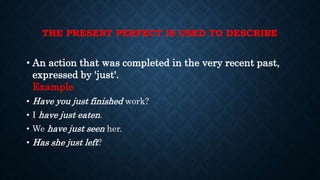
THE PRESENT PERFECT IS USED TO DESCRIBE
• An action that was completed in the very recent past,
expressed by 'just'.
Example
• Have you just finished work?
• I have just eaten.
• We have just seen her.
• Has she just left?
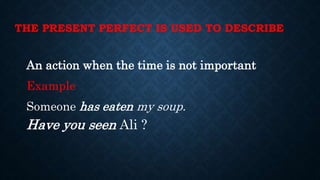
THE PRESENT PERFECT IS USED TO DESCRIBE
An action when the time is not important
Example
Someone has eaten my soup.
Have you seen Ali ?
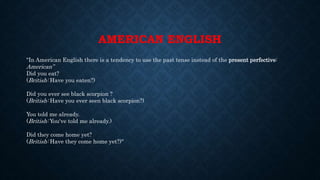
AMERICAN ENGLISH
"In American English there is a tendency to use the past tense instead of the present perfective:
American”
Did you eat?
(British: Have you eaten?)
Did you ever see black scorpion ?
(British: Have you ever seen black scorpion?)
You told me already.
(British: You've told me already.)
Did they come home yet?
(British: Have they come home yet?)"
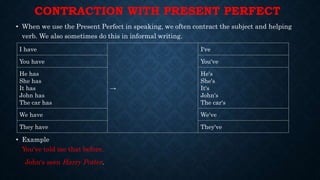
CONTRACTION WITH PRESENT PERFECT
• When we use the Present Perfect in speaking, we often contract the subject and helping
verb. We also sometimes do this in informal writing.
• Example
You've told me that before.
John's seen Harry Potter.
I have
→
I've
You have You've
He has
She has
It has
John has
The car has
He's
She's
It's
John's
The car's
We have We've
They have They've
.
Structure
of
Present Perfect Tense
HELPING VERBS
• There are 13 verbs that can be used as helping verbs in English. Some of these verbs have multiple forms,
But in Present Perfect We Use only Has and Have
be (including am, is, are, was, were, been)
• has,have , had
• do, does, did
• can
• could
• may
• might
• will
• would
• shall
• should
• must
• ought to
etc
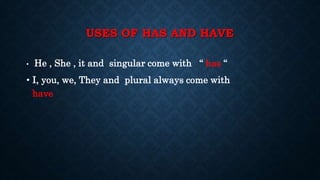
USES OF HAS AND HAVE
• He , She , it and singular come with “ has “
• I, you, we, They and plural always come with
have
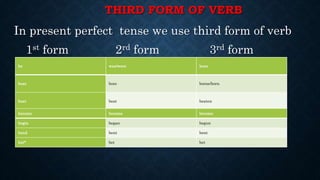
THIRD FORM OF VERB
In present perfect tense we use third form of verb
1st form 2rd form 3rd form
be was/were been
bear bore borne/born
beat beat beaten
become became become
begin began begun
bend bent bent
bet* bet bet
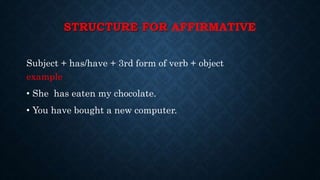
STRUCTURE FOR AFFIRMATIVE
Subject + has/have + 3rd form of verb + object
example
• She has eaten my chocolate.
• You have bought a new computer.
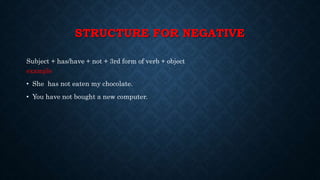
STRUCTURE FOR NEGATIVE
Subject + has/have + not + 3rd form of verb + object
example
• She has not eaten my chocolate.
• You have not bought a new computer.
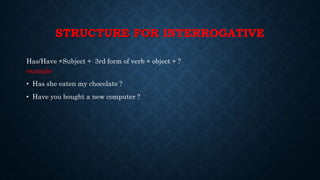
STRUCTURE FOR INTERROGATIVE
Has/Have +Subject + 3rd form of verb + object + ?
example
• Has she eaten my chocolate ?
• Have you bought a new computer ?
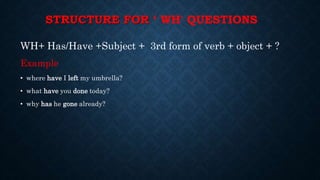
STRUCTURE FOR ‘ WH' QUESTIONS
WH+ Has/Have +Subject + 3rd form of verb + object + ?
Example
• where have I left my umbrella?
• what have you done today?
• why has he gone already?
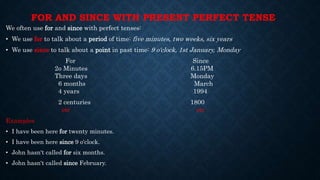
FOR AND SINCE WITH PRESENT PERFECT TENSE
We often use for and since with perfect tenses:
• We use for to talk about a period of time: five minutes, two weeks, six years
• We use since to talk about a point in past time: 9 o'clock, 1st January, Monday
For Since
2o Minutes 6.15PM
Three days Monday
6 months March
4 years 1994
2 centuries 1800
etc etc
Examples
• I have been here for twenty minutes.
• I have been here since 9 o'clock.
• John hasn't called for six months.
• John hasn't called since February.
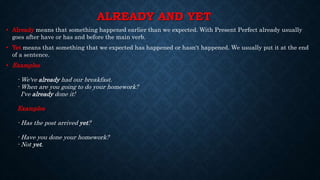
ALREADY AND YET
• Already means that something happened earlier than we expected. With Present Perfect already usually
goes after have or has and before the main verb.
• Yet means that something that we expected has happened or hasn't happened. We usually put it at the end
of a sentence.
• Examples
- We've already had our breakfast.
- When are you going to do your homework?
I've already done it!
Examples
- Has the post arrived yet?
- Have you done your homework?
- Not yet.
.

Present perfect Tense

  • 1.
  • 2.
    GROUPS MEMBERS Aleem Ahmad OmerShabbir Bhatti Hamza nadeem
  • 3.
    CONTENT • Present perfecttense • identification • Present perfect Structure • Use of For and Since • Present perfect uses
  • 4.
    PRESENT PERFECT TENSE Anaction that began in the past and that has recently been completed or continues into the present. Also known as the present perfective. Specific time such as two years ago, last week or that day is usually not used in the sentences of in this tense. Example 1) Ali has eaten pizza. 2) I have watched three I have watched three movies this week. movies last week.
  • 5.
    WHAT ARE SIGNALWORDS FOR THE PRESENT PERFECT? • just • yet • never • already • ever • so far • up to now • recently • since • For etc
  • 6.
    THE PRESENT PERFECTIS USED TO DESCRIBE • An action or situation that started in the past and continues in the present Example • I have lived in okara for 7 years . • I have lived in Bristol since 1984 .
  • 7.
    THE PRESENT PERFECTIS USED TO DESCRIBE • An action performed during a period that has not yet finished Example • I have worked hard this week. • We haven't seen her today.
  • 8.
    THE PRESENT PERFECTIS USED TO DESCRIBE • A repeated action in an unspecified period between the past and now EXAMPLE • It has happened several times already. • We have eaten at that restaurant many times.
  • 9.
    THE PRESENT PERFECTIS USED TO DESCRIBE • An action that was completed in the very recent past, expressed by 'just'. Example • Have you just finished work? • I have just eaten. • We have just seen her. • Has she just left?
  • 10.
    THE PRESENT PERFECTIS USED TO DESCRIBE An action when the time is not important Example Someone has eaten my soup. Have you seen Ali ?
  • 11.
    AMERICAN ENGLISH "In AmericanEnglish there is a tendency to use the past tense instead of the present perfective: American” Did you eat? (British: Have you eaten?) Did you ever see black scorpion ? (British: Have you ever seen black scorpion?) You told me already. (British: You've told me already.) Did they come home yet? (British: Have they come home yet?)"
  • 12.
    CONTRACTION WITH PRESENTPERFECT • When we use the Present Perfect in speaking, we often contract the subject and helping verb. We also sometimes do this in informal writing. • Example You've told me that before. John's seen Harry Potter. I have → I've You have You've He has She has It has John has The car has He's She's It's John's The car's We have We've They have They've
  • 13.
  • 14.
  • 15.
    HELPING VERBS • Thereare 13 verbs that can be used as helping verbs in English. Some of these verbs have multiple forms, But in Present Perfect We Use only Has and Have be (including am, is, are, was, were, been) • has,have , had • do, does, did • can • could • may • might • will • would • shall • should • must • ought to etc
  • 16.
    USES OF HASAND HAVE • He , She , it and singular come with “ has “ • I, you, we, They and plural always come with have
  • 17.
    THIRD FORM OFVERB In present perfect tense we use third form of verb 1st form 2rd form 3rd form be was/were been bear bore borne/born beat beat beaten become became become begin began begun bend bent bent bet* bet bet
  • 18.
    STRUCTURE FOR AFFIRMATIVE Subject+ has/have + 3rd form of verb + object example • She has eaten my chocolate. • You have bought a new computer.
  • 19.
    STRUCTURE FOR NEGATIVE Subject+ has/have + not + 3rd form of verb + object example • She has not eaten my chocolate. • You have not bought a new computer.
  • 20.
    STRUCTURE FOR INTERROGATIVE Has/Have+Subject + 3rd form of verb + object + ? example • Has she eaten my chocolate ? • Have you bought a new computer ?
  • 21.
    STRUCTURE FOR ‘WH' QUESTIONS WH+ Has/Have +Subject + 3rd form of verb + object + ? Example • where have I left my umbrella? • what have you done today? • why has he gone already?
  • 22.
    FOR AND SINCEWITH PRESENT PERFECT TENSE We often use for and since with perfect tenses: • We use for to talk about a period of time: five minutes, two weeks, six years • We use since to talk about a point in past time: 9 o'clock, 1st January, Monday For Since 2o Minutes 6.15PM Three days Monday 6 months March 4 years 1994 2 centuries 1800 etc etc Examples • I have been here for twenty minutes. • I have been here since 9 o'clock. • John hasn't called for six months. • John hasn't called since February.
  • 23.
    ALREADY AND YET •Already means that something happened earlier than we expected. With Present Perfect already usually goes after have or has and before the main verb. • Yet means that something that we expected has happened or hasn't happened. We usually put it at the end of a sentence. • Examples - We've already had our breakfast. - When are you going to do your homework? I've already done it! Examples - Has the post arrived yet? - Have you done your homework? - Not yet.
  • 24.