Present Perfect Tense
Language Open Learning English
Grammar Guide
Present Perfect
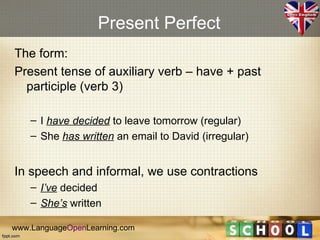
The form:
Present tense of auxiliary verb – have + past
  participle (verb 3)

    – I have decided to leave tomorrow (regular)
    – She has written an email to David (irregular)


In speech and informal, we use contractions
    – I’ve decided
    – She’s written

www.LanguageOpenLearning.com
Present Perfect
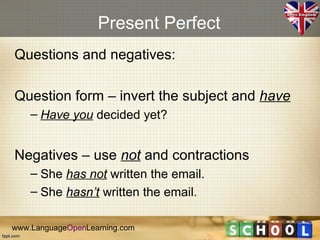
Questions and negatives:

Question form – invert the subject and have
    – Have you decided yet?


Negatives – use not and contractions
    – She has not written the email.
    – She hasn’t written the email.

www.LanguageOpenLearning.com
Present Perfect
Describes past events that connect to the present:

3. Experiences in our life up to now.
    –   Have you visited any other countries?
    –   Yes, I’ve been to Spain and Portugal.


Nb - No Time expressions as no individual event.
   For individual events – use past simple


www.LanguageOpenLearning.com
Present Perfect
Describes past events that connect to the present:

2. An event in the past that has a result in the
    present.
    –   Jayne has broken her pencil.
    –   I’ve hurt my foot


Nb. No time expressions as these are not important.
    Use past simple to say when the event
    happened.

www.LanguageOpenLearning.com
Present Perfect
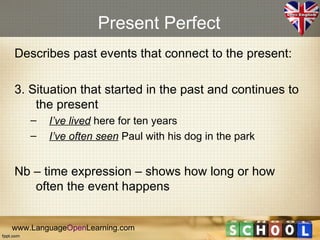
Describes past events that connect to the present:

3. Situation that started in the past and continues to
    the present
    –   I’ve lived here for ten years
    –   I’ve often seen Paul with his dog in the park


Nb – time expression – shows how long or how
   often the event happens


www.LanguageOpenLearning.com
Present Perfect
Describes past events that connect to the
  present:

4. Completion – describes how many things are
     completed so far.
    – I’ve read a hundred pages of this book


Nb – the exact time is not mentioned


www.LanguageOpenLearning.com
Present Perfect
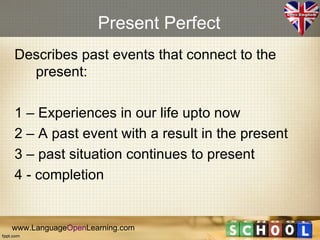
Describes past events that connect to the
  present:

1 – Experiences in our life upto now
2 – A past event with a result in the present
3 – past situation continues to present
4 - completion


www.LanguageOpenLearning.com
Present Perfect
Time Expressions

•    Ever, never

    – Have you ever eaten Chinese food?
    – No, I’ve never eaten it


www.LanguageOpenLearning.com
Present Perfect
Time Expressions

• Yet, so far
Yet – questions and negative sentences
So far – questions and positive sentences

    –   Have you finished this book yet? No, I’m on p56
    –   How many pages have you read? I’ve read 56 pages
        so far

www.LanguageOpenLearning.com
Present Perfect
Time Expressions

• already
Positive sentences –
   describe an action which happened
   before

    – When are you going to finish your book?
    – I’ve already finished it
www.LanguageOpenLearning.com
Present Perfect
Time Expressions

•    just
    describes a very recent event

    David has just phoned from the airport.


www.LanguageOpenLearning.com
Present Perfect
Time Expressions

•    Always, often etc (frequency adverbs)
    These are used with both present simple and
       present perfect

    – He has always loved you (a state)
    – We have often visited Spain (a repeated event)


www.LanguageOpenLearning.com
Present Perfect
Time Expressions

•    for, since

For – length of a period of time
    –   Tom has worked here for three months
Since – describes the point when the time started
    –   Tom has worked here since July 5th


www.LanguageOpenLearning.com
Present Perfect
Time Expressions
• Ever, never
• Yet, so far
• Already
• Just
• Always, often etc
• For, since


www.LanguageOpenLearning.com
Want to know more?
Contact us

•   www.LanguageOpenLearning.com
•   www.Facebook.com/LanguageOpenLearning
•   Skype - AjarnKen
•   Twitter - @AjarnKen


www.LanguageOpenLearning.com

English Grammar - Present perfect tense

  • 1.
    Present Perfect Tense LanguageOpen Learning English Grammar Guide
  • 2.
    Present Perfect The form: Presenttense of auxiliary verb – have + past participle (verb 3) – I have decided to leave tomorrow (regular) – She has written an email to David (irregular) In speech and informal, we use contractions – I’ve decided – She’s written www.LanguageOpenLearning.com
  • 3.
    Present Perfect Questions andnegatives: Question form – invert the subject and have – Have you decided yet? Negatives – use not and contractions – She has not written the email. – She hasn’t written the email. www.LanguageOpenLearning.com
  • 4.
    Present Perfect Describes pastevents that connect to the present: 3. Experiences in our life up to now. – Have you visited any other countries? – Yes, I’ve been to Spain and Portugal. Nb - No Time expressions as no individual event. For individual events – use past simple www.LanguageOpenLearning.com
  • 5.
    Present Perfect Describes pastevents that connect to the present: 2. An event in the past that has a result in the present. – Jayne has broken her pencil. – I’ve hurt my foot Nb. No time expressions as these are not important. Use past simple to say when the event happened. www.LanguageOpenLearning.com
  • 6.
    Present Perfect Describes pastevents that connect to the present: 3. Situation that started in the past and continues to the present – I’ve lived here for ten years – I’ve often seen Paul with his dog in the park Nb – time expression – shows how long or how often the event happens www.LanguageOpenLearning.com
  • 7.
    Present Perfect Describes pastevents that connect to the present: 4. Completion – describes how many things are completed so far. – I’ve read a hundred pages of this book Nb – the exact time is not mentioned www.LanguageOpenLearning.com
  • 8.
    Present Perfect Describes pastevents that connect to the present: 1 – Experiences in our life upto now 2 – A past event with a result in the present 3 – past situation continues to present 4 - completion www.LanguageOpenLearning.com
  • 9.
    Present Perfect Time Expressions • Ever, never – Have you ever eaten Chinese food? – No, I’ve never eaten it www.LanguageOpenLearning.com
  • 10.
    Present Perfect Time Expressions •Yet, so far Yet – questions and negative sentences So far – questions and positive sentences – Have you finished this book yet? No, I’m on p56 – How many pages have you read? I’ve read 56 pages so far www.LanguageOpenLearning.com
  • 11.
    Present Perfect Time Expressions •already Positive sentences – describe an action which happened before – When are you going to finish your book? – I’ve already finished it www.LanguageOpenLearning.com
  • 12.
    Present Perfect Time Expressions • just describes a very recent event David has just phoned from the airport. www.LanguageOpenLearning.com
  • 13.
    Present Perfect Time Expressions • Always, often etc (frequency adverbs) These are used with both present simple and present perfect – He has always loved you (a state) – We have often visited Spain (a repeated event) www.LanguageOpenLearning.com
  • 14.
    Present Perfect Time Expressions • for, since For – length of a period of time – Tom has worked here for three months Since – describes the point when the time started – Tom has worked here since July 5th www.LanguageOpenLearning.com
  • 15.
    Present Perfect Time Expressions •Ever, never • Yet, so far • Already • Just • Always, often etc • For, since www.LanguageOpenLearning.com
  • 16.
    Want to knowmore? Contact us • www.LanguageOpenLearning.com • www.Facebook.com/LanguageOpenLearning • Skype - AjarnKen • Twitter - @AjarnKen www.LanguageOpenLearning.com