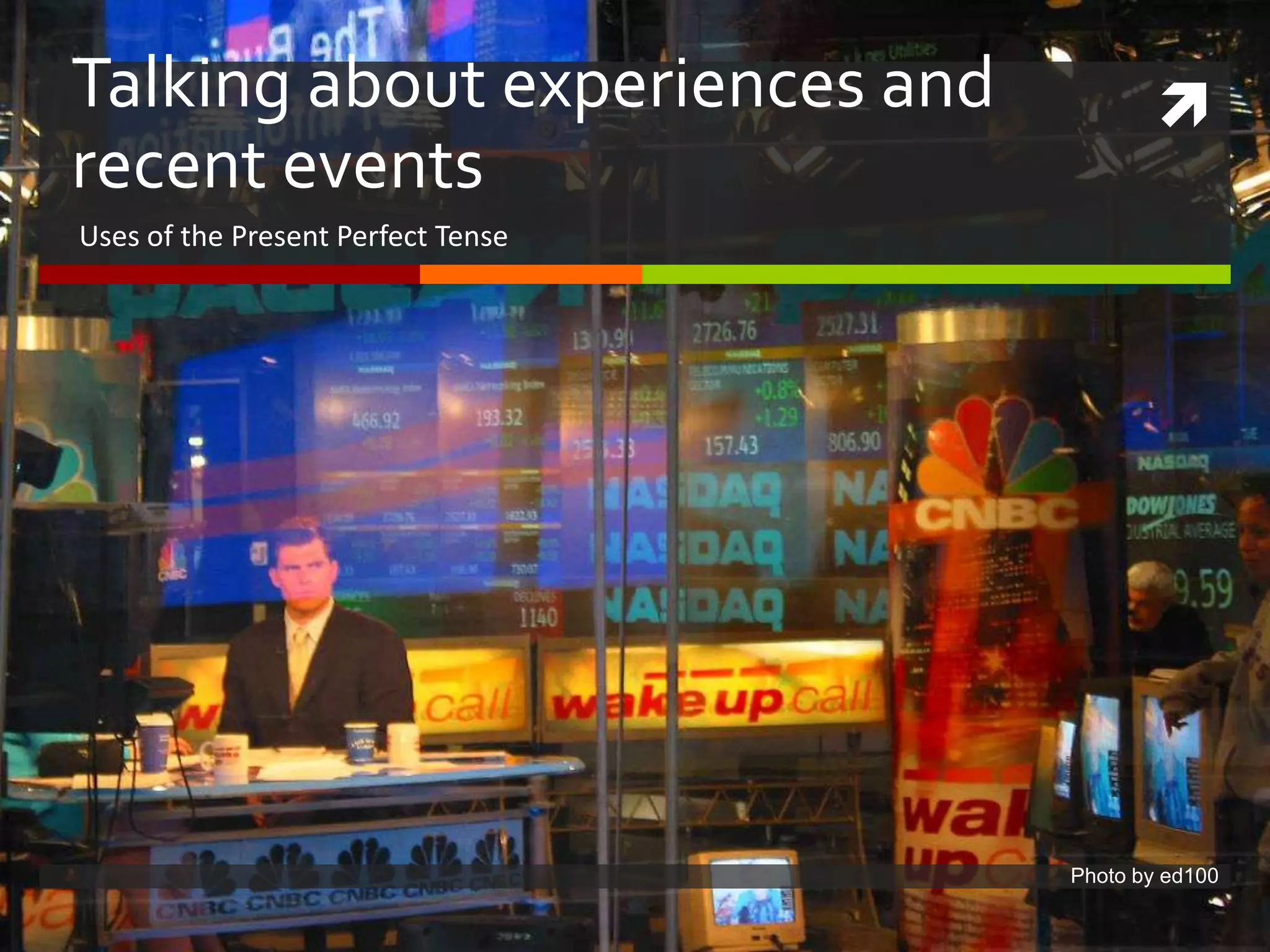
Talking about experiences and               
recent events
Uses of the Present Perfect Tense


                                    Photo by ed100
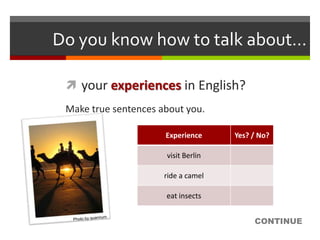
Do you know how to talk about…

  your experiences in English?
 Make true sentences about you.

                      Experience     Yes? / No?

                      visit Berlin

                      ride a camel

                      eat insects


                                          CONTINUE
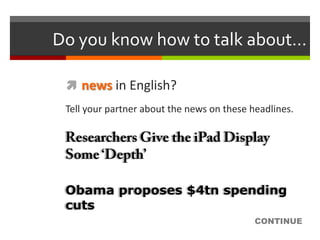
Do you know how to talk about…

  news in English?
 Tell your partner about the news on these headlines.


 Obama proposes $4tn spending
 cuts
                                            CONTINUE
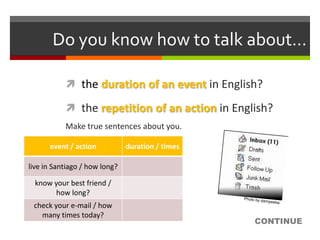
Do you know how to talk about…

            the duration of an event in English?

            the repetition of an action in English?
           Make true sentences about you.

      event / action           duration / times

live in Santiago / how long?

  know your best friend /
        how long?
 check your e-mail / how
   many times today?
                                                  CONTINUE
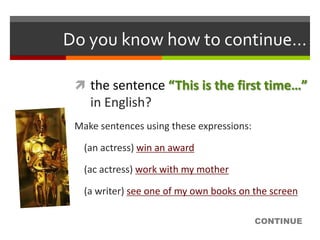
Do you know how to continue…

  the sentence “This is the first time…”
    in English?
 Make sentences using these expressions:

   (an actress) win an award

   (ac actress) work with my mother

   (a writer) see one of my own books on the screen

                                           CONTINUE
Have you noticed…

 that we use the same verb tense in all
  these situations?
 Yes, it’s Present Perfect.


                                CONTINUE
Uses of Present Perfect

 The use of the Present Perfect tense in English may
   be a bit complex for foreign students of English,
   because it is not always used as its equivalent forms
   in other languages like French, Spanish or Italian.

 In the following slides you will find a few simplified,
   general grammar rules.
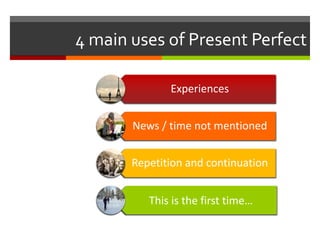
4 main uses of Present Perfect

              Experiences


       News / time not mentioned


       Repetition and continuation


          This is the first time…
1. Experiences

 We use Present Perfect when we talk about
   personal experiences or completed actions, usually
   with time adverbs that mean ‘at some / any time up
   to now’.
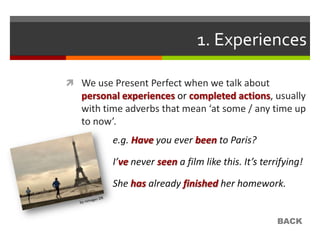
         e.g. Have you ever been to Paris?

         I’ve never seen a film like this. It’s terrifying!

         She has already finished her homework.


                                                    BACK
2. News / time not mentioned

 Present Perfect is the most frequent tense for giving
   news of recent events or when we talk about a past
   event and we do not mention exactly when it
   happened. We change to past simple when we give
   the details.

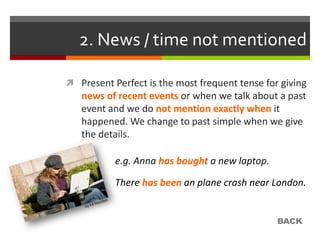
           e.g. Anna has bought a new laptop.

           There has been an plane crash near London.


                                                BACK
3. Repetition and continuation

 We often use Present Perfect to say that something
   has happened several times up to the present, or
   to talk about how long present situations have
   lasted in a time period that the speaker considers
   unfinished. Present tenses are not used in this way.

         e.g. I have read three books this month vs.
         I read three books last month.

         We’ve been friends since 1985.
         (NOT We are friends since 1985).
                                                BACK
4. This is the first time…

 We use Present Perfect in sentences constructed
   with ‘This / It / That is the first / second / third /
   only / best / worst time...’

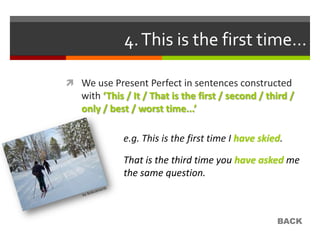
             e.g. This is the first time I have skied.

             That is the third time you have asked me
             the same question.


                                                    BACK
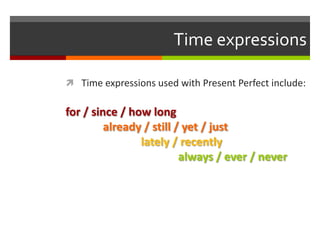
Time expressions

 Time expressions used with Present Perfect include:


for / since / how long
         already / still / yet / just
                lately / recently
                          always / ever / never
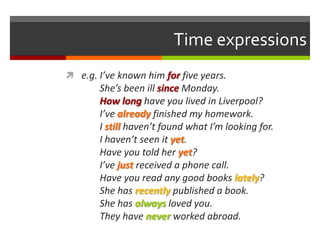
Time expressions
 e.g. I’ve known him for five years.
       She’s been ill since Monday.
       How long have you lived in Liverpool?
       I’ve already finished my homework.
       I still haven’t found what I’m looking for.
       I haven’t seen it yet.
       Have you told her yet?
       I’ve just received a phone call.
       Have you read any good books lately?
       She has recently published a book.
       She has always loved you.
       They have never worked abroad.
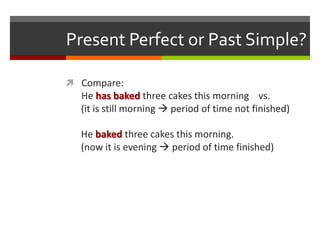
Present Perfect or Past Simple?

 Compare:
  He has baked three cakes this morning vs.
  (it is still morning  period of time not finished)

  He baked three cakes this morning.
  (now it is evening  period of time finished)
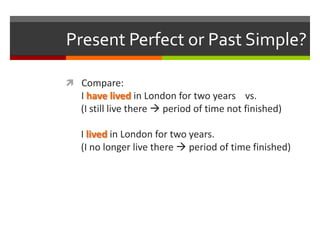
Present Perfect or Past Simple?

 Compare:
  I have lived in London for two years vs.
  (I still live there  period of time not finished)

  I lived in London for two years.
  (I no longer live there  period of time finished)
Been or gone?

 Compare:
  He has gone to London vs.
  (He’s still there. He hasn’t come back yet)

  He has been to London.
  (He’s visited London, but he is not there now. He’s
  come back)
Isabel de la Cruz

Talking about experiences and recent events

  • 1.
    Talking about experiencesand  recent events Uses of the Present Perfect Tense Photo by ed100
  • 2.
    Do you knowhow to talk about…  your experiences in English? Make true sentences about you. Experience Yes? / No? visit Berlin ride a camel eat insects CONTINUE
  • 3.
    Do you knowhow to talk about…  news in English? Tell your partner about the news on these headlines. Obama proposes $4tn spending cuts CONTINUE
  • 4.
    Do you knowhow to talk about…  the duration of an event in English?  the repetition of an action in English? Make true sentences about you. event / action duration / times live in Santiago / how long? know your best friend / how long? check your e-mail / how many times today? CONTINUE
  • 5.
    Do you knowhow to continue…  the sentence “This is the first time…” in English? Make sentences using these expressions: (an actress) win an award (ac actress) work with my mother (a writer) see one of my own books on the screen CONTINUE
  • 6.
    Have you noticed… that we use the same verb tense in all these situations?  Yes, it’s Present Perfect. CONTINUE
  • 7.
    Uses of PresentPerfect  The use of the Present Perfect tense in English may be a bit complex for foreign students of English, because it is not always used as its equivalent forms in other languages like French, Spanish or Italian.  In the following slides you will find a few simplified, general grammar rules.
  • 8.
    4 main usesof Present Perfect Experiences News / time not mentioned Repetition and continuation This is the first time…
  • 9.
    1. Experiences  Weuse Present Perfect when we talk about personal experiences or completed actions, usually with time adverbs that mean ‘at some / any time up to now’. e.g. Have you ever been to Paris? I’ve never seen a film like this. It’s terrifying! She has already finished her homework. BACK
  • 10.
    2. News /time not mentioned  Present Perfect is the most frequent tense for giving news of recent events or when we talk about a past event and we do not mention exactly when it happened. We change to past simple when we give the details. e.g. Anna has bought a new laptop. There has been an plane crash near London. BACK
  • 11.
    3. Repetition andcontinuation  We often use Present Perfect to say that something has happened several times up to the present, or to talk about how long present situations have lasted in a time period that the speaker considers unfinished. Present tenses are not used in this way. e.g. I have read three books this month vs. I read three books last month. We’ve been friends since 1985. (NOT We are friends since 1985). BACK
  • 12.
    4. This isthe first time…  We use Present Perfect in sentences constructed with ‘This / It / That is the first / second / third / only / best / worst time...’ e.g. This is the first time I have skied. That is the third time you have asked me the same question. BACK
  • 13.
    Time expressions  Timeexpressions used with Present Perfect include: for / since / how long already / still / yet / just lately / recently always / ever / never
  • 14.
    Time expressions  e.g.I’ve known him for five years. She’s been ill since Monday. How long have you lived in Liverpool? I’ve already finished my homework. I still haven’t found what I’m looking for. I haven’t seen it yet. Have you told her yet? I’ve just received a phone call. Have you read any good books lately? She has recently published a book. She has always loved you. They have never worked abroad.
  • 15.
    Present Perfect orPast Simple?  Compare: He has baked three cakes this morning vs. (it is still morning  period of time not finished) He baked three cakes this morning. (now it is evening  period of time finished)
  • 16.
    Present Perfect orPast Simple?  Compare: I have lived in London for two years vs. (I still live there  period of time not finished) I lived in London for two years. (I no longer live there  period of time finished)
  • 17.
    Been or gone? Compare: He has gone to London vs. (He’s still there. He hasn’t come back yet) He has been to London. (He’s visited London, but he is not there now. He’s come back)
  • 18.