Protecting Free Expression Online with Freenet I. Clarke, S. G. Miller, T. W. Hong, O. Sandberg, and B. Wiley Presented by Sivadon Chaisiri Related paper:  Freenet: A Distributed Anonymous Information Storage and Retrieval System
O utline Overview of Freenet Freenet Architecture Performance Analysis Summary Review Q&A
" I worry about my child and the Internet all the time, even though she's too young to have logged on yet .  Here's what I worry about .  I worry that 10 or 15 years from now, she will come to me and say  'Daddy, where were you when they took freedom of the press away from the Internet? ' " Mike Godwin,  Electronic Frontier Foundation
O verview of  F reenet Freenet is an adaptive peer-to-peer system P ermits the publication and retrieval of data  without fear of censorship  Freenet’s Goals Censorship-resistance Privacy  for users (publishers, requestors, and holders) -  anonymity High  availability ,  reliability  and  scalability
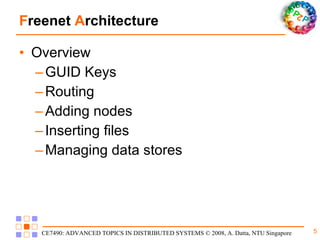
F reenet  A rchitecture Overview GUID Keys Routing Adding nodes Inserting files Managing data stores
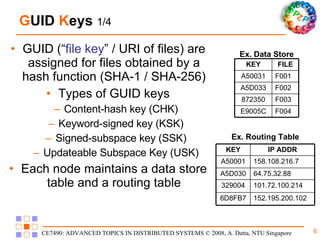
G UID  K eys  1/4 GUID ( “ file key ” / URI of files ) are assigned for files  obtained by a hash function (SHA-1 / SHA-256) Types of GUID keys Content-hash key (CHK) Keyword-signed key (KSK) Signed-subspace key (SSK) Updateable Subspace Key (USK) Each node maintains a data store   table   and a routing table Ex. Data Store Ex. Routing Table F001 A50031 F004 F003 F002 FILE E9005C 872350 A5D033 KEY 152.195.200.102 101.72.100.214 64.75.32.88 158.108.216.7 IP ADDR 6D8FB7 329004 A5D030 A50001 KEY
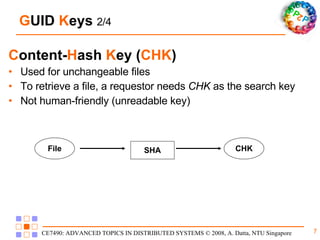
G UID  K eys  2/4 C ontent- H ash  K ey ( CHK ) Used for unchangeable files To retrieve a file, a requestor needs  CHK  as the search key Not human-friendly (unreadable key) File SHA CHK
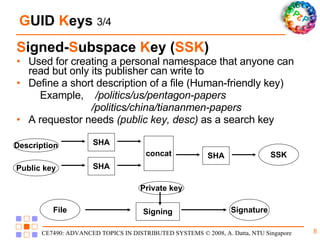
G UID  K eys  3/4 S igned- S ubspace  K ey ( SSK ) Used for creating a personal namespace that anyone can read but only its publisher can write to Define a short description of a file (Human-friendly key)    Example,   /politics/us/pentagon-papers /politics/china/tiananmen-papers A requestor needs  (public key, desc)  as a search key Public key SSK Private key Description SHA SHA concat SHA File Signing Signature
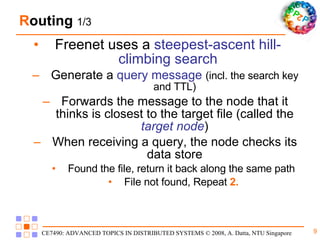
R outing  1/3 Freenet uses a  steepest-ascent hill-climbing search Generate a  query message   (incl. the search key and TTL) Forwards the message to the node that it thinks is closest to the target file (called the  target node ) When receiving a query, the node checks its data store Found the file, return it back along the same path File not found, Repeat  2.
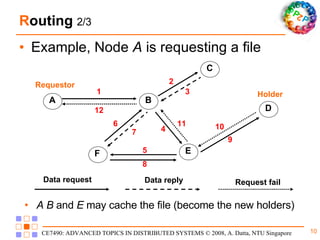
R outing  2/3 Example, Node  A  is requesting a file Requestor Holder A B  and  E  may cache the file (become the new holders) A B C F E D 1 2 3 4 11 10 9 5 8 6 7 12 Data request Data reply Request fail
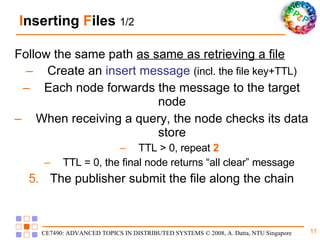
I nserting  F ile s  1/2 Follow the same path  as same as retrieving a file Create an  insert message   (incl. the file key+TTL) Each node forwards the message to the target node When receiving a query, the node checks its data store TTL > 0, repeat  2 TTL = 0, the final node returns “all clear” message The publisher submit the file along the chain
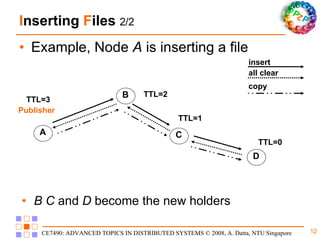
I nserting  F ile s  2/2 Example, Node  A  is inserting a file Publisher TTL=3 TTL=2 TTL=1 TTL=0 B C  and  D  become the new holders insert all clear copy A B C D
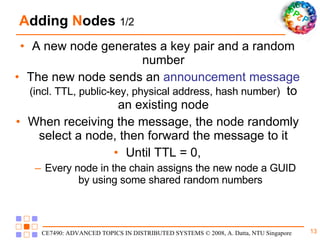
A dding  N odes  1/2 A new node generates a key pair and a random number The new node sends an  announcement message  (incl. TTL, public-key, physical address, hash number)   to an existing node When receiving the message, the node randomly select a node, then forward the message to it Until TTL = 0, Every node in the chain assigns the new node a GUID by using some shared random numbers
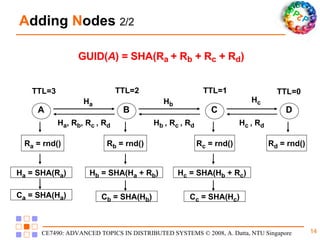
H a  = SHA(R a ) R a  = rnd() R b  = rnd() H b  = SHA(H a  + R b ) R c  = rnd() H c  = SHA(H b  + R c ) C b  = SHA(H b ) C c  = SHA(H c ) H a H b TTL=3 TTL=2 TTL=1 TTL=0 GUID( A ) = SHA(R a  + R b  + R c  + R d ) A dding  N odes  2/2 R d  = rnd() H c H c  , R d H b  , R c  , R d H a , R b , R c  , R d C a  = SHA(H a ) A B C D
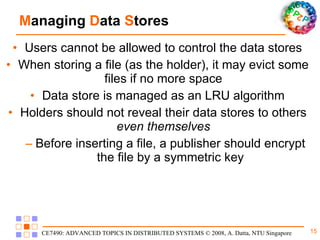
M anaging  D ata  S tores Users cannot be allowed to control the data stores When storing a file (as the holder), it may evict some files if no more space Data store is managed as an LRU algorithm Holders should not reveal their data stores to others  even themselves Before inserting a file, a publisher should encrypt the file by a symmetric key
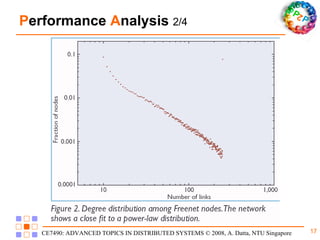
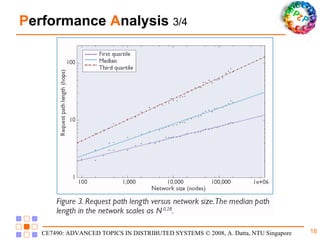
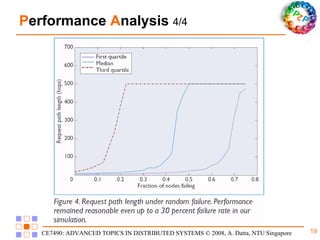
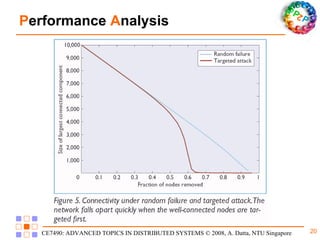
P erformance  A nalysis  1/4 Simulations Based on a small-word network model Observe Freenet’s characteristics Scalability Fault-tolerance
P erformance  A nalysis   2/4
P erformance  A nalysis  3/4
P erformance  A nalysis   4/4
P erformance  A nalysis
S ummary Freenet is an unstructured p2p storage system Deal with privacy and censorship-resistance Freenet is scale on a large network, and robust against large failures
R eview Closet key  ≠ Closest Meaning Disperse files of the similar topics Prevent single point of failures Freenet ’s Weakness No file-lifetime guarantees Due to its goal, no content censorship of illegal/corrupt/fake files DoS Attacks
R eference Ian Clarke, Scott G. Miller, Theodore W. Hong, Oskar Sandberg, and Brandon Wiley, “ Protecting Free Expression Online with Freenet ”, IEEE Internet Computing, JAN/FEB 2002 Ian Clarke, Scott G. Miller, Theodore W. Hong, Oskar Sandberg, and Brandon Wiley, “ Freenet: A Distributed Anonymous Information Storage and Retrieval System ”, In Proc. Of the ICSI Workshop on Design Issues in Anonymity and Unobservability, Berkeley, CA, 2000 http:// freenetproject.org http://en.wikipedia.org/wiki/Freenet
Q  &  A

Present Paper: Protecting Free Expression Online on Freenet

  • 1.
    Protecting Free ExpressionOnline with Freenet I. Clarke, S. G. Miller, T. W. Hong, O. Sandberg, and B. Wiley Presented by Sivadon Chaisiri Related paper: Freenet: A Distributed Anonymous Information Storage and Retrieval System
  • 2.
    O utline Overviewof Freenet Freenet Architecture Performance Analysis Summary Review Q&A
  • 3.
    " I worryabout my child and the Internet all the time, even though she's too young to have logged on yet . Here's what I worry about . I worry that 10 or 15 years from now, she will come to me and say 'Daddy, where were you when they took freedom of the press away from the Internet? ' " Mike Godwin, Electronic Frontier Foundation
  • 4.
    O verview of F reenet Freenet is an adaptive peer-to-peer system P ermits the publication and retrieval of data without fear of censorship Freenet’s Goals Censorship-resistance Privacy for users (publishers, requestors, and holders) - anonymity High availability , reliability and scalability
  • 5.
    F reenet A rchitecture Overview GUID Keys Routing Adding nodes Inserting files Managing data stores
  • 6.
    G UID K eys 1/4 GUID ( “ file key ” / URI of files ) are assigned for files obtained by a hash function (SHA-1 / SHA-256) Types of GUID keys Content-hash key (CHK) Keyword-signed key (KSK) Signed-subspace key (SSK) Updateable Subspace Key (USK) Each node maintains a data store table and a routing table Ex. Data Store Ex. Routing Table F001 A50031 F004 F003 F002 FILE E9005C 872350 A5D033 KEY 152.195.200.102 101.72.100.214 64.75.32.88 158.108.216.7 IP ADDR 6D8FB7 329004 A5D030 A50001 KEY
  • 7.
    G UID K eys 2/4 C ontent- H ash K ey ( CHK ) Used for unchangeable files To retrieve a file, a requestor needs CHK as the search key Not human-friendly (unreadable key) File SHA CHK
  • 8.
    G UID K eys 3/4 S igned- S ubspace K ey ( SSK ) Used for creating a personal namespace that anyone can read but only its publisher can write to Define a short description of a file (Human-friendly key) Example, /politics/us/pentagon-papers /politics/china/tiananmen-papers A requestor needs (public key, desc) as a search key Public key SSK Private key Description SHA SHA concat SHA File Signing Signature
  • 9.
    R outing 1/3 Freenet uses a steepest-ascent hill-climbing search Generate a query message (incl. the search key and TTL) Forwards the message to the node that it thinks is closest to the target file (called the target node ) When receiving a query, the node checks its data store Found the file, return it back along the same path File not found, Repeat 2.
  • 10.
    R outing 2/3 Example, Node A is requesting a file Requestor Holder A B and E may cache the file (become the new holders) A B C F E D 1 2 3 4 11 10 9 5 8 6 7 12 Data request Data reply Request fail
  • 11.
    I nserting F ile s 1/2 Follow the same path as same as retrieving a file Create an insert message (incl. the file key+TTL) Each node forwards the message to the target node When receiving a query, the node checks its data store TTL > 0, repeat 2 TTL = 0, the final node returns “all clear” message The publisher submit the file along the chain
  • 12.
    I nserting F ile s 2/2 Example, Node A is inserting a file Publisher TTL=3 TTL=2 TTL=1 TTL=0 B C and D become the new holders insert all clear copy A B C D
  • 13.
    A dding N odes 1/2 A new node generates a key pair and a random number The new node sends an announcement message (incl. TTL, public-key, physical address, hash number) to an existing node When receiving the message, the node randomly select a node, then forward the message to it Until TTL = 0, Every node in the chain assigns the new node a GUID by using some shared random numbers
  • 14.
    H a = SHA(R a ) R a = rnd() R b = rnd() H b = SHA(H a + R b ) R c = rnd() H c = SHA(H b + R c ) C b = SHA(H b ) C c = SHA(H c ) H a H b TTL=3 TTL=2 TTL=1 TTL=0 GUID( A ) = SHA(R a + R b + R c + R d ) A dding N odes 2/2 R d = rnd() H c H c , R d H b , R c , R d H a , R b , R c , R d C a = SHA(H a ) A B C D
  • 15.
    M anaging D ata S tores Users cannot be allowed to control the data stores When storing a file (as the holder), it may evict some files if no more space Data store is managed as an LRU algorithm Holders should not reveal their data stores to others even themselves Before inserting a file, a publisher should encrypt the file by a symmetric key
  • 16.
    P erformance A nalysis 1/4 Simulations Based on a small-word network model Observe Freenet’s characteristics Scalability Fault-tolerance
  • 17.
    P erformance A nalysis 2/4
  • 18.
    P erformance A nalysis 3/4
  • 19.
    P erformance A nalysis 4/4
  • 20.
    P erformance A nalysis
  • 21.
    S ummary Freenetis an unstructured p2p storage system Deal with privacy and censorship-resistance Freenet is scale on a large network, and robust against large failures
  • 22.
    R eview Closetkey ≠ Closest Meaning Disperse files of the similar topics Prevent single point of failures Freenet ’s Weakness No file-lifetime guarantees Due to its goal, no content censorship of illegal/corrupt/fake files DoS Attacks
  • 23.
    R eference IanClarke, Scott G. Miller, Theodore W. Hong, Oskar Sandberg, and Brandon Wiley, “ Protecting Free Expression Online with Freenet ”, IEEE Internet Computing, JAN/FEB 2002 Ian Clarke, Scott G. Miller, Theodore W. Hong, Oskar Sandberg, and Brandon Wiley, “ Freenet: A Distributed Anonymous Information Storage and Retrieval System ”, In Proc. Of the ICSI Workshop on Design Issues in Anonymity and Unobservability, Berkeley, CA, 2000 http:// freenetproject.org http://en.wikipedia.org/wiki/Freenet
  • 24.
    Q & A