Introduction to P2P  systems Davide Carboni © 2005-2006
License Attribution-ShareAlike 2.5  You are free: to copy, distribute, display, and perform the work  to make derivative works  to make commercial use of the work  Under the following conditions: Attribution . You must give the original author credit.  Share Alike . If you alter, transform, or build upon this work, you may distribute the resulting work only under a licence identical to this one. For any reuse or distribution, you must make clear to others the licence terms of this work.  Any of these conditions can be waived if you get permission from the copyright holder.  Your fair use and other rights are in no way affected by the above. This is a human-readable summary of the  Legal  Code (the full  licence ) .  Disclaimer
P2P is about sharing resources Your CPU time Your bandwidth Your disk space
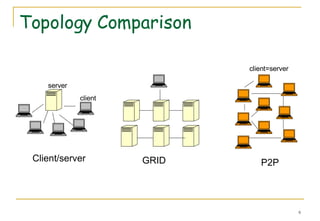
What is P2P From Wikipedia A  peer-to-peer  computer network is a  network  that relies on the computing power and  bandwidth  of the participants in the network rather than concentrating it in a relatively low number of  servers
P2P and GRID From Wikipedia Grid computing  […] performs higher throughput computing by taking advantage of many networked computers to model a virtual computer architecture.
Topology Comparison Client/server GRID P2P server client client=server
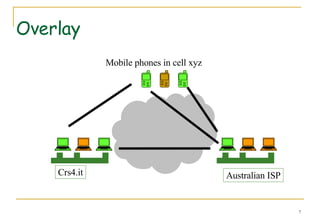
Overlay Crs4.it Australian ISP Mobile phones in cell xyz
Three main issues in P2P systems Bootstrapping Index/Lookup (query) Delivery of large objects (in case of file sharing)
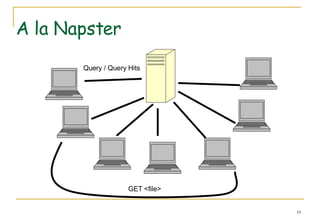
A la Napster Query / Query Hits GET <file>
Copyright issues with Napster Napster claimed that the law allows people to share music with friends. The court considered this position illegal and Napster was closed.
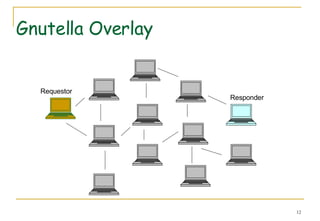
Gnutella Overlay Requestor Responder
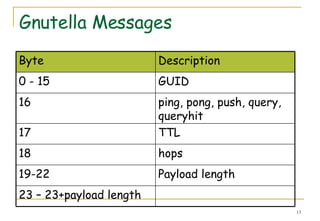
Gnutella Messages ping, pong, push, query, queryhit 16 23 – 23+payload length Payload length 19-22 hops 18 TTL 17 GUID 0 - 15 Description Byte
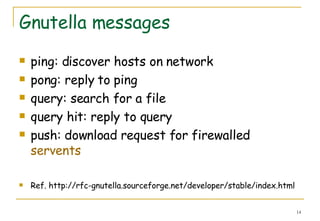
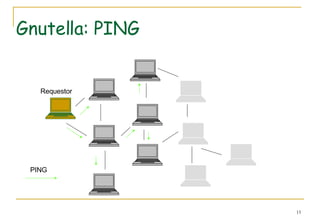
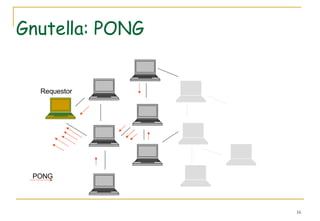
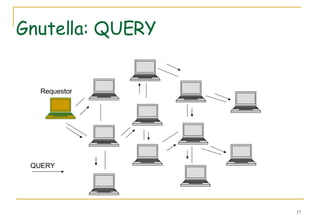
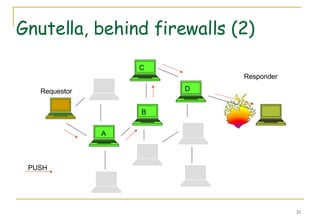
Gnutella messages ping: discover hosts on network  pong: reply to ping  query: search for a file  query hit: reply to query  push: download request for firewalled  servents   Ref. http://rfc-gnutella.sourceforge.net/developer/stable/index.html
Gnutella: PING Requestor PING
Gnutella: PONG Requestor PONG
Gnutella: QUERY Requestor QUERY
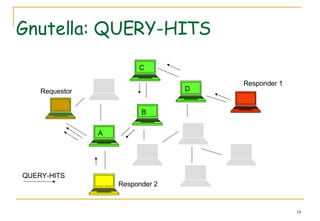
Gnutella: QUERY-HITS A C B D Requestor QUERY-HITS Responder 1 Responder 2
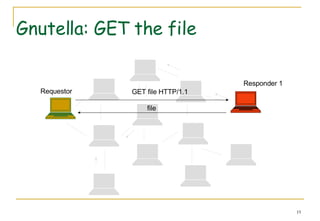
Gnutella: GET the file Requestor Responder 1 GET file HTTP/1.1 file
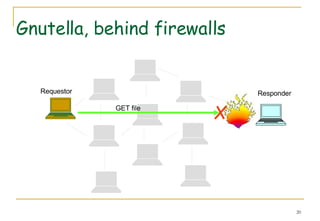
Gnutella, behind firewalls Requestor Responder GET file
Gnutella, behind firewalls (2) C B D Requestor Responder PUSH A
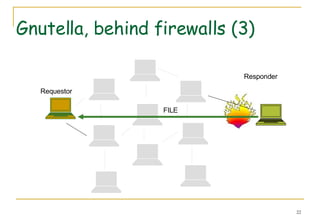
Gnutella, behind firewalls (3) Requestor Responder FILE
Bootstrapping in Gnutella X-Try Ping/Pong Storing from QueryHit messages GWebCache
Open issues in Gnutella Latency Scalability Vulnerability Privacy Security
Is Gnutella obsolete? Alive and Kicking The version 0.6 of the protocol prevents pure flooding and uses smart routing based on Ultrapeers More than 2 millions users with 500,000 nodes always up
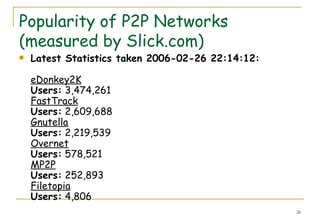
Popularity of P2P Networks  (measured by Slick.com) Latest Statistics taken 2006-02-26 22:14:12: eDonkey2K Users:  3,474,261 FastTrack Users:  2,609,688 Gnutella Users:  2,219,539 Overnet Users:  578,521 MP2P Users:  252,893 Filetopia Users:  4,806
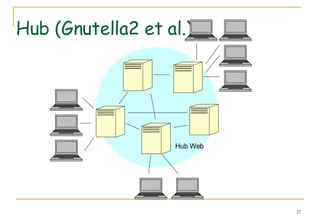
Hub (Gnutella2 et al.) Hub Web
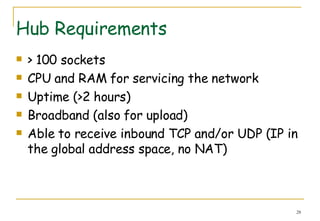
Hub Requirements > 100 sockets CPU and RAM for servicing the network Uptime (>2 hours) Broadband (also for upload) Able to receive inbound TCP and/or UDP (IP in the global address space, no NAT)
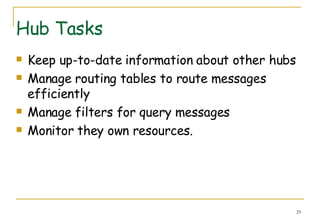
Hub Tasks Keep up-to-date information about other hubs Manage routing tables to route messages efficiently Manage filters for query messages Monitor they own resources.
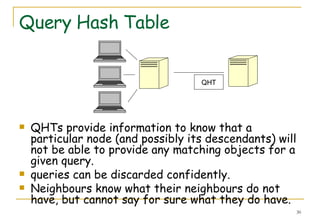
Query Hash Table QHTs provide information to know that a particular node (and possibly its descendants) will not be able to provide any matching objects for a given query.  queries can be discarded confidently.  Neighbours know what their neighbours do not have, but cannot say for sure what they do have.  QHT
What is Hashing From Wikipedia, the free encyclopedia A  hash function  or  hash algorithm  is a  function  for examining the input data and producing an output hash value. The process of computing such a value is known as  hashing . The process of hashing has the property that two different inputs are unlikely to hash to the same hash value.
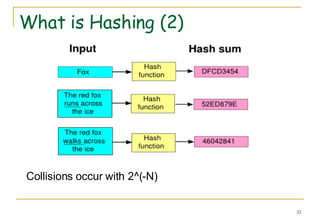
What is Hashing (2) Collisions occur with 2^(-N)
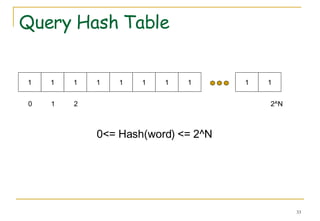
Query Hash Table 1 1 1 1 1 1 1 1 1 1 0 1 2 2^N 0<= Hash(word) <= 2^N
Query Filtering If any of the lookups based on URNs found a hit, send the query packet  If at least two thirds of lookups based on words found a hit, send  Otherwise, drop the packet  Consider all text content in the query, including generic search text and metadata search text if it is present.  Tokenize quoted phrases into words, ignoring the phrase at this level
Distributed hashtables
Distributed Hashtables Main features: a key is mapped onto a node of the network. Several proposals: Chord, Pastry and Kademlia.  Lookup(key) reaches the right node with O(log(N) ) hops.
Possible applications of DHT DHT DNS Content lookup Web search engine
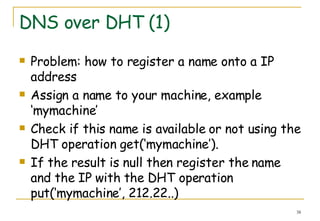
DNS over DHT (1) Problem: how to register a name onto a IP address Assign a name to your machine, example ‘mymachine’ Check if this name is available or not using the DHT operation get(‘mymachine’).  If the result is null then register the name and the IP with the DHT operation put(‘mymachine’, 212.22..)
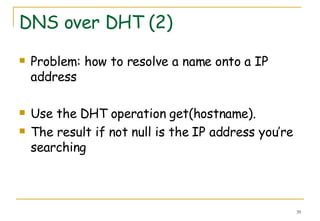
DNS over DHT (2) Problem: how to resolve a name onto a IP address Use the DHT operation get(hostname).  The result if not null is the IP address you’re searching
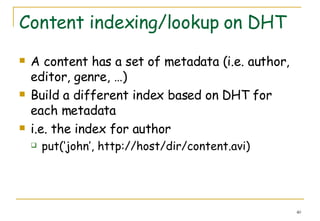
Content indexing/lookup on DHT A content has a set of metadata (i.e. author, editor, genre, …) Build a different index based on DHT for each metadata i.e. the index for author  put(‘john’, http://host/dir/content.avi)
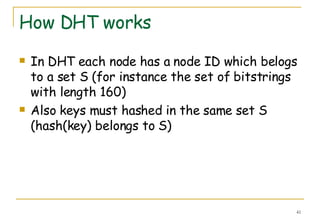
How DHT works In DHT each node has a node ID which belogs to a set S (for instance the set of bitstrings with length 160) Also keys must hashed in the same set S (hash(key) belongs to S)
Web crawlers and DHT Assume a network of nodes in a DHT Assume each node runs also a crawler. For each word in a Web page it performs Put(word,URL) So a distributed index of the Web is built[1]
Web search and DHT When the user type a keyword ‘foo’ lookup the DHT Get(‘foo’) The DHT will give the list of URL indexed with ‘foo’
Kademlia S = [00 ....0  - 11 ...1] the set of 160bit strings Each node has a node ID in S For each 'key' hash(key) is in S
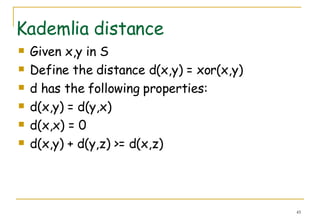
Kademlia distance Given x,y in S Define the distance d(x,y) = xor(x,y)  d has the following properties: d(x,y) = d(y,x) d(x,x) = 0 d(x,y) + d(y,z) >= d(x,z)
k-Buckets in kademlia  Each node stores an array of lists:  list[i] i  = 0,1, ... , 159 list[i]  stores up to k tuples: (IP,port,ID) list[i]  stores tuples whose ID is:  2^i <= D(this,ID)< 2^(i+1) list[i]  is ordered as LRS (last recent seen)
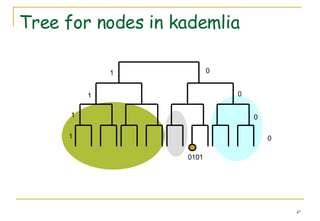
Tree for nodes in kademlia 1 1 1 1 0 0 0 0 0101
k-Buckets in kademlia  For small values of i,  list[i]  has few elements For larger values of i,  list[i]  is likely to contain more elements.
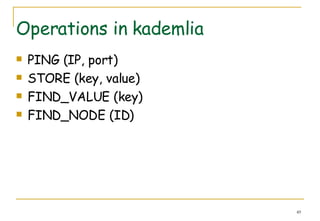
Operations in kademlia PING (IP, port) STORE (key, value) FIND_VALUE (key) FIND_NODE (ID)
Lookup in Kademlia FIND_NODE(hash(k)) Compute  D=xor(this,hash(key)) Find  a  tuples in  list[i]  (i.e. a=3) Send FIND_NODE(hash(key)) to the 3 nodes I receive other node addresses. Reiterate FIND_NODE(hash(key)) on them. Stop when no new addresses are received
Nodes Joining and Leaving Whenever one node asks another for its contacts, the called node stores the contact information of the caller. When a node joins the network it takes some of the contacts of an arbitrary node and uses them as its own. It then does a search for itself. This results in other nodes being called, which makes them aware of the new node's existence
Node Joining and Leaving (2) A new node may have become the closest node to certain keys The previous closest nodes will replicate the appropriate key/value pairs to the new node Ignoring replication the cost of a node joining is only O(log n) messages.
Range Query in DHT (1) DHT maps a key onto a node It is easy to lookup a value given a key It is uneasy lookup values in a range of keys Example 1:  Lookup all tuples in ‘aaaa’ < key < ‘bbbb’ Example 2: Lookup all tuples in ’39,88’ < lat < ’39,94’
References (1) Napster Timeline http://www.cnn.tv/SPECIALS/2001/napster/timeline.html The Gnutella Developer Forum http://www.the-gdf.org/wiki/index.php?title=Main_Page History of Gnutella in ‘Gnutella’ http://ntrg.cs.tcd.ie/undergrad/4ba2.02-03/p5.html Slyck.com DHT Links http://www.etse.urv.es/~cpairot/dhts.html
References (2) YACY (DHT Web search/index) http://www.yacy.net/yacy/ Kademlia : A  Peer-to-peer   Information  System  Based  on the XOR  Metric . (paper) Khashmir – Kademlia in Python http://khashmir.sourceforge.net/ A Case Study in Building Layered DHT Applications  (paper on range query/DHT) http://www.placelab.org/publications/pubs/IRS-TR-05-001.pdf
License Attribution-ShareAlike 2.5  You are free: to copy, distribute, display, and perform the work  to make derivative works  to make commercial use of the work  Under the following conditions: Attribution . You must give the original author credit.  Share Alike . If you alter, transform, or build upon this work, you may distribute the resulting work only under a licence identical to this one. For any reuse or distribution, you must make clear to others the licence terms of this work.  Any of these conditions can be waived if you get permission from the copyright holder.  Your fair use and other rights are in no way affected by the above. This is a human-readable summary of the  Legal  Code (the full  licence ) .  Disclaimer

Introduction P2p

  • 1.
    Introduction to P2P systems Davide Carboni © 2005-2006
  • 2.
    License Attribution-ShareAlike 2.5 You are free: to copy, distribute, display, and perform the work to make derivative works to make commercial use of the work Under the following conditions: Attribution . You must give the original author credit. Share Alike . If you alter, transform, or build upon this work, you may distribute the resulting work only under a licence identical to this one. For any reuse or distribution, you must make clear to others the licence terms of this work. Any of these conditions can be waived if you get permission from the copyright holder. Your fair use and other rights are in no way affected by the above. This is a human-readable summary of the Legal Code (the full licence ) . Disclaimer
  • 3.
    P2P is aboutsharing resources Your CPU time Your bandwidth Your disk space
  • 4.
    What is P2PFrom Wikipedia A peer-to-peer computer network is a network that relies on the computing power and bandwidth of the participants in the network rather than concentrating it in a relatively low number of servers
  • 5.
    P2P and GRIDFrom Wikipedia Grid computing […] performs higher throughput computing by taking advantage of many networked computers to model a virtual computer architecture.
  • 6.
    Topology Comparison Client/serverGRID P2P server client client=server
  • 7.
    Overlay Crs4.it AustralianISP Mobile phones in cell xyz
  • 8.
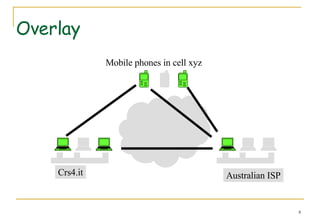
    Overlay Crs4.it AustralianISP Mobile phones in cell xyz
  • 9.
    Three main issuesin P2P systems Bootstrapping Index/Lookup (query) Delivery of large objects (in case of file sharing)
  • 10.
    A la NapsterQuery / Query Hits GET <file>
  • 11.
    Copyright issues withNapster Napster claimed that the law allows people to share music with friends. The court considered this position illegal and Napster was closed.
  • 12.
  • 13.
    Gnutella Messages ping,pong, push, query, queryhit 16 23 – 23+payload length Payload length 19-22 hops 18 TTL 17 GUID 0 - 15 Description Byte
  • 14.
    Gnutella messages ping:discover hosts on network pong: reply to ping query: search for a file query hit: reply to query push: download request for firewalled servents Ref. http://rfc-gnutella.sourceforge.net/developer/stable/index.html
  • 15.
  • 16.
  • 17.
  • 18.
    Gnutella: QUERY-HITS AC B D Requestor QUERY-HITS Responder 1 Responder 2
  • 19.
    Gnutella: GET thefile Requestor Responder 1 GET file HTTP/1.1 file
  • 20.
    Gnutella, behind firewallsRequestor Responder GET file
  • 21.
    Gnutella, behind firewalls(2) C B D Requestor Responder PUSH A
  • 22.
    Gnutella, behind firewalls(3) Requestor Responder FILE
  • 23.
    Bootstrapping in GnutellaX-Try Ping/Pong Storing from QueryHit messages GWebCache
  • 24.
    Open issues inGnutella Latency Scalability Vulnerability Privacy Security
  • 25.
    Is Gnutella obsolete?Alive and Kicking The version 0.6 of the protocol prevents pure flooding and uses smart routing based on Ultrapeers More than 2 millions users with 500,000 nodes always up
  • 26.
    Popularity of P2PNetworks (measured by Slick.com) Latest Statistics taken 2006-02-26 22:14:12: eDonkey2K Users: 3,474,261 FastTrack Users: 2,609,688 Gnutella Users: 2,219,539 Overnet Users: 578,521 MP2P Users: 252,893 Filetopia Users: 4,806
  • 27.
    Hub (Gnutella2 etal.) Hub Web
  • 28.
    Hub Requirements >100 sockets CPU and RAM for servicing the network Uptime (>2 hours) Broadband (also for upload) Able to receive inbound TCP and/or UDP (IP in the global address space, no NAT)
  • 29.
    Hub Tasks Keepup-to-date information about other hubs Manage routing tables to route messages efficiently Manage filters for query messages Monitor they own resources.
  • 30.
    Query Hash TableQHTs provide information to know that a particular node (and possibly its descendants) will not be able to provide any matching objects for a given query. queries can be discarded confidently. Neighbours know what their neighbours do not have, but cannot say for sure what they do have. QHT
  • 31.
    What is HashingFrom Wikipedia, the free encyclopedia A hash function or hash algorithm is a function for examining the input data and producing an output hash value. The process of computing such a value is known as hashing . The process of hashing has the property that two different inputs are unlikely to hash to the same hash value.
  • 32.
    What is Hashing(2) Collisions occur with 2^(-N)
  • 33.
    Query Hash Table1 1 1 1 1 1 1 1 1 1 0 1 2 2^N 0<= Hash(word) <= 2^N
  • 34.
    Query Filtering Ifany of the lookups based on URNs found a hit, send the query packet If at least two thirds of lookups based on words found a hit, send Otherwise, drop the packet Consider all text content in the query, including generic search text and metadata search text if it is present. Tokenize quoted phrases into words, ignoring the phrase at this level
  • 35.
  • 36.
    Distributed Hashtables Mainfeatures: a key is mapped onto a node of the network. Several proposals: Chord, Pastry and Kademlia. Lookup(key) reaches the right node with O(log(N) ) hops.
  • 37.
    Possible applications ofDHT DHT DNS Content lookup Web search engine
  • 38.
    DNS over DHT(1) Problem: how to register a name onto a IP address Assign a name to your machine, example ‘mymachine’ Check if this name is available or not using the DHT operation get(‘mymachine’). If the result is null then register the name and the IP with the DHT operation put(‘mymachine’, 212.22..)
  • 39.
    DNS over DHT(2) Problem: how to resolve a name onto a IP address Use the DHT operation get(hostname). The result if not null is the IP address you’re searching
  • 40.
    Content indexing/lookup onDHT A content has a set of metadata (i.e. author, editor, genre, …) Build a different index based on DHT for each metadata i.e. the index for author put(‘john’, http://host/dir/content.avi)
  • 41.
    How DHT worksIn DHT each node has a node ID which belogs to a set S (for instance the set of bitstrings with length 160) Also keys must hashed in the same set S (hash(key) belongs to S)
  • 42.
    Web crawlers andDHT Assume a network of nodes in a DHT Assume each node runs also a crawler. For each word in a Web page it performs Put(word,URL) So a distributed index of the Web is built[1]
  • 43.
    Web search andDHT When the user type a keyword ‘foo’ lookup the DHT Get(‘foo’) The DHT will give the list of URL indexed with ‘foo’
  • 44.
    Kademlia S =[00 ....0 - 11 ...1] the set of 160bit strings Each node has a node ID in S For each 'key' hash(key) is in S
  • 45.
    Kademlia distance Givenx,y in S Define the distance d(x,y) = xor(x,y) d has the following properties: d(x,y) = d(y,x) d(x,x) = 0 d(x,y) + d(y,z) >= d(x,z)
  • 46.
    k-Buckets in kademlia Each node stores an array of lists: list[i] i = 0,1, ... , 159 list[i] stores up to k tuples: (IP,port,ID) list[i] stores tuples whose ID is: 2^i <= D(this,ID)< 2^(i+1) list[i] is ordered as LRS (last recent seen)
  • 47.
    Tree for nodesin kademlia 1 1 1 1 0 0 0 0 0101
  • 48.
    k-Buckets in kademlia For small values of i, list[i] has few elements For larger values of i, list[i] is likely to contain more elements.
  • 49.
    Operations in kademliaPING (IP, port) STORE (key, value) FIND_VALUE (key) FIND_NODE (ID)
  • 50.
    Lookup in KademliaFIND_NODE(hash(k)) Compute D=xor(this,hash(key)) Find a tuples in list[i] (i.e. a=3) Send FIND_NODE(hash(key)) to the 3 nodes I receive other node addresses. Reiterate FIND_NODE(hash(key)) on them. Stop when no new addresses are received
  • 51.
    Nodes Joining andLeaving Whenever one node asks another for its contacts, the called node stores the contact information of the caller. When a node joins the network it takes some of the contacts of an arbitrary node and uses them as its own. It then does a search for itself. This results in other nodes being called, which makes them aware of the new node's existence
  • 52.
    Node Joining andLeaving (2) A new node may have become the closest node to certain keys The previous closest nodes will replicate the appropriate key/value pairs to the new node Ignoring replication the cost of a node joining is only O(log n) messages.
  • 53.
    Range Query inDHT (1) DHT maps a key onto a node It is easy to lookup a value given a key It is uneasy lookup values in a range of keys Example 1: Lookup all tuples in ‘aaaa’ < key < ‘bbbb’ Example 2: Lookup all tuples in ’39,88’ < lat < ’39,94’
  • 54.
    References (1) NapsterTimeline http://www.cnn.tv/SPECIALS/2001/napster/timeline.html The Gnutella Developer Forum http://www.the-gdf.org/wiki/index.php?title=Main_Page History of Gnutella in ‘Gnutella’ http://ntrg.cs.tcd.ie/undergrad/4ba2.02-03/p5.html Slyck.com DHT Links http://www.etse.urv.es/~cpairot/dhts.html
  • 55.
    References (2) YACY(DHT Web search/index) http://www.yacy.net/yacy/ Kademlia : A Peer-to-peer Information System Based on the XOR Metric . (paper) Khashmir – Kademlia in Python http://khashmir.sourceforge.net/ A Case Study in Building Layered DHT Applications (paper on range query/DHT) http://www.placelab.org/publications/pubs/IRS-TR-05-001.pdf
  • 56.
    License Attribution-ShareAlike 2.5 You are free: to copy, distribute, display, and perform the work to make derivative works to make commercial use of the work Under the following conditions: Attribution . You must give the original author credit. Share Alike . If you alter, transform, or build upon this work, you may distribute the resulting work only under a licence identical to this one. For any reuse or distribution, you must make clear to others the licence terms of this work. Any of these conditions can be waived if you get permission from the copyright holder. Your fair use and other rights are in no way affected by the above. This is a human-readable summary of the Legal Code (the full licence ) . Disclaimer