Downloaded 16 times
![Main Classes of Resource Discovery [1] Centralized third party Single server provides info of resources Example: DNS, LDAP, Napster, Globus Distributed third party Replication of multiple servers to provide info Example: UDDI, NetSolve, CORBA Multicast Limitation of LAN boundaries Example: Jini, Salutation, UPnP, Ninja P2P Genuinely distributed system Example: Chord, CAN, Gnutella, Pastry, Tapestry](https://image.slidesharecdn.com/rdmatchmaking-1216014972765629-8/85/Research-Issues-on-Resource-Discovery-Matching-Making-2-320.jpg)
![Convergence of P2P + Grid [2] Grid Nature: complexity (variety of resources + applications), administrative management + policy-based Requirement: scalability, intermittent participations P2P Nature: specific applications (either file sharing or CPU cycles), anonymity, intermittent participants Requirement: complexity and attributed-based search Grid + P2P Massively scalable sharing environment](https://image.slidesharecdn.com/rdmatchmaking-1216014972765629-8/85/Research-Issues-on-Resource-Discovery-Matching-Making-3-320.jpg)
![Iamnichi and Foster ‘s [2] Architectural Components: Membership protocol Overlay Construction Preprocessing Request Processing Emulated Grid: unstructured P2P of 32,768 virtual nodes Evaluated Resource Discovery Algorithms Random Walk: worst response but no cache Learning-based: best but require cache Best-neighbor: good for many distinct requests Learning-based + best-neighbor: unpredictable](https://image.slidesharecdn.com/rdmatchmaking-1216014972765629-8/85/Research-Issues-on-Resource-Discovery-Matching-Making-5-320.jpg)
![Sivadon and Putchong ’s [3] Unstructured Hierarchical P2P Form top-most to lowest: Global, VO, Super, Edge Flooding-based query algorithms Query-filter Backing links Backing resource links Simulation (implemented by Sugree’ Hypersim) 100,000 peers located in 8 VOs Evaluated algorithms by determining swamping problem + response time](https://image.slidesharecdn.com/rdmatchmaking-1216014972765629-8/85/Research-Issues-on-Resource-Discovery-Matching-Making-6-320.jpg)
![Condor’s Matchmaking [4] Condor’s Matchmaking Most distributed systems are basing on name/keyword search Matchmaking’s idea: advertise resources via classads Classads = advertisement + query Two Phases of Matchmaking Matching “ rank” = preference “ constraint” = requirement Claiming Try each one in the list of matching resources e.g., security issue + support different allocation models](https://image.slidesharecdn.com/rdmatchmaking-1216014972765629-8/85/Research-Issues-on-Resource-Discovery-Matching-Making-7-320.jpg)

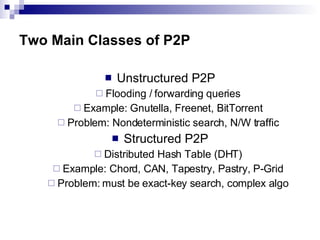
The document discusses different approaches to resource discovery in distributed computing environments including centralized third party, distributed third party, multicast, and peer-to-peer (P2P) methods. It also describes two main classes of P2P - unstructured which uses flooding/forwarding and structured which uses distributed hash tables. The document evaluates various resource discovery algorithms for P2P and grid environments including random walk, learning-based, and best-neighbor approaches.


