Partograph
Prepared by
Anu Thapa
M.Sc.Nursing (Maternal
Health Nursing
CONTENTS
 Definition
 Importance
 Advantages
 Uses
 Components
Definition
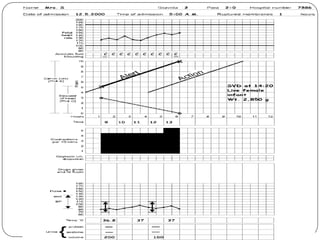
 Partograph is a composite graphical recording of
progress of labour and salient condition of mother
and fetus.
 For progress of labor and conditions of the mother
and the fetus
 It was developed and extensively tested by the world
health organization (WHO)
History
 The idea of recording was started first by Freidman
in 1954 by using graphic records of cervical
dilatation in labor.
 Further developed and extended by Philpot in 1972.
 Records in it can be easily analyzed and it provides a
basis for early recognition of any deviation from the
normal.
History…
 Introduced a partograph for use in developing
countries in 1994
 To increase the detection of woman with prolonged
labour or obstructed labour
 To improve the management of labour.
Importance
 It helps to detect whether labour has been
progressing satisfactory or not.
 It helps to make early recognition of problem for the
mother or fetus.
 It helps for timely decision of the need for
augmentation and termination of labour
Advantages
 A single sheet of paper can provide details of
necessary information at a glance.
 No need to record labour events repeteadly in
different sheet so it does not consume the time.
 It can be predict deviation from normal labour so
appropriate steps could be taken in time.
Advantages …
 It facilitates handover procedure Reduce the
incidence of prolonged labour and caeseran section.
 An introduction of partograph in labour management
brings improvement in reducing maternal and fetal
morbidity and mortality.
Uses
 Assessment of fetal well being, maternal well being and
labor.
 An important tool for preventing and diagnosing
prolonged/obstructed labor
 Associated with fewer operative deliveries and more
appropriate use of intrapartum oxytocin
 For BEOC sites, essential to predict the need for transfer
for caeserian section.
Principles of plotting partograph
 Active phase is commence at 4 cm dilation
 Latent phase should not last longer than 8 hour.
 During active labour, the rate of cervical dilatation
should not be slower than 1cm / hour.
 P/v should be performed as infrequently as it is
compatible with safe practice (4 hourly
recommended).
Components
 Basic recordings
 Fetal heart recording
 Amniotic fluid and moulding
 Dilation of cervix
 Descent of fetqal head
Components…
 Time and hour
 Uterine contraction
 Oxytocin drip
 Drug and other intravenous fluid
 Maternal condition
 Urine analysis
Patient information
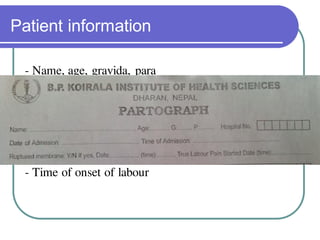
- Name, age, gravida, para
- Date and time of admission
- Time of membrane rupture
- Hospital number
- Time of onset of labour
Fetal heart recording
 Recorded every half hourly and each small square
equals to half an hour. Plot one dot (.) in line at the
level of the heart rate indicated in figure on left hand.
 If abnormal in 3 reading then take action.
Amniotic fluid and moulding
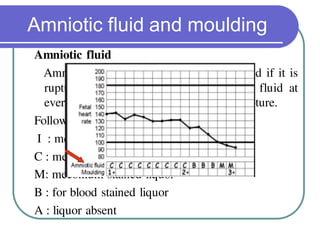
Amniotic fluid
Amniotic sac whether intact (+) or (-) and if it is
ruptured, record the colour of amniotic fluid at
every vaginal examination and time of rupture.
Following abbreviation stand for:
I : membrames intact
C : membranes ruptured, clear liquor
M: meconium stained liquor
B : for blood stained liquor
A : liquor absent
Amniotic fluid and moulding
 Moulding is an important finding as to know how
well the pelvis will accommodate the fetal head.
 Bones are separated and sutures can be felt easily
 + : Bones just touch each other
 ++ : Bones overlap but are reducible
 +++: Bones overlap but are irreversible
Dilatation of cervix
 Assessed at every vaginal examination and marked
with cross (×).
 Begin plotting on the partograph when patient is in
active phase of labour (4cm).
 Remember, first cervical dilatation should be plotted
on alert line. Subsequent cervical dilatation is plotted
on alert line
 Alert line: a line starts at 4 cm of cervical dilatation
to the point of expected full dilatation at the rate 1
cm per hour.
 Action line: parallel and 4 hours to the right of the
alert line. Any patient whose progress was slower the
action line was considered suitable for intervention
to expedite delivery.
Descent of the head
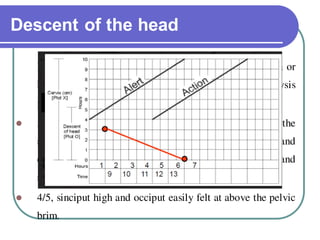
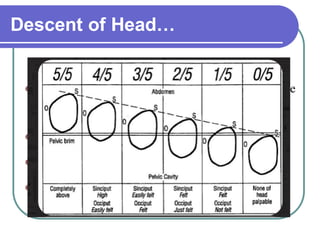
It is recorded as fifths of head palpable above the brim or
head (divided into 5 parts) palpable above the symphysis
pubis.
 At 5/5, the 5 parts of the head is palpable above the
symphysis pubis or brim in which the both sinciput and
occiput is plpable at same level. If the head is deflexed and
sinciput is higher the occiput in well flexed head.
 4/5, sinciput high and occiput easily felt at above the pelvic
brim.
Descent of Head…
 At 3/5th sinciput easily felt and occiput felt at the
pelvic brim.
 At 2/5th sinciput and occiput just felt.
 At 1/5th sinciput felt, occiput not felt.
 A 0/5th no of the head is palpable.
Hour and time
 Hours: refer to the time elapsed since onset of active
labour.
 Time: record actual time according to the hours of
active phase of labour started.
 The time is recorded hourly intervals in the space
provided. ‘O’ hour time for spontaneous labour is the
time of admission to the labour ward and for induced
labour is the time of induction. Then time is recorded
on the basis of first vaginal examination.
Uterine contraction
 The squares in the vertical columns are shaded
according to the duration and intensity.
 Chart every half hourly (each small vertical square
equals to half an hour). Plot the number of
contraction in 10 minutes and duration in seconds.
Uterine contraction…
 There are 5 verticle columns.
 Shade the square according to duration of
contraction as follows—
- Less than 20 seconds:
- Between 20-40 seconds:
- More than 40 seconds:
Drugs…
 Oxytocin: record the amount of oxytocin per
volume and Intravenous fluid in drops per minute
in every 30 minutes when used (on the base of
escalating).
 Drugs given: Any drug given is recorded in the
appropriate boxes.
Maternal condition
 Maternal condition is a record of pulse, blood pressure,
temperature, urine, oxytocin, drug and IV fluid (if used).
All the observation for the mother,s condition is written
at the bottom of the partograph.
 Pulse: record every 30 minutes and mark with a dot (.).
Maternal condition…
 Blood pressure: record every 4 hourly and mark with
record more frequently, if blood pressure is elevated.
 Temperature: record every 2 hourly
 Urine: record volume of urine, output every time as
urine is passed. The protein and acetone should be
tested in hospital if possible.
Duration of labour
Date and time of
- True labour pain.
- Membrane rupture
- Cervix fully dilated
- Baby born
- Placenta delivered
Type of delivery
Delivery conducted by
Time of delivery
Third stage
 Method of delivery of placenta
 Complete or incomplete
 Blood loss: …. ml approx.
 Post delivery BP
Perineum: intact, episiotomy , laceration
Baby examination
Prolonged
active phase
References
 Dutta DC, Konar H. Textbook of obstetrics. 7th Ed.
New Delhi. Jaypee Brothers Medical Publishers.
2013: P. 530- 531
 Fraser DM, Cooper MA, Myles Textbook for
Midwives. 14th edition, Churchill Livingstone.2006.
 Tuitui R. Mannual of Midwifery B,3rd Edition. 2005
 Managing complication in pregnancy and childbirth :
A guide for midwives and doctors. Integrated
Management of Pregnancy and Childbirth. WHO.
2005.
Any queries???
THANK YOU !!!

Partograph

  • 1.
  • 3.
    CONTENTS  Definition  Importance Advantages  Uses  Components
  • 4.
    Definition  Partograph isa composite graphical recording of progress of labour and salient condition of mother and fetus.  For progress of labor and conditions of the mother and the fetus  It was developed and extensively tested by the world health organization (WHO)
  • 5.
    History  The ideaof recording was started first by Freidman in 1954 by using graphic records of cervical dilatation in labor.  Further developed and extended by Philpot in 1972.  Records in it can be easily analyzed and it provides a basis for early recognition of any deviation from the normal.
  • 6.
    History…  Introduced apartograph for use in developing countries in 1994  To increase the detection of woman with prolonged labour or obstructed labour  To improve the management of labour.
  • 7.
    Importance  It helpsto detect whether labour has been progressing satisfactory or not.  It helps to make early recognition of problem for the mother or fetus.  It helps for timely decision of the need for augmentation and termination of labour
  • 8.
    Advantages  A singlesheet of paper can provide details of necessary information at a glance.  No need to record labour events repeteadly in different sheet so it does not consume the time.  It can be predict deviation from normal labour so appropriate steps could be taken in time.
  • 9.
    Advantages …  Itfacilitates handover procedure Reduce the incidence of prolonged labour and caeseran section.  An introduction of partograph in labour management brings improvement in reducing maternal and fetal morbidity and mortality.
  • 10.
    Uses  Assessment offetal well being, maternal well being and labor.  An important tool for preventing and diagnosing prolonged/obstructed labor  Associated with fewer operative deliveries and more appropriate use of intrapartum oxytocin  For BEOC sites, essential to predict the need for transfer for caeserian section.
  • 11.
    Principles of plottingpartograph  Active phase is commence at 4 cm dilation  Latent phase should not last longer than 8 hour.  During active labour, the rate of cervical dilatation should not be slower than 1cm / hour.  P/v should be performed as infrequently as it is compatible with safe practice (4 hourly recommended).
  • 12.
    Components  Basic recordings Fetal heart recording  Amniotic fluid and moulding  Dilation of cervix  Descent of fetqal head
  • 13.
    Components…  Time andhour  Uterine contraction  Oxytocin drip  Drug and other intravenous fluid  Maternal condition  Urine analysis
  • 14.
    Patient information - Name,age, gravida, para - Date and time of admission - Time of membrane rupture - Hospital number - Time of onset of labour
  • 15.
    Fetal heart recording Recorded every half hourly and each small square equals to half an hour. Plot one dot (.) in line at the level of the heart rate indicated in figure on left hand.  If abnormal in 3 reading then take action.
  • 16.
    Amniotic fluid andmoulding Amniotic fluid Amniotic sac whether intact (+) or (-) and if it is ruptured, record the colour of amniotic fluid at every vaginal examination and time of rupture. Following abbreviation stand for: I : membrames intact C : membranes ruptured, clear liquor M: meconium stained liquor B : for blood stained liquor A : liquor absent
  • 17.
    Amniotic fluid andmoulding  Moulding is an important finding as to know how well the pelvis will accommodate the fetal head.  Bones are separated and sutures can be felt easily  + : Bones just touch each other  ++ : Bones overlap but are reducible  +++: Bones overlap but are irreversible
  • 18.
    Dilatation of cervix Assessed at every vaginal examination and marked with cross (×).  Begin plotting on the partograph when patient is in active phase of labour (4cm).  Remember, first cervical dilatation should be plotted on alert line. Subsequent cervical dilatation is plotted on alert line
  • 20.
     Alert line:a line starts at 4 cm of cervical dilatation to the point of expected full dilatation at the rate 1 cm per hour.  Action line: parallel and 4 hours to the right of the alert line. Any patient whose progress was slower the action line was considered suitable for intervention to expedite delivery.
  • 21.
    Descent of thehead It is recorded as fifths of head palpable above the brim or head (divided into 5 parts) palpable above the symphysis pubis.  At 5/5, the 5 parts of the head is palpable above the symphysis pubis or brim in which the both sinciput and occiput is plpable at same level. If the head is deflexed and sinciput is higher the occiput in well flexed head.  4/5, sinciput high and occiput easily felt at above the pelvic brim.
  • 22.
    Descent of Head… At 3/5th sinciput easily felt and occiput felt at the pelvic brim.  At 2/5th sinciput and occiput just felt.  At 1/5th sinciput felt, occiput not felt.  A 0/5th no of the head is palpable.
  • 23.
    Hour and time Hours: refer to the time elapsed since onset of active labour.  Time: record actual time according to the hours of active phase of labour started.  The time is recorded hourly intervals in the space provided. ‘O’ hour time for spontaneous labour is the time of admission to the labour ward and for induced labour is the time of induction. Then time is recorded on the basis of first vaginal examination.
  • 24.
    Uterine contraction  Thesquares in the vertical columns are shaded according to the duration and intensity.  Chart every half hourly (each small vertical square equals to half an hour). Plot the number of contraction in 10 minutes and duration in seconds.
  • 25.
    Uterine contraction…  Thereare 5 verticle columns.  Shade the square according to duration of contraction as follows— - Less than 20 seconds: - Between 20-40 seconds: - More than 40 seconds:
  • 26.
    Drugs…  Oxytocin: recordthe amount of oxytocin per volume and Intravenous fluid in drops per minute in every 30 minutes when used (on the base of escalating).  Drugs given: Any drug given is recorded in the appropriate boxes.
  • 27.
    Maternal condition  Maternalcondition is a record of pulse, blood pressure, temperature, urine, oxytocin, drug and IV fluid (if used). All the observation for the mother,s condition is written at the bottom of the partograph.  Pulse: record every 30 minutes and mark with a dot (.).
  • 28.
    Maternal condition…  Bloodpressure: record every 4 hourly and mark with record more frequently, if blood pressure is elevated.  Temperature: record every 2 hourly  Urine: record volume of urine, output every time as urine is passed. The protein and acetone should be tested in hospital if possible.
  • 29.
    Duration of labour Dateand time of - True labour pain. - Membrane rupture - Cervix fully dilated - Baby born - Placenta delivered Type of delivery Delivery conducted by Time of delivery
  • 30.
    Third stage  Methodof delivery of placenta  Complete or incomplete  Blood loss: …. ml approx.  Post delivery BP Perineum: intact, episiotomy , laceration
  • 31.
  • 32.
  • 33.
    References  Dutta DC,Konar H. Textbook of obstetrics. 7th Ed. New Delhi. Jaypee Brothers Medical Publishers. 2013: P. 530- 531  Fraser DM, Cooper MA, Myles Textbook for Midwives. 14th edition, Churchill Livingstone.2006.  Tuitui R. Mannual of Midwifery B,3rd Edition. 2005  Managing complication in pregnancy and childbirth : A guide for midwives and doctors. Integrated Management of Pregnancy and Childbirth. WHO. 2005.
  • 34.
  • 35.