Umair
Tayyab
Shahzaib
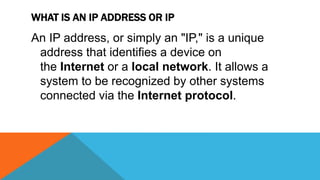
WHAT IS AN IP ADDRESS OR IP
An IP address, or simply an "IP," is a unique
address that identifies a device on
the Internet or a local network. It allows a
system to be recognized by other systems
connected via the Internet protocol.
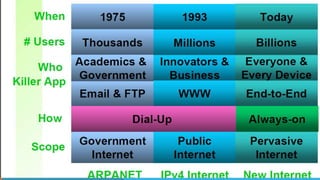
SHORT HISTORY
WHAT IS IPV6
Also known as IPng (next generation)
•A new version of the Internet Protocol
–Primarily designed to extend address space
–Enhancements and new features
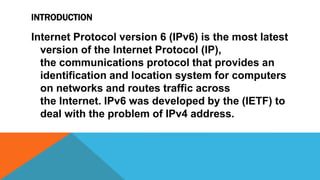
INTRODUCTION
Internet Protocol version 6 (IPv6) is the most latest
version of the Internet Protocol (IP),
the communications protocol that provides an
identification and location system for computers
on networks and routes traffic across
the Internet. IPv6 was developed by the (IETF) to
deal with the problem of IPv4 address.
INTERNET ENGINEERING TASK FORCE`
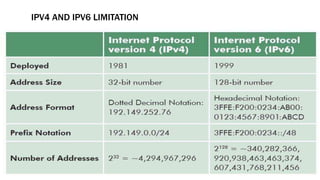
IPV4 AND IPV6 LIMITATION
CHALLENGES IN TODAY’S INTERNET
Address depletion
Increasing need for security PDA
Increased traffic flow
Increasing need for security and information protection
Increasing need for IP mobility
CHALLENGES IN TODAY’S INTERNET
QOS Issues
Security
Mobility
– Increasing number of wireless/mobile devices accessing Internet
services
LARGER ADDRESS SPACE
In contrast to IPv4, IPv6 uses 4 times more bits to address a
device on the Internet. This much of extra bits can provide
approximately 3.4×1038 different combinations of
addresses. This address can accumulate the aggressive
requirement of address allotment for almost everything in
this world. According to an estimate, 1564 addresses can be
allocated to every square meter of this earth.
END-TO-END CONNECTIVITY
Every system now has unique IP address and can traverse
through the Internet without using NAT (Network Address
Translation) or other translating components. After IPv6 is
fully implemented, every host can directly reach other hosts
on the Internet, with some limitations involved like Firewall,
organization policies, etc.
AUTO-CONFIGURATION
<IPv6 supports both stateful and stateless auto configuration mode of its
host devices. This way, absence of a DHCP server does not put a halt on
inter segment communication.
Stateful auto configuration of IPv6 is the equivalent to the use of DHCP in
IPv4. It requires a DHCPv6 service to provide the IPv6 address to the
client device and that both client device and server maintain the "state"
of that address (i.e. lease time , etc ).
Stateless auto configuration of IPv6 allows the client device to self
configure it's IPv6 address and routing based on the router
advertisements.
FASTER FORWARDING/ROUTING
Simplified header puts all unnecessary information at the end of the header.
The information contained in the first part of the header is adequate for a
Router to take routing decisions, thus making routing decision as quickly
as looking at the mandatory header
IPSEC
Initially it was decided that IPv6 must have IPSec security,
making it more secure than IPv4. This feature has now been
made optional. IPsec is said to be especially useful for
implementing virtual private networks and for remote user
access through dial-up connection to private networks. A big
advantage of IPsec is that security arrangements can be
handled without requiring changes to individual user
computers.
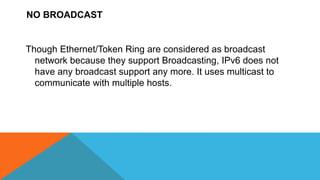
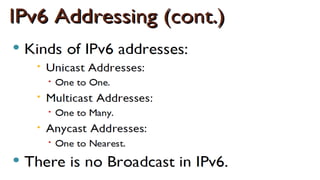
NO BROADCAST
Though Ethernet/Token Ring are considered as broadcast
network because they support Broadcasting, IPv6 does not
have any broadcast support any more. It uses multicast to
communicate with multiple hosts.
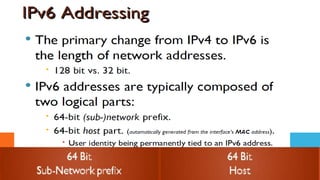
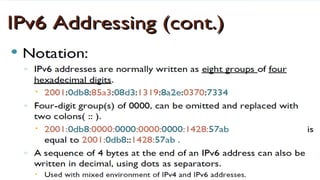
IPV6 ADDRESSING
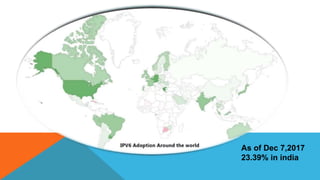
As of Dec 7,2017
23.39% in india
Ipv6 presention
Ipv6 presention

Ipv6 presention

  • 3.
  • 4.
    WHAT IS ANIP ADDRESS OR IP An IP address, or simply an "IP," is a unique address that identifies a device on the Internet or a local network. It allows a system to be recognized by other systems connected via the Internet protocol.
  • 5.
  • 6.
    WHAT IS IPV6 Alsoknown as IPng (next generation) •A new version of the Internet Protocol –Primarily designed to extend address space –Enhancements and new features
  • 7.
    INTRODUCTION Internet Protocol version6 (IPv6) is the most latest version of the Internet Protocol (IP), the communications protocol that provides an identification and location system for computers on networks and routes traffic across the Internet. IPv6 was developed by the (IETF) to deal with the problem of IPv4 address.
  • 8.
  • 10.
    IPV4 AND IPV6LIMITATION
  • 11.
    CHALLENGES IN TODAY’SINTERNET Address depletion Increasing need for security PDA Increased traffic flow Increasing need for security and information protection Increasing need for IP mobility
  • 12.
    CHALLENGES IN TODAY’SINTERNET QOS Issues Security Mobility – Increasing number of wireless/mobile devices accessing Internet services
  • 14.
    LARGER ADDRESS SPACE Incontrast to IPv4, IPv6 uses 4 times more bits to address a device on the Internet. This much of extra bits can provide approximately 3.4×1038 different combinations of addresses. This address can accumulate the aggressive requirement of address allotment for almost everything in this world. According to an estimate, 1564 addresses can be allocated to every square meter of this earth.
  • 15.
    END-TO-END CONNECTIVITY Every systemnow has unique IP address and can traverse through the Internet without using NAT (Network Address Translation) or other translating components. After IPv6 is fully implemented, every host can directly reach other hosts on the Internet, with some limitations involved like Firewall, organization policies, etc.
  • 16.
    AUTO-CONFIGURATION <IPv6 supports bothstateful and stateless auto configuration mode of its host devices. This way, absence of a DHCP server does not put a halt on inter segment communication. Stateful auto configuration of IPv6 is the equivalent to the use of DHCP in IPv4. It requires a DHCPv6 service to provide the IPv6 address to the client device and that both client device and server maintain the "state" of that address (i.e. lease time , etc ). Stateless auto configuration of IPv6 allows the client device to self configure it's IPv6 address and routing based on the router advertisements.
  • 17.
    FASTER FORWARDING/ROUTING Simplified headerputs all unnecessary information at the end of the header. The information contained in the first part of the header is adequate for a Router to take routing decisions, thus making routing decision as quickly as looking at the mandatory header
  • 18.
    IPSEC Initially it wasdecided that IPv6 must have IPSec security, making it more secure than IPv4. This feature has now been made optional. IPsec is said to be especially useful for implementing virtual private networks and for remote user access through dial-up connection to private networks. A big advantage of IPsec is that security arrangements can be handled without requiring changes to individual user computers.
  • 19.
    NO BROADCAST Though Ethernet/TokenRing are considered as broadcast network because they support Broadcasting, IPv6 does not have any broadcast support any more. It uses multicast to communicate with multiple hosts.
  • 20.
  • 26.
    As of Dec7,2017 23.39% in india