Grether and Plott:
Economic Theory of Choice and the Preference
Reversal Phenomenon
Economics 328
Spring 2004
What is a Preference Reversal?
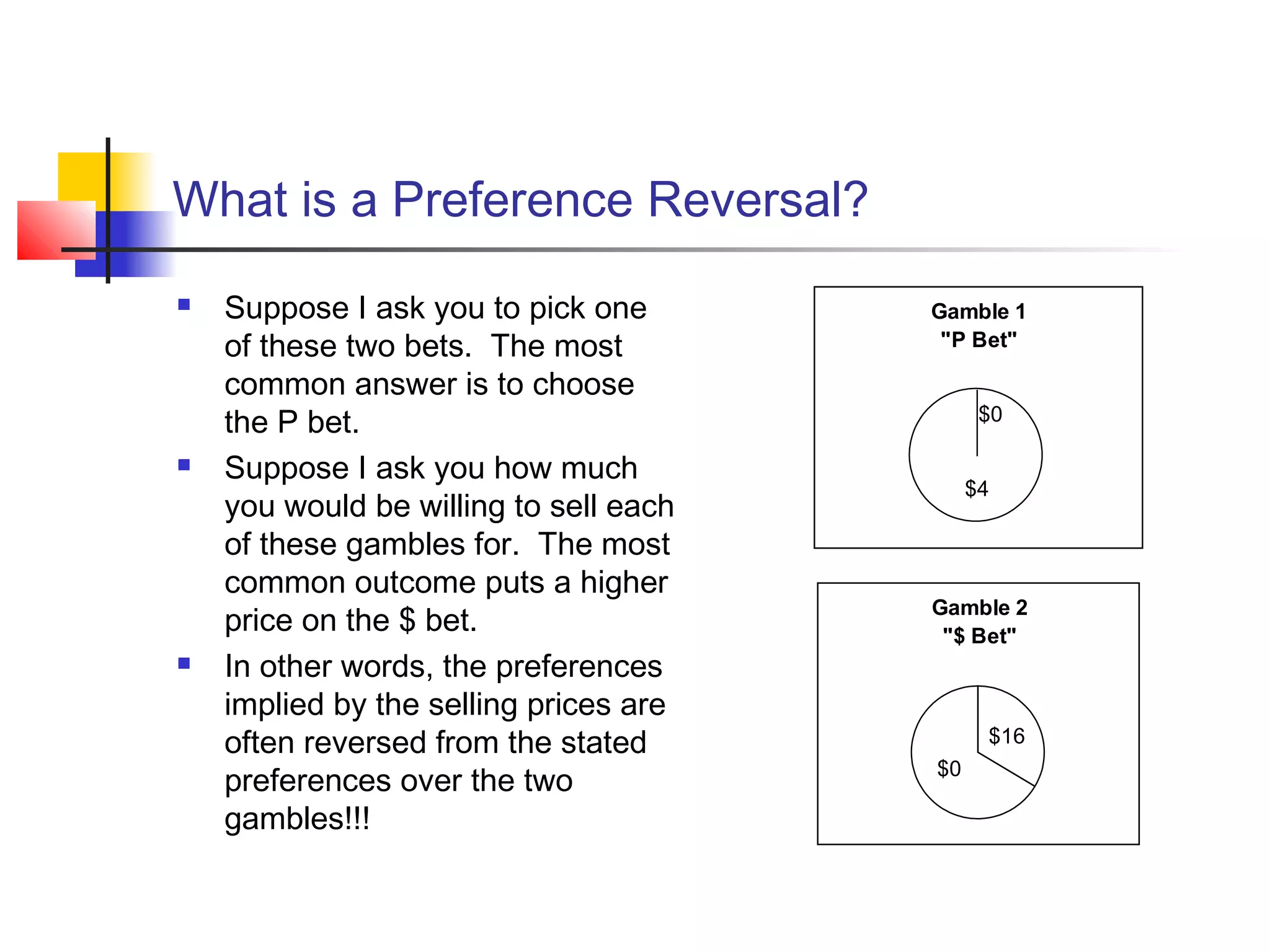
 Suppose I ask you to pick one
of these two bets. The most
common answer is to choose
the P bet.
 Suppose I ask you how much
you would be willing to sell each
of these gambles for. The most
common outcome puts a higher
price on the $ bet.
 In other words, the preferences
implied by the selling prices are
often reversed from the stated
preferences over the two
gambles!!!
Gamble 1
"P Bet"
$4
$0
Gamble 2
"$ Bet"
$0
$16
What are Preference Reversals?
 The most fundamental assumptions of economic theory are the
Axioms of Choice. These state that preferences are complete,
reflexive, and transitive. Preference reversals are a violation of
these fundamental assumptions. In particular, transitivity is
violated.
 In some fundamental sense, individuals who exhibit preference
reversals are irrational. Such people can be turned into “money
pumps.” This has been done successfully in laboratory
experiments (Berg, Daley, Dickhaut, & O’Brien, 1985; Chu &
Chu, 1990
Why Might Preference Reversals Occur?
 Grether and Plott hypothesize the following reasons for why preference
reversals might occur:
 Misspecified Incentives: The theory only makes prediction for gamble over
real known outcomes. Gambles over hypothetical payoffs or payoffs of
unspecified value may not yield valid violations of the theory.
 Income Effects: Expected utility theory is typically stated in term of the
utility of wealth. If an individual chooses over identical gambles with
differing initial levels of wealth, differing choices are not inconsistent with the
theory. This suggests that we should expect differences between buying
and selling, and that order effects can matter.
 Strategic Responses: The language of buying and selling may cause
people to behave strategically, even these responses aren’t sensible for the
experimental setting. These may lead to “false” violations. These are a
form of demand induced effect.
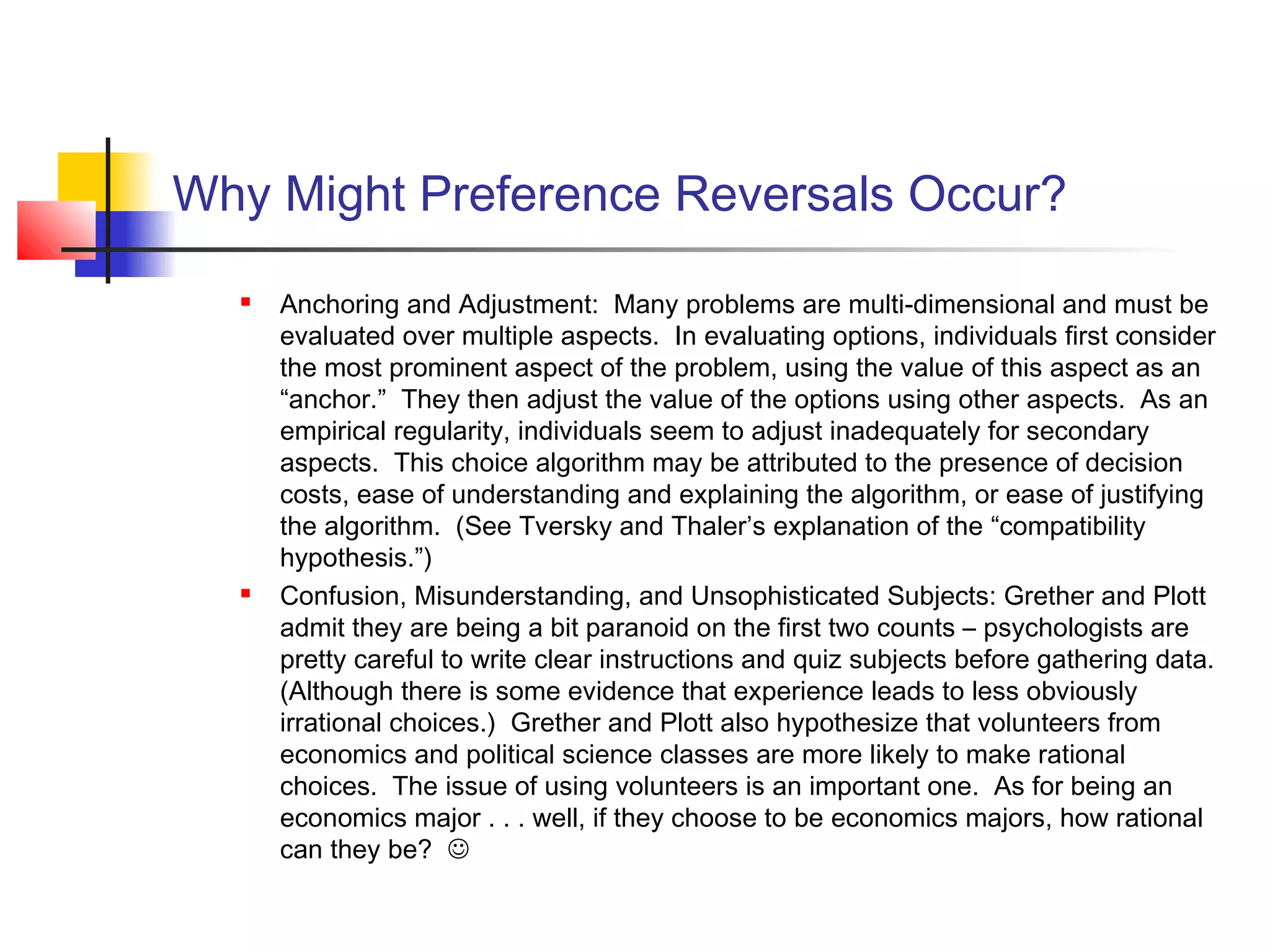
Why Might Preference Reversals Occur?
 Anchoring and Adjustment: Many problems are multi-dimensional and must be
evaluated over multiple aspects. In evaluating options, individuals first consider
the most prominent aspect of the problem, using the value of this aspect as an
“anchor.” They then adjust the value of the options using other aspects. As an
empirical regularity, individuals seem to adjust inadequately for secondary
aspects. This choice algorithm may be attributed to the presence of decision
costs, ease of understanding and explaining the algorithm, or ease of justifying
the algorithm. (See Tversky and Thaler’s explanation of the “compatibility
hypothesis.”)
 Confusion, Misunderstanding, and Unsophisticated Subjects: Grether and Plott
admit they are being a bit paranoid on the first two counts – psychologists are
pretty careful to write clear instructions and quiz subjects before gathering data.
(Although there is some evidence that experience leads to less obviously
irrational choices.) Grether and Plott also hypothesize that volunteers from
economics and political science classes are more likely to make rational
choices. The issue of using volunteers is an important one. As for being an
economics major . . . well, if they choose to be economics majors, how rational
can they be? 
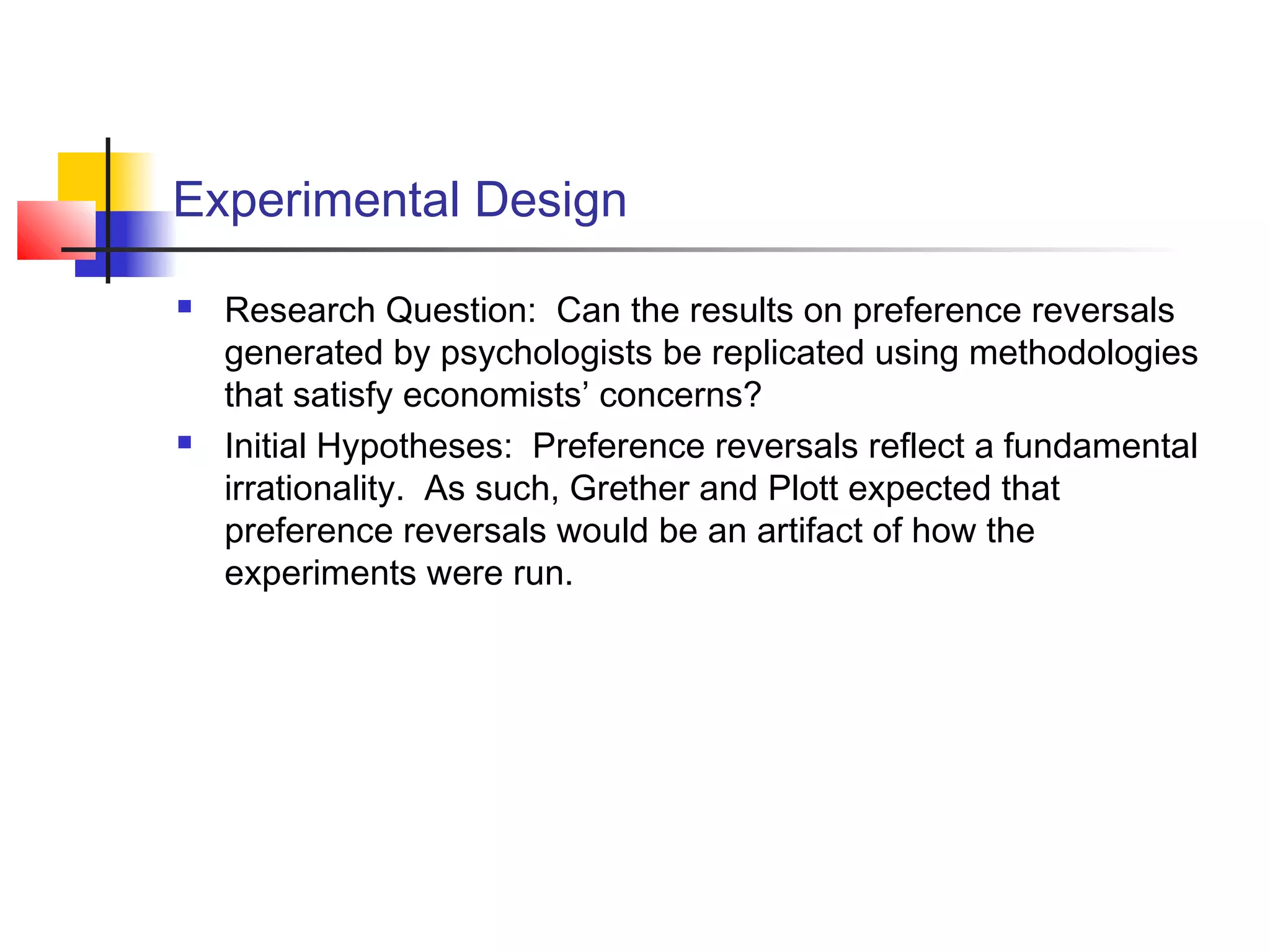
Experimental Design
 Research Question: Can the results on preference reversals
generated by psychologists be replicated using methodologies
that satisfy economists’ concerns?
 Initial Hypotheses: Preference reversals reflect a fundamental
irrationality. As such, Grether and Plott expected that
preference reversals would be an artifact of how the
experiments were run.
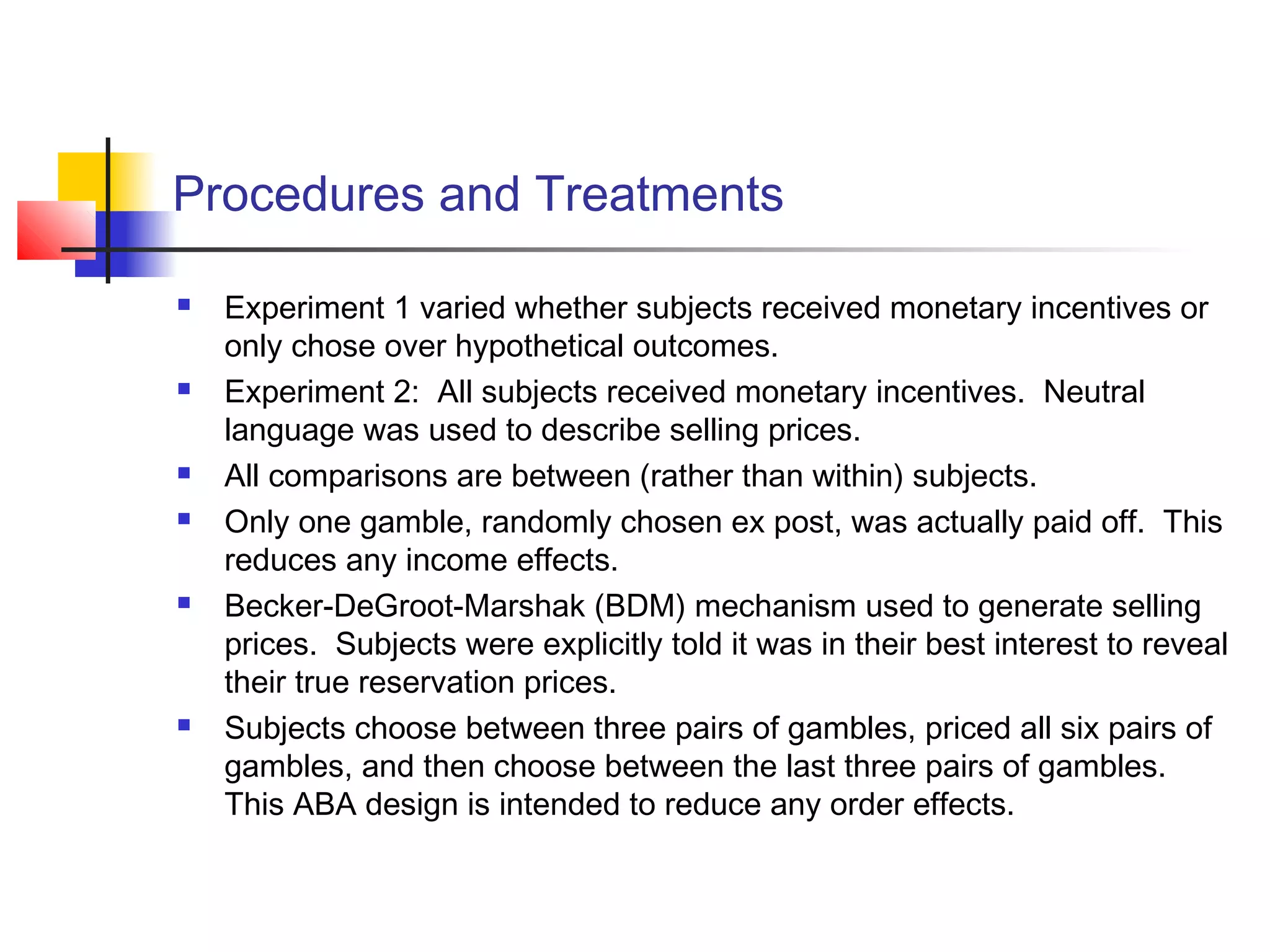
Procedures and Treatments
 Experiment 1 varied whether subjects received monetary incentives or
only chose over hypothetical outcomes.
 Experiment 2: All subjects received monetary incentives. Neutral
language was used to describe selling prices.
 All comparisons are between (rather than within) subjects.
 Only one gamble, randomly chosen ex post, was actually paid off. This
reduces any income effects.
 Becker-DeGroot-Marshak (BDM) mechanism used to generate selling
prices. Subjects were explicitly told it was in their best interest to reveal
their true reservation prices.
 Subjects choose between three pairs of gambles, priced all six pairs of
gambles, and then choose between the last three pairs of gambles.
This ABA design is intended to reduce any order effects.
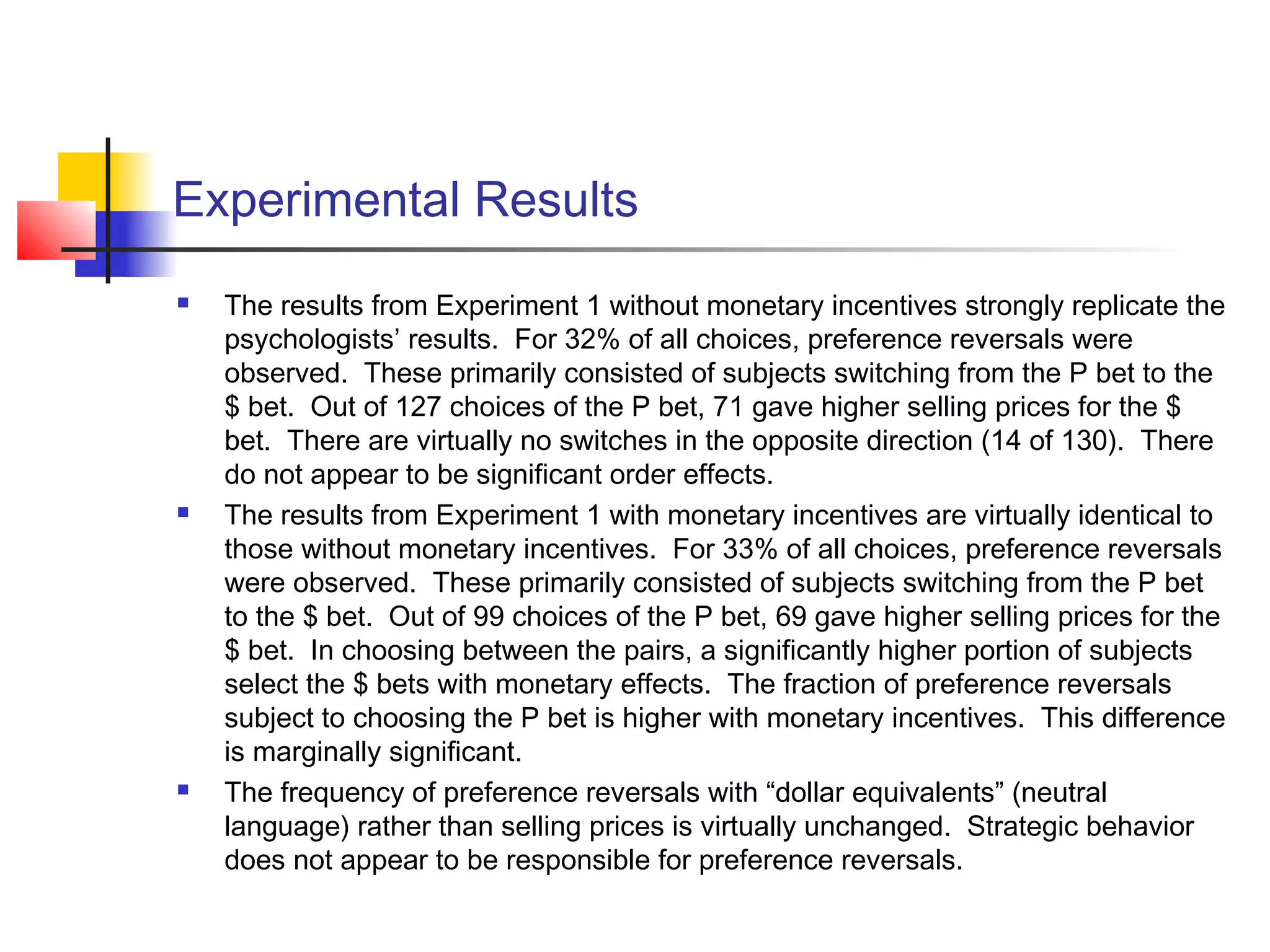
Experimental Results
 The results from Experiment 1 without monetary incentives strongly replicate the
psychologists’ results. For 32% of all choices, preference reversals were
observed. These primarily consisted of subjects switching from the P bet to the
$ bet. Out of 127 choices of the P bet, 71 gave higher selling prices for the $
bet. There are virtually no switches in the opposite direction (14 of 130). There
do not appear to be significant order effects.
 The results from Experiment 1 with monetary incentives are virtually identical to
those without monetary incentives. For 33% of all choices, preference reversals
were observed. These primarily consisted of subjects switching from the P bet
to the $ bet. Out of 99 choices of the P bet, 69 gave higher selling prices for the
$ bet. In choosing between the pairs, a significantly higher portion of subjects
select the $ bets with monetary effects. The fraction of preference reversals
subject to choosing the P bet is higher with monetary incentives. This difference
is marginally significant.
 The frequency of preference reversals with “dollar equivalents” (neutral
language) rather than selling prices is virtually unchanged. Strategic behavior
does not appear to be responsible for preference reversals.
Conclusion
 Preference reversals are an extremely robust
phenomenon! They hold up well to the main
objections raised by economists. This suggests a
fundamental flaw in the foundations of virtually all
economic theory.
New Explanations for Preference Reversals
 While Plott and Grether do better than the psychologists at offering subjects
monetary incentives express their true preferences, it may be that these
incentives still aren’t sufficiently large. Subsequent experiments find that
preference reversals are reduced by increased stakes, but still occur with
substantial frequency.
 Forcing subjects to be aware of the negative consequences of preference
reversals may eliminate the occurrence of such reversals. In other words,
subjects may be making a mistake that they can learn to avoid. Experiments
have been run in which subjects who express preference reversals are then
money pumped (ouch!). While this doesn’t reduce the frequency of reversals, it
does reduce the magnitude of reversals.
 More conservative (in the non-political sense) economists have argued that
market pressures will force subjects away from preference reversals. This
reflects the touching faith many economists have in the power of markets. While
the use of a market context reduces preference reversals, it does not eliminate
them. In general, most choice anomalies appear to be robust to market
pressures. People are very stubborn in their irrationality.
New Explanations for Preference Reversals
 For obscure theoretical reasons, the BDM mechanism may not elicit
truthful revelation of prices. The preference reversal results have been
replicated using other mechanisms that don’t have these theoretical
problems.
 The two leading explanation for preferences reversals that are still
standing are failures of transitivity and failures of procedural invariance.
Tversky and Thaler give a good summary of the compatibility
hypothesis, a leading explanation of why procedural invariance fails,
and experimental evidence in favor of it. These include a number of
treatments that don’t involve choice under uncertainty, suggesting that
preference reversals are part of a broader phenomenon. A number of
experiments have been run trying to determine if preference reversals
are due to intransitivity or failures of procedural invariance. The results
are ambiguous, but it appears that both causes play a substantial role.

Preference reversal

  • 1.
    Grether and Plott: EconomicTheory of Choice and the Preference Reversal Phenomenon Economics 328 Spring 2004
  • 2.
    What is aPreference Reversal?  Suppose I ask you to pick one of these two bets. The most common answer is to choose the P bet.  Suppose I ask you how much you would be willing to sell each of these gambles for. The most common outcome puts a higher price on the $ bet.  In other words, the preferences implied by the selling prices are often reversed from the stated preferences over the two gambles!!! Gamble 1 "P Bet" $4 $0 Gamble 2 "$ Bet" $0 $16
  • 3.
    What are PreferenceReversals?  The most fundamental assumptions of economic theory are the Axioms of Choice. These state that preferences are complete, reflexive, and transitive. Preference reversals are a violation of these fundamental assumptions. In particular, transitivity is violated.  In some fundamental sense, individuals who exhibit preference reversals are irrational. Such people can be turned into “money pumps.” This has been done successfully in laboratory experiments (Berg, Daley, Dickhaut, & O’Brien, 1985; Chu & Chu, 1990
  • 4.
    Why Might PreferenceReversals Occur?  Grether and Plott hypothesize the following reasons for why preference reversals might occur:  Misspecified Incentives: The theory only makes prediction for gamble over real known outcomes. Gambles over hypothetical payoffs or payoffs of unspecified value may not yield valid violations of the theory.  Income Effects: Expected utility theory is typically stated in term of the utility of wealth. If an individual chooses over identical gambles with differing initial levels of wealth, differing choices are not inconsistent with the theory. This suggests that we should expect differences between buying and selling, and that order effects can matter.  Strategic Responses: The language of buying and selling may cause people to behave strategically, even these responses aren’t sensible for the experimental setting. These may lead to “false” violations. These are a form of demand induced effect.
  • 5.
    Why Might PreferenceReversals Occur?  Anchoring and Adjustment: Many problems are multi-dimensional and must be evaluated over multiple aspects. In evaluating options, individuals first consider the most prominent aspect of the problem, using the value of this aspect as an “anchor.” They then adjust the value of the options using other aspects. As an empirical regularity, individuals seem to adjust inadequately for secondary aspects. This choice algorithm may be attributed to the presence of decision costs, ease of understanding and explaining the algorithm, or ease of justifying the algorithm. (See Tversky and Thaler’s explanation of the “compatibility hypothesis.”)  Confusion, Misunderstanding, and Unsophisticated Subjects: Grether and Plott admit they are being a bit paranoid on the first two counts – psychologists are pretty careful to write clear instructions and quiz subjects before gathering data. (Although there is some evidence that experience leads to less obviously irrational choices.) Grether and Plott also hypothesize that volunteers from economics and political science classes are more likely to make rational choices. The issue of using volunteers is an important one. As for being an economics major . . . well, if they choose to be economics majors, how rational can they be? 
  • 6.
    Experimental Design  ResearchQuestion: Can the results on preference reversals generated by psychologists be replicated using methodologies that satisfy economists’ concerns?  Initial Hypotheses: Preference reversals reflect a fundamental irrationality. As such, Grether and Plott expected that preference reversals would be an artifact of how the experiments were run.
  • 7.
    Procedures and Treatments Experiment 1 varied whether subjects received monetary incentives or only chose over hypothetical outcomes.  Experiment 2: All subjects received monetary incentives. Neutral language was used to describe selling prices.  All comparisons are between (rather than within) subjects.  Only one gamble, randomly chosen ex post, was actually paid off. This reduces any income effects.  Becker-DeGroot-Marshak (BDM) mechanism used to generate selling prices. Subjects were explicitly told it was in their best interest to reveal their true reservation prices.  Subjects choose between three pairs of gambles, priced all six pairs of gambles, and then choose between the last three pairs of gambles. This ABA design is intended to reduce any order effects.
  • 8.
    Experimental Results  Theresults from Experiment 1 without monetary incentives strongly replicate the psychologists’ results. For 32% of all choices, preference reversals were observed. These primarily consisted of subjects switching from the P bet to the $ bet. Out of 127 choices of the P bet, 71 gave higher selling prices for the $ bet. There are virtually no switches in the opposite direction (14 of 130). There do not appear to be significant order effects.  The results from Experiment 1 with monetary incentives are virtually identical to those without monetary incentives. For 33% of all choices, preference reversals were observed. These primarily consisted of subjects switching from the P bet to the $ bet. Out of 99 choices of the P bet, 69 gave higher selling prices for the $ bet. In choosing between the pairs, a significantly higher portion of subjects select the $ bets with monetary effects. The fraction of preference reversals subject to choosing the P bet is higher with monetary incentives. This difference is marginally significant.  The frequency of preference reversals with “dollar equivalents” (neutral language) rather than selling prices is virtually unchanged. Strategic behavior does not appear to be responsible for preference reversals.
  • 9.
    Conclusion  Preference reversalsare an extremely robust phenomenon! They hold up well to the main objections raised by economists. This suggests a fundamental flaw in the foundations of virtually all economic theory.
  • 10.
    New Explanations forPreference Reversals  While Plott and Grether do better than the psychologists at offering subjects monetary incentives express their true preferences, it may be that these incentives still aren’t sufficiently large. Subsequent experiments find that preference reversals are reduced by increased stakes, but still occur with substantial frequency.  Forcing subjects to be aware of the negative consequences of preference reversals may eliminate the occurrence of such reversals. In other words, subjects may be making a mistake that they can learn to avoid. Experiments have been run in which subjects who express preference reversals are then money pumped (ouch!). While this doesn’t reduce the frequency of reversals, it does reduce the magnitude of reversals.  More conservative (in the non-political sense) economists have argued that market pressures will force subjects away from preference reversals. This reflects the touching faith many economists have in the power of markets. While the use of a market context reduces preference reversals, it does not eliminate them. In general, most choice anomalies appear to be robust to market pressures. People are very stubborn in their irrationality.
  • 11.
    New Explanations forPreference Reversals  For obscure theoretical reasons, the BDM mechanism may not elicit truthful revelation of prices. The preference reversal results have been replicated using other mechanisms that don’t have these theoretical problems.  The two leading explanation for preferences reversals that are still standing are failures of transitivity and failures of procedural invariance. Tversky and Thaler give a good summary of the compatibility hypothesis, a leading explanation of why procedural invariance fails, and experimental evidence in favor of it. These include a number of treatments that don’t involve choice under uncertainty, suggesting that preference reversals are part of a broader phenomenon. A number of experiments have been run trying to determine if preference reversals are due to intransitivity or failures of procedural invariance. The results are ambiguous, but it appears that both causes play a substantial role.