Intermediate Macroeconomics
Chapter 10
Consumption and Savings
Intermediate Macroeconomics
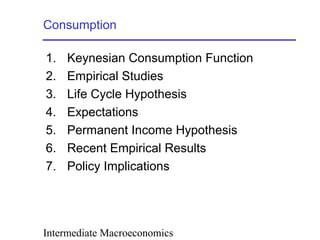
Consumption
1. Keynesian Consumption Function
2. Empirical Studies
3. Life Cycle Hypothesis
4. Expectations
5. Permanent Income Hypothesis
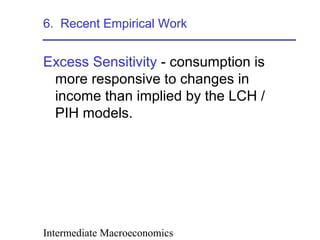
6. Recent Empirical Results
7. Policy Implications
Intermediate Macroeconomics
1. Keynesian Consumption Function
• C = C0 + c * Y
• Only current period income determines level of
consumption
• Marginal Propensity to Consume (MPC):
Constant at all levels of income
• Average Propensity to Consume (APC):
Declines as income increases
Intermediate Macroeconomics
1. Keynesian Consumption Function
Average propensity to consume
• APC = Total Consumption
Total Income
• APC = C(t) = C0 + c  Y(t) = C0 + c
Y(t) Y(t) Y(t)
• As income increases
• C0 / Y(t) gets smaller
• c (marginal propensity to consume) is
constant
• APC gets smaller
Intermediate Macroeconomics
1. Keynesian Consumption Function
Average propensity to consume
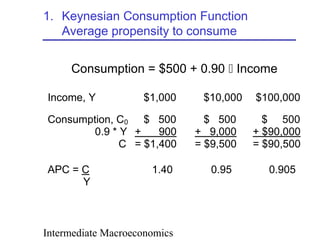
Income, Y $1,000 $10,000 $100,000
Consumption, C0
0.9 * Y
C
$ 500
+ 900
= $1,400
$ 500
+ 9,000
= $9,500
$ 500
+ $90,000
= $90,500
APC = C
Y
1.40 0.95 0.905
Consumption = $500 + 0.90  Income
Intermediate Macroeconomics
2. Empirical Studies
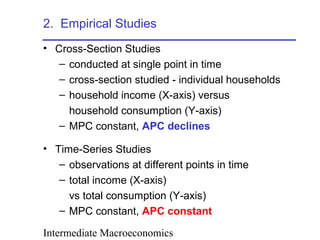
• Cross-Section Studies
– conducted at single point in time
– cross-section studied - individual households
– household income (X-axis) versus
household consumption (Y-axis)
– MPC constant, APC declines
• Time-Series Studies
– observations at different points in time
– total income (X-axis)
vs total consumption (Y-axis)
– MPC constant, APC constant
Intermediate Macroeconomics
2. Empirical Studies
Cross section – consumption vs income
$0
$20,000
$40,000
$60,000
$80,000
$100,000
$0 $20,000 $40,000 $60,000 $80,000 $100,000 $120,000
Annual After-tax Income
AnnualAverageExpenditures
Regression line:
Consumption = 15,444 + 0.580 * Income
U.S. Consumer Expenditure Survey, 2002
Source: U.S. Bureau of Labor Statistics
http://www.bls.gov/cex/home.htm
Marginal propensity to consume (slope) is constant
Intermediate Macroeconomics
2. Empirical Studies
Cross section - average propensity to consume
0
2
4
6
8
10
12
14
$0 $20,000 $40,000 $60,000 $80,000 $100,000 $120,000
Annual after-tax income
APC=Expenditures/After-Tax
Income
Source: U.S. Bureau of Economic Analysis
http://www.bea.gov/bea/dn/nipaweb/index.asp
Average propensity to consume is declining
Intermediate Macroeconomics
2. Empirical Studies
Time series - consumption vs income
$0
$1,000
$2,000
$3,000
$4,000
$5,000
$6,000
$7,000
$8,000
$0 $2,000 $4,000 $6,000 $8,000
U.S. Annual Nominal Personal Disposable
Income, billions of dollars
U.S.AnnualNominalConsumption
Expenditures,billionsofdollars
2002
1953
U.S. Aggregate Consumption and Income, 1953 - 2002
Source: U.S. Bureau of Economic Analysis
http://www.bea.gov/bea/dn/nipaweb/index.asp
Regression line:
Consumption = - 55.4 + 0.930 * Income
Marginal propensity to consume (slope) is constant
Intermediate Macroeconomics
2. Empirical Studies
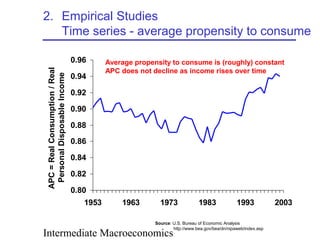
Time series - average propensity to consume
0.80
0.82
0.84
0.86
0.88
0.90
0.92
0.94
0.96
1953 1963 1973 1983 1993 2003
APC=RealConsumption/Real
PersonalDisposableIncome
Source: U.S. Bureau of Economic Analysis
http://www.bea.gov/bea/dn/nipaweb/index.asp
Average propensity to consume is (roughly) constant
APC does not decline as income rises over time
Intermediate Macroeconomics
3. Life-Cycle Hypothesis
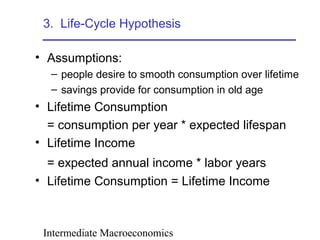
• Assumptions:
– people desire to smooth consumption over lifetime
– savings provide for consumption in old age
• Lifetime Consumption
= consumption per year * expected lifespan
• Lifetime Income
= expected annual income * labor years
• Lifetime Consumption = Lifetime Income
Intermediate Macroeconomics
3. Life Cycle Hypothesis
Simple model
Base Case
Year 1 2 3 4 5 6 Totals
Income 15 15 15 15 0 0 60
Consumption 10 10 10 10 10 10 60
Savings 5 5 5 5 -10 -10 0
• Consumption is based on current wealth
and total lifetime earnings
• Consumption is smoothed over lifetime
Intermediate Macroeconomics
3. Life Cycle Hypothesis
Simple model
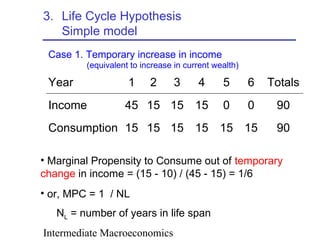
Case 1. Temporary increase in income
(equivalent to increase in current wealth)
Year 1 2 3 4 5 6 Totals
Income 45 15 15 15 0 0 90
Consumption 15 15 15 15 15 15 90
• Marginal Propensity to Consume out of temporary
change in income = (15 - 10) / (45 - 15) = 1/6
• or, MPC = 1 / NL
NL = number of years in life span
Intermediate Macroeconomics
3. Life Cycle Hypothesis
Simple model
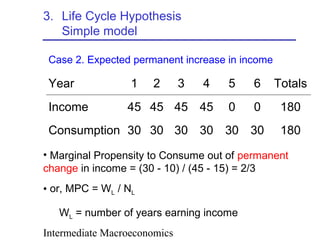
Case 2. Expected permanent increase in income
Year 1 2 3 4 5 6 Totals
Income 45 45 45 45 0 0 180
Consumption 30 30 30 30 30 30 180
• Marginal Propensity to Consume out of permanent
change in income = (30 - 10) / (45 - 15) = 2/3
• or, MPC = WL / NL
WL = number of years earning income
Intermediate Macroeconomics
3. Life Cycle Hypothesis
Simple model results
Temporary change in income
– Base case -> Case 1
– MPC = 1/NL, constant for any size
temporary change in income.
– APC declines as temporary change in
income becomes larger.
• Base case, year 1, APC = C/Y = 10/15
• Case 1, year 1, APC = C/Y = 15/45
Intermediate Macroeconomics
3. Life Cycle Hypothesis
Simple model results
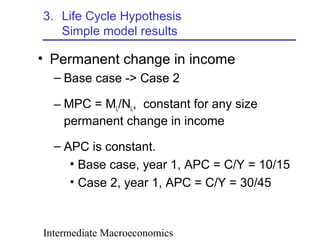
• Permanent change in income
– Base case -> Case 2
– MPC = ML/NL, constant for any size
permanent change in income
– APC is constant.
• Base case, year 1, APC = C/Y = 10/15
• Case 2, year 1, APC = C/Y = 30/45
Intermediate Macroeconomics
4. Expectations
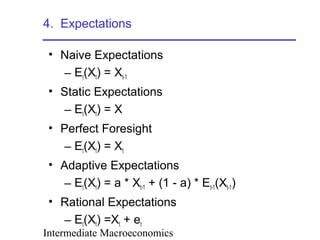
• Naive Expectations
– Et(Xt) = Xt-1
• Static Expectations
– Et(Xt) = X
• Perfect Foresight
– Et(Xt) = Xt
• Adaptive Expectations
– Et(Xt) = a * Xt-1 + (1 - a) * Et-1(Xt-1)
• Rational Expectations
– Et(Xt) =Xt + et
Intermediate Macroeconomics
5. Permanent Income Hypothesis
• LCH Model
• Incorporates adaptive expectations to
explain how expectations of future income
are formed
• Current changes in income are considered
to be permanent based on:
YP = Y(t-1) + a  [Y(t) - Y(t-1)]
• Consumption = c  YP
Intermediate Macroeconomics
6. Recent Empirical Work
Excess Sensitivity - consumption is
more responsive to changes in
income than implied by the LCH /
PIH models.
Intermediate Macroeconomics
6. Recent Empirical Work
Excess sensitivity explanations
• Durable goods are “lumpy”
• Purchase of durable goods doesn’t
represent Consumption represented by
theory. Consumption of a durable goods
extends over the lifetime of the good.
• Liquidity Constraints
• Precautionary Savings Motive
• Adaptive or Rational Expectations don’t
hold. People don’t forecast and don’t save
for retirement
Intermediate Macroeconomics
7. Policy Implications
• Temporary Tax Changes
• Ricardian Equivalence
• Higher Interest Rates
• Social Security

Ch10ppt

  • 1.
  • 2.
    Intermediate Macroeconomics Consumption 1. KeynesianConsumption Function 2. Empirical Studies 3. Life Cycle Hypothesis 4. Expectations 5. Permanent Income Hypothesis 6. Recent Empirical Results 7. Policy Implications
  • 3.
    Intermediate Macroeconomics 1. KeynesianConsumption Function • C = C0 + c * Y • Only current period income determines level of consumption • Marginal Propensity to Consume (MPC): Constant at all levels of income • Average Propensity to Consume (APC): Declines as income increases
  • 4.
    Intermediate Macroeconomics 1. KeynesianConsumption Function Average propensity to consume • APC = Total Consumption Total Income • APC = C(t) = C0 + c  Y(t) = C0 + c Y(t) Y(t) Y(t) • As income increases • C0 / Y(t) gets smaller • c (marginal propensity to consume) is constant • APC gets smaller
  • 5.
    Intermediate Macroeconomics 1. KeynesianConsumption Function Average propensity to consume Income, Y $1,000 $10,000 $100,000 Consumption, C0 0.9 * Y C $ 500 + 900 = $1,400 $ 500 + 9,000 = $9,500 $ 500 + $90,000 = $90,500 APC = C Y 1.40 0.95 0.905 Consumption = $500 + 0.90  Income
  • 6.
    Intermediate Macroeconomics 2. EmpiricalStudies • Cross-Section Studies – conducted at single point in time – cross-section studied - individual households – household income (X-axis) versus household consumption (Y-axis) – MPC constant, APC declines • Time-Series Studies – observations at different points in time – total income (X-axis) vs total consumption (Y-axis) – MPC constant, APC constant
  • 7.
    Intermediate Macroeconomics 2. EmpiricalStudies Cross section – consumption vs income $0 $20,000 $40,000 $60,000 $80,000 $100,000 $0 $20,000 $40,000 $60,000 $80,000 $100,000 $120,000 Annual After-tax Income AnnualAverageExpenditures Regression line: Consumption = 15,444 + 0.580 * Income U.S. Consumer Expenditure Survey, 2002 Source: U.S. Bureau of Labor Statistics http://www.bls.gov/cex/home.htm Marginal propensity to consume (slope) is constant
  • 8.
    Intermediate Macroeconomics 2. EmpiricalStudies Cross section - average propensity to consume 0 2 4 6 8 10 12 14 $0 $20,000 $40,000 $60,000 $80,000 $100,000 $120,000 Annual after-tax income APC=Expenditures/After-Tax Income Source: U.S. Bureau of Economic Analysis http://www.bea.gov/bea/dn/nipaweb/index.asp Average propensity to consume is declining
  • 9.
    Intermediate Macroeconomics 2. EmpiricalStudies Time series - consumption vs income $0 $1,000 $2,000 $3,000 $4,000 $5,000 $6,000 $7,000 $8,000 $0 $2,000 $4,000 $6,000 $8,000 U.S. Annual Nominal Personal Disposable Income, billions of dollars U.S.AnnualNominalConsumption Expenditures,billionsofdollars 2002 1953 U.S. Aggregate Consumption and Income, 1953 - 2002 Source: U.S. Bureau of Economic Analysis http://www.bea.gov/bea/dn/nipaweb/index.asp Regression line: Consumption = - 55.4 + 0.930 * Income Marginal propensity to consume (slope) is constant
  • 10.
    Intermediate Macroeconomics 2. EmpiricalStudies Time series - average propensity to consume 0.80 0.82 0.84 0.86 0.88 0.90 0.92 0.94 0.96 1953 1963 1973 1983 1993 2003 APC=RealConsumption/Real PersonalDisposableIncome Source: U.S. Bureau of Economic Analysis http://www.bea.gov/bea/dn/nipaweb/index.asp Average propensity to consume is (roughly) constant APC does not decline as income rises over time
  • 11.
    Intermediate Macroeconomics 3. Life-CycleHypothesis • Assumptions: – people desire to smooth consumption over lifetime – savings provide for consumption in old age • Lifetime Consumption = consumption per year * expected lifespan • Lifetime Income = expected annual income * labor years • Lifetime Consumption = Lifetime Income
  • 12.
    Intermediate Macroeconomics 3. LifeCycle Hypothesis Simple model Base Case Year 1 2 3 4 5 6 Totals Income 15 15 15 15 0 0 60 Consumption 10 10 10 10 10 10 60 Savings 5 5 5 5 -10 -10 0 • Consumption is based on current wealth and total lifetime earnings • Consumption is smoothed over lifetime
  • 13.
    Intermediate Macroeconomics 3. LifeCycle Hypothesis Simple model Case 1. Temporary increase in income (equivalent to increase in current wealth) Year 1 2 3 4 5 6 Totals Income 45 15 15 15 0 0 90 Consumption 15 15 15 15 15 15 90 • Marginal Propensity to Consume out of temporary change in income = (15 - 10) / (45 - 15) = 1/6 • or, MPC = 1 / NL NL = number of years in life span
  • 14.
    Intermediate Macroeconomics 3. LifeCycle Hypothesis Simple model Case 2. Expected permanent increase in income Year 1 2 3 4 5 6 Totals Income 45 45 45 45 0 0 180 Consumption 30 30 30 30 30 30 180 • Marginal Propensity to Consume out of permanent change in income = (30 - 10) / (45 - 15) = 2/3 • or, MPC = WL / NL WL = number of years earning income
  • 15.
    Intermediate Macroeconomics 3. LifeCycle Hypothesis Simple model results Temporary change in income – Base case -> Case 1 – MPC = 1/NL, constant for any size temporary change in income. – APC declines as temporary change in income becomes larger. • Base case, year 1, APC = C/Y = 10/15 • Case 1, year 1, APC = C/Y = 15/45
  • 16.
    Intermediate Macroeconomics 3. LifeCycle Hypothesis Simple model results • Permanent change in income – Base case -> Case 2 – MPC = ML/NL, constant for any size permanent change in income – APC is constant. • Base case, year 1, APC = C/Y = 10/15 • Case 2, year 1, APC = C/Y = 30/45
  • 17.
    Intermediate Macroeconomics 4. Expectations •Naive Expectations – Et(Xt) = Xt-1 • Static Expectations – Et(Xt) = X • Perfect Foresight – Et(Xt) = Xt • Adaptive Expectations – Et(Xt) = a * Xt-1 + (1 - a) * Et-1(Xt-1) • Rational Expectations – Et(Xt) =Xt + et
  • 18.
    Intermediate Macroeconomics 5. PermanentIncome Hypothesis • LCH Model • Incorporates adaptive expectations to explain how expectations of future income are formed • Current changes in income are considered to be permanent based on: YP = Y(t-1) + a  [Y(t) - Y(t-1)] • Consumption = c  YP
  • 19.
    Intermediate Macroeconomics 6. RecentEmpirical Work Excess Sensitivity - consumption is more responsive to changes in income than implied by the LCH / PIH models.
  • 20.
    Intermediate Macroeconomics 6. RecentEmpirical Work Excess sensitivity explanations • Durable goods are “lumpy” • Purchase of durable goods doesn’t represent Consumption represented by theory. Consumption of a durable goods extends over the lifetime of the good. • Liquidity Constraints • Precautionary Savings Motive • Adaptive or Rational Expectations don’t hold. People don’t forecast and don’t save for retirement
  • 21.
    Intermediate Macroeconomics 7. PolicyImplications • Temporary Tax Changes • Ricardian Equivalence • Higher Interest Rates • Social Security

Editor's Notes

  • #15 Inheritance - repeat cases but add 7th period of consumption fixed at amount of desired bequest. While consumption per year is reduced, the MPCs should not be affected for a given fixed level of inheritance.
  • #16 Cross-Section Income characterized by differences in temporary income change. Highest income brackets have largest proportion with temporary increases in income. Vice versa for lowest income brackets MPC out of temporary income constant across the income distribution. APC will decline as income increases and temporary increases in income rise. Repeat Case 1 with a larger temporary increase in income. Time Series In any given year temporary increases in income offset temporary declines. MPC out of permanent changes in income are constant APC will appear to be constant. Compare APC in Base Case to Case 2.
  • #17 Cross-Section Income characterized by differences in temporary income change. Highest income brackets have largest proportion with temporary increases in income. Vice versa for lowest income brackets MPC out of temporary income constant across the income distribution. APC will decline as income increases and temporary increases in income rise. Repeat Case 1 with a larger temporary increase in income. Time Series In any given year temporary increases in income offset temporary declines. MPC out of permanent changes in income are constant APC will appear to be constant. Compare APC in Base Case to Case 2.
  • #18 Naïve - expectations of some human behavior (criminal recidivism) Static – weather, Keynes prices Perfect Foresight - the Sun will rise in the East
  • #21 ”Lumpy” durable goods. Expensive items like a car or furniture require large payments that cannot be made until a large (even temporary) increase in income is realized. Consumption reported in GDP accounts and used in empirical studies does not correspond to the theoretical meaning of consumption. The purchase of a durable good (e.g., car or furniture) today represents consumption today in the GDP accounts, but actually represents consumption over the usable life of the product in economic theory. Imperfect credit markets (liquidity constraints). At low levels of income (students, recessions) people cannot borrow money to maintain smooth consumption. Consumption smoothing is not only motive - also precautionary savings motive that is not reflected in model. Introduces additional interesting explanations of consumption that reflect uncertainty of future. Adaptive or rational expectations don't hold. Consumers are myopic. Consumption responds fully to changes in income.
  • #22 Do announced temporary tax cuts or tax increases affect the economy as Keynes suggested? Probably not. According to the LCH/PIH, the current year's change in consumption due to a temporary change in income from a tax cut or increase is small (i.e., the MPC and the multiplier are much smaller than Keynes believed.) Will a tax cut financed by government borrowing stimulate total demand (another Keynesian belief)? Maybe not Government will someday have to pay off debt. Future tax increase expected. Private savings increase by the full amount of the tax cut with the expectation that the savings will be required to pay off a future tax increase to pay off the debt. Do higher interest rates lead to higher savings and lower consumption? Maybe not. Higher interest rate means current wealth will be worth more in future. Consume some of that additional future wealth today Does government Social Security program lead to higher national savings rate? Maybe not. If no liquidity constraints, higher savings rate forced by government (Social Security) may be offset $-for-$ by lower personal savings rate