
Predictive Analytics
&
Predictive Modelling
What is Predictive Modelling
 Predictive analytics is the branch of the advanced analytics which is used to
make predictions about unknown future events. Predictive analytics uses
many techniques from data mining, statistics, modeling, machine learning,
and artificial intelligence to analyze current data to make predictions
about future.
 Predictive modeling is a process used in predictive analytics to create a
statistical model of future behavior. Predictive analytics is the area of data
mining concerned with forecasting probabilities and trends.
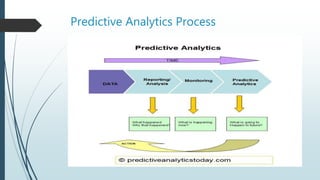
Predictive Analytics Process
Business process and features on Predictive
Modelling
 Business process on Predicting modelling
 Creating the model
 Testing the model
 Validating the model
 Evaluating the model
 Features in Predicting modelling
 Data analysis and manipulation
 Visualization
 Statistics
 Hypothesis testing
How the model work
 In predictive modeling, data is collected for the relevant predictors, a
statistical model is formulated, predictions are made and the model is
validated (or revised) as additional data becomes available. The model
may employ a simple linear equation or a complex neural network,
mapped out by sophisticated software.
How the model work(cont.)
 Here you will learn what a predictive model is, and how, by actively guiding
marketing campaigns, it constitutes a key form of business intelligence. we'll take a
look inside to see how a model works-
1. Predictors Rank Your Customers to Guide Your Marketing
2. Combined Predictors Means Smarter Rankings
3. The Computer Makes Your Model from Your Customer Data
4. A Simple Curve Shows How Well Your Model Works
5. Conclusions
Why Predictive Modelling
Nearly every business in competitive markets will eventually need to do predictive
modeling to remain ahead of the curve. Predicting Modeling (also known as
Predictive Analytics) is the process of automatically detecting patterns in data, then
using those patterns to foretell some event. Predictive models are commonly built to
predict:
 Customer Relationship Management
 the chance a prospect will respond to an ad
 Mail recipients likely to buy
 when a customer is likely to churn
 if a person is likely to get sick
 Portfolio or Product Prediction
 Risk Management & Pricing
Some Predictive Models
Ideally, these techniques are widely used:
• Linear regression
• Logistic regression
• Regression with regularization
• Neural networks
• Support vector machines
• Naive Bayes models
• K-nearest-neighbors classification
• Decision trees
• Ensembles of trees
• Gradient boosting
Applications of Predictive Modelling
 Analytical customer relationship management (CRM)
 Health Care
 Collection Analytics
 Cross-cell
 Fraud detection
 Risk management
 Industry Applications
Predictive modelling are used in insurance, banking, marketing, financial
services, telecommunications, retail, travel, healthcare, oil & gas and other
industries.
Predictive Models in Retail industry
 Campaign Response Model – this model predicts the
likelihood that a customer responds to a specific campaign by
purchasing a products solicited in the campaign. The model
also predicts the amount of the purchase given response.
 Regression models
 Customer Segmentation
 Cross-Sell and Upsell
 New Product Recommendation
 Customer Retention/Loyalty/Churn
 Inventory Management
Predictive Models in Telecom industry
 Campaign analytics
Based on historical data and customer profiles, it is possible to classify customers according
to their likelihood of buying a product or a service through a campaign. Thus, every
campaign can target the set of customers with better purchasing potential for that
service/product. While these statistics-driven campaigns yield higher ROI, they also reduce
the irritation caused by non-relevant communication, thereby indirectly reducing customer
dissonance.
 Churn modeling
The customers leaving the current company and moving to another telecom company are
called churn and it can be reduced by analyzing the past history of the potential customers
systematically.
 Cross-selling and up-selling
A very real challenge in the telecom industry is how to increase yield from the current
subscribers, or how to improve Average Revenue per User (ARPU).Cross-selling and up-
selling activities can now be supported by predictive analytics, while drawing on association
rules and transaction histories. Analytics driven cross-selling and up-selling campaigns
provide remarkably higher returns.
 Customer lifetime value analytics
The Customer Lifetime Value model provides the predicted yield from each customer
over the customer life cycle. High priority customers can be given loyalty bonuses,
preferential treatment through personalized service, better credit norms for contract
subscribers etc. This analytics model may be utilized across all the functions like
marketing, credit Risk, customer service and so on.
 Customer segmentation
Customers are segmented both at the pre-subscription and subscription phases. At
the first stage, segmentation helps reach out to prospects with higher predicted
conversion rates, thereby increasing the campaign success rate as well as the ROI.
During campaigns, subscribers are divided into segments to which specific campaigns
are targeted.
 Marketing spend optimization
A Marketing Spend Optimization model helps marketing managers and product
managers take decisions based on what works and what does not. This analytics model
has been of considerable benefit to the marketing function, and is hence widely used
to improve marketing Return on Investment (ROI).
 Fraud analytics
Data synthesis can help telecom service providers (TSPs) navigate their complex
organizational structures and target and collect relevant fraud data when the need
arises.
 Provide future-proof detection techniques
 Guard against habitual offenders
 Ensure that pre-paid service is truly risk free
 Launch profitable IP-based services
 Network optimization
Network management is possibly be the most complex operation in a telecom
company, the size of the investment decisions and the cost of a failure in terms of
customer perception. Predictive analytics help forecast traffic patterns and peak period
routing, and is thus of immense benefit in the smooth running of network operations.
Analytics can ensure that network operations are run as pro-actively and scientifically,
taking cognizance of changing traffic patterns.
 Price optimization
Price optimization contributes significantly to revenue development and profitability
and is especially important in the corporate sales segment, where awareness of the
impact of the various pricing options offered is critical. Simulated scenarios can help
evaluate the revenues at various price points. These models are widely used by
product managers and finance teams.
 Sales territory optimization
optimization of sales territories is necessary to align and balance workload and market
potential. the focus of the model is usually on how to reach the markets efficiently, this
model is used mainly for revenue and workload allocation activities. It’s also
extensively used for allocation of territory for managing operations, among channel
intermediaries in pre-pay business units.
Predictive Analytics Software
 SAS Analytics
 R
 STATISTICA
 IBM Predictive Analytics
 MATLAB
 Minitab
Thank you

Predictive modelling

  • 1.
  • 2.
    What is PredictiveModelling  Predictive analytics is the branch of the advanced analytics which is used to make predictions about unknown future events. Predictive analytics uses many techniques from data mining, statistics, modeling, machine learning, and artificial intelligence to analyze current data to make predictions about future.  Predictive modeling is a process used in predictive analytics to create a statistical model of future behavior. Predictive analytics is the area of data mining concerned with forecasting probabilities and trends.
  • 3.
  • 4.
    Business process andfeatures on Predictive Modelling  Business process on Predicting modelling  Creating the model  Testing the model  Validating the model  Evaluating the model  Features in Predicting modelling  Data analysis and manipulation  Visualization  Statistics  Hypothesis testing
  • 5.
    How the modelwork  In predictive modeling, data is collected for the relevant predictors, a statistical model is formulated, predictions are made and the model is validated (or revised) as additional data becomes available. The model may employ a simple linear equation or a complex neural network, mapped out by sophisticated software.
  • 6.
    How the modelwork(cont.)  Here you will learn what a predictive model is, and how, by actively guiding marketing campaigns, it constitutes a key form of business intelligence. we'll take a look inside to see how a model works- 1. Predictors Rank Your Customers to Guide Your Marketing 2. Combined Predictors Means Smarter Rankings 3. The Computer Makes Your Model from Your Customer Data 4. A Simple Curve Shows How Well Your Model Works 5. Conclusions
  • 7.
    Why Predictive Modelling Nearlyevery business in competitive markets will eventually need to do predictive modeling to remain ahead of the curve. Predicting Modeling (also known as Predictive Analytics) is the process of automatically detecting patterns in data, then using those patterns to foretell some event. Predictive models are commonly built to predict:  Customer Relationship Management  the chance a prospect will respond to an ad  Mail recipients likely to buy  when a customer is likely to churn  if a person is likely to get sick  Portfolio or Product Prediction  Risk Management & Pricing
  • 8.
    Some Predictive Models Ideally,these techniques are widely used: • Linear regression • Logistic regression • Regression with regularization • Neural networks • Support vector machines • Naive Bayes models • K-nearest-neighbors classification • Decision trees • Ensembles of trees • Gradient boosting
  • 9.
    Applications of PredictiveModelling  Analytical customer relationship management (CRM)  Health Care  Collection Analytics  Cross-cell  Fraud detection  Risk management  Industry Applications Predictive modelling are used in insurance, banking, marketing, financial services, telecommunications, retail, travel, healthcare, oil & gas and other industries.
  • 10.
    Predictive Models inRetail industry  Campaign Response Model – this model predicts the likelihood that a customer responds to a specific campaign by purchasing a products solicited in the campaign. The model also predicts the amount of the purchase given response.  Regression models  Customer Segmentation  Cross-Sell and Upsell  New Product Recommendation  Customer Retention/Loyalty/Churn  Inventory Management
  • 11.
    Predictive Models inTelecom industry  Campaign analytics Based on historical data and customer profiles, it is possible to classify customers according to their likelihood of buying a product or a service through a campaign. Thus, every campaign can target the set of customers with better purchasing potential for that service/product. While these statistics-driven campaigns yield higher ROI, they also reduce the irritation caused by non-relevant communication, thereby indirectly reducing customer dissonance.  Churn modeling The customers leaving the current company and moving to another telecom company are called churn and it can be reduced by analyzing the past history of the potential customers systematically.  Cross-selling and up-selling A very real challenge in the telecom industry is how to increase yield from the current subscribers, or how to improve Average Revenue per User (ARPU).Cross-selling and up- selling activities can now be supported by predictive analytics, while drawing on association rules and transaction histories. Analytics driven cross-selling and up-selling campaigns provide remarkably higher returns.
  • 12.
     Customer lifetimevalue analytics The Customer Lifetime Value model provides the predicted yield from each customer over the customer life cycle. High priority customers can be given loyalty bonuses, preferential treatment through personalized service, better credit norms for contract subscribers etc. This analytics model may be utilized across all the functions like marketing, credit Risk, customer service and so on.  Customer segmentation Customers are segmented both at the pre-subscription and subscription phases. At the first stage, segmentation helps reach out to prospects with higher predicted conversion rates, thereby increasing the campaign success rate as well as the ROI. During campaigns, subscribers are divided into segments to which specific campaigns are targeted.  Marketing spend optimization A Marketing Spend Optimization model helps marketing managers and product managers take decisions based on what works and what does not. This analytics model has been of considerable benefit to the marketing function, and is hence widely used to improve marketing Return on Investment (ROI).
  • 13.
     Fraud analytics Datasynthesis can help telecom service providers (TSPs) navigate their complex organizational structures and target and collect relevant fraud data when the need arises.  Provide future-proof detection techniques  Guard against habitual offenders  Ensure that pre-paid service is truly risk free  Launch profitable IP-based services  Network optimization Network management is possibly be the most complex operation in a telecom company, the size of the investment decisions and the cost of a failure in terms of customer perception. Predictive analytics help forecast traffic patterns and peak period routing, and is thus of immense benefit in the smooth running of network operations. Analytics can ensure that network operations are run as pro-actively and scientifically, taking cognizance of changing traffic patterns.
  • 14.
     Price optimization Priceoptimization contributes significantly to revenue development and profitability and is especially important in the corporate sales segment, where awareness of the impact of the various pricing options offered is critical. Simulated scenarios can help evaluate the revenues at various price points. These models are widely used by product managers and finance teams.  Sales territory optimization optimization of sales territories is necessary to align and balance workload and market potential. the focus of the model is usually on how to reach the markets efficiently, this model is used mainly for revenue and workload allocation activities. It’s also extensively used for allocation of territory for managing operations, among channel intermediaries in pre-pay business units.
  • 15.
    Predictive Analytics Software SAS Analytics  R  STATISTICA  IBM Predictive Analytics  MATLAB  Minitab
  • 16.