Predictive Analytics
Sayantini Biswas
Predictive Analytics-Introduction
Predictive analytics is a form of advanced analytics that uses both new
and historical data to forecast activity, behaviour and trends.
How it works?
• Uses many techniques from data mining, statistics, machine learning &
artificial intelligence to analyze current data to make predictions about
future.
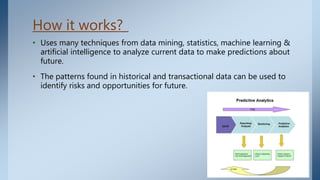
• The patterns found in historical and transactional data can be used to
identify risks and opportunities for future.
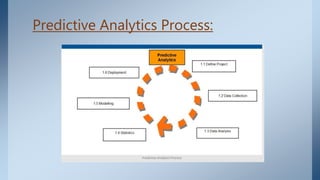
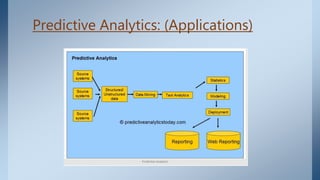
Predictive Analytics Process:
Predictive Analytics Process: (Contd.)
• Define Project:
Define the project outcomes, deliverables, scoping of the effort, business objectives, identify the data sets which are going to
be used.
• Data Collection:
Data mining for predictive analytics prepares data from multiple sources for analytics. This provides a complete view of
customer interactions.
• Data analysis:
Data analysis is the process of inspecting ,cleaning, transforming, and modelling data with the objective of discoverable
useful information, arriving at conclusions.
• Statistics:
Statistical Analysis enables to validate the assumptions, hypothesis and test them with using standard statistical models.
Predictive Analytics Process: (Contd.)
• Modelling:
Predictive modelling provides the ability to automatically create accurate predictive models about future.
• Deployment:
Predictive model deployment provides the option to deploy the analytical results in to the everyday decision making process
to get results.
• Model Monitoring:
Models are monitored and managed to review the model performance to endure that it is providing the results expected.
Predictive Analytics: (Applications)
• Customer Relationship Management
• Health care
• Collection Analytics
• Cross sell
• Fraud detection
• Risk management
• Direct Marketing
• Underwriting
Predictive Analytics: (Applications)
Predictive analytics techniques that typically are applied:
• Descriptive: This technique summarizes what has happened in the
past and attempts to analyse and characterize it.
• Correlation. Users can do correlation analysis to identify relationships
and dependencies between different data variables to predict how
they'll affect one another going forward.
• Segmentation. This technique is a way to analyze a large collection of
entity data, such as a customer database, and organize it into smaller
groups.
Predictive analytics techniques that typically are applied:
• Regression. This technique is designed to identify meaningful
relationships among data variables, specifically looking at the
connections between a dependent variable and other factors that may
or may not affect it.
• Association. One more technique for highlighting relationships
between data elements for predictive purposes is to look for ones that
demonstrate affinity.
• Classification. Another means of separating different entities in a data
set into related groups is to map them into predefined categories
based on relevant characteristics or behaviours.
THANK YOU

Predictive analytics

  • 1.
  • 2.
    Predictive Analytics-Introduction Predictive analyticsis a form of advanced analytics that uses both new and historical data to forecast activity, behaviour and trends.
  • 3.
    How it works? •Uses many techniques from data mining, statistics, machine learning & artificial intelligence to analyze current data to make predictions about future. • The patterns found in historical and transactional data can be used to identify risks and opportunities for future.
  • 4.
  • 5.
    Predictive Analytics Process:(Contd.) • Define Project: Define the project outcomes, deliverables, scoping of the effort, business objectives, identify the data sets which are going to be used. • Data Collection: Data mining for predictive analytics prepares data from multiple sources for analytics. This provides a complete view of customer interactions. • Data analysis: Data analysis is the process of inspecting ,cleaning, transforming, and modelling data with the objective of discoverable useful information, arriving at conclusions. • Statistics: Statistical Analysis enables to validate the assumptions, hypothesis and test them with using standard statistical models.
  • 6.
    Predictive Analytics Process:(Contd.) • Modelling: Predictive modelling provides the ability to automatically create accurate predictive models about future. • Deployment: Predictive model deployment provides the option to deploy the analytical results in to the everyday decision making process to get results. • Model Monitoring: Models are monitored and managed to review the model performance to endure that it is providing the results expected.
  • 7.
    Predictive Analytics: (Applications) •Customer Relationship Management • Health care • Collection Analytics • Cross sell • Fraud detection • Risk management • Direct Marketing • Underwriting
  • 8.
  • 9.
    Predictive analytics techniquesthat typically are applied: • Descriptive: This technique summarizes what has happened in the past and attempts to analyse and characterize it. • Correlation. Users can do correlation analysis to identify relationships and dependencies between different data variables to predict how they'll affect one another going forward. • Segmentation. This technique is a way to analyze a large collection of entity data, such as a customer database, and organize it into smaller groups.
  • 10.
    Predictive analytics techniquesthat typically are applied: • Regression. This technique is designed to identify meaningful relationships among data variables, specifically looking at the connections between a dependent variable and other factors that may or may not affect it. • Association. One more technique for highlighting relationships between data elements for predictive purposes is to look for ones that demonstrate affinity. • Classification. Another means of separating different entities in a data set into related groups is to map them into predefined categories based on relevant characteristics or behaviours.
  • 11.