What Is Predictive analytics
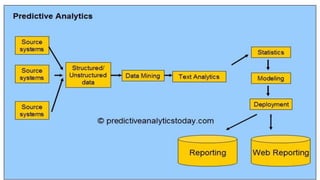
In business, predictive models exploit patterns found in historical and
transactional data to identify risks and opportunities. Models capture
relationships among many factors to allow assessment of risk or
potential associated with a particular set of conditions, guiding decision
making for candidate transactions.
Why is predictive analytics
important?
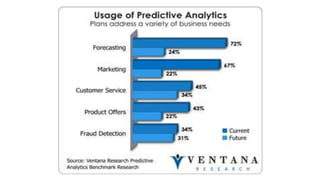
Organizations are turning to predictive analytics to help solve difficult
problems and uncover new opportunities. Common uses include:-
Detecting fraud:- Combining multiple analytics methods can improve
pattern detection and prevent criminal behavior.
Optimizing marketing campaigns:- Predictive analytics are used to
determine customer responses or purchases, as well as promote cross-
sell opportunities.
Improving operations:- Many companies use predictive models to
forecast inventory and manage resources. Airlines use predictive
analytics to set ticket prices.
Reducing risk:- Credit scores are used to assess a buyer’s likelihood of
default for purchases and are a well-known example of predictive
analytics.
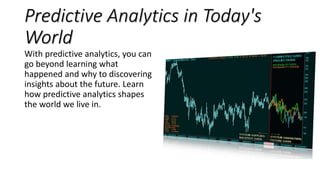
Predictive Analytics in Today's
World
With predictive analytics, you can
go beyond learning what
happened and why to discovering
insights about the future. Learn
how predictive analytics shapes
the world we live in.
How It Works
Predictive models use known results to develop (or train) a model that
can be used to predict values for different or new data. Modeling
provides results in the form of predictions that represent a probability
of the target variable (for example, revenue) based on estimated
significance from a set of input variables.
There are two types of predictive models:-
predict class membership. For instance, you try
to classify whether someone is likely to leave, whether he will respond
to a solicitation, whether he’s a good or bad credit risk, etc. Usually, the
model results are in the form of 0 or 1, with 1 being the event you are
targeting.
predict a number – for example, how much
revenue a customer will generate over the next year or the number of
months before a component will fail on a machine.
Three of the most widely used
predictive modeling techniques
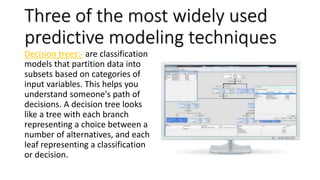
Decision trees:- are classification
models that partition data into
subsets based on categories of
input variables. This helps you
understand someone's path of
decisions. A decision tree looks
like a tree with each branch
representing a choice between a
number of alternatives, and each
leaf representing a classification
or decision.
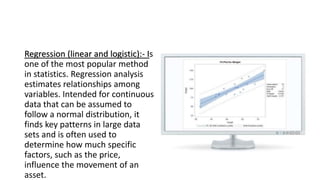
Regression (linear and logistic):- Is
one of the most popular method
in statistics. Regression analysis
estimates relationships among
variables. Intended for continuous
data that can be assumed to
follow a normal distribution, it
finds key patterns in large data
sets and is often used to
determine how much specific
factors, such as the price,
influence the movement of an
asset.
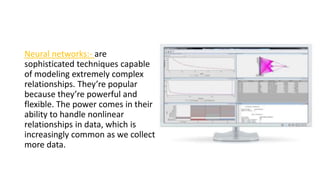
Neural networks:- are
sophisticated techniques capable
of modeling extremely complex
relationships. They’re popular
because they’re powerful and
flexible. The power comes in their
ability to handle nonlinear
relationships in data, which is
increasingly common as we collect
more data.
Predictive analytics

Predictive analytics

  • 2.
  • 4.
    In business, predictivemodels exploit patterns found in historical and transactional data to identify risks and opportunities. Models capture relationships among many factors to allow assessment of risk or potential associated with a particular set of conditions, guiding decision making for candidate transactions.
  • 5.
    Why is predictiveanalytics important? Organizations are turning to predictive analytics to help solve difficult problems and uncover new opportunities. Common uses include:- Detecting fraud:- Combining multiple analytics methods can improve pattern detection and prevent criminal behavior. Optimizing marketing campaigns:- Predictive analytics are used to determine customer responses or purchases, as well as promote cross- sell opportunities.
  • 6.
    Improving operations:- Manycompanies use predictive models to forecast inventory and manage resources. Airlines use predictive analytics to set ticket prices. Reducing risk:- Credit scores are used to assess a buyer’s likelihood of default for purchases and are a well-known example of predictive analytics.
  • 7.
    Predictive Analytics inToday's World With predictive analytics, you can go beyond learning what happened and why to discovering insights about the future. Learn how predictive analytics shapes the world we live in.
  • 9.
    How It Works Predictivemodels use known results to develop (or train) a model that can be used to predict values for different or new data. Modeling provides results in the form of predictions that represent a probability of the target variable (for example, revenue) based on estimated significance from a set of input variables.
  • 11.
    There are twotypes of predictive models:- predict class membership. For instance, you try to classify whether someone is likely to leave, whether he will respond to a solicitation, whether he’s a good or bad credit risk, etc. Usually, the model results are in the form of 0 or 1, with 1 being the event you are targeting.
  • 12.
    predict a number– for example, how much revenue a customer will generate over the next year or the number of months before a component will fail on a machine.
  • 13.
    Three of themost widely used predictive modeling techniques Decision trees:- are classification models that partition data into subsets based on categories of input variables. This helps you understand someone's path of decisions. A decision tree looks like a tree with each branch representing a choice between a number of alternatives, and each leaf representing a classification or decision.
  • 14.
    Regression (linear andlogistic):- Is one of the most popular method in statistics. Regression analysis estimates relationships among variables. Intended for continuous data that can be assumed to follow a normal distribution, it finds key patterns in large data sets and is often used to determine how much specific factors, such as the price, influence the movement of an asset.
  • 15.
    Neural networks:- are sophisticatedtechniques capable of modeling extremely complex relationships. They’re popular because they’re powerful and flexible. The power comes in their ability to handle nonlinear relationships in data, which is increasingly common as we collect more data.