January 20, 2018 Data Mining: Concepts and Techniques1
Data Mining:
Concepts and
Techniques
— Slides for Textbook —
— Chapter 5 —
©Jiawei Han and Micheline Kamber
Intelligent Database Systems Research Lab
School of Computing Science
Simon Fraser University, Canada
http://www.cs.sfu.ca
January 20, 2018 Data Mining: Concepts and Techniques2
Chapter 5: Concept Description:
Characterization and Comparison
 What is concept description?
 Data generalization and summarization-based
characterization
 Analytical characterization: Analysis of attribute relevance
 Mining class comparisons: Discriminating between
different classes
 Mining descriptive statistical measures in large databases
 Discussion
 Summary
January 20, 2018 Data Mining: Concepts and Techniques
What is Concept Description?
 Descriptive vs. predictive data mining
 Descriptive mining: describes concepts or task-relevant
data sets in concise, summarative, informative,
discriminative forms
 Predictive mining: Based on data and analysis,
constructs models for the database, and predicts the
trend and properties of unknown data
 Concept description:
 Characterization: provides a concise and succinct
summarization of the given collection of data
 Comparison: provides descriptions comparing two or
more collections of data
January 20, 2018 Data Mining: Concepts and Techniques4
Concept Description vs. OLAP
 Concept description:
 can handle complex data types of the
attributes and their aggregations
 a more automated process
 OLAP:
 restricted to a small number of dimension
and measure types
 user-controlled process
January 20, 2018 Data Mining: Concepts and Techniques5
Chapter 5: Concept Description:
Characterization and Comparison
 What is concept description?
 Data generalization and summarization-based
characterization
 Analytical characterization: Analysis of attribute relevance
 Mining class comparisons: Discriminating between
different classes
 Mining descriptive statistical measures in large databases
 Discussion
 Summary
January 20, 2018 Data Mining: Concepts and Techniques6
Data Generalization and Summarization-
based Characterization
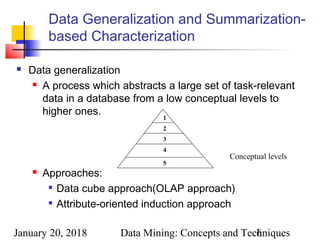
 Data generalization
 A process which abstracts a large set of task-relevant
data in a database from a low conceptual levels to
higher ones.
 Approaches:

Data cube approach(OLAP approach)

Attribute-oriented induction approach
1
2
3
4
5
Conceptual levels
January 20, 2018 Data Mining: Concepts and Techniques7
Characterization: Data Cube Approach
(without using AO-Induction)
 Perform computations and store results in data cubes
 Strength
 An efficient implementation of data generalization
 Computation of various kinds of measures

e.g., count( ), sum( ), average( ), max( )
 Generalization and specialization can be performed on a data
cube by roll-up and drill-down
 Limitations
 handle only dimensions of simple nonnumeric data and
measures of simple aggregated numeric values.
 Lack of intelligent analysis, can’t tell which dimensions should
be used and what levels should the generalization reach
January 20, 2018 Data Mining: Concepts and Techniques8
Attribute-Oriented Induction
 Proposed in 1989 (KDD ‘89 workshop)
 Not confined to categorical data nor particular measures.
 How it is done?
 Collect the task-relevant data( initial relation) using a
relational database query
 Perform generalization by attribute removal or attribute
generalization.
 Apply aggregation by merging identical, generalized
tuples and accumulating their respective counts.
 Interactive presentation with users.
January 20, 2018 Data Mining: Concepts and Techniques
Basic Principles of Attribute-
Oriented Induction
 Data focusing: task-relevant data, including dimensions,
and the result is the initial relation.
 Attribute-removal: remove attribute A if there is a large set
of distinct values for A but (1) there is no generalization
operator on A, or (2) A’s higher level concepts are
expressed in terms of other attributes.
 Attribute-generalization: If there is a large set of distinct
values for A, and there exists a set of generalization
operators on A, then select an operator and generalize A.
 Attribute-threshold control: typical 2-8, specified/default.
 Generalized relation threshold control: control the final
relation/rule size. see example
January 20, 2018 Data Mining: Concepts and Techniques
Basic Algorithm for Attribute-Oriented
Induction
 InitialRel: Query processing of task-relevant data, deriving
the initial relation.
 PreGen: Based on the analysis of the number of distinct
values in each attribute, determine generalization plan for
each attribute: removal? or how high to generalize?
 PrimeGen: Based on the PreGen plan, perform
generalization to the right level to derive a “prime
generalized relation”, accumulating the counts.
 Presentation: User interaction: (1) adjust levels by drilling,
(2) pivoting, (3) mapping into rules, cross tabs, visualization
presentations.
See Implementation See example See complexity
January 20, 2018 Data Mining: Concepts and Techniques11
Example
 DMQL: Describe general characteristics of graduate
students in the Big-University database
use Big_University_DB
mine characteristics as “Science_Students”
in relevance to name, gender, major, birth_place,
birth_date, residence, phone#, gpa
from student
where status in “graduate”
 Corresponding SQL statement:
Select name, gender, major, birth_place, birth_date,
residence, phone#, gpa
from student
where status in {“Msc”, “MBA”, “PhD” }
January 20, 2018 Data Mining: Concepts and Techniques
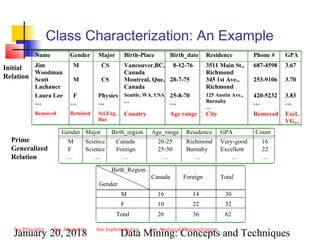
Class Characterization: An Example
Name Gender Major Birth-Place Birth_date Residence Phone # GPA
Jim
Woodman
M CS Vancouver,BC,
Canada
8-12-76 3511 Main St.,
Richmond
687-4598 3.67
Scott
Lachance
M CS Montreal, Que,
Canada
28-7-75 345 1st Ave.,
Richmond
253-9106 3.70
Laura Lee
…
F
…
Physics
…
Seattle, WA, USA
…
25-8-70
…
125 Austin Ave.,
Burnaby
…
420-5232
…
3.83
…
Removed Retained Sci,Eng,
Bus
Country Age range City Removed Excl,
VG,..
Gender Major Birth_region Age_range Residence GPA Count
M Science Canada 20-25 Richmond Very-good 16
F Science Foreign 25-30 Burnaby Excellent 22
… … … … … … …
Birth_Region
Gender
Canada Foreign Total
M 16 14 30
F 10 22 32
Total 26 36 62
See Principles See Algorithm
Prime
Generalized
Relation
Initial
Relation
See Implementation See Analytical Characterization
January 20, 2018 Data Mining: Concepts and Techniques
Presentation of Generalized Results
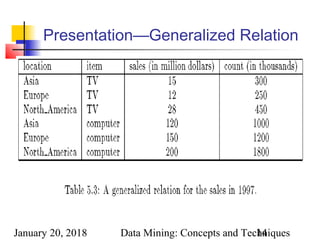
 Generalized relation:
 Relations where some or all attributes are generalized, with counts
or other aggregation values accumulated.
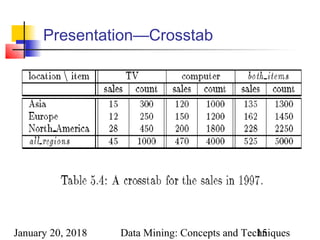
 Cross tabulation:
 Mapping results into cross tabulation form (similar to contingency
tables).
 Visualization techniques:
 Pie charts, bar charts, curves, cubes, and other visual forms.
 Quantitative characteristic rules:
 Mapping generalized result into characteristic rules with quantitative
information associated with it, e.g.,
.%]47:["")(_%]53:["")(_
)()(
tforeignxregionbirthtCanadaxregionbirth
xmalexgrad
=∨=
⇒∧
January 20, 2018 Data Mining: Concepts and Techniques14
Presentation—Generalized Relation
January 20, 2018 Data Mining: Concepts and Techniques15
Presentation—Crosstab
January 20, 2018 Data Mining: Concepts and Techniques16
Implementation by Cube Technology
 Construct a data cube on-the-fly for the given data
mining query
 Facilitate efficient drill-down analysis
 May increase the response time
 A balanced solution: precomputation of “subprime”
relation
 Use a predefined & precomputed data cube
 Construct a data cube beforehand
 Facilitate not only the attribute-oriented induction, but
also attribute relevance analysis, dicing, slicing, roll-
up and drill-down
 Cost of cube computation and the nontrivial storage
overhead
January 20, 2018 Data Mining: Concepts and Techniques17
Chapter 5: Concept Description:
Characterization and Comparison
 What is concept description?
 Data generalization and summarization-based
characterization
 Analytical characterization: Analysis of attribute relevance
 Mining class comparisons: Discriminating between
different classes
 Mining descriptive statistical measures in large databases
 Discussion
 Summary
January 20, 2018 Data Mining: Concepts and Techniques18
Characterization vs. OLAP
 Similarity:
 Presentation of data summarization at multiple levels of
abstraction.
 Interactive drilling, pivoting, slicing and dicing.
 Differences:
 Automated desired level allocation.
 Dimension relevance analysis and ranking when there
are many relevant dimensions.
 Sophisticated typing on dimensions and measures.
 Analytical characterization: data dispersion analysis.
January 20, 2018 Data Mining: Concepts and Techniques19
Attribute Relevance Analysis
 Why?
 Which dimensions should be included?
 How high level of generalization?
 Automatic vs. interactive
 Reduce # attributes; easy to understand patterns
 What?
 statistical method for preprocessing data

filter out irrelevant or weakly relevant attributes

retain or rank the relevant attributes
 relevance related to dimensions and levels
 analytical characterization, analytical comparison
January 20, 2018 Data Mining: Concepts and Techniques20
Attribute relevance analysis (cont’d)
 How?
 Data Collection
 Analytical Generalization

Use information gain analysis (e.g., entropy or other
measures) to identify highly relevant dimensions and levels.
 Relevance Analysis

Sort and select the most relevant dimensions and levels.
 Attribute-oriented Induction for class description

On selected dimension/level
 OLAP operations (e.g. drilling, slicing) on relevance
rules
January 20, 2018 Data Mining: Concepts and Techniques21
Relevance Measures
 Quantitative relevance measure determines the
classifying power of an attribute within a set of
data.
 Methods
 information gain (ID3)
 gain ratio (C4.5)
 gini index
 χ2
contingency table statistics
 uncertainty coefficient
January 20, 2018 Data Mining: Concepts and Techniques22
Information-Theoretic Approach
 Decision tree
 each internal node tests an attribute
 each branch corresponds to attribute value
 each leaf node assigns a classification
 ID3 algorithm
 build decision tree based on training objects with
known class labels to classify testing objects
 rank attributes with information gain measure
 minimal height

the least number of tests to classify an object
See example
January 20, 2018 Data Mining: Concepts and Techniques23
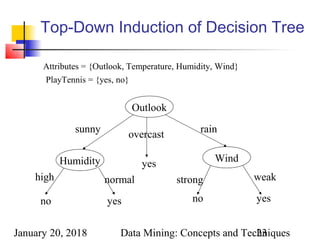
Top-Down Induction of Decision Tree
Attributes = {Outlook, Temperature, Humidity, Wind}
Outlook
Humidity Wind
sunny rain
overcast
yes
no yes
high normal
no
strong weak
yes
PlayTennis = {yes, no}
January 20, 2018 Data Mining: Concepts and Techniques24
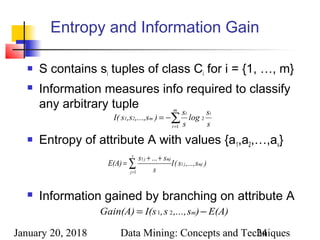
Entropy and Information Gain
 S contains si tuples of class Ci for i = {1, …, m}
 Information measures info required to classify
any arbitrary tuple
 Entropy of attribute A with values {a1,a2,…,av}
 Information gained by branching on attribute A
s
s
log
s
s
),...,s,ssI(
i
m
i
i
m21 2
1
∑=
−=
)s,...,s(I
s
s...s
E(A) mjj
v
j
mjj
1
1
1
∑=
++
=
E(A))s,...,s,I(sGain(A) m −= 21
January 20, 2018 Data Mining: Concepts and Techniques25
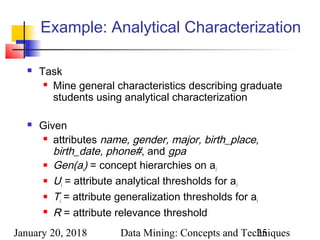
Example: Analytical Characterization
 Task
 Mine general characteristics describing graduate
students using analytical characterization
 Given
 attributes name, gender, major, birth_place,
birth_date, phone#, and gpa
 Gen(ai) = concept hierarchies on ai
 Ui = attribute analytical thresholds for ai
 Ti = attribute generalization thresholds for ai
 R = attribute relevance threshold
January 20, 2018 Data Mining: Concepts and Techniques26
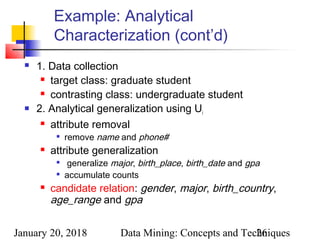
Example: Analytical
Characterization (cont’d)
 1. Data collection
 target class: graduate student
 contrasting class: undergraduate student
 2. Analytical generalization using Ui
 attribute removal

remove name and phone#
 attribute generalization

generalize major, birth_place, birth_date and gpa

accumulate counts
 candidate relation: gender, major, birth_country,
age_range and gpa
January 20, 2018 Data Mining: Concepts and Techniques27
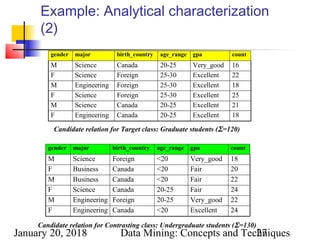
Example: Analytical characterization
(2)
gender major birth_country age_range gpa count
M Science Canada 20-25 Very_good 16
F Science Foreign 25-30 Excellent 22
M Engineering Foreign 25-30 Excellent 18
F Science Foreign 25-30 Excellent 25
M Science Canada 20-25 Excellent 21
F Engineering Canada 20-25 Excellent 18
Candidate relation for Target class: Graduate students (Σ=120)
gender major birth_country age_range gpa count
M Science Foreign <20 Very_good 18
F Business Canada <20 Fair 20
M Business Canada <20 Fair 22
F Science Canada 20-25 Fair 24
M Engineering Foreign 20-25 Very_good 22
F Engineering Canada <20 Excellent 24
Candidate relation for Contrasting class: Undergraduate students (Σ=130)
January 20, 2018 Data Mining: Concepts and Techniques28
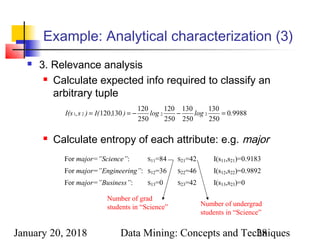
Example: Analytical characterization (3)
 3. Relevance analysis
 Calculate expected info required to classify an
arbitrary tuple
 Calculate entropy of each attribute: e.g. major
99880
250
130
250
130
250
120
250
120
130120 2221 .loglog),I()s,I(s =−−==
For major=”Science”: S11=84 S21=42 I(s11,s21)=0.9183
For major=”Engineering”: S12=36 S22=46 I(s12,s22)=0.9892
For major=”Business”: S13=0 S23=42 I(s13,s23)=0
Number of grad
students in “Science” Number of undergrad
students in “Science”
January 20, 2018 Data Mining: Concepts and Techniques29
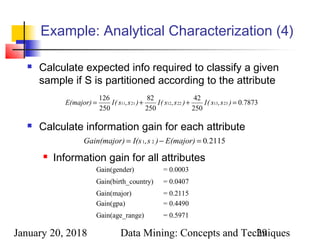
Example: Analytical Characterization (4)
 Calculate expected info required to classify a given
sample if S is partitioned according to the attribute
 Calculate information gain for each attribute
 Information gain for all attributes
78730
250
42
250
82
250
126
231322122111 .)s,s(I)s,s(I)s,s(IE(major) =++=
2115021 .E(major))s,I(s)Gain(major =−=
Gain(gender) = 0.0003
Gain(birth_country) = 0.0407
Gain(major) = 0.2115
Gain(gpa) = 0.4490
Gain(age_range) = 0.5971
January 20, 2018 Data Mining: Concepts and Techniques30
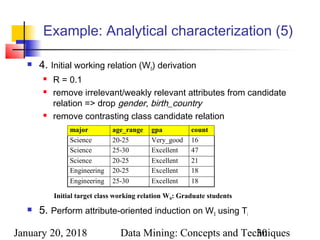
Example: Analytical characterization (5)
 4. Initial working relation (W0) derivation
 R = 0.1
 remove irrelevant/weakly relevant attributes from candidate
relation => drop gender, birth_country
 remove contrasting class candidate relation
 5. Perform attribute-oriented induction on W0 using Ti
major age_range gpa count
Science 20-25 Very_good 16
Science 25-30 Excellent 47
Science 20-25 Excellent 21
Engineering 20-25 Excellent 18
Engineering 25-30 Excellent 18
Initial target class working relation W0: Graduate students
January 20, 2018 Data Mining: Concepts and Techniques31
Chapter 5: Concept Description:
Characterization and Comparison
 What is concept description?
 Data generalization and summarization-based
characterization
 Analytical characterization: Analysis of attribute relevance
 Mining class comparisons: Discriminating between
different classes
 Mining descriptive statistical measures in large databases
 Discussion
 Summary
January 20, 2018 Data Mining: Concepts and Techniques
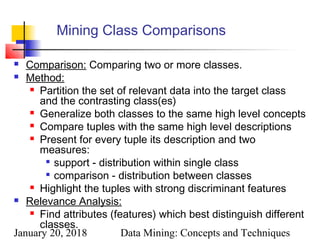
Mining Class Comparisons
 Comparison: Comparing two or more classes.
 Method:
 Partition the set of relevant data into the target class
and the contrasting class(es)
 Generalize both classes to the same high level concepts
 Compare tuples with the same high level descriptions
 Present for every tuple its description and two
measures:

support - distribution within single class

comparison - distribution between classes
 Highlight the tuples with strong discriminant features
 Relevance Analysis:
 Find attributes (features) which best distinguish different
classes.
January 20, 2018 Data Mining: Concepts and Techniques33
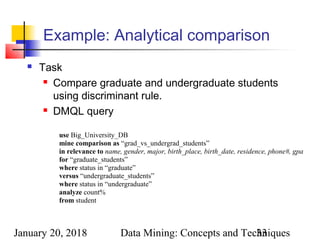
Example: Analytical comparison
 Task
 Compare graduate and undergraduate students
using discriminant rule.
 DMQL query
use Big_University_DB
mine comparison as “grad_vs_undergrad_students”
in relevance to name, gender, major, birth_place, birth_date, residence, phone#, gpa
for “graduate_students”
where status in “graduate”
versus “undergraduate_students”
where status in “undergraduate”
analyze count%
from student
January 20, 2018 Data Mining: Concepts and Techniques34
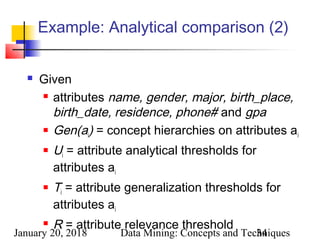
Example: Analytical comparison (2)
 Given
 attributes name, gender, major, birth_place,
birth_date, residence, phone# and gpa
 Gen(ai) = concept hierarchies on attributes ai
 Ui = attribute analytical thresholds for
attributes ai
 Ti = attribute generalization thresholds for
attributes ai
 R = attribute relevance threshold
January 20, 2018 Data Mining: Concepts and Techniques35
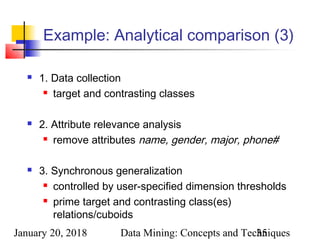
Example: Analytical comparison (3)
 1. Data collection
 target and contrasting classes
 2. Attribute relevance analysis
 remove attributes name, gender, major, phone#
 3. Synchronous generalization
 controlled by user-specified dimension thresholds
 prime target and contrasting class(es)
relations/cuboids
January 20, 2018 Data Mining: Concepts and Techniques36
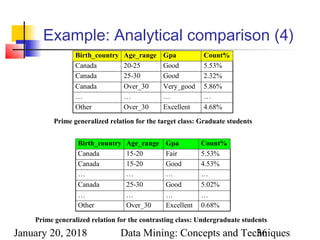
Example: Analytical comparison (4)
Birth_country Age_range Gpa Count%
Canada 20-25 Good 5.53%
Canada 25-30 Good 2.32%
Canada Over_30 Very_good 5.86%
… … … …
Other Over_30 Excellent 4.68%
Prime generalized relation for the target class: Graduate students
Birth_country Age_range Gpa Count%
Canada 15-20 Fair 5.53%
Canada 15-20 Good 4.53%
… … … …
Canada 25-30 Good 5.02%
… … … …
Other Over_30 Excellent 0.68%
Prime generalized relation for the contrasting class: Undergraduate students
January 20, 2018 Data Mining: Concepts and Techniques37
Example: Analytical comparison (5)
 4. Drill down, roll up and other OLAP operations
on target and contrasting classes to adjust
levels of abstractions of resulting description
 5. Presentation
 as generalized relations, crosstabs, bar
charts, pie charts, or rules
 contrasting measures to reflect comparison
between target and contrasting classes

e.g. count%
January 20, 2018 Data Mining: Concepts and Techniques38
Quantitative Discriminant Rules
 Cj = target class
 qa = a generalized tuple covers some tuples of class
 but can also cover some tuples of contrasting class
 d-weight
 range: [0, 1]
 quantitative discriminant rule form
∑=
∈
∈
=− m
i
ia
ja
)Ccount(q
)Ccount(q
weightd
1
d_weight]:[dX)condition(ss(X)target_claX, ⇐∀
January 20, 2018 Data Mining: Concepts and Techniques39
Example: Quantitative Discriminant
Rule
 Quantitative discriminant rule
 where 90/(90+120) = 30%
Status Birth_country Age_range Gpa Count
Graduate Canada 25-30 Good 90
Undergraduate Canada 25-30 Good 210
Count distribution between graduate and undergraduate students for a generalized tuple
%]30:["")("3025")(_"")(_
)(_,
dgoodXgpaXrangeageCanadaXcountrybirth
XstudentgraduateX
=∧−=∧=
⇐∀
January 20, 2018 Data Mining: Concepts and Techniques40
Class Description
 Quantitative characteristic rule
 necessary
 Quantitative discriminant rule
 sufficient
 Quantitative description rule
 necessary and sufficient
]w:d,w:[t...]w:d,w:[t nn111 ′∨∨′
⇔∀
(X)condition(X)condition
ss(X)target_claX,
n
d_weight]:[dX)condition(ss(X)target_claX, ⇐∀
t_weight]:[tX)condition(ss(X)target_claX, ⇒∀
January 20, 2018 Data Mining: Concepts and Techniques41
Example: Quantitative Description
Rule
 Quantitative description rule for target class Europe
Location/item TV Computer Both_items
Count t-wt d-wt Count t-wt d-wt Count t-wt d-wt
Europe 80 25% 40% 240 75% 30% 320 100% 32%
N_Am 120 17.65% 60% 560 82.35% 70% 680 100% 68%
Both_
regions
200 20% 100% 800 80% 100% 1000 100% 100%
Crosstab showing associated t-weight, d-weight values and total number (in thousands) of TVs and
computers sold at AllElectronics in 1998
30%]:d75%,:[t40%]:d25%,:[t )computer""(item(X))TV""(item(X)
Europe(X)X,
=∨=
⇔∀
January 20, 2018 Data Mining: Concepts and Techniques42
Chapter 5: Concept Description:
Characterization and Comparison
 What is concept description?
 Data generalization and summarization-based
characterization
 Analytical characterization: Analysis of attribute relevance
 Mining class comparisons: Discriminating between
different classes
 Mining descriptive statistical measures in large databases
 Discussion
 Summary
January 20, 2018 Data Mining: Concepts and Techniques43
Mining Data Dispersion Characteristics
 Motivation
 To better understand the data: central tendency, variation and
spread
 Data dispersion characteristics
 median, max, min, quantiles, outliers, variance, etc.
 Numerical dimensions correspond to sorted intervals
 Data dispersion: analyzed with multiple granularities of
precision
 Boxplot or quantile analysis on sorted intervals
 Dispersion analysis on computed measures
 Folding measures into numerical dimensions
 Boxplot or quantile analysis on the transformed cube
January 20, 2018 Data Mining: Concepts and Techniques44
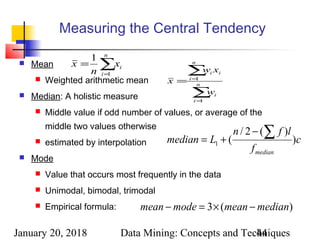
Measuring the Central Tendency
 Mean
 Weighted arithmetic mean
 Median: A holistic measure
 Middle value if odd number of values, or average of the
middle two values otherwise
 estimated by interpolation
 Mode
 Value that occurs most frequently in the data
 Unimodal, bimodal, trimodal
 Empirical formula:
∑=
=
n
i
ix
n
x
1
1
∑
∑
=
=
= n
i
i
n
i
ii
w
xw
x
1
1
c
f
lfn
Lmedian
median
)
)(2/
(1
∑−
+=
)(3 medianmeanmodemean −×=−
January 20, 2018 Data Mining: Concepts and Techniques45
Measuring the Dispersion of Data
 Quartiles, outliers and boxplots
 Quartiles: Q1 (25th
percentile), Q3 (75th
percentile)
 Inter-quartile range: IQR = Q3 –Q1
 Five number summary: min, Q1, M,Q3, max
 Boxplot: ends of the box are the quartiles, median is marked,
whiskers, and plot outlier individually
 Outlier: usually, a value higher/lower than 1.5 x IQR
 Variance and standard deviation
 Variance s2
: (algebraic, scalable computation)
 Standard deviation s is the square root of variance s2
∑ ∑∑ = ==
−
−
=−
−
=
n
i
n
i
ii
n
i
i x
n
x
n
xx
n
s
1 1
22
1
22
])(
1
[
1
1
)(
1
1
January 20, 2018 Data Mining: Concepts and Techniques46
Boxplot Analysis
 Five-number summary of a distribution:
Minimum, Q1, M, Q3, Maximum
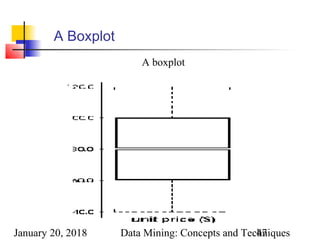
 Boxplot
 Data is represented with a box
 The ends of the box are at the first and third
quartiles, i.e., the height of the box is IRQ
 The median is marked by a line within the
box
 Whiskers: two lines outside the box extend to
Minimum and Maximum
January 20, 2018 Data Mining: Concepts and Techniques47
A Boxplot
A boxplot
January 20, 2018 Data Mining: Concepts and Techniques48
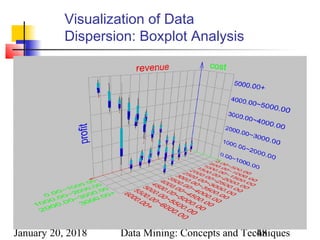
Visualization of Data
Dispersion: Boxplot Analysis
January 20, 2018 Data Mining: Concepts and Techniques49
Mining Descriptive Statistical Measures in
Large Databases
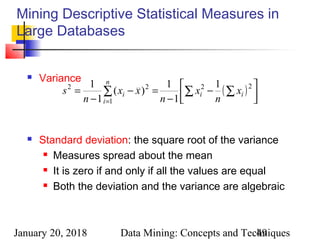
 Variance
 Standard deviation: the square root of the variance
 Measures spread about the mean
 It is zero if and only if all the values are equal
 Both the deviation and the variance are algebraic
( ) 



−
−
=−
−
= ∑ ∑∑
=
22
1
22 1
1
1
)(
1
1
ii
n
i
i x
n
x
n
xx
n
s
January 20, 2018 Data Mining: Concepts and Techniques50
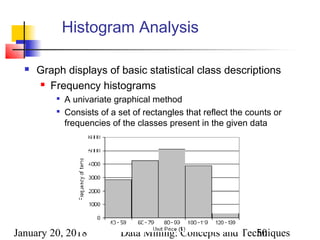
Histogram Analysis
 Graph displays of basic statistical class descriptions
 Frequency histograms

A univariate graphical method

Consists of a set of rectangles that reflect the counts or
frequencies of the classes present in the given data
January 20, 2018 Data Mining: Concepts and Techniques51
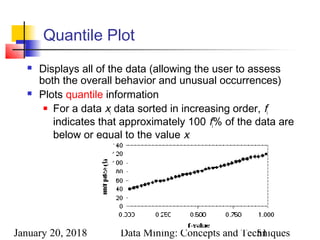
Quantile Plot
 Displays all of the data (allowing the user to assess
both the overall behavior and unusual occurrences)
 Plots quantile information
 For a data xi data sorted in increasing order, fi
indicates that approximately 100 fi% of the data are
below or equal to the value xi
January 20, 2018 Data Mining: Concepts and Techniques52
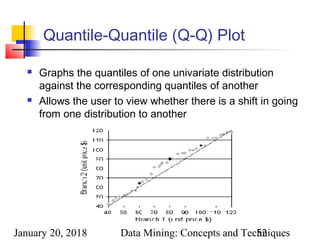
Quantile-Quantile (Q-Q) Plot
 Graphs the quantiles of one univariate distribution
against the corresponding quantiles of another
 Allows the user to view whether there is a shift in going
from one distribution to another
January 20, 2018 Data Mining: Concepts and Techniques53
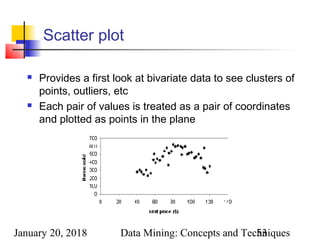
Scatter plot
 Provides a first look at bivariate data to see clusters of
points, outliers, etc
 Each pair of values is treated as a pair of coordinates
and plotted as points in the plane
January 20, 2018 Data Mining: Concepts and Techniques54
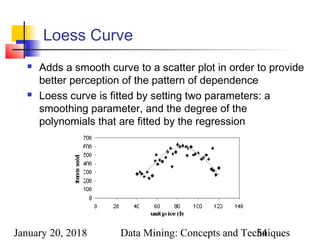
Loess Curve
 Adds a smooth curve to a scatter plot in order to provide
better perception of the pattern of dependence
 Loess curve is fitted by setting two parameters: a
smoothing parameter, and the degree of the
polynomials that are fitted by the regression
January 20, 2018 Data Mining: Concepts and Techniques55
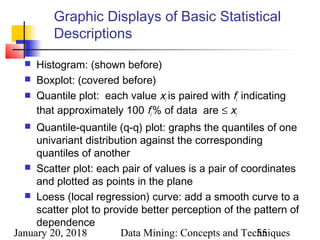
Graphic Displays of Basic Statistical
Descriptions
 Histogram: (shown before)
 Boxplot: (covered before)
 Quantile plot: each value xi is paired with fi indicating
that approximately 100 fi % of data are ≤ xi
 Quantile-quantile (q-q) plot: graphs the quantiles of one
univariant distribution against the corresponding
quantiles of another
 Scatter plot: each pair of values is a pair of coordinates
and plotted as points in the plane
 Loess (local regression) curve: add a smooth curve to a
scatter plot to provide better perception of the pattern of
dependence
January 20, 2018 Data Mining: Concepts and Techniques56
Chapter 5: Concept Description:
Characterization and Comparison
 What is concept description?
 Data generalization and summarization-based
characterization
 Analytical characterization: Analysis of attribute relevance
 Mining class comparisons: Discriminating between
different classes
 Mining descriptive statistical measures in large databases
 Discussion
 Summary
January 20, 2018 Data Mining: Concepts and Techniques57
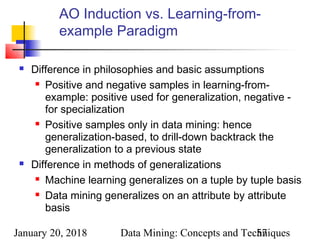
AO Induction vs. Learning-from-
example Paradigm
 Difference in philosophies and basic assumptions
 Positive and negative samples in learning-from-
example: positive used for generalization, negative -
for specialization
 Positive samples only in data mining: hence
generalization-based, to drill-down backtrack the
generalization to a previous state
 Difference in methods of generalizations
 Machine learning generalizes on a tuple by tuple basis
 Data mining generalizes on an attribute by attribute
basis
January 20, 2018 Data Mining: Concepts and Techniques58
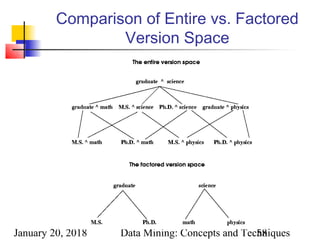
Comparison of Entire vs. Factored
Version Space
January 20, 2018 Data Mining: Concepts and Techniques59
Incremental and Parallel Mining of
Concept Description
 Incremental mining: revision based on newly added data
∆DB
 Generalize ∆DB to the same level of abstraction in the
generalized relation R to derive ∆R
 Union R U ∆R, i.e., merge counts and other statistical
information to produce a new relation R’
 Similar philosophy can be applied to data sampling,
parallel and/or distributed mining, etc.
January 20, 2018 Data Mining: Concepts and Techniques60
Chapter 5: Concept Description:
Characterization and Comparison
 What is concept description?
 Data generalization and summarization-based
characterization
 Analytical characterization: Analysis of attribute relevance
 Mining class comparisons: Discriminating between
different classes
 Mining descriptive statistical measures in large databases
 Discussion
 Summary
January 20, 2018 Data Mining: Concepts and Techniques61
Summary
 Concept description: characterization and
discrimination
 OLAP-based vs. attribute-oriented induction
 Efficient implementation of AOI
 Analytical characterization and comparison
 Mining descriptive statistical measures in large
databases
 Discussion
 Incremental and parallel mining of description
 Descriptive mining of complex types of data
January 20, 2018 Data Mining: Concepts and Techniques62
References
 Y. Cai, N. Cercone, and J. Han. Attribute-oriented induction in relational databases. In
G. Piatetsky-Shapiro and W. J. Frawley, editors, Knowledge Discovery in Databases,
pages 213-228. AAAI/MIT Press, 1991.
 S. Chaudhuri and U. Dayal. An overview of data warehousing and OLAP technology.
ACM SIGMOD Record, 26:65-74, 1997
 C. Carter and H. Hamilton. Efficient attribute-oriented generalization for knowledge
discovery from large databases. IEEE Trans. Knowledge and Data Engineering,
10:193-208, 1998.
 W. Cleveland. Visualizing Data. Hobart Press, Summit NJ, 1993.
 J. L. Devore. Probability and Statistics for Engineering and the Science, 4th ed.
Duxbury Press, 1995.
 T. G. Dietterich and R. S. Michalski. A comparative review of selected methods for
learning from examples. In Michalski et al., editor, Machine Learning: An Artificial
Intelligence Approach, Vol. 1, pages 41-82. Morgan Kaufmann, 1983.
 J. Gray, S. Chaudhuri, A. Bosworth, A. Layman, D. Reichart, M. Venkatrao, F. Pellow,
and H. Pirahesh. Data cube: A relational aggregation operator generalizing group-by,
cross-tab and sub-totals. Data Mining and Knowledge Discovery, 1:29-54, 1997.
 J. Han, Y. Cai, and N. Cercone. Data-driven discovery of quantitative rules in
relational databases. IEEE Trans. Knowledge and Data Engineering, 5:29-40, 1993.
January 20, 2018 Data Mining: Concepts and Techniques63
References (cont.)
 J. Han and Y. Fu. Exploration of the power of attribute-oriented induction in data
mining. In U.M. Fayyad, G. Piatetsky-Shapiro, P. Smyth, and R. Uthurusamy, editors,
Advances in Knowledge Discovery and Data Mining, pages 399-421. AAAI/MIT
Press, 1996.
 R. A. Johnson and D. A. Wichern. Applied Multivariate Statistical Analysis, 3rd ed.
Prentice Hall, 1992.
 E. Knorr and R. Ng. Algorithms for mining distance-based outliers in large datasets.
VLDB'98, New York, NY, Aug. 1998.
 H. Liu and H. Motoda. Feature Selection for Knowledge Discovery and Data Mining.
Kluwer Academic Publishers, 1998.
 R. S. Michalski. A theory and methodology of inductive learning. In Michalski et al.,
editor, Machine Learning: An Artificial Intelligence Approach, Vol. 1, Morgan
Kaufmann, 1983.
 T. M. Mitchell. Version spaces: A candidate elimination approach to rule learning.
IJCAI'97, Cambridge, MA.
 T. M. Mitchell. Generalization as search. Artificial Intelligence, 18:203-226, 1982.
 T. M. Mitchell. Machine Learning. McGraw Hill, 1997.
 J. R. Quinlan. Induction of decision trees. Machine Learning, 1:81-106, 1986.
 D. Subramanian and J. Feigenbaum. Factorization in experiment generation.
AAAI'86, Philadelphia, PA, Aug. 1986.
January 20, 2018 Data Mining: Concepts and Techniques64
http://www.cs.sfu.ca/~han/dmbook
Thank you !!!Thank you !!!

5desc

  • 1.
    January 20, 2018Data Mining: Concepts and Techniques1 Data Mining: Concepts and Techniques — Slides for Textbook — — Chapter 5 — ©Jiawei Han and Micheline Kamber Intelligent Database Systems Research Lab School of Computing Science Simon Fraser University, Canada http://www.cs.sfu.ca
  • 2.
    January 20, 2018Data Mining: Concepts and Techniques2 Chapter 5: Concept Description: Characterization and Comparison  What is concept description?  Data generalization and summarization-based characterization  Analytical characterization: Analysis of attribute relevance  Mining class comparisons: Discriminating between different classes  Mining descriptive statistical measures in large databases  Discussion  Summary
  • 3.
    January 20, 2018Data Mining: Concepts and Techniques What is Concept Description?  Descriptive vs. predictive data mining  Descriptive mining: describes concepts or task-relevant data sets in concise, summarative, informative, discriminative forms  Predictive mining: Based on data and analysis, constructs models for the database, and predicts the trend and properties of unknown data  Concept description:  Characterization: provides a concise and succinct summarization of the given collection of data  Comparison: provides descriptions comparing two or more collections of data
  • 4.
    January 20, 2018Data Mining: Concepts and Techniques4 Concept Description vs. OLAP  Concept description:  can handle complex data types of the attributes and their aggregations  a more automated process  OLAP:  restricted to a small number of dimension and measure types  user-controlled process
  • 5.
    January 20, 2018Data Mining: Concepts and Techniques5 Chapter 5: Concept Description: Characterization and Comparison  What is concept description?  Data generalization and summarization-based characterization  Analytical characterization: Analysis of attribute relevance  Mining class comparisons: Discriminating between different classes  Mining descriptive statistical measures in large databases  Discussion  Summary
  • 6.
    January 20, 2018Data Mining: Concepts and Techniques6 Data Generalization and Summarization- based Characterization  Data generalization  A process which abstracts a large set of task-relevant data in a database from a low conceptual levels to higher ones.  Approaches:  Data cube approach(OLAP approach)  Attribute-oriented induction approach 1 2 3 4 5 Conceptual levels
  • 7.
    January 20, 2018Data Mining: Concepts and Techniques7 Characterization: Data Cube Approach (without using AO-Induction)  Perform computations and store results in data cubes  Strength  An efficient implementation of data generalization  Computation of various kinds of measures  e.g., count( ), sum( ), average( ), max( )  Generalization and specialization can be performed on a data cube by roll-up and drill-down  Limitations  handle only dimensions of simple nonnumeric data and measures of simple aggregated numeric values.  Lack of intelligent analysis, can’t tell which dimensions should be used and what levels should the generalization reach
  • 8.
    January 20, 2018Data Mining: Concepts and Techniques8 Attribute-Oriented Induction  Proposed in 1989 (KDD ‘89 workshop)  Not confined to categorical data nor particular measures.  How it is done?  Collect the task-relevant data( initial relation) using a relational database query  Perform generalization by attribute removal or attribute generalization.  Apply aggregation by merging identical, generalized tuples and accumulating their respective counts.  Interactive presentation with users.
  • 9.
    January 20, 2018Data Mining: Concepts and Techniques Basic Principles of Attribute- Oriented Induction  Data focusing: task-relevant data, including dimensions, and the result is the initial relation.  Attribute-removal: remove attribute A if there is a large set of distinct values for A but (1) there is no generalization operator on A, or (2) A’s higher level concepts are expressed in terms of other attributes.  Attribute-generalization: If there is a large set of distinct values for A, and there exists a set of generalization operators on A, then select an operator and generalize A.  Attribute-threshold control: typical 2-8, specified/default.  Generalized relation threshold control: control the final relation/rule size. see example
  • 10.
    January 20, 2018Data Mining: Concepts and Techniques Basic Algorithm for Attribute-Oriented Induction  InitialRel: Query processing of task-relevant data, deriving the initial relation.  PreGen: Based on the analysis of the number of distinct values in each attribute, determine generalization plan for each attribute: removal? or how high to generalize?  PrimeGen: Based on the PreGen plan, perform generalization to the right level to derive a “prime generalized relation”, accumulating the counts.  Presentation: User interaction: (1) adjust levels by drilling, (2) pivoting, (3) mapping into rules, cross tabs, visualization presentations. See Implementation See example See complexity
  • 11.
    January 20, 2018Data Mining: Concepts and Techniques11 Example  DMQL: Describe general characteristics of graduate students in the Big-University database use Big_University_DB mine characteristics as “Science_Students” in relevance to name, gender, major, birth_place, birth_date, residence, phone#, gpa from student where status in “graduate”  Corresponding SQL statement: Select name, gender, major, birth_place, birth_date, residence, phone#, gpa from student where status in {“Msc”, “MBA”, “PhD” }
  • 12.
    January 20, 2018Data Mining: Concepts and Techniques Class Characterization: An Example Name Gender Major Birth-Place Birth_date Residence Phone # GPA Jim Woodman M CS Vancouver,BC, Canada 8-12-76 3511 Main St., Richmond 687-4598 3.67 Scott Lachance M CS Montreal, Que, Canada 28-7-75 345 1st Ave., Richmond 253-9106 3.70 Laura Lee … F … Physics … Seattle, WA, USA … 25-8-70 … 125 Austin Ave., Burnaby … 420-5232 … 3.83 … Removed Retained Sci,Eng, Bus Country Age range City Removed Excl, VG,.. Gender Major Birth_region Age_range Residence GPA Count M Science Canada 20-25 Richmond Very-good 16 F Science Foreign 25-30 Burnaby Excellent 22 … … … … … … … Birth_Region Gender Canada Foreign Total M 16 14 30 F 10 22 32 Total 26 36 62 See Principles See Algorithm Prime Generalized Relation Initial Relation See Implementation See Analytical Characterization
  • 13.
    January 20, 2018Data Mining: Concepts and Techniques Presentation of Generalized Results  Generalized relation:  Relations where some or all attributes are generalized, with counts or other aggregation values accumulated.  Cross tabulation:  Mapping results into cross tabulation form (similar to contingency tables).  Visualization techniques:  Pie charts, bar charts, curves, cubes, and other visual forms.  Quantitative characteristic rules:  Mapping generalized result into characteristic rules with quantitative information associated with it, e.g., .%]47:["")(_%]53:["")(_ )()( tforeignxregionbirthtCanadaxregionbirth xmalexgrad =∨= ⇒∧
  • 14.
    January 20, 2018Data Mining: Concepts and Techniques14 Presentation—Generalized Relation
  • 15.
    January 20, 2018Data Mining: Concepts and Techniques15 Presentation—Crosstab
  • 16.
    January 20, 2018Data Mining: Concepts and Techniques16 Implementation by Cube Technology  Construct a data cube on-the-fly for the given data mining query  Facilitate efficient drill-down analysis  May increase the response time  A balanced solution: precomputation of “subprime” relation  Use a predefined & precomputed data cube  Construct a data cube beforehand  Facilitate not only the attribute-oriented induction, but also attribute relevance analysis, dicing, slicing, roll- up and drill-down  Cost of cube computation and the nontrivial storage overhead
  • 17.
    January 20, 2018Data Mining: Concepts and Techniques17 Chapter 5: Concept Description: Characterization and Comparison  What is concept description?  Data generalization and summarization-based characterization  Analytical characterization: Analysis of attribute relevance  Mining class comparisons: Discriminating between different classes  Mining descriptive statistical measures in large databases  Discussion  Summary
  • 18.
    January 20, 2018Data Mining: Concepts and Techniques18 Characterization vs. OLAP  Similarity:  Presentation of data summarization at multiple levels of abstraction.  Interactive drilling, pivoting, slicing and dicing.  Differences:  Automated desired level allocation.  Dimension relevance analysis and ranking when there are many relevant dimensions.  Sophisticated typing on dimensions and measures.  Analytical characterization: data dispersion analysis.
  • 19.
    January 20, 2018Data Mining: Concepts and Techniques19 Attribute Relevance Analysis  Why?  Which dimensions should be included?  How high level of generalization?  Automatic vs. interactive  Reduce # attributes; easy to understand patterns  What?  statistical method for preprocessing data  filter out irrelevant or weakly relevant attributes  retain or rank the relevant attributes  relevance related to dimensions and levels  analytical characterization, analytical comparison
  • 20.
    January 20, 2018Data Mining: Concepts and Techniques20 Attribute relevance analysis (cont’d)  How?  Data Collection  Analytical Generalization  Use information gain analysis (e.g., entropy or other measures) to identify highly relevant dimensions and levels.  Relevance Analysis  Sort and select the most relevant dimensions and levels.  Attribute-oriented Induction for class description  On selected dimension/level  OLAP operations (e.g. drilling, slicing) on relevance rules
  • 21.
    January 20, 2018Data Mining: Concepts and Techniques21 Relevance Measures  Quantitative relevance measure determines the classifying power of an attribute within a set of data.  Methods  information gain (ID3)  gain ratio (C4.5)  gini index  χ2 contingency table statistics  uncertainty coefficient
  • 22.
    January 20, 2018Data Mining: Concepts and Techniques22 Information-Theoretic Approach  Decision tree  each internal node tests an attribute  each branch corresponds to attribute value  each leaf node assigns a classification  ID3 algorithm  build decision tree based on training objects with known class labels to classify testing objects  rank attributes with information gain measure  minimal height  the least number of tests to classify an object See example
  • 23.
    January 20, 2018Data Mining: Concepts and Techniques23 Top-Down Induction of Decision Tree Attributes = {Outlook, Temperature, Humidity, Wind} Outlook Humidity Wind sunny rain overcast yes no yes high normal no strong weak yes PlayTennis = {yes, no}
  • 24.
    January 20, 2018Data Mining: Concepts and Techniques24 Entropy and Information Gain  S contains si tuples of class Ci for i = {1, …, m}  Information measures info required to classify any arbitrary tuple  Entropy of attribute A with values {a1,a2,…,av}  Information gained by branching on attribute A s s log s s ),...,s,ssI( i m i i m21 2 1 ∑= −= )s,...,s(I s s...s E(A) mjj v j mjj 1 1 1 ∑= ++ = E(A))s,...,s,I(sGain(A) m −= 21
  • 25.
    January 20, 2018Data Mining: Concepts and Techniques25 Example: Analytical Characterization  Task  Mine general characteristics describing graduate students using analytical characterization  Given  attributes name, gender, major, birth_place, birth_date, phone#, and gpa  Gen(ai) = concept hierarchies on ai  Ui = attribute analytical thresholds for ai  Ti = attribute generalization thresholds for ai  R = attribute relevance threshold
  • 26.
    January 20, 2018Data Mining: Concepts and Techniques26 Example: Analytical Characterization (cont’d)  1. Data collection  target class: graduate student  contrasting class: undergraduate student  2. Analytical generalization using Ui  attribute removal  remove name and phone#  attribute generalization  generalize major, birth_place, birth_date and gpa  accumulate counts  candidate relation: gender, major, birth_country, age_range and gpa
  • 27.
    January 20, 2018Data Mining: Concepts and Techniques27 Example: Analytical characterization (2) gender major birth_country age_range gpa count M Science Canada 20-25 Very_good 16 F Science Foreign 25-30 Excellent 22 M Engineering Foreign 25-30 Excellent 18 F Science Foreign 25-30 Excellent 25 M Science Canada 20-25 Excellent 21 F Engineering Canada 20-25 Excellent 18 Candidate relation for Target class: Graduate students (Σ=120) gender major birth_country age_range gpa count M Science Foreign <20 Very_good 18 F Business Canada <20 Fair 20 M Business Canada <20 Fair 22 F Science Canada 20-25 Fair 24 M Engineering Foreign 20-25 Very_good 22 F Engineering Canada <20 Excellent 24 Candidate relation for Contrasting class: Undergraduate students (Σ=130)
  • 28.
    January 20, 2018Data Mining: Concepts and Techniques28 Example: Analytical characterization (3)  3. Relevance analysis  Calculate expected info required to classify an arbitrary tuple  Calculate entropy of each attribute: e.g. major 99880 250 130 250 130 250 120 250 120 130120 2221 .loglog),I()s,I(s =−−== For major=”Science”: S11=84 S21=42 I(s11,s21)=0.9183 For major=”Engineering”: S12=36 S22=46 I(s12,s22)=0.9892 For major=”Business”: S13=0 S23=42 I(s13,s23)=0 Number of grad students in “Science” Number of undergrad students in “Science”
  • 29.
    January 20, 2018Data Mining: Concepts and Techniques29 Example: Analytical Characterization (4)  Calculate expected info required to classify a given sample if S is partitioned according to the attribute  Calculate information gain for each attribute  Information gain for all attributes 78730 250 42 250 82 250 126 231322122111 .)s,s(I)s,s(I)s,s(IE(major) =++= 2115021 .E(major))s,I(s)Gain(major =−= Gain(gender) = 0.0003 Gain(birth_country) = 0.0407 Gain(major) = 0.2115 Gain(gpa) = 0.4490 Gain(age_range) = 0.5971
  • 30.
    January 20, 2018Data Mining: Concepts and Techniques30 Example: Analytical characterization (5)  4. Initial working relation (W0) derivation  R = 0.1  remove irrelevant/weakly relevant attributes from candidate relation => drop gender, birth_country  remove contrasting class candidate relation  5. Perform attribute-oriented induction on W0 using Ti major age_range gpa count Science 20-25 Very_good 16 Science 25-30 Excellent 47 Science 20-25 Excellent 21 Engineering 20-25 Excellent 18 Engineering 25-30 Excellent 18 Initial target class working relation W0: Graduate students
  • 31.
    January 20, 2018Data Mining: Concepts and Techniques31 Chapter 5: Concept Description: Characterization and Comparison  What is concept description?  Data generalization and summarization-based characterization  Analytical characterization: Analysis of attribute relevance  Mining class comparisons: Discriminating between different classes  Mining descriptive statistical measures in large databases  Discussion  Summary
  • 32.
    January 20, 2018Data Mining: Concepts and Techniques Mining Class Comparisons  Comparison: Comparing two or more classes.  Method:  Partition the set of relevant data into the target class and the contrasting class(es)  Generalize both classes to the same high level concepts  Compare tuples with the same high level descriptions  Present for every tuple its description and two measures:  support - distribution within single class  comparison - distribution between classes  Highlight the tuples with strong discriminant features  Relevance Analysis:  Find attributes (features) which best distinguish different classes.
  • 33.
    January 20, 2018Data Mining: Concepts and Techniques33 Example: Analytical comparison  Task  Compare graduate and undergraduate students using discriminant rule.  DMQL query use Big_University_DB mine comparison as “grad_vs_undergrad_students” in relevance to name, gender, major, birth_place, birth_date, residence, phone#, gpa for “graduate_students” where status in “graduate” versus “undergraduate_students” where status in “undergraduate” analyze count% from student
  • 34.
    January 20, 2018Data Mining: Concepts and Techniques34 Example: Analytical comparison (2)  Given  attributes name, gender, major, birth_place, birth_date, residence, phone# and gpa  Gen(ai) = concept hierarchies on attributes ai  Ui = attribute analytical thresholds for attributes ai  Ti = attribute generalization thresholds for attributes ai  R = attribute relevance threshold
  • 35.
    January 20, 2018Data Mining: Concepts and Techniques35 Example: Analytical comparison (3)  1. Data collection  target and contrasting classes  2. Attribute relevance analysis  remove attributes name, gender, major, phone#  3. Synchronous generalization  controlled by user-specified dimension thresholds  prime target and contrasting class(es) relations/cuboids
  • 36.
    January 20, 2018Data Mining: Concepts and Techniques36 Example: Analytical comparison (4) Birth_country Age_range Gpa Count% Canada 20-25 Good 5.53% Canada 25-30 Good 2.32% Canada Over_30 Very_good 5.86% … … … … Other Over_30 Excellent 4.68% Prime generalized relation for the target class: Graduate students Birth_country Age_range Gpa Count% Canada 15-20 Fair 5.53% Canada 15-20 Good 4.53% … … … … Canada 25-30 Good 5.02% … … … … Other Over_30 Excellent 0.68% Prime generalized relation for the contrasting class: Undergraduate students
  • 37.
    January 20, 2018Data Mining: Concepts and Techniques37 Example: Analytical comparison (5)  4. Drill down, roll up and other OLAP operations on target and contrasting classes to adjust levels of abstractions of resulting description  5. Presentation  as generalized relations, crosstabs, bar charts, pie charts, or rules  contrasting measures to reflect comparison between target and contrasting classes  e.g. count%
  • 38.
    January 20, 2018Data Mining: Concepts and Techniques38 Quantitative Discriminant Rules  Cj = target class  qa = a generalized tuple covers some tuples of class  but can also cover some tuples of contrasting class  d-weight  range: [0, 1]  quantitative discriminant rule form ∑= ∈ ∈ =− m i ia ja )Ccount(q )Ccount(q weightd 1 d_weight]:[dX)condition(ss(X)target_claX, ⇐∀
  • 39.
    January 20, 2018Data Mining: Concepts and Techniques39 Example: Quantitative Discriminant Rule  Quantitative discriminant rule  where 90/(90+120) = 30% Status Birth_country Age_range Gpa Count Graduate Canada 25-30 Good 90 Undergraduate Canada 25-30 Good 210 Count distribution between graduate and undergraduate students for a generalized tuple %]30:["")("3025")(_"")(_ )(_, dgoodXgpaXrangeageCanadaXcountrybirth XstudentgraduateX =∧−=∧= ⇐∀
  • 40.
    January 20, 2018Data Mining: Concepts and Techniques40 Class Description  Quantitative characteristic rule  necessary  Quantitative discriminant rule  sufficient  Quantitative description rule  necessary and sufficient ]w:d,w:[t...]w:d,w:[t nn111 ′∨∨′ ⇔∀ (X)condition(X)condition ss(X)target_claX, n d_weight]:[dX)condition(ss(X)target_claX, ⇐∀ t_weight]:[tX)condition(ss(X)target_claX, ⇒∀
  • 41.
    January 20, 2018Data Mining: Concepts and Techniques41 Example: Quantitative Description Rule  Quantitative description rule for target class Europe Location/item TV Computer Both_items Count t-wt d-wt Count t-wt d-wt Count t-wt d-wt Europe 80 25% 40% 240 75% 30% 320 100% 32% N_Am 120 17.65% 60% 560 82.35% 70% 680 100% 68% Both_ regions 200 20% 100% 800 80% 100% 1000 100% 100% Crosstab showing associated t-weight, d-weight values and total number (in thousands) of TVs and computers sold at AllElectronics in 1998 30%]:d75%,:[t40%]:d25%,:[t )computer""(item(X))TV""(item(X) Europe(X)X, =∨= ⇔∀
  • 42.
    January 20, 2018Data Mining: Concepts and Techniques42 Chapter 5: Concept Description: Characterization and Comparison  What is concept description?  Data generalization and summarization-based characterization  Analytical characterization: Analysis of attribute relevance  Mining class comparisons: Discriminating between different classes  Mining descriptive statistical measures in large databases  Discussion  Summary
  • 43.
    January 20, 2018Data Mining: Concepts and Techniques43 Mining Data Dispersion Characteristics  Motivation  To better understand the data: central tendency, variation and spread  Data dispersion characteristics  median, max, min, quantiles, outliers, variance, etc.  Numerical dimensions correspond to sorted intervals  Data dispersion: analyzed with multiple granularities of precision  Boxplot or quantile analysis on sorted intervals  Dispersion analysis on computed measures  Folding measures into numerical dimensions  Boxplot or quantile analysis on the transformed cube
  • 44.
    January 20, 2018Data Mining: Concepts and Techniques44 Measuring the Central Tendency  Mean  Weighted arithmetic mean  Median: A holistic measure  Middle value if odd number of values, or average of the middle two values otherwise  estimated by interpolation  Mode  Value that occurs most frequently in the data  Unimodal, bimodal, trimodal  Empirical formula: ∑= = n i ix n x 1 1 ∑ ∑ = = = n i i n i ii w xw x 1 1 c f lfn Lmedian median ) )(2/ (1 ∑− += )(3 medianmeanmodemean −×=−
  • 45.
    January 20, 2018Data Mining: Concepts and Techniques45 Measuring the Dispersion of Data  Quartiles, outliers and boxplots  Quartiles: Q1 (25th percentile), Q3 (75th percentile)  Inter-quartile range: IQR = Q3 –Q1  Five number summary: min, Q1, M,Q3, max  Boxplot: ends of the box are the quartiles, median is marked, whiskers, and plot outlier individually  Outlier: usually, a value higher/lower than 1.5 x IQR  Variance and standard deviation  Variance s2 : (algebraic, scalable computation)  Standard deviation s is the square root of variance s2 ∑ ∑∑ = == − − =− − = n i n i ii n i i x n x n xx n s 1 1 22 1 22 ])( 1 [ 1 1 )( 1 1
  • 46.
    January 20, 2018Data Mining: Concepts and Techniques46 Boxplot Analysis  Five-number summary of a distribution: Minimum, Q1, M, Q3, Maximum  Boxplot  Data is represented with a box  The ends of the box are at the first and third quartiles, i.e., the height of the box is IRQ  The median is marked by a line within the box  Whiskers: two lines outside the box extend to Minimum and Maximum
  • 47.
    January 20, 2018Data Mining: Concepts and Techniques47 A Boxplot A boxplot
  • 48.
    January 20, 2018Data Mining: Concepts and Techniques48 Visualization of Data Dispersion: Boxplot Analysis
  • 49.
    January 20, 2018Data Mining: Concepts and Techniques49 Mining Descriptive Statistical Measures in Large Databases  Variance  Standard deviation: the square root of the variance  Measures spread about the mean  It is zero if and only if all the values are equal  Both the deviation and the variance are algebraic ( )     − − =− − = ∑ ∑∑ = 22 1 22 1 1 1 )( 1 1 ii n i i x n x n xx n s
  • 50.
    January 20, 2018Data Mining: Concepts and Techniques50 Histogram Analysis  Graph displays of basic statistical class descriptions  Frequency histograms  A univariate graphical method  Consists of a set of rectangles that reflect the counts or frequencies of the classes present in the given data
  • 51.
    January 20, 2018Data Mining: Concepts and Techniques51 Quantile Plot  Displays all of the data (allowing the user to assess both the overall behavior and unusual occurrences)  Plots quantile information  For a data xi data sorted in increasing order, fi indicates that approximately 100 fi% of the data are below or equal to the value xi
  • 52.
    January 20, 2018Data Mining: Concepts and Techniques52 Quantile-Quantile (Q-Q) Plot  Graphs the quantiles of one univariate distribution against the corresponding quantiles of another  Allows the user to view whether there is a shift in going from one distribution to another
  • 53.
    January 20, 2018Data Mining: Concepts and Techniques53 Scatter plot  Provides a first look at bivariate data to see clusters of points, outliers, etc  Each pair of values is treated as a pair of coordinates and plotted as points in the plane
  • 54.
    January 20, 2018Data Mining: Concepts and Techniques54 Loess Curve  Adds a smooth curve to a scatter plot in order to provide better perception of the pattern of dependence  Loess curve is fitted by setting two parameters: a smoothing parameter, and the degree of the polynomials that are fitted by the regression
  • 55.
    January 20, 2018Data Mining: Concepts and Techniques55 Graphic Displays of Basic Statistical Descriptions  Histogram: (shown before)  Boxplot: (covered before)  Quantile plot: each value xi is paired with fi indicating that approximately 100 fi % of data are ≤ xi  Quantile-quantile (q-q) plot: graphs the quantiles of one univariant distribution against the corresponding quantiles of another  Scatter plot: each pair of values is a pair of coordinates and plotted as points in the plane  Loess (local regression) curve: add a smooth curve to a scatter plot to provide better perception of the pattern of dependence
  • 56.
    January 20, 2018Data Mining: Concepts and Techniques56 Chapter 5: Concept Description: Characterization and Comparison  What is concept description?  Data generalization and summarization-based characterization  Analytical characterization: Analysis of attribute relevance  Mining class comparisons: Discriminating between different classes  Mining descriptive statistical measures in large databases  Discussion  Summary
  • 57.
    January 20, 2018Data Mining: Concepts and Techniques57 AO Induction vs. Learning-from- example Paradigm  Difference in philosophies and basic assumptions  Positive and negative samples in learning-from- example: positive used for generalization, negative - for specialization  Positive samples only in data mining: hence generalization-based, to drill-down backtrack the generalization to a previous state  Difference in methods of generalizations  Machine learning generalizes on a tuple by tuple basis  Data mining generalizes on an attribute by attribute basis
  • 58.
    January 20, 2018Data Mining: Concepts and Techniques58 Comparison of Entire vs. Factored Version Space
  • 59.
    January 20, 2018Data Mining: Concepts and Techniques59 Incremental and Parallel Mining of Concept Description  Incremental mining: revision based on newly added data ∆DB  Generalize ∆DB to the same level of abstraction in the generalized relation R to derive ∆R  Union R U ∆R, i.e., merge counts and other statistical information to produce a new relation R’  Similar philosophy can be applied to data sampling, parallel and/or distributed mining, etc.
  • 60.
    January 20, 2018Data Mining: Concepts and Techniques60 Chapter 5: Concept Description: Characterization and Comparison  What is concept description?  Data generalization and summarization-based characterization  Analytical characterization: Analysis of attribute relevance  Mining class comparisons: Discriminating between different classes  Mining descriptive statistical measures in large databases  Discussion  Summary
  • 61.
    January 20, 2018Data Mining: Concepts and Techniques61 Summary  Concept description: characterization and discrimination  OLAP-based vs. attribute-oriented induction  Efficient implementation of AOI  Analytical characterization and comparison  Mining descriptive statistical measures in large databases  Discussion  Incremental and parallel mining of description  Descriptive mining of complex types of data
  • 62.
    January 20, 2018Data Mining: Concepts and Techniques62 References  Y. Cai, N. Cercone, and J. Han. Attribute-oriented induction in relational databases. In G. Piatetsky-Shapiro and W. J. Frawley, editors, Knowledge Discovery in Databases, pages 213-228. AAAI/MIT Press, 1991.  S. Chaudhuri and U. Dayal. An overview of data warehousing and OLAP technology. ACM SIGMOD Record, 26:65-74, 1997  C. Carter and H. Hamilton. Efficient attribute-oriented generalization for knowledge discovery from large databases. IEEE Trans. Knowledge and Data Engineering, 10:193-208, 1998.  W. Cleveland. Visualizing Data. Hobart Press, Summit NJ, 1993.  J. L. Devore. Probability and Statistics for Engineering and the Science, 4th ed. Duxbury Press, 1995.  T. G. Dietterich and R. S. Michalski. A comparative review of selected methods for learning from examples. In Michalski et al., editor, Machine Learning: An Artificial Intelligence Approach, Vol. 1, pages 41-82. Morgan Kaufmann, 1983.  J. Gray, S. Chaudhuri, A. Bosworth, A. Layman, D. Reichart, M. Venkatrao, F. Pellow, and H. Pirahesh. Data cube: A relational aggregation operator generalizing group-by, cross-tab and sub-totals. Data Mining and Knowledge Discovery, 1:29-54, 1997.  J. Han, Y. Cai, and N. Cercone. Data-driven discovery of quantitative rules in relational databases. IEEE Trans. Knowledge and Data Engineering, 5:29-40, 1993.
  • 63.
    January 20, 2018Data Mining: Concepts and Techniques63 References (cont.)  J. Han and Y. Fu. Exploration of the power of attribute-oriented induction in data mining. In U.M. Fayyad, G. Piatetsky-Shapiro, P. Smyth, and R. Uthurusamy, editors, Advances in Knowledge Discovery and Data Mining, pages 399-421. AAAI/MIT Press, 1996.  R. A. Johnson and D. A. Wichern. Applied Multivariate Statistical Analysis, 3rd ed. Prentice Hall, 1992.  E. Knorr and R. Ng. Algorithms for mining distance-based outliers in large datasets. VLDB'98, New York, NY, Aug. 1998.  H. Liu and H. Motoda. Feature Selection for Knowledge Discovery and Data Mining. Kluwer Academic Publishers, 1998.  R. S. Michalski. A theory and methodology of inductive learning. In Michalski et al., editor, Machine Learning: An Artificial Intelligence Approach, Vol. 1, Morgan Kaufmann, 1983.  T. M. Mitchell. Version spaces: A candidate elimination approach to rule learning. IJCAI'97, Cambridge, MA.  T. M. Mitchell. Generalization as search. Artificial Intelligence, 18:203-226, 1982.  T. M. Mitchell. Machine Learning. McGraw Hill, 1997.  J. R. Quinlan. Induction of decision trees. Machine Learning, 1:81-106, 1986.  D. Subramanian and J. Feigenbaum. Factorization in experiment generation. AAAI'86, Philadelphia, PA, Aug. 1986.
  • 64.
    January 20, 2018Data Mining: Concepts and Techniques64 http://www.cs.sfu.ca/~han/dmbook Thank you !!!Thank you !!!