TOOLS AND TECHNIQUES
FOR PREDICTIVE
ANALYTICS FOR PROJECT
RISK MANAGEMENT
Addepalli Mahidhar 2005003
Ajay Adhikrao Waghmare 2005006
Rohan Kumar Jumnani 2005027
Preetika Baniwal 2005026
Md Yusuf Jamil 2005020
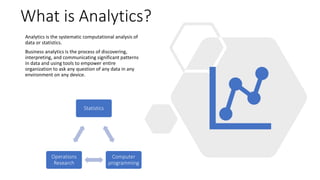
What is Analytics?
Analytics is the systematic computational analysis of
data or statistics.
Business analytics is the process of discovering,
interpreting, and communicating significant patterns
in data and using tools to empower entire
organization to ask any question of any data in any
environment on any device.
Statistics
Computer
programming
Operations
Research
Business value of Analytics
A new way to
work
• Change is
continuous
• Centralized
analytics
platfrom
• Importance of
IT-led
innovations
Uncover new
opportunities
• Modern tools
are predictive,
self learning and
adaptive
• Right data at the
right time
• Visualizing the
data and seeing
the data signals
before the
competitor
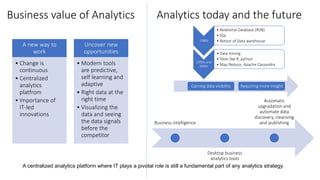
Analytics today and the future
1980s
• Relational Database (RDB)
• SQL
• Notion of Data warehouse
1990s and
2000s
• Data mining
• Tools like R, python
• Map Reduce, Apache Cassandra
Gaining data visibility Requiring more insight
Business intelligence
Desktop business
analytics tools
Automatic
upgradation and
automate data
discovery, cleansing
and publishing
A centralized analytics platform where IT plays a pivotal role is still a fundamental part of any analytics strategy.
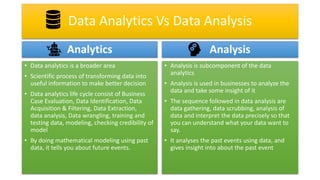
Data Analytics Vs Data Analysis
Analytics
• Data analytics is a broader area
• Scientific process of transforming data into
useful information to make better decision
• Data analytics life cycle consist of Business
Case Evaluation, Data Identification, Data
Acquisition & Filtering, Data Extraction,
data analysis, Data wrangling, training and
testing data, modeling, checking credibility of
model
• By doing mathematical modeling using past
data, it tells you about future events.
Analysis
• Analysis is subcomponent of the data
analytics
• Analysis is used in businesses to analyze the
data and take some insight of it
• The sequence followed in data analysis are
data gathering, data scrubbing, analysis of
data and interpret the data precisely so that
you can understand what your data want to
say.
• It analyses the past events using data, and
gives insight into about the past event
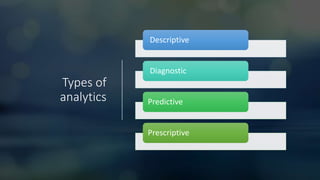
Types of
analytics
Descriptive
Diagnostic
Predictive
Prescriptive
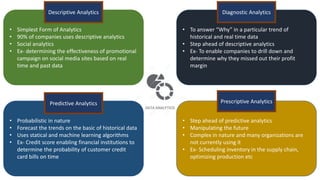
• Simplest Form of Analytics
• 90% of companies uses descriptive analytics
• Social analytics
• Ex- determining the effectiveness of promotional
campaign on social media sites based on real
time and past data
Descriptive Analytics
• To answer “Why” in a particular trend of
historical and real time data
• Step ahead of descriptive analytics
• Ex- To enable companies to drill down and
determine why they missed out their profit
margin
Diagnostic Analytics
• Probabilistic in nature
• Forecast the trends on the basic of historical data
• Uses statical and machine learning algorithms
• Ex- Credit score enabling financial institutions to
determine the probability of customer credit
card bills on time
Predictive Analytics
• Step ahead of predictive analytics
• Manipulating the future
• Complex in nature and many organizations are
not currently using it
• Ex- Scheduling inventory in the supply chain,
optimizing production etc
Prescriptive Analytics
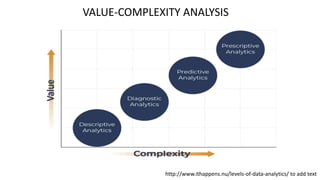
VALUE-COMPLEXITY ANALYSIS
http://www.ithappens.nu/levels-of-data-analytics/ to add text
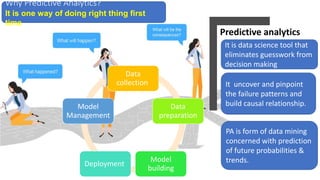
Predictive analytics
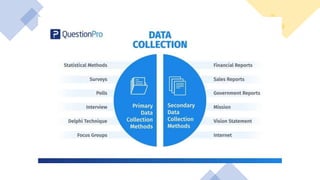
Data
collection
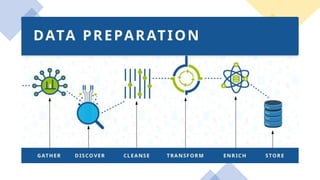
Data
preparation
Model
building
Deployment
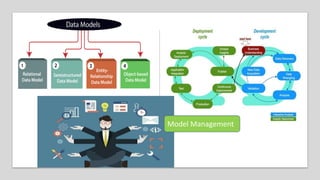
Model
Management
Why Predictive Analytics?
It is one way of doing right thing first
time
PA is form of data mining
concerned with prediction
of future probabilities &
trends.
It is data science tool that
eliminates guesswork from
decision making
It uncover and pinpoint
the failure patterns and
build causal relationship.
Model Management
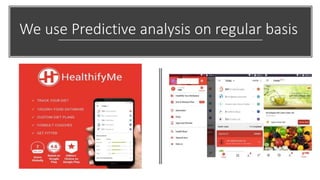
We use Predictive analysis on regular basis
Google Fit
Predictive Analytics in
Project Management
Preventing problems before they
arise.
There is data, but the mindset
is (still) missing !
As per Deloitte research
21% of projects were
cancelled prior to being
delivered or were never used
37% of all projects
succeeded in delivering the
required functionality on
time and on budget
46% of projects were over
budget
63% of projects were
either challenged or failed
71% of projects were
delivered late
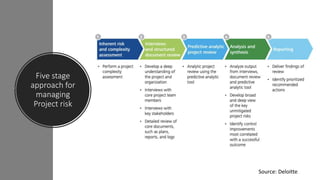
Five stage
approach for
managing
Project risk
Source: Deloitte
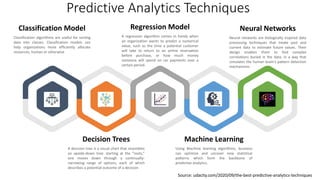
Predictive Analytics Techniques
Decision Trees
A decision tree is a visual chart that resembles
an upside-down tree: starting at the “roots,”
one moves down through a continually-
narrowing range of options, each of which
describes a potential outcome of a decision
Machine Learning
Using Machine learning algorithms, business
can optimize and uncover new statistical
patterns which form the backbone of
predictive analytics.
Classification Model
Classification algorithms are useful for sorting
data into classes. Classification models can
help organizations more efficiently allocate
resources, human or otherwise
Regression Model
A regression algorithm comes in handy when
an organization wants to predict a numerical
value, such as the time a potential customer
will take to return to an airline reservation
before purchase, or how much money
someone will spend on car payments over a
certain period.
.
Neural Networks
Neural networks are biologically inspired data
processing techniques that intake past and
current data to estimate future values. Their
design enables them to find complex
correlations buried in the data, in a way that
simulates the human brain’s pattern detection
mechanisms
Source: udacity.com/2020/09/the-best-predictive-analytics-techniques
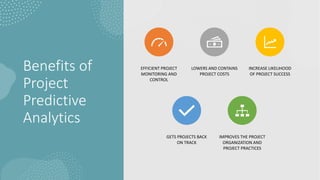
Benefits of
Project
Predictive
Analytics
EFFICIENT PROJECT
MONITORING AND
CONTROL
LOWERS AND CONTAINS
PROJECT COSTS
INCREASE LIKELIHOOD
OF PROJECT SUCCESS
GETS PROJECTS BACK
ON TRACK
IMPROVES THE PROJECT
ORGANIZATION AND
PROJECT PRACTICES
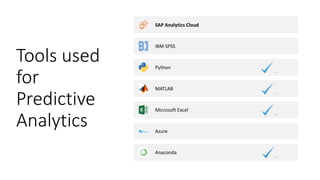
Tools used
for
Predictive
Analytics
SAP Analytics Cloud
IBM SPSS
Python
MATLAB
Microsoft Excel
Azure
Anaconda
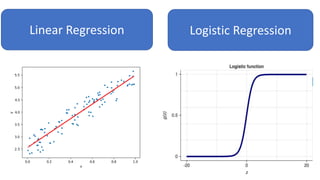
Linear Regression Logistic Regression
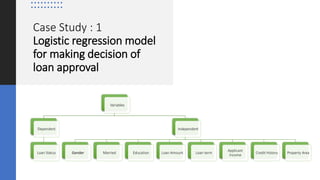
Case Study : 1
Logistic regression model
for making decision of
loan approval
Variables
Dependent
Loan Status
Independent
Gender Married Education Loan Amount Loan term
Applicant
Income
Credit History Property Area
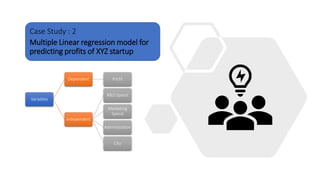
Case Study : 2
Multiple Linear regression model for
predicting profits of XYZ startup
Variables
Dependent Profit
Independent
R&D Spend
Marketing
Spend
Adminstration
City
Summary

Tools and techniques for predictive analytics

  • 1.
    TOOLS AND TECHNIQUES FORPREDICTIVE ANALYTICS FOR PROJECT RISK MANAGEMENT Addepalli Mahidhar 2005003 Ajay Adhikrao Waghmare 2005006 Rohan Kumar Jumnani 2005027 Preetika Baniwal 2005026 Md Yusuf Jamil 2005020
  • 2.
    What is Analytics? Analyticsis the systematic computational analysis of data or statistics. Business analytics is the process of discovering, interpreting, and communicating significant patterns in data and using tools to empower entire organization to ask any question of any data in any environment on any device. Statistics Computer programming Operations Research
  • 3.
    Business value ofAnalytics A new way to work • Change is continuous • Centralized analytics platfrom • Importance of IT-led innovations Uncover new opportunities • Modern tools are predictive, self learning and adaptive • Right data at the right time • Visualizing the data and seeing the data signals before the competitor Analytics today and the future 1980s • Relational Database (RDB) • SQL • Notion of Data warehouse 1990s and 2000s • Data mining • Tools like R, python • Map Reduce, Apache Cassandra Gaining data visibility Requiring more insight Business intelligence Desktop business analytics tools Automatic upgradation and automate data discovery, cleansing and publishing A centralized analytics platform where IT plays a pivotal role is still a fundamental part of any analytics strategy.
  • 4.
    Data Analytics VsData Analysis Analytics • Data analytics is a broader area • Scientific process of transforming data into useful information to make better decision • Data analytics life cycle consist of Business Case Evaluation, Data Identification, Data Acquisition & Filtering, Data Extraction, data analysis, Data wrangling, training and testing data, modeling, checking credibility of model • By doing mathematical modeling using past data, it tells you about future events. Analysis • Analysis is subcomponent of the data analytics • Analysis is used in businesses to analyze the data and take some insight of it • The sequence followed in data analysis are data gathering, data scrubbing, analysis of data and interpret the data precisely so that you can understand what your data want to say. • It analyses the past events using data, and gives insight into about the past event
  • 5.
  • 6.
    • Simplest Formof Analytics • 90% of companies uses descriptive analytics • Social analytics • Ex- determining the effectiveness of promotional campaign on social media sites based on real time and past data Descriptive Analytics • To answer “Why” in a particular trend of historical and real time data • Step ahead of descriptive analytics • Ex- To enable companies to drill down and determine why they missed out their profit margin Diagnostic Analytics • Probabilistic in nature • Forecast the trends on the basic of historical data • Uses statical and machine learning algorithms • Ex- Credit score enabling financial institutions to determine the probability of customer credit card bills on time Predictive Analytics • Step ahead of predictive analytics • Manipulating the future • Complex in nature and many organizations are not currently using it • Ex- Scheduling inventory in the supply chain, optimizing production etc Prescriptive Analytics
  • 7.
  • 8.
    Predictive analytics Data collection Data preparation Model building Deployment Model Management Why PredictiveAnalytics? It is one way of doing right thing first time PA is form of data mining concerned with prediction of future probabilities & trends. It is data science tool that eliminates guesswork from decision making It uncover and pinpoint the failure patterns and build causal relationship.
  • 11.
  • 12.
    We use Predictiveanalysis on regular basis
  • 13.
  • 15.
    Predictive Analytics in ProjectManagement Preventing problems before they arise.
  • 16.
    There is data,but the mindset is (still) missing !
  • 17.
    As per Deloitteresearch 21% of projects were cancelled prior to being delivered or were never used 37% of all projects succeeded in delivering the required functionality on time and on budget 46% of projects were over budget 63% of projects were either challenged or failed 71% of projects were delivered late
  • 18.
  • 19.
    Predictive Analytics Techniques DecisionTrees A decision tree is a visual chart that resembles an upside-down tree: starting at the “roots,” one moves down through a continually- narrowing range of options, each of which describes a potential outcome of a decision Machine Learning Using Machine learning algorithms, business can optimize and uncover new statistical patterns which form the backbone of predictive analytics. Classification Model Classification algorithms are useful for sorting data into classes. Classification models can help organizations more efficiently allocate resources, human or otherwise Regression Model A regression algorithm comes in handy when an organization wants to predict a numerical value, such as the time a potential customer will take to return to an airline reservation before purchase, or how much money someone will spend on car payments over a certain period. . Neural Networks Neural networks are biologically inspired data processing techniques that intake past and current data to estimate future values. Their design enables them to find complex correlations buried in the data, in a way that simulates the human brain’s pattern detection mechanisms Source: udacity.com/2020/09/the-best-predictive-analytics-techniques
  • 20.
    Benefits of Project Predictive Analytics EFFICIENT PROJECT MONITORINGAND CONTROL LOWERS AND CONTAINS PROJECT COSTS INCREASE LIKELIHOOD OF PROJECT SUCCESS GETS PROJECTS BACK ON TRACK IMPROVES THE PROJECT ORGANIZATION AND PROJECT PRACTICES
  • 21.
    Tools used for Predictive Analytics SAP AnalyticsCloud IBM SPSS Python MATLAB Microsoft Excel Azure Anaconda
  • 22.
  • 23.
    Case Study :1 Logistic regression model for making decision of loan approval Variables Dependent Loan Status Independent Gender Married Education Loan Amount Loan term Applicant Income Credit History Property Area
  • 24.
    Case Study :2 Multiple Linear regression model for predicting profits of XYZ startup Variables Dependent Profit Independent R&D Spend Marketing Spend Adminstration City
  • 25.