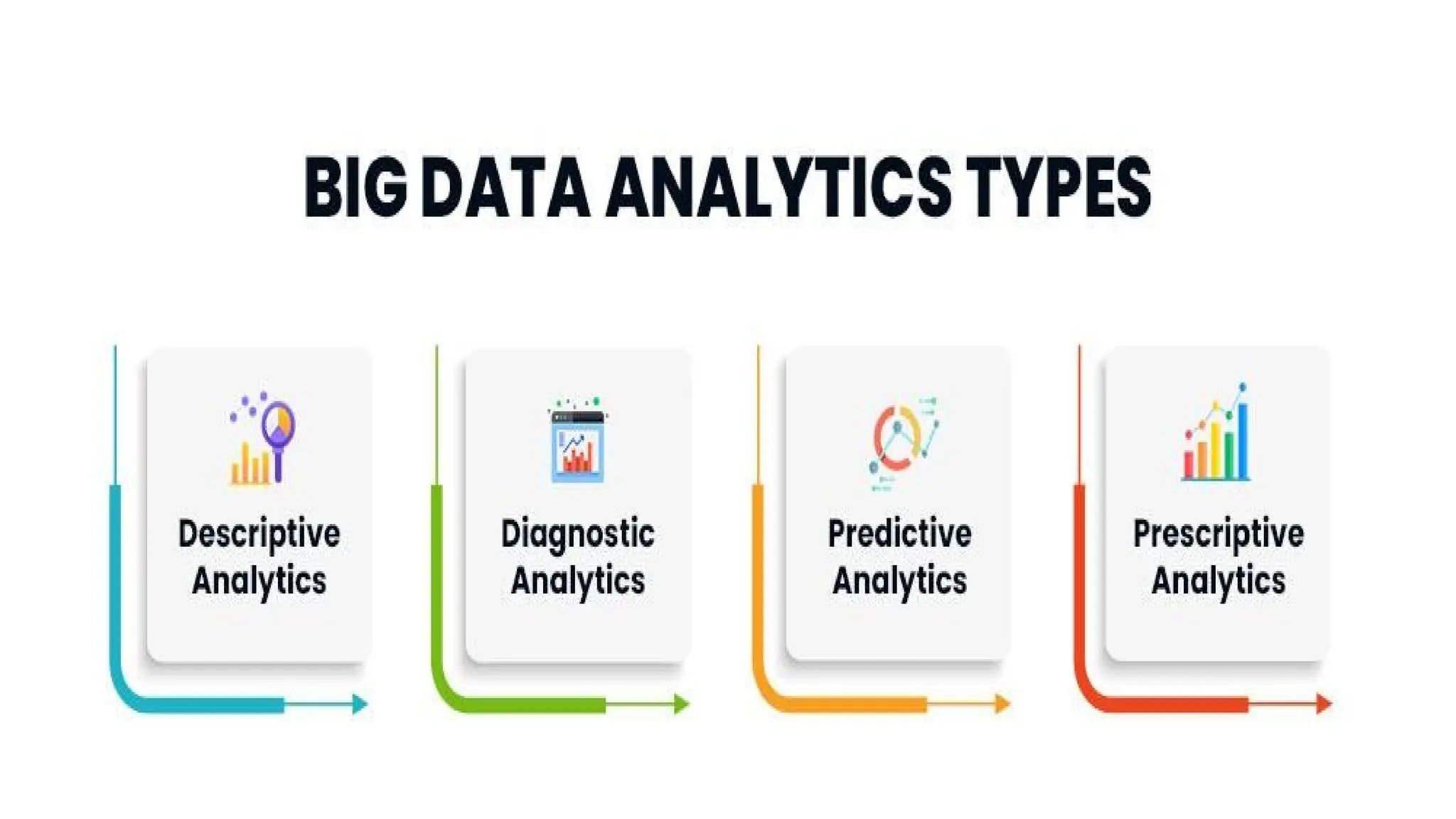
TYPES OF BIG DATA
ANALYTICS
Click icon to add picture
Descriptive
Analytics
Steps in descriptive analytics
1. Quantify goals. The process starts by translating some broad business goals,
2. Identify relevant data. Teams need to identify any types of data that may help improve the
understanding of the critical metric.
3. Organize data. Data from different sources, applications or teams needs to be cleaned and
normalized to improve analytics accuracy.
4. Analysis. Various statistical and mathematical techniques combine, summarize and compare
the raw data in different ways to generate data features.
5. Presentation. Data features may be numerically presented in a report, dashboard or
visualization
How is descriptive analytics used?
Descriptive analysis supports a broad range of users in interpreting data.
Descriptive analytics are commonly used for the following:
• financial reports
• planning a new program
• measuring effectiveness of a new program
• understanding sales trends
• comparing companies
• motivating behavior with KPIs
• recognizing anomalous behavior
• interpreting survey results
Benefits and drawbacks of descriptive
analytics
The use of descriptive analytics can provide the following
benefits:
■ It can simplify communication about numerical data.
■ It can improve understanding of complex situations.
■ Companies can compare performance against the
competition or across product lines.
■ It can be used to help motivate teams to reach new goals.
Top drawbacks and weaknesses of descriptive analytics include the
following:
• Existing biases can be amplified either accidentally or deliberately.
• Results can direct a company's focus to metrics that are not
helpful, like sales versus profits.
• Motivational metrics can be gamed to encourage unintended
behavior, such as mouse movers or sales fraud.
• Poorly chosen metrics can lead to a false sense of security.
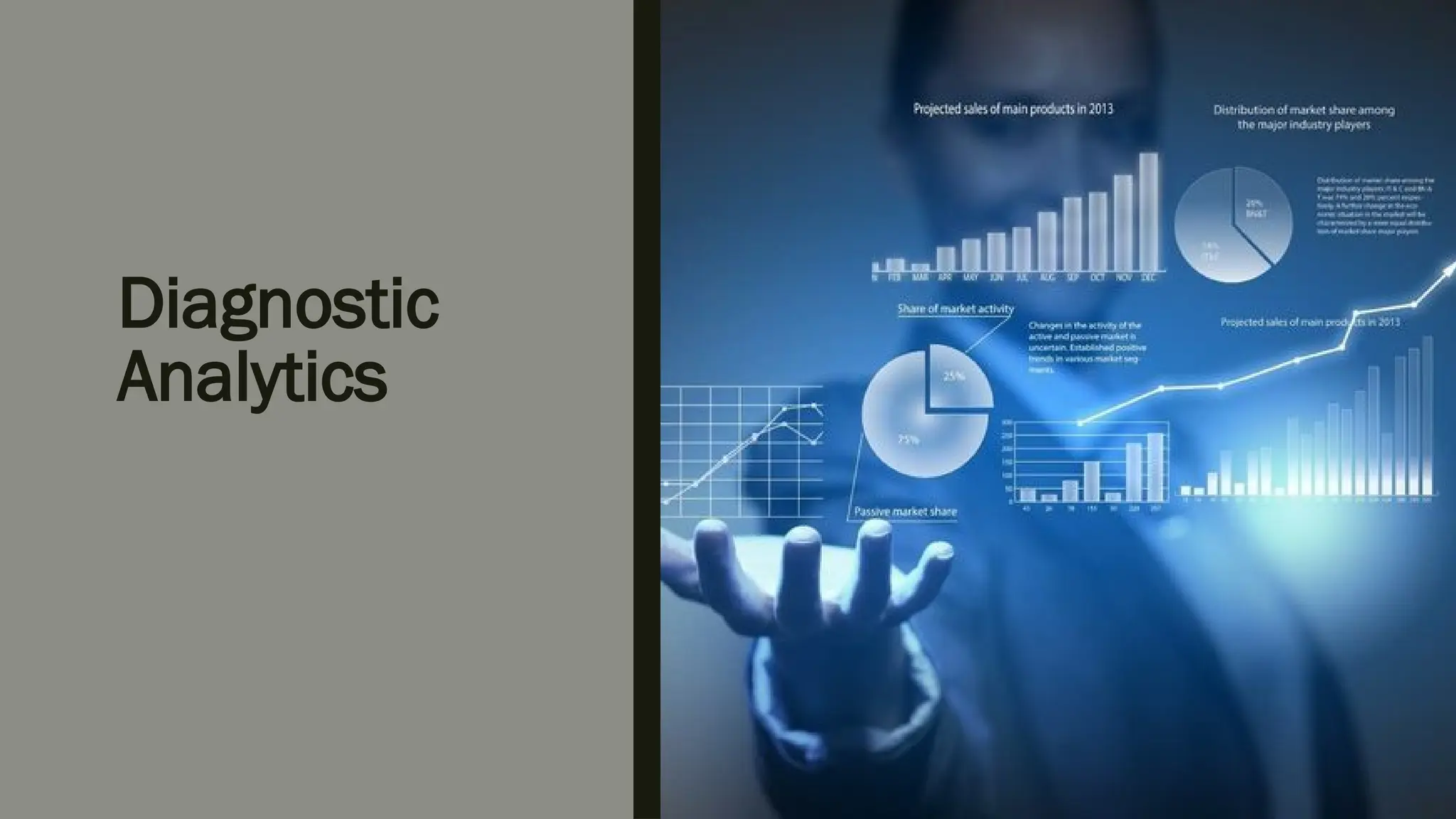
Diagnostic
Analytics
Here are the steps in the diagnostic analytics
process:
■ Identifying the Problem
■ Collecting Data
■ Cleaning and Preparing Data
■ Run the Data through Tools
■ Analyzing Data
The benefits of diagnostic analytics for
businesses include:
1. Improved decision-making: Diagnostic analytics
provides businesses with valuable insights into their
operations, enabling them to make informed decisions.
2. Cost savings: By identifying and resolving issues,
businesses can save money and improve their efficiency.
3. Increased revenue: Diagnostic analytics can help
businesses identify opportunities for growth and
optimize their strategies to generate more revenue.
Challenges and Limitations of Diagnostic
Analytics
Here are some of the key challenges and limitations of diagnostic analytics:
1. Data Quality Issues: If data is incomplete or inaccurate, it can lead to flawed
conclusions and poor decision-making.
2. Data Privacy and Security Concerns: It is important for businesses to take steps
to protect their customers' data and comply with data protection regulations.
3. Legal and Ethical Considerations: Another challenge of diagnostic analytics is
ensuring that the analysis and resulting decisions are legal and ethical.
4. Human Limitations: While diagnostic and predictive analytics both rely on
advanced algorithms and technology, it requires skills to analyses and interpret
correctly.
5. Biases and Subjectivity in Analyzing Data: Human biases can be introduced
into the analysis at various stages and can lead to inaccurate results and flawed
conclusions.
Predictive
Analytics
Techniques and Tools
■ Statistical Modeling
■ Machine Learning
■ Data Mining
Types of Predictive Analytical Models
■ Decision Trees. This type of model places data into different sections based on
certain variables, such as price or market capitalization..
■ Regression. This is the model that is used the most in statistical analysis. Use it
when you want to decipher patterns in large sets of data and when there's a
linear relationship between the inputs.
■ Neural Networks. Use this method if you have any of several hurdles that you
need to overcome.
How Businesses Can Use Predictive
Analytics
Predictive analysis can be used in a number of
different applications. Businesses can capitalize on
models to help advance their interests and improve
their operations.
Uses of Predictive Analytics
■ Manufacturing. Forecasting is essential in manufacturing to optimize the use of resources in a
supply chain.
■ Credit. Credit scoring makes extensive use of predictive analytics.
■ Underwriting. Data and predictive analytics play an important role in underwriting.
■ Marketing. Marketing professionals planning a new campaign look at how consumers have reacted
to the overall economy.
■ Stock Traders. Active traders look at various historical metrics when deciding whether to buy a
particular stock or other asset.
■ Fraud Detection. Financial services use predictive analytics to examine transactions for irregular
trends and patterns.
■ Supply Chain. Supply chain analytics is used to manage inventory levels and set pricing strategies.
■ Human Resources. Human resources uses predictive analytics to improve various processes such as
identifying future workforce skill requirements or identifying factors that contribute to high staff
turnover.
Benefits of Predictive Analytics
Predictive analytics can help anticipate outcomes when
there are no obvious answers available.
What is Predictive Analytics Good For?
Predictive analytics is good for forecasting, risk management,
customer behavior analytics, fraud detection, and operational
optimization.
What Is the Best Model for Predictive
Analytics?
■ The best model for predictive analytics depends on several
factors, such as the type of data, the objective of the
analysis, the complexity of the problem, and the desired
accuracy of the results.
Prescriptive
Analytics
Benefits
■ Make data-driven, not instinct-driven
decisions.
■ Simplify complex decisions.
■ Focus on execution rather than making
decisions.
How It Works
■ Define the question.
■ Integrate your data
■ Develop your model.
■ Deploy your model.
■ Take action.
Predictive vs Prescriptive Analytics
Predictive Analytics Prescriptive Analytics
Output Forecast of possible outcomes but
no guidance (“What will happen”).
Specific recommendation for a
given business decision (“What
you should do”).
Scope Typically only focuses on limited
aspects of your business. This can
result in optimizing one area at the
expense of others.
Takes interdependencies into
account and models your entire
business.
Models The hypotheses of
predictive models are typically
based on predetermined scenarios
and these scenarios usually have a
limited number of options.
Consider all variables and
potential outputs to more
accurately represent how your
organization operates.
Human Bias Predictive analytics requires
human decision making because
the outputs do not provide
guidance.
Data-driven recommendations
remove the human factor and
therefore the risk of personal bias.
END

types-of-big-data-analytics-overview.pptx

  • 1.
    TYPES OF BIGDATA ANALYTICS
  • 2.
    Click icon toadd picture
  • 3.
  • 4.
    Steps in descriptiveanalytics 1. Quantify goals. The process starts by translating some broad business goals, 2. Identify relevant data. Teams need to identify any types of data that may help improve the understanding of the critical metric. 3. Organize data. Data from different sources, applications or teams needs to be cleaned and normalized to improve analytics accuracy. 4. Analysis. Various statistical and mathematical techniques combine, summarize and compare the raw data in different ways to generate data features. 5. Presentation. Data features may be numerically presented in a report, dashboard or visualization
  • 5.
    How is descriptiveanalytics used? Descriptive analysis supports a broad range of users in interpreting data. Descriptive analytics are commonly used for the following: • financial reports • planning a new program • measuring effectiveness of a new program • understanding sales trends • comparing companies • motivating behavior with KPIs • recognizing anomalous behavior • interpreting survey results
  • 6.
    Benefits and drawbacksof descriptive analytics The use of descriptive analytics can provide the following benefits: ■ It can simplify communication about numerical data. ■ It can improve understanding of complex situations. ■ Companies can compare performance against the competition or across product lines. ■ It can be used to help motivate teams to reach new goals.
  • 7.
    Top drawbacks andweaknesses of descriptive analytics include the following: • Existing biases can be amplified either accidentally or deliberately. • Results can direct a company's focus to metrics that are not helpful, like sales versus profits. • Motivational metrics can be gamed to encourage unintended behavior, such as mouse movers or sales fraud. • Poorly chosen metrics can lead to a false sense of security.
  • 8.
  • 9.
    Here are thesteps in the diagnostic analytics process: ■ Identifying the Problem ■ Collecting Data ■ Cleaning and Preparing Data ■ Run the Data through Tools ■ Analyzing Data
  • 10.
    The benefits ofdiagnostic analytics for businesses include: 1. Improved decision-making: Diagnostic analytics provides businesses with valuable insights into their operations, enabling them to make informed decisions. 2. Cost savings: By identifying and resolving issues, businesses can save money and improve their efficiency. 3. Increased revenue: Diagnostic analytics can help businesses identify opportunities for growth and optimize their strategies to generate more revenue.
  • 11.
    Challenges and Limitationsof Diagnostic Analytics Here are some of the key challenges and limitations of diagnostic analytics: 1. Data Quality Issues: If data is incomplete or inaccurate, it can lead to flawed conclusions and poor decision-making. 2. Data Privacy and Security Concerns: It is important for businesses to take steps to protect their customers' data and comply with data protection regulations. 3. Legal and Ethical Considerations: Another challenge of diagnostic analytics is ensuring that the analysis and resulting decisions are legal and ethical. 4. Human Limitations: While diagnostic and predictive analytics both rely on advanced algorithms and technology, it requires skills to analyses and interpret correctly. 5. Biases and Subjectivity in Analyzing Data: Human biases can be introduced into the analysis at various stages and can lead to inaccurate results and flawed conclusions.
  • 12.
  • 13.
    Techniques and Tools ■Statistical Modeling ■ Machine Learning ■ Data Mining
  • 14.
    Types of PredictiveAnalytical Models ■ Decision Trees. This type of model places data into different sections based on certain variables, such as price or market capitalization.. ■ Regression. This is the model that is used the most in statistical analysis. Use it when you want to decipher patterns in large sets of data and when there's a linear relationship between the inputs. ■ Neural Networks. Use this method if you have any of several hurdles that you need to overcome.
  • 15.
    How Businesses CanUse Predictive Analytics Predictive analysis can be used in a number of different applications. Businesses can capitalize on models to help advance their interests and improve their operations.
  • 16.
    Uses of PredictiveAnalytics ■ Manufacturing. Forecasting is essential in manufacturing to optimize the use of resources in a supply chain. ■ Credit. Credit scoring makes extensive use of predictive analytics. ■ Underwriting. Data and predictive analytics play an important role in underwriting. ■ Marketing. Marketing professionals planning a new campaign look at how consumers have reacted to the overall economy. ■ Stock Traders. Active traders look at various historical metrics when deciding whether to buy a particular stock or other asset. ■ Fraud Detection. Financial services use predictive analytics to examine transactions for irregular trends and patterns. ■ Supply Chain. Supply chain analytics is used to manage inventory levels and set pricing strategies. ■ Human Resources. Human resources uses predictive analytics to improve various processes such as identifying future workforce skill requirements or identifying factors that contribute to high staff turnover.
  • 17.
    Benefits of PredictiveAnalytics Predictive analytics can help anticipate outcomes when there are no obvious answers available.
  • 18.
    What is PredictiveAnalytics Good For? Predictive analytics is good for forecasting, risk management, customer behavior analytics, fraud detection, and operational optimization.
  • 19.
    What Is theBest Model for Predictive Analytics? ■ The best model for predictive analytics depends on several factors, such as the type of data, the objective of the analysis, the complexity of the problem, and the desired accuracy of the results.
  • 20.
  • 21.
    Benefits ■ Make data-driven,not instinct-driven decisions. ■ Simplify complex decisions. ■ Focus on execution rather than making decisions.
  • 22.
    How It Works ■Define the question. ■ Integrate your data ■ Develop your model. ■ Deploy your model. ■ Take action.
  • 23.
    Predictive vs PrescriptiveAnalytics Predictive Analytics Prescriptive Analytics Output Forecast of possible outcomes but no guidance (“What will happen”). Specific recommendation for a given business decision (“What you should do”). Scope Typically only focuses on limited aspects of your business. This can result in optimizing one area at the expense of others. Takes interdependencies into account and models your entire business. Models The hypotheses of predictive models are typically based on predetermined scenarios and these scenarios usually have a limited number of options. Consider all variables and potential outputs to more accurately represent how your organization operates. Human Bias Predictive analytics requires human decision making because the outputs do not provide guidance. Data-driven recommendations remove the human factor and therefore the risk of personal bias.
  • 24.