POWER OF DATA
VISUALIZATION
ART OF CLASSIFYING DATA.
WHAT IS DATA VISUALIZATION?
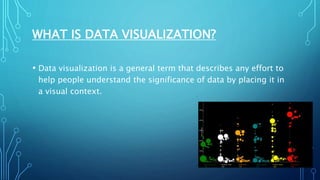
• Data visualization is a general term that describes any effort to
help people understand the significance of data by placing it in
a visual context.
USES OF DATA VISUALIZATION.
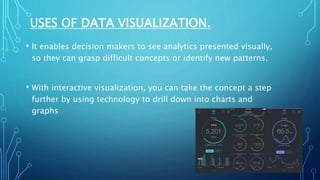
• It enables decision makers to see analytics presented visually,
so they can grasp difficult concepts or identify new patterns.
• With interactive visualization, you can take the concept a step
further by using technology to drill down into charts and
graphs
WHY IS DATA VISUALIZATION IMPORTANT?
Data visualization can:
• Identify areas that need attention or improvement.
• Clarify which factors influence customer behaviour.
• Help you understand which products to place where.
• Predict sales volumes.
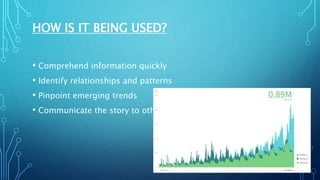
HOW IS IT BEING USED?
• Comprehend information quickly
• Identify relationships and patterns
• Pinpoint emerging trends
• Communicate the story to others
ADVANTAGES:
• Enhanced Assimilation of Business Information
• Quick Access to Relevant Business Insights
• Better Understanding of Operational & Business Activities
• Rapid Identification of Latest Trends
• Accurate Customer Sentiment Analysis
• Direct Interaction with Data
• Predictive Sales Analysis
• Drill-Down Sales Analysis
• Easy Comprehension of Data
• Customized Data-Visualization
•
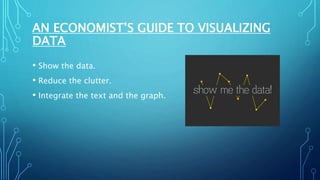
AN ECONOMIST’S GUIDE TO VISUALIZING
DATA
• Show the data.
• Reduce the clutter.
• Integrate the text and the graph.
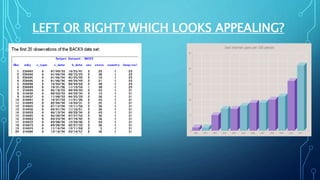
LEFT OR RIGHT? WHICH LOOKS APPEALING?
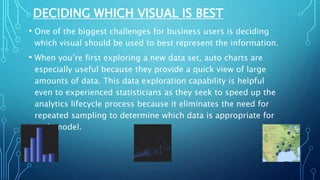
DECIDING WHICH VISUAL IS BEST
• One of the biggest challenges for business users is deciding
which visual should be used to best represent the information.
• When you’re first exploring a new data set, auto charts are
especially useful because they provide a quick view of large
amounts of data. This data exploration capability is helpful
even to experienced statisticians as they seek to speed up the
analytics lifecycle process because it eliminates the need for
repeated sampling to determine which data is appropriate for
each model.
KEY POINTS:
• Data visualization tool can be a real powerful tool.
• Always bear in mind the users/audience of the data
visualisation.
CONCLUSION
• Data visualization is going to change the way our analysts work
with data. They’re going to be expected to respond to issues
more rapidly. And they’ll need to be able to dig for more
insights – look at data differently, more imaginatively. Data
visualization will promote that creative data exploration.
THANK YOU

Power of data visualization

  • 1.
    POWER OF DATA VISUALIZATION ARTOF CLASSIFYING DATA.
  • 2.
    WHAT IS DATAVISUALIZATION? • Data visualization is a general term that describes any effort to help people understand the significance of data by placing it in a visual context.
  • 3.
    USES OF DATAVISUALIZATION. • It enables decision makers to see analytics presented visually, so they can grasp difficult concepts or identify new patterns. • With interactive visualization, you can take the concept a step further by using technology to drill down into charts and graphs
  • 4.
    WHY IS DATAVISUALIZATION IMPORTANT? Data visualization can: • Identify areas that need attention or improvement. • Clarify which factors influence customer behaviour. • Help you understand which products to place where. • Predict sales volumes.
  • 5.
    HOW IS ITBEING USED? • Comprehend information quickly • Identify relationships and patterns • Pinpoint emerging trends • Communicate the story to others
  • 6.
    ADVANTAGES: • Enhanced Assimilationof Business Information • Quick Access to Relevant Business Insights • Better Understanding of Operational & Business Activities • Rapid Identification of Latest Trends • Accurate Customer Sentiment Analysis • Direct Interaction with Data • Predictive Sales Analysis • Drill-Down Sales Analysis • Easy Comprehension of Data • Customized Data-Visualization •
  • 7.
    AN ECONOMIST’S GUIDETO VISUALIZING DATA • Show the data. • Reduce the clutter. • Integrate the text and the graph.
  • 8.
    LEFT OR RIGHT?WHICH LOOKS APPEALING?
  • 9.
    DECIDING WHICH VISUALIS BEST • One of the biggest challenges for business users is deciding which visual should be used to best represent the information. • When you’re first exploring a new data set, auto charts are especially useful because they provide a quick view of large amounts of data. This data exploration capability is helpful even to experienced statisticians as they seek to speed up the analytics lifecycle process because it eliminates the need for repeated sampling to determine which data is appropriate for each model.
  • 10.
    KEY POINTS: • Datavisualization tool can be a real powerful tool. • Always bear in mind the users/audience of the data visualisation.
  • 11.
    CONCLUSION • Data visualizationis going to change the way our analysts work with data. They’re going to be expected to respond to issues more rapidly. And they’ll need to be able to dig for more insights – look at data differently, more imaginatively. Data visualization will promote that creative data exploration.
  • 12.