









PVPMC 2017 - SUPSI - LUGANO
31.03.2017
1
Gianluca Corbellini
Modeling of mismatch losses due to partial
shading in PV plants with custom modules
PVPMC 2017 - SUPSI - LUGANO
Agenda
 Context of the project
 Mismatch in PV fields
 Case studies
 Machine learning approaches
 Results
 Conclusions and next steps
31.03.2017
2
PVPMC 2017 - SUPSI - LUGANO
Context of the project
31.03.2017
3
PV plants are becoming very cheap, already in grid parity in most of countries
• lower margins  short time to optimize the design (15min)
• designers not specialized in PV technology  lack of know how
• DSOs reducing feed-in tariffs  self consumption improves ROI
• MLPE are becoming more competitive  when are they convenient?
There is a need in the market for a tool that has an high accuracy and can easily
optimize the design of overall PV plant in energetic and economic meanings
PVPMC 2017 - SUPSI - LUGANO
Context of the project
31.03.2017
4
The DesignPV project aims to support the development of inSun, a new tool for
the design and simulation of PV plants, implementing innovative features to:
 Improve the accuracy of irradiation patterns
 Simulate the mismatches occurring in complex PV installation
 Optimize the electrical layout of PV plants (orientation, inverters, arrays,
cabling, BoS)
The project is financed by the Commission for Innovation and Technology of the
Swiss Confederation
PVPMC 2017 - SUPSI - LUGANO
inSun
31.03.2017
5
PVPMC 2017 - SUPSI - LUGANO
Test case - Residential
31.03.2017
6
House fully covered with BIPV modules and complex shadings due to obstacles
and surrounding buildings – Optimal economic (LCOE) solution is not trivial.
PVPMC 2017 - SUPSI - LUGANO
Test cases - Industrial
31.03.2017
7
Industrial building with sheds and trees, a good positioning of modules and
cabling into string and MPPTs can improve significantly overall performances.
It could be hard to find the best trade off between cablings and energy yield.
PVPMC 2017 - SUPSI - LUGANO
Test cases - BIPV
31.03.2017
8
Installation on façade need to have a smart cabling of modules, very hard to
design it manually depending on obstacles.
PVPMC 2017 - SUPSI - LUGANO
Mismatch in PV fields
31.03.2017
9
PV plants performance are affected by different sources of mismatch:
• Electrical characteristics of PV modules (current and voltage)
• Cells’ temperature (voltage)
• Non uniform soiling
• Degradation
• Irradiance due to partial shading (current)
Mismatch losses are defined as:
ML =
𝑃𝐼 − 𝑃𝐴
𝑃𝐼
Where 𝑃𝐼 is the ideal power output if every cells work at MPP, while 𝑃𝐴 is the
power output in actual conditions
PVPMC 2017 - SUPSI - LUGANO
Approximation of Mismatch
Random Forest
Averages the output of regression trees that approximate
the target as a piecewise-constant function for different
subset of the inputs
Artificial Neural Newtork
Approximate the target iteratively transforming affine
functions of the inputs with a nonlinear 'activation
function' (usually sigmoid)
31.03.2017
10
For big PV plants and complex irradiation patterns the exact computation of mismatch
losses can be computationally expensive, so an approximated model could speed up the
energy yield simulation.
Two machine learning approaches have been studied:
Averaging
PVPMC 2017 - SUPSI - LUGANO
PV Field modelling
31.03.2017
11
To generalize the model to any number of submodules per string, the input of the ANN and
RF have been normalized to the length of the string (shading fraction), moreover the
diffuse fraction is considered as input. The test case is a Poly-Si module.
Machine Learning
s1
s2
…
sN
kD
Mismatch
Losses
Example
s = [7/16 6/16 3/16 0 0 0]
kD = 0.3
ML = 0.244
Both machine learning approaches
need to be trained with a large dataset
of examples, to minimize the size of
the training dataset some equivalence
classes are considered:
• the shading fraction is sorted
• Position of modules inside its string
is not considered
The computation of the prediction is
extremely fast in both cases.
si ∈ [0, 1] kD ∈ 0.1, 1 ML ∈ [0.1, 1]
PVPMC 2017 - SUPSI - LUGANO
Case Study
PV Plant with a single inverter (single MPPT), field of 6 strings of 16 submodules each.
Yellow submodules get full irradiance (global) while grey ones get only diffuse irradiance,
different diffuse ratio are simulated, results below are referring to 0.3 (e.g. global of 1000
W/m2 of which 300 W/m of diffuse).
16 submodules are shaded, how the mismatch loss is affected from the distribution of the
shading pattern among the strings?
Optimal cabling of modules in arrays
BEST CASE - 0.1%WORST CASE - 24.4%
31.03.2017
12
PVPMC 2017 - SUPSI - LUGANO
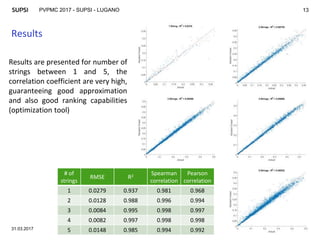
Results
Results are presented for number of
strings between 1 and 5, the
correlation coefficient are very high,
guaranteeing good approximation
and also good ranking capabilities
(optimization tool)
31.03.2017
13
# of
strings
RMSE R2 Spearman
correlation
Pearson
correlation
1 0.0279 0.937 0.981 0.968
2 0.0128 0.988 0.996 0.994
3 0.0084 0.995 0.998 0.997
4 0.0082 0.997 0.998 0.998
5 0.0148 0.985 0.994 0.992
PVPMC 2017 - SUPSI - LUGANO
Conclusions and next steps
The Random Forest model provide a very good accuracy and is fast to run inside a
simulation tool
• Generalize the approach to different technologies, high efficiency modules (> losses)
and modules with lower fill factor (< losses)
 New Random Forest can be easily trained
• Validate the exact and approximated models with real PV plants
 Measurement during the summer with natural and artificial shadings
• Design and implementation of a tool for the layout optimization of PV fields,
arrangement of modules in strings to minimize the mismatch losses
 Ongoing CTI project with inSun
31.03.2017
14
PVPMC 2017 - SUPSI - LUGANO
Thank you for you attention
31.03.2017
15

26 corbellini random forest for mismatch

  • 1.
    PVPMC 2017 -SUPSI - LUGANO 31.03.2017 1 Gianluca Corbellini Modeling of mismatch losses due to partial shading in PV plants with custom modules
  • 2.
    PVPMC 2017 -SUPSI - LUGANO Agenda  Context of the project  Mismatch in PV fields  Case studies  Machine learning approaches  Results  Conclusions and next steps 31.03.2017 2
  • 3.
    PVPMC 2017 -SUPSI - LUGANO Context of the project 31.03.2017 3 PV plants are becoming very cheap, already in grid parity in most of countries • lower margins  short time to optimize the design (15min) • designers not specialized in PV technology  lack of know how • DSOs reducing feed-in tariffs  self consumption improves ROI • MLPE are becoming more competitive  when are they convenient? There is a need in the market for a tool that has an high accuracy and can easily optimize the design of overall PV plant in energetic and economic meanings
  • 4.
    PVPMC 2017 -SUPSI - LUGANO Context of the project 31.03.2017 4 The DesignPV project aims to support the development of inSun, a new tool for the design and simulation of PV plants, implementing innovative features to:  Improve the accuracy of irradiation patterns  Simulate the mismatches occurring in complex PV installation  Optimize the electrical layout of PV plants (orientation, inverters, arrays, cabling, BoS) The project is financed by the Commission for Innovation and Technology of the Swiss Confederation
  • 5.
    PVPMC 2017 -SUPSI - LUGANO inSun 31.03.2017 5
  • 6.
    PVPMC 2017 -SUPSI - LUGANO Test case - Residential 31.03.2017 6 House fully covered with BIPV modules and complex shadings due to obstacles and surrounding buildings – Optimal economic (LCOE) solution is not trivial.
  • 7.
    PVPMC 2017 -SUPSI - LUGANO Test cases - Industrial 31.03.2017 7 Industrial building with sheds and trees, a good positioning of modules and cabling into string and MPPTs can improve significantly overall performances. It could be hard to find the best trade off between cablings and energy yield.
  • 8.
    PVPMC 2017 -SUPSI - LUGANO Test cases - BIPV 31.03.2017 8 Installation on façade need to have a smart cabling of modules, very hard to design it manually depending on obstacles.
  • 9.
    PVPMC 2017 -SUPSI - LUGANO Mismatch in PV fields 31.03.2017 9 PV plants performance are affected by different sources of mismatch: • Electrical characteristics of PV modules (current and voltage) • Cells’ temperature (voltage) • Non uniform soiling • Degradation • Irradiance due to partial shading (current) Mismatch losses are defined as: ML = 𝑃𝐼 − 𝑃𝐴 𝑃𝐼 Where 𝑃𝐼 is the ideal power output if every cells work at MPP, while 𝑃𝐴 is the power output in actual conditions
  • 10.
    PVPMC 2017 -SUPSI - LUGANO Approximation of Mismatch Random Forest Averages the output of regression trees that approximate the target as a piecewise-constant function for different subset of the inputs Artificial Neural Newtork Approximate the target iteratively transforming affine functions of the inputs with a nonlinear 'activation function' (usually sigmoid) 31.03.2017 10 For big PV plants and complex irradiation patterns the exact computation of mismatch losses can be computationally expensive, so an approximated model could speed up the energy yield simulation. Two machine learning approaches have been studied: Averaging
  • 11.
    PVPMC 2017 -SUPSI - LUGANO PV Field modelling 31.03.2017 11 To generalize the model to any number of submodules per string, the input of the ANN and RF have been normalized to the length of the string (shading fraction), moreover the diffuse fraction is considered as input. The test case is a Poly-Si module. Machine Learning s1 s2 … sN kD Mismatch Losses Example s = [7/16 6/16 3/16 0 0 0] kD = 0.3 ML = 0.244 Both machine learning approaches need to be trained with a large dataset of examples, to minimize the size of the training dataset some equivalence classes are considered: • the shading fraction is sorted • Position of modules inside its string is not considered The computation of the prediction is extremely fast in both cases. si ∈ [0, 1] kD ∈ 0.1, 1 ML ∈ [0.1, 1]
  • 12.
    PVPMC 2017 -SUPSI - LUGANO Case Study PV Plant with a single inverter (single MPPT), field of 6 strings of 16 submodules each. Yellow submodules get full irradiance (global) while grey ones get only diffuse irradiance, different diffuse ratio are simulated, results below are referring to 0.3 (e.g. global of 1000 W/m2 of which 300 W/m of diffuse). 16 submodules are shaded, how the mismatch loss is affected from the distribution of the shading pattern among the strings? Optimal cabling of modules in arrays BEST CASE - 0.1%WORST CASE - 24.4% 31.03.2017 12
  • 13.
    PVPMC 2017 -SUPSI - LUGANO Results Results are presented for number of strings between 1 and 5, the correlation coefficient are very high, guaranteeing good approximation and also good ranking capabilities (optimization tool) 31.03.2017 13 # of strings RMSE R2 Spearman correlation Pearson correlation 1 0.0279 0.937 0.981 0.968 2 0.0128 0.988 0.996 0.994 3 0.0084 0.995 0.998 0.997 4 0.0082 0.997 0.998 0.998 5 0.0148 0.985 0.994 0.992
  • 14.
    PVPMC 2017 -SUPSI - LUGANO Conclusions and next steps The Random Forest model provide a very good accuracy and is fast to run inside a simulation tool • Generalize the approach to different technologies, high efficiency modules (> losses) and modules with lower fill factor (< losses)  New Random Forest can be easily trained • Validate the exact and approximated models with real PV plants  Measurement during the summer with natural and artificial shadings • Design and implementation of a tool for the layout optimization of PV fields, arrangement of modules in strings to minimize the mismatch losses  Ongoing CTI project with inSun 31.03.2017 14
  • 15.
    PVPMC 2017 -SUPSI - LUGANO Thank you for you attention 31.03.2017 15