Confidential | © 2016 SunPower Corporation
Quantification of System
Level Mismatch Losses
using PVMismatch
Flash test results
Mismatch at STC
Annual Energy Loss due to Mismatch
Authors:
Chetan Chaudhari
Gregory M. Kimball
Raymond Hickey
Ben Bourne
2Confidential | © 2016 SunPower Corporation |
Introduction
• What is Mismatch loss ?
–Differences in the current-voltage characteristics of photovoltaic (PV)
modules connected in series and parallel combinations lead to a loss in the
system level power referred to as “mismatch loss” or “electrical mismatch
loss”.
• Pmpp@system < Pmpp@module
3Confidential | © 2016 SunPower Corporation |
Contributing factors to mismatch loss
• Manufacturing variability
• Shading
• Operating temperature non-uniformity
• Varying DC wiring lengths
• Uneven degradation
4Confidential | © 2016 SunPower Corporation |
Contributing factors to mismatch loss
• Manufacturing variability
• Shading
• Operating temperature non-uniformity
• Varying DC wiring lengths
• Uneven degradation
5Confidential | © 2016 SunPower Corporation |
Need
• Literature survey shows guidance on mismatch loss from 0.01% to 2%
• Mismatch loss typically used as a flat derating factor for system capacity
6Confidential | © 2016 SunPower Corporation |
Goal
• Create a framework that can be utilized to model various factors that contribute to
mismatch loss for
–a given population of flash test results
7Confidential | © 2016 SunPower Corporation |
Goal
• Create a framework that can be utilized to model various factors that contribute to
mismatch loss for
–a given population of flash test results
–system configuration
8Confidential | © 2016 SunPower Corporation |
Goal
• Create a framework that can be utilized to model various factors that contribute to
mismatch loss for
–a given population of flash test results
–system configuration,
–site location
9Confidential | © 2016 SunPower Corporation |
Goal
• Create a framework that can be utilized to model various factors that contribute to
mismatch loss for
–a given population of flash test results
–system configuration,
–site location
–impact on annual Energy
10Confidential | © 2016 SunPower Corporation |
Quick overview of PVMismatch
• Core framework for the study
• An explicit IV curve calculator
• Written in Python
• Go Open Source! (https://github.com/SunPower/PVMismatch)
• PVMismatch Model chain
–Cell > Cell string > Module > String > System
–Capability to set ”Suns” and temperature for each cell (individually or
collectively)
–Capability to configure cell string layout and bypass diodes
• Former work using PVMismatch
– Accurate Modeling of Partially Shaded PV Arrays [2]
– A fast parameterized model for predicting PV system performance under partial shade conditions. [3]
11Confidential | © 2016 SunPower Corporation |
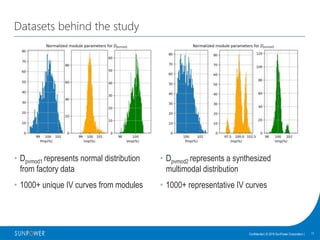
Datasets behind the study
• Dpvmod1 represents normal distribution
from factory data
• 1000+ unique IV curves from modules
• Dpvmod2 represents a synthesized
multimodal distribution
• 1000+ representative IV curves
Mismatch loss at STC
13Confidential | © 2016 SunPower Corporation |
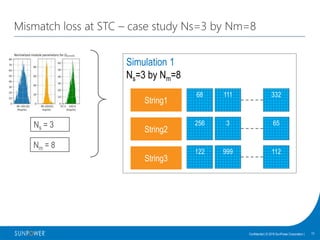
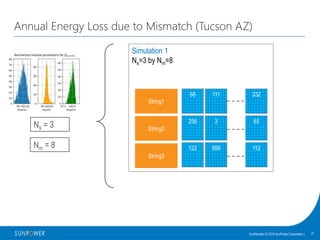
Mismatch loss at STC – case study Ns=3 by Nm=8
Simulation 1
Ns=3 by Nm=8
68 111 332
String1
256 3 65
122 999 112
String2
String3
Ns = 3
Nm = 8
14Confidential | © 2016 SunPower Corporation |
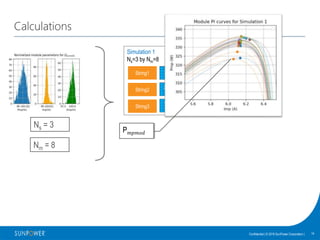
Calculations
Simulation 1
Ns=3 by Nm=8
68 111 332
String1
256 3 65
122 999 112
String2
String3
P 𝑚𝑝𝑚𝑜𝑑
Ns = 3
Nm = 8
15Confidential | © 2016 SunPower Corporation |
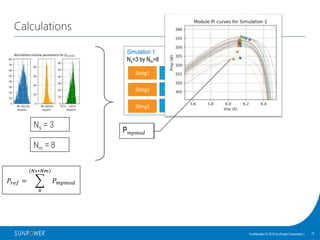
Calculations
Simulation 1
Ns=3 by Nm=8
68 111 332
String1
256 3 65
122 999 112
String2
String3
P 𝑚𝑝𝑚𝑜𝑑
Ns = 3
Nm = 8
𝑃𝑟𝑒𝑓 =
0
𝑁𝑠∗𝑁𝑚
𝑃 𝑚𝑝𝑚𝑜𝑑
16Confidential | © 2016 SunPower Corporation |
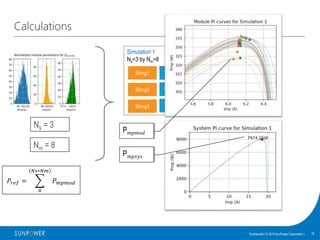
Calculations
Simulation 1
Ns=3 by Nm=8
68 111 332
String1
256 3 65
122 999 112
String2
String3
P 𝑚𝑝𝑚𝑜𝑑
P 𝑚𝑝𝑠𝑦𝑠
Ns = 3
Nm = 8
𝑃𝑟𝑒𝑓 =
0
𝑁𝑠∗𝑁𝑚
𝑃 𝑚𝑝𝑚𝑜𝑑
17Confidential | © 2016 SunPower Corporation |
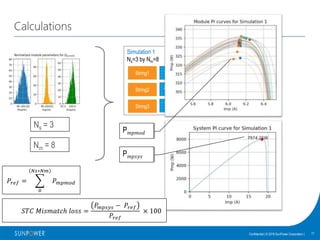
Calculations
Simulation 1
Ns=3 by Nm=8
68 111 332
String1
256 3 65
122 999 112
String2
String3
𝑃𝑟𝑒𝑓 =
0
𝑁𝑠∗𝑁𝑚
𝑃 𝑚𝑝𝑚𝑜𝑑
P 𝑚𝑝𝑚𝑜𝑑
P 𝑚𝑝𝑠𝑦𝑠
𝑆𝑇𝐶 𝑀𝑖𝑠𝑚𝑎𝑡𝑐ℎ 𝑙𝑜𝑠𝑠 =
𝑃𝑚𝑝𝑠𝑦𝑠 − 𝑃𝑟𝑒𝑓
𝑃𝑟𝑒𝑓
× 100
Ns = 3
Nm = 8
18Confidential | © 2016 SunPower Corporation |
Monte Carlo Simulations
Simulation 1
Ns=3 by Nm=8
68 111 332
String1
256 3 65
122 999 112
String2
String3
Simulation 1000
Ns=3 by Nm=8
2 111 2
String1
141 378
8
33
3 988 55
String2
String3
Ns = 3
Nm = 8
19Confidential | © 2016 SunPower Corporation |
Mismatch loss at STC - resulting distribution
Simulation 1
Ns=3 by Nm=8
68 111 332
String1
256 3 65
122 999 112
String2
String3
Simulation 1000
Ns=3 by Nm=8
2 111 2
String1
141 3788 33
3 988 55
String2
String3
Mismatch loss
distribution
Ns = 3
Nm = 8
Annual Energy Loss
due to
Mismatch
21Confidential | © 2016 SunPower Corporation |
Annual Energy Loss due to Mismatch (Tucson AZ)
Simulation 1
Ns=3 by Nm=8
68 111 332
String1
256 3 65
122 999 112
String2
String3
Ns = 3
Nm = 8
22Confidential | © 2016 SunPower Corporation |
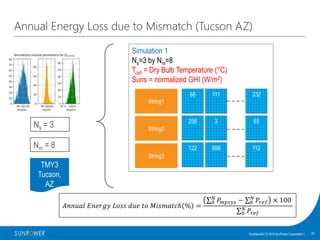
Annual Energy Loss due to Mismatch (Tucson AZ)
Simulation 1
Ns=3 by Nm=8
Tcell = Dry Bulb Temperature (°C)
Suns = normalized GHI (W/m2)
68 111 332
String1
256 3 65
122 999 112
String2
String3
𝐴𝑛𝑛𝑢𝑎𝑙 𝐸𝑛𝑒𝑟𝑔𝑦 𝐿𝑜𝑠𝑠 𝑑𝑢𝑒 𝑡𝑜 𝑀𝑖𝑠𝑚𝑎𝑡𝑐ℎ % =
0
𝑁
𝑃𝑚𝑝𝑠𝑦𝑠 − 0
𝑁
𝑃𝑟𝑒𝑓 × 100
0
𝑁
𝑃𝑟𝑒𝑓
TMY3
Tucson,
AZ
Ns = 3
Nm = 8
23Confidential | © 2016 SunPower Corporation |
Annual Energy Loss due to Mismatch
Annual Energy Loss
due to Mismatch
Simulation 1
Ns=3 by Nm=8
Tcell = Dry Bulb Temperature (°C)
Suns = normalized GHI (W/m2)
68 111 332
String1
256 3 65
122 999 112
String2
String3
Simulation 200
Ns=3 by Nm=8
Tcell = Dry Bulb Temperature (°C)
Suns = normalized GHI (W/m2)
68 111 332
String1
256 3 65
122 999 112
String2
String3
TMY3
Tucson,
AZ
Ns = 3
Nm = 8
Results
25Confidential | © 2016 SunPower Corporation |
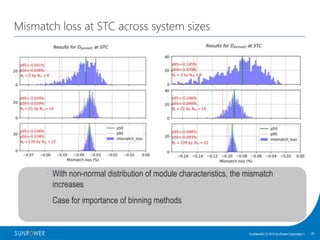
Mismatch loss at STC across system sizes
• With non-normal distribution of module characteristics, the mismatch
increases
• Case for importance of binning methods
26Confidential | © 2016 SunPower Corporation |
Concluding remarks
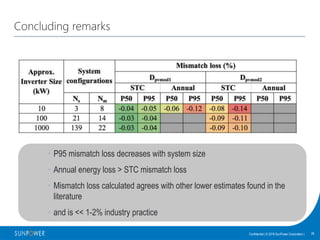
• P95 mismatch loss decreases with system size
• Annual energy loss > STC mismatch loss
• Mismatch loss calculated agrees with other lower estimates found in the
literature
• and is << 1-2% industry practice
27Confidential | © 2016 SunPower Corporation |
Future scope
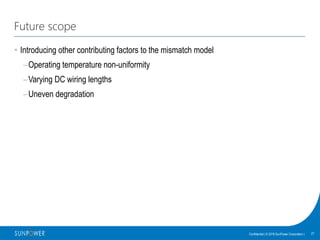
• Introducing other contributing factors to the mismatch model
–Operating temperature non-uniformity
–Varying DC wiring lengths
–Uneven degradation
Thank You
Let’s change the way our world is powered.
Confidential | © 2016 SunPower Corporation
Appendix A
30Confidential | © 2016 SunPower Corporation |
References
1. J. W. Bishop, “Computer simulation of the effects of electrical mismatches in photovoltaic cell interconnection circuits,” Sol. Cells, vol. 25, no.
1, pp. 73–89, Oct. 1988.
2. Meyers, B., & Mikofski, M. (2017). Accurate Modeling of Partially Shaded PV Arrays. In 44th IEEE Photovoltaic Specialists Conference.
3. Meyers, B., Mikofski, M., & Anderson, M. (2016). A fast parameterized model for predicting PV system performance under partial shade
conditions. In Conference Record of the IEEE Photovoltaic Specialists Conference (Vol. 2016–November, pp. 3173–3178). Institute of
Electrical and Electronics Engineers Inc. https://doi.org/10.1109/PVSC.2016.7750251
31Confidential | © 2016 SunPower Corporation |
Method – Mismatch loss at STC
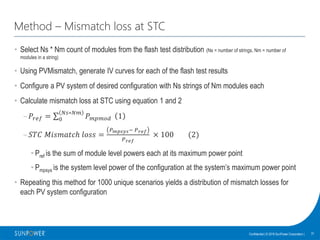
• Select Ns * Nm count of modules from the flash test distribution (Ns = number of strings, Nm = number of
modules in a string)
• Using PVMismatch, generate IV curves for each of the flash test results
• Configure a PV system of desired configuration with Ns strings of Nm modules each
• Calculate mismatch loss at STC using equation 1 and 2
– 𝑃𝑟𝑒𝑓 = 0
𝑁𝑠∗𝑁𝑚
𝑃 𝑚𝑝𝑚𝑜𝑑 1
– 𝑆𝑇𝐶 𝑀𝑖𝑠𝑚𝑎𝑡𝑐ℎ 𝑙𝑜𝑠𝑠 =
𝑃 𝑚𝑝𝑠𝑦𝑠− 𝑃 𝑟𝑒𝑓
𝑃 𝑟𝑒𝑓
× 100 (2)
• Pref is the sum of module level powers each at its maximum power point
• Pmpsys is the system level power of the configuration at the system’s maximum power point
• Repeating this method for 1000 unique scenarios yields a distribution of mismatch losses for
each PV system configuration

PV Mismatch loss study using flash test datasets

  • 1.
    Confidential | ©2016 SunPower Corporation Quantification of System Level Mismatch Losses using PVMismatch Flash test results Mismatch at STC Annual Energy Loss due to Mismatch Authors: Chetan Chaudhari Gregory M. Kimball Raymond Hickey Ben Bourne
  • 2.
    2Confidential | ©2016 SunPower Corporation | Introduction • What is Mismatch loss ? –Differences in the current-voltage characteristics of photovoltaic (PV) modules connected in series and parallel combinations lead to a loss in the system level power referred to as “mismatch loss” or “electrical mismatch loss”. • Pmpp@system < Pmpp@module
  • 3.
    3Confidential | ©2016 SunPower Corporation | Contributing factors to mismatch loss • Manufacturing variability • Shading • Operating temperature non-uniformity • Varying DC wiring lengths • Uneven degradation
  • 4.
    4Confidential | ©2016 SunPower Corporation | Contributing factors to mismatch loss • Manufacturing variability • Shading • Operating temperature non-uniformity • Varying DC wiring lengths • Uneven degradation
  • 5.
    5Confidential | ©2016 SunPower Corporation | Need • Literature survey shows guidance on mismatch loss from 0.01% to 2% • Mismatch loss typically used as a flat derating factor for system capacity
  • 6.
    6Confidential | ©2016 SunPower Corporation | Goal • Create a framework that can be utilized to model various factors that contribute to mismatch loss for –a given population of flash test results
  • 7.
    7Confidential | ©2016 SunPower Corporation | Goal • Create a framework that can be utilized to model various factors that contribute to mismatch loss for –a given population of flash test results –system configuration
  • 8.
    8Confidential | ©2016 SunPower Corporation | Goal • Create a framework that can be utilized to model various factors that contribute to mismatch loss for –a given population of flash test results –system configuration, –site location
  • 9.
    9Confidential | ©2016 SunPower Corporation | Goal • Create a framework that can be utilized to model various factors that contribute to mismatch loss for –a given population of flash test results –system configuration, –site location –impact on annual Energy
  • 10.
    10Confidential | ©2016 SunPower Corporation | Quick overview of PVMismatch • Core framework for the study • An explicit IV curve calculator • Written in Python • Go Open Source! (https://github.com/SunPower/PVMismatch) • PVMismatch Model chain –Cell > Cell string > Module > String > System –Capability to set ”Suns” and temperature for each cell (individually or collectively) –Capability to configure cell string layout and bypass diodes • Former work using PVMismatch – Accurate Modeling of Partially Shaded PV Arrays [2] – A fast parameterized model for predicting PV system performance under partial shade conditions. [3]
  • 11.
    11Confidential | ©2016 SunPower Corporation | Datasets behind the study • Dpvmod1 represents normal distribution from factory data • 1000+ unique IV curves from modules • Dpvmod2 represents a synthesized multimodal distribution • 1000+ representative IV curves
  • 12.
  • 13.
    13Confidential | ©2016 SunPower Corporation | Mismatch loss at STC – case study Ns=3 by Nm=8 Simulation 1 Ns=3 by Nm=8 68 111 332 String1 256 3 65 122 999 112 String2 String3 Ns = 3 Nm = 8
  • 14.
    14Confidential | ©2016 SunPower Corporation | Calculations Simulation 1 Ns=3 by Nm=8 68 111 332 String1 256 3 65 122 999 112 String2 String3 P 𝑚𝑝𝑚𝑜𝑑 Ns = 3 Nm = 8
  • 15.
    15Confidential | ©2016 SunPower Corporation | Calculations Simulation 1 Ns=3 by Nm=8 68 111 332 String1 256 3 65 122 999 112 String2 String3 P 𝑚𝑝𝑚𝑜𝑑 Ns = 3 Nm = 8 𝑃𝑟𝑒𝑓 = 0 𝑁𝑠∗𝑁𝑚 𝑃 𝑚𝑝𝑚𝑜𝑑
  • 16.
    16Confidential | ©2016 SunPower Corporation | Calculations Simulation 1 Ns=3 by Nm=8 68 111 332 String1 256 3 65 122 999 112 String2 String3 P 𝑚𝑝𝑚𝑜𝑑 P 𝑚𝑝𝑠𝑦𝑠 Ns = 3 Nm = 8 𝑃𝑟𝑒𝑓 = 0 𝑁𝑠∗𝑁𝑚 𝑃 𝑚𝑝𝑚𝑜𝑑
  • 17.
    17Confidential | ©2016 SunPower Corporation | Calculations Simulation 1 Ns=3 by Nm=8 68 111 332 String1 256 3 65 122 999 112 String2 String3 𝑃𝑟𝑒𝑓 = 0 𝑁𝑠∗𝑁𝑚 𝑃 𝑚𝑝𝑚𝑜𝑑 P 𝑚𝑝𝑚𝑜𝑑 P 𝑚𝑝𝑠𝑦𝑠 𝑆𝑇𝐶 𝑀𝑖𝑠𝑚𝑎𝑡𝑐ℎ 𝑙𝑜𝑠𝑠 = 𝑃𝑚𝑝𝑠𝑦𝑠 − 𝑃𝑟𝑒𝑓 𝑃𝑟𝑒𝑓 × 100 Ns = 3 Nm = 8
  • 18.
    18Confidential | ©2016 SunPower Corporation | Monte Carlo Simulations Simulation 1 Ns=3 by Nm=8 68 111 332 String1 256 3 65 122 999 112 String2 String3 Simulation 1000 Ns=3 by Nm=8 2 111 2 String1 141 378 8 33 3 988 55 String2 String3 Ns = 3 Nm = 8
  • 19.
    19Confidential | ©2016 SunPower Corporation | Mismatch loss at STC - resulting distribution Simulation 1 Ns=3 by Nm=8 68 111 332 String1 256 3 65 122 999 112 String2 String3 Simulation 1000 Ns=3 by Nm=8 2 111 2 String1 141 3788 33 3 988 55 String2 String3 Mismatch loss distribution Ns = 3 Nm = 8
  • 20.
  • 21.
    21Confidential | ©2016 SunPower Corporation | Annual Energy Loss due to Mismatch (Tucson AZ) Simulation 1 Ns=3 by Nm=8 68 111 332 String1 256 3 65 122 999 112 String2 String3 Ns = 3 Nm = 8
  • 22.
    22Confidential | ©2016 SunPower Corporation | Annual Energy Loss due to Mismatch (Tucson AZ) Simulation 1 Ns=3 by Nm=8 Tcell = Dry Bulb Temperature (°C) Suns = normalized GHI (W/m2) 68 111 332 String1 256 3 65 122 999 112 String2 String3 𝐴𝑛𝑛𝑢𝑎𝑙 𝐸𝑛𝑒𝑟𝑔𝑦 𝐿𝑜𝑠𝑠 𝑑𝑢𝑒 𝑡𝑜 𝑀𝑖𝑠𝑚𝑎𝑡𝑐ℎ % = 0 𝑁 𝑃𝑚𝑝𝑠𝑦𝑠 − 0 𝑁 𝑃𝑟𝑒𝑓 × 100 0 𝑁 𝑃𝑟𝑒𝑓 TMY3 Tucson, AZ Ns = 3 Nm = 8
  • 23.
    23Confidential | ©2016 SunPower Corporation | Annual Energy Loss due to Mismatch Annual Energy Loss due to Mismatch Simulation 1 Ns=3 by Nm=8 Tcell = Dry Bulb Temperature (°C) Suns = normalized GHI (W/m2) 68 111 332 String1 256 3 65 122 999 112 String2 String3 Simulation 200 Ns=3 by Nm=8 Tcell = Dry Bulb Temperature (°C) Suns = normalized GHI (W/m2) 68 111 332 String1 256 3 65 122 999 112 String2 String3 TMY3 Tucson, AZ Ns = 3 Nm = 8
  • 24.
  • 25.
    25Confidential | ©2016 SunPower Corporation | Mismatch loss at STC across system sizes • With non-normal distribution of module characteristics, the mismatch increases • Case for importance of binning methods
  • 26.
    26Confidential | ©2016 SunPower Corporation | Concluding remarks • P95 mismatch loss decreases with system size • Annual energy loss > STC mismatch loss • Mismatch loss calculated agrees with other lower estimates found in the literature • and is << 1-2% industry practice
  • 27.
    27Confidential | ©2016 SunPower Corporation | Future scope • Introducing other contributing factors to the mismatch model –Operating temperature non-uniformity –Varying DC wiring lengths –Uneven degradation
  • 28.
    Thank You Let’s changethe way our world is powered. Confidential | © 2016 SunPower Corporation
  • 29.
    Confidential | ©2016 SunPower Corporation Appendix A
  • 30.
    30Confidential | ©2016 SunPower Corporation | References 1. J. W. Bishop, “Computer simulation of the effects of electrical mismatches in photovoltaic cell interconnection circuits,” Sol. Cells, vol. 25, no. 1, pp. 73–89, Oct. 1988. 2. Meyers, B., & Mikofski, M. (2017). Accurate Modeling of Partially Shaded PV Arrays. In 44th IEEE Photovoltaic Specialists Conference. 3. Meyers, B., Mikofski, M., & Anderson, M. (2016). A fast parameterized model for predicting PV system performance under partial shade conditions. In Conference Record of the IEEE Photovoltaic Specialists Conference (Vol. 2016–November, pp. 3173–3178). Institute of Electrical and Electronics Engineers Inc. https://doi.org/10.1109/PVSC.2016.7750251
  • 31.
    31Confidential | ©2016 SunPower Corporation | Method – Mismatch loss at STC • Select Ns * Nm count of modules from the flash test distribution (Ns = number of strings, Nm = number of modules in a string) • Using PVMismatch, generate IV curves for each of the flash test results • Configure a PV system of desired configuration with Ns strings of Nm modules each • Calculate mismatch loss at STC using equation 1 and 2 – 𝑃𝑟𝑒𝑓 = 0 𝑁𝑠∗𝑁𝑚 𝑃 𝑚𝑝𝑚𝑜𝑑 1 – 𝑆𝑇𝐶 𝑀𝑖𝑠𝑚𝑎𝑡𝑐ℎ 𝑙𝑜𝑠𝑠 = 𝑃 𝑚𝑝𝑠𝑦𝑠− 𝑃 𝑟𝑒𝑓 𝑃 𝑟𝑒𝑓 × 100 (2) • Pref is the sum of module level powers each at its maximum power point • Pmpsys is the system level power of the configuration at the system’s maximum power point • Repeating this method for 1000 unique scenarios yields a distribution of mismatch losses for each PV system configuration