EMOTIONAL
INTELLIGENCE Submitted by,
Neethu P Rajeev
PGDLSE
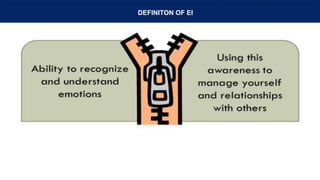
DEFINITON OF EI
• an ability, capacity, or skill to perceive, assess, and manage emotions of one’s self, of others, and of
groups
• coined by Salovey and Mayer in 1990
• popularised by Daniel Goleman (1995) in his book “Emotional Intelligence: Why it can matter more
than IQ?”
• defined as the aptitude to recognize, understand, express, manage, evaluate, and apply one's own and
other people's emotional states in order to maintain positive and fruitful interpersonal relationships
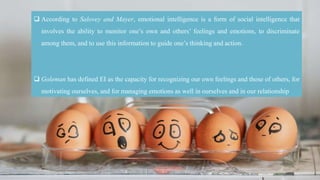
 According to Salovey and Mayer, emotional intelligence is a form of social intelligence that
involves the ability to monitor one’s own and others’ feelings and emotions, to discriminate
among them, and to use this information to guide one’s thinking and action.
 Goleman has defined EI as the capacity for recognizing our own feelings and those of others, for
motivating ourselves, and for managing emotions as well in ourselves and in our relationship
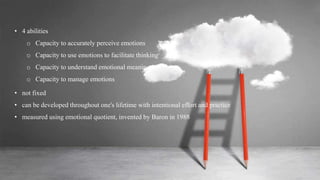
• 4 abilities
o Capacity to accurately perceive emotions
o Capacity to use emotions to facilitate thinking
o Capacity to understand emotional meaning
o Capacity to manage emotions
• not fixed
• can be developed throughout one's lifetime with intentional effort and practice
• measured using emotional quotient, invented by Baron in 1988
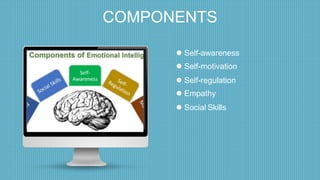
COMPONENTS
 Self-awareness
 Self-motivation
 Self-regulation
 Empathy
 Social Skills
• ability to recognize and understand your moods and emotions and
how they affect others
• Intrapersonal skills
• Self-actualization
• Using gut feelings to guide decisions
• can take themselves and life less seriously, have faith in their own
abilities, and can read body language
• Eg: one way to learn how others view you is by perusing their
responses.
Self-awareness
Self-regulation
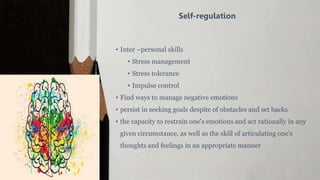
• Inter –personal skills
• Stress management
• Stress tolerance
• Impulse control
• Find ways to manage negative emotions
• persist in seeking goals despite of obstacles and set backs
• the capacity to restrain one's emotions and act rationally in any
given circumstance, as well as the skill of articulating one's
thoughts and feelings in an appropriate manner
• being driven to pursue goals for personal reasons, rather
than for some kind of reward
• help us take initiate and strive to improve
• persevere in the face of setbacks and frustrations
• about making plans and sticking to them
Self-motivation
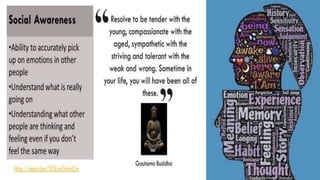
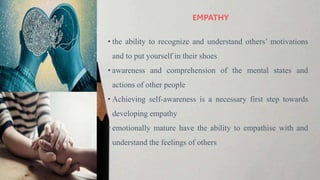
• the ability to recognize and understand others’ motivations
and to put yourself in their shoes
• awareness and comprehension of the mental states and
actions of other people
• Achieving self-awareness is a necessary first step towards
developing empathy
• emotionally mature have the ability to empathise with and
understand the feelings of others
EMPATHY
SOCIAL SKILLS
• The ability to manage relationships, build networks, and c
onnect with people
• Some of the skills:
o Handling emotions in relationships well
o accurately reading social situations and networks
o interacting smoothly
o using these skills to persuade and lead, negotiate
o settle disputes, for cooperation and teamwork
Life Skills.pptx

Life Skills.pptx

  • 1.
  • 2.
  • 3.
    • an ability,capacity, or skill to perceive, assess, and manage emotions of one’s self, of others, and of groups • coined by Salovey and Mayer in 1990 • popularised by Daniel Goleman (1995) in his book “Emotional Intelligence: Why it can matter more than IQ?” • defined as the aptitude to recognize, understand, express, manage, evaluate, and apply one's own and other people's emotional states in order to maintain positive and fruitful interpersonal relationships
  • 4.
     According toSalovey and Mayer, emotional intelligence is a form of social intelligence that involves the ability to monitor one’s own and others’ feelings and emotions, to discriminate among them, and to use this information to guide one’s thinking and action.  Goleman has defined EI as the capacity for recognizing our own feelings and those of others, for motivating ourselves, and for managing emotions as well in ourselves and in our relationship
  • 5.
    • 4 abilities oCapacity to accurately perceive emotions o Capacity to use emotions to facilitate thinking o Capacity to understand emotional meaning o Capacity to manage emotions • not fixed • can be developed throughout one's lifetime with intentional effort and practice • measured using emotional quotient, invented by Baron in 1988
  • 6.
    COMPONENTS  Self-awareness  Self-motivation Self-regulation  Empathy  Social Skills
  • 7.
    • ability torecognize and understand your moods and emotions and how they affect others • Intrapersonal skills • Self-actualization • Using gut feelings to guide decisions • can take themselves and life less seriously, have faith in their own abilities, and can read body language • Eg: one way to learn how others view you is by perusing their responses. Self-awareness
  • 9.
    Self-regulation • Inter –personalskills • Stress management • Stress tolerance • Impulse control • Find ways to manage negative emotions • persist in seeking goals despite of obstacles and set backs • the capacity to restrain one's emotions and act rationally in any given circumstance, as well as the skill of articulating one's thoughts and feelings in an appropriate manner
  • 10.
    • being drivento pursue goals for personal reasons, rather than for some kind of reward • help us take initiate and strive to improve • persevere in the face of setbacks and frustrations • about making plans and sticking to them Self-motivation
  • 11.
    • the abilityto recognize and understand others’ motivations and to put yourself in their shoes • awareness and comprehension of the mental states and actions of other people • Achieving self-awareness is a necessary first step towards developing empathy • emotionally mature have the ability to empathise with and understand the feelings of others EMPATHY
  • 12.
    SOCIAL SKILLS • Theability to manage relationships, build networks, and c onnect with people • Some of the skills: o Handling emotions in relationships well o accurately reading social situations and networks o interacting smoothly o using these skills to persuade and lead, negotiate o settle disputes, for cooperation and teamwork