1
International Open Access Week 2018 Program
at Northern Campus Library, Hokkaido University, Japan
Afternoon Talk on
Open Access and Predatory Journals
October 2018
Hokkaido University
Northern Campus Library
1. Predatory Journals, Open Access, and us
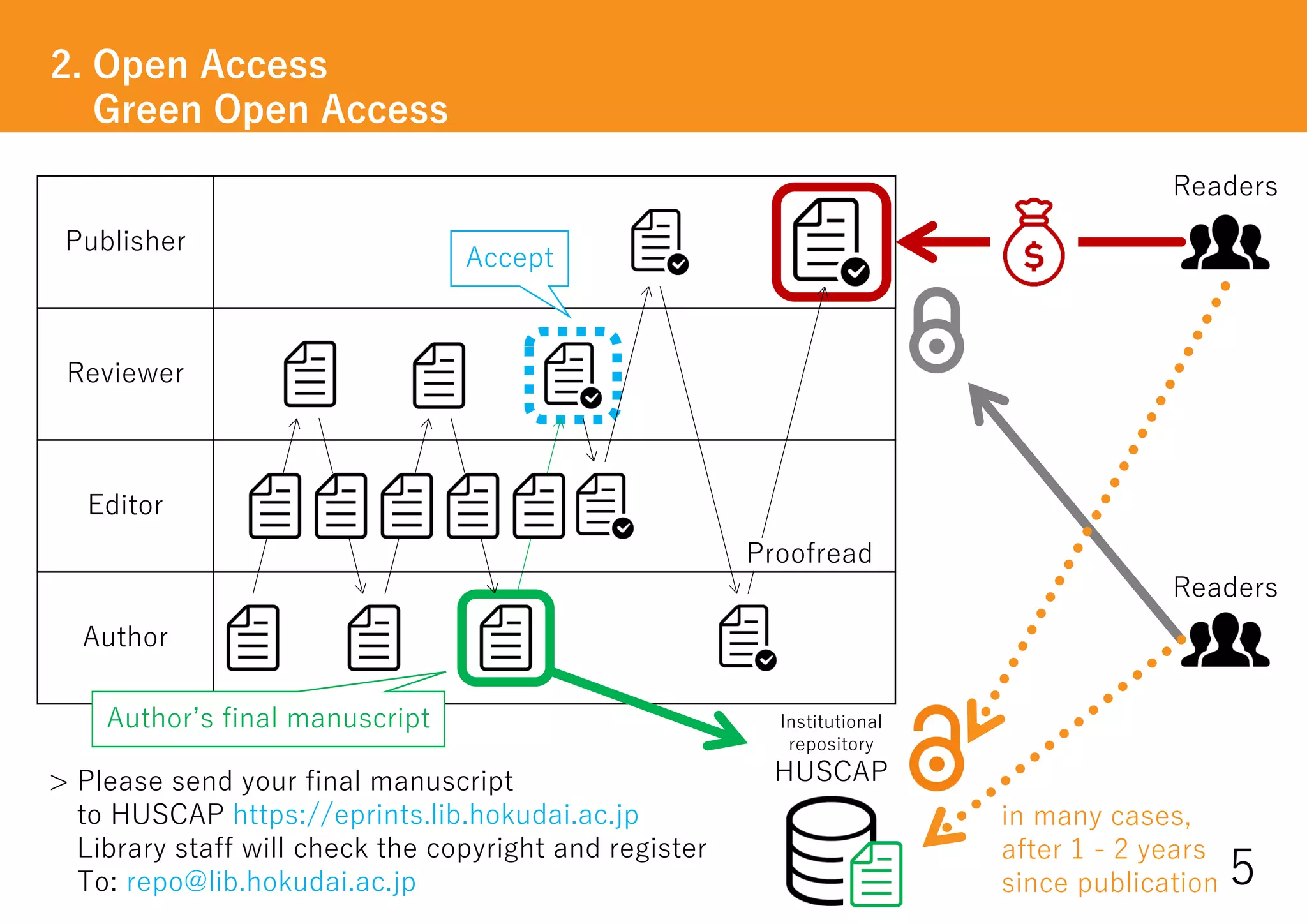
2. Open Access
3. Predatory Journals
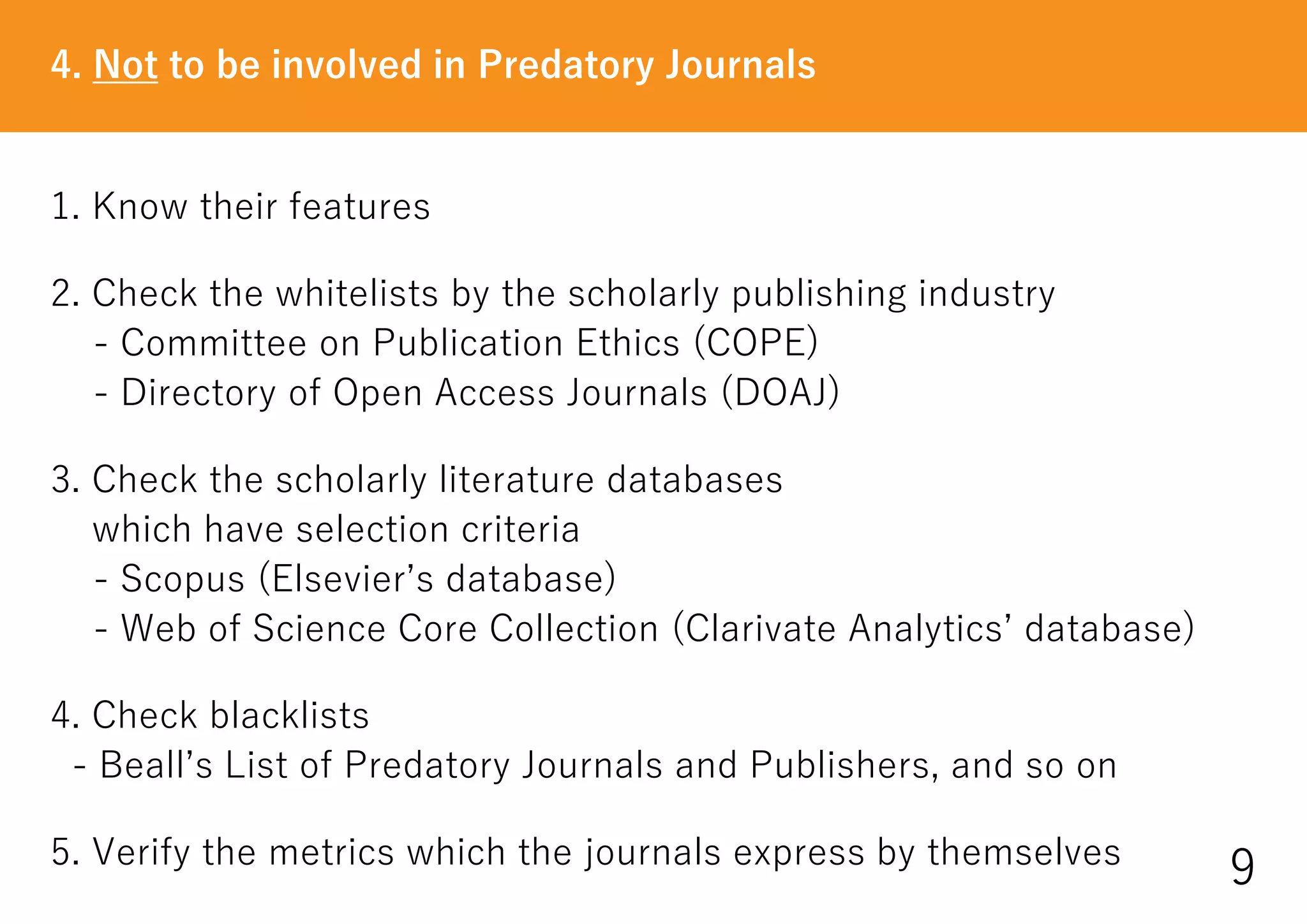
4. Not to be involved in Predatory Journals
1. Know their features
2. Check the whitelists by the scholarly publishing industry
3. Check the scholarly literature databases
which have selection criteria
4. Check blacklists
5. Verify the metrics which the journals express by themselves
5. Literacy, calm, and communication are important
Afternoon Talk on Open Access and Predatory Journals
2
Predatory Journals (in Japanese : 粗悪学術誌, ハゲタカジャーナル)
- intend for only revenue from publication fee paid by authors
> abuse of the business model for Open Access Journals
- Their peer review is poor/inappropriate, or not done,
and the quality of published papers is not guaranteed
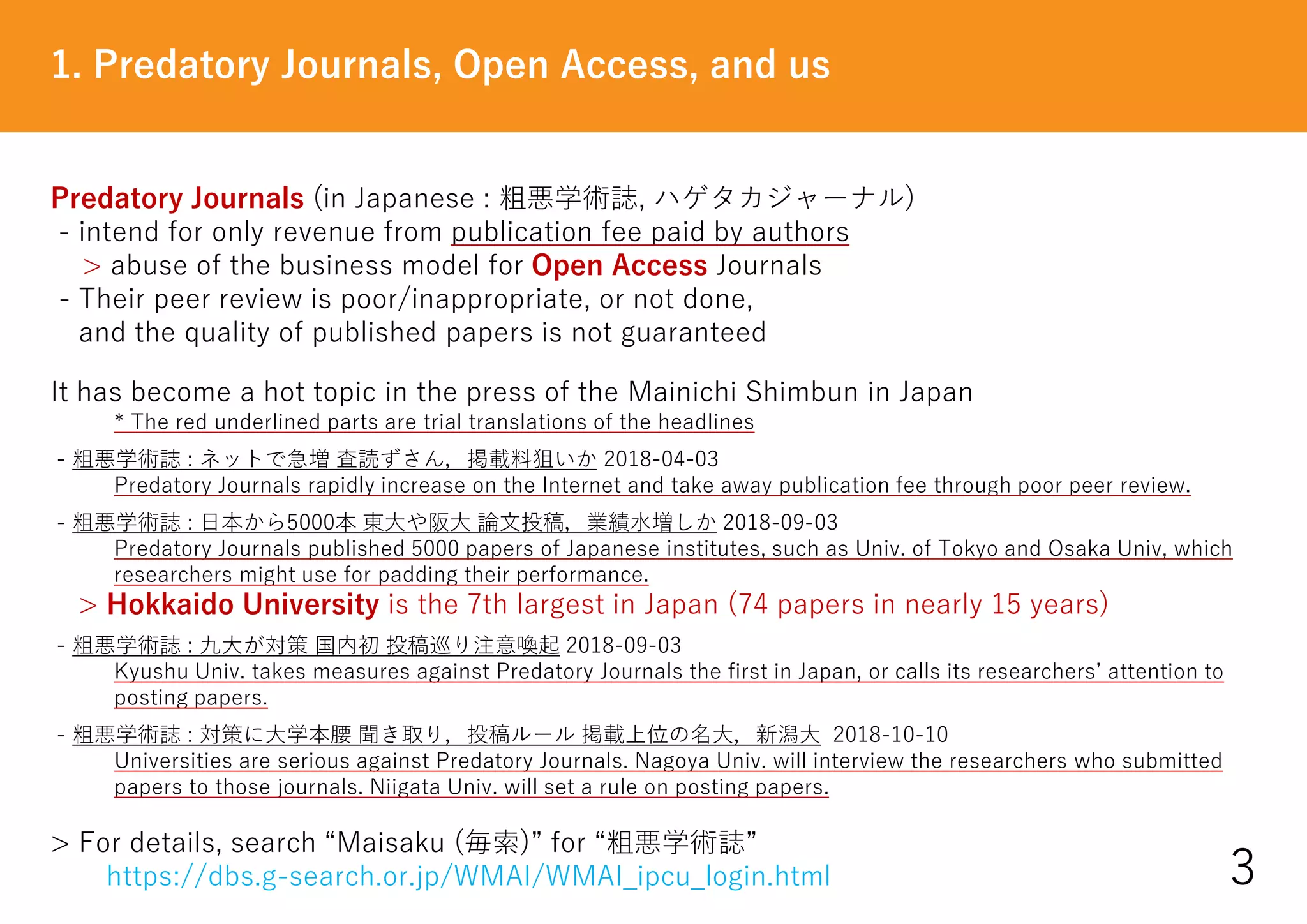
It has become a hot topic in the press of the Mainichi Shimbun in Japan
* The red underlined parts are trial translations of the headlines
- 粗悪学術誌 : ネットで急増 査読ずさん,掲載料狙いか 2018-04-03
Predatory Journals rapidly increase on the Internet and take away publication fee through poor peer review.
- 粗悪学術誌 : 日本から5000本 東大や阪大 論文投稿,業績水増しか 2018-09-03
Predatory Journals published 5000 papers of Japanese institutes, such as Univ. of Tokyo and Osaka Univ, which
researchers might use for padding their performance.
> Hokkaido University is the 7th largest in Japan (74 papers in nearly 15 years)
- 粗悪学術誌 : 九大が対策 国内初 投稿巡り注意喚起 2018-09-03
Kyushu Univ. takes measures against Predatory Journals the first in Japan, or calls its researchers’ attention to
posting papers.
- 粗悪学術誌 : 対策に大学本腰 聞き取り,投稿ルール 掲載上位の名大,新潟大 2018-10-10
Universities are serious against Predatory Journals. Nagoya Univ. will interview the researchers who submitted
papers to those journals. Niigata Univ. will set a rule on posting papers.
> For details, search “Maisaku (毎索)” for “粗悪学術誌”
https://dbs.g-search.or.jp/WMAI/WMAI_ipcu_login.html
1. Predatory Journals, Open Access, and us
3
0%
20%
40%
60%
80%
100%
1998 1999 2000 2001 2002 2003 2004 2005 2006 2007 2008 2009 2010 2011 2012 2013 2014 2015 2016 2017
To publish research works on the Internet
and make them available for free by everyone
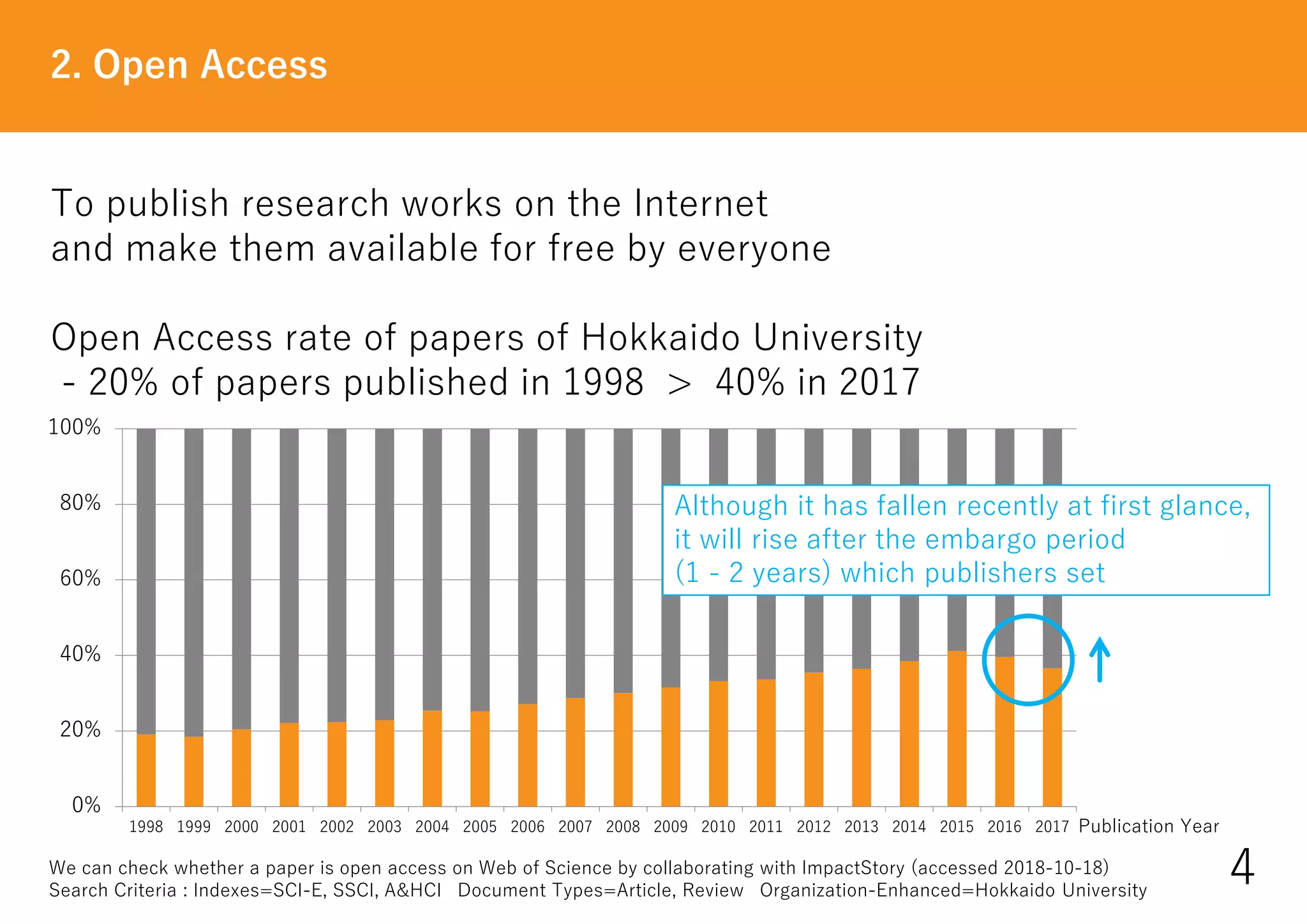
Open Access rate of papers of Hokkaido University
- 20% of papers published in 1998 > 40% in 2017
2. Open Access
4We can check whether a paper is open access on Web of Science by collaborating with ImpactStory (accessed 2018-10-18)
Search Criteria : Indexes=SCI-E, SSCI, A&HCI Document Types=Article, Review Organization-Enhanced=Hokkaido University
Publication Year
Although it has fallen recently at first glance,
it will rise after the embargo period
(1 - 2 years) which publishers set
2. Open Access
Green Open Access
5
Publisher
Reviewer
Editor
Author
Readers
Readers
Accept
Proofread
Institutional
repository
HUSCAP> Please send your final manuscript
to HUSCAP https://eprints.lib.hokudai.ac.jp
Library staff will check the copyright and register
To: repo@lib.hokudai.ac.jp
Author’s final manuscript
in many cases,
after 1 - 2 years
since publication
2. Open Access
Gold Open Access
6
Publisher
Reviewer
Editor
Author
Readers
Readers
Accept
APC : Article Processing Charge
> Discounts for Gold Open Access
https://www.lib.hokudai.ac.jp/en/support/apc
Proofread
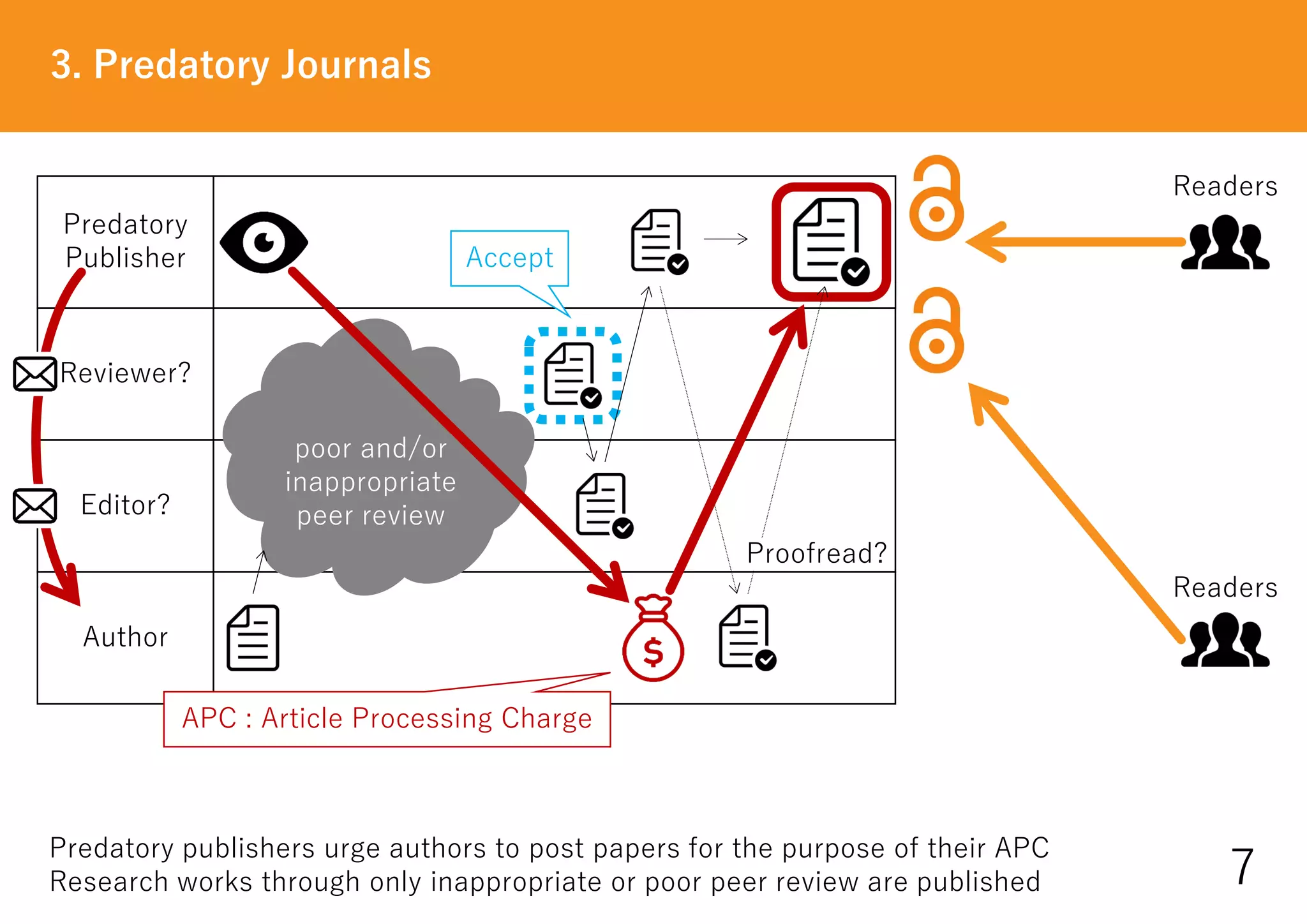
3. Predatory Journals
7
Predatory
Publisher
Reviewer?
Editor?
Author
Readers
Readers
Accept
APC : Article Processing Charge
Proofread?
Predatory publishers urge authors to post papers for the purpose of their APC
Research works through only inappropriate or poor peer review are published
poor and/or
inappropriate
peer review
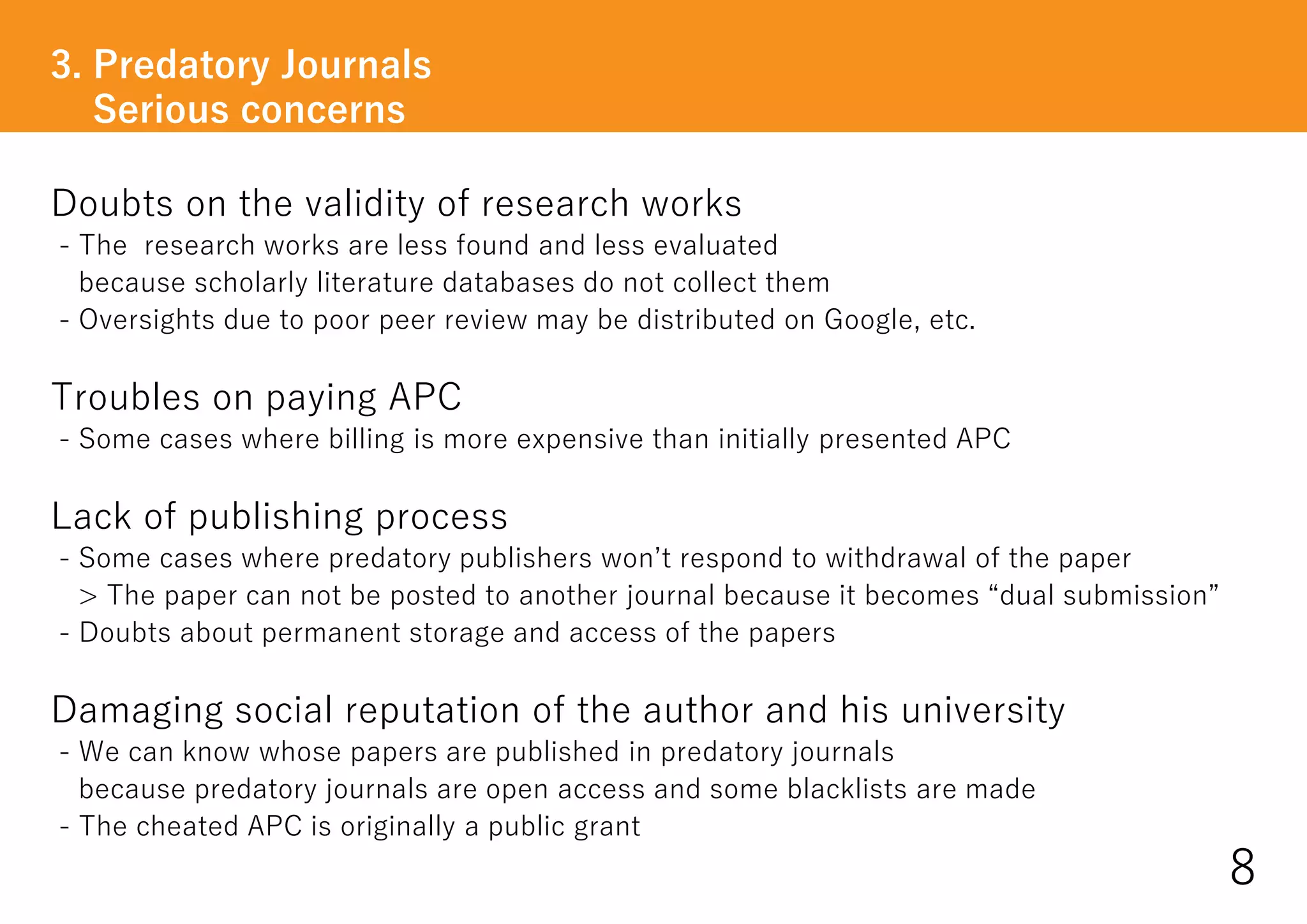
Doubts on the validity of research works
- The research works are less found and less evaluated
because scholarly literature databases do not collect them
- Oversights due to poor peer review may be distributed on Google, etc.
Troubles on paying APC
- Some cases where billing is more expensive than initially presented APC
Lack of publishing process
- Some cases where predatory publishers won’t respond to withdrawal of the paper
> The paper can not be posted to another journal because it becomes “dual submission”
- Doubts about permanent storage and access of the papers
Damaging social reputation of the author and his university
- We can know whose papers are published in predatory journals
because predatory journals are open access and some blacklists are made
- The cheated APC is originally a public grant
3. Predatory Journals
Serious concerns
8
1. Know their features
2. Check the whitelists by the scholarly publishing industry
- Committee on Publication Ethics (COPE)
- Directory of Open Access Journals (DOAJ)
3. Check the scholarly literature databases
which have selection criteria
- Scopus (Elsevier’s database)
- Web of Science Core Collection (Clarivate Analytics’ database)
4. Check blacklists
- Beall’s List of Predatory Journals and Publishers, and so on
5. Verify the metrics which the journals express by themselves
4. Not to be involved in Predatory Journals
9
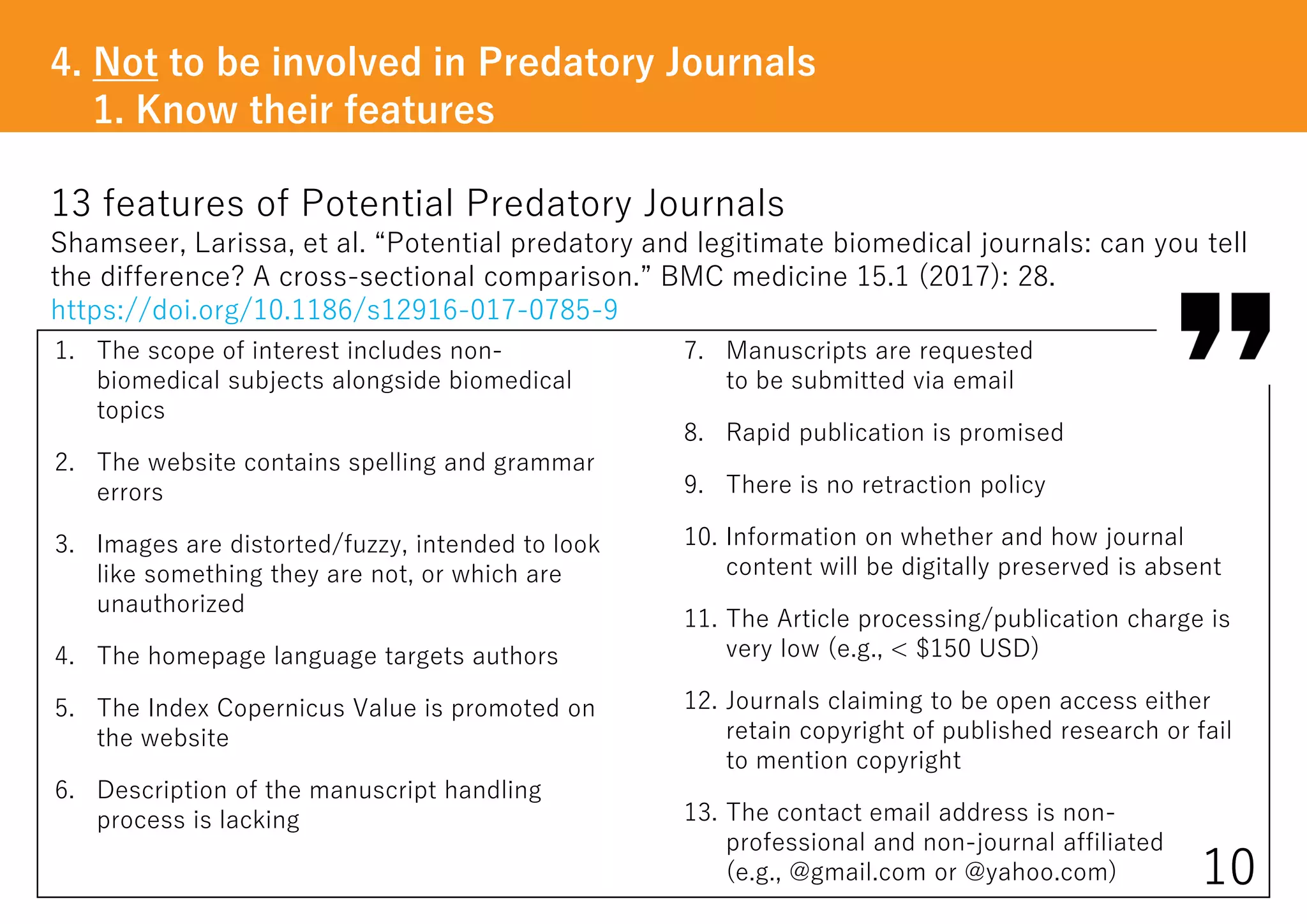
13 features of Potential Predatory Journals
Shamseer, Larissa, et al. “Potential predatory and legitimate biomedical journals: can you tell
the difference? A cross-sectional comparison.” BMC medicine 15.1 (2017): 28.
https://doi.org/10.1186/s12916-017-0785-9
4. Not to be involved in Predatory Journals
1. Know their features
10
1. The scope of interest includes non-
biomedical subjects alongside biomedical
topics
2. The website contains spelling and grammar
errors
3. Images are distorted/fuzzy, intended to look
like something they are not, or which are
unauthorized
4. The homepage language targets authors
5. The Index Copernicus Value is promoted on
the website
6. Description of the manuscript handling
process is lacking
7. Manuscripts are requested
to be submitted via email
8. Rapid publication is promised
9. There is no retraction policy
10. Information on whether and how journal
content will be digitally preserved is absent
11. The Article processing/publication charge is
very low (e.g., < $150 USD)
12. Journals claiming to be open access either
retain copyright of published research or fail
to mention copyright
13. The contact email address is non-
professional and non-journal affiliated
(e.g., @gmail.com or @yahoo.com)
Committee on Publication Ethics (COPE) - Members
https://publicationethics.org/members
4. Not to be involved in Predatory Journals
2. Check the whitelists by the scholarly publishing industry
11
12,036 journals (including
non-OA journals) join COPE
(accessed 2018-10-23)
Directory of Open Access Journals (DOAJ)
https://doaj.org
4. Not to be involved in Predatory Journals
2. Check the whitelists by the scholarly publishing industry
12
12,917 peer-reviewed OA journals pass
the rigorous screening and are registered
(accessed 2018-10-23)
Scopus
https://www.scopus.com/sources
13
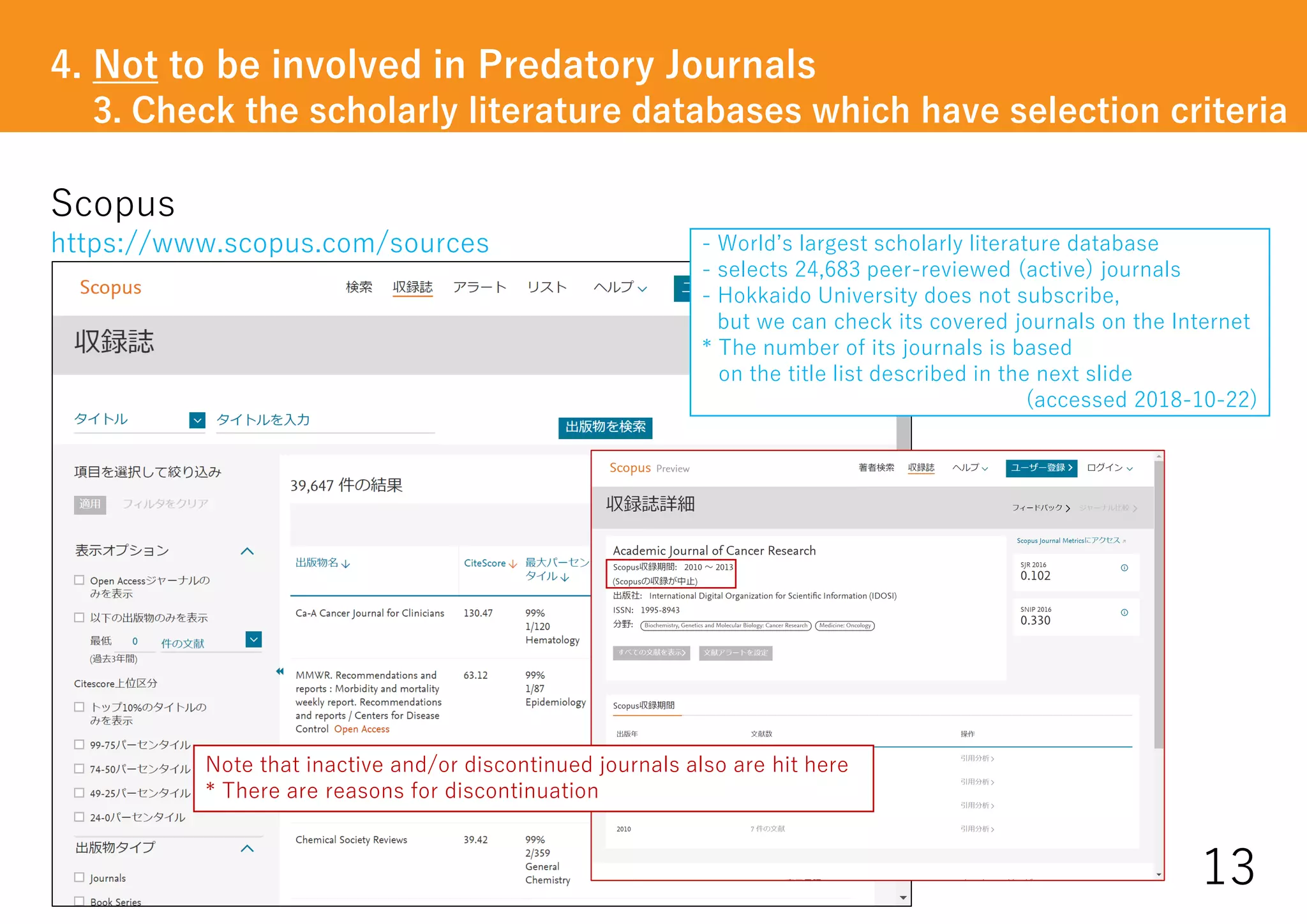
- World’s largest scholarly literature database
- selects 24,683 peer-reviewed (active) journals
- Hokkaido University does not subscribe,
but we can check its covered journals on the Internet
* The number of its journals is based
on the title list described in the next slide
(accessed 2018-10-22)
Note that inactive and/or discontinued journals also are hit here
* There are reasons for discontinuation
4. Not to be involved in Predatory Journals
3. Check the scholarly literature databases which have selection criteria
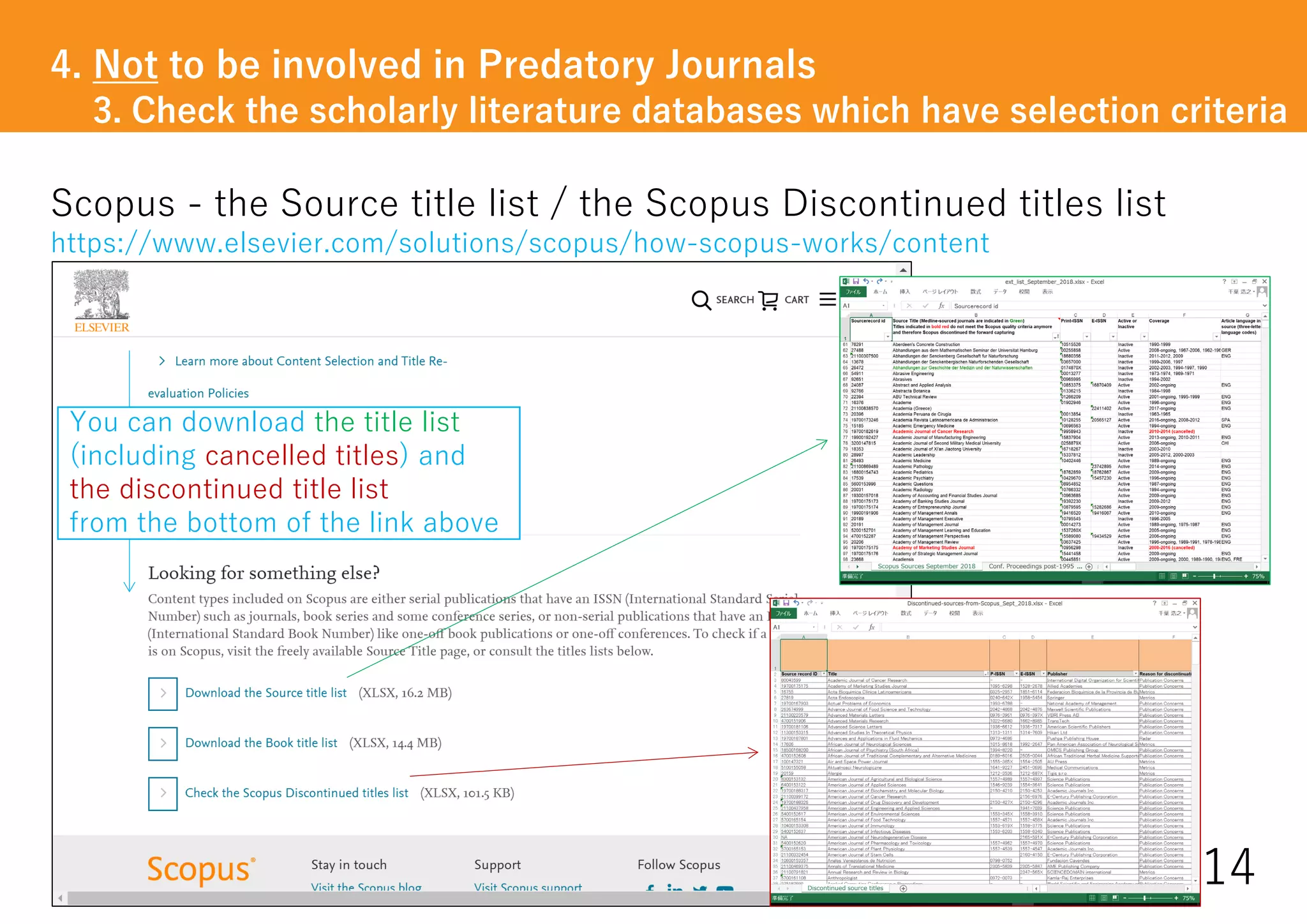
Scopus - the Source title list / the Scopus Discontinued titles list
https://www.elsevier.com/solutions/scopus/how-scopus-works/content
14
You can download the title list
(including cancelled titles) and
the discontinued title list
from the bottom of the link above
4. Not to be involved in Predatory Journals
3. Check the scholarly literature databases which have selection criteria
Web of Science Core Collection - SCI-E, SSCI, A&HCI, & ESCI
http://webofknowledge.com/wos
15
- World’s largest scholarly literature database
- All the index files of journals are available in Hokkaido University
- famous for its rigorous selection criteria
- The collection has covered 20,687 peer-reviewed journals
by the addition of the new index file, ESCI since 2015
* The number of the covered journals is based
on the Master Journal List described on the next slide
(accessed 2018-10-22)
Web of Science by Clarivate Analytics
4. Not to be involved in Predatory Journals
3. Check the scholarly literature databases which have selection criteria
Web of Science - Master Journal List
http://mjl.clarivate.com
16
On the Internet we can check the journals covered
by Web of Science Core Collection,
and also the journals of other index files,
whose criteria differ from the collection above
4. Not to be involved in Predatory Journals
3. Check the scholarly literature databases which have selection criteria
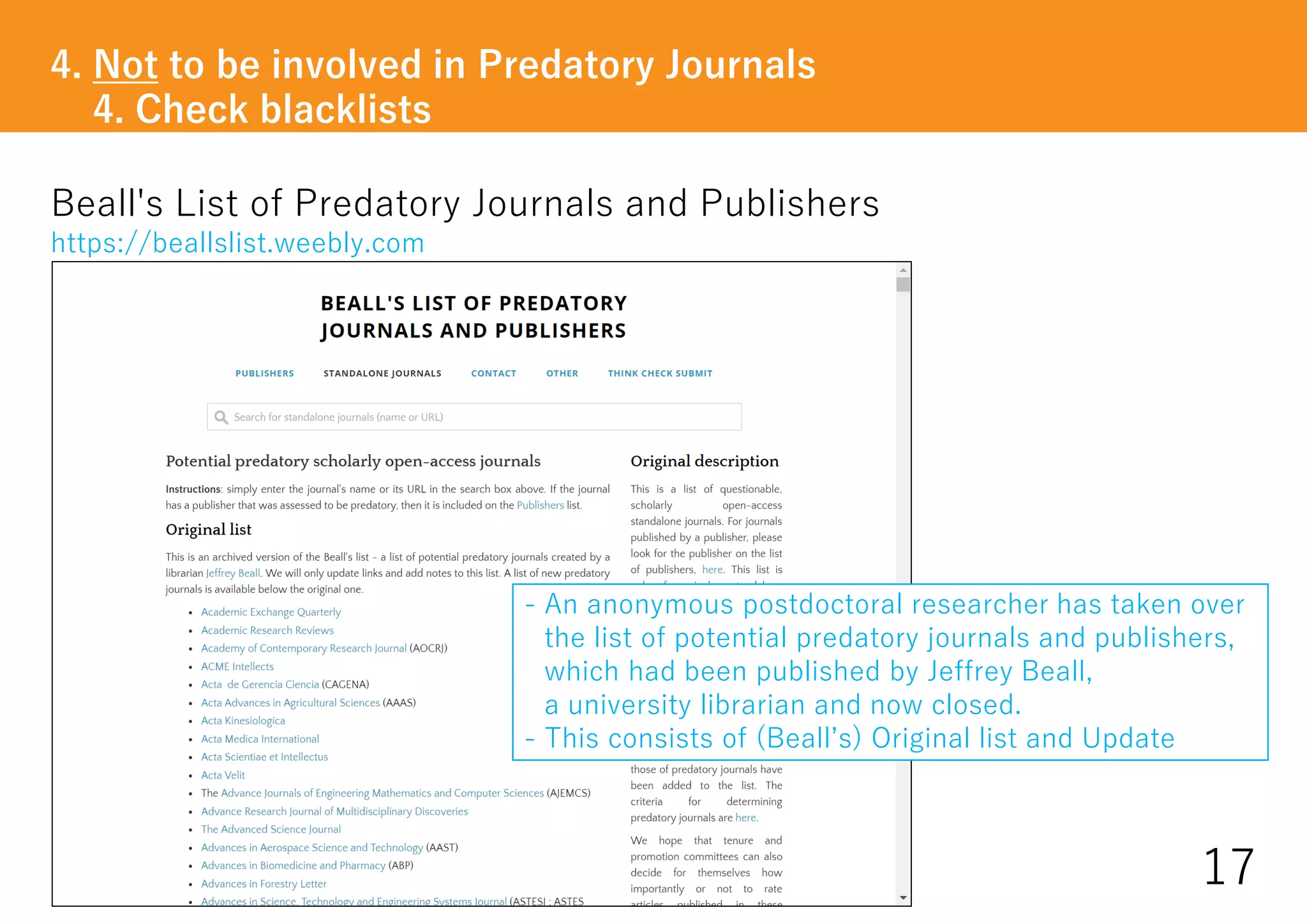
Beall's List of Predatory Journals and Publishers
https://beallslist.weebly.com
4. Not to be involved in Predatory Journals
4. Check blacklists
17
- An anonymous postdoctoral researcher has taken over
the list of potential predatory journals and publishers,
which had been published by Jeffrey Beall,
a university librarian and now closed.
- This consists of (Beall’s) Original list and Update
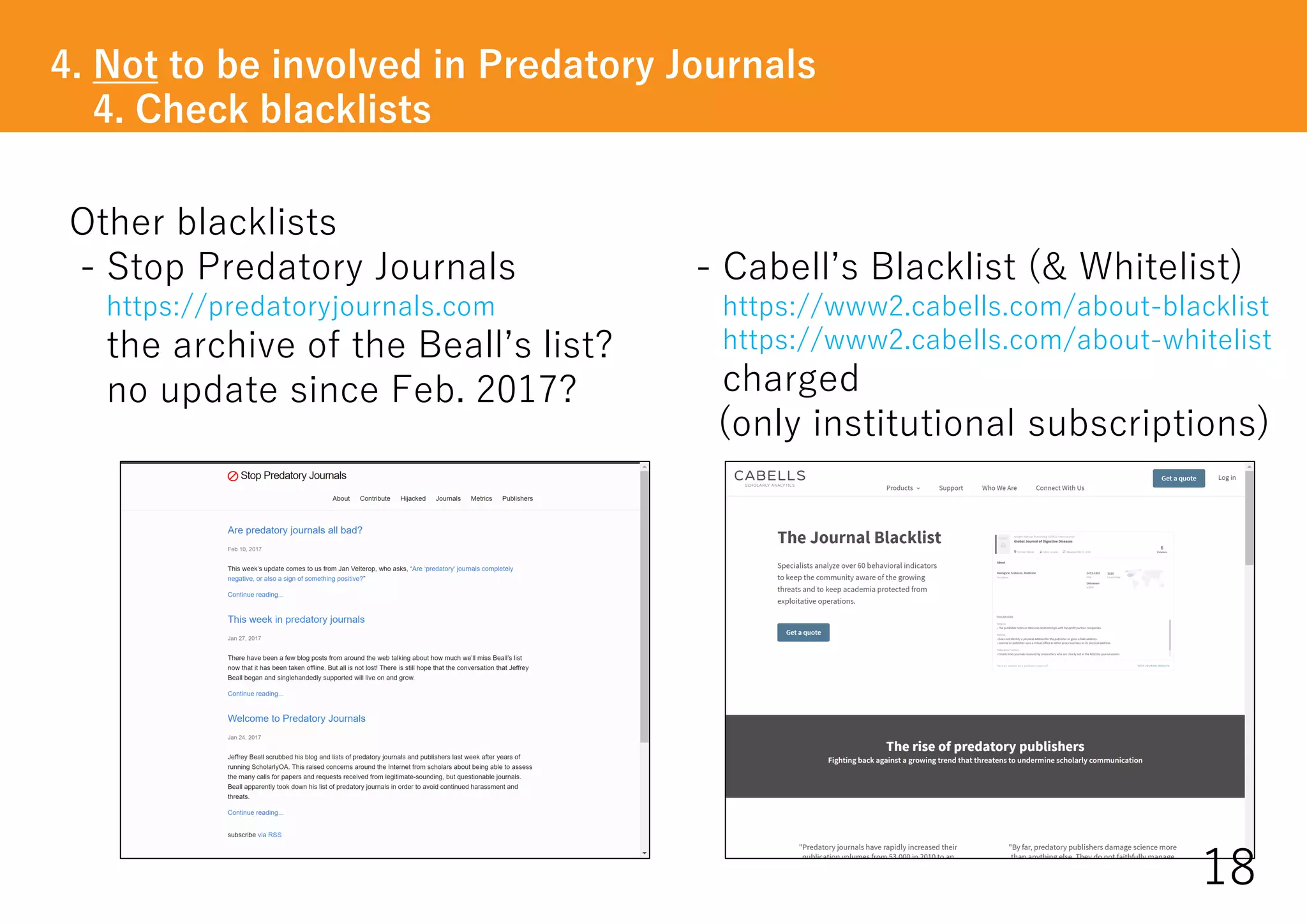
- Cabell’s Blacklist (& Whitelist)
https://www2.cabells.com/about-blacklist
https://www2.cabells.com/about-whitelist
charged
(only institutional subscriptions)
4. Not to be involved in Predatory Journals
4. Check blacklists
18
Other blacklists
- Stop Predatory Journals
https://predatoryjournals.com
the archive of the Beall’s list?
no update since Feb. 2017?
Journal Impact Factor : JIF, one of the most famous metrics
- calculated and provided by Clarivate Analytics
- for only the journals covered by SCI-E or SSCI of Web of Science Core Collection
(i.e. top journals of natural science or social sciences)
- The first JIF of a journal needs 3 years from the first issue
- We can check JIF on Journal Citation Reports (JCR)
http://jcr.incites.thomsonreuters.com
4. Not to be involved in Predatory Journals
5. Verify the metrics which the journals express by themselves
19Journal Citation Reports by Clarivate Analytics
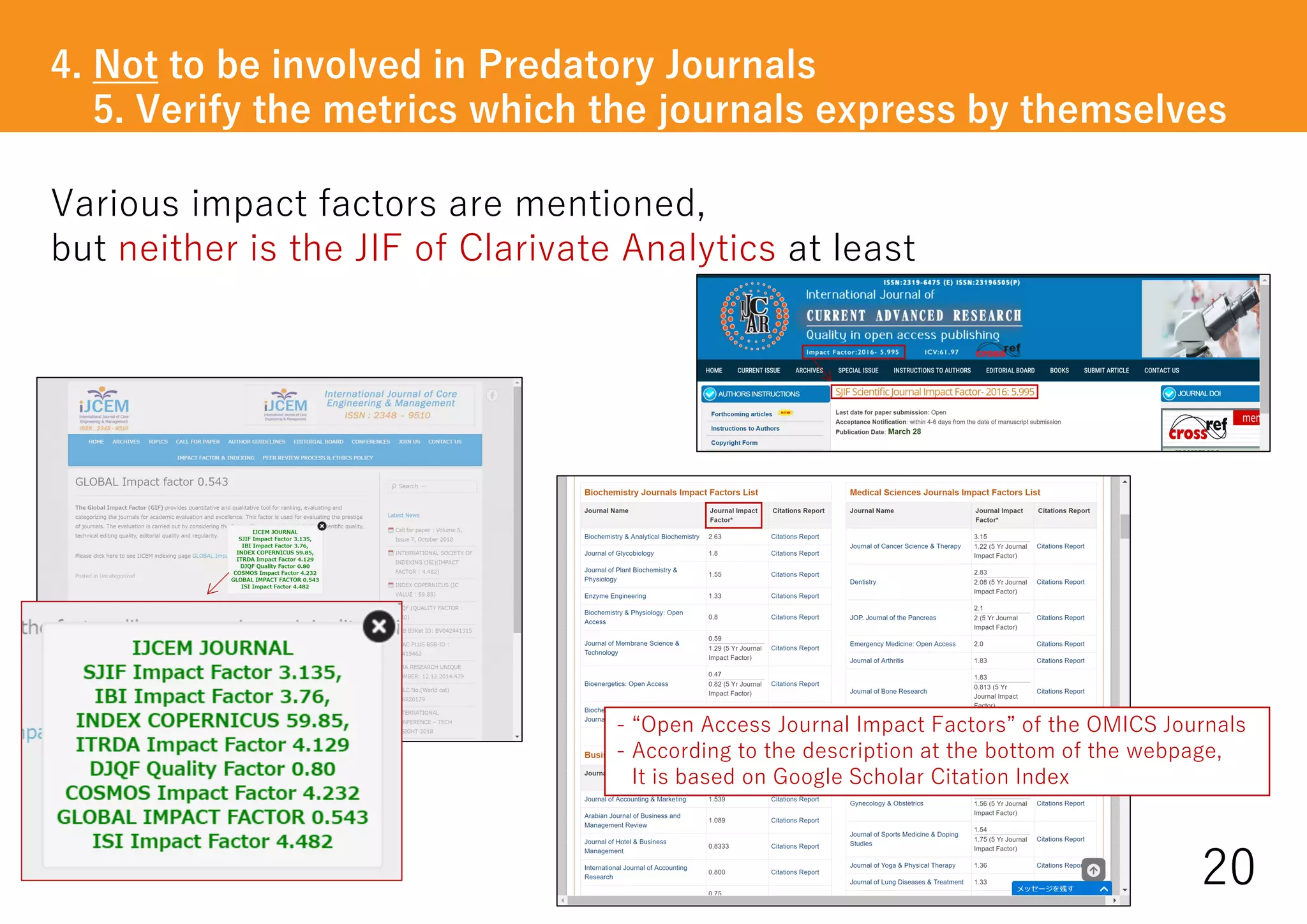
Various impact factors are mentioned,
but neither is the JIF of Clarivate Analytics at least
20
- “Open Access Journal Impact Factors” of the OMICS Journals
- According to the description at the bottom of the webpage,
It is based on Google Scholar Citation Index
4. Not to be involved in Predatory Journals
5. Verify the metrics which the journals express by themselves
Think. Check. Submit.
https://thinkchecksubmit.org
http://thinkchecksubmit.org/translations/japanese
I think the followings are important:
- beware sweet words
(excessively flattering call for papers, too short publication process)
- do not lose to the pressure of “Publish or perish”
- consult with your boss and colleagues (and also library staff!)
5. Literacy, calm, and communication are important
21
ASK
ME
ANYTIME:
kitacam@lib.hokudai.ac.jp
22

Afternoon Talk on Open Access and Predatory Journals

  • 1.
    1 International Open AccessWeek 2018 Program at Northern Campus Library, Hokkaido University, Japan Afternoon Talk on Open Access and Predatory Journals October 2018 Hokkaido University Northern Campus Library
  • 2.
    1. Predatory Journals,Open Access, and us 2. Open Access 3. Predatory Journals 4. Not to be involved in Predatory Journals 1. Know their features 2. Check the whitelists by the scholarly publishing industry 3. Check the scholarly literature databases which have selection criteria 4. Check blacklists 5. Verify the metrics which the journals express by themselves 5. Literacy, calm, and communication are important Afternoon Talk on Open Access and Predatory Journals 2
  • 3.
    Predatory Journals (inJapanese : 粗悪学術誌, ハゲタカジャーナル) - intend for only revenue from publication fee paid by authors > abuse of the business model for Open Access Journals - Their peer review is poor/inappropriate, or not done, and the quality of published papers is not guaranteed It has become a hot topic in the press of the Mainichi Shimbun in Japan * The red underlined parts are trial translations of the headlines - 粗悪学術誌 : ネットで急増 査読ずさん,掲載料狙いか 2018-04-03 Predatory Journals rapidly increase on the Internet and take away publication fee through poor peer review. - 粗悪学術誌 : 日本から5000本 東大や阪大 論文投稿,業績水増しか 2018-09-03 Predatory Journals published 5000 papers of Japanese institutes, such as Univ. of Tokyo and Osaka Univ, which researchers might use for padding their performance. > Hokkaido University is the 7th largest in Japan (74 papers in nearly 15 years) - 粗悪学術誌 : 九大が対策 国内初 投稿巡り注意喚起 2018-09-03 Kyushu Univ. takes measures against Predatory Journals the first in Japan, or calls its researchers’ attention to posting papers. - 粗悪学術誌 : 対策に大学本腰 聞き取り,投稿ルール 掲載上位の名大,新潟大 2018-10-10 Universities are serious against Predatory Journals. Nagoya Univ. will interview the researchers who submitted papers to those journals. Niigata Univ. will set a rule on posting papers. > For details, search “Maisaku (毎索)” for “粗悪学術誌” https://dbs.g-search.or.jp/WMAI/WMAI_ipcu_login.html 1. Predatory Journals, Open Access, and us 3
  • 4.
    0% 20% 40% 60% 80% 100% 1998 1999 20002001 2002 2003 2004 2005 2006 2007 2008 2009 2010 2011 2012 2013 2014 2015 2016 2017 To publish research works on the Internet and make them available for free by everyone Open Access rate of papers of Hokkaido University - 20% of papers published in 1998 > 40% in 2017 2. Open Access 4We can check whether a paper is open access on Web of Science by collaborating with ImpactStory (accessed 2018-10-18) Search Criteria : Indexes=SCI-E, SSCI, A&HCI Document Types=Article, Review Organization-Enhanced=Hokkaido University Publication Year Although it has fallen recently at first glance, it will rise after the embargo period (1 - 2 years) which publishers set
  • 5.
    2. Open Access GreenOpen Access 5 Publisher Reviewer Editor Author Readers Readers Accept Proofread Institutional repository HUSCAP> Please send your final manuscript to HUSCAP https://eprints.lib.hokudai.ac.jp Library staff will check the copyright and register To: repo@lib.hokudai.ac.jp Author’s final manuscript in many cases, after 1 - 2 years since publication
  • 6.
    2. Open Access GoldOpen Access 6 Publisher Reviewer Editor Author Readers Readers Accept APC : Article Processing Charge > Discounts for Gold Open Access https://www.lib.hokudai.ac.jp/en/support/apc Proofread
  • 7.
    3. Predatory Journals 7 Predatory Publisher Reviewer? Editor? Author Readers Readers Accept APC: Article Processing Charge Proofread? Predatory publishers urge authors to post papers for the purpose of their APC Research works through only inappropriate or poor peer review are published poor and/or inappropriate peer review
  • 8.
    Doubts on thevalidity of research works - The research works are less found and less evaluated because scholarly literature databases do not collect them - Oversights due to poor peer review may be distributed on Google, etc. Troubles on paying APC - Some cases where billing is more expensive than initially presented APC Lack of publishing process - Some cases where predatory publishers won’t respond to withdrawal of the paper > The paper can not be posted to another journal because it becomes “dual submission” - Doubts about permanent storage and access of the papers Damaging social reputation of the author and his university - We can know whose papers are published in predatory journals because predatory journals are open access and some blacklists are made - The cheated APC is originally a public grant 3. Predatory Journals Serious concerns 8
  • 9.
    1. Know theirfeatures 2. Check the whitelists by the scholarly publishing industry - Committee on Publication Ethics (COPE) - Directory of Open Access Journals (DOAJ) 3. Check the scholarly literature databases which have selection criteria - Scopus (Elsevier’s database) - Web of Science Core Collection (Clarivate Analytics’ database) 4. Check blacklists - Beall’s List of Predatory Journals and Publishers, and so on 5. Verify the metrics which the journals express by themselves 4. Not to be involved in Predatory Journals 9
  • 10.
    13 features ofPotential Predatory Journals Shamseer, Larissa, et al. “Potential predatory and legitimate biomedical journals: can you tell the difference? A cross-sectional comparison.” BMC medicine 15.1 (2017): 28. https://doi.org/10.1186/s12916-017-0785-9 4. Not to be involved in Predatory Journals 1. Know their features 10 1. The scope of interest includes non- biomedical subjects alongside biomedical topics 2. The website contains spelling and grammar errors 3. Images are distorted/fuzzy, intended to look like something they are not, or which are unauthorized 4. The homepage language targets authors 5. The Index Copernicus Value is promoted on the website 6. Description of the manuscript handling process is lacking 7. Manuscripts are requested to be submitted via email 8. Rapid publication is promised 9. There is no retraction policy 10. Information on whether and how journal content will be digitally preserved is absent 11. The Article processing/publication charge is very low (e.g., < $150 USD) 12. Journals claiming to be open access either retain copyright of published research or fail to mention copyright 13. The contact email address is non- professional and non-journal affiliated (e.g., @gmail.com or @yahoo.com)
  • 11.
    Committee on PublicationEthics (COPE) - Members https://publicationethics.org/members 4. Not to be involved in Predatory Journals 2. Check the whitelists by the scholarly publishing industry 11 12,036 journals (including non-OA journals) join COPE (accessed 2018-10-23)
  • 12.
    Directory of OpenAccess Journals (DOAJ) https://doaj.org 4. Not to be involved in Predatory Journals 2. Check the whitelists by the scholarly publishing industry 12 12,917 peer-reviewed OA journals pass the rigorous screening and are registered (accessed 2018-10-23)
  • 13.
    Scopus https://www.scopus.com/sources 13 - World’s largestscholarly literature database - selects 24,683 peer-reviewed (active) journals - Hokkaido University does not subscribe, but we can check its covered journals on the Internet * The number of its journals is based on the title list described in the next slide (accessed 2018-10-22) Note that inactive and/or discontinued journals also are hit here * There are reasons for discontinuation 4. Not to be involved in Predatory Journals 3. Check the scholarly literature databases which have selection criteria
  • 14.
    Scopus - theSource title list / the Scopus Discontinued titles list https://www.elsevier.com/solutions/scopus/how-scopus-works/content 14 You can download the title list (including cancelled titles) and the discontinued title list from the bottom of the link above 4. Not to be involved in Predatory Journals 3. Check the scholarly literature databases which have selection criteria
  • 15.
    Web of ScienceCore Collection - SCI-E, SSCI, A&HCI, & ESCI http://webofknowledge.com/wos 15 - World’s largest scholarly literature database - All the index files of journals are available in Hokkaido University - famous for its rigorous selection criteria - The collection has covered 20,687 peer-reviewed journals by the addition of the new index file, ESCI since 2015 * The number of the covered journals is based on the Master Journal List described on the next slide (accessed 2018-10-22) Web of Science by Clarivate Analytics 4. Not to be involved in Predatory Journals 3. Check the scholarly literature databases which have selection criteria
  • 16.
    Web of Science- Master Journal List http://mjl.clarivate.com 16 On the Internet we can check the journals covered by Web of Science Core Collection, and also the journals of other index files, whose criteria differ from the collection above 4. Not to be involved in Predatory Journals 3. Check the scholarly literature databases which have selection criteria
  • 17.
    Beall's List ofPredatory Journals and Publishers https://beallslist.weebly.com 4. Not to be involved in Predatory Journals 4. Check blacklists 17 - An anonymous postdoctoral researcher has taken over the list of potential predatory journals and publishers, which had been published by Jeffrey Beall, a university librarian and now closed. - This consists of (Beall’s) Original list and Update
  • 18.
    - Cabell’s Blacklist(& Whitelist) https://www2.cabells.com/about-blacklist https://www2.cabells.com/about-whitelist charged (only institutional subscriptions) 4. Not to be involved in Predatory Journals 4. Check blacklists 18 Other blacklists - Stop Predatory Journals https://predatoryjournals.com the archive of the Beall’s list? no update since Feb. 2017?
  • 19.
    Journal Impact Factor: JIF, one of the most famous metrics - calculated and provided by Clarivate Analytics - for only the journals covered by SCI-E or SSCI of Web of Science Core Collection (i.e. top journals of natural science or social sciences) - The first JIF of a journal needs 3 years from the first issue - We can check JIF on Journal Citation Reports (JCR) http://jcr.incites.thomsonreuters.com 4. Not to be involved in Predatory Journals 5. Verify the metrics which the journals express by themselves 19Journal Citation Reports by Clarivate Analytics
  • 20.
    Various impact factorsare mentioned, but neither is the JIF of Clarivate Analytics at least 20 - “Open Access Journal Impact Factors” of the OMICS Journals - According to the description at the bottom of the webpage, It is based on Google Scholar Citation Index 4. Not to be involved in Predatory Journals 5. Verify the metrics which the journals express by themselves
  • 21.
    Think. Check. Submit. https://thinkchecksubmit.org http://thinkchecksubmit.org/translations/japanese Ithink the followings are important: - beware sweet words (excessively flattering call for papers, too short publication process) - do not lose to the pressure of “Publish or perish” - consult with your boss and colleagues (and also library staff!) 5. Literacy, calm, and communication are important 21
  • 22.