Snehal Arun Mane
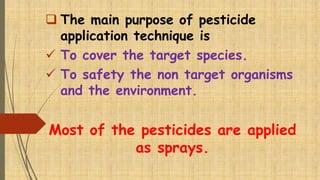
 The main purpose of pesticide
application technique is
 To cover the target species.
 To safety the non target organisms
and the environment.
Most of the pesticides are applied
as sprays.
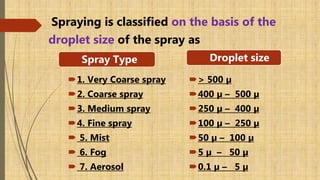
Spraying is classified on the basis of the
droplet size of the spray as
Spray Type
1. Very Coarse spray
2. Coarse spray
3. Medium spray
4. Fine spray
 5. Mist
 6. Fog
 7. Aerosol
Droplet size
> 500 µ
400 µ – 500 µ
250 µ – 400 µ
100 µ – 250 µ
50 µ – 100 µ
5 µ – 50 µ
0.1 µ – 5 µ
On the basis of Volume of spray fluid per
unit area, Spraying is classified as
1. High volume spraying (HVS) or
Full Cover spraying or
conventional spraying
2. Low volume spray (LVS)
3. Ultra low volume spray (ULVS)
4. Aerial spraying
1.High volume spraying (HVS)
Pesticide is diluted with water and
droplet size is larger.
Spray fluid requirement is -
500 – 1000 lit/ha in case of field
crops
1500 – 2000 lit/ha – Orchard
crops.
Advantages : 1. Meant for chewing insects.
2. Drift is very less
Disadvantages : 1. Less area is covered
2. More water is required
3. More time; labor and
labor cost
2.Low volume spray (LVS)
The low volume sprays are 8-25
times more concentrated than high
volume spraying.
 Spray fluid requirement ranges
from 12 -125 lit/ha.
 The droplet size is 70 – 150 µ.
Advantages
Less time required
The cost of application is minimized
 More area is covered (6 – 8 acres
in a day)
Control of pests is in time
Disadvantages
Loss of chemical.
 Application of LVS is preferred
when wind velocity is less than 8
km/hour.
3.Ultra low volume spray (ULVS)
ULV sprayer or air craft with
special nozzles require 0.5 -
5.6 lit/ha
Droplet size of 20 – 70 µ.
Advantages
 Very less time is
required
 Little or No
water requirement
 Labor cost is less
 Larger area
covered (8
ha/day).
Disadvantages
 Drift is more
 More hazardous
 Special
foundations are
needed
 High cost
4.Aerial spraying
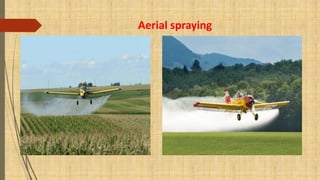
 Aerial Air crafts has been employed
for application of agricultural and
public health pesticides.
 It is used for spraying, dusting and
application of baits.
Aerial spraying
Spray formulations are more suitable
than dusts because of wind speed
should not be more than > 5 KMPH.
 It has to be done at low heights
and in the early hours of the days to
ensure uniform deposition of dust
particles.
Advantages
Large area covered
Locusts, cut worms, army worms
could be checked before much damage
is done.
Cost of application is cheap per unit
area.
Inaccessible areas are also can be
protected.
Disadvantages
Drift is more
Undersurface of leaves is not fully
covered
Depend on weather conditions
Preplanning and collaboration with
other agencies is required
Pollution is more
ECOSYSTEM AND
THEIR TYPES
SNEHAL ARUN MANE
G. Tansley - in 1935.
Ecosystem is ecological system
where all living and non living
factors of environment interact
with each other with their own
component .
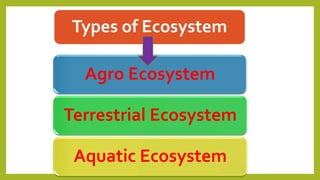
Types of Ecosystem
Agro Ecosystem
Terrestrial Ecosystem
Aquatic Ecosystem
1.Agro ecosystem
It is an artificial ecosystem created
by man introducing crops or plants
for cultivation.
Eg- Pest of various crops
2.Terrestrial ecosystem
Terrestrial habitats includes
insect life on land
ie - Forest ,Desert, Mountains,
Plains and Valleys
Soil is an important factor in terrestrial
habitats because it supports the vegetation
growing in that area.
Terrestrial insect benefited with supply of
oxygen and carbon dioxide and good support
of soil as media.
Eg- Grasshopper , Termite, White grub,
Butterfly , Moths.
3.Aquatic Ecosystem
Insect life present in water .
It includes fishes ,whales ,plants
present in sea ,lake ,pounds ,river.
Eg- water bug, mosquito ,stoneflies
.
Fresh water ecosystem - mayflies , caddish
flies ( have gills for respiration )
Fresh water habitats classified as lentic and lotic habitats
Lentic – Standing water of lake ,pond – little or no
movement of water
Lotic – River,streams – great movement of water
Stagnated water ecosystem –
mosquito, water scavenger beetle
•Get oxygen from atmosphere by
their periodic visit to the water
surface

Application techniques of spray fluids

  • 1.
  • 2.
     The mainpurpose of pesticide application technique is  To cover the target species.  To safety the non target organisms and the environment. Most of the pesticides are applied as sprays.
  • 3.
    Spraying is classifiedon the basis of the droplet size of the spray as Spray Type 1. Very Coarse spray 2. Coarse spray 3. Medium spray 4. Fine spray  5. Mist  6. Fog  7. Aerosol Droplet size > 500 µ 400 µ – 500 µ 250 µ – 400 µ 100 µ – 250 µ 50 µ – 100 µ 5 µ – 50 µ 0.1 µ – 5 µ
  • 4.
    On the basisof Volume of spray fluid per unit area, Spraying is classified as 1. High volume spraying (HVS) or Full Cover spraying or conventional spraying 2. Low volume spray (LVS) 3. Ultra low volume spray (ULVS) 4. Aerial spraying
  • 5.
    1.High volume spraying(HVS) Pesticide is diluted with water and droplet size is larger. Spray fluid requirement is - 500 – 1000 lit/ha in case of field crops 1500 – 2000 lit/ha – Orchard crops.
  • 6.
    Advantages : 1.Meant for chewing insects. 2. Drift is very less Disadvantages : 1. Less area is covered 2. More water is required 3. More time; labor and labor cost
  • 7.
    2.Low volume spray(LVS) The low volume sprays are 8-25 times more concentrated than high volume spraying.  Spray fluid requirement ranges from 12 -125 lit/ha.  The droplet size is 70 – 150 µ.
  • 8.
    Advantages Less time required Thecost of application is minimized  More area is covered (6 – 8 acres in a day) Control of pests is in time
  • 9.
    Disadvantages Loss of chemical. Application of LVS is preferred when wind velocity is less than 8 km/hour.
  • 10.
    3.Ultra low volumespray (ULVS) ULV sprayer or air craft with special nozzles require 0.5 - 5.6 lit/ha Droplet size of 20 – 70 µ.
  • 11.
    Advantages  Very lesstime is required  Little or No water requirement  Labor cost is less  Larger area covered (8 ha/day). Disadvantages  Drift is more  More hazardous  Special foundations are needed  High cost
  • 12.
    4.Aerial spraying  AerialAir crafts has been employed for application of agricultural and public health pesticides.  It is used for spraying, dusting and application of baits.
  • 13.
  • 14.
    Spray formulations aremore suitable than dusts because of wind speed should not be more than > 5 KMPH.  It has to be done at low heights and in the early hours of the days to ensure uniform deposition of dust particles.
  • 15.
    Advantages Large area covered Locusts,cut worms, army worms could be checked before much damage is done. Cost of application is cheap per unit area. Inaccessible areas are also can be protected.
  • 16.
    Disadvantages Drift is more Undersurfaceof leaves is not fully covered Depend on weather conditions Preplanning and collaboration with other agencies is required Pollution is more
  • 17.
  • 18.
    G. Tansley -in 1935. Ecosystem is ecological system where all living and non living factors of environment interact with each other with their own component .
  • 19.
    Types of Ecosystem AgroEcosystem Terrestrial Ecosystem Aquatic Ecosystem
  • 20.
    1.Agro ecosystem It isan artificial ecosystem created by man introducing crops or plants for cultivation. Eg- Pest of various crops
  • 21.
    2.Terrestrial ecosystem Terrestrial habitatsincludes insect life on land ie - Forest ,Desert, Mountains, Plains and Valleys
  • 22.
    Soil is animportant factor in terrestrial habitats because it supports the vegetation growing in that area. Terrestrial insect benefited with supply of oxygen and carbon dioxide and good support of soil as media. Eg- Grasshopper , Termite, White grub, Butterfly , Moths.
  • 23.
    3.Aquatic Ecosystem Insect lifepresent in water . It includes fishes ,whales ,plants present in sea ,lake ,pounds ,river. Eg- water bug, mosquito ,stoneflies .
  • 24.
    Fresh water ecosystem- mayflies , caddish flies ( have gills for respiration ) Fresh water habitats classified as lentic and lotic habitats Lentic – Standing water of lake ,pond – little or no movement of water Lotic – River,streams – great movement of water
  • 25.
    Stagnated water ecosystem– mosquito, water scavenger beetle •Get oxygen from atmosphere by their periodic visit to the water surface