Advanced periodontal regenerations
Stephanie Chahrouk
BDS. BAU
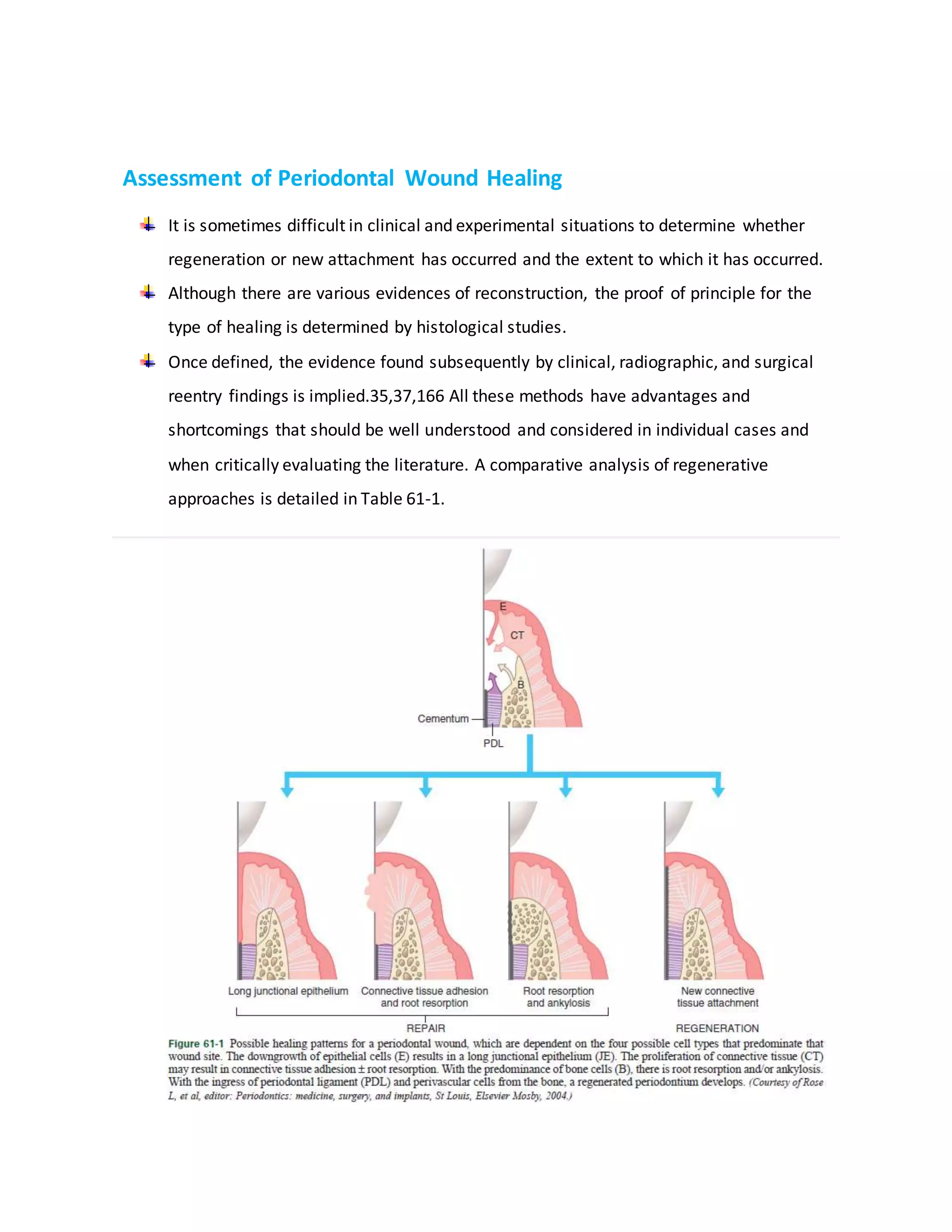
“Assessment of Periodontal Wound Healing
It is sometimes difficult in clinical and experimental situations to determine whether
regeneration or new attachment has occurred and the extent to which it has occurred.
Although there are various evidences of reconstruction, the proof of principle for the
type of healing is determined by histological studies.
Once defined, the evidence found subsequently by clinical, radiographic, and surgical
reentry findings is implied.35,37,166 All these methods have advantages and
shortcomings that should be well understood and considered in individual cases and
when critically evaluating the literature. A comparative analysis of regenerative
approaches is detailed in Table 61-1.”
“ReconstructiveSurgicalTechniques
 Reconstructive techniques can be subdivided into three major therapeutic
approaches:
1. non–bone graft–associated,
2. graft-associated,
3. Biological mediator–associated new attachment and regeneration.
 All recommended techniques include careful case selection and complete removal of
all irritants on the root surface.
 in the great majority of cases, it should be done after exposure of the area with a
flap.
 Systemic antibiotics are generally used after reconstructive periodontal therapy”
“GOAL of PDL Therapy !!!
“ The ultimate goal of periodontal therapy is:
 the complete restoration of the structure and function of diseased periodontal tissues.
 Regeneration of periodontium is considered to be an essential part of current mode of
periodontal treatment approach.”
Principles of Osseous regeneration
“Therapeutic bone regeneration approaches uses the principles of osteogenesis,
osteoconduction and osteoinduction.
1. Osteogenesis: The direct transfer of vital cells to the area that will regenerate
new bone.
2. Osteoconduction: Embraces the principles of providing the space and a
substratum for the cellular and biochemical events progressing to bone
formation.
3. Osteoinduction: Embodies the principle of converting pluripotential ,
mesenchymal derived cells along the osteoblasts pathway with subsequent bone
formation””.
“Evaluation of new attachment and periodontal reconstruction
“Clinical methods:
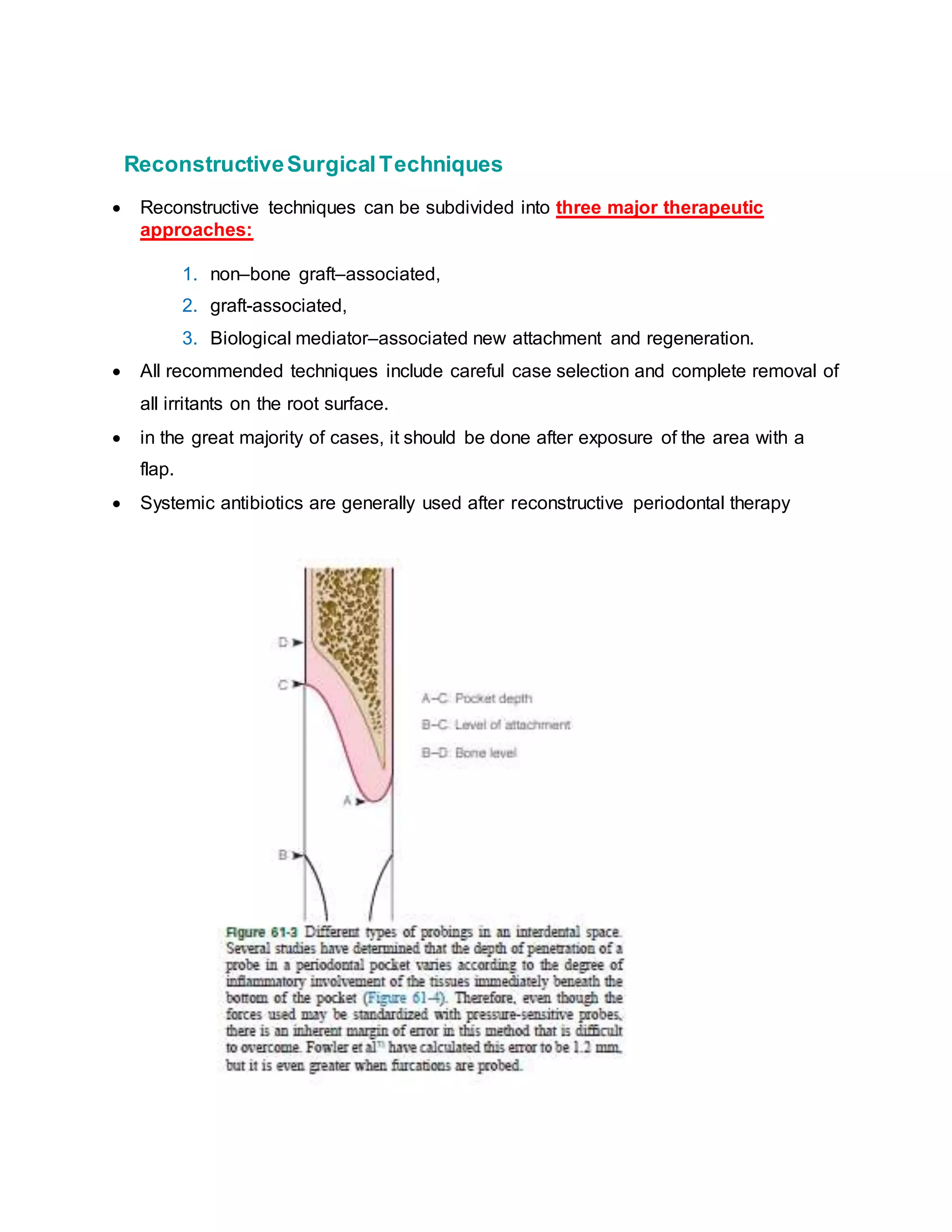
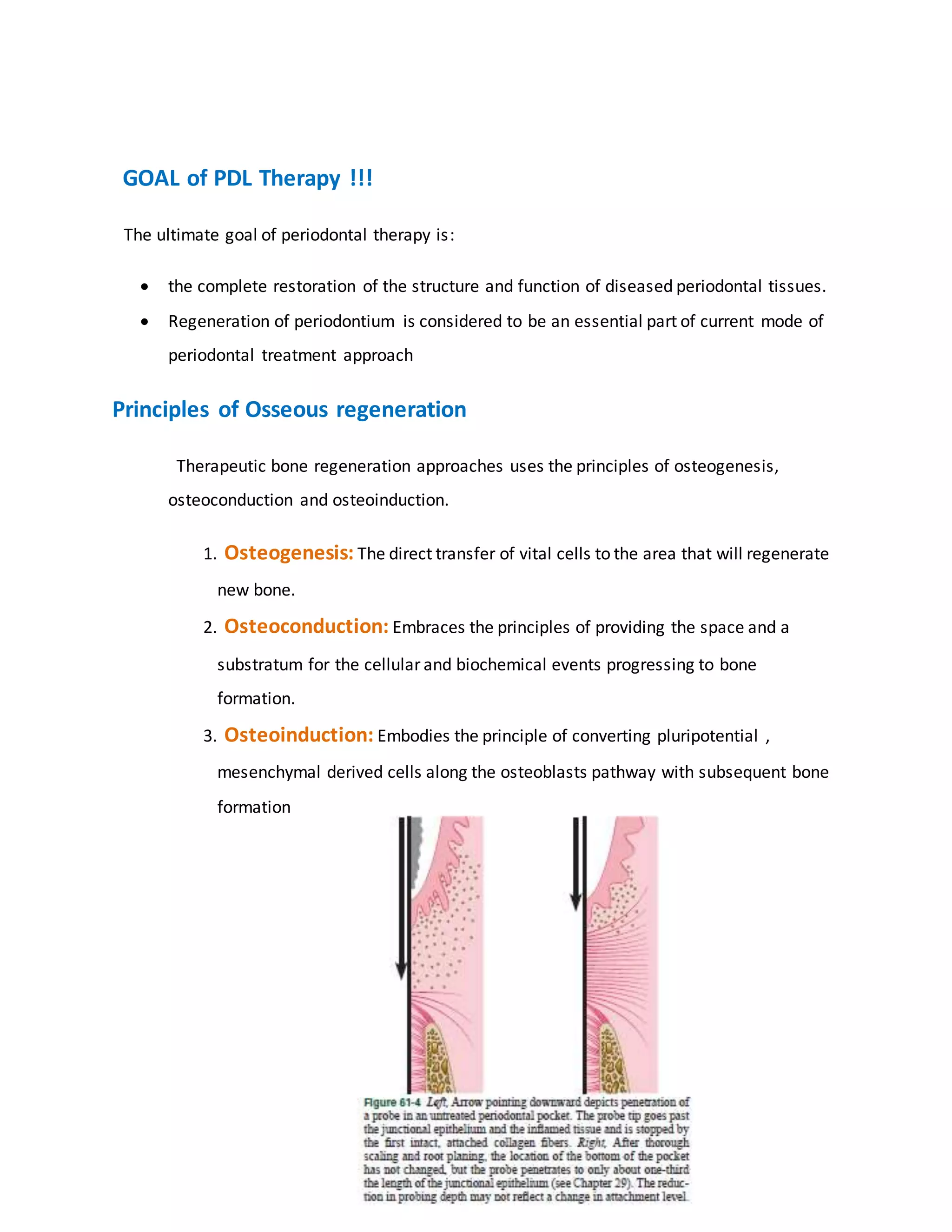
It consists of comparisons between pretreatment and post treatment pocket probings
and determination of clinical gingival findings. Probe can be used to determine pocket
depth, attachment level and bone level.”
“Radiographic methods:
It allows assessment of the bone tissue adjacent to the tooth. A comparative study of
pretreatment bone level and post therapy bone fill with 12 month reentry bone
measurement showed that linear radiographic analgesics significantly underestimates
pretreatment bone loss and post treatment bone fall.”
“Recent radiographic evaluationmethods are:
1. Substraction radiography
2. CADIA (Computer Assisted Densitometric Image Analysis)”
“Surgical re-entry:
1. Surgical reentry of a treated defect after a period of healing can provide a good view
of the state of the bone crest that can be compared with the view taken during the
initial surgical intervention.
2. This method is very useful but has two shortcomings:
i. It requires a frequently unnecessary second procedure and it does not show the
type of attachment that exists.”
“Histologic methods:
 Type of attachment can be determined by histological analysis of tissue blocks””
“Techniques”
“ NON BONEGRAFTASSOCIATED PROCEDURES
“Removal of junctional and pocket epithelium
 Its presence interferes with the direct apposition of connective tissue and cementum,
thus limiting the height to which periodontal fibers can insert to the cementum.
 Methods to remove junctional and pocket epithelia are:
Curettage: Use of ultrasonic methods, lasers, rotary abrasives.
Chemical agents: Sodium sulphide, phenol camphor, Antiformin and
NaOCl.
Techniques: Recommended one””
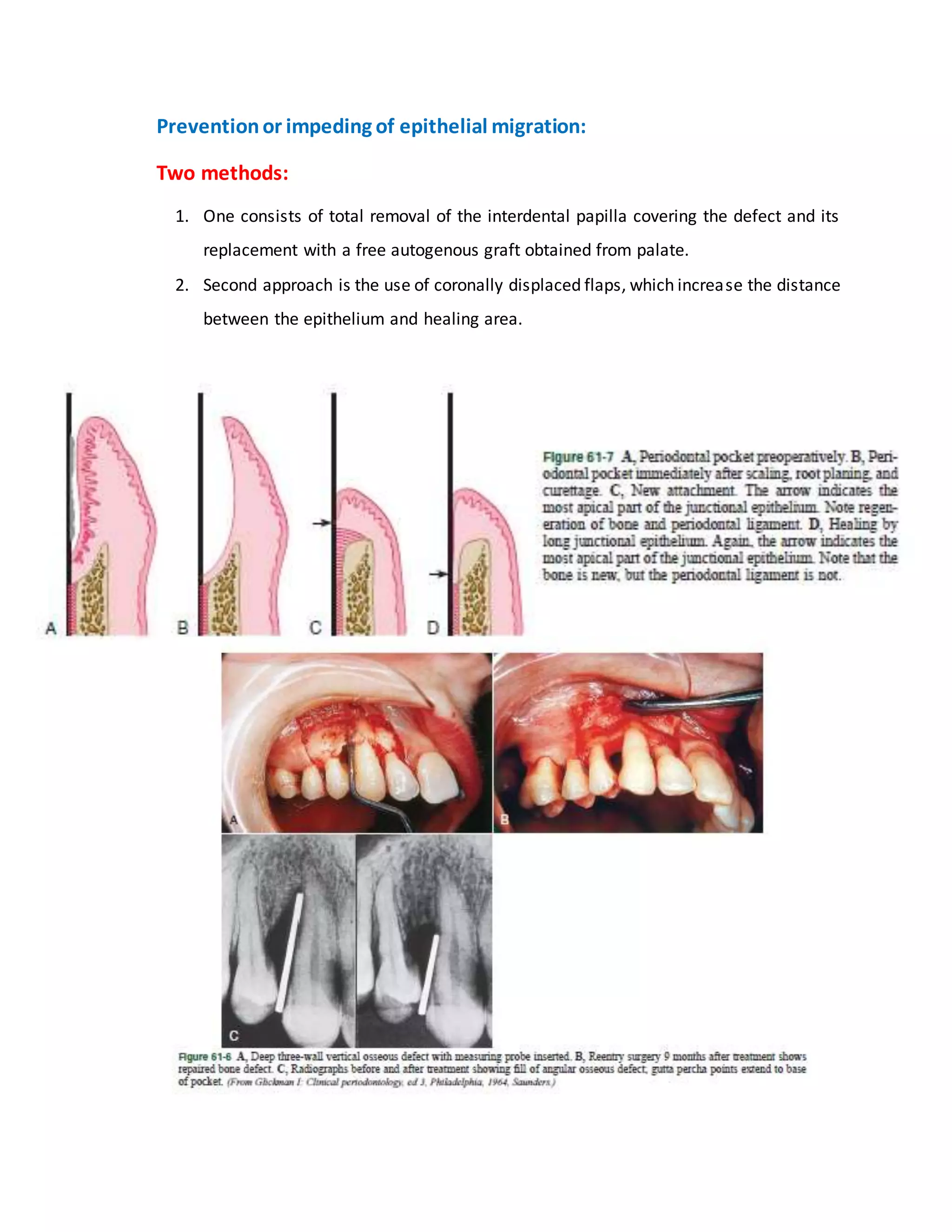
“Preventionor impeding of epithelial migration:”
“Two methods:
1. One consists of total removal of the interdental papilla covering the defect and its
replacement with a free autogenous graft obtained from palate.
2. Second approach is the use of coronally displaced flaps, which increase the distance
between the epithelium and healing area.””
“”Clot stabilization, woundprotectionandspace creation:”
“Some investigatorshave attributedthe successfulresults
reportedwithgraftmaterials,barriermembranesand
coronally displacedflapstothe factthat these techniques
protectthe woundand create a space forundistributedand
stable maturationof the clot.”
“Biomodificationof the root surface:
Changesinthe tooth wall offersperiodontalpocketsinterfere
withnewattachment.Several substanceshave beenusedin
attemptsto betterconditionthe rootsurface forattachment
of newconnective tissue fibers.Theyare:
Citricacid
Fibronectin
Tetracycline””
“Polypeptide growth factors:”
“Growth factorsare polypeptide moleculesreleased by cells in the inflamed area that regulate
eventsinwoundhealing.TheyregulateC.Tmigrationandproliferationand synthesis of protein
and other components of the extracellular matrix.
They are recreated by macrophages, endothelial cells, fibroblasts, platelets etc..”
“Enamel matrix proteins
They are believed to favour periodontal regeneration. Enamel matrix proteins that are derived from
…..teeth with trade name ‘Emdogain’ can also be used for periodontal regeneration””.
“”Guided tissue regeneration”
“Definition
GTR isthe term usedtodefine procedureswhereinregenerationof lostperiodontalstructuresis
sought via selective cell and tissue reproduction of the periodontal wound (AAP 1992)”
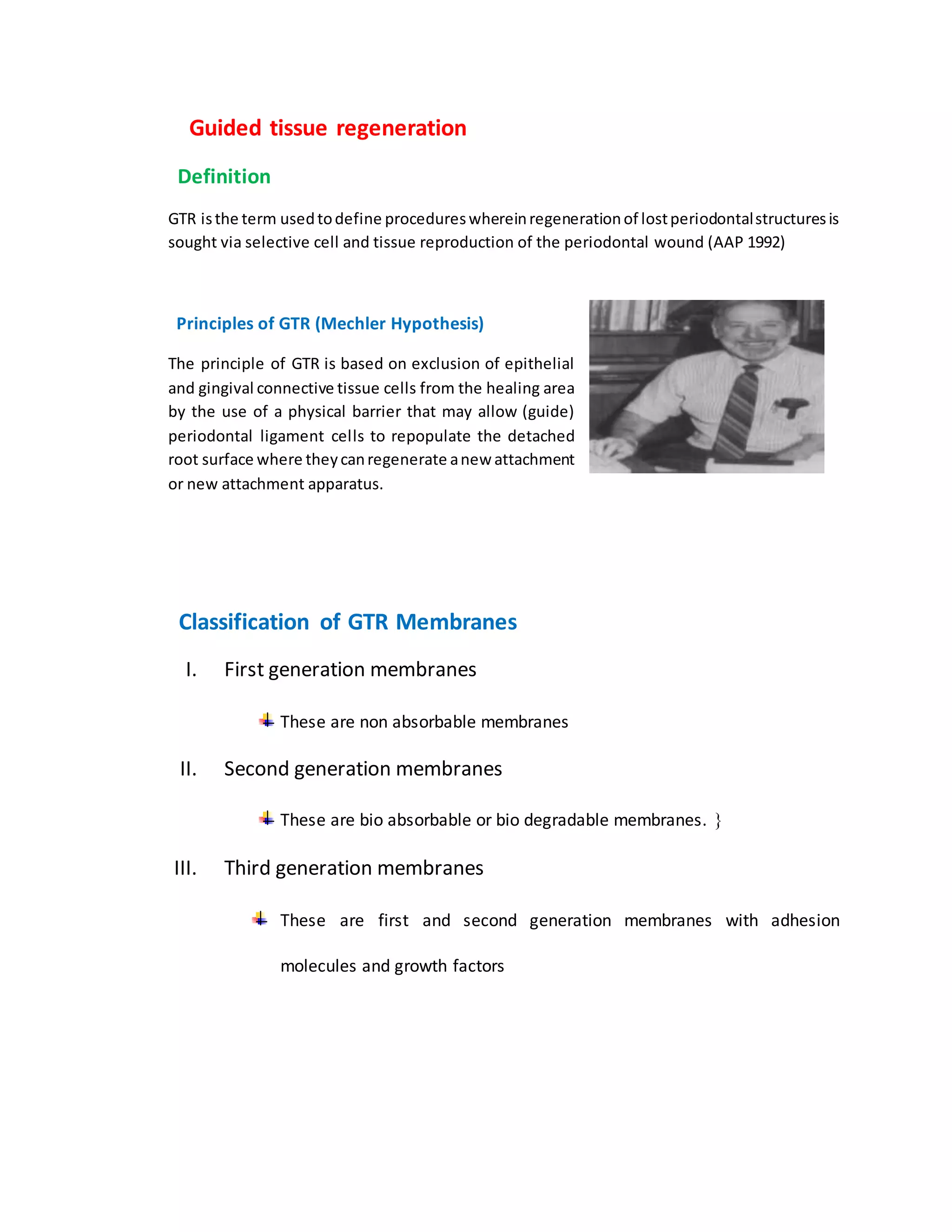
“Principles of GTR (Mechler Hypothesis)
The principle of GTR is based on exclusion of epithelial
and gingival connective tissue cells from the healing area
by the use of a physical barrier that may allow (guide)
periodontal ligament cells to repopulate the detached
root surface where theycanregenerate anew attachment
or new attachment apparatus.”
“Classification of GTR Membranes
I. First generation membranes
These are non absorbable membranes
II. Second generation membranes
These are bio absorbable or bio degradable membranes. 
III. Third generation membranes
These are first and second generation membranes with adhesion
molecules and growth factors”.”
“|”Bio absorbable membranes:
 Guidor
 Resolute
 Biomend
 Perioguide
 Periogen”
“Non absorbable membranes
 Silicon sheets
 Cellulose outate lab filters
 Millipore filters
 Polytetrafluroethylene (PTFE)
membrane
 Rubber dam”
“Ideal requisites of GTR membranes
Bio compatible: it should not elicit an immune response that interferes with healing
Stabilization of the blood clot: it should stabilize the blood clot as it acts as a reservoir
of precursor cells required for regeneration.
Cell occlusiveness: it should act as barrier for certain cells that prevent regeneration.
Space maintenance: it should provide space for ingrowth of cells potential for
regeneration from adjacent periodontal ligament.
Tissue regeneration
Ease of use: it should be easy to trim and place in the defect site
Biological activity””
“”Procedure
Step I: A full thickness of mucoperiosteal flap should be reflected 2-3 mm beyond the
defect. Vertical incision should be given where ever necessary.
Step II: Debridement of osseous defect and curettage of the inner surface of the flap.
Step III: Root planning followed by root conditioning of the exposed root surfaces
should be accomplished. 
Step IV: Create fresh bleeding at the defect site to allow progenitor cells to progress
from bone to the site.
Step V: The membrane should be trimmed so that it extends 2-3 mm beyond the
margins of the defect in all directions. Trimming of the flap should also permit primary
tension- free closure of the flap.
Step VI: The membrane should be adapted to the site and stabilized with the help of
suture or tacks.
Step VII: Suture the site with silk suture to obtain tension free primary closure.
Dressing may be considered to enhance patient comfort but it should not displace or
collapse the graft.
Step VIII: Post operative instructions and antibiotics should be given.
Step IX: If non-re absorbable membrane is used, it should be removed after 4-6
weeks.””
“”Root biomodification”
“Definition:”
“It is a process which aims at obtaining new attachment by conditioning the root surface
with the help of agents known as root bio modifiers.”
“Root bio modification can be done with the help of the following:”
 “Chemical treatment of root surface Acid etching (Citric acid and tetracycline)
Detergents (cetylpyridinium chloride and Na N- lauroylsarcosine)
 Chelating agents: ethylene diamine tetra acetic (EDTA)acid. Enzymes Attachment
proteins (fibronectin and growth factors)
 Mechanical
 Lasers””
“Citric Acid
 It is used at a pH of 1 for 2-5 minutes
 It removes smear layer of microcrystalline debris and
eliminates endo toxins and bacteria from root-planned
surface.
 It exposes the dentinal tubules that appear wider with
funnel shaped orifices.
 An early fibrin leakage occurs to the exposed collagen fibers which prevents the
migration of epithelial cells on the treated root surfaces.
 It accelerates healing and promotes formation of new attachment by enduring
cementogenesis and attachment of collagen fibers.”
EDTA
1. It is used at concentration of 24% at pH 7.
2. It exposes the collagen fibers of the dentine matrix.
3. It improves clot organization, retards epithelium growth and enhances
clinical attachment gain.
4. EDTA has advantage over citric acid as it acts at neutral pH unlike citric acid that
necrotizes the surrounding periodontal tissues.”
“”Fibronectin
 It is a glycoprotein and acts as an adhesive for the attachment of fibroblast on
root surfaces.
 Promotes connective tissue attachment and bone regeneration
 Prevents the separation of flap and favours hemostasis
 Prevents the migration and proliferation of epithelial cells
 Commercially available: tissucol and tisseel”
“TETRACYCLINE:
 It removes the smear layer and exposes the dentinal
tubule
 It decreases the epithelial cell attachment
 It also reduces the gingival collagenolytic activity”
“GROWTH FACTORS:
 Naturally occurring polypeptide
molecules secreted by macrophages,
endothelial cells, fibroblasts and
platelets.
 They regulate C.T cell migration and
proliferation of periodontal ligament
cells, differentiation of osteoblasts and cementoblasts and production of
extracelluar matrix proteins.””
““ENAMEL MATRIX PROTEIN
 Enamel matrix proteins mainly amelogenin are secreted by Hertwig epithelial
root sheath during tooth development.
 They induce a cellular cementum formation and therefore play a role in in
periodontal regeneration.
 It is osteopromotive not osteoinductive as it stimulates bone formation when
combine with freeze dried bone allograft.
 It promote cell spreading and bone cell attachment and differentiate immature
bone cell into mature cell that form new bone.
 It consists of proteins such as Amelogenin(90 %), Proline rich non Amelogenin,
Tuftlin and tuft protein, serum protein, Ameloblastin, Amelin.
 It is commercially available as Emdogain derived from developing procaine tooth
approved by U.S Food & Drug Administration.
 It is available as viscous gel.”
“PROCEDURE
1. Raise a flap for regenerative purpose.
2. Remove all granulation tissue and tissue tags, exposing the underlying bone and remove
all root deposit by hand, Ultrasonic scaling or both.
3. Completely control bleeding within the defect.
4. Demineralise the root surface with Citric acid (pH 1). This removes the smear layer and
facilitates adherence of Emdogain.
5. Rinse the wound with saline and apply the gel to fully cover the exposed root surface.
Avoid contamination with blood or saliva.
6. Close the wound with sutures. Perfect abutment of the flap is necessary””
“GRAFTS”
“”Definition:
Bone grafting is a surgical procedure by which new bone or a replacement material is placed
into spaces between or around broken bone (fractures) or defects to aid in healing.”
“Classification:”
“Autograft:
1. Extraoral – lip marrow
 Fresh
 Frozen
2. Intraoral
 Osseous coagulum
 Bone blend
 Tuberosity
 Extraction sites
 Continguous autografts”
“Allograft:
1. DFDB allograft 
2. FDBA’s / Autogenous bone grafts (ABG’s) 
3. Freeze dried bone allografts””
“”Xenografts
1. Bovine anorganic cancellous bone
2. Procine non antigenic collagen”
“Alloplastic materials
1. Reabsorb able – β- tricalcium phosphate
2. Non absorbable- durapatite, hydroxyapatite [hard tissue replacement »
“Ideal prerequisites of bone grafts :
1. Osteoinductive potential
2. Predictability
3. Accessability
4. Availability – quantity
5. Safety
 Biologic compactibility
 Immunologic acceptability
 Minimal sequelae
6. Rapid vascularisation
7. Minimal operative hazards””
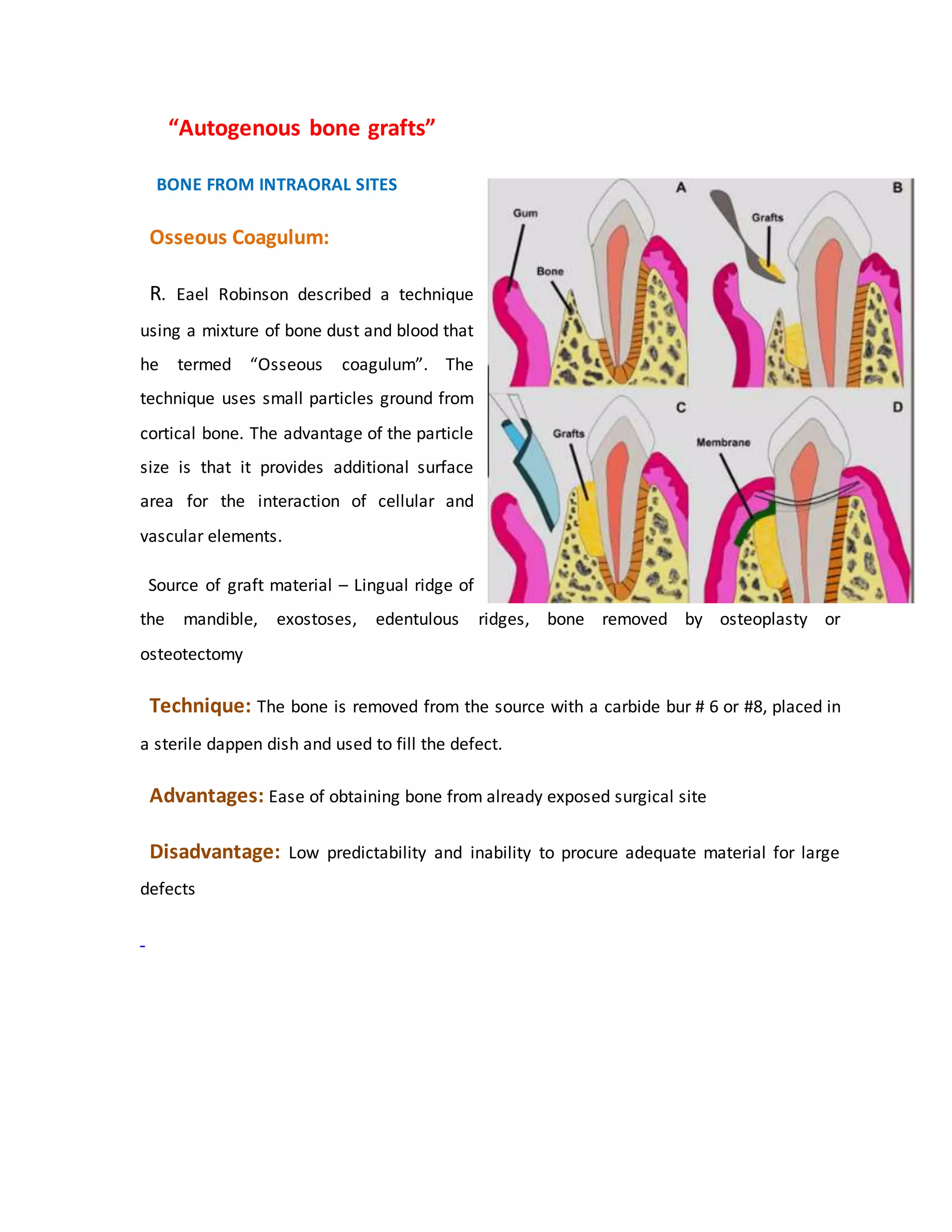
“Autogenous bone grafts”
“”BONE FROM INTRAORAL SITES :”
“Osseous Coagulum:”
“R. Eael Robinson described a technique
using a mixture of bone dust and blood that
he termed “Osseous coagulum”. The
technique uses small particles ground from
cortical bone. The advantage of the particle
size is that it provides additional surface
area for the interaction of cellular and
vascular elements.”
“Source of graft material – Lingual ridge of
the mandible, exostoses, edentulous ridges, bone removed by osteoplasty or
osteotectomy”
“Technique: The bone is removed from the source with a carbide bur # 6 or #8, placed in
a sterile dappen dish and used to fill the defect.”
“Advantages: Ease of obtaining bone from already exposed surgical site”
“Disadvantage: Low predictability and inability to procure adequate material for large
defects”.”
“”Bone blend:
To overcome the disadvantage of osseous coagulum, the bone blend
technique has been proposed. It uses an autoclaved plastic capsule and
pestle. Bone is removed from a predetermined site, triturated in the
capsule to a workable plastic like mass and packed into bony defects.”
“Cancellous bone marrow transplants:
Cancellous bone can be obtained from the maxillary tuberosity,
edentulous areas and aling sockets. The maxillary tuberosity is also
contains a good amount of cancellous bone.”
“Bone swagging:
This technique requires an edentulous area
adjacent to the defect from which the bone is
pushed into contact with root surface without
fracturing the bone at its base. It is a different
procedure”.
“BONE FROM EXTRA ORAL SITES:
Iliac autografts:
The use of fresh or preserved iliac cancellous
marrow bone has been extensively
investigated. However, because of problems
associated with its use, the technique is no
longer in use. Problems like post operative
infection, exfoliation, sequestration etc”.”
“”Allograft and Xenograft”
1. “Foreign to body---risk to provoke immune response
2. Suppress antigenic potential—by radiation, freezing, chemical treatment
3. Allograft –DFDBA(Decalcified Freeze-Dried Bone Allograft ), FDBA
4. Commercially obtained—cortical bone—12 hours—death of DONOR ---Defatted----cut in
pieces---washed in absolute alcohol---deep frozen
5. May be demineralized then---ground and sieved---250 to 750um and
6. Freeze-dried
7. Finally Vacuum sealed in glass vials”
 “FDBA--- Osteoconductive
 DFDBA– Osteoinductive
 DFDBA more osteogenic---so preferable
 DFDBA—Demineralisation—in cold, diluted HCL acid
 Exposes –component of bone matrix---BMPs[bone morphogenetic protein]
 Cancellous DFDBA>>>Cortical DFDBA”
 “Osteogenin or BMP3 –bone inductive protein isolated from the
extracellular matrix of human bone—tested and found to enhance osseous
regeneration.”
“Xenograft”
“• Calf bone [ Boplant –treated by detergent extraction—sterilized—freeze-dried.
• Kiel bone is calf or OX bone –denatured with 20% H2O2---Dries with Acetone—
Sterilized with ethylene oxide.
• Anorganic bone is OX bone—organic material extracted by---ethylenediamine--- then
sterilized by autoclaving.
• Ospurane : cow bone soaked in KOH , acetone and salt solution
• Boiled Bone: cow bone boiled or autoclaved”
“Bio-Oss:
“anorganic, osteoconductive, porous bone mineral matrix from bovine
cancellous or cortical bone.”
“Physical feature
 trabecular architecture and porosity
 permit clot stabilization and revascularization
 allow for migration of osteoblasts, leading to osteogenesis.”
“Non Bone Graft Materials
 Sclera, dura, cartilage, cementum, dentin, plaster of
paris, plastic materials, ceramics and coral derived
materials.
 Not a reliable substitute.”
“Cartilage:
 serves as a scaffolding, received limited evaluation”
“Plaster of Paris [calcium sulfate] :
 biocompatible, porous, allowing fluid exchange, resorbs
completely in 1 to 2 weeks.
 Usefulness in human studies not proved”
“Plastic material :
 composite of Polymethyl-methacrylate and Polyhydroxyethylmethacrylate”.
“”Calcium Phosphate Biomaterial”
• “Osteoconductive, excellent tissue
biocompatibility, no inflammation or foreign body response.
• Two Types: Hydroxyapatite(HA): calcium : phosphate ratio :
1.67
• Tricalcium phosphate (TCP) : 1.5”
“Bioactive Glass
• Consist of: sodium and calcium salts, phosphates, and silicon
dioxide
• Used in the form of irregular particles measuring 90-170um or
300-355um
• When this material comes in contact with tissue fluids, the
surface of particles become coated with hydroxycarbonate apatite, incorporates organic
proteins such as chondroitin sulfate and glycosaminoglycans and attract osteoblast.”
“Coral Derived Material
 Two types:
1. Natural coral [resorbed slowly-several months]
2. Coral derived porous hydroxyapatite [ years for
resorption]
 Shows microscopic cementum and bone formation
 But slow resorbability —limited clinical success””
“”Combined technique”
“Froum et al : criteria for choice of treatment”
“Clinical result depend upon:
• 1) dimension and morphology of defect( deeper>shallower)
• 2) number of walls
• 3) amount of root surface exposed and ability to obtain
adequate flap coverage
• 4) angle of defect with long axis of tooth (smaller – better)”
“Clinical Decision Tree
• For Deep, Well-Contained Defects—EMD alone, CAF (if necessary)
• For Moderate-Deep, Noncontained defects- EMD+Graft, CAF(if
necessary)
• For Supracrestal Defects with a shallow Vertical Defect-
EMD+Graft+Barrier membrane, with Coronally Advanced Flap”
“EMD- enamel matrix derivative. Emdogain [Froum et al 2001] »
« References : Carranza 10th
.ed. and 12th
.ed.”

Advanced periodontal regenerations

  • 1.
  • 2.
    “Assessment of PeriodontalWound Healing It is sometimes difficult in clinical and experimental situations to determine whether regeneration or new attachment has occurred and the extent to which it has occurred. Although there are various evidences of reconstruction, the proof of principle for the type of healing is determined by histological studies. Once defined, the evidence found subsequently by clinical, radiographic, and surgical reentry findings is implied.35,37,166 All these methods have advantages and shortcomings that should be well understood and considered in individual cases and when critically evaluating the literature. A comparative analysis of regenerative approaches is detailed in Table 61-1.”
  • 3.
    “ReconstructiveSurgicalTechniques  Reconstructive techniquescan be subdivided into three major therapeutic approaches: 1. non–bone graft–associated, 2. graft-associated, 3. Biological mediator–associated new attachment and regeneration.  All recommended techniques include careful case selection and complete removal of all irritants on the root surface.  in the great majority of cases, it should be done after exposure of the area with a flap.  Systemic antibiotics are generally used after reconstructive periodontal therapy”
  • 5.
    “GOAL of PDLTherapy !!! “ The ultimate goal of periodontal therapy is:  the complete restoration of the structure and function of diseased periodontal tissues.  Regeneration of periodontium is considered to be an essential part of current mode of periodontal treatment approach.” Principles of Osseous regeneration “Therapeutic bone regeneration approaches uses the principles of osteogenesis, osteoconduction and osteoinduction. 1. Osteogenesis: The direct transfer of vital cells to the area that will regenerate new bone. 2. Osteoconduction: Embraces the principles of providing the space and a substratum for the cellular and biochemical events progressing to bone formation. 3. Osteoinduction: Embodies the principle of converting pluripotential , mesenchymal derived cells along the osteoblasts pathway with subsequent bone formation””.
  • 6.
    “Evaluation of newattachment and periodontal reconstruction “Clinical methods: It consists of comparisons between pretreatment and post treatment pocket probings and determination of clinical gingival findings. Probe can be used to determine pocket depth, attachment level and bone level.” “Radiographic methods: It allows assessment of the bone tissue adjacent to the tooth. A comparative study of pretreatment bone level and post therapy bone fill with 12 month reentry bone measurement showed that linear radiographic analgesics significantly underestimates pretreatment bone loss and post treatment bone fall.” “Recent radiographic evaluationmethods are: 1. Substraction radiography 2. CADIA (Computer Assisted Densitometric Image Analysis)” “Surgical re-entry: 1. Surgical reentry of a treated defect after a period of healing can provide a good view of the state of the bone crest that can be compared with the view taken during the initial surgical intervention. 2. This method is very useful but has two shortcomings: i. It requires a frequently unnecessary second procedure and it does not show the type of attachment that exists.” “Histologic methods:  Type of attachment can be determined by histological analysis of tissue blocks””
  • 7.
    “Techniques” “ NON BONEGRAFTASSOCIATEDPROCEDURES “Removal of junctional and pocket epithelium  Its presence interferes with the direct apposition of connective tissue and cementum, thus limiting the height to which periodontal fibers can insert to the cementum.  Methods to remove junctional and pocket epithelia are: Curettage: Use of ultrasonic methods, lasers, rotary abrasives. Chemical agents: Sodium sulphide, phenol camphor, Antiformin and NaOCl. Techniques: Recommended one””
  • 8.
    “Preventionor impeding ofepithelial migration:” “Two methods: 1. One consists of total removal of the interdental papilla covering the defect and its replacement with a free autogenous graft obtained from palate. 2. Second approach is the use of coronally displaced flaps, which increase the distance between the epithelium and healing area.””
  • 9.
    “”Clot stabilization, woundprotectionandspacecreation:” “Some investigatorshave attributedthe successfulresults reportedwithgraftmaterials,barriermembranesand coronally displacedflapstothe factthat these techniques protectthe woundand create a space forundistributedand stable maturationof the clot.” “Biomodificationof the root surface: Changesinthe tooth wall offersperiodontalpocketsinterfere withnewattachment.Several substanceshave beenusedin attemptsto betterconditionthe rootsurface forattachment of newconnective tissue fibers.Theyare: Citricacid Fibronectin Tetracycline””
  • 10.
    “Polypeptide growth factors:” “Growthfactorsare polypeptide moleculesreleased by cells in the inflamed area that regulate eventsinwoundhealing.TheyregulateC.Tmigrationandproliferationand synthesis of protein and other components of the extracellular matrix. They are recreated by macrophages, endothelial cells, fibroblasts, platelets etc..” “Enamel matrix proteins They are believed to favour periodontal regeneration. Enamel matrix proteins that are derived from …..teeth with trade name ‘Emdogain’ can also be used for periodontal regeneration””.
  • 11.
    “”Guided tissue regeneration” “Definition GTRisthe term usedtodefine procedureswhereinregenerationof lostperiodontalstructuresis sought via selective cell and tissue reproduction of the periodontal wound (AAP 1992)” “Principles of GTR (Mechler Hypothesis) The principle of GTR is based on exclusion of epithelial and gingival connective tissue cells from the healing area by the use of a physical barrier that may allow (guide) periodontal ligament cells to repopulate the detached root surface where theycanregenerate anew attachment or new attachment apparatus.” “Classification of GTR Membranes I. First generation membranes These are non absorbable membranes II. Second generation membranes These are bio absorbable or bio degradable membranes.  III. Third generation membranes These are first and second generation membranes with adhesion molecules and growth factors”.”
  • 12.
    “|”Bio absorbable membranes: Guidor  Resolute  Biomend  Perioguide  Periogen” “Non absorbable membranes  Silicon sheets  Cellulose outate lab filters  Millipore filters  Polytetrafluroethylene (PTFE) membrane  Rubber dam” “Ideal requisites of GTR membranes Bio compatible: it should not elicit an immune response that interferes with healing Stabilization of the blood clot: it should stabilize the blood clot as it acts as a reservoir of precursor cells required for regeneration. Cell occlusiveness: it should act as barrier for certain cells that prevent regeneration. Space maintenance: it should provide space for ingrowth of cells potential for regeneration from adjacent periodontal ligament. Tissue regeneration Ease of use: it should be easy to trim and place in the defect site Biological activity””
  • 13.
    “”Procedure Step I: Afull thickness of mucoperiosteal flap should be reflected 2-3 mm beyond the defect. Vertical incision should be given where ever necessary. Step II: Debridement of osseous defect and curettage of the inner surface of the flap. Step III: Root planning followed by root conditioning of the exposed root surfaces should be accomplished.  Step IV: Create fresh bleeding at the defect site to allow progenitor cells to progress from bone to the site. Step V: The membrane should be trimmed so that it extends 2-3 mm beyond the margins of the defect in all directions. Trimming of the flap should also permit primary tension- free closure of the flap. Step VI: The membrane should be adapted to the site and stabilized with the help of suture or tacks. Step VII: Suture the site with silk suture to obtain tension free primary closure. Dressing may be considered to enhance patient comfort but it should not displace or collapse the graft. Step VIII: Post operative instructions and antibiotics should be given. Step IX: If non-re absorbable membrane is used, it should be removed after 4-6 weeks.””
  • 14.
    “”Root biomodification” “Definition:” “It isa process which aims at obtaining new attachment by conditioning the root surface with the help of agents known as root bio modifiers.” “Root bio modification can be done with the help of the following:”  “Chemical treatment of root surface Acid etching (Citric acid and tetracycline) Detergents (cetylpyridinium chloride and Na N- lauroylsarcosine)  Chelating agents: ethylene diamine tetra acetic (EDTA)acid. Enzymes Attachment proteins (fibronectin and growth factors)  Mechanical  Lasers”” “Citric Acid  It is used at a pH of 1 for 2-5 minutes  It removes smear layer of microcrystalline debris and eliminates endo toxins and bacteria from root-planned surface.  It exposes the dentinal tubules that appear wider with funnel shaped orifices.  An early fibrin leakage occurs to the exposed collagen fibers which prevents the migration of epithelial cells on the treated root surfaces.  It accelerates healing and promotes formation of new attachment by enduring cementogenesis and attachment of collagen fibers.” EDTA 1. It is used at concentration of 24% at pH 7. 2. It exposes the collagen fibers of the dentine matrix. 3. It improves clot organization, retards epithelium growth and enhances clinical attachment gain. 4. EDTA has advantage over citric acid as it acts at neutral pH unlike citric acid that necrotizes the surrounding periodontal tissues.”
  • 15.
    “”Fibronectin  It isa glycoprotein and acts as an adhesive for the attachment of fibroblast on root surfaces.  Promotes connective tissue attachment and bone regeneration  Prevents the separation of flap and favours hemostasis  Prevents the migration and proliferation of epithelial cells  Commercially available: tissucol and tisseel” “TETRACYCLINE:  It removes the smear layer and exposes the dentinal tubule  It decreases the epithelial cell attachment  It also reduces the gingival collagenolytic activity” “GROWTH FACTORS:  Naturally occurring polypeptide molecules secreted by macrophages, endothelial cells, fibroblasts and platelets.  They regulate C.T cell migration and proliferation of periodontal ligament cells, differentiation of osteoblasts and cementoblasts and production of extracelluar matrix proteins.””
  • 16.
    ““ENAMEL MATRIX PROTEIN Enamel matrix proteins mainly amelogenin are secreted by Hertwig epithelial root sheath during tooth development.  They induce a cellular cementum formation and therefore play a role in in periodontal regeneration.  It is osteopromotive not osteoinductive as it stimulates bone formation when combine with freeze dried bone allograft.  It promote cell spreading and bone cell attachment and differentiate immature bone cell into mature cell that form new bone.  It consists of proteins such as Amelogenin(90 %), Proline rich non Amelogenin, Tuftlin and tuft protein, serum protein, Ameloblastin, Amelin.  It is commercially available as Emdogain derived from developing procaine tooth approved by U.S Food & Drug Administration.  It is available as viscous gel.” “PROCEDURE 1. Raise a flap for regenerative purpose. 2. Remove all granulation tissue and tissue tags, exposing the underlying bone and remove all root deposit by hand, Ultrasonic scaling or both. 3. Completely control bleeding within the defect. 4. Demineralise the root surface with Citric acid (pH 1). This removes the smear layer and facilitates adherence of Emdogain. 5. Rinse the wound with saline and apply the gel to fully cover the exposed root surface. Avoid contamination with blood or saliva. 6. Close the wound with sutures. Perfect abutment of the flap is necessary””
  • 17.
    “GRAFTS” “”Definition: Bone grafting isa surgical procedure by which new bone or a replacement material is placed into spaces between or around broken bone (fractures) or defects to aid in healing.” “Classification:” “Autograft: 1. Extraoral – lip marrow  Fresh  Frozen 2. Intraoral  Osseous coagulum  Bone blend  Tuberosity  Extraction sites  Continguous autografts” “Allograft: 1. DFDB allograft  2. FDBA’s / Autogenous bone grafts (ABG’s)  3. Freeze dried bone allografts””
  • 18.
    “”Xenografts 1. Bovine anorganiccancellous bone 2. Procine non antigenic collagen” “Alloplastic materials 1. Reabsorb able – β- tricalcium phosphate 2. Non absorbable- durapatite, hydroxyapatite [hard tissue replacement » “Ideal prerequisites of bone grafts : 1. Osteoinductive potential 2. Predictability 3. Accessability 4. Availability – quantity 5. Safety  Biologic compactibility  Immunologic acceptability  Minimal sequelae 6. Rapid vascularisation 7. Minimal operative hazards””
  • 19.
    “Autogenous bone grafts” “”BONEFROM INTRAORAL SITES :” “Osseous Coagulum:” “R. Eael Robinson described a technique using a mixture of bone dust and blood that he termed “Osseous coagulum”. The technique uses small particles ground from cortical bone. The advantage of the particle size is that it provides additional surface area for the interaction of cellular and vascular elements.” “Source of graft material – Lingual ridge of the mandible, exostoses, edentulous ridges, bone removed by osteoplasty or osteotectomy” “Technique: The bone is removed from the source with a carbide bur # 6 or #8, placed in a sterile dappen dish and used to fill the defect.” “Advantages: Ease of obtaining bone from already exposed surgical site” “Disadvantage: Low predictability and inability to procure adequate material for large defects”.”
  • 20.
    “”Bone blend: To overcomethe disadvantage of osseous coagulum, the bone blend technique has been proposed. It uses an autoclaved plastic capsule and pestle. Bone is removed from a predetermined site, triturated in the capsule to a workable plastic like mass and packed into bony defects.” “Cancellous bone marrow transplants: Cancellous bone can be obtained from the maxillary tuberosity, edentulous areas and aling sockets. The maxillary tuberosity is also contains a good amount of cancellous bone.” “Bone swagging: This technique requires an edentulous area adjacent to the defect from which the bone is pushed into contact with root surface without fracturing the bone at its base. It is a different procedure”. “BONE FROM EXTRA ORAL SITES: Iliac autografts: The use of fresh or preserved iliac cancellous marrow bone has been extensively investigated. However, because of problems associated with its use, the technique is no longer in use. Problems like post operative infection, exfoliation, sequestration etc”.”
  • 21.
    “”Allograft and Xenograft” 1.“Foreign to body---risk to provoke immune response 2. Suppress antigenic potential—by radiation, freezing, chemical treatment 3. Allograft –DFDBA(Decalcified Freeze-Dried Bone Allograft ), FDBA 4. Commercially obtained—cortical bone—12 hours—death of DONOR ---Defatted----cut in pieces---washed in absolute alcohol---deep frozen 5. May be demineralized then---ground and sieved---250 to 750um and 6. Freeze-dried 7. Finally Vacuum sealed in glass vials”  “FDBA--- Osteoconductive  DFDBA– Osteoinductive  DFDBA more osteogenic---so preferable  DFDBA—Demineralisation—in cold, diluted HCL acid  Exposes –component of bone matrix---BMPs[bone morphogenetic protein]  Cancellous DFDBA>>>Cortical DFDBA”  “Osteogenin or BMP3 –bone inductive protein isolated from the extracellular matrix of human bone—tested and found to enhance osseous regeneration.” “Xenograft” “• Calf bone [ Boplant –treated by detergent extraction—sterilized—freeze-dried. • Kiel bone is calf or OX bone –denatured with 20% H2O2---Dries with Acetone— Sterilized with ethylene oxide. • Anorganic bone is OX bone—organic material extracted by---ethylenediamine--- then sterilized by autoclaving. • Ospurane : cow bone soaked in KOH , acetone and salt solution • Boiled Bone: cow bone boiled or autoclaved”
  • 22.
    “Bio-Oss: “anorganic, osteoconductive, porousbone mineral matrix from bovine cancellous or cortical bone.” “Physical feature  trabecular architecture and porosity  permit clot stabilization and revascularization  allow for migration of osteoblasts, leading to osteogenesis.” “Non Bone Graft Materials  Sclera, dura, cartilage, cementum, dentin, plaster of paris, plastic materials, ceramics and coral derived materials.  Not a reliable substitute.” “Cartilage:  serves as a scaffolding, received limited evaluation” “Plaster of Paris [calcium sulfate] :  biocompatible, porous, allowing fluid exchange, resorbs completely in 1 to 2 weeks.  Usefulness in human studies not proved” “Plastic material :  composite of Polymethyl-methacrylate and Polyhydroxyethylmethacrylate”.
  • 23.
    “”Calcium Phosphate Biomaterial” •“Osteoconductive, excellent tissue biocompatibility, no inflammation or foreign body response. • Two Types: Hydroxyapatite(HA): calcium : phosphate ratio : 1.67 • Tricalcium phosphate (TCP) : 1.5” “Bioactive Glass • Consist of: sodium and calcium salts, phosphates, and silicon dioxide • Used in the form of irregular particles measuring 90-170um or 300-355um • When this material comes in contact with tissue fluids, the surface of particles become coated with hydroxycarbonate apatite, incorporates organic proteins such as chondroitin sulfate and glycosaminoglycans and attract osteoblast.” “Coral Derived Material  Two types: 1. Natural coral [resorbed slowly-several months] 2. Coral derived porous hydroxyapatite [ years for resorption]  Shows microscopic cementum and bone formation  But slow resorbability —limited clinical success””
  • 24.
    “”Combined technique” “Froum etal : criteria for choice of treatment” “Clinical result depend upon: • 1) dimension and morphology of defect( deeper>shallower) • 2) number of walls • 3) amount of root surface exposed and ability to obtain adequate flap coverage • 4) angle of defect with long axis of tooth (smaller – better)” “Clinical Decision Tree • For Deep, Well-Contained Defects—EMD alone, CAF (if necessary) • For Moderate-Deep, Noncontained defects- EMD+Graft, CAF(if necessary) • For Supracrestal Defects with a shallow Vertical Defect- EMD+Graft+Barrier membrane, with Coronally Advanced Flap” “EMD- enamel matrix derivative. Emdogain [Froum et al 2001] »
  • 25.
    « References :Carranza 10th .ed. and 12th .ed.”