11/09/2025 2
Contents
Introduction
Attachment
History of attachments
Classification of attachment systems
Intracoronal attachments
Extracoronal attachments
3.
11/09/2025 3
Studattachments
Bar attachments
Magnetic retainers
Auxillary attachments
Attachment selection
Conclusion
4.
11/09/2025 4
Introduction
Inthe present society, patients approach a dentist for two main reasons;
discomfort or esthetics
Attachments are used as alternative to clasps in removable partial
denture therapy, which gives both esthetic and functional outcome
The correct use of attachments may overcome both physical and
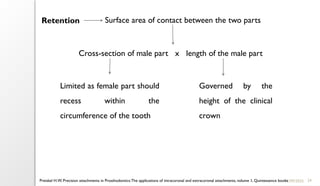
psychological problems associated with conventional RPD designs
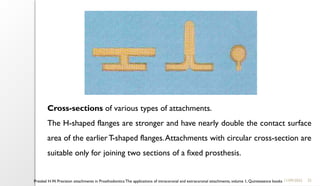
5.
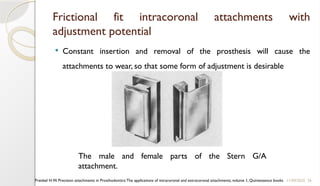
11/09/2025 5
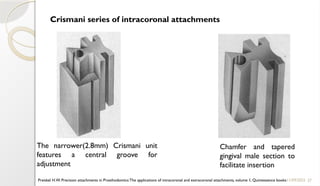
Attachment
Amechanical device for the fixation, retention, and stabilization of a
prosthesis; OR a retainer consisting of a metal receptacle and a closely
fitting part; the former (matrix component) is usually contained within
the normal or expanded contours of the crown of the abutment tooth
and the latter (patrix component), is attached to a pontic or the denture
framework
GPT9
6.
6
Attachments actas stress redirectors and absorbers.Their function is to
preserve soft tissue and bone as well as provide retention
The direct retention function of precision attachments prove to be more
efficient than clasps
11/09/2025
Kanathila H. et al., An insight into various attachments used in prosthodontics:A review, International Journal of Applied Dental
Sciences, 2018; 4(4): 157-160
7.
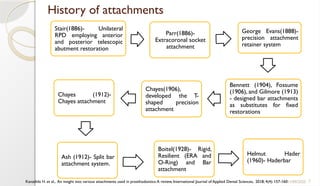
History of attachments
11/09/20257
Stair(1886)- Unilateral
RPD employing anterior
and posterior telescopic
abutment restoration
Parr(1886)-
Extracoronal socket
attachment
George Evans(1888)-
precision attachment
retainer system
Bennett (1904), Fossume
(1906), and Gilmore (1913)
- designed bar attachments
as substitutes for fixed
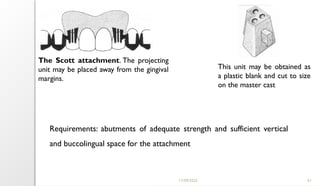
restorations
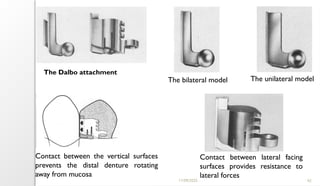
Chayes(1906),
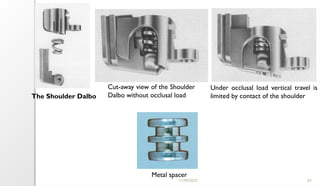
developed the T-
shaped precision
attachment
Chayes (1912)-
Chayes attachment
Ash (1912)- Split bar
attachment system.
Helmut Hader
(1960)- Haderbar
Boitel(1928)- Rigid,
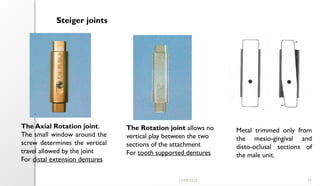
Resilient (ERA and
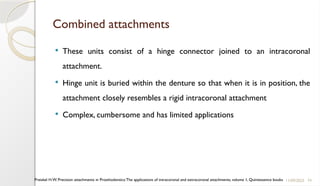
O-Ring) and Bar
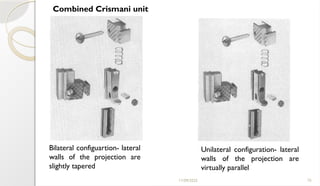
attachment
Kanathila H. et al., An insight into various attachments used in prosthodontics:A review, International Journal of Applied Dental Sciences, 2018; 4(4): 157-160
8.
8
11/09/2025
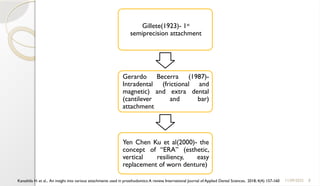
Gillete(1923)- 1st
semiprecision attachment
GerardoBecerra (1987)-
Intradental (frictional and
magnetic) and extra dental
(cantilever and bar)
attachment
Yen Chen Ku et al(2000)- the
concept of “ERA” (esthetic,
vertical resiliency, easy
replacement of worn denture)
Kanathila H. et al., An insight into various attachments used in prosthodontics:A review, International Journal of Applied Dental Sciences, 2018; 4(4): 157-160
9.
9
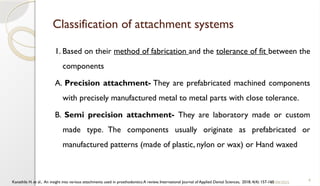
Classification of attachmentsystems
1. Based on their method of fabrication and the tolerance of fit between the
components
A. Precision attachment- They are prefabricated machined components
with precisely manufactured metal to metal parts with close tolerance.
B. Semi precision attachment- They are laboratory made or custom
made type. The components usually originate as prefabricated or
manufactured patterns (made of plastic, nylon or wax) or Hand waxed
11/09/2025
Kanathila H. et al., An insight into various attachments used in prosthodontics:A review, International Journal of Applied Dental Sciences, 2018; 4(4): 157-160
10.
11/09/2025 10
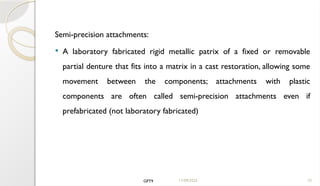
Semi-precision attachments:
A laboratory fabricated rigid metallic patrix of a fixed or removable
partial denture that fits into a matrix in a cast restoration, allowing some
movement between the components; attachments with plastic
components are often called semi-precision attachments even if
prefabricated (not laboratory fabricated)
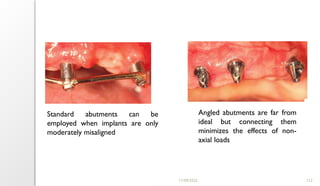
GPT9
11.
11
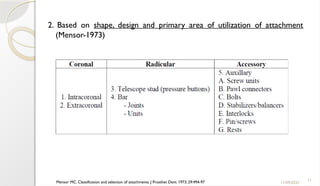
2. Based onshape, design and primary area of utilization of attachment
(Mensor-1973)
11/09/2025
Mensor MC. Classification and selection of attachments. J Prosthet Dent. 1973; 29:494-97
12.
12
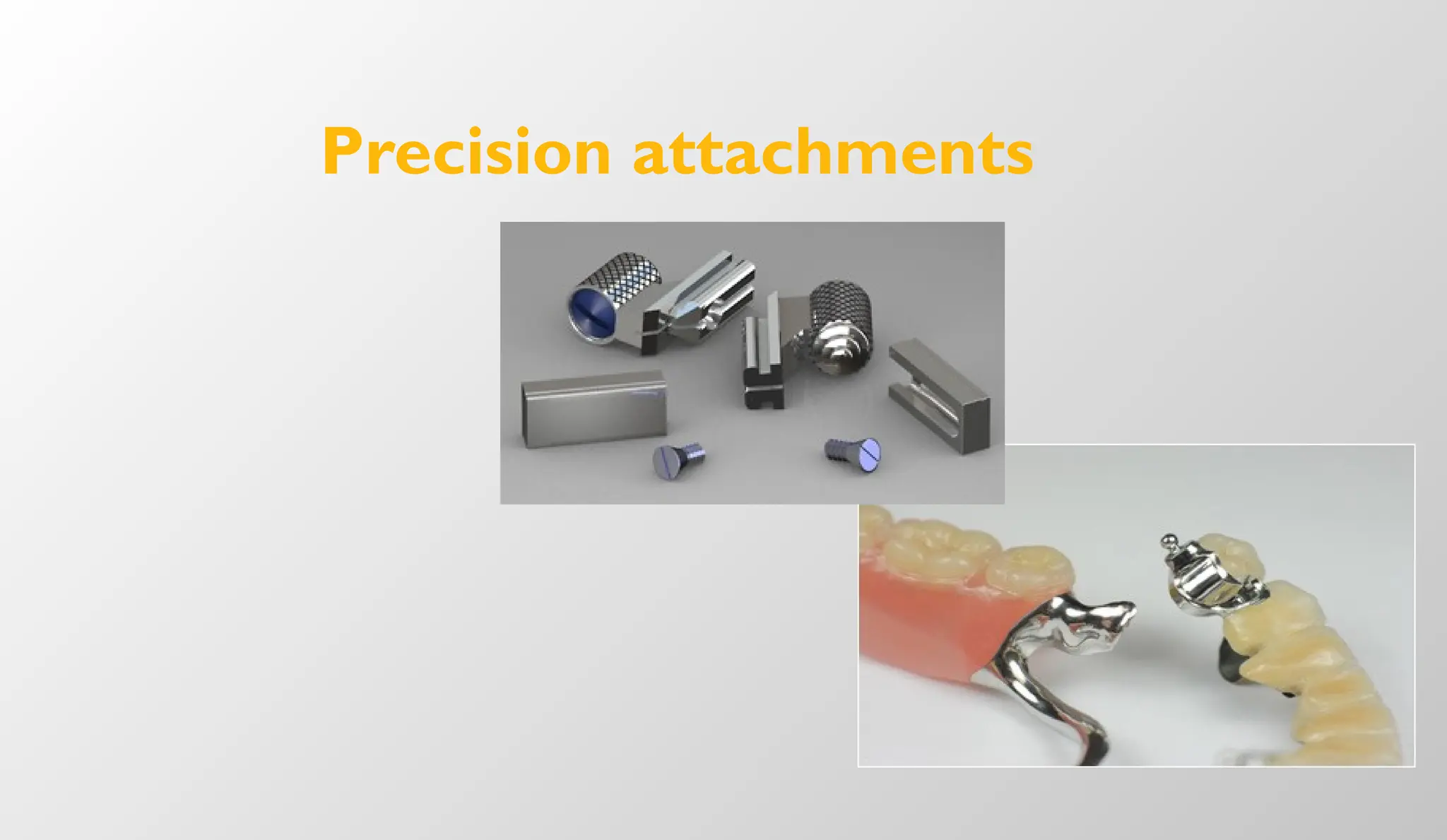
Precision attachments
Accordingto GPT 9- An interlocking device, one component of which is
fixed to an abutment or abutments, and the other is integrated into a
removable partial denture
Cohn states, “The precision attachment prevents lateral stress to the
periodontium of the abutment teeth when inserting or removing the
denture. It distributes stress vertically to the tooth during function and
stabilizes the abutment teeth against lateral stress”
11/09/2025
GPT9
Zinner I.D. Precision attachments, Full-Mouth Reconstruction: Fixed Removable, Dental Clinics of North America, July 1987,Vol.31, No. 3, 395-415
13.
13
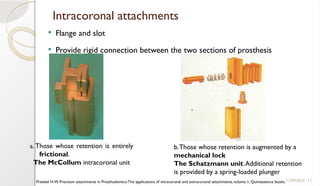
Intracoronal attachments
Flangeand slot
Provide rigid connection between the two sections of prosthesis
11/09/2025
a. Those whose retention is entirely
frictional.
The McCollum intracoronal unit
b.Those whose retention is augmented by a
mechanical lock
The Schatzmann unit.Additional retention
is provided by a spring-loaded plunger
Preiskel H.W. Precision attachments in Prosthodontics:The applications of intracoronal and extracoronal attachments, volume 1, Quintessence books.
14.
14
Most intracoronalattachments consist of a parallel-sided flange engaging a
slot
Vertical space of at least 4 mm and buccolingual space of 3 mm is usually
required
Small bounded spaces, with appreciable bone loss, may be restored with
intracoronal attachments
11/09/2025
Making the prosthesis removable simplifies
oral hygiene practice and allows artificial
mucosa to replace missing bone
Preiskel H.W. Precision attachments for partially dentate mouth, Annals of the Royal College of Surgeons of England (I974), vol 55, 294-298
15.
15
Henderson andSteffel have noted that “ the intracoronal attachment has
two major advantages over the extracoronal attachments, which is the
elimination of a visible retentive component and vertical support through
rest seat locked more favourable in relation to the horizontal axis of the
abutment tooth. It provides some horizontal stabilization similar to that
of an internal rest, but some additional bracing extracoronally is usually
desirable”
11/09/2025
Zinner I.D. Precision attachments, Full-Mouth Reconstruction: Fixed Removable, Dental Clinics of North America, July 1987,Vol.31, No. 3, 395-415
16.
16
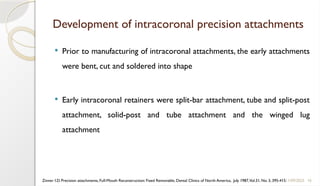
Development of intracoronalprecision attachments
Prior to manufacturing of intracoronal attachments, the early attachments
were bent, cut and soldered into shape
Early intracoronal retainers were split-bar attachment, tube and split-post
attachment, solid-post and tube attachment and the winged lug
attachment
11/09/2025
Zinner I.D. Precision attachments, Full-Mouth Reconstruction: Fixed Removable, Dental Clinics of North America, July 1987,Vol.31, No. 3, 395-415
17.
17
11/09/2025
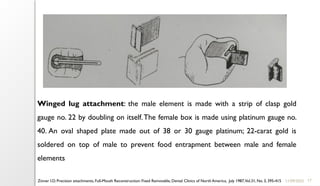
Winged lug attachment:the male element is made with a strip of clasp gold
gauge no. 22 by doubling on itself.The female box is made using platinum gauge no.
40. An oval shaped plate made out of 38 or 30 gauge platinum; 22-carat gold is
soldered on top of male to prevent food entrapment between male and female
elements
Zinner I.D. Precision attachments, Full-Mouth Reconstruction: Fixed Removable, Dental Clinics of North America, July 1987,Vol.31, No. 3, 395-415
18.
18
11/09/2025
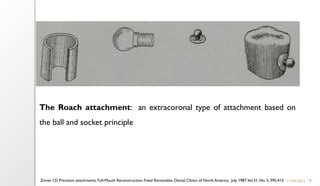
The Roach attachment:an extracoronal type of attachment based on
the ball and socket principle
Zinner I.D. Precision attachments, Full-Mouth Reconstruction: Fixed Removable, Dental Clinics of North America, July 1987,Vol.31, No. 3, 395-415
19.
19
11/09/2025
Zinner I.D. Precisionattachments, Full-Mouth Reconstruction: Fixed Removable, Dental Clinics of North America, July 1987,Vol.31, No. 3, 395-415
20.
20
11/09/2025
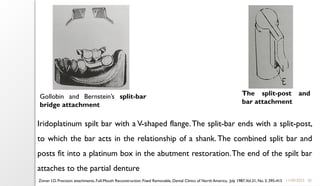
Gollobin and Bernstein’ssplit-bar
bridge attachment
The split-post and
bar attachment
Iridoplatinum spilt bar with a V-shaped flange.The split-bar ends with a split-post,
to which the bar acts in the relationship of a shank.The combined split bar and
posts fit into a platinum box in the abutment restoration.The end of the spilt bar
attaches to the partial denture
Zinner I.D. Precision attachments, Full-Mouth Reconstruction: Fixed Removable, Dental Clinics of North America, July 1987,Vol.31, No. 3, 395-415
21.
11/09/2025 21
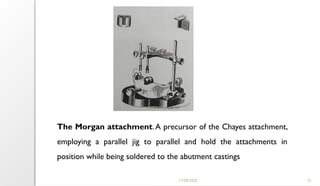
The Morganattachment.A precursor of the Chayes attachment,
employing a parallel jig to parallel and hold the attachments in
position while being soldered to the abutment castings
22.
22
11/09/2025
Preiskel H.W. Precisionattachments in Prosthodontics:The applications of intracoronal and extracoronal attachments, volume 1, Quintessence books
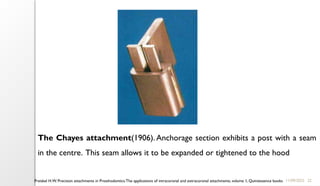
The Chayes attachment(1906). Anchorage section exhibits a post with a seam
in the centre. This seam allows it to be expanded or tightened to the hood
23.
23
11/09/2025
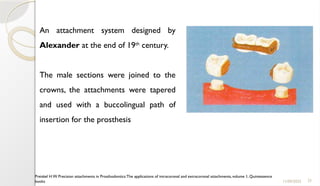
An attachment systemdesigned by
Alexander at the end of 19th
century.
The male sections were joined to the
crowns, the attachments were tapered
and used with a buccolingual path of
insertion for the prosthesis
Preiskel H.W. Precision attachments in Prosthodontics:The applications of intracoronal and extracoronal attachments, volume 1, Quintessence
books
24.
24
11/09/2025
Retention Surface areaof contact between the two parts
Cross-section of male part x length of the male part
Limited as female part should
recess within the
circumference of the tooth
Governed by the
height of the clinical
crown
Preiskel H.W. Precision attachments in Prosthodontics:The applications of intracoronal and extracoronal attachments, volume 1, Quintessence books
25.
25
11/09/2025
Preiskel H.W. Precisionattachments in Prosthodontics:The applications of intracoronal and extracoronal attachments, volume 1, Quintessence books
Cross-sections of various types of attachments.
The H-shaped flanges are stronger and have nearly double the contact surface
area of the earlier T-shaped flanges.Attachments with circular cross-section are
suitable only for joining two sections of a fixed prosthesis.
26.
26
Frictional fit intracoronalattachments with
adjustment potential
Constant insertion and removal of the prosthesis will cause the
attachments to wear, so that some form of adjustment is desirable
11/09/2025
Preiskel H.W. Precision attachments in Prosthodontics:The applications of intracoronal and extracoronal attachments, volume 1, Quintessence books
The male and female parts of the Stern G/A
attachment.
27.
27
Crismani series ofintracoronal attachments
11/09/2025
Preiskel H.W. Precision attachments in Prosthodontics:The applications of intracoronal and extracoronal attachments, volume 1, Quintessence books
The narrower(2.8mm) Crismani unit
features a central groove for
adjustment
Chamfer and tapered
gingival male section to
facilitate insertion
28.
28
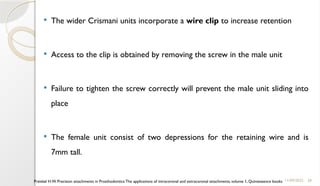
The widerCrismani units incorporate a wire clip to increase retention
Access to the clip is obtained by removing the screw in the male unit
Failure to tighten the screw correctly will prevent the male unit sliding into
place
The female unit consist of two depressions for the retaining wire and is
7mm tall.
11/09/2025
Preiskel H.W. Precision attachments in Prosthodontics:The applications of intracoronal and extracoronal attachments, volume 1, Quintessence books
29.
29
11/09/2025
Preiskel H.W. Precisionattachments in Prosthodontics:The applications of intracoronal and extracoronal attachments, volume 1, Quintessence books
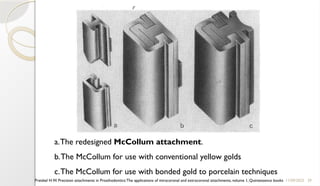
a.The redesigned McCollum attachment.
b.The McCollum for use with conventional yellow golds
c.The McCollum for use with bonded gold to porcelain techniques
30.
30
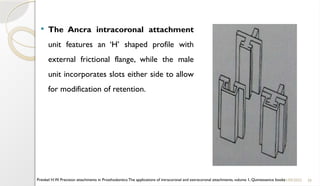
The Ancraintracoronal attachment
unit features an ‘H’ shaped profile with
external frictional flange, while the male
unit incorporates slots either side to allow
for modification of retention.
11/09/2025
Preiskel H.W. Precision attachments in Prosthodontics:The applications of intracoronal and extracoronal attachments, volume 1, Quintessence books
31.
31
11/09/2025
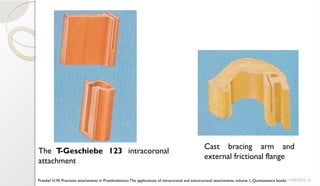
The T
-Geschiebe 123intracoronal
attachment
Cast bracing arm and
external frictional flange
Preiskel H.W. Precision attachments in Prosthodontics:The applications of intracoronal and extracoronal attachments, volume 1, Quintessence books
32.
32
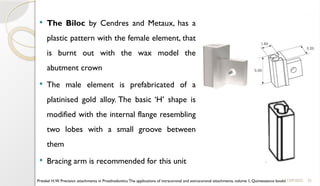
The Bilocby Cendres and Metaux, has a
plastic pattern with the female element, that
is burnt out with the wax model the
abutment crown
The male element is prefabricated of a
platinised gold alloy. The basic ‘H’ shape is
modified with the internal flange resembling
two lobes with a small groove between
them
Bracing arm is recommended for this unit
11/09/2025
Preiskel H.W. Precision attachments in Prosthodontics:The applications of intracoronal and extracoronal attachments, volume 1, Quintessence books
33.
33
Auxillary retentive features
Incorporated to provide more retention for a given contact area,
although no extra stability is provided
A minimum of 4mm vertical space is still usually necessary
11/09/2025
Preiskel H.W. Precision attachments in Prosthodontics:The applications of intracoronal and extracoronal attachments, volume 1, Quintessence books
34.
34
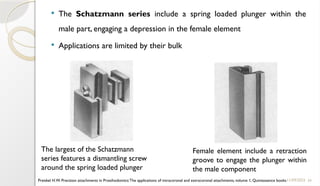
The Schatzmannseries include a spring loaded plunger within the
male part, engaging a depression in the female element
Applications are limited by their bulk
11/09/2025
The largest of the Schatzmann
series features a dismantling screw
around the spring loaded plunger
Preiskel H.W. Precision attachments in Prosthodontics:The applications of intracoronal and extracoronal attachments, volume 1, Quintessence books
Female element include a retraction
groove to engage the plunger within
the male component
35.
35
11/09/2025
Preiskel H.W. Precisionattachments in Prosthodontics:The applications of intracoronal and extracoronal attachments, volume 1, Quintessence books
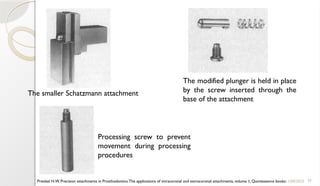
The modified plunger is held in place
by the screw inserted through the
base of the attachment
The smaller Schatzmann attachment
Processing screw to prevent
movement during processing
procedures
36.
36
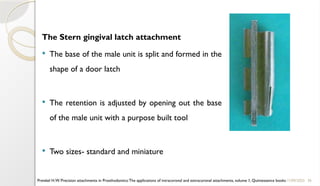
The Stern gingivallatch attachment
The base of the male unit is split and formed in the
shape of a door latch
The retention is adjusted by opening out the base
of the male unit with a purpose built tool
Two sizes- standard and miniature
11/09/2025
Preiskel H.W. Precision attachments in Prosthodontics:The applications of intracoronal and extracoronal attachments, volume 1, Quintessence books
37.
37
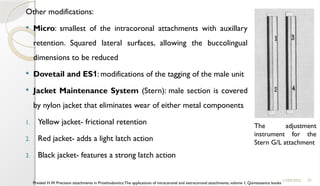
Other modifications:
Micro:smallest of the intracoronal attachments with auxillary
retention. Squared lateral surfaces, allowing the buccolingual
dimensions to be reduced
Dovetail and ES1: modifications of the tagging of the male unit
Jacket Maintenance System (Stern): male section is covered
by nylon jacket that eliminates wear of either metal components
1. Yellow jacket- frictional retention
2. Red jacket- adds a light latch action
3. Black jacket- features a strong latch action
11/09/2025
The adjustment
instrument for the
Stern G/L attachment
Preiskel H.W. Precision attachments in Prosthodontics:The applications of intracoronal and extracoronal attachments, volume 1, Quintessence books
38.
38
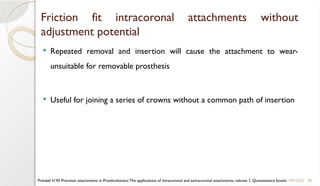
Friction fit intracoronalattachments without
adjustment potential
Repeated removal and insertion will cause the attachment to wear-
unsuitable for removable prosthesis
Useful for joining a series of crowns without a common path of insertion
11/09/2025
Preiskel H.W. Precision attachments in Prosthodontics:The applications of intracoronal and extracoronal attachments, volume 1, Quintessence books
39.
39
11/09/2025
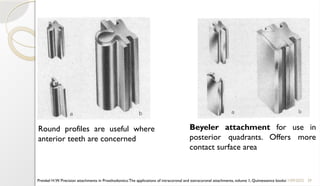
Round profiles areuseful where
anterior teeth are concerned
Beyeler attachment for use in
posterior quadrants. Offers more
contact surface area
Preiskel H.W. Precision attachments in Prosthodontics:The applications of intracoronal and extracoronal attachments, volume 1, Quintessence books
40.
40
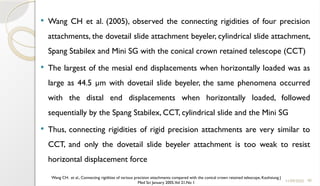
Wang CHet al. (2005), observed the connecting rigidities of four precision
attachments, the dovetail slide attachment beyeler, cylindrical slide attachment,
Spang Stabilex and Mini SG with the conical crown retained telescope (CCT)
The largest of the mesial end displacements when horizontally loaded was as
large as 44.5 µm with dovetail slide beyeler, the same phenomena occurred
with the distal end displacements when horizontally loaded, followed
sequentially by the Spang Stabilex, CCT, cylindrical slide and the Mini SG
Thus, connecting rigidities of rigid precision attachments are very similar to
CCT, and only the dovetail slide beyeler attachment is too weak to resist
horizontal displacement force
11/09/2025
Wang CH. et al., Connecting rigidities of various precision attachments compared with the conical crown retained telescope, Kaohsiung J
Med Sci January 2005,Vol 21,No 1
41.
41
Abutment tooth preparation
1.Survey the diagnostic cast to ensure proper placement of the
required precision attachment for esthetics, periodontal health,
restoration of biologic tooth contours, and an optimal path of insertion
of the RPD
2. Prepare guide planes to avoid an overcontoured restoration on
these surfaces of the subsequent restoration
3. Prepare a box or deep recess to house the precision attachment
rest seat so as to avoid an overbuilt casting
11/09/2025
Zinner I.D. Precision attachments, Full-Mouth Reconstruction: Fixed Removable, Dental Clinics of North America, July 1987,Vol.31, No. 3, 395-415
42.
42
4. Prepare theentire abutment tooth using a full shoulder with a bevel
type of preparation. When preparing a tooth for any intracoronal
attachment, whether a precision or a semi-precision attachment, the
dentist must deepen the shoulder from the mid-point on the buccal
surface to the midpoint on the lingual surface, on the near-proximal
zone
5. Add grooves or boxes to increase the resistance to dislodgement on
short crowned abutment preparation or on those ravaged by caries or
large previous restorations
11/09/2025
Zinner I.D. Precision attachments, Full-Mouth Reconstruction: Fixed Removable, Dental Clinics of North America, July 1987,Vol.31, No. 3, 395-415
43.
43
Guidelines for utilizationintracoronal precision attachments
Selected abutment teeth should be splinted together for proper distribution
of forces for use in precision attachment type RPD
Use of minimum of 2/3rd
of the attachment
The length of the attachment is more important than the width. A full-
length, narrow attachment is preferable to a short, wide attachment
11/09/2025
Zinner I.D. Precision attachments, Full-Mouth Reconstruction: Fixed Removable, Dental Clinics of North America, July 1987,Vol.31, No. 3, 395-415
44.
44
If attachmentlength is less than 5mm, another type of intracoronal
attachment must be substituted as there will be insufficient length for the
optimal utilization of the precision attachment
Prepare the abutment tooth sufficiently, so that the rest seat portion is
maintained within the normal confines of the crown contours for proper
periodontal health
11/09/2025
Zinner I.D. Precision attachments, Full-Mouth Reconstruction: Fixed Removable, Dental Clinics of North America, July 1987,Vol.31, No. 3, 395-415
45.
45
All ofthe precision attachments utilized should be of equal length.When
this is not feasible, pairs of precision attachments on similar teeth
bilaterally should be equal length
At no time should a rest be grounded or relieved to make it fit.To achieve
a proper fit, clinical and laboratory procedures must be followed precisely.
The attachments must be parallel to each other to avoid improper fit,
mutilation, and torquing of abutments
11/09/2025
Zinner I.D. Precision attachments, Full-Mouth Reconstruction: Fixed Removable, Dental Clinics of North America, July 1987,Vol.31, No. 3, 395-415
46.
46
Uses and advantagesof intracoronal precision
attachments
Connectors: sections of a fixed prosthesis may be joined with precision
attachments to facilitate parallelism of abutment teeth, ease of
cementation and avoidance of torque on full-arch restoration
Questionable prognosis: when the prognosis of a segment of fixed partial
prosthesis is questionable, this section can be joined to the part of the
prosthesis with a more favourable prognosis by precision attachments. If
this segment should be lost, it can be replaced with an attachment-
retained, removable partial denture
11/09/2025
Zinner I.D. Precision attachments, Full-Mouth Reconstruction: Fixed Removable, Dental Clinics of North America, July 1987,Vol.31, No. 3, 395-415
47.
47
Aesthetics (tooth-borneRPD): precision attachments allow for the
construction of an aesthetic partial denture that retains the appliance
dislodging forces without damage to the abutment teeth and aids in
resisting any tendency of the denture to be displaced horizontally. In
addition, the partial denture enables the dentist to achieve a cross-arch
stabilization
Precision attachments: these have more advantageous force distribution
to abutment
11/09/2025
Zinner I.D. Precision attachments, Full-Mouth Reconstruction: Fixed Removable, Dental Clinics of North America, July 1987,Vol.31, No. 3, 395-415
48.
48
Ease ofrepair: when the rest portion of the attachment fractures, the
appliance can be repaired easily.This is accomplished by selecting the size
and make of the attachment that was originally utilized and fitting this into
the rest seat.
11/09/2025
Zinner I.D. Precision attachments, Full-Mouth Reconstruction: Fixed Removable, Dental Clinics of North America, July 1987,Vol.31, No. 3, 395-415
49.
49
Disadvantages of intracoronalprecision attachments
Lack of rotational movement
Complicated clinical and laboratory procedures
Increased cost to patient
Limited in use owing to large pulp size and length of clinical crown
11/09/2025
Zinner I.D. Precision attachments, Full-Mouth Reconstruction: Fixed Removable, Dental Clinics of North America, July 1987,Vol.31, No. 3, 395-415
50.
50
When used properly,intracoronal precision attachments in conjunction
with fixed partial prosthesis offer the dentist as well as the patient an
optimal result in the rehabilitation of the compromised dentition
11/09/2025
Zinner I.D. Precision attachments, Full-Mouth Reconstruction: Fixed Removable, Dental Clinics of North America, July 1987,Vol.31, No. 3, 395-415
51.
51
Extracoronal attachments
Unlikeintracoronal attachments these units need no space within the
abutment crown and are unrestricted by pulpal considerations.
They may be employed where buccolingual space is limited-particularly
useful where lower canines are the most distal abutments.
3 groups of extracoronal attachments:
1. Projection units
2. Connecting units
3. Combined units
11/09/2025
Preiskel H.W. Precision attachments for partially dentate mouth, Annals of the Royal College of Surgeons of England (I974), vol 55, 294-298
52.
52
Projection units
Largestand most popular
Since they project from the abutment crowns, no box preparation is
required but they complicate plaque control
1. Rigid projection units
2. Projection units allowing play between two sections
11/09/2025
Preiskel H.W. Precision attachments in Prosthodontics:The applications of intracoronal and extracoronal attachments, volume 1, Quintessence books
53.
11/09/2025 53
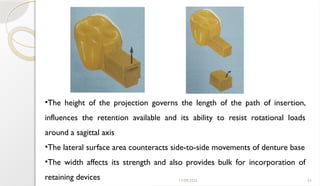
•The heightof the projection governs the length of the path of insertion,
influences the retention available and its ability to resist rotational loads
around a sagittal axis
•The lateral surface area counteracts side-to-side movements of denture base
•The width affects its strength and also provides bulk for incorporation of
retaining devices
54.
11/09/2025 54
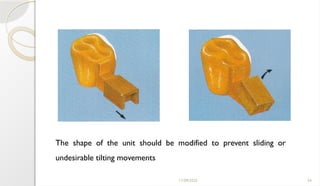
The shapeof the unit should be modified to prevent sliding or
undesirable tilting movements
55.
11/09/2025 55
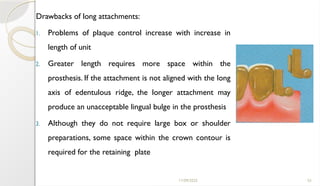
Drawbacks oflong attachments:
1. Problems of plaque control increase with increase in
length of unit
2. Greater length requires more space within the
prosthesis. If the attachment is not aligned with the long
axis of edentulous ridge, the longer attachment may
produce an unacceptable lingual bulge in the prosthesis
3. Although they do not require large box or shoulder
preparations, some space within the crown contour is
required for the retaining plate
11/09/2025 57
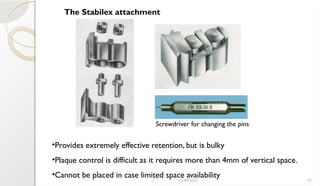
The Stabilexattachment
Screwdriver for changing the pins
•Provides extremely effective retention, but is bulky
•Plaque control is difficult as it requires more than 4mm of vertical space.
•Cannot be placed in case limited space availability
58.
11/09/2025 58
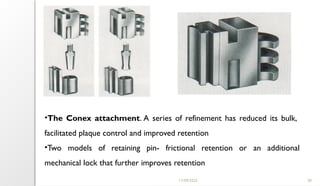
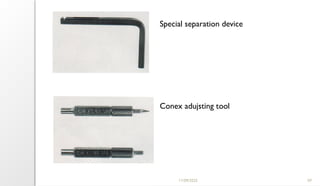
•The Conexattachment. A series of refinement has reduced its bulk,
facilitated plaque control and improved retention
•Two models of retaining pin- frictional retention or an additional
mechanical lock that further improves retention
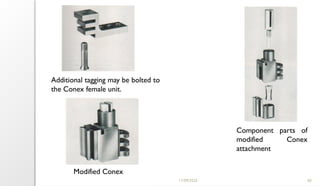
11/09/2025 60
Additional taggingmay be bolted to
the Conex female unit.
Modified Conex
Component parts of
modified Conex
attachment
61.
11/09/2025 61
The Scottattachment. The projecting
unit may be placed away from the gingival
margins.
This unit may be obtained as
a plastic blank and cut to size
on the master cast
Requirements: abutments of adequate strength and sufficient vertical
and buccolingual space for the attachment
62.
11/09/2025 62
The Dalboattachment
The bilateral model The unilateral model
Contact between the vertical surfaces
prevents the distal denture rotating
away from mucosa
Contact between lateral facing
surfaces provides resistance to
lateral forces
63.
11/09/2025 63
The ShoulderDalbo
Cut-away view of the Shoulder
Dalbo without occlusal load
Under occlusal load vertical travel is
limited by contact of the shoulder
Metal spacer
65
A studyreported by Caputo AP et al. (1981), showed stress patterns
resulting from the use of a Dalbo, Thompson dowel rest and Sterns
attachment with a distal extension type of prosthesis.
With a single abutment, there was too much stress on the apical one
third of the abutment tooth.
Most apical stress was with Sterns attachment and least for splinted teeth
with Thompson dowel rest attachment
If a single abutment tooth was employed, a Dalbo extracoronal
attachment showed the least stress.
11/09/2025
Caputo AP et al., Photoelastic analysis of stress patterns on teeth and bone with attachment retainers for removable partial dentures, J Prosthet
Dent, 46:21, 1981
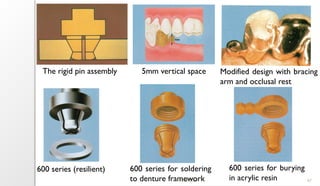
11/09/2025 67
The rigidpin assembly 5mm vertical space Modified design with bracing
arm and occlusal rest
600 series (resilient) 600 series for soldering
to denture framework
600 series for burying
in acrylic resin
68.
11/09/2025 68
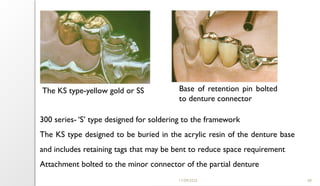
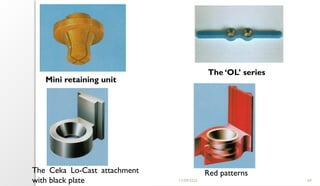
300 series-‘S’ type designed for soldering to the framework
The KS type designed to be buried in the acrylic resin of the denture base
and includes retaining tags that may be bent to reduce space requirement
Attachment bolted to the minor connector of the partial denture
The KS type-yellow gold or SS Base of retention pin bolted
to denture connector
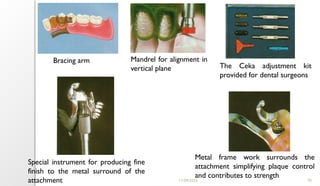
11/09/2025 70
Bracing armMandrel for alignment in
vertical plane
Metal frame work surrounds the
attachment simplifying plaque control
and contributes to strength
Special instrument for producing fine
finish to the metal surround of the
attachment
The Ceka adjustment kit
provided for dental surgeons
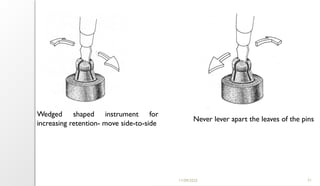
71.
11/09/2025 71
Wedged shapedinstrument for
increasing retention- move side-to-side
Never lever apart the leaves of the pins
72.
72
Connecting units
Theseunits connect two parts of a removable prosthesis, allowing a
certain limited amount of play
They have a similar function to a long and flexible major connector, but
act in a more precise and predictable manner
11/09/2025
Preiskel H.W. Precision attachments in Prosthodontics:The applications of intracoronal and extracoronal attachments, volume 1, Quintessence books
73.
11/09/2025 73
The AxialRotation joint.
The small window around the
screw determines the vertical
travel allowed by the joint
For distal extension dentures
The Rotation joint allows no
vertical play between the two
sections of the attachment
For tooth supported dentures
Steiger joints
Metal trimmed only from
the mesio-gingival and
disto-oclusal sections of
the male unit.
74.
74
Combined attachments
Theseunits consist of a hinge connector joined to an intracoronal
attachment.
Hinge unit is buried within the denture so that when it is in position, the
attachment closely resembles a rigid intracoronal attachment
Complex, cumbersome and has limited applications
11/09/2025
Preiskel H.W. Precision attachments in Prosthodontics:The applications of intracoronal and extracoronal attachments, volume 1, Quintessence books
75.
11/09/2025 75
Combined Crismaniunit
Bilateral configuartion- lateral
walls of the projection are
slightly tapered
Unilateral configuration- lateral
walls of the projection are
virtually parallel
76.
76
Daas M.et al. (2008) evaluated the influence of the retention mechanism on
the behavior of a mandibular implant-retained overdenture (IRO) during the
simulation of mastication
Three foodstuff positions were analyzed for two retention mechanisms,
“resilient” or “rigid”
The “resilient” configuration provided a wider contact area between the
mucosa of the denture bearing area and the prosthesis. An increase of the
mastication force transiting through the mucosa was also noted and lower
stresses were observed in the bone surrounding implants
They concluded that the resilient attachments allowed for an increase of the
mastication load transiting through denture bearing surface
11/09/2025
Daas M. et al., complete finite element model of a mandibular implant-retained overdenture with two implants: Comparison between rigid and
resilient attachment configurations, Medical Engineering & Physics 30 (2008) 218–225
77.
77
Wang Het al. (2011), compared the mechanical effects of 2 types of
extracoronal attachments (rigid and nonrigid) in distal extension
removable partial prostheses on the alveolar ridge and abutment tooth
periodontal ligament
They concluded that stress on the terminal abutment can be reduced by
the use of an extracoronal resilient attachment that allocates more
loads onto the distal edentulous ridge. Lateral force has the greatest effect
on the terminal abutment in distal extension base PRDPs with universal
hinge attachments. Movement of the component parts in the attachment is
most affected by buccolingual loading.
11/09/2025
Wang H et al., Effects of rigid and nonrigid extracoronal attachments on supporting tissues in extension base partial removable
dental prostheses:A nonlinear finite element study, J Prosthet Dent 2011;105:338-346
78.
78
Rivaldo EGet al. (2011), evaluated the retentive ability and weight change
of two extracoronal attachments, one with plastic inserts and the other
with conventional metal-alloy after repeated insertion/removal cycles
They concluded that metal-alloy precision attachments showed a greater
increase in retentive ability compared to precision attachment with
plastic inserts over time and both precision attachments did not show
weight change after five years of simulated use.
11/09/2025
Rivaldo EG et al., “In vitro” wear behavior of extracoronal precision attachments, Stomatos,Vol. 17, N.33, July/Dec. 2011
79.
79
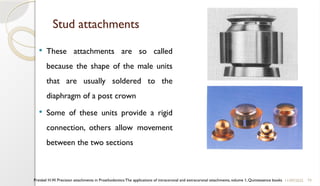
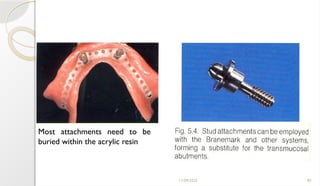
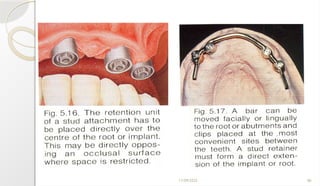
Stud attachments
Theseattachments are so called
because the shape of the male units
that are usually soldered to the
diaphragm of a post crown
Some of these units provide a rigid
connection, others allow movement
between the two sections
11/09/2025
Preiskel H.W. Precision attachments in Prosthodontics:The applications of intracoronal and extracoronal attachments, volume 1, Quintessence books
80.
80
11/09/2025
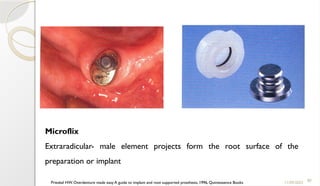
Microflix
Extraradicular- male elementprojects form the root surface of the
preparation or implant
Prieskel HW. Overdenture made easy A guide to implant and root supported prosthesis, 1996, Quintessence Books
81.
11/09/2025 81
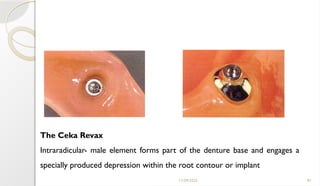
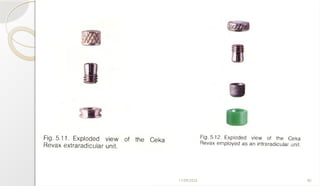
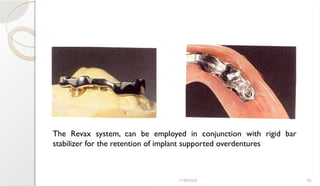
The CekaRevax
Intraradicular- male element forms part of the denture base and engages a
specially produced depression within the root contour or implant
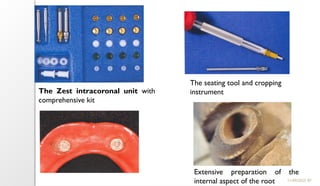
87
11/09/2025
The Zest intracoronalunit with
comprehensive kit
The seating tool and cropping
instrument
Extensive preparation of the
internal aspect of the root
88.
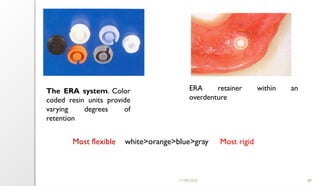
11/09/2025 88
The ERAsystem. Color
coded resin units provide
varying degrees of
retention
ERA retainer within an
overdenture
Most flexible white>orange>blue>gray Most rigid
89.
11/09/2025 89
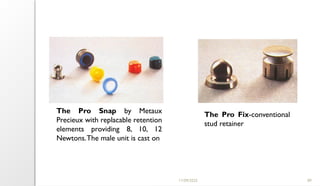
The ProSnap by Metaux
Precieux with replacable retention
elements providing 8, 10, 12
Newtons.The male unit is cast on
The Pro Fix-conventional
stud retainer
90.
11/09/2025 90
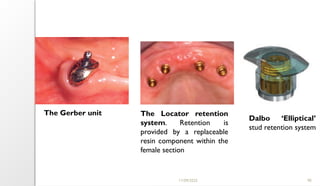
The Gerberunit The Locator retention
system. Retention is
provided by a replaceable
resin component within the
female section
Dalbo ‘Elliptical’
stud retention system
92
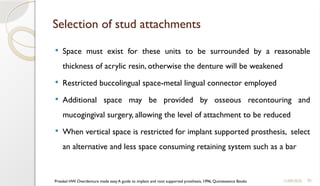
Selection of studattachments
Space must exist for these units to be surrounded by a reasonable
thickness of acrylic resin, otherwise the denture will be weakened
Restricted buccolingual space-metal lingual connector employed
Additional space may be provided by osseous recontouring and
mucogingival surgery, allowing the level of attachment to be reduced
When vertical space is restricted for implant supported prosthesis, select
an alternative and less space consuming retaining system such as a bar
11/09/2025
Prieskel HW. Overdenture made easy A guide to implant and root supported prosthesis, 1996, Quintessence Books
93.
11/09/2025 93
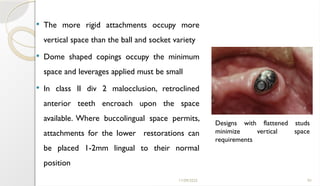
Themore rigid attachments occupy more
vertical space than the ball and socket variety
Dome shaped copings occupy the minimum
space and leverages applied must be small
In class II div 2 malocclusion, retroclined
anterior teeth encroach upon the space
available. Where buccolingual space permits,
attachments for the lower restorations can
be placed 1-2mm lingual to their normal
position
Designs with flattened studs
minimize vertical space
requirements
94.
11/09/2025 94
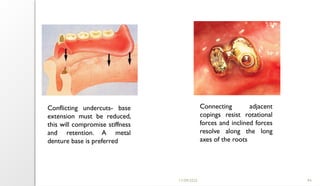
Connecting adjacent
copingsresist rotational
forces and inclined forces
resolve along the long
axes of the roots
Conflicting undercuts- base
extension must be reduced,
this will compromise stiffness
and retention. A metal
denture base is preferred
95.
95
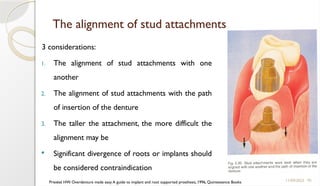
The alignment ofstud attachments
3 considerations:
1. The alignment of stud attachments with one
another
2. The alignment of stud attachments with the path
of insertion of the denture
3. The taller the attachment, the more difficult the
alignment may be
Significant divergence of roots or implants should
be considered contraindication
11/09/2025
Prieskel HW. Overdenture made easy A guide to implant and root supported prosthesis, 1996, Quintessence Books
96.
96
The number ofattachments
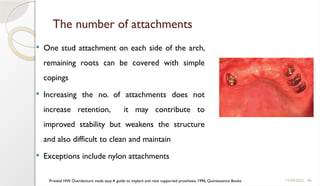
One stud attachment on each side of the arch,
remaining roots can be covered with simple
copings
Increasing the no. of attachments does not
increase retention, it may contribute to
improved stability but weakens the structure
and also difficult to clean and maintain
Exceptions include nylon attachments
11/09/2025
Prieskel HW. Overdenture made easy A guide to implant and root supported prosthesis, 1996, Quintessence Books
97.
97
11/09/2025
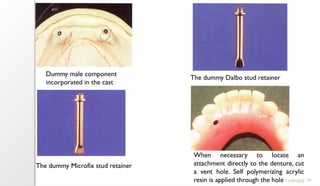
Dummy male component
incorporatedin the cast
The dummy Dalbo stud retainer
The dummy Microfix stud retainer
When necessary to locate an
attachment directly to the denture, cut
a vent hole. Self polymerizing acrylic
resin is applied through the hole
98.
98
Kim Set al. (2015), compare the changes in retentive force of stud
attachments, Kerator blue, O-ring red, and EZ lock for implant overdentures
by in vitro 2-year–wear simulation
Results revealed the highest value for Kerator, followed by the O-ring and EZ
lock attachments. However, no significant difference was detected between
Kerator and O-ring after 2500 insertion and removal cycles, the highest
retention loss was recorded for O-ring, and no significant difference between
Kerator and EZ lock.
11/09/2025
Kim S et al., Comparison of changes in retentive force of three stud attachments for implant overdentures, J Adv Prosthodont 2015;7:303-11
99.
11/09/2025 99
Also,Kerator showed the highest retentive force, followed by EZ
lock and O-ring, after 2500 cycles. Based on SEM analysis, the polymeric
components in O-ring and Kerator were observed to exhibit surface
wear and deformation
Conclusion-After 2500 insertion and removal cycles, all attachments
exhibited significant loss in retention
100.
100
Aroso Cet al. (2016), conducted a study to evaluate the durability of and
variations in the retention force of three implant overdenture stud-type
attachment systems at three different angulations in an aqueous
environment of artificial saliva.
Three commercial attachment systems were selected for the study: Clix,
Dalbo-Plus and Locator
The abutments were placed at angulations of 0°, 10°and 20°
11/09/2025
Aroso C et al., Effect of abutment angulation in the retention and durability of three overdenture attachment systems:An in vitro study, J Adv
Prosthodont 2016;8:21-9
101.
101
Results revealedthat the greater angulation of the abutment values were
found to influence the retention capacity of the attachments, the
attachment systems evaluated presented adequate retention for clinical
usage, the fatigue test simulating 5 years of denture insertion and removal
did not produce wear in metal abutments
Overall, the Dalbo- Plus system provided the best retention followed by
the white Locator system.
11/09/2025
Aroso C et al., Effect of abutment angulation in the retention and durability of three overdenture attachment systems:An in vitro study, J Adv
Prosthodont 2016;8:21-9
102.
102
Mahrous AIet al (2015), compared and evaluated the effect of two
different attachments (locator attachment and ball and socket [B&S]
attachment) on implants and natural abutments supporting structures, in
cases of limited inter-arch spaces in mandibular Kennedy Class I implant
supported removable partial over dentures by measuring the bone height
changes through the cone beam radiographic technology
The side of the implant-supported partial over denture restored with the
locator attachment showed better effect on bone health around both the
placed dental implant and the main natural abutment as compared with
the B&S attachment
11/09/2025
Mahrous AI et al., Implant Supported Distal Extension over Denture Retained by TwoTypes of Attachments.A Comparative Radiographic
Study by Cone Beam Computed Tomography, Journal of International Oral Health 2015; 7(5):5-10
103.
11/09/2025 103
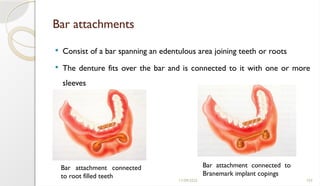
Bar attachments
Consist of a bar spanning an edentulous area joining teeth or roots
The denture fits over the bar and is connected to it with one or more
sleeves
Bar attachment connected
to root filled teeth
Bar attachment connected to
Branemark implant copings
104.
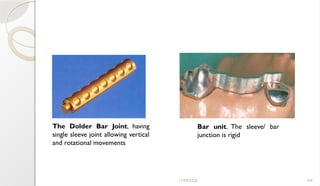
11/09/2025 104
The DolderBar Joint, having
single sleeve joint allowing vertical
and rotational movements
Bar unit. The sleeve/ bar
junction is rigid
105.
11/09/2025 105
Complications ofbar attachments
Vertical and buccolingual space requirements limit the applications
Require more plaque removal skill on the part of the patient than most
other retainers
Require adequate and equal retention for abutment retainers if
cementation failures are to be avoided
Requires technical skills together with clinical expertise. Rebasing and
repair can be complicated
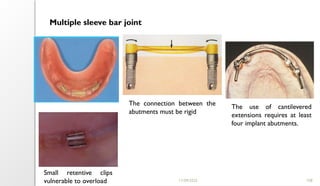
11/09/2025 108
Multiple sleevebar joint
The connection between the
abutments must be rigid
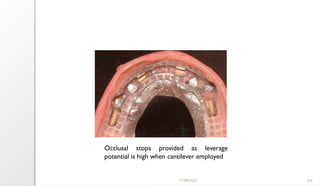
The use of cantilevered
extensions requires at least
four implant abutments.
Small retentive clips
vulnerable to overload
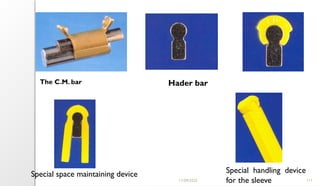
11/09/2025 111
The C.M.bar Hader bar
Special space maintaining device Special handling device
for the sleeve
112.
11/09/2025 112
Standard abutmentscan be
employed when implants are only
moderately misaligned
Angled abutments are far from
ideal but connecting them
minimizes the effects of non-
axial loads
113.
113
Mohammad D.H.et al. (2013) compared two types of attachments (bar
and ball systems) on the basis of the stresses introduced to the
mandibular posterior residual ridge by an overdenture retained by two
implants. He found that the bar-retained overdenture introduced higher
stresses to the posterior mandibular residual ridge compared to the ball-
retained overdenture (0.4 MPa and 0.1 MPa, respectively)
11/09/2025
Mohammad D.H. et al.,The effects of two attachment types on the stresses introduced to the mandibular residual ridge, Quintessence Int,
2013, vol. 44 no. 8, 555-634
114.
114
Petropoulus V.C., Mante F.,(2011) compared the retentive forces and strain
energies of the Nobel Biocare standard ball, Nobel Biocare newer generation
ball (Yorba Linda, CA), Zest Anchor, Zest Anchor Advanced Generation
(Escondido, CA), Sterngold-Implamed ERA white, and Sterngold-Implamed
orange attachments (Attleboro, MA) on an implant-retained in vitro
overdenture model
Results revealed that the Zest Anchor Advanced Generation attachment had
significantly the highest retentive vertical and oblique forces.The Zest Anchor
had the lowest vertical force , and Nobel Biocare Standard had the lowest
oblique retentive force..
11/09/2025
PetropoulusV.C., Mante F., Comparison of Retention and Strain Energies of Stud Attachments for Implant Overdentures, Journal of
Prosthodontics 20 (2011) 286–293 by the American College of Prosthodontists
115.
115
The NobelBiocare Standard Ball attachment had the highest strain
energies in the vertical and oblique directions. The Sterngold-Implamed
ERA White and Zest Anchor had the lowest strain energies, in the vertical
and oblique directions
He concluded that the retentive forces and strain energies of implant
overdenture stud attachments are different and should be considered
during prosthesis selection
11/09/2025
PetropoulusV.C., Mante F., Comparison of Retention and Strain Energies of Stud Attachments for Implant Overdentures,
Journal of Prosthodontics 20 (2011) 286–293 by the American College of Prosthodontists
116.
116
Silva ASet al. (2015), compared the durability and retention of 4 types of
attachments, Hader Yellow, Hader Red, Ackerman Gold and Ackerman
Stainless Steel, placed over computer aided design/computer aided
manufacturing (CAD/CAM) titanium bars when subjected to different pH
conditions
All the attachments lost retention (insertion/removal) over time.
The more acidic pH value (pH 4) caused a significant decrease in the
average values of the insertion and removal forces of all the attachments
11/09/2025
Silva AS et al., The influence of saliva pH value on the retention and durability of bar-clip attachments, J Adv Prosthodont 2015;7:32-8
117.
117
The attachmentwith the most stable behavior was the Ackerman
Gold.
The Ackerman Stainless Steel was the attachment with the highest values
of insertion and removal initially.
The highest percentage of loss retention after 5400 cycles was observed
in the Ackerman Stainless Steel attachment (pH 4), with 91.47%
11/09/2025
Silva AS et al., The influence of saliva pH value on the retention and durability of bar-clip attachments, J Adv Prosthodont 2015;7:32-8
118.
11/09/2025 118
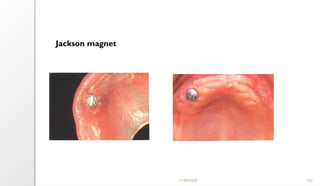
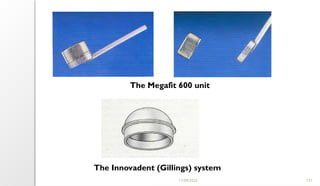
Magnetic retainers
The introduction of rare earth alloys with high field strength and an
intrinsic coercivity many times that of earlier alloys allowed the production
of magnets that were not much larger than stud retainers
The pioneering work of Gillings, at the University of Sydney, developed a
split pole magnet assembly using cobalt samarium alloys.When paired with
a magnetizable alloy keeper, this produced closed field magnetic retention
The magnet was placed in the denture and the flat keeper on the
abutment root, so that the path of the insertion of the denture was
unaffected by the retainer
119.
11/09/2025 119
Theproduction of iron neodymium boron magnets in a laser-welded
capsule solved the problem of corrosion
Since magnetic retainers resist shear loads to a very small extent (10% of
the normal retention force), only a small amount of lateral load can be
transmitted by the actual retainer
122
Hu Fet al. (2019), conducted a study to evaluate the biomechanical
behaviors of three different types of magnetic attachments, Flat-type,
dometype and cushion-type, in two-implant-supported overdentures by
three-dimensional finite element analysis methods.
The biomechanical behaviors of peri-implant bone, abutment, and mucosa
were recorded
Flat-type magnetic attachment exhibited higher levels of maximum
equivalent strain/stress in the peri-implant bone compared to dome-type
and cushion-type attachments under vertical and oblique loading
conditions
11/09/2025
Hu F et al., Comparison ofThree DifferentTypes of Two-Implant-Supported Magnetic Attachments on the Stress Distribution in Edentulous
Mandible, Computational and Mathematical Methods in Medicine,Volume 2019
123.
123
Oblique loadingmay play a detrimental role for all magnetic attachments
in strain/stress distribution and denture stability
Cushion-type and dome-type attachments are better choices in two-
implant-retained mandibular overdentures, especially for patients with bad
bone conditions such as osteoporosis or when a shorter or smaller
diameter implant has to be used
11/09/2025
Hu F et al., Comparison ofThree DifferentTypes of Two-Implant-Supported Magnetic Attachments on the Stress Distribution in Edentulous
Mandible, Computational and Mathematical Methods in Medicine,Volume 2019
124.
124
Kim H.et al. (2012) conducted systematic review to address treatment outcome
according to attachment systems for mandibular implant overdentures in terms of
implant survival rate, prosthetic maintenance and complications, and patient
satisfaction
Four studies presented implant survival rates (95.8 - 97.5% for bar, 96.2 - 100%
for ball, 91.7% for magnet) according to attachment system. Ten other studies
presented an implant survival rate ranging from 93.3% to 100% without respect to
the attachment groups.
Common prosthetic maintenance and complications were replacement of an assay
for magnet attachments, and activation of a matrix or clip for ball or bar
attachments..
11/09/2025
kim H. et al, Attachment systems for mandibular implant overdentures: a systematic review, J Adv Prosthodont 2012;4:197-203
125.
125
Conflicting findingswere found on the rate of prosthetic maintenance and
complications comparing ball and bar attachments. Most studies showed
no significant differences in patient satisfaction depending upon
attachment systems
The implant survival rate of mandibular overdentures seemed to be high
regardless attachment systems. The prosthetic maintenance and
complications may be influenced by attachment systems. However patient
satisfaction may be independent of the attachment system.
11/09/2025
kim H. et al, Attachment systems for mandibular implant overdentures: a systematic review, J Adv Prosthodont 2012;4:197-203
126.
126
Sato Het al. (2019), conducted a study to determine the appropriate
attachment and design of a denture base for mandibular implant
overdenture (IOD), the oral mucosa pressure caused by mandibular
implant overdentures was measured using edentulous jaw models with
various attachments
Locator attachments (LA), ball attachments (BA), magnetic attachments
(MA), and round-bar attachments (R-BA) were tested
11/09/2025
Sato H et al., Oral mucosa pressure caused by mandibular implant overdenture with different types of attachments, J Prosthodont Res (2019)
127.
127
Under thebilateral load condition, the lower oral mucosa pressure value
with BA was measured, compared to other attachments at all
measurement sites.
Under the unilateral load condition, the oral mucosa pressure value of BA
was smaller than the other attachments at the measurement site on the
loading side.
BA has exerted the greatest effects on support and bracing, suggesting
that, BA is suitable for reducing oral mucosa pressure during mastication
11/09/2025
Sato H et al., Oral mucosa pressure caused by mandibular implant overdenture with different types of attachments, J Prosthodont Res (2019)
128.
128
Auxillary attachments
Usuallythey are used with other attachments for improving retention. A
variety of attachments fall into this category. They are screw and tube
attachment, key and keyway/ interlocks, press o matic, Sectional dentures,
bar connectors
11/09/2025
Kanathila H. et al., An insight into various attachments used in prosthodontics:A review, International Journal of Applied Dental
Sciences, 2018; 4(4): 157-160
129.
11/09/2025 129
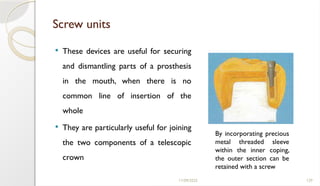
Screw units
These devices are useful for securing
and dismantling parts of a prosthesis
in the mouth, when there is no
common line of insertion of the
whole
They are particularly useful for joining
the two components of a telescopic
crown
By incorporating precious
metal threaded sleeve
within the inner coping,
the outer section can be
retained with a screw
130.
11/09/2025 130
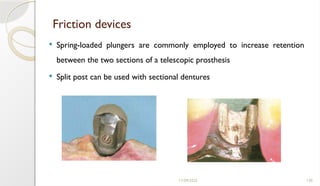
Friction devices
Spring-loaded plungers are commonly employed to increase retention
between the two sections of a telescopic prosthesis
Split post can be used with sectional dentures
131.
11/09/2025 131
Bolts
Boltunits are used to connect the two parts of a sectional denture in
the mouth
Each part of the denture is inserted separately and the patient locks
them together with the bolt
132.
11/09/2025 132
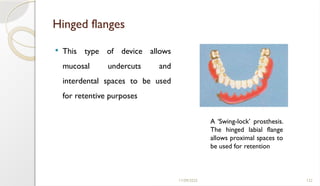
Hinged flanges
This type of device allows
mucosal undercuts and
interdental spaces to be used
for retentive purposes
A ‘Swing-lock’ prosthesis.
The hinged labial flange
allows proximal spaces to
be used for retention
133.
133
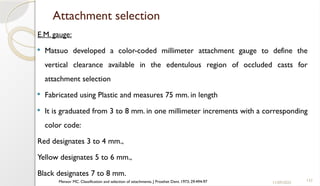
Attachment selection
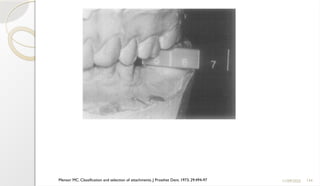
E.M. gauge:
Matsuo developed a color-coded millimeter attachment gauge to define the
vertical clearance available in the edentulous region of occluded casts for
attachment selection
Fabricated using Plastic and measures 75 mm. in length
It is graduated from 3 to 8 mm. in one millimeter increments with a corresponding
color code:
Red designates 3 to 4 mm.,
Yellow designates 5 to 6 mm.,
Black designates 7 to 8 mm.
11/09/2025
Mensor MC. Classification and selection of attachments. J Prosthet Dent. 1973; 29:494-97
135
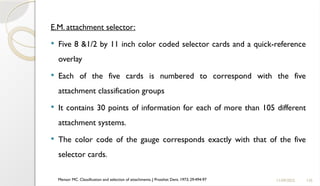
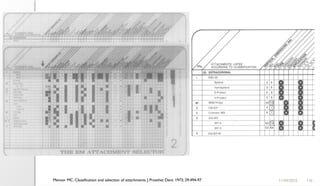
E.M. attachment selector:
Five 8 &1/2 by 11 inch color coded selector cards and a quick-reference
overlay
Each of the five cards is numbered to correspond with the five
attachment classification groups
It contains 30 points of information for each of more than 105 different
attachment systems.
The color code of the gauge corresponds exactly with that of the five
selector cards.
11/09/2025
Mensor MC. Classification and selection of attachments. J Prosthet Dent. 1973; 29:494-97
137
Use of thegauge and selector:
The gauge is used to establish the height limitation.The proper attachments
is first selected from the classification group; the overlay, which is a
duplication of the slant-line information index, is used for the selection of an
extracoronal attachment and the points of information are read directly
from the compendium card.
The keyed color-code measurements represent “Max.“-the size available
commercially and “Min.‘‘-the amount an attachment may be reduced
vertically and still maintain its manufactured characteristics.
11/09/2025
Mensor MC. Classification and selection of attachments. J Prosthet Dent. 1973; 29:494-97
138.
11/09/2025 138
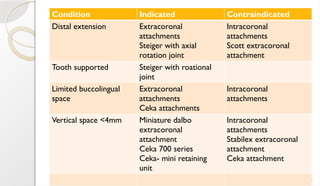
Condition IndicatedContraindicated
Distal extension Extracoronal
attachments
Steiger with axial
rotation joint
Intracoronal
attachments
Scott extracoronal
attachment
Tooth supported Steiger with roational
joint
Limited buccolingual
space
Extracoronal
attachments
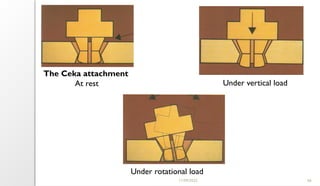
Ceka attachments
Intracoronal
attachments
Vertical space <4mm Miniature dalbo
extracoronal
attachment
Ceka 700 series
Ceka- mini retaining
unit
Intracoronal
attachments
Stabilex extracoronal
attachment
Ceka attachment
139.
11/09/2025 139
Conclusion
Precision attachmentsserve the function of retention, stress distribution
and aesthetics successfully. Appropriate selection of attachments, plays a
major role in the success of treatment. Proper maintenance and care by
the patient and regular follow up decides on the long term success of the
attachment and prosthesis. Use of precision attachment strengthens the
aspects of retention and particularly, esthetics when compared to
conventional removable partial dentures
140.
11/09/2025 140
References
GPT9
Kanathila H. et al., An insight into various attachments used in
prosthodontics:A review, International Journal of Applied Dental Sciences,
2018; 4(4): 157-160
Mensor MC. Classification and selection of attachments. J Prosthet Dent.
1973; 29:494-97
Preiskel H.W. Precision attachments in Prosthodontics:The applications of
intracoronal and extracoronal attachments, volume 1, Quintessence books
141.
11/09/2025 141
ZinnerI.D. Precision attachments, Full-Mouth Reconstruction: Fixed
Removable, Dental Clinics of North America, July 1987,Vol.31, No. 3, 395-415
Preiskel H.W. Precision attachments for partially dentate mouth, Annals of
the Royal College of Surgeons of England (I974), vol 55, 294-298
Mohammad D.H. et al., The effects of two attachment types on the stresses
introduced to the mandibular residual ridge, Quintessence Int, 2013, vol. 44
no. 8, 555-634
Petropoulus V.C., Mante F., Comparison of Retention and Strain Energies of
Stud Attachments for Implant Overdentures, Journal of Prosthodontics 20
(2011) 286–293 by the American College of Prosthodontists
142.
11/09/2025 142
WangCH. et al., Connecting rigidities of various precision attachments
compared with the conical crown retained telescope, Kaohsiung J Med Sci
January 2005,Vol 21,No 1
kim H. et al, Attachment systems for mandibular implant overdentures: a
systematic review, J Adv Prosthodont 2012;4:197-203
Caputo AP et al., Photoelastic analysis of stress patterns on teeth and bone
with attachment retainers for removable partial dentures, J Prosthet Dent,
46:21, 1981
Aroso C et al., Effect of abutment angulation in the retention and durability
of three overdenture attachment systems: An in vitro study, J Adv
Prosthodont 2016;8:21-9
143.
11/09/2025 143
DaasM. et al., complete finite element model of a mandibular implant-
retained overdenture with two implants: Comparison between rigid and
resilient attachment configurations, Medical Engineering & Physics 30
(2008) 218–225
Mahrous AI et al., Implant Supported Distal Extension over Denture
Retained by TwoTypes of Attachments.A Comparative Radiographic Study
by Cone Beam Computed Tomography, Journal of International Oral
Health 2015; 7(5):5-10
Kim S et al., Comparison of changes in retentive force of three stud
attachments for implant overdentures, J Adv Prosthodont 2015;7:303-11
144.
11/09/2025 144
PrieskelHW. Overdenture made easy A guide to implant and root
supported prosthesis, 1996, Quintessence Books
Wang H et al., Effects of rigid and nonrigid extracoronal attachments on
supporting tissues in extension base partial removable dental prostheses:
A nonlinear finite element study, J Prosthet Dent 2011;105:338-346
Rivaldo EG et al., “In vitro” wear behavior of extracoronal precision
attachments, Stomatos,Vol. 17, N.33, July/Dec. 2011
Silva AS et al., The influence of saliva pH value on the retention and
durability of bar-clip attachments, J Adv Prosthodont 2015;7:32-8
145.
11/09/2025 145
SatoH et al., Oral mucosa pressure caused by mandibular implant
overdenture with different types of attachments, J Prosthodont Res
(2019)
Hu F et al., Comparison of Three Different Types of Two-Implant-
Supported Magnetic Attachments on the Stress Distribution in
Edentulous Mandible, Computational and Mathematical Methods in
Medicine,Volume 2019
Editor's Notes
#7 In the 19th Century the various extracoronal and intracoronal attachments were developed
Dr. Herman E.S Chayes, developed the concept of internal frictional resistance early in the twentieth century
Chayes attachment- This forms the basic pattern for most of the modern attachments. Chayes also put forward the stress breaker design, which is an attachment to which a hinge was added, thus allowing limited simple movement and this design was later improved by McCollum
Haderbar- available as prefabricated plastic pattern
#13 Precision- parallel sided flanges
Semi-precision- the flanges are slightly tapered
#14 Where vertical space is restricted a laboratory-produced Channel Shoulder Pin system can be employed. Retention is provided by a series of
parallel-sided pins augmented by guiding grooves.
#20 The V-shaped flange is to meet the lines of the abutment tooth in an occlusal direction. The attachments are made in 4 sizes for left and right sides with a split-post.
#21 Flattened loop of clasp metal(the keeper) into which fits a two-winged section (the anchor). The attachment moves parallel and does not allow rotation. The anchor has a seam that allows retention to be increased
#22 Originally called buccolingual attachment. His original idea was to position the attachment lingually, but a mesiodistal position was suggested
This T-shaped unit is still in production today
#27 Available in two basic configurations
The unit is 7mm tall and can be shortened by up to 2mm
#29 Has been redesigned for additional strength. The adjustment split runs part way through the attachment from one side.
The splits should face laterally, right and left sided attachments are available and manufacturers have selected lower restoration for their terminology, so when for upper denture, a left sided attachment should be placed on right side and vice versa
#30 Two sizes are available and female unit may be obtained in either high heat or conventional yellow gold alloys
#31 To retain removable prosthesis, an external frictional flange is cast together with a bracing arm.
#32 The lateral facing surfaces and total areas of contact are far greater than those offered by a conventional intra-coronal attachment and this may compensate for the reduced precision of fit between the two components
#33 Since the size and shape of the tooth governs both the cross-section and length of an intracoronal attachment, there exist a definite limit to the retention available
#34 This male unit is manufactured in two configurations, one for soldering to the major connector and other designed for burying within the acrylic resin of the denture base
#35 0.7mm narrower
The width is reduced by placing the dismantling screw under the attachment base
#36 The result is to provide a lock as the male slide is engaged
#37 Fig.: The free ends are of varying thickness and the male unit is adjusted by inserting the adjusting instruments in sequence until the retention desired is achieved
Dovetail-simplifies soldering and useful when attachment is used in split-pontic mode
ES1 features a long extension plate that simplifies electro-soldering the male to the denture framework. Alternatively, Extensions can be roughened to permit retention by the acrylic resin
Never attempt to shorten the jacket with scalpel, discing is recommended
#39 Both the units feature an external frictional flange
#42 This room is needed for the technician to maneuver the attachment on the surveyor for proper parallelism and placement of the precision attachment and lingual sleeve without overcontouring the restoration in relation to the other precision attachments employed in that particular situation
#44 Length is imp factor in attachment retention and stability
#48 Remove the broken rest part from the partial denture and insert the denture into the patients mouth. Paint Duralay resin between the new rest part and the partial denture and make a plaster impression. Remove the impression when it has hardened and have the rest part soldered to the partial denture framework
#49 1. And therefore should not be used in tissue-supported, distal extension, removable partial denture situation. A large percentage of combination fixed-removable restorations do involve distal extension situations
#51 Extracoronal attachments are often employed to retain bilateral distal extension prostheses.
#53 1.Consider a Hypothetical rectangular unit soldered to the distal aspect of the abutment for DDB
2. This surface area is a function of height and length
#54 The hinge movement around the abutment should be restricted or even eliminated
#55 1.The mechanical advantages of a long attachment and corresponding large lateral surfaces have been mentioned, but when applied to the mouth the drawbacks may be intolerable.
2. Bracing arm may over come this problem. An additional lateral surface contact area provided by a bracing arm is a useful way of overcoming the effects of reducing the length of the attachment
3. Problem of pulpal space is not completely eliminated
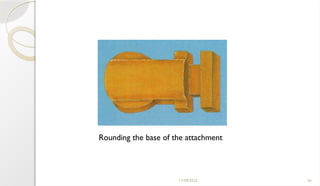
#56 Rounding the base of the attachment will be helpful to plaque control
#57 Provides rigid connection between male and female sections, with additional retention provided by pins
The retention of pins is adjustable. If necessary, unscrewed and replaced
All rigid attachments are bulky
#58 Far smaller mesiodistally
The female section is designed for incorporation within the acrylic resin of the denture base
#59 1. Retention is so effective that a special separation device is produced to help part the two sections
2.The pointed end spreads the retaining pins and increases retention. The opposite end unscrews the pin. When not in use the pointed should be protected within the tool using the screw threads available
#60 This tagging may be soldered to the major connector
Modified Conex allowing the construction of screw retained fixed prosthesis that enables the operator to screw the removable section of the prosthesis in place
Manufacturers do not recommend soldering to the removable section of the attachment
The parallel sides of Conex attachment permit it to be used in conjunction with intracoronal attachments
May be employed in conjunction with parallel sided telescopic crowns
#61 1.May be rigid or allow movement depending on inclusion of axial rotational joint
2. With considerable advantages to plaque control
3. Used to retain anterior restoration. Its design allows close adaptation to the underlying mucosa
#62 Excellent examples of units allowing play between two units. L-shaped bar with a ball on the lower extremity
Available in two sizes, with matrix height of 5mm or 6mm.
Two configurations- with base of the L-shaped male unit longer in one than other
This increased lateral surface area of the longer unit provides additional resistance to rotational and lateral displacing forces
‘Tilt-preventing device’ that maintains the denture base in contact with mucosa
#63 Vertical play- loads in this direction are transmitted through a coil to the ball connector
Shoulder dalbo is a modification of the spring controlled dalbo in which the vertical travel is restricted by metal-to-metal contact
Spring controls only the hinge movement, loss or damage of spring does not completely destroy occlusal support
Spring requires maintenance, replaced by metal spacer
#64 Vertical space requirements-halved
Lingual twist increases the slope at which mucosa falls away
Allowing the two sections to be locked together during impression or rebasing techniques
#65 With intracoronal attachments, single abutments should be avoided, wherever possible, double abutments are employed
The Dalbo is a mechanical stress breaker that eliminates the stress on the abutment tooth and transfers it to the edentulous ridge
#67 1.May be unscrewed for replacement
2. Circular shape will not prevent rotation around a vertical axis-occlusal rest preparation
3. To prevent lateral movements-lingual bracing arm
4. 600 series- used with correct retaining pins and spacers. Allow vertical and rotational play. Bracing arm and rest seat required
5. 700 series- rigid, male spring eliminates vertical play, height reduced to 3.25mm
#68 Base of the male pin may be connected to the denture in 3 ways
Bolt occupies additional vertical space
#69 Retaining pin and base form one solid unit to save space. Reduces height of the retaining pin to 2.45mm for rigid and 2.75mm for resilient connection
OL series features a plastic pattern with a line of metal that can be invested and burnt out, allowing the attachment and crown to be cast on, ensuring precision of fit with the male retention pin and adequate wear resistance. Color coded: red- platinized alloy, used with precious alloys, ‘Irax’. Blue- used with non-precious alloy, ‘Noprax’ that can be employed with porcelain bonding
Prefabricated ceka unit with its own guide plane for use with high fusing alloys. 696 series- resilient, 726 series rigid. 300,400 and mini male parts can also be used. Plastic patterns in red and blue
In case of limited buccolingual space, position slightly lingual to original place. In particularly, restricted buccolingual space, ceka not recommended
#71 H9 unit for reducing retention-simply placed over the male pin
#73 Joints used for joining a denture base to the major connector of a clasp-retained denture
Female section-vertical sleeve soldered to the removable crowns or the clasp-retained section of the denture
Male unit-flattened rod attached to the denture saddle and fitted within the sleeve
The two parts are held together by a small screw
2 types of joints-axial rotation and rotation
Axial- DDB- screw should be at the top of the window when teeth were apart and should move downwards as load was applied to the artificial teeth
Rotational – vertical movement could be damaging to the teeth in tooth supported
The other surfaces prevent the denture base moving away from the mucosa and should not be touched
#74 The male section of combined attachments may be inter-changable with those of an equivalent intracoronal attachment
#79 Attachments allowing limited degree of play should be provided with metal spacers for use during processing
Image- dalbo series of stud attachments
#91 Patrix- eccentric cylinder with undercut or groove
Matrix-clip or clasp arm
Activation- bending the clasp arm toward the center
#92 The lower the level of attachment, the more buccolingual space available for the artificial teeth
#94 But connecting copings complicate plaque control. Note the lingual positioning of the stud in class II div2
Can be employed with root copings
#95 1. Ball and socket type of retainer-most popular variety. The scope for misalignment of two units is quite narrow, divergence of about 10 degrees is tolerated. Excessive wear will result from wide divergencies
2. Attachments will be aligned with one another when path of insertion of denture is selected
#96 Exception- or those of similar construction with awkward distributions of remaining roots
#97 Relining, rebasing or extensive repair of a denture with an extraradicular stud retainer dictates the use of dummy male component that is incorporated in the cast
#105 1.The bulk of bar raises several problems
2. Cannot be recommended for arthritic pts with limited manual dexterity.
3. Prognosis is best when mobility of abutment do not reach grade 2
#107 Allow some movement between the components
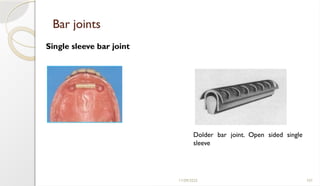
Single sleeve bar runs straight cannot follow AP curvature and cannot be adapted to vertical contours, used in square type arch
#108 1. Relatively short, allows the bar to follow the curvature of the ridge and adapt to its vertical contours
2.Failure to achieve this rigidity can lead to stress concentrations around implants and endanger their integration within the bone
3. Sleeves positioned on the extension will prevent any tendency for the distal part of the maxillary denture to drop
#109 Circular is most versatile. Can bent into all planes
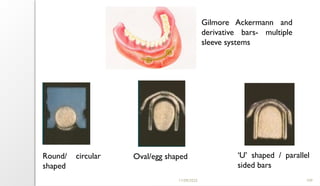
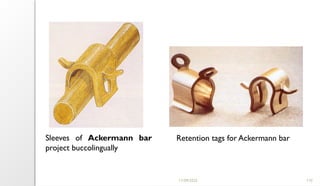
#110 Metal sleeves are secucred in the acrylic resin by retention tags. The tagging must at right angles to the bar-resist rotational forces but encroaches buccolingual space or parallel with it- simplifies relocation procedures and arrangement of the teeth but require more vertical space to resist side to side movement
#111 CM bar- retention tags project in the long axis of the bar. The retention with a hole punched through has been found to be more fracture resistant
Hader bar incorporates a resin sleeve that is speadily replaced when it slackens. Sleeve seats directly on the bar with no intervening spacer
Space maintaining device placed in wax up of the denture base it ensures that denture base is properly contoured to accept the retaining sleeve
#117 The clinical implications of this study are related to the necessity of shorten the overdenture attachments maintenance, when treating patients with poor hygiene habits, bad eating habits and diseases that decrease the oral pH
#118 The prosthesis was effectively self-seating, a bonus for elderly or arthritic patients, while the denture construction was relatively straightforward
#120 Employed as transitional overdenture retaining system on the implant
#121 Examples of modern encapsulated magnetic retainer using sandwich principle-one magnet between two ferromagnetic plates acted as split pole magnetic assembly and occupied far less space
#130 Plunger unit employed to increase retention between the fixed and removable sections of a telescopic prosthesis
#134 The E. M. gauge is placed between the occluded casts adjacent to the tooth that will carry an attachment. The measurement is then read both numerically and according to color
#135 It is a compendium of the attachments and connecting units available throughout the world
This is a total of over 3,000 points of information.
#136 This card represents the typical data available from any of the five selector cards. The shaded area highlights the overlay and illustrates its use.
Card 2 represents group 2 extracoronal attachments



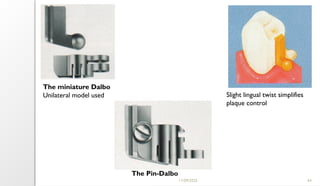
![102
Mahrous AI et al (2015), compared and evaluated the effect of two
different attachments (locator attachment and ball and socket [B&S]
attachment) on implants and natural abutments supporting structures, in
cases of limited inter-arch spaces in mandibular Kennedy Class I implant
supported removable partial over dentures by measuring the bone height
changes through the cone beam radiographic technology
The side of the implant-supported partial over denture restored with the
locator attachment showed better effect on bone health around both the
placed dental implant and the main natural abutment as compared with
the B&S attachment
11/09/2025
Mahrous AI et al., Implant Supported Distal Extension over Denture Retained by TwoTypes of Attachments.A Comparative Radiographic
Study by Cone Beam Computed Tomography, Journal of International Oral Health 2015; 7(5):5-10](https://image.slidesharecdn.com/5-precisionattachments-251109054252-801d198b/85/5-Precision-attachments-in-prosthodontics-ppt-102-320.jpg)