PRE FABRICATED,PRE CAST & PRE
STRESSED CONCRETE
SUBMITTED TO-
AR. JITENDRA CHAUDHARY
SUBMITTED BY-
AAYUSH CHIPPAD
ARBAJ KHAN
ABHISHEK
ANCHIT
ASHISH
BHUMIKA MAHESHWARI
INTRODUCTION
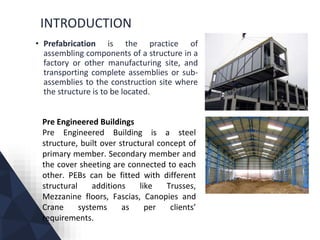
• Prefabrication is the practice of
assembling components of a structure in a
factory or other manufacturing site, and
transporting complete assemblies or sub-
assemblies to the construction site where
the structure is to be located.
Pre Engineered Buildings
Pre Engineered Building is a steel
structure, built over structural concept of
primary member. Secondary member and
the cover sheeting are connected to each
other. PEBs can be fitted with different
structural additions like Trusses,
Mezzanine floors, Fascias, Canopies and
Crane systems as per clients’
requirements.
ADVANTAGES
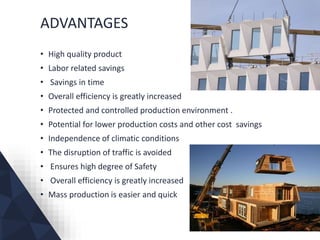
• High quality product
• Labor related savings
• Savings in time
• Overall efficiency is greatly increased
• Protected and controlled production environment .
• Potential for lower production costs and other cost savings
• Independence of climatic conditions
• The disruption of traffic is avoided
• Ensures high degree of Safety
• Overall efficiency is greatly increased
• Mass production is easier and quick
CHARACTERISTICS ARE TO BE
CONSIDERED
• Easy availability
• Light weight for easy handling and transport, and to economies on
sections and sizes of foundations
• Thermal insulation property
• Easy workability
• Durability in all weather conditions
• Non-combustibility
• Economy in cost
• Sound insulation.
DISADVANTAGE
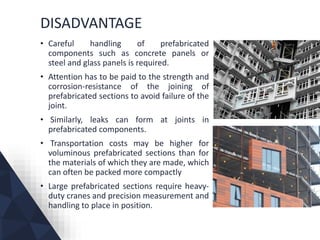
• Careful handling of prefabricated
components such as concrete panels or
steel and glass panels is required.
• Attention has to be paid to the strength and
corrosion-resistance of the joining of
prefabricated sections to avoid failure of the
joint.
• Similarly, leaks can form at joints in
prefabricated components.
• Transportation costs may be higher for
voluminous prefabricated sections than for
the materials of which they are made, which
can often be packed more compactly
• Large prefabricated sections require heavy-
duty cranes and precision measurement and
handling to place in position.
6
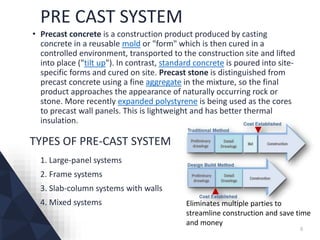
• Precast concrete is a construction product produced by casting
concrete in a reusable mold or "form" which is then cured in a
controlled environment, transported to the construction site and lifted
into place ("tilt up"). In contrast, standard concrete is poured into site-
specific forms and cured on site. Precast stone is distinguished from
precast concrete using a fine aggregate in the mixture, so the final
product approaches the appearance of naturally occurring rock or
stone. More recently expanded polystyrene is being used as the cores
to precast wall panels. This is lightweight and has better thermal
insulation.
TYPES OF PRE-CAST SYSTEM
1. Large-panel systems
2. Frame systems
3. Slab-column systems with walls
4. Mixed systems Eliminates multiple parties to
streamline construction and save time
and money
PRE CAST SYSTEM
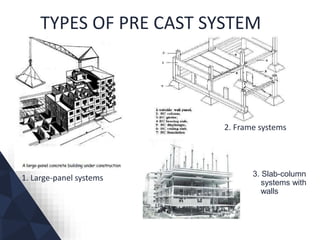
TYPES OF PRE CAST SYSTEM
1. Large-panel systems
2. Frame systems
3. Slab-column
systems with
walls
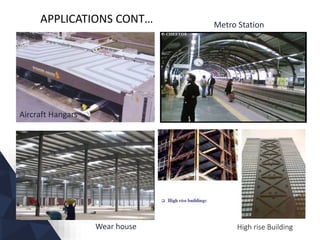
APPLICATIONS
• Industrial Buildings
• Warehouses
• Commercial Complexes
• Showrooms
• Offices
• Schools
• Indoor Stadiums
• Outdoor Stadiums with canopies
• Gas Stations
• Metro Stations, Bus Terminals, Parking Lots
• Primary Health Centers, Angan wadi’s
• And many more…
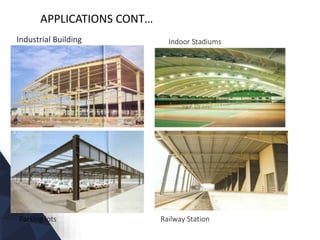
APPLICATIONS CONT…
Industrial Building
Parking lots
Indoor Stadiums
Railway Station
High rise Building
Aircraft Hangars
APPLICATIONS CONT… Metro Station
Wear house
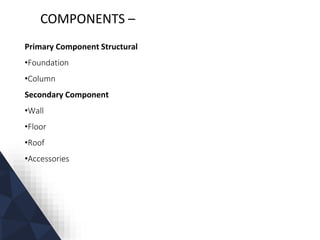
COMPONENTS –
Primary Component Structural
•Foundation
•Column
Secondary Component
•Wall
•Floor
•Roof
•Accessories
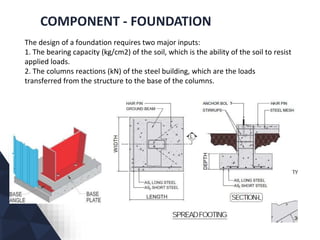
COMPONENT - FOUNDATION
The design of a foundation requires two major inputs:
1. The bearing capacity (kg/cm2) of the soil, which is the ability of the soil to resist
applied loads.
2. The columns reactions (kN) of the steel building, which are the loads
transferred from the structure to the base of the columns.
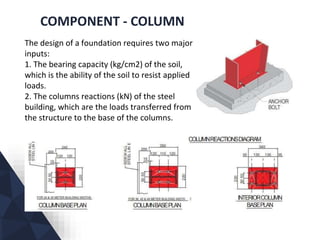
COMPONENT - COLUMN
The design of a foundation requires two major
inputs:
1. The bearing capacity (kg/cm2) of the soil,
which is the ability of the soil to resist applied
loads.
2. The columns reactions (kN) of the steel
building, which are the loads transferred from
the structure to the base of the columns.
COMPONENTS – WALL
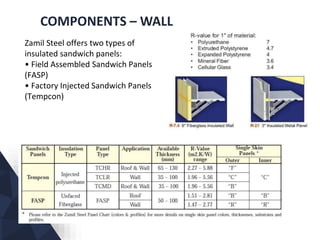
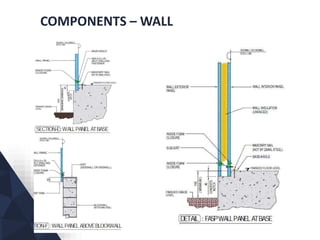
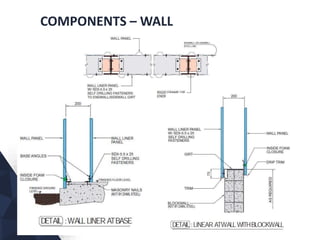
Zamil Steel offers two types of
insulated sandwich panels:
• Field Assembled Sandwich Panels
(FASP)
• Factory Injected Sandwich Panels
(Tempcon)
COMPONENTS – WALL
COMPONENTS – WALL
COMPONENTS – FLOOR
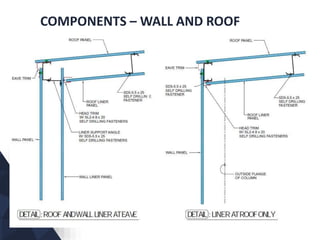
COMPONENTS – WALL AND ROOF
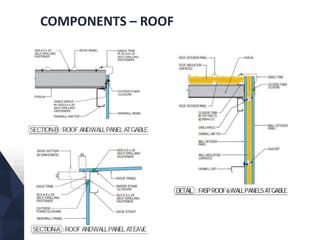
COMPONENTS – ROOF
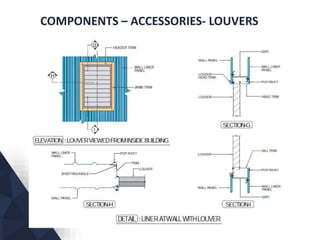
COMPONENTS – ACCESSORIES- LOUVERS
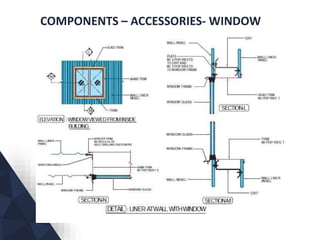
COMPONENTS – ACCESSORIES- WINDOW
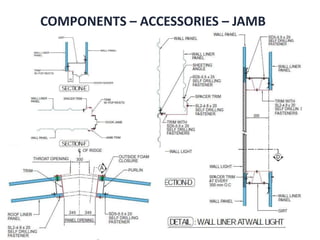
COMPONENTS – ACCESSORIES – JAMB
PRE STRESSED CONCRETE
• Prestressed concrete is a form of concrete used in construction. It is substantially
"prestressed" (compressed) during its fabrication, in a manner that strengthens it
against tensile forces which will exist when in service.
TYPES OF PRE STRESSED CONCRETE
Internal prestressing
In this system, a prestressing force is applied to the high tensile steel i.e. the
steel reinforcement. It induces internal compressive stresses in concrete. it is
the most commonly used method because of easy and accurate application.
Internal prestressing can be done by two methods:
•Pre-tensioning
•Post-tensioning
External prestressing
This method is not commonly used. In this method, the prestressing is done
by adjusting the external reactions (by introducing different support
conditions). The externally prestressing system requires very much accuracy
in the planning and applications. The method of prestressing involves pre-
tensioning and post-tensioning methods.
Your Footer Here 24
• Pre-tensioning method
• In this method, prestressing is induced (the tendons are tensioned) before
the concrete is placed. It is done in factories. In this method, the tendons
are enclosed temporarily against some abutments and then they are pulled
by using jack type devices. The concrete is placed while maintaining the
tension. When concrete is hardened sufficiently, the tendons are released
slowly or cut. This will transfer prestress from steel to concrete through
bond.
• This type of prestressing method is commonly used for small sized
members like beams, slabs, piles, sleepers and electric poles, etc which can
be casted easily in factories.
• Post-tensioning method
• In this method, the prestress is induced or tendons are tensioned only after
the concrete has hardened. In this system, the concreting is done first and a
duct is formed in the member with tube or with a metal sheathe. When
concrete has sufficiently hardened then tendons or cable is transferred
from the tendon to the member through anchorage wedges. The space
between the tendon and the duct is filled with cement grout.
• Post tensioning method of prestressing is used for both precast and cast in
situ construction. It is used for large span structures like bridges.
Your Footer Here 25
• Advantages and disadvantages of pre-tensioning
method of prestressing:
• Pre-tensioning is done in the factories so it is more reliable and
durable technique. But is used for smaller sections, so heavier and
longer sections cannot be prestressed. When cable is released or cut,
after pre-tensioning it leads to more losses due to shortening. The
shrinkage and creep losses are also more in pre-tensioning system.
Your Date
Advantages and disadvantages of post tensioning
method:
Post-tensioning can be done in factories and at the site also
The loss of prestress is less as compared to pre-tensioning system.
This method is used for large spans and heavily loaded structures.
The disadvantages of post tensioning method are that it is costly as
compared to pre tensioning method because of use of sheathing.
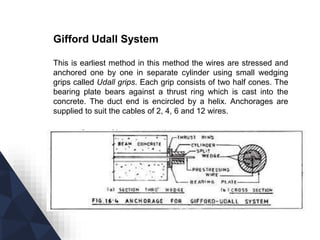
Gifford Udall System
This is earliest method in this method the wires are stressed and
anchored one by one in separate cylinder using small wedging
grips called Udall grips. Each grip consists of two half cones. The
bearing plate bears against a thrust ring which is cast into the
concrete. The duct end is encircled by a helix. Anchorages are
supplied to suit the cables of 2, 4, 6 and 12 wires.
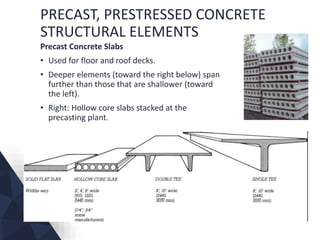
PRECAST, PRESTRESSED CONCRETE
STRUCTURAL ELEMENTS
Precast Concrete Slabs
• Used for floor and roof decks.
• Deeper elements (toward the right below) span
further than those that are shallower (toward
the left).
• Right: Hollow core slabs stacked at the
precasting plant.
PRECAST, PRESTRESSED CONCRETE
STRUCTURAL ELEMENTS cont
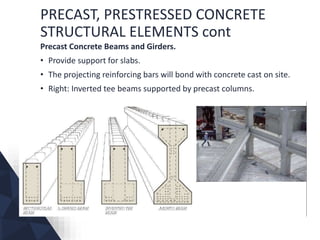
Precast Concrete Beams and Girders.
• Provide support for slabs.
• The projecting reinforcing bars will bond with concrete cast on site.
• Right: Inverted tee beams supported by precast columns.
PRECAST, PRESTRESSED CONCRETE
STRUCTURAL ELEMENTS cont
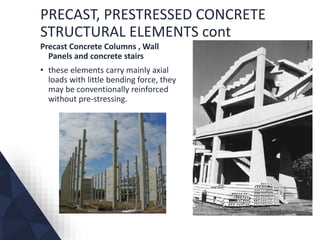
Precast Concrete Columns , Wall
Panels and concrete stairs
• these elements carry mainly axial
loads with little bending force, they
may be conventionally reinforced
without pre-stressing.

Pre fabricatted and pre engineered building

  • 1.
    PRE FABRICATED,PRE CAST& PRE STRESSED CONCRETE SUBMITTED TO- AR. JITENDRA CHAUDHARY SUBMITTED BY- AAYUSH CHIPPAD ARBAJ KHAN ABHISHEK ANCHIT ASHISH BHUMIKA MAHESHWARI
  • 2.
    INTRODUCTION • Prefabrication isthe practice of assembling components of a structure in a factory or other manufacturing site, and transporting complete assemblies or sub- assemblies to the construction site where the structure is to be located. Pre Engineered Buildings Pre Engineered Building is a steel structure, built over structural concept of primary member. Secondary member and the cover sheeting are connected to each other. PEBs can be fitted with different structural additions like Trusses, Mezzanine floors, Fascias, Canopies and Crane systems as per clients’ requirements.
  • 3.
    ADVANTAGES • High qualityproduct • Labor related savings • Savings in time • Overall efficiency is greatly increased • Protected and controlled production environment . • Potential for lower production costs and other cost savings • Independence of climatic conditions • The disruption of traffic is avoided • Ensures high degree of Safety • Overall efficiency is greatly increased • Mass production is easier and quick
  • 4.
    CHARACTERISTICS ARE TOBE CONSIDERED • Easy availability • Light weight for easy handling and transport, and to economies on sections and sizes of foundations • Thermal insulation property • Easy workability • Durability in all weather conditions • Non-combustibility • Economy in cost • Sound insulation.
  • 5.
    DISADVANTAGE • Careful handlingof prefabricated components such as concrete panels or steel and glass panels is required. • Attention has to be paid to the strength and corrosion-resistance of the joining of prefabricated sections to avoid failure of the joint. • Similarly, leaks can form at joints in prefabricated components. • Transportation costs may be higher for voluminous prefabricated sections than for the materials of which they are made, which can often be packed more compactly • Large prefabricated sections require heavy- duty cranes and precision measurement and handling to place in position.
  • 6.
    6 • Precast concreteis a construction product produced by casting concrete in a reusable mold or "form" which is then cured in a controlled environment, transported to the construction site and lifted into place ("tilt up"). In contrast, standard concrete is poured into site- specific forms and cured on site. Precast stone is distinguished from precast concrete using a fine aggregate in the mixture, so the final product approaches the appearance of naturally occurring rock or stone. More recently expanded polystyrene is being used as the cores to precast wall panels. This is lightweight and has better thermal insulation. TYPES OF PRE-CAST SYSTEM 1. Large-panel systems 2. Frame systems 3. Slab-column systems with walls 4. Mixed systems Eliminates multiple parties to streamline construction and save time and money PRE CAST SYSTEM
  • 7.
    TYPES OF PRECAST SYSTEM 1. Large-panel systems 2. Frame systems 3. Slab-column systems with walls
  • 8.
    APPLICATIONS • Industrial Buildings •Warehouses • Commercial Complexes • Showrooms • Offices • Schools • Indoor Stadiums • Outdoor Stadiums with canopies • Gas Stations • Metro Stations, Bus Terminals, Parking Lots • Primary Health Centers, Angan wadi’s • And many more…
  • 9.
    APPLICATIONS CONT… Industrial Building Parkinglots Indoor Stadiums Railway Station
  • 10.
    High rise Building AircraftHangars APPLICATIONS CONT… Metro Station Wear house
  • 11.
    COMPONENTS – Primary ComponentStructural •Foundation •Column Secondary Component •Wall •Floor •Roof •Accessories
  • 12.
    COMPONENT - FOUNDATION Thedesign of a foundation requires two major inputs: 1. The bearing capacity (kg/cm2) of the soil, which is the ability of the soil to resist applied loads. 2. The columns reactions (kN) of the steel building, which are the loads transferred from the structure to the base of the columns.
  • 13.
    COMPONENT - COLUMN Thedesign of a foundation requires two major inputs: 1. The bearing capacity (kg/cm2) of the soil, which is the ability of the soil to resist applied loads. 2. The columns reactions (kN) of the steel building, which are the loads transferred from the structure to the base of the columns.
  • 14.
    COMPONENTS – WALL ZamilSteel offers two types of insulated sandwich panels: • Field Assembled Sandwich Panels (FASP) • Factory Injected Sandwich Panels (Tempcon)
  • 15.
  • 16.
  • 17.
  • 18.
  • 19.
  • 20.
  • 21.
  • 22.
  • 23.
    PRE STRESSED CONCRETE •Prestressed concrete is a form of concrete used in construction. It is substantially "prestressed" (compressed) during its fabrication, in a manner that strengthens it against tensile forces which will exist when in service. TYPES OF PRE STRESSED CONCRETE Internal prestressing In this system, a prestressing force is applied to the high tensile steel i.e. the steel reinforcement. It induces internal compressive stresses in concrete. it is the most commonly used method because of easy and accurate application. Internal prestressing can be done by two methods: •Pre-tensioning •Post-tensioning External prestressing This method is not commonly used. In this method, the prestressing is done by adjusting the external reactions (by introducing different support conditions). The externally prestressing system requires very much accuracy in the planning and applications. The method of prestressing involves pre- tensioning and post-tensioning methods.
  • 24.
    Your Footer Here24 • Pre-tensioning method • In this method, prestressing is induced (the tendons are tensioned) before the concrete is placed. It is done in factories. In this method, the tendons are enclosed temporarily against some abutments and then they are pulled by using jack type devices. The concrete is placed while maintaining the tension. When concrete is hardened sufficiently, the tendons are released slowly or cut. This will transfer prestress from steel to concrete through bond. • This type of prestressing method is commonly used for small sized members like beams, slabs, piles, sleepers and electric poles, etc which can be casted easily in factories. • Post-tensioning method • In this method, the prestress is induced or tendons are tensioned only after the concrete has hardened. In this system, the concreting is done first and a duct is formed in the member with tube or with a metal sheathe. When concrete has sufficiently hardened then tendons or cable is transferred from the tendon to the member through anchorage wedges. The space between the tendon and the duct is filled with cement grout. • Post tensioning method of prestressing is used for both precast and cast in situ construction. It is used for large span structures like bridges.
  • 25.
    Your Footer Here25 • Advantages and disadvantages of pre-tensioning method of prestressing: • Pre-tensioning is done in the factories so it is more reliable and durable technique. But is used for smaller sections, so heavier and longer sections cannot be prestressed. When cable is released or cut, after pre-tensioning it leads to more losses due to shortening. The shrinkage and creep losses are also more in pre-tensioning system. Your Date Advantages and disadvantages of post tensioning method: Post-tensioning can be done in factories and at the site also The loss of prestress is less as compared to pre-tensioning system. This method is used for large spans and heavily loaded structures. The disadvantages of post tensioning method are that it is costly as compared to pre tensioning method because of use of sheathing.
  • 26.
    Gifford Udall System Thisis earliest method in this method the wires are stressed and anchored one by one in separate cylinder using small wedging grips called Udall grips. Each grip consists of two half cones. The bearing plate bears against a thrust ring which is cast into the concrete. The duct end is encircled by a helix. Anchorages are supplied to suit the cables of 2, 4, 6 and 12 wires.
  • 27.
    PRECAST, PRESTRESSED CONCRETE STRUCTURALELEMENTS Precast Concrete Slabs • Used for floor and roof decks. • Deeper elements (toward the right below) span further than those that are shallower (toward the left). • Right: Hollow core slabs stacked at the precasting plant.
  • 28.
    PRECAST, PRESTRESSED CONCRETE STRUCTURALELEMENTS cont Precast Concrete Beams and Girders. • Provide support for slabs. • The projecting reinforcing bars will bond with concrete cast on site. • Right: Inverted tee beams supported by precast columns.
  • 29.
    PRECAST, PRESTRESSED CONCRETE STRUCTURALELEMENTS cont Precast Concrete Columns , Wall Panels and concrete stairs • these elements carry mainly axial loads with little bending force, they may be conventionally reinforced without pre-stressing.

Editor's Notes

  • #2 © Copyright PresentationGo.com – The free PowerPoint library
  • #3 © Copyright PresentationGo.com – The free PowerPoint library
  • #4 © Copyright PresentationGo.com – The free PowerPoint library
  • #5 © Copyright PresentationGo.com – The free PowerPoint library
  • #6 © Copyright PresentationGo.com – The free PowerPoint library
  • #7 © Copyright PresentationGo.com – The free PowerPoint library
  • #8 © Copyright PresentationGo.com – The free PowerPoint library
  • #28 © Copyright PresentationGo.com – The free PowerPoint library
  • #29 © Copyright PresentationGo.com – The free PowerPoint library
  • #30 © Copyright PresentationGo.com – The free PowerPoint library