





A
Seminar
on
“The Cambrian Deposits of
Extra-Peninsular India”
• Introduction
• Classification of Cambrian
• Cambrian of India
• Salt Range
• Spiti
• Kumaon (Garbyang Series)
• Kashmir
• Conclusion
• Bibliography
The Cambrian System is the Earliest Period of the
Palaeozoic Era. It is named after the “Cambria”; the Roman
name for Wales in the British Isles by Prof. Adam Sedgewick
(1785-1873), Cambridge University in 1839, where the Rocks of
this Age were first studied. It covers a Span of Time between
(570-500) m.y. and has a Duration of approximately 70 m.y.
 
This Period is well developed in Northern Europe, in the
Mediterranean Region, in Eastern as well as Western America,
in the Himalayas, China and else where. The three (3) major
Sub-divisions of this System are named after the Fossils
(Trilobites) in Europe and after the Places in North America.
 
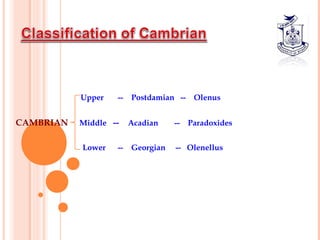
Upper -- Postdamian -- Olenus
 
CAMBRIAN Middle -- Acadian -- Paradoxides
Lower -- Georgian -- Olenellus
Marine fossiliferous Rocks of Cambrian
Period are found in a thick Series of Strata at 3 places
in Extra-Peninsular India;
 
i). Salt Range in North-West of Punjab
ii). Spiti Valley
iii). Kashmir
 
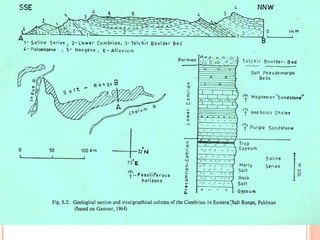
The Salt Range is continuous Range of Low, flat-
topped Mountains rising abruptly out of the flat Punjab Plains.
This Range is having an approximately East-West Strike, from the
Jhelum westwards through the Indus. Salt range is often called
Field Museum of Geology. Wynne studied this Region in 1878
and later, it was mapped by E.R. Gee during 1930s.
The important Ridges in the Salt Range are Chambal,
Nili, Rohtas, Pabbi, Sakesar, etc. The Ridges attain an average
Height of (750-900) m; the Highest point being the Mount
Sakesar of about 1525 m high above Mean Sea Level.
Salt Pseudomorph Shales – The Salt Pseudomorph Shales are bright Red to variegated Shales with
laminated Sandstone Layers having thickness up to 105 m. These Shales contain Cubic
Pseudomorphs or Casts which represent the replacement of Salt Crystals by Clay on the Shores of an
enclosed Marine Basin which was drying up.
 Magnesium Sandstone --The Magnesium Sandstones are prominently displayed in the
eastern Salt Range. They are 75m thick in the East, diminishing to 24m in the West. They
show Fucoid and Annelid Markings and contain Cambrian Gastropods. E.g. Stenotheca.
Neobolus Beds -- Dark Greenish and Purplish. They are (6-60) m thick and are well exposed in
Khusak Hills near Khewra. The beds contains primitive brachiopod Neobulus.
 Purple Sandstones – These Sandstones are up to 140m thick in the East and 75m thick in the West.
They are entirely unfossiliferous. They show evidences of shallow water deposition like CurrentCurrent
Bedding, Rain PrintsBedding, Rain Prints etc.
Saline Series –This Saline Series is well developed in at Khewra in the Eastern Salt Range
including Salt Marl as the Oldest Member. The Marls form a practically unstratified mass,
conspicuously Red to Dull Purple or Maroon in color and contain Grains of NaCl, Gypsum, and
Dolomite.
Trilobites: Ptychoparia, Redlichia, Chittidilla, Conocephalus, etc.
 
Brachiopods: Lingula, Lingulella, Mobergia, Descinoleptis,
Orthis, etc.
 
Pteropods: Hyoliths
 
These Fossil Assemblages indicate Lower Cambrian Age.
Pre cambrain deposits

Pre cambrain deposits

  • 1.
    A Seminar on “The Cambrian Depositsof Extra-Peninsular India”
  • 2.
    • Introduction • Classificationof Cambrian • Cambrian of India • Salt Range • Spiti • Kumaon (Garbyang Series) • Kashmir • Conclusion • Bibliography
  • 3.
    The Cambrian Systemis the Earliest Period of the Palaeozoic Era. It is named after the “Cambria”; the Roman name for Wales in the British Isles by Prof. Adam Sedgewick (1785-1873), Cambridge University in 1839, where the Rocks of this Age were first studied. It covers a Span of Time between (570-500) m.y. and has a Duration of approximately 70 m.y.   This Period is well developed in Northern Europe, in the Mediterranean Region, in Eastern as well as Western America, in the Himalayas, China and else where. The three (3) major Sub-divisions of this System are named after the Fossils (Trilobites) in Europe and after the Places in North America.
  • 4.
      Upper -- Postdamian-- Olenus   CAMBRIAN Middle -- Acadian -- Paradoxides Lower -- Georgian -- Olenellus
  • 5.
    Marine fossiliferous Rocksof Cambrian Period are found in a thick Series of Strata at 3 places in Extra-Peninsular India;   i). Salt Range in North-West of Punjab ii). Spiti Valley iii). Kashmir  
  • 7.
    The Salt Rangeis continuous Range of Low, flat- topped Mountains rising abruptly out of the flat Punjab Plains. This Range is having an approximately East-West Strike, from the Jhelum westwards through the Indus. Salt range is often called Field Museum of Geology. Wynne studied this Region in 1878 and later, it was mapped by E.R. Gee during 1930s. The important Ridges in the Salt Range are Chambal, Nili, Rohtas, Pabbi, Sakesar, etc. The Ridges attain an average Height of (750-900) m; the Highest point being the Mount Sakesar of about 1525 m high above Mean Sea Level.
  • 9.
    Salt Pseudomorph Shales– The Salt Pseudomorph Shales are bright Red to variegated Shales with laminated Sandstone Layers having thickness up to 105 m. These Shales contain Cubic Pseudomorphs or Casts which represent the replacement of Salt Crystals by Clay on the Shores of an enclosed Marine Basin which was drying up.  Magnesium Sandstone --The Magnesium Sandstones are prominently displayed in the eastern Salt Range. They are 75m thick in the East, diminishing to 24m in the West. They show Fucoid and Annelid Markings and contain Cambrian Gastropods. E.g. Stenotheca. Neobolus Beds -- Dark Greenish and Purplish. They are (6-60) m thick and are well exposed in Khusak Hills near Khewra. The beds contains primitive brachiopod Neobulus.  Purple Sandstones – These Sandstones are up to 140m thick in the East and 75m thick in the West. They are entirely unfossiliferous. They show evidences of shallow water deposition like CurrentCurrent Bedding, Rain PrintsBedding, Rain Prints etc. Saline Series –This Saline Series is well developed in at Khewra in the Eastern Salt Range including Salt Marl as the Oldest Member. The Marls form a practically unstratified mass, conspicuously Red to Dull Purple or Maroon in color and contain Grains of NaCl, Gypsum, and Dolomite.
  • 10.
    Trilobites: Ptychoparia, Redlichia,Chittidilla, Conocephalus, etc.   Brachiopods: Lingula, Lingulella, Mobergia, Descinoleptis, Orthis, etc.   Pteropods: Hyoliths   These Fossil Assemblages indicate Lower Cambrian Age.