



1
Field Report
Salt Range
Submitted to
Mr. Salman Khattak
Submitted By
Samiullah
Roll Number
5208
Semester
4th
Department
Geology
University Of Haripur
2
Table of Contents
S.NO Topics Page No
1 Acknowledgement
2 Abstract
3 Introduction
4 Day# 1
5 Stop Number 1) Pidh Choa saidan shah road
6 Measuring Strike
7 Measuring Dip
8 Day# 2
9 Stop number 2) Katas Raj youth hostel
10 Sakessorlimestone
11 Stop Number 2)Dandot road
12 Baghanwala formation
13 Tobra formation
14 Dandot formation
15 Warcha sandstone
16 Stop# 3 Khewra George
17 Salt range formation
18 Khewra formation
19 Khussak formation
20 Jutana formation
21 Pictures of Day# 2
22 Day# 3
23 Stop No 1) Pail Khushab Road
24 Siwalik groups
25 Stop No 2) Pail khushab road
26 Hangu formation
27 Lochart formation
28 Patala formation
29 Sakessorlimestone
30 Stop No 3) Pail Khushab road
31 Sardai formation
32 Stop No 4) Pail Khushab road
33 Day# 4
34 Stop No 1) Nammal George
3
35 Wargal limestone
36 Chidru formation
37 Mianwali formation
38 Permo-Triassic boundry
39 Tredian formation
40 Kingriyali formation
41 Data formation
42 Samansuk formation
43 Hangu formation
44 Lochart formation
45 Patala formation
46 Nammal formation
47 Sakessorformation
48 Siwalik groups
49 Kalabagh conglomerates
50 Angular unconformity
51 Stop No 2) Zaluch nala
52 Tobra formation
53 Sardai clays
54 Amb formation
55 Warcha formation
56 Wargal limestone
57 Kalbagh trustfault
58 Day No 5
59 Stop No 1) Talakang-Fateh Jang road Dhok pathan formation
4
5
Acknowledgement
Thanks to Allah Almighty who gave me strength to be a part of fieldtrip
to salt range and gave me sense to understand the demonstration given
by teachers at the field, that was organized by Department of Geology
University of Haripur and. After that I would like to thanks to my
instructors, Sir Salman Khattak, Sir Azeem Shah and Sir Toufeeq
Ahmed, who were with us during our field and they helped me a lot
during the field trip. I am very thankful to Sir Hammad (Pakistan
museum of natural history) for sharing his knowledge about salt range.I Am
very thankful to Ahsan Saeed(Seniour) for guidance.
6
Abstract
The Salt Range contains the most important geologic and paleontological localities in Pakistan,
and is one of the outstanding field areas in the entire world. Despite its easy accessibility, it has a
wealth of geological and paleontological features. In fact, it represents an open book of geology
where various richly fossiliferous stratified rocks are very well exposed due to lack of
vegetation. These include the Permian carbonate succession with its outstanding brachiopod
fauna, Lower Triassic ammonoid beds (the Mianwali Formation, formerly known as "Ceratite
Beds"), and Lower Tertiary marine strata with age diagnostic foraminifera. These rocks also
provide an excellent opportunity for appreciation of tectonics in the field. In addition to the
easily available roadside geology, some prominent gorges provide fantastic locations to study the
sedimentary succession. Older strata are exposed in the eastern Salt Range between the Khewra-
Choa Saidan Shah, including the famous Khewra Gorge. In the west, beyond Kallar Kahar, are
younger strata such as in the Nilawahan Gorge at Nurpur, the Nammal Gorge near Mianwali.
This succession has been rightly called a Field Museum of Geology and Paleontology and can
be classified as one of the great paleontological areas of the world, fully worthy of conservation
and protection efforts.
7
Introduction
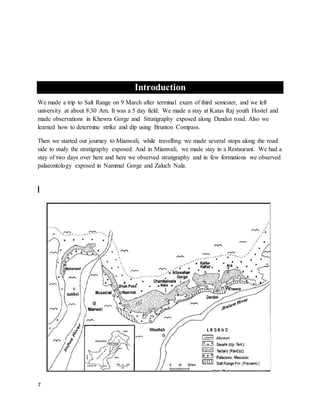
We made a trip to Salt Range on 9 March after terminal exam of third semester, and we left
university at about 8:30 Am. It was a 5 day field. We made a stay at Katas Raj youth Hostel and
made observations in Khewra Gorge and Stratigraphy exposed along Dandot road. Also we
learned how to determine strike and dip using Brunton Compass.
Then we started out journey to Mianwali, while travelling we made several stops along the road
side to study the stratigraphy exposed. And in Mianwali, we made stay in a Restaurant. We had a
stay of two days over here and here we observed stratigraphy and in few formations we observed
palaeontology exposed in Nammal Gorge and Zaluch Nala.
8
Day # 1
9
Observations:
Stop Number 1: Pidh Choa Saidan Shah Road
Determination of Strike and Dip using Brinton compass:
At this stop we determined how to find strike and dip at the field.
Measuring Strike:
Strike:
Direction of the line of intersection between a tilted plane and a horizontal plane.
 Compass must be horizontal (bull’s eye bubble centered), with compass edge flush to the
tilted plane
 And note the reading.
 S50E
Measuring Dip:
Dip:
 Place compass on its side, perpendicular to strike.
 Level the clinometers (center the bubble).
 Read the dip.
 10NW
10
Day# 2
11
Stop number 1) Katas Raj youth hostel:
Observations:
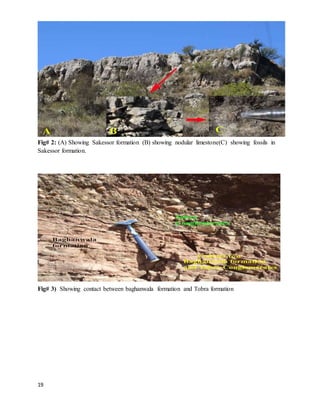
Here we observed Sakesar Limestone, which was highly fossiliferous.
 Sakessor limestone
 Type Locality
Name was given after peak Sakesarin the Central Salt Range.
 Lithology:
 As we observed on the field, mostly it was massive creamish to Grey Limestone.
 Nodules are present in it.
 We also seen chemical dissolution in its upper part.
 Fossils:
The formation is rich in fossils, and it mostly contains Foraminifers. Also, it possesses several
molluscs and echinoids fossils.
 Age:
Early Eocene
 Contact:
Lower contact is conformable with Nammal formation while its upper contact is conformable
with Chorgalli formation.
Stop number 2) Dandot road
Observations:
Here we observed Baghanwala and Tobra Formation, Dandot and Warcha Sandstone.
 Baghanwala Formation:
 Type Locality:
12
Baghanwala Village, Eastern Salt Range.
 Lithology:
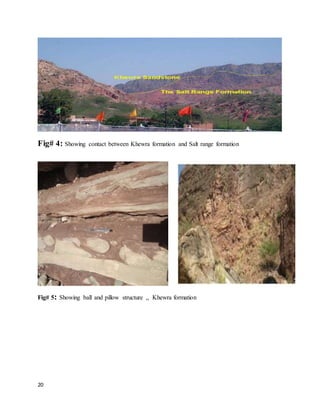
It is composed of clay stone, Mud stone, Siltstone and thin bedded flaggy sandstone. The flags
are purple, grey or blue green. The part observed by us was reddish in appearance.
 Fossils:
No fossil record
 Age:
Middle Cambrian
 Contacts:
The upper contact is unconformable with Tobra Formation while lower contact is conformable
with Juttana Formation.
 Environment of Deposition:
Lagoonal with Arid Climatic conditions.
 Tobra Formation:
 Type Locality:
Tobra Eastern Salt Range, Jhelum district, Punjab Province.
 Lithology:
Mostly it is composed of conglomerate, and is also called as Tobra Conglomerate.
 Contacts:
The lower contact of the Tobra Formation is a widespread unconformity with Khewra
Sandstone. The upper contact is (gradational) conformable with the Dandot Formation.
 Age:
Early Permian
 Fossils:
13
The Formation contains rich fauna of brachiopods, bivalves, gastropods, pteropods, bryozoans
and ostracodes, as well as spores).
 Environment of Deposition:
Shallow Marine
 Dandot Formation:
 Type Locality:
Dandot Formation is formulized after the village Dandot in Eastern Salt Range, Jhelum district,
Punjab Province.
 Lithology:
The part observed by us was mostly vegetated, it consist of light-grey to olive green sandstone
with occasional pebbly beds and subordinate shale.
 Fossils:
We observed no fossil under the study area.
The Formation contains rich fauna of brachiopods, bivalves, gastropods, bryozoans and
ostracodes, as well as spores.
 Age :
Early Permian
 Contacts:
The lower contact of Dandot Formation has a gradational contact with the underlying Tobra
Formation. The upper contact is conformable with Warcha Sandstone.
 Environment of Deposition:
Shallow Marine
 Warcha Sandstone
 Type Locality:
14
The type section of Warcha Sandstone is Warcha Gorge (lat. 32°27’N; long. 71°58’E), in Central
Salt Range, Punjab Province.
 Lithology:
The part observed by us was massive sandstone, yellowish to purplish in colour. It was highly
jointed. And was medium to coarse grained and is thick bedded.
 Fossils:
No diagnostic fossils are known from this Formation.
 Age:
,Early Permian age
 Contacts:
The lower contact is conformable with Dandot Formation. The upper contact is transitional with
the Sardhai Formation which is placed at the top of the highest massive sandstone.
 Environment of Deposition
Non-Marine.
Stop Number 3) Khewra Gorge:
Khewra gorge is present in eastern salt range. And is located 1km away from Khewra Town and
that is why it is named as Khewra gorge.
Observations:
Here we observed following formations:
1. Salt Range Formation
2. Khewra Formation
3. Khussak Formation
4. Juttana Formation
We observed these formations, and various Geological Structures as we moved inside Khewra
Gorge.
15
 Salt Range Formation
 Nomenclature and Type Locality:
The term “Salt Range Formation” has been introduced by Asrarullah (1962) after the Salt Range
in the Punjab Province. Previously it was named as “Saline Series” by Wynne (1878) and
“Punjab Saline Series” by Gee (1945).Khewra Gorge (lat. 32°40’N; long. 73°00’30” E) in the
Eastern Salt Range, Jhelum district, Punjab Province, has been designated as the type section
(Shah, 1977)
 Lithology:
It has three members:
1) SahiwalMarl Member:
It consist of Red Marl bed with salt seems, thick bedded gypsum is also found. Khewra trap is
also present in some parts of this member.
2) Bandar Kas Gypsum Member:
This member consist of massive gypsum with some salt seems; also we find some minor bed of
clay and dolomite in this member.
3) Billianwala Member:
We observed it when we went under the Khewra Salt Mine; we observed salt crystals inside the
mine.
 Fossils:
It is devoid of fossils.
 Age:
Precambrian
 Contacts:
Base of the formation is not exposed anywhere including the study area. The upper contact is
transitional with the Khewra Sandstone.
 Environment of Deposition:
16
Evaporitic
We also observe hoodules in salt range formation in which soft rocks was eroded.
 Khewra Formation
 Type Locality:
Khewra Gorge in the Eastern Salt Range, Jhelum district, Punjab Province.
 Lithology:
Here the part of Khewra sandstone we studied appeared to be:
 Fine Textured
 Compact in form
 Maroonish in colour
 Gave a smooth touch
 Fossils:
The Khewra Sandstone does not contain well-preserved fossils.
 Age:
Lower Cambrian
 Contacts:
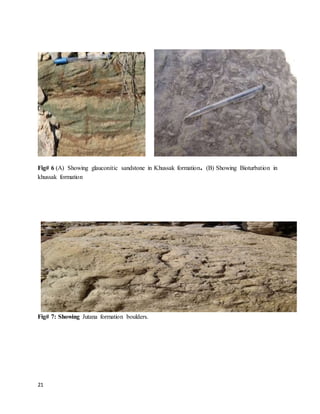
It has its lower contact with Salt Range formation and upper with Khussak formation and both
are conformable.
 Environment of Deposition:
Deltaic of Fluvial
 Sedimentary Structures
 Ball and pillows structure
 Cross bedding
 Ball and Pillows
17
Ball-and-pillow structures are masses of clastic sediment that take the form of
isolatedpillows or protruding ball structures. These soft-sediment deformations are usually
found at the base of sandstone beds that are interbedded with mudstone.
 Cross bedding
layering within a stratum and at an angle to the main bedding plane.
 Khussak Formation
 Type Locality:
Khussak Fort, Eastern Salt Range, Punjab.
 Lithology:
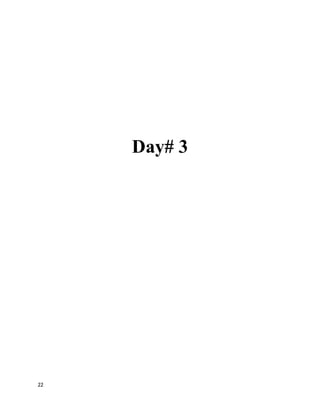
It consists of shale, sandstone and siltstone, and it appeared to be blackish in colour in area of
observation.
 Fossils:
Though we did not observe any fossils here, but the Formation is reported to be fossiliferous,
especially in the upper part. Schindewolf, Seilacher (1955) and Pascoe reported following
fossils.
 Age :
Early Cambrian.
 Contacts:
Lower contact is conformable with Khewra formation by means of micro conglomerates, while
upper is conformable with Juttana formation.
 Environment of Deposition:
Shallow Marine
 Juttana Formation
 Type Locality:
Juttana Formation is formulized after Juttana Village in eastern Salt Range, Punjab.
18
 Lithology:
It is mainly composed of dolomite, also possess shale and sandstone. It appeared to be whitish to
creamish in colour.
 Fossils:
The Formation contains tracks and burrows of Trilobites.
 Age :
Early Cambrian or Early Middle Cambrian age.
 Contacts:
Lower contact is conformable with Khussak formation and upper contact is conformable with
Baghanwala formation.
 Environment of Deposition:
Shallow Marine
Fig# 1: Showing contact between Warcha sandstone, Tobra conglomerates and Baghanwala
formation.
19
Fig# 2: (A) Showing Sakessor formation (B) showing nodular limestone(C) showing fossils in
Sakessor formation.
Fig# 3) Showing contact between baghanwala formation and Tobra formation
20
Fig# 4: Showing contact between Khewra formation and Salt range formation
Fig# 5: Showing ball and pillow structure ,, Khewra formation
21
Fig# 6 (A) Showing glauconitic sandstone in Khussak formation. (B) Showing Bioturbation in
khussak formation
Fig# 7: Showing Jutana formation boulders.
22
Day# 3
23
Stop Number 1) Pail khushab Road
Observations:
Here we observed Siwaliks (Chinji and Nagri), and as all the siwaliks are of same lithology and
it’s difficult to analyse which formation of Siwalik it is.
 Siwalik Group
 Lithology:
The portion observed by us reddish in colour and was not well compacted in upper part as there
was no pressure. It was sandstone friable sandstone. Clay was also present.
 Fossils:
No fossils were observed. Though it is reported to be fossiliferous.
 Age :
Early Pleistocene to Mid. Miocene
 Contacts:
Upper contact is unconformable with Kalabagh Conglomerate, while lower is conformable with
Kamlial.
 Environment of Deposition:
All siwaliks have fluvial environment of deposition.
Members of Siwalik
The group has following members
1. Chinji
2. Nagri
3. Dhok Patan
4. Soan
24
Stop Number 2): Pail Khushab Road Section
Observations:
Here we observed Hangu, Lokhart, Patala and Sakesar.
 Hangu Formation
 Type Locality:
The Hangu Shale and Hangu Sandstone of Davies (1930) from Kohat area have been formalized
by the Stratigraphic Committee of Pakistan (1973) as Hangu Formation. Type section of the
formation is Fort Lockhart in the Samana Range.
 Lithology:
At that stop, there were two different beds of Hangu formation, one was bedded and other was
not and was in form of a thick bed. Its colour appeared to be creamish to brownish, the lower
part was also possessed a bit of ferruginous colour.
 Fossils:
We did not studied any fossils in the field region. No fossils evidence was seen in the field
survey. However, Davies (1937), Cox (1933) reported the mollusks and corals from the upper
part of Hangu formation.
 Age :
On the basis of the above fossil evidence, and stratigraphic position, Early Paleocene age is
assigned to this formation.
 Contacts:
Its lower contact is unconformable and was not exposed in area we observed, while upper
contact is with Lokhart limestone, at the portion we observed.
 Environment of Deposition:
Marine
 Lockhart Limestone
25
 Nomenclature and Type Locality:
Davies (1930) introduced the term “Lockhart Limestone” for the Palaeocene Limestone in the
Kohat area after Fort Kohat in Western Kohat. This name is extended by the Stratigraphic
Committee of Pakistan for similar units in neighbouring areas.
 Lithology:
Here it appeared to be massive creamish to yellowish limestone, with nodules that were not well
developed.
 Fossils:
It is highly fossiliferous, Lockartia, Assilina, Nummulites was reported in the formation.
 Age :
On the basis of fossils, Paleocene age is assigned to it.
 Contacts:
Its lower contact is conformable with Hangu formation and upper is conformable with Patala
formation.
 Environment of Deposition:
Marine
 Patala Formation
 Type Locality:
Patala Nala in Western Salt Range, Mianwali district, Punjab Province has been designated as
type section.
 Lithology:
At the area of observation, it was vegetated, and thus it was not observed. This formation
consists of shales which are dark greenish grey in colour. Coal seams of economic value are also
present in this formation.
 Fossils:
 Though we did not observed any fossils at observation area, but it is reported that
formation is rich in fossils such as: foraminifera, molluscs, and ostracodes.
26
 Age :
The age of the formation is Late Paleocene.
 Contacts:
It has its lower contact with Lokhart limestone, and upper was unconformable with Sakessar
on field area as we moved a bit forward by roadside, but it do lies conformably with Nammal
formation at many places.
 Environment of Deposition:
Shelfal (Marine)
 Sakesar Limestone
Here Sakesar was forming massive peaks, and was limestone of whitish to greyish colour.
Formation was briefly explained before.
Stop Number 3) Pail Khushab Road
We made another stop at the same road and here we observed:
Observation:
Here Mesozoic unit was absent.
Here we observed Sardhai Formation.
 Sardhai Formation
It is fourth member of Nilawahan Group.
 Nomenclature and Type Locality:
“Upper part of Warcha Group” by Noetling (1901) is named as “Lavender Clays” or “Sardhai
Formation” by Gee and Pascoe in 1959. Sardhai gorge, eastern Salt Range, Punjab is its type
locality.
27
 Lithology:
 It consist mostly of clays
 Colour was purplish at the portion we observed.
 Minor grey sandstone and gypsum is also found.
 Fossils:
Though we did not found any fossils in area we observed, but brachiopods are reported in this
formation.
 Age :
Early Permian
 Contacts:
Upper contact is conformable with Amb formation, and lower is conformable with Warcha
sandstone.
 Environment of Deposition:
Marine
Stop number 4) Pail Khushab Road:
Another Stop was made by us at Pail Khushab Road.
Observations:
 Here we observed Warcha sandstone lying over Dandot.
 Both Warcha and Dandot were explained before.
 Dandot:
 Dandot was overlying Warcha and was thin bedded, and was brownish to reddish in
colour.
 Warcha:Warcha appeared to be thick bedded and reddish in colour
28
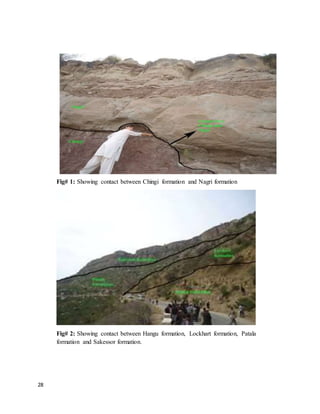
Fig# 1: Showing contact between Chingi formation and Nagri formation
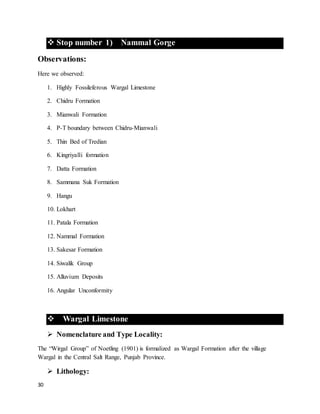
Fig# 2: Showing contact between Hangu formation, Lockhart formation, Patala
formation and Sakessor formation.
29
Day # 4)
30
 Stop number 1) Nammal Gorge
Observations:
Here we observed:
1. Highly Fossileferous Wargal Limestone
2. Chidru Formation
3. Mianwali Formation
4. P-T boundary between Chidru-Mianwali
5. Thin Bed of Tredian
6. Kingriyalli formation
7. Datta Formation
8. Sammana Suk Formation
9. Hangu
10. Lokhart
11. Patala Formation
12. Nammal Formation
13. Sakesar Formation
14. Siwalik Group
15. Alluvium Deposits
16. Angular Unconformity
 Wargal Limestone
 Nomenclature and Type Locality:
The “Wirgal Group” of Noetling (1901) is formalized as Wargal Formation after the village
Wargal in the Central Salt Range, Punjab Province.
 Lithology:
31
 Massive Grey Dolomitic Limestone
 Highly fractured
 Rough Touch
 Highly compact and hard
 Fossils:
Highly rich in fossils, mostly brachiopods and bivalves and Gastropods were observed by us
during the field.
 Age :
Late Permian
 Contacts:
The lower contact of Wargal Limestone with the underlying Amb Formation is conformable
and is not well defined. The upper contact is transitional with Chidru Formation
 Environment of Deposition:
Shallow Marine
 Chidru Formation
It is third member of Zaluch Group.
 Type Locality:
It was called as Chidru Beds by Waagen (1891), Chidru Group by Dunbar (1932), and is
presently called as Chidru formation by stratigraphic committee of Pakistan.
 Lithology:
On the field the portion of Chidru formation we observed was whitish in colour and was
sandstone.
 Fossils:
We did not observe any fossils in this during our field, but Brachiopods and ammonites are
reported from Chidru formation.
32
 Age :
On the basis of fossils found, Late Permian age is assigned to it.
 Contacts:
Lower contact is conformable with Wargal limestone, while upper was unconformable with
Mianwali at the area under study.
 Environment of Deposition:
Shallow Marine
 Mianwali Formation
It is first member of Musakhail group.
 Type Locality:
Type locality of the formation is Nammal Gorge Western Salt Range.
 Lithology:
We observed green colour shale, sandstone
 Fossils:
No fossils were observed by us on the field in this formation. Though its reported to have
bivalves, brachiopods, ammonoids, nautiloids, echinoid spines and crinoidal remains. (Kummel
and Teichert, 1970)
 Age :
Early Triassic age is assigned to it on basis of its fossils.
 Contacts:
The lower contact with Chhidru Formation is marked by a Paraconformity; upper contact is
conformable with Tredian Formation.
 Environment of Deposition:
33
Marine (Open Deltaic)
Permo-Triassic Boundary
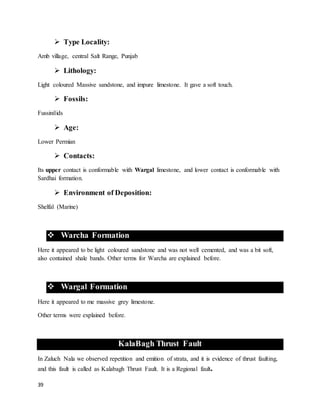
 It is marked by contact between Chidru and Mianwali. And it is a major unconformity.
It is a Paraconformity.
 The Permian–Triassic (P–Tr) extinction event, colloquially known as the Great Dying,
occurred about 252 Ma (million years) ago, forming the boundary between the Permian
and Triassic geologic periods, as well as the Palaeozoic and Mesozoic eras. It is the
Earth's most severe known extinction event, with up to 96% of all marine species and
70% of terrestrial vertebrate species becoming extinct. It is the only known mass
extinction of insects. Some 57% of all families and 83% of all genera became extinct.
Because so much biodiversity was lost, the recovery of life on Earth took significantly
longer than after any other extinction event,] possibly up to 10 million years.
 Tredian Formation
 Type Locality:
Not designated, Ref sections are: Zaluch Nala western Salt Range & Tappan Wahan, Khisor
Range.
 Lithology:
On our field we observed purplish sandstone, it was not well exposed under our region of study,
and there was a thick band, though we found a boulder of it that was purplish, is soft when
touched.
 Fossils:
No fossils were observed by us here.
 Age :
Middle Triassic
 Contacts:
Upper contact is conformable with Kingriali formation and lower is conformable with
Mianwali formation.
34
 Environment of Deposition:
Fluvial (Non Marine)
 Kingriali Formation
 Type Locality:
After Kingriali peak in Khisor Range.
 Lithology:
Anwar et al 1992, divided the formation into two members
1. Doya Member
2. Vanjari Member
Dolomite and dolomitic sandstone
 Age:
Late Triassic
 Contact:
Lower is conformable with Tredian Formation and upper is Disconformable with Datta
Formation.
 Fossil:
We did observe here any fossils but it is reported that gastropods, bivalves, Crinoids, and many
benthic organisms
 Environment of Deposition:
Tidal Flats
 Datta Formation
 Type Locality:
Datta Nala, Surghar Range is designated as its type locality.
35
 Lithology:
Variegated Sandstone, limestone and shale, and also it were giving nodules like structures
formed due to chemical dissolution.
 Fossils:
No fossils were observed by us here.
 Age :
Jurassic.
 Contacts:
Lower contact is unconformable with Tredian formation, while upper is conformable with
Shinowri formation.
 Environment of Deposition:
Deltaic
 Sammana Suk Formation
 Type Locality:
NE of Shinawari (Samana Range, NWFP) is designated as it type locality.
 Lithology:
Purplish sandstone with shale.
 Fossils:
No fossils were observed by us here.
 Age :
Jurassic.
 Contacts:
Lower contact is conformable with Shinowri formation, while upper contact is unconformable
with Hangu formation.
36
 Environment of Deposition:
Marine
 Hangu Formation
Hangu formation is briefly explained before. It appeared to have blackish shale and ferruginous
sandstone.
 Lokhart Formation
It was not well exposed there, it appeared to be whitish to greyish limestone. Explained it briefly
before.
 Patala Formation
It appeared to be blackish in colour and it was shale with fissility. It is briefly explained before.
 Nammal Formation
 Type Locality:
Nammal Gorge Salt Range, Punjab
 Lithology:
It was massive light coloured limestone, with shale at base.
 Fossils:
No fossils were observed by us here.
 Age :
Early Eocene.
 Contacts:
37
Upper contact is conformable with Sakesarformation, while lower is conformable with Patala
formation.
 Environment of Deposition
Shallow Marine.
 Sakesar Formation
It was massive nodular limestone, light yellowish in colour. And other stratigraphic terms for it
were explained briefly before.
 Siwalik Group
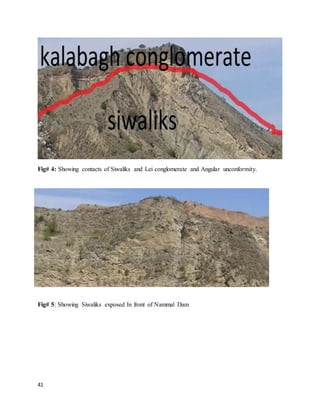
Siwalik are difficult to differentiate as a formation. Here they appeared to be massive greyish to
yellowish sandstone, and were thick bedded. Explained briefly before.
 Kalabagh Conglomerate
 Lithology:
Brown and clay conglomerate with sandstone and clay interbeds.
 Age:
Pleistocene and Late Pliocene
 Fossils:
No fossils were observed by us under study area as we took a faraway view; also not so much
research has yet been done on it.
 Contact:
Lower contact is unconformable with Siwalik Group, while upper was not exposed in the study
region.
Angular Unconformity
38
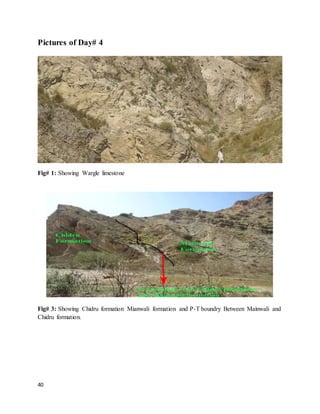
We also observed an angular unconformity and that was contact of Siwaliks with overlying
Kalabagh conglomerate, Siwaliks were tilted, while Kalabagh is horizontally deposited over
them.
 Stop number 2 ) Zaluch Nala
Zaluch Nala is located in western salt range.
Observations:
Here we observed older units than Wargal are exposed and we also observed Kalabagh Thrust
Fault. Here we observed repetition and emition of strata, and that is a sign of faulting.
Here we observed:
1. Tobra Formation
2. Sardhai Clays
3. Amb Formation
4. Warcha formation
5. Wargal Limestone
Here we get various time repetition and emition of strata and that was sign of faulting, the fault is
called as Kalabagh Thrust Fault.
 Tobra Formation
Its conglomeratic, and contain different types of rocks. Other terms for it were explained before.
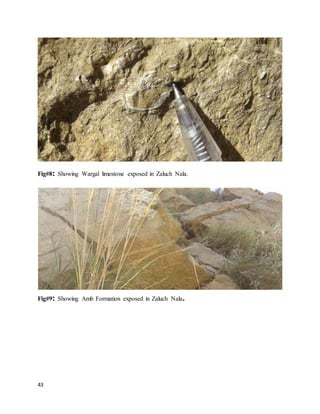
 Sardhai Clays
Here it appeared to be greenish, bluish and reddish in colour and displayed a great variety. Other
terms for it were explained before.
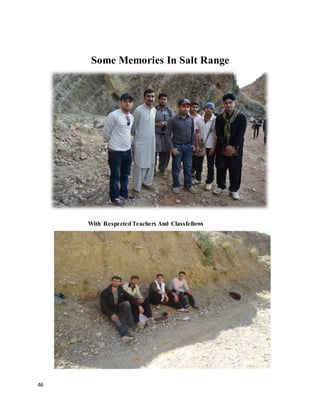
 Amb Formation
39
 Type Locality:
Amb village, central Salt Range, Punjab
 Lithology:
Light coloured Massive sandstone, and impure limestone. It gave a soft touch.
 Fossils:
Fussinilids
 Age:
Lower Permian
 Contacts:
Its upper contact is conformable with Wargal limestone, and lower contact is conformable with
Sardhai formation.
 Environment of Deposition:
Shelfal (Marine)
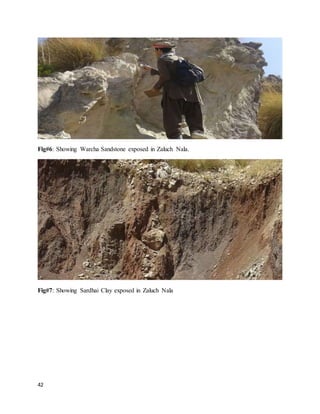
 Warcha Formation
Here it appeared to be light coloured sandstone and was not well cemented, and was a bit soft,
also contained shale bands. Other terms for Warcha are explained before.
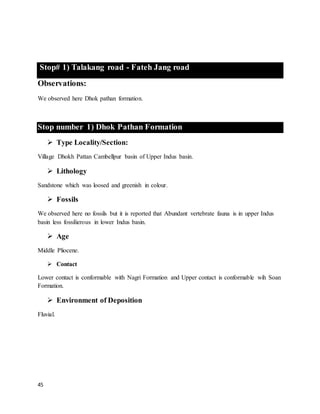
 Wargal Formation
Here it appeared to me massive grey limestone.
Other terms were explained before.
KalaBagh Thrust Fault
In Zaluch Nala we observed repetition and emition of strata, and it is evidence of thrust faulting,
and this fault is called as Kalabagh Thrust Fault. It is a Regional fault.
40
Pictures of Day# 4
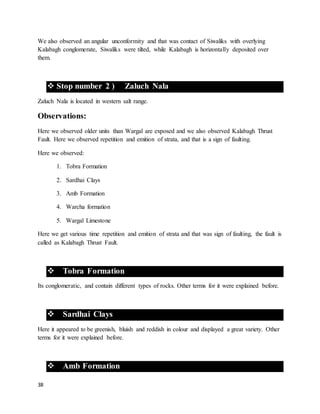
Fig# 1: Showing Wargle limestone
Fig# 3: Showing Chidru formation Mianwali formation and P-T boundry Between Mainwali and
Chidru formation.
41
Fig# 4: Showing contacts of Siwaliks and Lei conglomerate and Angular unconformity.
Fig# 5: Showing Siwaliks exposed In front of Nammal Dam
42
Fig#6: Showing Warcha Sandstone exposed in Zaluch Nala.
Fig#7: Showing Sardhai Clay exposed in Zaluch Nala
43
Fig#8: Showing Wargal limestone exposed in Zaluch Nala.
Fig#9: Showing Amb Formation exposed in Zaluch Nala.
44
Day # 5
45
Stop# 1) Talakang road - Fateh Jang road
Observations:
We observed here Dhok pathan formation.
Stop number 1) Dhok Pathan Formation
 Type Locality/Section:
Village Dhokh Pattan Cambellpur basin of Upper Indus basin.
 Lithology
Sandstone which was loosed and greenish in colour.
 Fossils
We observed here no fossils but it is reported that Abundant vertebrate fauna is in upper Indus
basin less fossilierous in lower Indus basin.
 Age
Middle Pliocene.
 Contact
Lower contact is conformable with Nagri Formation and Upper contact is conformable wih Soan
Formation.
 Environment of Deposition
Fluvial.
46
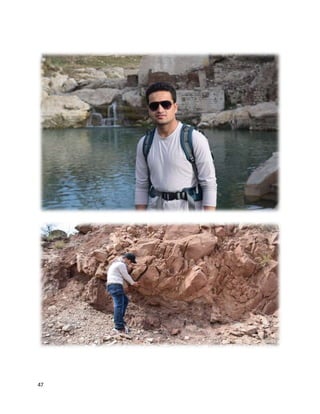
Some Memories In Salt Range
With RespectedTeachers And Classfellows
47

Salt Range field Report By Samiullah

  • 1.
    1 Field Report Salt Range Submittedto Mr. Salman Khattak Submitted By Samiullah Roll Number 5208 Semester 4th Department Geology University Of Haripur
  • 2.
    2 Table of Contents S.NOTopics Page No 1 Acknowledgement 2 Abstract 3 Introduction 4 Day# 1 5 Stop Number 1) Pidh Choa saidan shah road 6 Measuring Strike 7 Measuring Dip 8 Day# 2 9 Stop number 2) Katas Raj youth hostel 10 Sakessorlimestone 11 Stop Number 2)Dandot road 12 Baghanwala formation 13 Tobra formation 14 Dandot formation 15 Warcha sandstone 16 Stop# 3 Khewra George 17 Salt range formation 18 Khewra formation 19 Khussak formation 20 Jutana formation 21 Pictures of Day# 2 22 Day# 3 23 Stop No 1) Pail Khushab Road 24 Siwalik groups 25 Stop No 2) Pail khushab road 26 Hangu formation 27 Lochart formation 28 Patala formation 29 Sakessorlimestone 30 Stop No 3) Pail Khushab road 31 Sardai formation 32 Stop No 4) Pail Khushab road 33 Day# 4 34 Stop No 1) Nammal George
  • 3.
    3 35 Wargal limestone 36Chidru formation 37 Mianwali formation 38 Permo-Triassic boundry 39 Tredian formation 40 Kingriyali formation 41 Data formation 42 Samansuk formation 43 Hangu formation 44 Lochart formation 45 Patala formation 46 Nammal formation 47 Sakessorformation 48 Siwalik groups 49 Kalabagh conglomerates 50 Angular unconformity 51 Stop No 2) Zaluch nala 52 Tobra formation 53 Sardai clays 54 Amb formation 55 Warcha formation 56 Wargal limestone 57 Kalbagh trustfault 58 Day No 5 59 Stop No 1) Talakang-Fateh Jang road Dhok pathan formation
  • 4.
  • 5.
    5 Acknowledgement Thanks to AllahAlmighty who gave me strength to be a part of fieldtrip to salt range and gave me sense to understand the demonstration given by teachers at the field, that was organized by Department of Geology University of Haripur and. After that I would like to thanks to my instructors, Sir Salman Khattak, Sir Azeem Shah and Sir Toufeeq Ahmed, who were with us during our field and they helped me a lot during the field trip. I am very thankful to Sir Hammad (Pakistan museum of natural history) for sharing his knowledge about salt range.I Am very thankful to Ahsan Saeed(Seniour) for guidance.
  • 6.
    6 Abstract The Salt Rangecontains the most important geologic and paleontological localities in Pakistan, and is one of the outstanding field areas in the entire world. Despite its easy accessibility, it has a wealth of geological and paleontological features. In fact, it represents an open book of geology where various richly fossiliferous stratified rocks are very well exposed due to lack of vegetation. These include the Permian carbonate succession with its outstanding brachiopod fauna, Lower Triassic ammonoid beds (the Mianwali Formation, formerly known as "Ceratite Beds"), and Lower Tertiary marine strata with age diagnostic foraminifera. These rocks also provide an excellent opportunity for appreciation of tectonics in the field. In addition to the easily available roadside geology, some prominent gorges provide fantastic locations to study the sedimentary succession. Older strata are exposed in the eastern Salt Range between the Khewra- Choa Saidan Shah, including the famous Khewra Gorge. In the west, beyond Kallar Kahar, are younger strata such as in the Nilawahan Gorge at Nurpur, the Nammal Gorge near Mianwali. This succession has been rightly called a Field Museum of Geology and Paleontology and can be classified as one of the great paleontological areas of the world, fully worthy of conservation and protection efforts.
  • 7.
    7 Introduction We made atrip to Salt Range on 9 March after terminal exam of third semester, and we left university at about 8:30 Am. It was a 5 day field. We made a stay at Katas Raj youth Hostel and made observations in Khewra Gorge and Stratigraphy exposed along Dandot road. Also we learned how to determine strike and dip using Brunton Compass. Then we started out journey to Mianwali, while travelling we made several stops along the road side to study the stratigraphy exposed. And in Mianwali, we made stay in a Restaurant. We had a stay of two days over here and here we observed stratigraphy and in few formations we observed palaeontology exposed in Nammal Gorge and Zaluch Nala.
  • 8.
  • 9.
    9 Observations: Stop Number 1:Pidh Choa Saidan Shah Road Determination of Strike and Dip using Brinton compass: At this stop we determined how to find strike and dip at the field. Measuring Strike: Strike: Direction of the line of intersection between a tilted plane and a horizontal plane.  Compass must be horizontal (bull’s eye bubble centered), with compass edge flush to the tilted plane  And note the reading.  S50E Measuring Dip: Dip:  Place compass on its side, perpendicular to strike.  Level the clinometers (center the bubble).  Read the dip.  10NW
  • 10.
  • 11.
    11 Stop number 1)Katas Raj youth hostel: Observations: Here we observed Sakesar Limestone, which was highly fossiliferous.  Sakessor limestone  Type Locality Name was given after peak Sakesarin the Central Salt Range.  Lithology:  As we observed on the field, mostly it was massive creamish to Grey Limestone.  Nodules are present in it.  We also seen chemical dissolution in its upper part.  Fossils: The formation is rich in fossils, and it mostly contains Foraminifers. Also, it possesses several molluscs and echinoids fossils.  Age: Early Eocene  Contact: Lower contact is conformable with Nammal formation while its upper contact is conformable with Chorgalli formation. Stop number 2) Dandot road Observations: Here we observed Baghanwala and Tobra Formation, Dandot and Warcha Sandstone.  Baghanwala Formation:  Type Locality:
  • 12.
    12 Baghanwala Village, EasternSalt Range.  Lithology: It is composed of clay stone, Mud stone, Siltstone and thin bedded flaggy sandstone. The flags are purple, grey or blue green. The part observed by us was reddish in appearance.  Fossils: No fossil record  Age: Middle Cambrian  Contacts: The upper contact is unconformable with Tobra Formation while lower contact is conformable with Juttana Formation.  Environment of Deposition: Lagoonal with Arid Climatic conditions.  Tobra Formation:  Type Locality: Tobra Eastern Salt Range, Jhelum district, Punjab Province.  Lithology: Mostly it is composed of conglomerate, and is also called as Tobra Conglomerate.  Contacts: The lower contact of the Tobra Formation is a widespread unconformity with Khewra Sandstone. The upper contact is (gradational) conformable with the Dandot Formation.  Age: Early Permian  Fossils:
  • 13.
    13 The Formation containsrich fauna of brachiopods, bivalves, gastropods, pteropods, bryozoans and ostracodes, as well as spores).  Environment of Deposition: Shallow Marine  Dandot Formation:  Type Locality: Dandot Formation is formulized after the village Dandot in Eastern Salt Range, Jhelum district, Punjab Province.  Lithology: The part observed by us was mostly vegetated, it consist of light-grey to olive green sandstone with occasional pebbly beds and subordinate shale.  Fossils: We observed no fossil under the study area. The Formation contains rich fauna of brachiopods, bivalves, gastropods, bryozoans and ostracodes, as well as spores.  Age : Early Permian  Contacts: The lower contact of Dandot Formation has a gradational contact with the underlying Tobra Formation. The upper contact is conformable with Warcha Sandstone.  Environment of Deposition: Shallow Marine  Warcha Sandstone  Type Locality:
  • 14.
    14 The type sectionof Warcha Sandstone is Warcha Gorge (lat. 32°27’N; long. 71°58’E), in Central Salt Range, Punjab Province.  Lithology: The part observed by us was massive sandstone, yellowish to purplish in colour. It was highly jointed. And was medium to coarse grained and is thick bedded.  Fossils: No diagnostic fossils are known from this Formation.  Age: ,Early Permian age  Contacts: The lower contact is conformable with Dandot Formation. The upper contact is transitional with the Sardhai Formation which is placed at the top of the highest massive sandstone.  Environment of Deposition Non-Marine. Stop Number 3) Khewra Gorge: Khewra gorge is present in eastern salt range. And is located 1km away from Khewra Town and that is why it is named as Khewra gorge. Observations: Here we observed following formations: 1. Salt Range Formation 2. Khewra Formation 3. Khussak Formation 4. Juttana Formation We observed these formations, and various Geological Structures as we moved inside Khewra Gorge.
  • 15.
    15  Salt RangeFormation  Nomenclature and Type Locality: The term “Salt Range Formation” has been introduced by Asrarullah (1962) after the Salt Range in the Punjab Province. Previously it was named as “Saline Series” by Wynne (1878) and “Punjab Saline Series” by Gee (1945).Khewra Gorge (lat. 32°40’N; long. 73°00’30” E) in the Eastern Salt Range, Jhelum district, Punjab Province, has been designated as the type section (Shah, 1977)  Lithology: It has three members: 1) SahiwalMarl Member: It consist of Red Marl bed with salt seems, thick bedded gypsum is also found. Khewra trap is also present in some parts of this member. 2) Bandar Kas Gypsum Member: This member consist of massive gypsum with some salt seems; also we find some minor bed of clay and dolomite in this member. 3) Billianwala Member: We observed it when we went under the Khewra Salt Mine; we observed salt crystals inside the mine.  Fossils: It is devoid of fossils.  Age: Precambrian  Contacts: Base of the formation is not exposed anywhere including the study area. The upper contact is transitional with the Khewra Sandstone.  Environment of Deposition:
  • 16.
    16 Evaporitic We also observehoodules in salt range formation in which soft rocks was eroded.  Khewra Formation  Type Locality: Khewra Gorge in the Eastern Salt Range, Jhelum district, Punjab Province.  Lithology: Here the part of Khewra sandstone we studied appeared to be:  Fine Textured  Compact in form  Maroonish in colour  Gave a smooth touch  Fossils: The Khewra Sandstone does not contain well-preserved fossils.  Age: Lower Cambrian  Contacts: It has its lower contact with Salt Range formation and upper with Khussak formation and both are conformable.  Environment of Deposition: Deltaic of Fluvial  Sedimentary Structures  Ball and pillows structure  Cross bedding  Ball and Pillows
  • 17.
    17 Ball-and-pillow structures aremasses of clastic sediment that take the form of isolatedpillows or protruding ball structures. These soft-sediment deformations are usually found at the base of sandstone beds that are interbedded with mudstone.  Cross bedding layering within a stratum and at an angle to the main bedding plane.  Khussak Formation  Type Locality: Khussak Fort, Eastern Salt Range, Punjab.  Lithology: It consists of shale, sandstone and siltstone, and it appeared to be blackish in colour in area of observation.  Fossils: Though we did not observe any fossils here, but the Formation is reported to be fossiliferous, especially in the upper part. Schindewolf, Seilacher (1955) and Pascoe reported following fossils.  Age : Early Cambrian.  Contacts: Lower contact is conformable with Khewra formation by means of micro conglomerates, while upper is conformable with Juttana formation.  Environment of Deposition: Shallow Marine  Juttana Formation  Type Locality: Juttana Formation is formulized after Juttana Village in eastern Salt Range, Punjab.
  • 18.
    18  Lithology: It ismainly composed of dolomite, also possess shale and sandstone. It appeared to be whitish to creamish in colour.  Fossils: The Formation contains tracks and burrows of Trilobites.  Age : Early Cambrian or Early Middle Cambrian age.  Contacts: Lower contact is conformable with Khussak formation and upper contact is conformable with Baghanwala formation.  Environment of Deposition: Shallow Marine Fig# 1: Showing contact between Warcha sandstone, Tobra conglomerates and Baghanwala formation.
  • 19.
    19 Fig# 2: (A)Showing Sakessor formation (B) showing nodular limestone(C) showing fossils in Sakessor formation. Fig# 3) Showing contact between baghanwala formation and Tobra formation
  • 20.
    20 Fig# 4: Showingcontact between Khewra formation and Salt range formation Fig# 5: Showing ball and pillow structure ,, Khewra formation
  • 21.
    21 Fig# 6 (A)Showing glauconitic sandstone in Khussak formation. (B) Showing Bioturbation in khussak formation Fig# 7: Showing Jutana formation boulders.
  • 22.
  • 23.
    23 Stop Number 1)Pail khushab Road Observations: Here we observed Siwaliks (Chinji and Nagri), and as all the siwaliks are of same lithology and it’s difficult to analyse which formation of Siwalik it is.  Siwalik Group  Lithology: The portion observed by us reddish in colour and was not well compacted in upper part as there was no pressure. It was sandstone friable sandstone. Clay was also present.  Fossils: No fossils were observed. Though it is reported to be fossiliferous.  Age : Early Pleistocene to Mid. Miocene  Contacts: Upper contact is unconformable with Kalabagh Conglomerate, while lower is conformable with Kamlial.  Environment of Deposition: All siwaliks have fluvial environment of deposition. Members of Siwalik The group has following members 1. Chinji 2. Nagri 3. Dhok Patan 4. Soan
  • 24.
    24 Stop Number 2):Pail Khushab Road Section Observations: Here we observed Hangu, Lokhart, Patala and Sakesar.  Hangu Formation  Type Locality: The Hangu Shale and Hangu Sandstone of Davies (1930) from Kohat area have been formalized by the Stratigraphic Committee of Pakistan (1973) as Hangu Formation. Type section of the formation is Fort Lockhart in the Samana Range.  Lithology: At that stop, there were two different beds of Hangu formation, one was bedded and other was not and was in form of a thick bed. Its colour appeared to be creamish to brownish, the lower part was also possessed a bit of ferruginous colour.  Fossils: We did not studied any fossils in the field region. No fossils evidence was seen in the field survey. However, Davies (1937), Cox (1933) reported the mollusks and corals from the upper part of Hangu formation.  Age : On the basis of the above fossil evidence, and stratigraphic position, Early Paleocene age is assigned to this formation.  Contacts: Its lower contact is unconformable and was not exposed in area we observed, while upper contact is with Lokhart limestone, at the portion we observed.  Environment of Deposition: Marine  Lockhart Limestone
  • 25.
    25  Nomenclature andType Locality: Davies (1930) introduced the term “Lockhart Limestone” for the Palaeocene Limestone in the Kohat area after Fort Kohat in Western Kohat. This name is extended by the Stratigraphic Committee of Pakistan for similar units in neighbouring areas.  Lithology: Here it appeared to be massive creamish to yellowish limestone, with nodules that were not well developed.  Fossils: It is highly fossiliferous, Lockartia, Assilina, Nummulites was reported in the formation.  Age : On the basis of fossils, Paleocene age is assigned to it.  Contacts: Its lower contact is conformable with Hangu formation and upper is conformable with Patala formation.  Environment of Deposition: Marine  Patala Formation  Type Locality: Patala Nala in Western Salt Range, Mianwali district, Punjab Province has been designated as type section.  Lithology: At the area of observation, it was vegetated, and thus it was not observed. This formation consists of shales which are dark greenish grey in colour. Coal seams of economic value are also present in this formation.  Fossils:  Though we did not observed any fossils at observation area, but it is reported that formation is rich in fossils such as: foraminifera, molluscs, and ostracodes.
  • 26.
    26  Age : Theage of the formation is Late Paleocene.  Contacts: It has its lower contact with Lokhart limestone, and upper was unconformable with Sakessar on field area as we moved a bit forward by roadside, but it do lies conformably with Nammal formation at many places.  Environment of Deposition: Shelfal (Marine)  Sakesar Limestone Here Sakesar was forming massive peaks, and was limestone of whitish to greyish colour. Formation was briefly explained before. Stop Number 3) Pail Khushab Road We made another stop at the same road and here we observed: Observation: Here Mesozoic unit was absent. Here we observed Sardhai Formation.  Sardhai Formation It is fourth member of Nilawahan Group.  Nomenclature and Type Locality: “Upper part of Warcha Group” by Noetling (1901) is named as “Lavender Clays” or “Sardhai Formation” by Gee and Pascoe in 1959. Sardhai gorge, eastern Salt Range, Punjab is its type locality.
  • 27.
    27  Lithology:  Itconsist mostly of clays  Colour was purplish at the portion we observed.  Minor grey sandstone and gypsum is also found.  Fossils: Though we did not found any fossils in area we observed, but brachiopods are reported in this formation.  Age : Early Permian  Contacts: Upper contact is conformable with Amb formation, and lower is conformable with Warcha sandstone.  Environment of Deposition: Marine Stop number 4) Pail Khushab Road: Another Stop was made by us at Pail Khushab Road. Observations:  Here we observed Warcha sandstone lying over Dandot.  Both Warcha and Dandot were explained before.  Dandot:  Dandot was overlying Warcha and was thin bedded, and was brownish to reddish in colour.  Warcha:Warcha appeared to be thick bedded and reddish in colour
  • 28.
    28 Fig# 1: Showingcontact between Chingi formation and Nagri formation Fig# 2: Showing contact between Hangu formation, Lockhart formation, Patala formation and Sakessor formation.
  • 29.
  • 30.
    30  Stop number1) Nammal Gorge Observations: Here we observed: 1. Highly Fossileferous Wargal Limestone 2. Chidru Formation 3. Mianwali Formation 4. P-T boundary between Chidru-Mianwali 5. Thin Bed of Tredian 6. Kingriyalli formation 7. Datta Formation 8. Sammana Suk Formation 9. Hangu 10. Lokhart 11. Patala Formation 12. Nammal Formation 13. Sakesar Formation 14. Siwalik Group 15. Alluvium Deposits 16. Angular Unconformity  Wargal Limestone  Nomenclature and Type Locality: The “Wirgal Group” of Noetling (1901) is formalized as Wargal Formation after the village Wargal in the Central Salt Range, Punjab Province.  Lithology:
  • 31.
    31  Massive GreyDolomitic Limestone  Highly fractured  Rough Touch  Highly compact and hard  Fossils: Highly rich in fossils, mostly brachiopods and bivalves and Gastropods were observed by us during the field.  Age : Late Permian  Contacts: The lower contact of Wargal Limestone with the underlying Amb Formation is conformable and is not well defined. The upper contact is transitional with Chidru Formation  Environment of Deposition: Shallow Marine  Chidru Formation It is third member of Zaluch Group.  Type Locality: It was called as Chidru Beds by Waagen (1891), Chidru Group by Dunbar (1932), and is presently called as Chidru formation by stratigraphic committee of Pakistan.  Lithology: On the field the portion of Chidru formation we observed was whitish in colour and was sandstone.  Fossils: We did not observe any fossils in this during our field, but Brachiopods and ammonites are reported from Chidru formation.
  • 32.
    32  Age : Onthe basis of fossils found, Late Permian age is assigned to it.  Contacts: Lower contact is conformable with Wargal limestone, while upper was unconformable with Mianwali at the area under study.  Environment of Deposition: Shallow Marine  Mianwali Formation It is first member of Musakhail group.  Type Locality: Type locality of the formation is Nammal Gorge Western Salt Range.  Lithology: We observed green colour shale, sandstone  Fossils: No fossils were observed by us on the field in this formation. Though its reported to have bivalves, brachiopods, ammonoids, nautiloids, echinoid spines and crinoidal remains. (Kummel and Teichert, 1970)  Age : Early Triassic age is assigned to it on basis of its fossils.  Contacts: The lower contact with Chhidru Formation is marked by a Paraconformity; upper contact is conformable with Tredian Formation.  Environment of Deposition:
  • 33.
    33 Marine (Open Deltaic) Permo-TriassicBoundary  It is marked by contact between Chidru and Mianwali. And it is a major unconformity. It is a Paraconformity.  The Permian–Triassic (P–Tr) extinction event, colloquially known as the Great Dying, occurred about 252 Ma (million years) ago, forming the boundary between the Permian and Triassic geologic periods, as well as the Palaeozoic and Mesozoic eras. It is the Earth's most severe known extinction event, with up to 96% of all marine species and 70% of terrestrial vertebrate species becoming extinct. It is the only known mass extinction of insects. Some 57% of all families and 83% of all genera became extinct. Because so much biodiversity was lost, the recovery of life on Earth took significantly longer than after any other extinction event,] possibly up to 10 million years.  Tredian Formation  Type Locality: Not designated, Ref sections are: Zaluch Nala western Salt Range & Tappan Wahan, Khisor Range.  Lithology: On our field we observed purplish sandstone, it was not well exposed under our region of study, and there was a thick band, though we found a boulder of it that was purplish, is soft when touched.  Fossils: No fossils were observed by us here.  Age : Middle Triassic  Contacts: Upper contact is conformable with Kingriali formation and lower is conformable with Mianwali formation.
  • 34.
    34  Environment ofDeposition: Fluvial (Non Marine)  Kingriali Formation  Type Locality: After Kingriali peak in Khisor Range.  Lithology: Anwar et al 1992, divided the formation into two members 1. Doya Member 2. Vanjari Member Dolomite and dolomitic sandstone  Age: Late Triassic  Contact: Lower is conformable with Tredian Formation and upper is Disconformable with Datta Formation.  Fossil: We did observe here any fossils but it is reported that gastropods, bivalves, Crinoids, and many benthic organisms  Environment of Deposition: Tidal Flats  Datta Formation  Type Locality: Datta Nala, Surghar Range is designated as its type locality.
  • 35.
    35  Lithology: Variegated Sandstone,limestone and shale, and also it were giving nodules like structures formed due to chemical dissolution.  Fossils: No fossils were observed by us here.  Age : Jurassic.  Contacts: Lower contact is unconformable with Tredian formation, while upper is conformable with Shinowri formation.  Environment of Deposition: Deltaic  Sammana Suk Formation  Type Locality: NE of Shinawari (Samana Range, NWFP) is designated as it type locality.  Lithology: Purplish sandstone with shale.  Fossils: No fossils were observed by us here.  Age : Jurassic.  Contacts: Lower contact is conformable with Shinowri formation, while upper contact is unconformable with Hangu formation.
  • 36.
    36  Environment ofDeposition: Marine  Hangu Formation Hangu formation is briefly explained before. It appeared to have blackish shale and ferruginous sandstone.  Lokhart Formation It was not well exposed there, it appeared to be whitish to greyish limestone. Explained it briefly before.  Patala Formation It appeared to be blackish in colour and it was shale with fissility. It is briefly explained before.  Nammal Formation  Type Locality: Nammal Gorge Salt Range, Punjab  Lithology: It was massive light coloured limestone, with shale at base.  Fossils: No fossils were observed by us here.  Age : Early Eocene.  Contacts:
  • 37.
    37 Upper contact isconformable with Sakesarformation, while lower is conformable with Patala formation.  Environment of Deposition Shallow Marine.  Sakesar Formation It was massive nodular limestone, light yellowish in colour. And other stratigraphic terms for it were explained briefly before.  Siwalik Group Siwalik are difficult to differentiate as a formation. Here they appeared to be massive greyish to yellowish sandstone, and were thick bedded. Explained briefly before.  Kalabagh Conglomerate  Lithology: Brown and clay conglomerate with sandstone and clay interbeds.  Age: Pleistocene and Late Pliocene  Fossils: No fossils were observed by us under study area as we took a faraway view; also not so much research has yet been done on it.  Contact: Lower contact is unconformable with Siwalik Group, while upper was not exposed in the study region. Angular Unconformity
  • 38.
    38 We also observedan angular unconformity and that was contact of Siwaliks with overlying Kalabagh conglomerate, Siwaliks were tilted, while Kalabagh is horizontally deposited over them.  Stop number 2 ) Zaluch Nala Zaluch Nala is located in western salt range. Observations: Here we observed older units than Wargal are exposed and we also observed Kalabagh Thrust Fault. Here we observed repetition and emition of strata, and that is a sign of faulting. Here we observed: 1. Tobra Formation 2. Sardhai Clays 3. Amb Formation 4. Warcha formation 5. Wargal Limestone Here we get various time repetition and emition of strata and that was sign of faulting, the fault is called as Kalabagh Thrust Fault.  Tobra Formation Its conglomeratic, and contain different types of rocks. Other terms for it were explained before.  Sardhai Clays Here it appeared to be greenish, bluish and reddish in colour and displayed a great variety. Other terms for it were explained before.  Amb Formation
  • 39.
    39  Type Locality: Ambvillage, central Salt Range, Punjab  Lithology: Light coloured Massive sandstone, and impure limestone. It gave a soft touch.  Fossils: Fussinilids  Age: Lower Permian  Contacts: Its upper contact is conformable with Wargal limestone, and lower contact is conformable with Sardhai formation.  Environment of Deposition: Shelfal (Marine)  Warcha Formation Here it appeared to be light coloured sandstone and was not well cemented, and was a bit soft, also contained shale bands. Other terms for Warcha are explained before.  Wargal Formation Here it appeared to me massive grey limestone. Other terms were explained before. KalaBagh Thrust Fault In Zaluch Nala we observed repetition and emition of strata, and it is evidence of thrust faulting, and this fault is called as Kalabagh Thrust Fault. It is a Regional fault.
  • 40.
    40 Pictures of Day#4 Fig# 1: Showing Wargle limestone Fig# 3: Showing Chidru formation Mianwali formation and P-T boundry Between Mainwali and Chidru formation.
  • 41.
    41 Fig# 4: Showingcontacts of Siwaliks and Lei conglomerate and Angular unconformity. Fig# 5: Showing Siwaliks exposed In front of Nammal Dam
  • 42.
    42 Fig#6: Showing WarchaSandstone exposed in Zaluch Nala. Fig#7: Showing Sardhai Clay exposed in Zaluch Nala
  • 43.
    43 Fig#8: Showing Wargallimestone exposed in Zaluch Nala. Fig#9: Showing Amb Formation exposed in Zaluch Nala.
  • 44.
  • 45.
    45 Stop# 1) Talakangroad - Fateh Jang road Observations: We observed here Dhok pathan formation. Stop number 1) Dhok Pathan Formation  Type Locality/Section: Village Dhokh Pattan Cambellpur basin of Upper Indus basin.  Lithology Sandstone which was loosed and greenish in colour.  Fossils We observed here no fossils but it is reported that Abundant vertebrate fauna is in upper Indus basin less fossilierous in lower Indus basin.  Age Middle Pliocene.  Contact Lower contact is conformable with Nagri Formation and Upper contact is conformable wih Soan Formation.  Environment of Deposition Fluvial.
  • 46.
    46 Some Memories InSalt Range With RespectedTeachers And Classfellows
  • 47.