Southridge
VIDEO
ETHICS THROUGH
THICK AND THIN,
AND ETHICS AND
RELIGION
Southridge
VIDEO
Southridge
VIDEO
• a kind of concept that both
has a significant degree of
descriptive content and is
evaluatively loaded.
• Paradigmatic examples
various virtues and vices
such as courage, cruelty,
truthfulness and kindness.
THICK AND
ETHICAL
CONCEPTS
THICKETHICALCONCEPTS
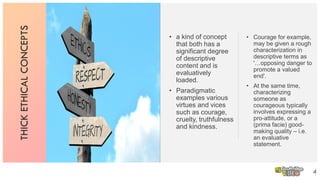
• a kind of concept
that both has a
significant degree
of descriptive
content and is
evaluatively
loaded.
• Paradigmatic
examples various
virtues and vices
such as courage,
cruelty, truthfulness
and kindness.
4
• Courage for example,
may be given a rough
characterization in
descriptive terms as
'…opposing danger to
promote a valued
end'.
• At the same time,
characterizing
someone as
courageous typically
involves expressing a
pro-attitude, or a
(prima facie) good-
making quality – i.e.
an evaluative
statement.
THICKETHICALCONCEPTS
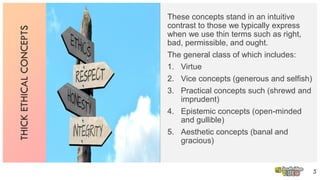
These concepts stand in an intuitive
contrast to those we typically express
when we use thin terms such as right,
bad, permissible, and ought.
The general class of which includes:
1. Virtue
2. Vice concepts (generous and selfish)
3. Practical concepts such (shrewd and
imprudent)
4. Epistemic concepts (open-minded
and gullible)
5. Aesthetic concepts (banal and
gracious)
5
THINETHICALCONCEPTS
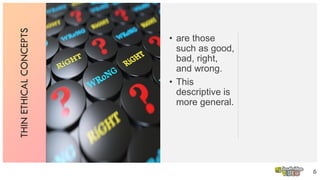
• are those
such as good,
bad, right,
and wrong.
• This
descriptive is
more general.
6
Religion
a proposed way of living based,
generally, on superstition and
power structures.
Ethics
a code of behavior intended to
govern a person’s interaction
with the world.
Religions base their ethics on
what a person or group wrote
at some past time, in some
different place, as the
foundation of the religion and,
the justification of the
mandated code of behavior is
“this is what [we say] the god
wants you to do”.
Outside of religion, secular
persons and groups tend to
base their code, their ethics, on
best-outcome interaction of
persons, frequently with the
“Golden Rule” as the core
reference - Do unto others as
you would have them do unto
you.
• In short, if you are an atheist
and do the right thing, you are
a good person. For an atheist,
virtue is (or at least can be) its
own reward.
• If you are a theist and you do
the right thing, it’s incidental
to your real motivation. For a
theist, “virtue” is an attempt to
please the god and reap a
reward or to avoid
punishment.
It is particularly relevant to
remember:
• Your Ethics are the code of
conduct by which you believe
you should behave.
• Your Morals are how well you
adhere to your own ethics.
Southridge
VIDEO
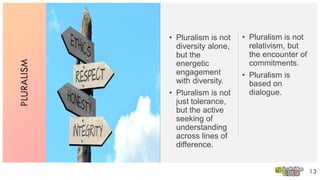
PLURALISM
• Pluralism is not
diversity alone,
but the
energetic
engagement
with diversity.
• Pluralism is not
just tolerance,
but the active
seeking of
understanding
across lines of
difference.
13
• Pluralism is not
relativism, but
the encounter of
commitments.
• Pluralism is
based on
dialogue.
FUNDAMENTAALISM
• usually has a
religious
connotation that
indicates
unwavering
attachment to a set
of irreducible
beliefs.
• A movement in
20th century
Protestantism
emphasizing the
literally interpreted
Bible as the
fundamental to
Christian life.
14
• A movement
or attitude
stressing
strict and
literal
adherence to
a set basic
principles.
CHALLENGESTOPLURALISM
15
But this is where the problem comes in.
Because as Bazelon’s blithe (and
increasingly typical) dismissal of current
religious-liberty concerns suggests, it’s
precisely when people in liberal
societies see themselves as out on the
vanguard of history that they’re least
likely to concede that they might, just
might, be making a mistake, and most
inclined to feel instead that the thing to
do is shatter the shield wall around the
remaining bastions of unenlightenment
rather than permit them to persist.
CHALLENGESTOPLURALISM
16
It’s when a consensus is at its most self-
confident, in other words
• and therefore most vulnerable to the
errors of overconfidence
• that the kind of pluralism that might
serve as a corrective becomes
hardest for that consensus’s
exponents to accept.
CHALLENGESTOPLURALISM
17
Example:
There are plenty of competing ideas
and warring schools of thought on
college campuses, and plenty of forms
of diversity represented in their
faculties.
But this is usually a pluralism of the
already-acceptable, not the genuinely
challenging, and as such it tends to
evaporate when it seems to conflict with
the (left-liberal, secular, liberationist)
ideas that the academic community
holds most dear.
Southridge
VIDEO
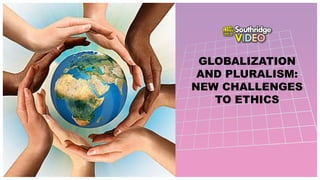
GLOBALIZATION
AND PLURALISM:
NEW CHALLENGES
TO ETHICS
Southridge
VIDEO
GLOBALIZATION
AND PLURALISM:
NEW CHALLENGES
TO ETHICS
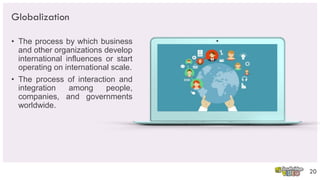
Globalization
• The process by which business
and other organizations develop
international influences or start
operating on international scale.
• The process of interaction and
integration among people,
companies, and governments
worldwide.
20
Globalization
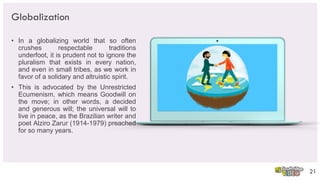
• In a globalizing world that so often
crushes respectable traditions
underfoot, it is prudent not to ignore the
pluralism that exists in every nation,
and even in small tribes, as we work in
favor of a solidary and altruistic spirit.
• This is advocated by the Unrestricted
Ecumenism, which means Goodwill on
the move; in other words, a decided
and generous will; the universal will to
live in peace, as the Brazilian writer and
poet Alziro Zarur (1914-1979) preached
for so many years.
21
Globalization
• The process by which business
and other organizations develop
international influences or start
operating on international scale.
• The process of interaction and
integration among people,
companies, and governments
worldwide.
22
Moral Challenge of Globalization
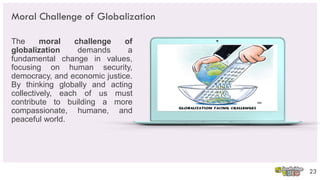
The moral challenge of
globalization demands a
fundamental change in values,
focusing on human security,
democracy, and economic justice.
By thinking globally and acting
collectively, each of us must
contribute to building a more
compassionate, humane, and
peaceful world.
23
Challenges of Globalization
Globalization poses four major
challenges that will have to be
addressed by governments, civil
society, and other policy actors.
• One is to ensure that the benefits of
globalization extend to all countries. That
will certainly not happen automatically.
• The second is to deal with the fear that
globalization leads to instability, which is
particularly marked in the developing
world.
24
Challenges of Globalization
• The third challenge is to address the
very real fear in the industrial world that
increased global competition will lead
inexorably to a race to the bottom in
wages, labor rights, employment
practices, and the environment.
• And finally, globalization and all of the
complicated problems related to it must
not be used as excuses to avoid
searching for new ways to cooperate in
the overall interest of countries and
people.
25
Challenges of Globalization
Several implications for civil society, for
governments and for multinational institutions
stem from the challenges of globalization.
• Civil society organizations concerned with
development have traditionally focused on
aid and resource transfers; they now are
going to have to broaden their agenda to
deal with the much more complex issues of
trade and investment, international financial
flows, environment, and migration, among
others. Civil society organizations in the old
industrial countries also will have to deal with
the backlash against global ization, which is
producing a growing unwillingness to support
multilateral cooperation.
26
Challenges of Globalization
Governments are going to have to decide what
they mean by “civil society” and to identify new
ways of dealing with its organizations. At the
Overseas Development Council, we define civil
society broadly to encompass not only
development and advocacy groups, but also
corporations, financial institutions, think tanks,
foundations, and a range of other groups that
are not part of government. But governments
and other actors need to decide whether civil
society is simply an effective—and even
cheap—way of delivering social programs, or
whether it is good in and of itself, an essential
component of a democratic society. In other
words, they are going to have to be much more
precise about the purposes of working with civil
society groups and about how they fund them.
27
Challenges of Globalization
Then, there is a whole set of critical
questions for the multilateral institutions,
particularly concerning participation and
transparency. These issues are extremely
difficult because these remain
governmental institutions, and
governments often do not welcome the
participation of civil society in decisions.
28
Challenges of Globalization
Finally, there is a need for high-level
political discussions among leaders from
the old industrial countries, the emerging
economies, and the countries that risk
marginalization by globalization.
29
Ethics and religion

Ethics and religion

  • 1.
    Southridge VIDEO ETHICS THROUGH THICK ANDTHIN, AND ETHICS AND RELIGION
  • 2.
  • 3.
    Southridge VIDEO • a kindof concept that both has a significant degree of descriptive content and is evaluatively loaded. • Paradigmatic examples various virtues and vices such as courage, cruelty, truthfulness and kindness. THICK AND ETHICAL CONCEPTS
  • 4.
    THICKETHICALCONCEPTS • a kindof concept that both has a significant degree of descriptive content and is evaluatively loaded. • Paradigmatic examples various virtues and vices such as courage, cruelty, truthfulness and kindness. 4 • Courage for example, may be given a rough characterization in descriptive terms as '…opposing danger to promote a valued end'. • At the same time, characterizing someone as courageous typically involves expressing a pro-attitude, or a (prima facie) good- making quality – i.e. an evaluative statement.
  • 5.
    THICKETHICALCONCEPTS These concepts standin an intuitive contrast to those we typically express when we use thin terms such as right, bad, permissible, and ought. The general class of which includes: 1. Virtue 2. Vice concepts (generous and selfish) 3. Practical concepts such (shrewd and imprudent) 4. Epistemic concepts (open-minded and gullible) 5. Aesthetic concepts (banal and gracious) 5
  • 6.
    THINETHICALCONCEPTS • are those suchas good, bad, right, and wrong. • This descriptive is more general. 6
  • 7.
    Religion a proposed wayof living based, generally, on superstition and power structures. Ethics a code of behavior intended to govern a person’s interaction with the world.
  • 8.
    Religions base theirethics on what a person or group wrote at some past time, in some different place, as the foundation of the religion and, the justification of the mandated code of behavior is “this is what [we say] the god wants you to do”.
  • 9.
    Outside of religion,secular persons and groups tend to base their code, their ethics, on best-outcome interaction of persons, frequently with the “Golden Rule” as the core reference - Do unto others as you would have them do unto you.
  • 10.
    • In short,if you are an atheist and do the right thing, you are a good person. For an atheist, virtue is (or at least can be) its own reward. • If you are a theist and you do the right thing, it’s incidental to your real motivation. For a theist, “virtue” is an attempt to please the god and reap a reward or to avoid punishment.
  • 11.
    It is particularlyrelevant to remember: • Your Ethics are the code of conduct by which you believe you should behave. • Your Morals are how well you adhere to your own ethics.
  • 12.
  • 13.
    PLURALISM • Pluralism isnot diversity alone, but the energetic engagement with diversity. • Pluralism is not just tolerance, but the active seeking of understanding across lines of difference. 13 • Pluralism is not relativism, but the encounter of commitments. • Pluralism is based on dialogue.
  • 14.
    FUNDAMENTAALISM • usually hasa religious connotation that indicates unwavering attachment to a set of irreducible beliefs. • A movement in 20th century Protestantism emphasizing the literally interpreted Bible as the fundamental to Christian life. 14 • A movement or attitude stressing strict and literal adherence to a set basic principles.
  • 15.
    CHALLENGESTOPLURALISM 15 But this iswhere the problem comes in. Because as Bazelon’s blithe (and increasingly typical) dismissal of current religious-liberty concerns suggests, it’s precisely when people in liberal societies see themselves as out on the vanguard of history that they’re least likely to concede that they might, just might, be making a mistake, and most inclined to feel instead that the thing to do is shatter the shield wall around the remaining bastions of unenlightenment rather than permit them to persist.
  • 16.
    CHALLENGESTOPLURALISM 16 It’s when aconsensus is at its most self- confident, in other words • and therefore most vulnerable to the errors of overconfidence • that the kind of pluralism that might serve as a corrective becomes hardest for that consensus’s exponents to accept.
  • 17.
    CHALLENGESTOPLURALISM 17 Example: There are plentyof competing ideas and warring schools of thought on college campuses, and plenty of forms of diversity represented in their faculties. But this is usually a pluralism of the already-acceptable, not the genuinely challenging, and as such it tends to evaporate when it seems to conflict with the (left-liberal, secular, liberationist) ideas that the academic community holds most dear.
  • 18.
  • 19.
  • 20.
    Globalization • The processby which business and other organizations develop international influences or start operating on international scale. • The process of interaction and integration among people, companies, and governments worldwide. 20
  • 21.
    Globalization • In aglobalizing world that so often crushes respectable traditions underfoot, it is prudent not to ignore the pluralism that exists in every nation, and even in small tribes, as we work in favor of a solidary and altruistic spirit. • This is advocated by the Unrestricted Ecumenism, which means Goodwill on the move; in other words, a decided and generous will; the universal will to live in peace, as the Brazilian writer and poet Alziro Zarur (1914-1979) preached for so many years. 21
  • 22.
    Globalization • The processby which business and other organizations develop international influences or start operating on international scale. • The process of interaction and integration among people, companies, and governments worldwide. 22
  • 23.
    Moral Challenge ofGlobalization The moral challenge of globalization demands a fundamental change in values, focusing on human security, democracy, and economic justice. By thinking globally and acting collectively, each of us must contribute to building a more compassionate, humane, and peaceful world. 23
  • 24.
    Challenges of Globalization Globalizationposes four major challenges that will have to be addressed by governments, civil society, and other policy actors. • One is to ensure that the benefits of globalization extend to all countries. That will certainly not happen automatically. • The second is to deal with the fear that globalization leads to instability, which is particularly marked in the developing world. 24
  • 25.
    Challenges of Globalization •The third challenge is to address the very real fear in the industrial world that increased global competition will lead inexorably to a race to the bottom in wages, labor rights, employment practices, and the environment. • And finally, globalization and all of the complicated problems related to it must not be used as excuses to avoid searching for new ways to cooperate in the overall interest of countries and people. 25
  • 26.
    Challenges of Globalization Severalimplications for civil society, for governments and for multinational institutions stem from the challenges of globalization. • Civil society organizations concerned with development have traditionally focused on aid and resource transfers; they now are going to have to broaden their agenda to deal with the much more complex issues of trade and investment, international financial flows, environment, and migration, among others. Civil society organizations in the old industrial countries also will have to deal with the backlash against global ization, which is producing a growing unwillingness to support multilateral cooperation. 26
  • 27.
    Challenges of Globalization Governmentsare going to have to decide what they mean by “civil society” and to identify new ways of dealing with its organizations. At the Overseas Development Council, we define civil society broadly to encompass not only development and advocacy groups, but also corporations, financial institutions, think tanks, foundations, and a range of other groups that are not part of government. But governments and other actors need to decide whether civil society is simply an effective—and even cheap—way of delivering social programs, or whether it is good in and of itself, an essential component of a democratic society. In other words, they are going to have to be much more precise about the purposes of working with civil society groups and about how they fund them. 27
  • 28.
    Challenges of Globalization Then,there is a whole set of critical questions for the multilateral institutions, particularly concerning participation and transparency. These issues are extremely difficult because these remain governmental institutions, and governments often do not welcome the participation of civil society in decisions. 28
  • 29.
    Challenges of Globalization Finally,there is a need for high-level political discussions among leaders from the old industrial countries, the emerging economies, and the countries that risk marginalization by globalization. 29