Exploring
Reported by: Lance Y. Recaña
MORAL COURAGE
in Ethics
WHAT IS MORAL
COURAGE IN
TERMS OF ETHICS?
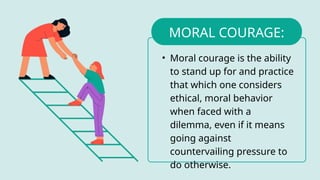
• Moral courage is the ability
to stand up for and practice
that which one considers
ethical, moral behavior
when faced with a
dilemma, even if it means
going against
countervailing pressure to
do otherwise.
MORAL COURAGE:
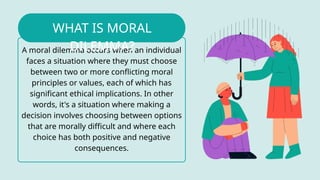
A moral dilemma occurs when an individual
faces a situation where they must choose
between two or more conflicting moral
principles or values, each of which has
significant ethical implications. In other
words, it's a situation where making a
decision involves choosing between options
that are morally difficult and where each
choice has both positive and negative
consequences.
WHAT IS MORAL
DILEMMA?
You find a wallet on the ground in a busy park. Inside, there’s a
significant amount of cash and an ID card with the owner's contact
information. You have two choices:
1.Choice 1: Take the wallet to the park's lost and found office. This
action could help return the wallet to its owner, but you’re
uncertain if the cash will be returned as well.
2.Choice 2: Keep the cash for yourself and leave the wallet where
you found it. This would benefit you financially, but the owner
of the wallet might be left without any way to retrieve their
belongings, which could be distressing and financially
damaging for them.
Moral Dilemma: Do you act with honesty and integrity by trying
to return the wallet in its entirety, potentially losing the cash but
ensuring it reaches its rightful owner, or do you take advantage
of the situation by keeping the cash, which benefits you but
harms the wallet's owner?
EXAMPLE:
Confronting and
addressing ethical
dilemmas or injustices
even when doing so
may lead to personal
loss, criticism, or
conflict.
Being willing to
uphold and act
upon one's ethical
principles even
when it is
challenging to do
so.
Maintaining
consistency
between one's
values and
actions, and being
honest about
one's beliefs and
choices.
THREE KEY ASPECTS:
Commitment to
Values
Facing Adversity
Integrity
So what role does literature play in exploring social, moral and ethical positions?
Literature holds a unique power to both reflect and challenge societal norms and values.
Moral courage is often
required to navigate moral
dilemmas. When faced with a
dilemma, a person might need
moral courage to make and act
upon a decision that aligns
with their ethical principles,
despite potential backlash or
personal loss.
In the context of a moral
dilemma, moral courage
involves the resolve to make
tough choices and act on
them. It’s about overcoming
fear and standing firm in one's
convictions, even when it is not
easy or popular.
CONNECTIONS:
Navigating
Dilemmas:
Making Tough
Choices:
Moral courage is crucial for navigating
complex ethical landscapes and making
principled decisions. It empowers individuals
to confront wrongdoing, advocate for justice,
and act in ways that align with their values,
fostering integrity and ethical behavior in both
personal and professional spheres. In essence,
moral courage is the driving force behind
principled action and the pursuit of moral
truth, enabling individuals to act with
conviction and stand up for what is right.
CONCLUSION:

Moral Courage in ethics sadasdasdasdsadas.pptx

  • 1.
    Exploring Reported by: LanceY. Recaña MORAL COURAGE in Ethics
  • 2.
    WHAT IS MORAL COURAGEIN TERMS OF ETHICS?
  • 3.
    • Moral courageis the ability to stand up for and practice that which one considers ethical, moral behavior when faced with a dilemma, even if it means going against countervailing pressure to do otherwise. MORAL COURAGE:
  • 4.
    A moral dilemmaoccurs when an individual faces a situation where they must choose between two or more conflicting moral principles or values, each of which has significant ethical implications. In other words, it's a situation where making a decision involves choosing between options that are morally difficult and where each choice has both positive and negative consequences. WHAT IS MORAL DILEMMA?
  • 5.
    You find awallet on the ground in a busy park. Inside, there’s a significant amount of cash and an ID card with the owner's contact information. You have two choices: 1.Choice 1: Take the wallet to the park's lost and found office. This action could help return the wallet to its owner, but you’re uncertain if the cash will be returned as well. 2.Choice 2: Keep the cash for yourself and leave the wallet where you found it. This would benefit you financially, but the owner of the wallet might be left without any way to retrieve their belongings, which could be distressing and financially damaging for them. Moral Dilemma: Do you act with honesty and integrity by trying to return the wallet in its entirety, potentially losing the cash but ensuring it reaches its rightful owner, or do you take advantage of the situation by keeping the cash, which benefits you but harms the wallet's owner? EXAMPLE:
  • 6.
    Confronting and addressing ethical dilemmasor injustices even when doing so may lead to personal loss, criticism, or conflict. Being willing to uphold and act upon one's ethical principles even when it is challenging to do so. Maintaining consistency between one's values and actions, and being honest about one's beliefs and choices. THREE KEY ASPECTS: Commitment to Values Facing Adversity Integrity
  • 7.
    So what roledoes literature play in exploring social, moral and ethical positions? Literature holds a unique power to both reflect and challenge societal norms and values. Moral courage is often required to navigate moral dilemmas. When faced with a dilemma, a person might need moral courage to make and act upon a decision that aligns with their ethical principles, despite potential backlash or personal loss. In the context of a moral dilemma, moral courage involves the resolve to make tough choices and act on them. It’s about overcoming fear and standing firm in one's convictions, even when it is not easy or popular. CONNECTIONS: Navigating Dilemmas: Making Tough Choices:
  • 8.
    Moral courage iscrucial for navigating complex ethical landscapes and making principled decisions. It empowers individuals to confront wrongdoing, advocate for justice, and act in ways that align with their values, fostering integrity and ethical behavior in both personal and professional spheres. In essence, moral courage is the driving force behind principled action and the pursuit of moral truth, enabling individuals to act with conviction and stand up for what is right. CONCLUSION: