Practical Security Advice for the
CloudPresented by
Chirag Joshi, M.S., CISA, CISM, CRISC, MCTS
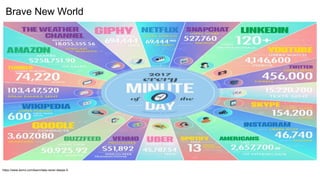
Brave New World
https://www.domo.com/learn/data-never-sleeps-5
Agenda
 Cutting through buzzwords, hype and complexities
 Cloud Computing Overview
 Security Risks
 Governance Controls
 Practical Technical Controls
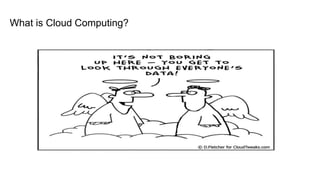
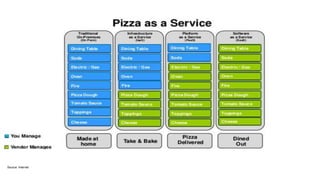
What is Cloud Computing?
Source: Internet
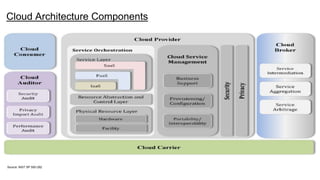
Cloud Architecture Components
Source: NIST SP 500-292
Security Risks
Source: Internet
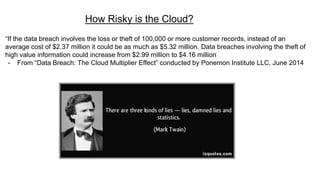
“If the data breach involves the loss or theft of 100,000 or more customer records, instead of an
average cost of $2.37 million it could be as much as $5.32 million. Data breaches involving the theft of
high value information could increase from $2.99 million to $4.16 million
- From “Data Breach: The Cloud Multiplier Effect” conducted by Ponemon Institute LLC, June 2014
How Risky is the Cloud?
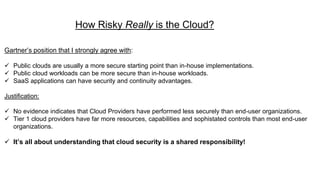
Gartner’s position that I strongly agree with:
 Public clouds are usually a more secure starting point than in-house implementations.
 Public cloud workloads can be more secure than in-house workloads.
 SaaS applications can have security and continuity advantages.
Justification:
 No evidence indicates that Cloud Providers have performed less securely than end-user organizations.
 Tier 1 cloud providers have far more resources, capabilities and sophistated controls than most end-user
organizations.
 It’s all about understanding that cloud security is a shared responsibility!
How Risky Really is the Cloud?
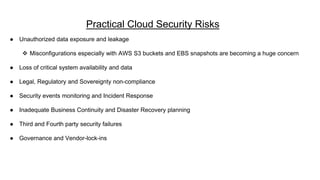
Practical Cloud Security Risks
● Unauthorized data exposure and leakage
 Misconfigurations especially with AWS S3 buckets and EBS snapshots are becoming a huge concern
● Loss of critical system availability and data
● Legal, Regulatory and Sovereignty non-compliance
● Security events monitoring and Incident Response
● Inadequate Business Continuity and Disaster Recovery planning
● Third and Fourth party security failures
● Governance and Vendor-lock-ins
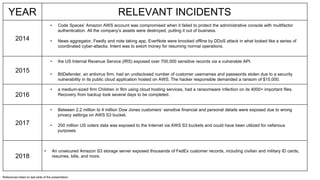
YEAR RELEVANT INCIDENTS
2014
• Code Spaces’ Amazon AWS account was compromised when it failed to protect the administrative console with multifactor
authentication. All the company’s assets were destroyed, putting it out of business.
• News aggregator, Feedly and note taking app, EverNote were knocked offline by DDoS attack in what looked like a series of
coordinated cyber-attacks. Intent was to extort money for resuming normal operations.
2015
• the US Internal Revenue Service (IRS) exposed over 700,000 sensitive records via a vulnerable API.
• BitDefender, an antivirus firm, had an undisclosed number of customer usernames and passwords stolen due to a security
vulnerability in its public cloud application hosted on AWS. The hacker responsible demanded a ransom of $15,000.
2016
• a medium-sized firm Children in film using cloud hosting services, had a ransomware infection on its 4000+ important files.
Recovery from backup took several days to be completed.
2017
• Between 2.2 million to 4 million Dow Jones customers’ sensitive financial and personal details were exposed due to wrong
privacy settings on AWS S3 bucket.
• 200 million US voters data was exposed to the Internet via AWS S3 buckets and could have been utilized for nefarious
purposes.
2018
• An unsecured Amazon S3 storage server exposed thousands of FedEx customer records, including civilian and military ID cards,
resumes, bills, and more.
References listed on last slide of the presentation
European Union Agency for Network and Information Security, Cloud Security Guide for SMEs
https://downloads.cloudsecurityalliance.org/assets/research/top-threats/Treacherous-12_Cloud-Computing_Top-Threats.pdf
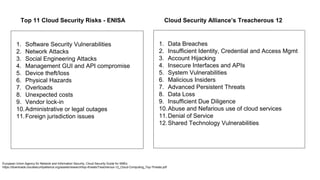
Top 11 Cloud Security Risks - ENISA
1. Data Breaches
2. Insufficient Identity, Credential and Access Mgmt
3. Account Hijacking
4. Insecure Interfaces and APIs
5. System Vulnerabilities
6. Malicious Insiders
7. Advanced Persistent Threats
8. Data Loss
9. Insufficient Due Diligence
10.Abuse and Nefarious use of cloud services
11.Denial of Service
12.Shared Technology Vulnerabilities
Cloud Security Alliance’s Treacherous 12
1. Software Security Vulnerabilities
2. Network Attacks
3. Social Engineering Attacks
4. Management GUI and API compromise
5. Device theft/loss
6. Physical Hazards
7. Overloads
8. Unexpected costs
9. Vendor lock-in
10.Administrative or legal outages
11.Foreign jurisdiction issues
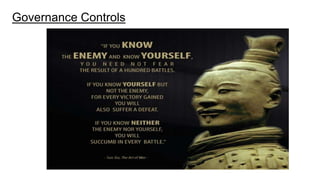
Governance Controls
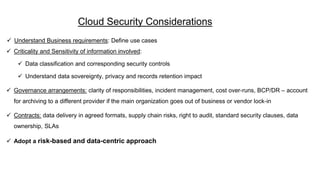
Cloud Security Considerations
 Understand Business requirements: Define use cases
 Criticality and Sensitivity of information involved:
 Data classification and corresponding security controls
 Understand data sovereignty, privacy and records retention impact
 Governance arrangements: clarity of responsibilities, incident management, cost over-runs, BCP/DR – account
for archiving to a different provider if the main organization goes out of business or vendor lock-in
 Contracts: data delivery in agreed formats, supply chain risks, right to audit, standard security clauses, data
ownership, SLAs
 Adopt a risk-based and data-centric approach
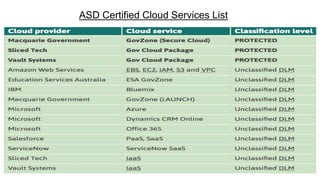
ASD Certified Cloud Services List
Technical Controls
Source: Internet
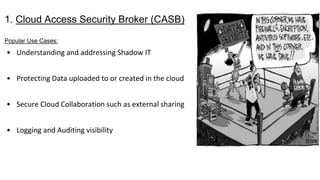
1. Cloud Access Security Broker (CASB)
Popular Use Cases:
• Understanding and addressing Shadow IT
• Protecting Data uploaded to or created in the cloud
• Secure Cloud Collaboration such as external sharing
• Logging and Auditing visibility
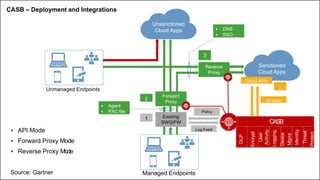
6 © 2017 Gartner, Inc. and/or its affiliates. All rights reserved.
 API Mode
 Forward Proxy Mode
 Reverse Proxy Mode
Unsanctioned
Cloud Apps
Sanctioned
Cloud Apps
Cloud APIs
Reverse
Proxy
Forward
Proxy
Existing
SWG/FW
API Mode
Log Feed
Managed Endpoints
Unmanaged Endpoints
1
2
3
4
Policy
 Agent
 PAC file
 DNS
 SSO
CASB
DLP
Encrypt
User
Activity
Logging
Device
Mgmt
Identity
Threat
Protect
Source: Gartner
CASB – Deployment and Integrations
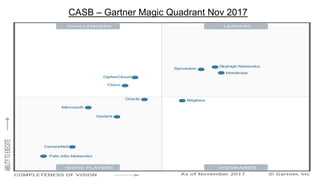
CASB – Gartner Magic Quadrant Nov 2017
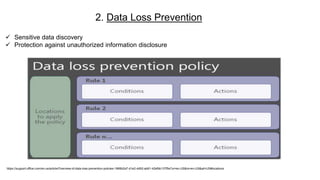
2. Data Loss Prevention
https://support.office.com/en-us/article/Overview-of-data-loss-prevention-policies-1966b2a7-d1e2-4d92-ab61-42efbb137f5e?ui=en-US&rs=en-US&ad=US#locations
 Sensitive data discovery
 Protection against unauthorized information disclosure
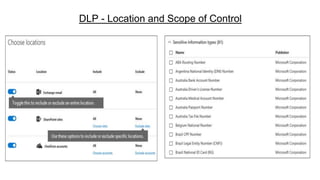
DLP - Location and Scope of Control
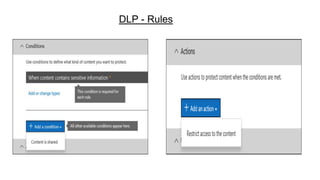
DLP - Rules
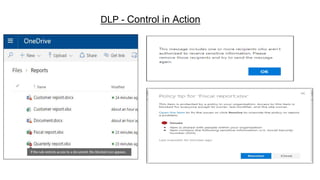
DLP - Control in Action
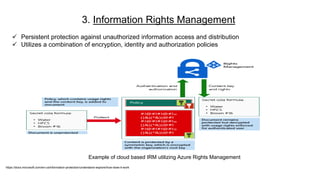
3. Information Rights Management
 Persistent protection against unauthorized information access and distribution
 Utilizes a combination of encryption, identity and authorization policies
Example of cloud based IRM utilizing Azure Rights Management
https://docs.microsoft.com/en-us/information-protection/understand-explore/how-does-it-work
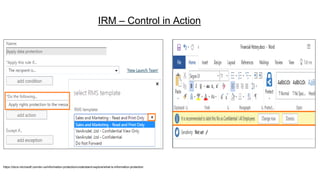
IRM – Control in Action
https://docs.microsoft.com/en-us/information-protection/understand-explore/what-is-information-protection
• How do I get visibility in my Cloud environments?
 CASBs, APIs and potentially security rating tools.
• How do I secure my users?
 Identity and Access Management (MFA, SSO), Privileged Access Management, Adaptive
access controls.
• How do I secure and protect my data against threats?
 DDoS protection including network redundancy, sensitive data monitoring, DLP, Encryption at rest
and in-transit, Information Rights Management, Anti-malware scanning, content sandbox and User
Entity Behavior Analytics (UEBA).
• How do I secure my applications/actions?
 Transport Encryption, Usage reporting, Auditing, logging/alerting.
Practical Advice for Technical Controls
Thinking of AWS or Azure?
 Get Identity and Access Management Right – Make sure MFA is enabled for all root and privileged
accounts!
 Ensure secure configurations for instances
 Encrypt data where practical – cloud-based Key Management Services are quite reliable
 Enable inspection and segmentation of traffic to instances
 Lots of apps in Office 365 and ever increasing AWS functionalities can turn into a scaling nightmare.
Establish governance around assessing apps that’ll be released
Identity is the New Perimeter and Humans are the New Firewalls
Gartner’s predictions:
● Strategic Planning Assumption: By 2020, 50% of enterprises will require an approved exception to
put new workloads in house.
● Strategic Planning Assumption: By 2022, we will stop referring to the exceptional scenario as "cloud
computing," and instead, will use "local computing" to describe the less common model.
Useful Links and Resources
● https://www.asd.gov.au/publications/protect/cloud_computing_security_considerations.htm
● http://collaborate.nist.gov/twiki-cloud-computing/bin/view/CloudComputing/WebHome
● https://www.enisa.europa.eu/topics/cloud-and-big-data/cloud-security
● https://www.asd.gov.au/infosec/irap/certified_clouds.htm
● https://cloudsecurityalliance.org/guidance/#_overview
● https://www.nist.gov/publications/nist-cloud-computing-reference-architecture?pub_id=909505
● http://go.netskope.com/rs/netskope/images/Ponemon-DataBreach-CloudMultiplierEffect-June2014.pdf
● http://docs.aws.amazon.com/AmazonS3/latest/dev/example-walkthroughs-managing-access.html
References for Incidents
● https://www.infoworld.com/article/2608076/data-center/murder-in-the-amazon-cloud.html
● https://techcrunch.com/2014/06/11/feedly-evernote-and-others-become-latest-victims-of-ddos-attacks/
● https://threatpost.com/one-year-after-hack-irs-debuts-updated-get-transcript-service/
● https://www.forbes.com/sites/thomasbrewster/2015/07/31/bitdefender-hacked/
● https://krebsonsecurity.com/2016/01/ransomware-a-threat-to-cloud-services-too/
● https://www.theregister.co.uk/2017/07/18/dow_jones_index_of_customers_not_prices_leaks_from_aws_repo/
● https://www.symantec.com/connect/blogs/casb-rescue-story-data-exposure-aws-s3-buckets
● https://www.techrepublic.com/article/leaked-fedex-customer-data-was-stored-on-amazon-s3-server-with-no-
password/

Practical Security for the Cloud

  • 1.
    Practical Security Advicefor the CloudPresented by Chirag Joshi, M.S., CISA, CISM, CRISC, MCTS
  • 2.
  • 3.
    Agenda  Cutting throughbuzzwords, hype and complexities  Cloud Computing Overview  Security Risks  Governance Controls  Practical Technical Controls
  • 4.
    What is CloudComputing?
  • 5.
  • 6.
  • 7.
  • 8.
    “If the databreach involves the loss or theft of 100,000 or more customer records, instead of an average cost of $2.37 million it could be as much as $5.32 million. Data breaches involving the theft of high value information could increase from $2.99 million to $4.16 million - From “Data Breach: The Cloud Multiplier Effect” conducted by Ponemon Institute LLC, June 2014 How Risky is the Cloud?
  • 9.
    Gartner’s position thatI strongly agree with:  Public clouds are usually a more secure starting point than in-house implementations.  Public cloud workloads can be more secure than in-house workloads.  SaaS applications can have security and continuity advantages. Justification:  No evidence indicates that Cloud Providers have performed less securely than end-user organizations.  Tier 1 cloud providers have far more resources, capabilities and sophistated controls than most end-user organizations.  It’s all about understanding that cloud security is a shared responsibility! How Risky Really is the Cloud?
  • 10.
    Practical Cloud SecurityRisks ● Unauthorized data exposure and leakage  Misconfigurations especially with AWS S3 buckets and EBS snapshots are becoming a huge concern ● Loss of critical system availability and data ● Legal, Regulatory and Sovereignty non-compliance ● Security events monitoring and Incident Response ● Inadequate Business Continuity and Disaster Recovery planning ● Third and Fourth party security failures ● Governance and Vendor-lock-ins
  • 11.
    YEAR RELEVANT INCIDENTS 2014 •Code Spaces’ Amazon AWS account was compromised when it failed to protect the administrative console with multifactor authentication. All the company’s assets were destroyed, putting it out of business. • News aggregator, Feedly and note taking app, EverNote were knocked offline by DDoS attack in what looked like a series of coordinated cyber-attacks. Intent was to extort money for resuming normal operations. 2015 • the US Internal Revenue Service (IRS) exposed over 700,000 sensitive records via a vulnerable API. • BitDefender, an antivirus firm, had an undisclosed number of customer usernames and passwords stolen due to a security vulnerability in its public cloud application hosted on AWS. The hacker responsible demanded a ransom of $15,000. 2016 • a medium-sized firm Children in film using cloud hosting services, had a ransomware infection on its 4000+ important files. Recovery from backup took several days to be completed. 2017 • Between 2.2 million to 4 million Dow Jones customers’ sensitive financial and personal details were exposed due to wrong privacy settings on AWS S3 bucket. • 200 million US voters data was exposed to the Internet via AWS S3 buckets and could have been utilized for nefarious purposes. 2018 • An unsecured Amazon S3 storage server exposed thousands of FedEx customer records, including civilian and military ID cards, resumes, bills, and more. References listed on last slide of the presentation
  • 12.
    European Union Agencyfor Network and Information Security, Cloud Security Guide for SMEs https://downloads.cloudsecurityalliance.org/assets/research/top-threats/Treacherous-12_Cloud-Computing_Top-Threats.pdf Top 11 Cloud Security Risks - ENISA 1. Data Breaches 2. Insufficient Identity, Credential and Access Mgmt 3. Account Hijacking 4. Insecure Interfaces and APIs 5. System Vulnerabilities 6. Malicious Insiders 7. Advanced Persistent Threats 8. Data Loss 9. Insufficient Due Diligence 10.Abuse and Nefarious use of cloud services 11.Denial of Service 12.Shared Technology Vulnerabilities Cloud Security Alliance’s Treacherous 12 1. Software Security Vulnerabilities 2. Network Attacks 3. Social Engineering Attacks 4. Management GUI and API compromise 5. Device theft/loss 6. Physical Hazards 7. Overloads 8. Unexpected costs 9. Vendor lock-in 10.Administrative or legal outages 11.Foreign jurisdiction issues
  • 13.
  • 14.
    Cloud Security Considerations Understand Business requirements: Define use cases  Criticality and Sensitivity of information involved:  Data classification and corresponding security controls  Understand data sovereignty, privacy and records retention impact  Governance arrangements: clarity of responsibilities, incident management, cost over-runs, BCP/DR – account for archiving to a different provider if the main organization goes out of business or vendor lock-in  Contracts: data delivery in agreed formats, supply chain risks, right to audit, standard security clauses, data ownership, SLAs  Adopt a risk-based and data-centric approach
  • 15.
    ASD Certified CloudServices List
  • 16.
  • 17.
    1. Cloud AccessSecurity Broker (CASB) Popular Use Cases: • Understanding and addressing Shadow IT • Protecting Data uploaded to or created in the cloud • Secure Cloud Collaboration such as external sharing • Logging and Auditing visibility
  • 18.
    6 © 2017Gartner, Inc. and/or its affiliates. All rights reserved.  API Mode  Forward Proxy Mode  Reverse Proxy Mode Unsanctioned Cloud Apps Sanctioned Cloud Apps Cloud APIs Reverse Proxy Forward Proxy Existing SWG/FW API Mode Log Feed Managed Endpoints Unmanaged Endpoints 1 2 3 4 Policy  Agent  PAC file  DNS  SSO CASB DLP Encrypt User Activity Logging Device Mgmt Identity Threat Protect Source: Gartner CASB – Deployment and Integrations
  • 19.
    CASB – GartnerMagic Quadrant Nov 2017
  • 20.
    2. Data LossPrevention https://support.office.com/en-us/article/Overview-of-data-loss-prevention-policies-1966b2a7-d1e2-4d92-ab61-42efbb137f5e?ui=en-US&rs=en-US&ad=US#locations  Sensitive data discovery  Protection against unauthorized information disclosure
  • 21.
    DLP - Locationand Scope of Control
  • 22.
  • 23.
    DLP - Controlin Action
  • 24.
    3. Information RightsManagement  Persistent protection against unauthorized information access and distribution  Utilizes a combination of encryption, identity and authorization policies Example of cloud based IRM utilizing Azure Rights Management https://docs.microsoft.com/en-us/information-protection/understand-explore/how-does-it-work
  • 25.
    IRM – Controlin Action https://docs.microsoft.com/en-us/information-protection/understand-explore/what-is-information-protection
  • 26.
    • How doI get visibility in my Cloud environments?  CASBs, APIs and potentially security rating tools. • How do I secure my users?  Identity and Access Management (MFA, SSO), Privileged Access Management, Adaptive access controls. • How do I secure and protect my data against threats?  DDoS protection including network redundancy, sensitive data monitoring, DLP, Encryption at rest and in-transit, Information Rights Management, Anti-malware scanning, content sandbox and User Entity Behavior Analytics (UEBA). • How do I secure my applications/actions?  Transport Encryption, Usage reporting, Auditing, logging/alerting. Practical Advice for Technical Controls
  • 27.
    Thinking of AWSor Azure?  Get Identity and Access Management Right – Make sure MFA is enabled for all root and privileged accounts!  Ensure secure configurations for instances  Encrypt data where practical – cloud-based Key Management Services are quite reliable  Enable inspection and segmentation of traffic to instances  Lots of apps in Office 365 and ever increasing AWS functionalities can turn into a scaling nightmare. Establish governance around assessing apps that’ll be released
  • 28.
    Identity is theNew Perimeter and Humans are the New Firewalls Gartner’s predictions: ● Strategic Planning Assumption: By 2020, 50% of enterprises will require an approved exception to put new workloads in house. ● Strategic Planning Assumption: By 2022, we will stop referring to the exceptional scenario as "cloud computing," and instead, will use "local computing" to describe the less common model.
  • 29.
    Useful Links andResources ● https://www.asd.gov.au/publications/protect/cloud_computing_security_considerations.htm ● http://collaborate.nist.gov/twiki-cloud-computing/bin/view/CloudComputing/WebHome ● https://www.enisa.europa.eu/topics/cloud-and-big-data/cloud-security ● https://www.asd.gov.au/infosec/irap/certified_clouds.htm ● https://cloudsecurityalliance.org/guidance/#_overview ● https://www.nist.gov/publications/nist-cloud-computing-reference-architecture?pub_id=909505 ● http://go.netskope.com/rs/netskope/images/Ponemon-DataBreach-CloudMultiplierEffect-June2014.pdf ● http://docs.aws.amazon.com/AmazonS3/latest/dev/example-walkthroughs-managing-access.html
  • 30.
    References for Incidents ●https://www.infoworld.com/article/2608076/data-center/murder-in-the-amazon-cloud.html ● https://techcrunch.com/2014/06/11/feedly-evernote-and-others-become-latest-victims-of-ddos-attacks/ ● https://threatpost.com/one-year-after-hack-irs-debuts-updated-get-transcript-service/ ● https://www.forbes.com/sites/thomasbrewster/2015/07/31/bitdefender-hacked/ ● https://krebsonsecurity.com/2016/01/ransomware-a-threat-to-cloud-services-too/ ● https://www.theregister.co.uk/2017/07/18/dow_jones_index_of_customers_not_prices_leaks_from_aws_repo/ ● https://www.symantec.com/connect/blogs/casb-rescue-story-data-exposure-aws-s3-buckets ● https://www.techrepublic.com/article/leaked-fedex-customer-data-was-stored-on-amazon-s3-server-with-no- password/