Practical Research 1
Senior High School Applied - Academic
Unit 6: Data Collection for Qualitative Research
Lesson 2
Collating Collected Data
ENGAGE EXPLORE EXPLAIN EXTEND
EVALUAT 2
What is data
collation in
research?
Learning
Objective
ENGAGE EXPLORE EXPLAIN EXTEND
EVALUAT
At the end of the
lesson, you should
be able to do the
following:
Collate data from interviews,
observations, and surveys.
3
3
ENGAGE EXPLORE EXPLAIN EXTEND
EVALUAT 4
4
What are the different steps in collating data in
a qualitative study?
ENGAGE EXPLORE EXPLAIN EXTEND
EVALUAT 5
5
How can collating data help in the data analysis of
your study?
ENGAGE EXPLORE EXPLAIN EXTEND
EVALUAT
Collating Collected Data
6
The process of collating data means to collect,
combine, review, and organize data.
Why do you need to collect, combine,
review, and organize your research
data?
7
ENGAGE EXPLORE EXPLAIN EXTEND
EVALUAT
Collating Interview Data
8
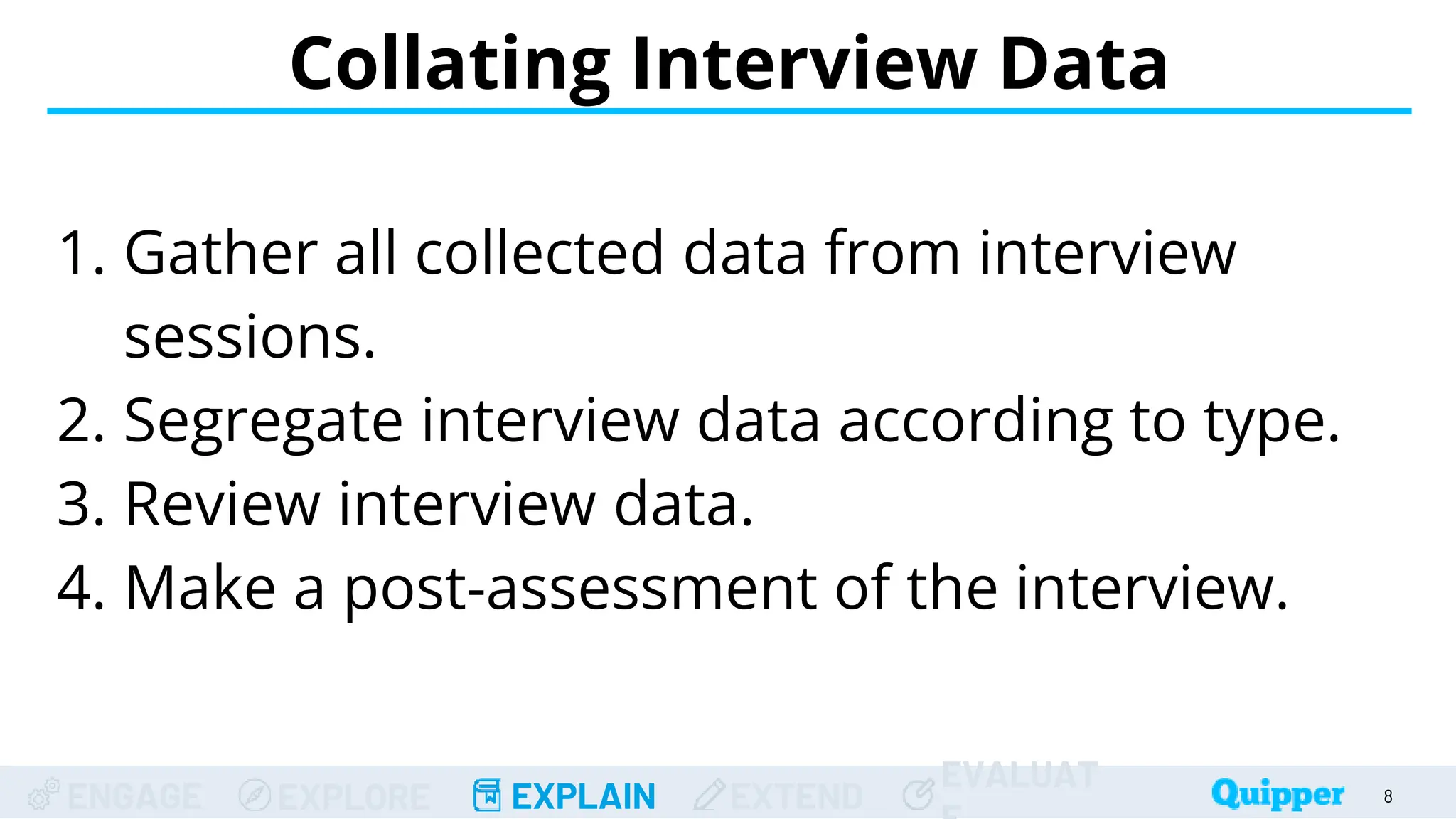
1. Gather all collected data from interview
sessions.
2. Segregate interview data according to type.
3. Review interview data.
4. Make a post-assessment of the interview.
Did you know?
Segregating interview data is
important in order to make the data
transcription process more efficient.
9
ENGAGE EXPLORE EXPLAIN EXTEND
EVALUAT
Types of Observation Notes
10
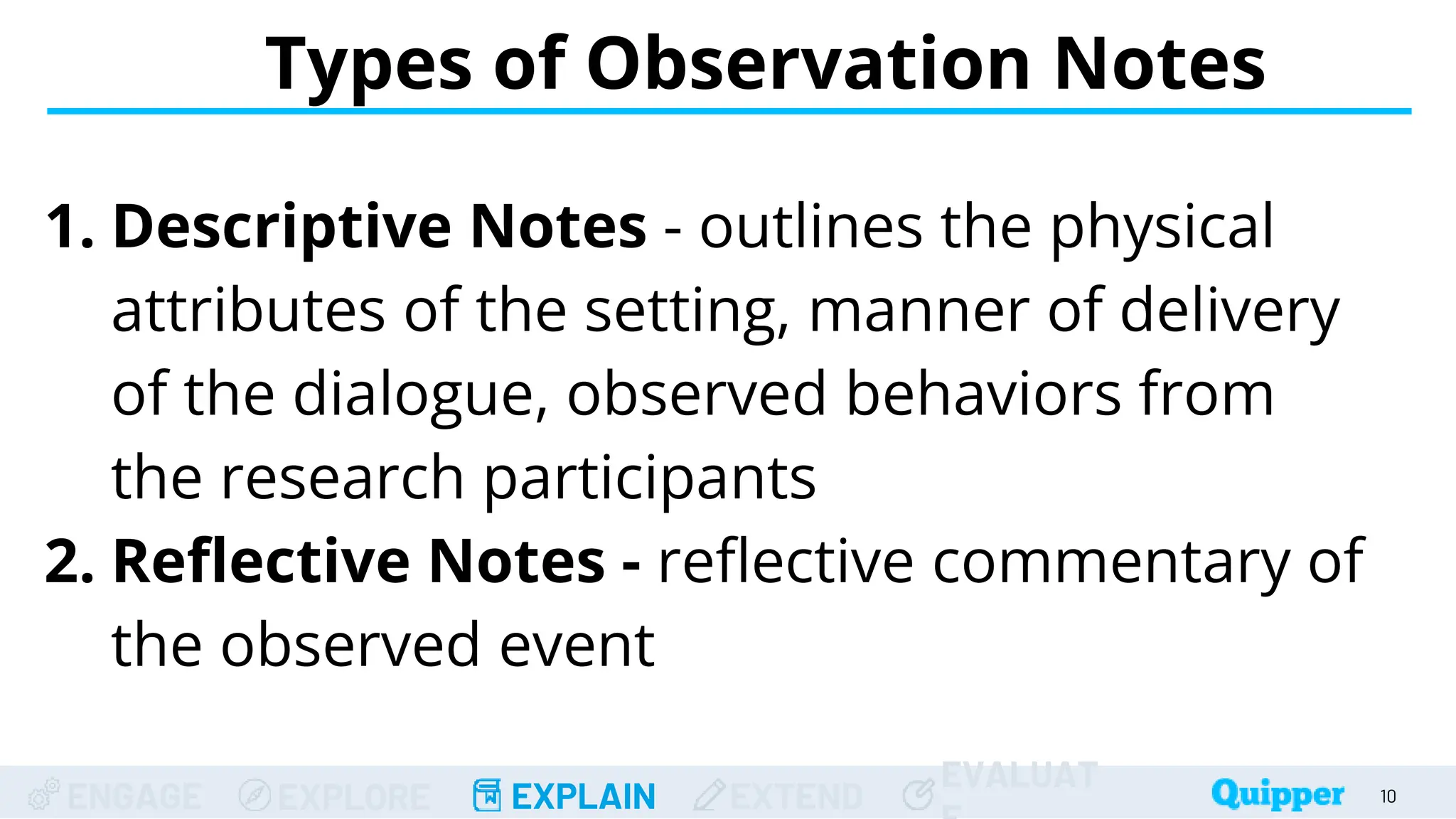
1. Descriptive Notes - outlines the physical
attributes of the setting, manner of delivery
of the dialogue, observed behaviors from
the research participants
2. Reflective Notes - reflective commentary of
the observed event
ENGAGE EXPLORE EXPLAIN EXTEND
EVALUAT
Descriptive Notes
11
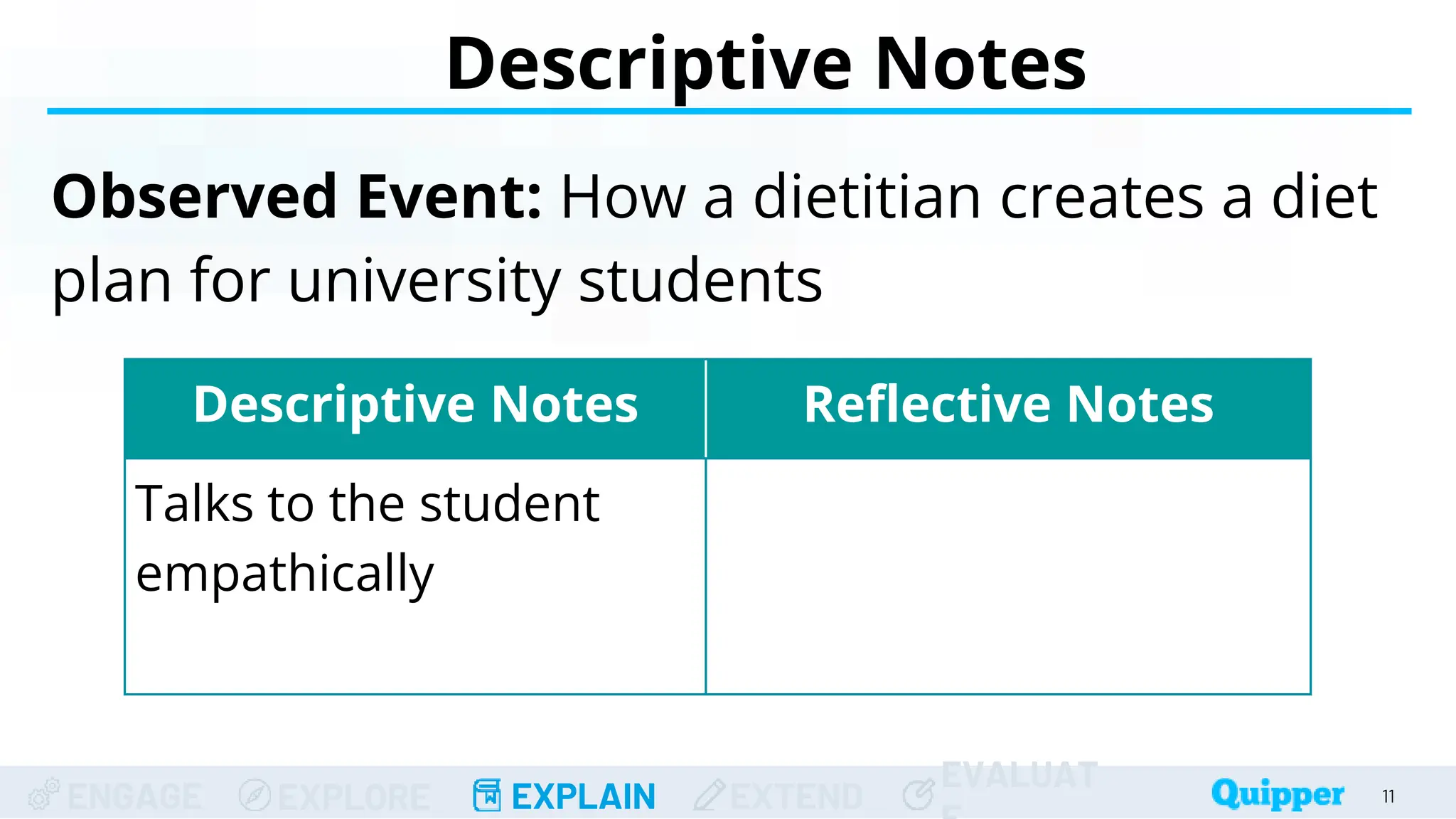
Observed Event: How a dietitian creates a diet
plan for university students
Descriptive Notes Reflective Notes
Talks to the student
empathically
ENGAGE EXPLORE EXPLAIN EXTEND
EVALUAT
Reflective Notes
12
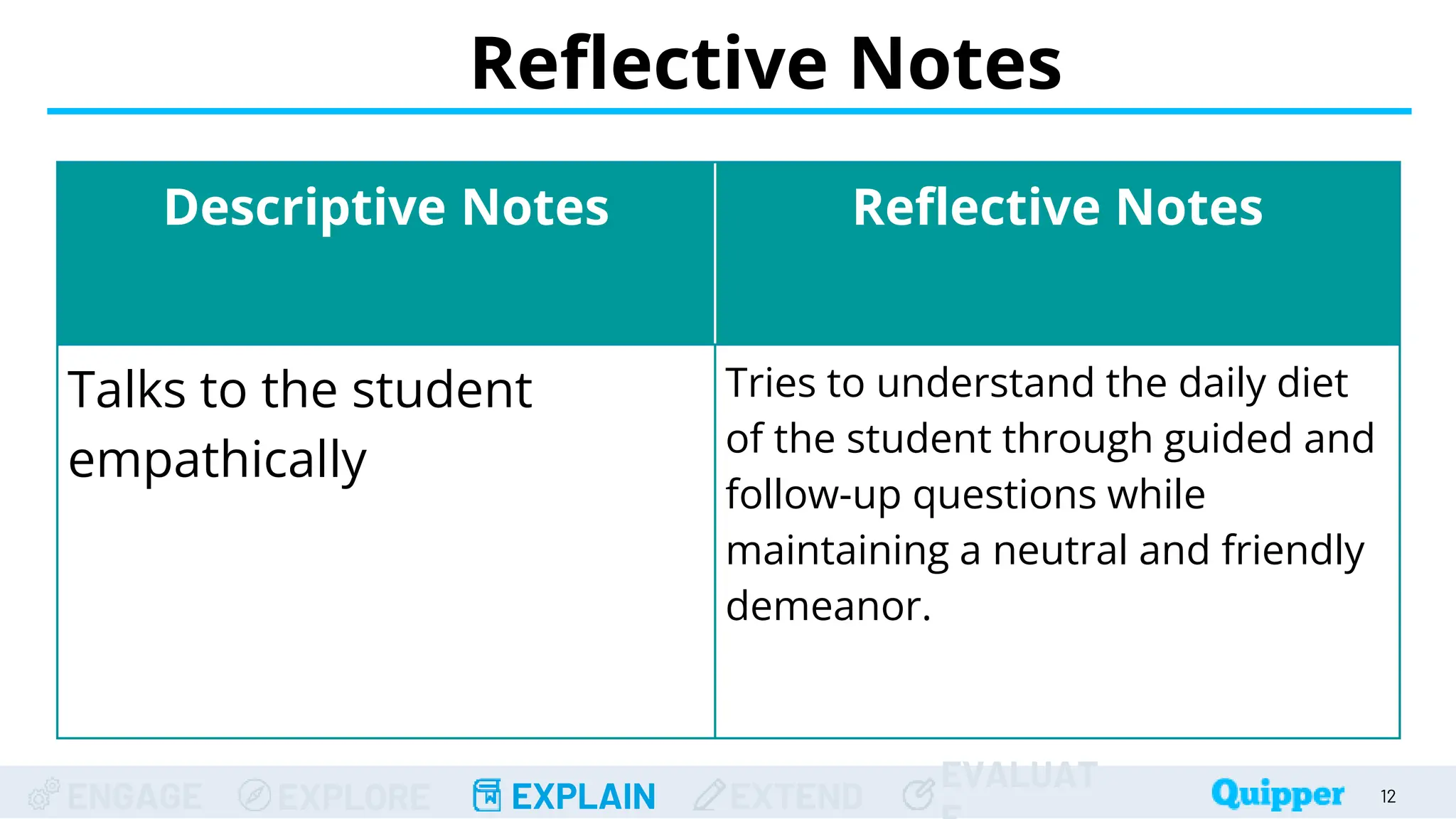
Descriptive Notes Reflective Notes
Talks to the student
empathically
Tries to understand the daily diet
of the student through guided and
follow-up questions while
maintaining a neutral and friendly
demeanor.
Did you know?
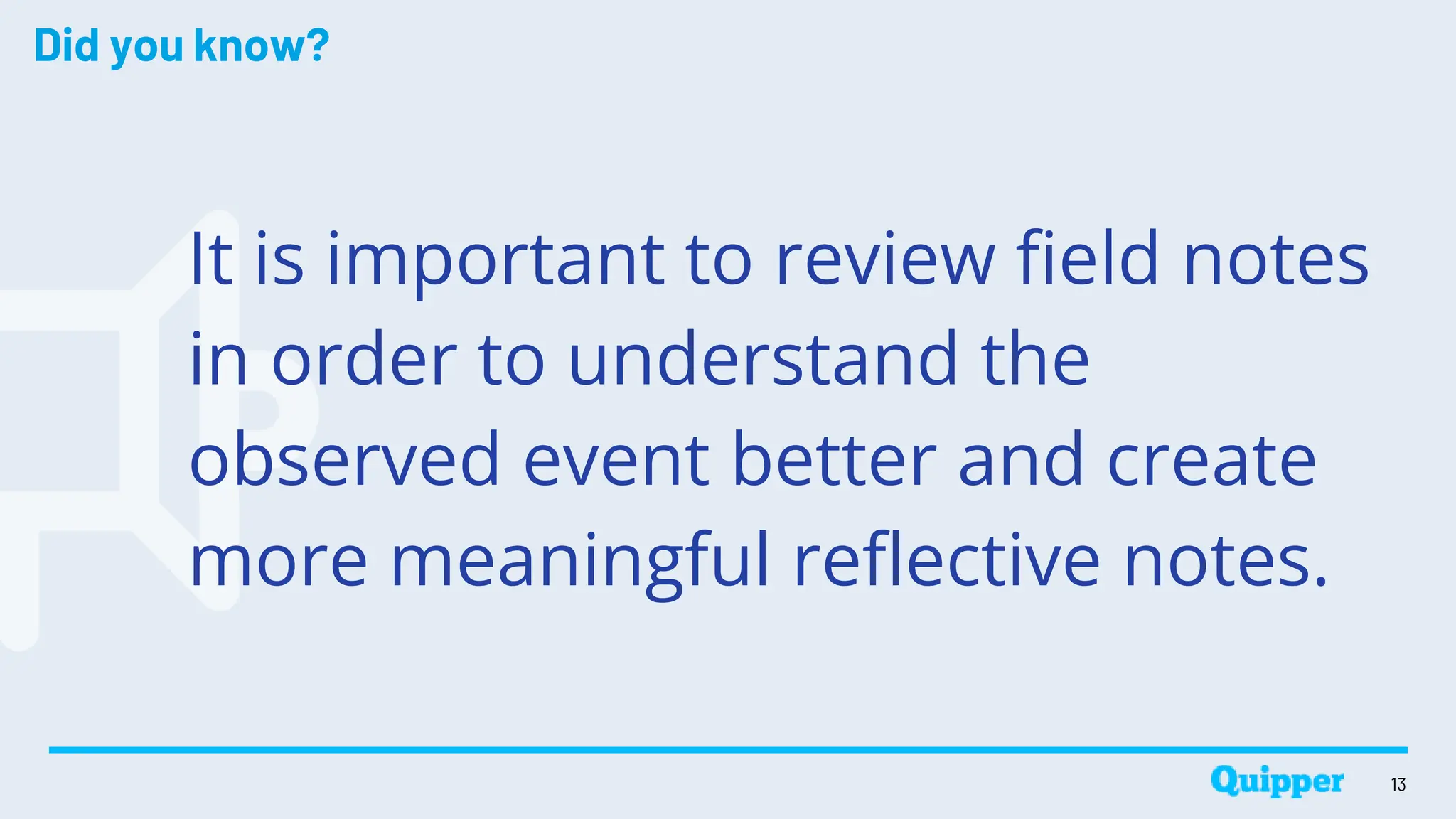
It is important to review field notes
in order to understand the
observed event better and create
more meaningful reflective notes.
13
ENGAGE EXPLORE EXPLAIN EXTEND
EVALUAT
Collating Observation Data
14
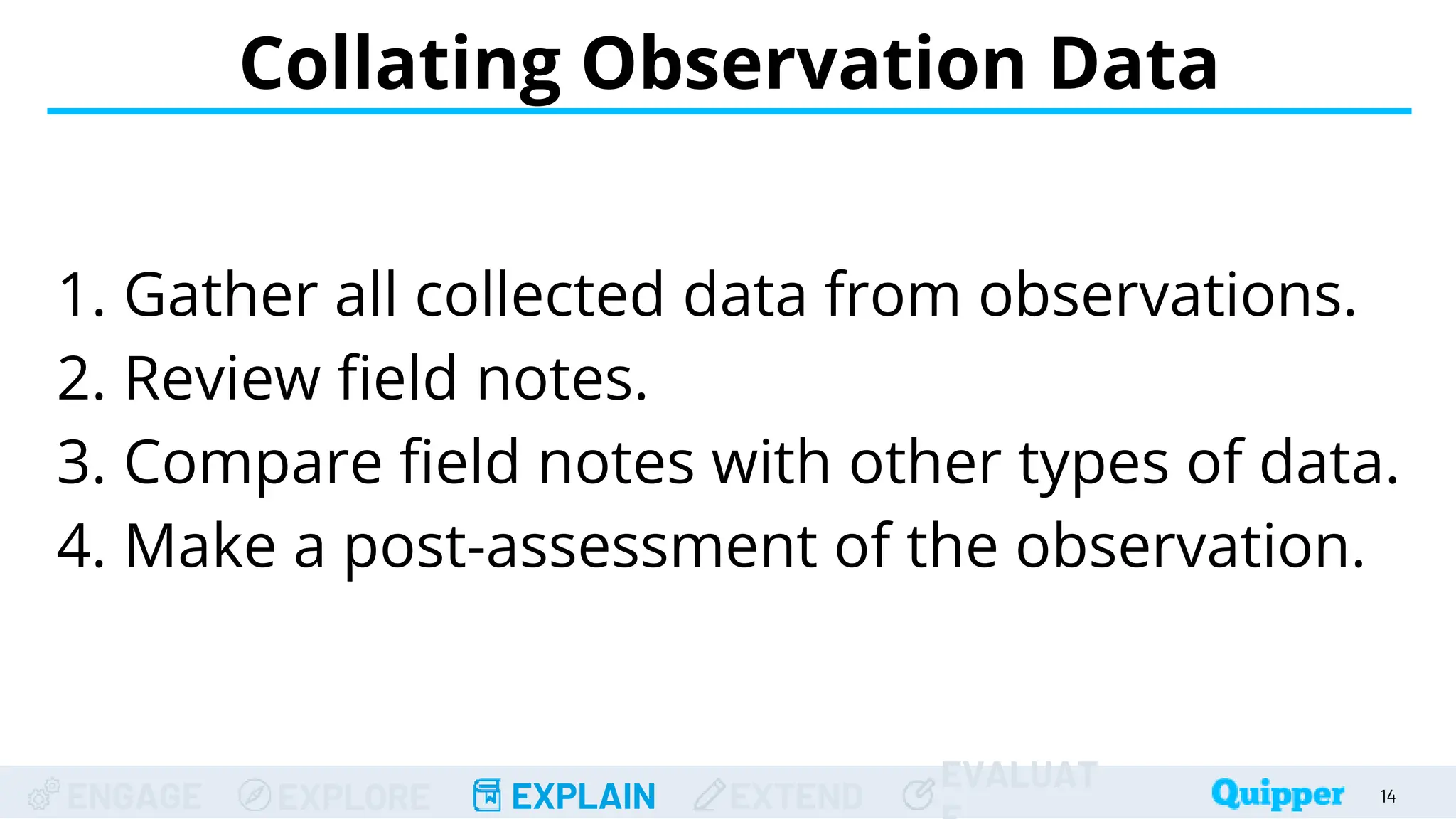
1. Gather all collected data from observations.
2. Review field notes.
3. Compare field notes with other types of data.
4. Make a post-assessment of the observation.
Why do you need to compare your
field notes with the other types of
data that you have gathered?
15
ENGAGE EXPLORE EXPLAIN EXTEND
EVALUAT
Collating Data from Surveys
16
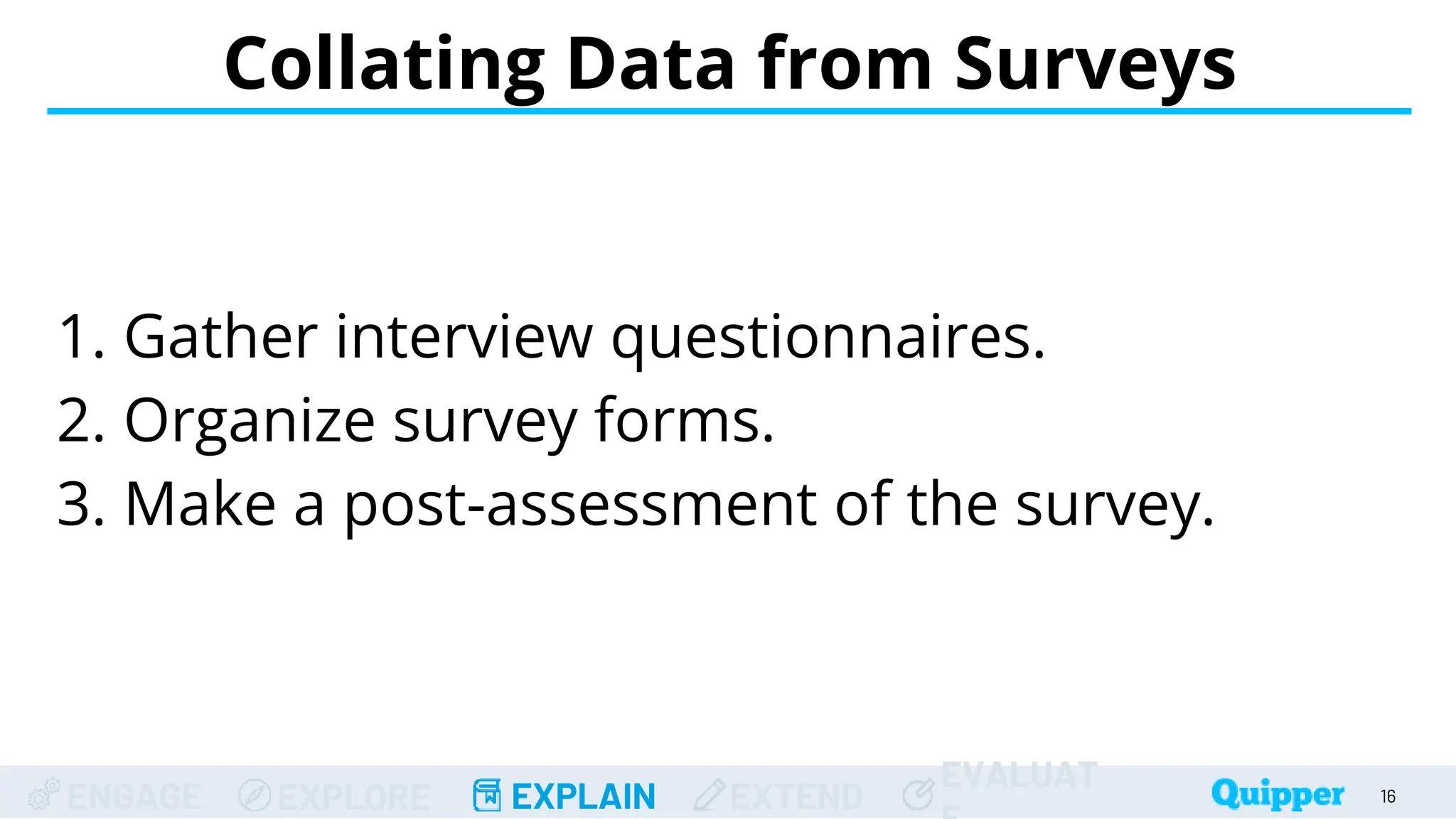
1. Gather interview questionnaires.
2. Organize survey forms.
3. Make a post-assessment of the survey.
Did you know?
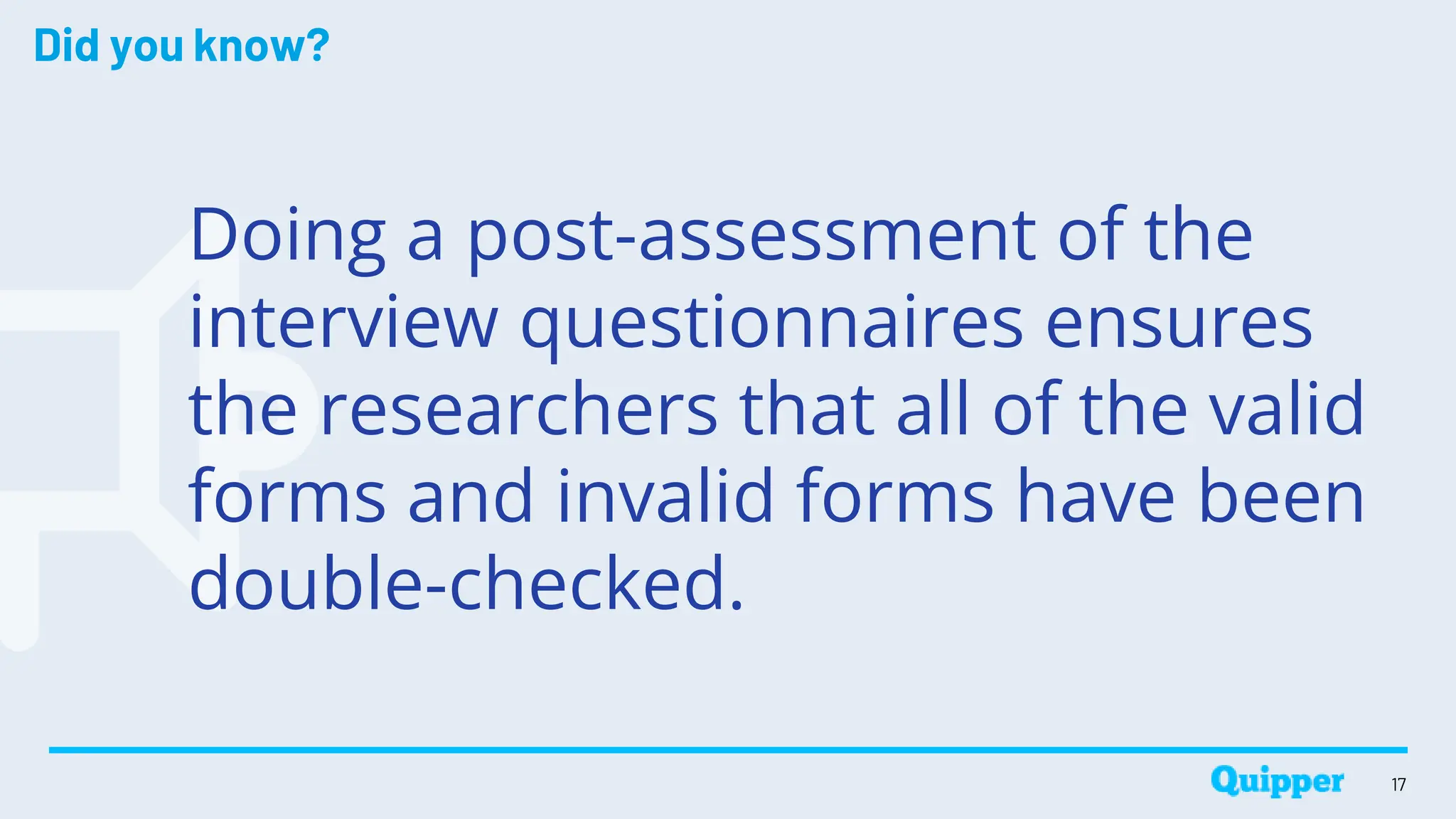
Doing a post-assessment of the
interview questionnaires ensures
the researchers that all of the valid
forms and invalid forms have been
double-checked.
17
ENGAGE EXPLORE EXPLAIN EXTEND
EVALUAT
Practice
Create your own topic-specific
guidelines on how to collate data.
Provide a maximum of five steps.
18
ENGAGE EXPLORE EXPLAIN EXTEND
EVALUAT
ENGAGE EXPLORE EXPLAIN EXTEND
EVALUAT 19
Quick Check
19
19
19
19
1. What is the second step in collating interview
data?
ENGAGE EXPLORE EXPLAIN EXTEND
EVALUAT
ENGAGE EXPLORE EXPLAIN EXTEND
EVALUAT 20
Quick Check
20
20
20
20
2. What is a reflective note?
ENGAGE EXPLORE EXPLAIN EXTEND
EVALUAT
ENGAGE EXPLORE EXPLAIN EXTEND
EVALUAT 21
Quick Check
21
21
21
21
3. Why is it important to compare and
cross-reference different kinds of observation
data?
Wrap Up
Collating data means to collect,
combine, review, and organize
data.
The researcher must note the
participant/s per interview, details of
the interview, and the types of data
collected per session.
22
Wrap Up
Field notes must be taken at the
time of observation.
Whether a data collection method is
conducted on a single day or in
multiple days, it is necessary to
gather all the collected data from
the different sessions.
23
Wrap Up
24
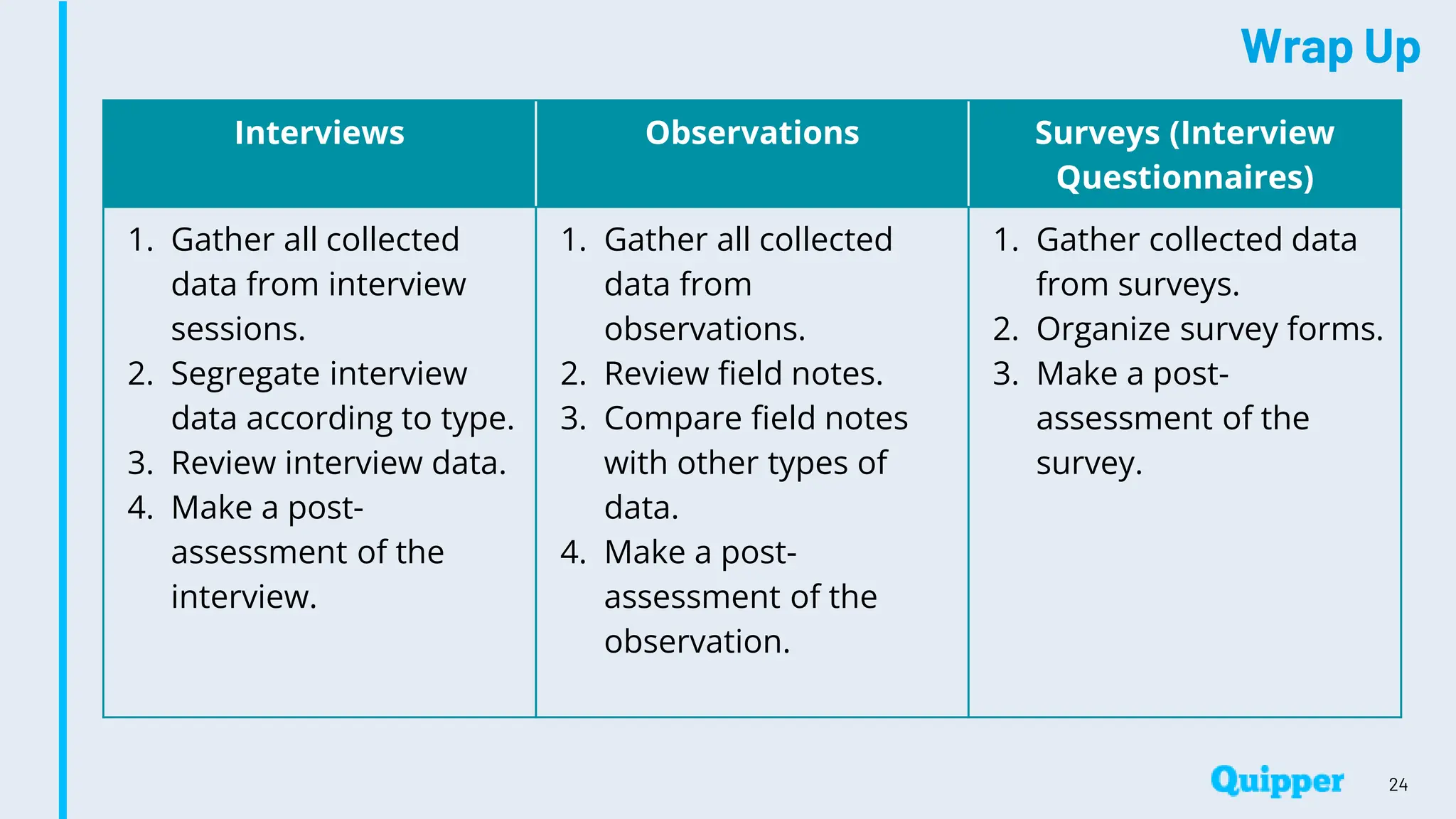
Interviews Observations Surveys (Interview
Questionnaires)
1. Gather all collected
data from interview
sessions.
2. Segregate interview
data according to type.
3. Review interview data.
4. Make a post-
assessment of the
interview.
1. Gather all collected
data from
observations.
2. Review field notes.
3. Compare field notes
with other types of
data.
4. Make a post-
assessment of the
observation.
1. Gather collected data
from surveys.
2. Organize survey forms.
3. Make a post-
assessment of the
survey.
Bibliography
25
Chabot, Kathy, and Jeannie Shoveller. “Fieldwork: Observations and Interviews.”
In Designing and Conducting Gender, Sex, and Health Research, edited by John
L. Oliffe and Lorraine Greaves, 105-126. California: SAGE Publications, Ltd.,
2012.
Creswell, John. Research Design: Qualitative, Quantitative, and Mixed Methods
Approaches. California: SAGE Publications Ltd., 2013.
Kothari, C. R. Research Methodology: Methods & Techniques. New Delhi: New Age
International Publishers, 2004.
Kumar, Ranjit. Research Methodology: A Step-by-Step Guide for Beginners. 3rd ed.
New Delhi: SAGE Publications Ltd., 2011.
Vanderstoep, Scott, and Johnston, Deirdre. Research Methods for Everyday Life:
Blending Qualitative: Blending Qualitative and Quantitative Approaches. New
Jersey: Jossey-Bass, 2009.

Practical Research Collating Collected Data.pptx

  • 1.
    Practical Research 1 SeniorHigh School Applied - Academic Unit 6: Data Collection for Qualitative Research Lesson 2 Collating Collected Data
  • 2.
    ENGAGE EXPLORE EXPLAINEXTEND EVALUAT 2 What is data collation in research?
  • 3.
    Learning Objective ENGAGE EXPLORE EXPLAINEXTEND EVALUAT At the end of the lesson, you should be able to do the following: Collate data from interviews, observations, and surveys. 3 3
  • 4.
    ENGAGE EXPLORE EXPLAINEXTEND EVALUAT 4 4 What are the different steps in collating data in a qualitative study?
  • 5.
    ENGAGE EXPLORE EXPLAINEXTEND EVALUAT 5 5 How can collating data help in the data analysis of your study?
  • 6.
    ENGAGE EXPLORE EXPLAINEXTEND EVALUAT Collating Collected Data 6 The process of collating data means to collect, combine, review, and organize data.
  • 7.
    Why do youneed to collect, combine, review, and organize your research data? 7
  • 8.
    ENGAGE EXPLORE EXPLAINEXTEND EVALUAT Collating Interview Data 8 1. Gather all collected data from interview sessions. 2. Segregate interview data according to type. 3. Review interview data. 4. Make a post-assessment of the interview.
  • 9.
    Did you know? Segregatinginterview data is important in order to make the data transcription process more efficient. 9
  • 10.
    ENGAGE EXPLORE EXPLAINEXTEND EVALUAT Types of Observation Notes 10 1. Descriptive Notes - outlines the physical attributes of the setting, manner of delivery of the dialogue, observed behaviors from the research participants 2. Reflective Notes - reflective commentary of the observed event
  • 11.
    ENGAGE EXPLORE EXPLAINEXTEND EVALUAT Descriptive Notes 11 Observed Event: How a dietitian creates a diet plan for university students Descriptive Notes Reflective Notes Talks to the student empathically
  • 12.
    ENGAGE EXPLORE EXPLAINEXTEND EVALUAT Reflective Notes 12 Descriptive Notes Reflective Notes Talks to the student empathically Tries to understand the daily diet of the student through guided and follow-up questions while maintaining a neutral and friendly demeanor.
  • 13.
    Did you know? Itis important to review field notes in order to understand the observed event better and create more meaningful reflective notes. 13
  • 14.
    ENGAGE EXPLORE EXPLAINEXTEND EVALUAT Collating Observation Data 14 1. Gather all collected data from observations. 2. Review field notes. 3. Compare field notes with other types of data. 4. Make a post-assessment of the observation.
  • 15.
    Why do youneed to compare your field notes with the other types of data that you have gathered? 15
  • 16.
    ENGAGE EXPLORE EXPLAINEXTEND EVALUAT Collating Data from Surveys 16 1. Gather interview questionnaires. 2. Organize survey forms. 3. Make a post-assessment of the survey.
  • 17.
    Did you know? Doinga post-assessment of the interview questionnaires ensures the researchers that all of the valid forms and invalid forms have been double-checked. 17
  • 18.
    ENGAGE EXPLORE EXPLAINEXTEND EVALUAT Practice Create your own topic-specific guidelines on how to collate data. Provide a maximum of five steps. 18
  • 19.
    ENGAGE EXPLORE EXPLAINEXTEND EVALUAT ENGAGE EXPLORE EXPLAIN EXTEND EVALUAT 19 Quick Check 19 19 19 19 1. What is the second step in collating interview data?
  • 20.
    ENGAGE EXPLORE EXPLAINEXTEND EVALUAT ENGAGE EXPLORE EXPLAIN EXTEND EVALUAT 20 Quick Check 20 20 20 20 2. What is a reflective note?
  • 21.
    ENGAGE EXPLORE EXPLAINEXTEND EVALUAT ENGAGE EXPLORE EXPLAIN EXTEND EVALUAT 21 Quick Check 21 21 21 21 3. Why is it important to compare and cross-reference different kinds of observation data?
  • 22.
    Wrap Up Collating datameans to collect, combine, review, and organize data. The researcher must note the participant/s per interview, details of the interview, and the types of data collected per session. 22
  • 23.
    Wrap Up Field notesmust be taken at the time of observation. Whether a data collection method is conducted on a single day or in multiple days, it is necessary to gather all the collected data from the different sessions. 23
  • 24.
    Wrap Up 24 Interviews ObservationsSurveys (Interview Questionnaires) 1. Gather all collected data from interview sessions. 2. Segregate interview data according to type. 3. Review interview data. 4. Make a post- assessment of the interview. 1. Gather all collected data from observations. 2. Review field notes. 3. Compare field notes with other types of data. 4. Make a post- assessment of the observation. 1. Gather collected data from surveys. 2. Organize survey forms. 3. Make a post- assessment of the survey.
  • 25.
    Bibliography 25 Chabot, Kathy, andJeannie Shoveller. “Fieldwork: Observations and Interviews.” In Designing and Conducting Gender, Sex, and Health Research, edited by John L. Oliffe and Lorraine Greaves, 105-126. California: SAGE Publications, Ltd., 2012. Creswell, John. Research Design: Qualitative, Quantitative, and Mixed Methods Approaches. California: SAGE Publications Ltd., 2013. Kothari, C. R. Research Methodology: Methods & Techniques. New Delhi: New Age International Publishers, 2004. Kumar, Ranjit. Research Methodology: A Step-by-Step Guide for Beginners. 3rd ed. New Delhi: SAGE Publications Ltd., 2011. Vanderstoep, Scott, and Johnston, Deirdre. Research Methods for Everyday Life: Blending Qualitative: Blending Qualitative and Quantitative Approaches. New Jersey: Jossey-Bass, 2009.

Editor's Notes

  • #4 Introduce the lesson objectives to narrow down and set the expectations for the lesson. For only one objective, copy the objective in sentence format from the study guide. Use the template for one learning objective. Example: In the study guide: In this lesson, you should be able to calculate the kinetic energy of a moving object. In the presentation slide: Calculate the kinetic energy of a moving object. For more than one objective, copy the bulleted sentences from the study guide. There is no need to write the introductory sentence (In this lesson, you should be able to do the following:).
  • #19 Prompt: Focus on one type of data. Make sure that the set of guidelines is applicable to your strand.
  • #20 Answer: Segregate interview data according to type
  • #21 Answer: A reflective note is a commentary of the descriptive note.
  • #22 Sample Answer: Field notes are the primary observation data, but it is important to cross-reference field notes with other data in order to validate whether the notes match the salient details in the observation. Other types of data (audio/video recordings) can also expose gaps or missed points in the field notes, if any.