Practical Implementation of BGP Community
with Geotags
Muhammad Moinur Rahman
1Asia Alliance Communication Ltd
moin@1asia-ahl.com
GeoTAGS
•  Geographical Identification Metadata
•  A form of GeoSpatial Metadata
–  Applicable to objects that have GeoGraphic Extent
–  Or applicable to objects with some position on this
Earth
–  Objects like Photo, Audio/Video Files, SMS Messages
–  Unlikely but true DNS information (LOC resources)
•  Facebook Check-in or Photos @
–  Adds Geotaggs in our Facebook updates
–  Adds Geotaggs in our Facebook Photos
Geotags in BGP Routes
•  A router is a device which intelligently
routes packets
– Not a Phone
– Not a Camera
– Not a GPS Device
•  How can we add metatags in a route?
– GeoCoding
Geocoding
•  A process of enriching description of a
location
•  Most frequently a postal address/place with
GeoGraphic co-ordinates
–  From a Spatial Reference Data
•  Or reverse Geocoding
•  Enriching a GeoGraphic Co-ordinate with a
postal address/place
–  Facebook/Google Plus and other social sites use
reverse Geocoding for our Check-in
BGP routes with location
information
•  Routers don’t have a builtin GPS device
•  Need a process to manually Geocode it’s
route-origin
•  Need to add a tag to the route objects or
group of routes
•  Answer : BGP Communities
BGP Communities
•  A BGP attribute (RFC1997)
•  A mechanism for coloring or (GEO)tagging
route destinations or a group of route
destinations
•  A 4-byte value (RFC1998)
•  Two types of communities
– Regular
– Extended
BGP Communities(Contd)
•  A 32-bit integer isn’t always easy to work with
–  More common convention is to split into two 16-bit values
–  Commonly <local-ASN>:value e.g 10102:0 (Sorry no help
for 4 byte ASNs)
–  Specially reserved (0:0 – 0:65535 and 65535:0 –
65535:65535)
–  First value is intended to define the scope or “target”
•  So you know if this community is “for you” or someone else
•  So two networks don’t do conflicting things with the same data
–  Second value is arbitrary data for the targeted network
•  Whatever data you’re trying to encode
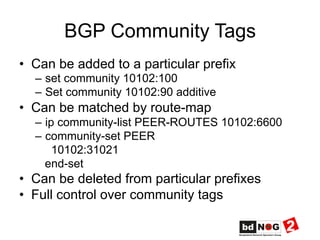
BGP Community Tags
•  Can be added to a particular prefix
–  set community 10102:100
–  Set community 10102:90 additive
•  Can be matched by route-map
–  ip community-list PEER-ROUTES 10102:6600
–  community-set PEER
10102:31021
end-set
•  Can be deleted from particular prefixes
•  Full control over community tags
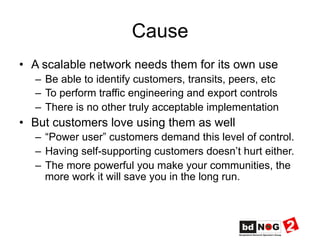
Cause
•  A scalable network needs them for its own use
–  Be able to identify customers, transits, peers, etc
–  To perform traffic engineering and export controls
–  There is no other truly acceptable implementation
•  But customers love using them as well
–  “Power user” customers demand this level of control.
–  Having self-supporting customers doesn’t hurt either.
–  The more powerful you make your communities, the
more work it will save you in the long run.
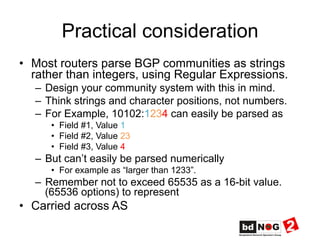
Practical consideration
•  Most routers parse BGP communities as strings
rather than integers, using Regular Expressions.
–  Design your community system with this in mind.
–  Think strings and character positions, not numbers.
–  For Example, 10102:1234 can easily be parsed as
•  Field #1, Value 1
•  Field #2, Value 23
•  Field #3, Value 4
–  But can’t easily be parsed numerically
•  For example as “larger than 1233”.
–  Remember not to exceed 65535 as a 16-bit value.
(65536 options) to represent
•  Carried across AS
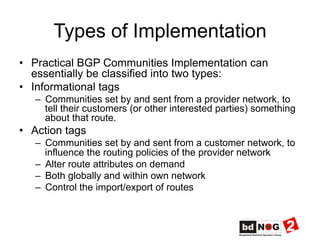
Types of Implementation
•  Practical BGP Communities Implementation can
essentially be classified into two types:
•  Informational tags
–  Communities set by and sent from a provider network, to
tell their customers (or other interested parties) something
about that route.
•  Action tags
–  Communities set by and sent from a customer network, to
influence the routing policies of the provider network
–  Alter route attributes on demand
–  Both globally and within own network
–  Control the import/export of routes
Informational tags
•  Information communities typically focus on
–  Where the route was learned
•  AKA Geographic data (continent, country, region, city, etc in
short geotag)
–  How the route was learned
•  AKA Relationship data (transit, peer, customer, internal, etc)
–  There is no other good way to pass on this data
•  This data is then used to make policy decisions
–  Either by you, your customer, or an unknown third party.
–  Exporting this data to the Internet can provide invaluable
assistance to third party networks you may never even
know about. This is usually a good thing for everyone.
Ways to encode Information
•  Encode simple arbitrary data
–  No standards, each network defines its own
mapping
•  Which must be published somewhere like ASN
description in IRR for others to use
–  Ex: Continent (1 = Asia, 2 = Africa, etc)
–  Ex: Relationship (1 = Transit, 2 = Public Peer, etc)
•  Standards based encoding
–  Ex: ISO 3166 encodes Country Codes into 2
digits
Providing information
•  As always, the exact design decision
depends on specific network and footprint.
•  Networks in only a few major cities may want
to focus on enumerating those cities in a
short list.
•  Networks in a great number of cities may
want to focus on regional aggregation
specific to their scope.
•  Plan for the future!
–  Changing community design after it is already
being used by customers may prove impossible.
Practical Use of Informational Tags
•  Make certain that Informational Tags from your
Action Tags can easily be distinguished
•  Ex: Make Informational Tags always 5 characters
in length, and action tags to be 4 characters or
less.
•  This allow to easily match Info tags: “10102:.{5}”
•  Filter communities from neighbors
–  None is allowed to send Informational tags, these
should only be set by Service Provider, and these
should be stripped from all BGP neighbors
(customers, transits, peers, etc).
–  Otherwise there is a massive security problem.
A simple approach towards
providing information
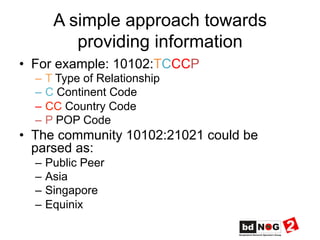
•  For example: 10102:TCCCP
–  T Type of Relationship
–  C Continent Code
–  CC Country Code
–  P POP Code
•  The community 10102:21021 could be
parsed as:
–  Public Peer
–  Asia
–  Singapore
–  Equinix
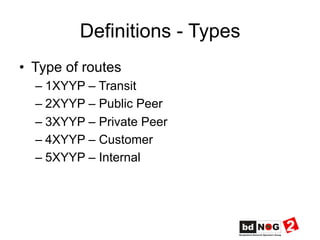
Definitions - Types
•  Type of routes
– 1XYYP – Transit
– 2XYYP – Public Peer
– 3XYYP – Private Peer
– 4XYYP – Customer
– 5XYYP – Internal
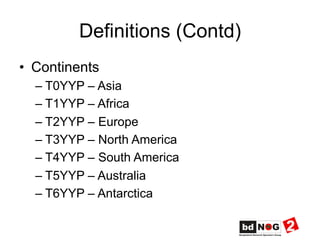
Definitions (Contd)
•  Continents
– T0YYP – Asia
– T1YYP – Africa
– T2YYP – Europe
– T3YYP – North America
– T4YYP – South America
– T5YYP – Australia
– T6YYP – Antarctica
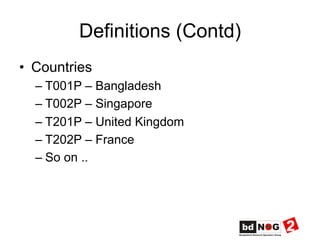
Definitions (Contd)
•  Countries
– T001P – Bangladesh
– T002P – Singapore
– T201P – United Kingdom
– T202P – France
– So on ..
Definitions (Contd)
•  PoP
– T0011 – Central NOC
– T0021 – Singapore Global Switch
– T0022 – Singapore Equinix
– T2011 – United Kingdom Telehouse North
– T3011 – United States TelX
– So on ..
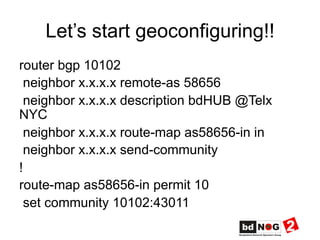
Let’s start geoconfiguring!!
router bgp 10102
neighbor x.x.x.x remote-as 58656
neighbor x.x.x.x description bdHUB @Telx
NYC
neighbor x.x.x.x route-map as58656-in in
neighbor x.x.x.x send-community
!
route-map as58656-in permit 10
set community 10102:43011
References
1.  Using Communities for Multihoming (
http://bgp4all.com/ftp/isp-workshops/BGP%20Presentations/09-
BGP-Communities.pdf)
2.  BGP Techniques for Internet Service Providers – Philip Smith
3.  BGP Communities: A guide for Service Providers – Richard A.
Steenbergen & Tom Scholl

Practical Implementation of BGP Community with Geotags

  • 1.
    Practical Implementation ofBGP Community with Geotags Muhammad Moinur Rahman 1Asia Alliance Communication Ltd moin@1asia-ahl.com
  • 2.
    GeoTAGS •  Geographical IdentificationMetadata •  A form of GeoSpatial Metadata –  Applicable to objects that have GeoGraphic Extent –  Or applicable to objects with some position on this Earth –  Objects like Photo, Audio/Video Files, SMS Messages –  Unlikely but true DNS information (LOC resources) •  Facebook Check-in or Photos @ –  Adds Geotaggs in our Facebook updates –  Adds Geotaggs in our Facebook Photos
  • 3.
    Geotags in BGPRoutes •  A router is a device which intelligently routes packets – Not a Phone – Not a Camera – Not a GPS Device •  How can we add metatags in a route? – GeoCoding
  • 4.
    Geocoding •  A processof enriching description of a location •  Most frequently a postal address/place with GeoGraphic co-ordinates –  From a Spatial Reference Data •  Or reverse Geocoding •  Enriching a GeoGraphic Co-ordinate with a postal address/place –  Facebook/Google Plus and other social sites use reverse Geocoding for our Check-in
  • 5.
    BGP routes withlocation information •  Routers don’t have a builtin GPS device •  Need a process to manually Geocode it’s route-origin •  Need to add a tag to the route objects or group of routes •  Answer : BGP Communities
  • 6.
    BGP Communities •  ABGP attribute (RFC1997) •  A mechanism for coloring or (GEO)tagging route destinations or a group of route destinations •  A 4-byte value (RFC1998) •  Two types of communities – Regular – Extended
  • 7.
    BGP Communities(Contd) •  A32-bit integer isn’t always easy to work with –  More common convention is to split into two 16-bit values –  Commonly <local-ASN>:value e.g 10102:0 (Sorry no help for 4 byte ASNs) –  Specially reserved (0:0 – 0:65535 and 65535:0 – 65535:65535) –  First value is intended to define the scope or “target” •  So you know if this community is “for you” or someone else •  So two networks don’t do conflicting things with the same data –  Second value is arbitrary data for the targeted network •  Whatever data you’re trying to encode
  • 8.
    BGP Community Tags • Can be added to a particular prefix –  set community 10102:100 –  Set community 10102:90 additive •  Can be matched by route-map –  ip community-list PEER-ROUTES 10102:6600 –  community-set PEER 10102:31021 end-set •  Can be deleted from particular prefixes •  Full control over community tags
  • 9.
    Cause •  A scalablenetwork needs them for its own use –  Be able to identify customers, transits, peers, etc –  To perform traffic engineering and export controls –  There is no other truly acceptable implementation •  But customers love using them as well –  “Power user” customers demand this level of control. –  Having self-supporting customers doesn’t hurt either. –  The more powerful you make your communities, the more work it will save you in the long run.
  • 10.
    Practical consideration •  Mostrouters parse BGP communities as strings rather than integers, using Regular Expressions. –  Design your community system with this in mind. –  Think strings and character positions, not numbers. –  For Example, 10102:1234 can easily be parsed as •  Field #1, Value 1 •  Field #2, Value 23 •  Field #3, Value 4 –  But can’t easily be parsed numerically •  For example as “larger than 1233”. –  Remember not to exceed 65535 as a 16-bit value. (65536 options) to represent •  Carried across AS
  • 11.
    Types of Implementation • Practical BGP Communities Implementation can essentially be classified into two types: •  Informational tags –  Communities set by and sent from a provider network, to tell their customers (or other interested parties) something about that route. •  Action tags –  Communities set by and sent from a customer network, to influence the routing policies of the provider network –  Alter route attributes on demand –  Both globally and within own network –  Control the import/export of routes
  • 12.
    Informational tags •  Informationcommunities typically focus on –  Where the route was learned •  AKA Geographic data (continent, country, region, city, etc in short geotag) –  How the route was learned •  AKA Relationship data (transit, peer, customer, internal, etc) –  There is no other good way to pass on this data •  This data is then used to make policy decisions –  Either by you, your customer, or an unknown third party. –  Exporting this data to the Internet can provide invaluable assistance to third party networks you may never even know about. This is usually a good thing for everyone.
  • 13.
    Ways to encodeInformation •  Encode simple arbitrary data –  No standards, each network defines its own mapping •  Which must be published somewhere like ASN description in IRR for others to use –  Ex: Continent (1 = Asia, 2 = Africa, etc) –  Ex: Relationship (1 = Transit, 2 = Public Peer, etc) •  Standards based encoding –  Ex: ISO 3166 encodes Country Codes into 2 digits
  • 14.
    Providing information •  Asalways, the exact design decision depends on specific network and footprint. •  Networks in only a few major cities may want to focus on enumerating those cities in a short list. •  Networks in a great number of cities may want to focus on regional aggregation specific to their scope. •  Plan for the future! –  Changing community design after it is already being used by customers may prove impossible.
  • 15.
    Practical Use ofInformational Tags •  Make certain that Informational Tags from your Action Tags can easily be distinguished •  Ex: Make Informational Tags always 5 characters in length, and action tags to be 4 characters or less. •  This allow to easily match Info tags: “10102:.{5}” •  Filter communities from neighbors –  None is allowed to send Informational tags, these should only be set by Service Provider, and these should be stripped from all BGP neighbors (customers, transits, peers, etc). –  Otherwise there is a massive security problem.
  • 16.
    A simple approachtowards providing information •  For example: 10102:TCCCP –  T Type of Relationship –  C Continent Code –  CC Country Code –  P POP Code •  The community 10102:21021 could be parsed as: –  Public Peer –  Asia –  Singapore –  Equinix
  • 17.
    Definitions - Types • Type of routes – 1XYYP – Transit – 2XYYP – Public Peer – 3XYYP – Private Peer – 4XYYP – Customer – 5XYYP – Internal
  • 18.
    Definitions (Contd) •  Continents – T0YYP– Asia – T1YYP – Africa – T2YYP – Europe – T3YYP – North America – T4YYP – South America – T5YYP – Australia – T6YYP – Antarctica
  • 19.
    Definitions (Contd) •  Countries – T001P– Bangladesh – T002P – Singapore – T201P – United Kingdom – T202P – France – So on ..
  • 20.
    Definitions (Contd) •  PoP – T0011– Central NOC – T0021 – Singapore Global Switch – T0022 – Singapore Equinix – T2011 – United Kingdom Telehouse North – T3011 – United States TelX – So on ..
  • 21.
    Let’s start geoconfiguring!! routerbgp 10102 neighbor x.x.x.x remote-as 58656 neighbor x.x.x.x description bdHUB @Telx NYC neighbor x.x.x.x route-map as58656-in in neighbor x.x.x.x send-community ! route-map as58656-in permit 10 set community 10102:43011
  • 22.
    References 1.  Using Communitiesfor Multihoming ( http://bgp4all.com/ftp/isp-workshops/BGP%20Presentations/09- BGP-Communities.pdf) 2.  BGP Techniques for Internet Service Providers – Philip Smith 3.  BGP Communities: A guide for Service Providers – Richard A. Steenbergen & Tom Scholl