Network Layer Routing
⚫ When a device has multiple paths to reach a
destination, it always selects one path by preferring it
over others.
⚫ This selection process is termed as Routing.
⚫ Routing is done by special network devices called
routers or it can be done by means of software
processes.
⚫ The software based routers have limited
functionality and limited scope.
⚫ Routes can be statically configured or dynamically
learnt.
⚫ One route can be configured to be preferred over
others.
Unicast routing
⚫ Most of the traffic on the internet and intranets
known as unicast data or unicast traffic is sent with
specified destination.
⚫ Routing unicast data over the internet is called
unicast routing.
⚫ It is the simplest form of routing because the
destination is already known.
⚫ Hence the router just has to look up the routing table
and forward the packet to next hop.
Broadcast routing
⚫ By default, the broadcast packets are not routed and
forwarded by the routers on any network. Routers
create broadcast domains.
⚫ But it can be configured to forward broadcasts in
some special cases. A broadcast message is destined
to all network devices.
Broadcast routing can be done in two ways
(algorithm):
⚫ A router creates a data packet and then sends it to
each host one by one. In this case, the router creates
multiple copies of single data packet with different
destination addresses. All packets are sent as unicast
but because they are sent to all, it simulates as if
router is broadcasting.
⚫ This method consumes lots of bandwidth and router
must destination address of each node.
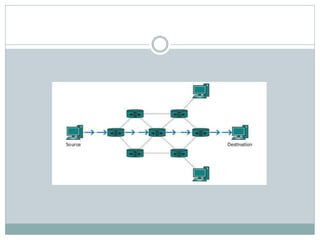
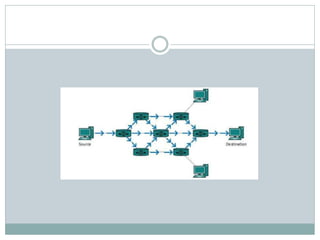
⚫ Secondly, when router receives a packet that is to be
broadcasted, it simply floods those packets out of all
interfaces. All routers are configured in the same
way.
Multicast Routing
⚫ Multicast routing is special case of broadcast routing
with significance difference and challenges.
⚫ In broadcast routing, packets are sent to all nodes
even if they do not want it.
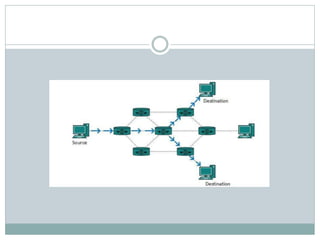
⚫ But in Multicast routing, the data is sent to only
nodes which wants to receive the packets.
⚫ The router must know that there are nodes, which
wish to receive multicast packets (or stream) then
only it should forward. Multicast routing works
spanning tree protocol to avoid looping.
⚫ Multicast routing also uses reverse path Forwarding
technique, to detect and discard duplicates and
loops.
⚫ BGP stands for Border Gateway Protocol. It is a
standardized gateway protocol that exchanges
routing information across autonomous systems
(AS).
⚫ When one network router is linked to other
networks, it cannot decide which network is the best
network to share its data to by itself.
⚫ Border Gateway Protocol considers all peering
partners that a router has and sends traffic to the
router closest to the data’s destination.
⚫ This communication is possible because, at boot,
BGP allows peers to communicate their routing
information and then stores that information in a
Routing Information Base (RIB).
⚫ BGP stands for Border Gateway Protocol.
⚫ It can be defined as a standardized exterior gateway
protocol which is developed to interchange routing
information and reachability information between
various autonomous systems (AS) on the Internet.
⚫ It is classified as a path vector protocol as well as a
distance-vector routing protocol.
⚫ It manages how packets get routed from network to
network through the exchange of routing and
reachability information among edge routers.
⚫ BGP directs packets between autonomous systems
(AS), which are networks managed by a single
enterprise or service provider.
⚫ BGP creates network stability by guaranteeing
routers can adapt to route failures: when one path
goes down, a new path is quickly found.
⚫ BGP makes routing decisions based on paths,
defined by rules or network policies set by network
administrators.
How does BGP work?
⚫ Each router maintains a routing table controlling
how packets are directed. Routing table information
is generated by the BGP process on the router, based
on incoming information from other routers, and
information in the BGP routing information base
(RIB), which is a data table stored on a server on the
BGP router.
⚫ The RIB contains information both from directly
connected external peers, as well as internal peers,
and based on policies for what routes should be used
and what information should be published,
continually updates the routing table as changes
occur.
What is BGP used for?
⚫ BGP offers network stability that guarantees routers
can quickly adapt to send packets through another
reconnection if one internet path goes down.
⚫ BGP makes routing decisions based on paths, rules
or network policies configured by a network
administrator.
⚫ Each BGP router maintains a standard routing table
used to direct packets in transit.
⚫ BGP uses client-server topology to communicate
routing information, with the client-server initiating
a BGP session by sending a request to the server.
BGP routing basics
⚫ BGP sends updated router table information only
when something changes, and only the affected
information.
⚫ BGP has no automatic discovery mechanism, which
means connections between peers must be set up
manually, with peer addresses programmed in at
both ends.
⚫ BGP makes best-path decisions based on current
reachability, hop counts and other path
characteristics.
⚫ In situations where multiple paths are available -- as
within a major hosting facility -- BGP policies
communicate an organization's preferences for what
path traffic should follow in and out.
⚫ BGP community tags can control route
advertisement behavior among peers.
Message Types
⚫ There are four message types of BGP which are
explained below −
⚫ Open Message − This is a message that is sent to
establish the session after the different autonomous
system successfully makes the connection. This
message contains the information related to the
autonomous system like the version of BGP using,
Hold time, BGP identifier (IP address), AS number
and some optional parameters.
⚫ Update Message − This message is sent after the
session has been established successfully. This is
used to share the routing information. This type of
message contains information on routers that are
feasible to access, routers that are not feasible to
access and the path attributes.
⚫ KeepAlive − This is another message that helps us
to be sure that the neighbour router is still up. This
message is generally sent before the update message
is sent. The neighbour will reset the hold time as
soon as it receives the KeepAlive message
⚫ Notification − This is another kind of message sent
when some error occurs. It contains error code,
specific error sub code and reason for error.
Need of BGP
⚫ BGP has an advantage as it gives us much more
control over what routes we advertise and over what
advertisements we accept from our neighbours.
⚫ We need it for exchanging routing and reachability
information among autonomous systems on the
Internet.
⚫ It gives control over ours and our neighbour’s route
selection. Hence it is the routing protocol for the
Internet.
⚫ Also, BGP is the most popular exterior gateway
protocol. It is more flexible and scalable than Open
Shortest Path First (OSPF). Moreover, it puts
emphasis on determining the best path.
⚫ It provides Internet service advantages as running
BGP in our network is almost a must. Multiprotocol
Label Switching (MPLS) based Layer 3 VPN services
uses BGP as the underlying routing protocol. It
increases network stability.
⚫ It includes automatic response to sop worms and
Denial-of-Service (DoS) attacks. It offers large-scale
Quality-of-Service (QOS) and provides scalability.
Types
⚫ The types of BGP are as follows −
⚫ Internal BGP
⚫ Routes are exchanged, and traffic is transmitted over
the Internet using external BGP.
⚫ Autonomous systems can also use an internal BGP
version to route through their internal networks,
known as internal BGP.
⚫ It should be noted that using internal BGP is NOT a
requirement for using external BGP.
⚫ Autonomous systems can choose from several
internal protocols to connect the routers on their
internal network.
⚫ External BGP
⚫ External BGP is like international shipping; some
specific standards and guidelines need to be followed
when shipping a piece of mail internationally. Once
that piece of mail reaches its destination country, it
has to go through its local mail service to reach its
final destination.
⚫ Each country has its internal mail service that
doesn’t necessarily follow the same guidelines as
other countries. Similarly, each autonomous system
can have its internal routing protocol for routing
data within its network.
U5CSS2 (1).pdf

  • 1.
  • 2.
    ⚫ When adevice has multiple paths to reach a destination, it always selects one path by preferring it over others. ⚫ This selection process is termed as Routing. ⚫ Routing is done by special network devices called routers or it can be done by means of software processes. ⚫ The software based routers have limited functionality and limited scope.
  • 3.
    ⚫ Routes canbe statically configured or dynamically learnt. ⚫ One route can be configured to be preferred over others.
  • 4.
    Unicast routing ⚫ Mostof the traffic on the internet and intranets known as unicast data or unicast traffic is sent with specified destination. ⚫ Routing unicast data over the internet is called unicast routing. ⚫ It is the simplest form of routing because the destination is already known. ⚫ Hence the router just has to look up the routing table and forward the packet to next hop.
  • 6.
    Broadcast routing ⚫ Bydefault, the broadcast packets are not routed and forwarded by the routers on any network. Routers create broadcast domains. ⚫ But it can be configured to forward broadcasts in some special cases. A broadcast message is destined to all network devices.
  • 7.
    Broadcast routing canbe done in two ways (algorithm): ⚫ A router creates a data packet and then sends it to each host one by one. In this case, the router creates multiple copies of single data packet with different destination addresses. All packets are sent as unicast but because they are sent to all, it simulates as if router is broadcasting. ⚫ This method consumes lots of bandwidth and router must destination address of each node.
  • 8.
    ⚫ Secondly, whenrouter receives a packet that is to be broadcasted, it simply floods those packets out of all interfaces. All routers are configured in the same way.
  • 10.
    Multicast Routing ⚫ Multicastrouting is special case of broadcast routing with significance difference and challenges. ⚫ In broadcast routing, packets are sent to all nodes even if they do not want it. ⚫ But in Multicast routing, the data is sent to only nodes which wants to receive the packets.
  • 11.
    ⚫ The routermust know that there are nodes, which wish to receive multicast packets (or stream) then only it should forward. Multicast routing works spanning tree protocol to avoid looping. ⚫ Multicast routing also uses reverse path Forwarding technique, to detect and discard duplicates and loops.
  • 13.
    ⚫ BGP standsfor Border Gateway Protocol. It is a standardized gateway protocol that exchanges routing information across autonomous systems (AS). ⚫ When one network router is linked to other networks, it cannot decide which network is the best network to share its data to by itself.
  • 14.
    ⚫ Border GatewayProtocol considers all peering partners that a router has and sends traffic to the router closest to the data’s destination. ⚫ This communication is possible because, at boot, BGP allows peers to communicate their routing information and then stores that information in a Routing Information Base (RIB).
  • 15.
    ⚫ BGP standsfor Border Gateway Protocol. ⚫ It can be defined as a standardized exterior gateway protocol which is developed to interchange routing information and reachability information between various autonomous systems (AS) on the Internet. ⚫ It is classified as a path vector protocol as well as a distance-vector routing protocol.
  • 16.
    ⚫ It manageshow packets get routed from network to network through the exchange of routing and reachability information among edge routers. ⚫ BGP directs packets between autonomous systems (AS), which are networks managed by a single enterprise or service provider.
  • 17.
    ⚫ BGP createsnetwork stability by guaranteeing routers can adapt to route failures: when one path goes down, a new path is quickly found. ⚫ BGP makes routing decisions based on paths, defined by rules or network policies set by network administrators.
  • 18.
    How does BGPwork? ⚫ Each router maintains a routing table controlling how packets are directed. Routing table information is generated by the BGP process on the router, based on incoming information from other routers, and information in the BGP routing information base (RIB), which is a data table stored on a server on the BGP router.
  • 19.
    ⚫ The RIBcontains information both from directly connected external peers, as well as internal peers, and based on policies for what routes should be used and what information should be published, continually updates the routing table as changes occur.
  • 20.
    What is BGPused for? ⚫ BGP offers network stability that guarantees routers can quickly adapt to send packets through another reconnection if one internet path goes down. ⚫ BGP makes routing decisions based on paths, rules or network policies configured by a network administrator. ⚫ Each BGP router maintains a standard routing table used to direct packets in transit. ⚫ BGP uses client-server topology to communicate routing information, with the client-server initiating a BGP session by sending a request to the server.
  • 21.
    BGP routing basics ⚫BGP sends updated router table information only when something changes, and only the affected information. ⚫ BGP has no automatic discovery mechanism, which means connections between peers must be set up manually, with peer addresses programmed in at both ends.
  • 22.
    ⚫ BGP makesbest-path decisions based on current reachability, hop counts and other path characteristics. ⚫ In situations where multiple paths are available -- as within a major hosting facility -- BGP policies communicate an organization's preferences for what path traffic should follow in and out. ⚫ BGP community tags can control route advertisement behavior among peers.
  • 23.
    Message Types ⚫ Thereare four message types of BGP which are explained below − ⚫ Open Message − This is a message that is sent to establish the session after the different autonomous system successfully makes the connection. This message contains the information related to the autonomous system like the version of BGP using, Hold time, BGP identifier (IP address), AS number and some optional parameters.
  • 24.
    ⚫ Update Message− This message is sent after the session has been established successfully. This is used to share the routing information. This type of message contains information on routers that are feasible to access, routers that are not feasible to access and the path attributes.
  • 25.
    ⚫ KeepAlive −This is another message that helps us to be sure that the neighbour router is still up. This message is generally sent before the update message is sent. The neighbour will reset the hold time as soon as it receives the KeepAlive message
  • 26.
    ⚫ Notification −This is another kind of message sent when some error occurs. It contains error code, specific error sub code and reason for error.
  • 27.
    Need of BGP ⚫BGP has an advantage as it gives us much more control over what routes we advertise and over what advertisements we accept from our neighbours. ⚫ We need it for exchanging routing and reachability information among autonomous systems on the Internet. ⚫ It gives control over ours and our neighbour’s route selection. Hence it is the routing protocol for the Internet.
  • 28.
    ⚫ Also, BGPis the most popular exterior gateway protocol. It is more flexible and scalable than Open Shortest Path First (OSPF). Moreover, it puts emphasis on determining the best path.
  • 29.
    ⚫ It providesInternet service advantages as running BGP in our network is almost a must. Multiprotocol Label Switching (MPLS) based Layer 3 VPN services uses BGP as the underlying routing protocol. It increases network stability. ⚫ It includes automatic response to sop worms and Denial-of-Service (DoS) attacks. It offers large-scale Quality-of-Service (QOS) and provides scalability.
  • 30.
    Types ⚫ The typesof BGP are as follows − ⚫ Internal BGP ⚫ Routes are exchanged, and traffic is transmitted over the Internet using external BGP. ⚫ Autonomous systems can also use an internal BGP version to route through their internal networks, known as internal BGP.
  • 31.
    ⚫ It shouldbe noted that using internal BGP is NOT a requirement for using external BGP. ⚫ Autonomous systems can choose from several internal protocols to connect the routers on their internal network.
  • 32.
    ⚫ External BGP ⚫External BGP is like international shipping; some specific standards and guidelines need to be followed when shipping a piece of mail internationally. Once that piece of mail reaches its destination country, it has to go through its local mail service to reach its final destination.
  • 33.
    ⚫ Each countryhas its internal mail service that doesn’t necessarily follow the same guidelines as other countries. Similarly, each autonomous system can have its internal routing protocol for routing data within its network.