RPKI with rpki.net ToolS
bdNOG 1
22nd May 20143, Dhaka, Bangladesh
Muhammad Moinur Rahman, bdNOG
SANOG 23 : Thiphu, BhutanbdNOG Page 2
RPKI: Introduction
Tutorial
Target audience
- Knowledge of Internet Routing(specially BGP)
- Familiar with any IRR Database
- No need to know Cryptography
- Basic knowledge of PKI(Public Key Infrastructure)
Layout
- Theory
- Handson Lab using rpki.net tools on Cisco IOS, Cisco IOS-XR and
Juniper
SANOG 23 : Thiphu, BhutanbdNOG Page 3
Historical Incident
November, 2012 – Google traffic affected in AP region
due to hardware failure of Moratel
Pakistan Telecom and Youtube incident
7007 accident, UU/Sprint for 2 days
SANOG 23 : Thiphu, BhutanbdNOG Page 4
Historical Incident (Thinks to Consider)
For theory of positivity lets call all these as Mis-
Origination
Traffic Hijacking or Prefix Hijacking assumes Negative
intent
SANOG 23 : Thiphu, BhutanbdNOG Page 5
Historical Context
1986 – Bellovin & Perlman identify the vulnerability in
DNS and Routing
1999 - National Academies study called it out
2000 – S-BGP – X.509 PKI to support Secure BGP -
Kent, Lynn, et al.
2003 – NANOG S-BGP Workshop
2006 – RPKI.NET(for ARIN) & APNIC start work on
RPKI. RIPE starts in 2008.
2009 – RPKI.NET Open Testbed and running code in
test routers
SANOG 23 : Thiphu, BhutanbdNOG Page 6
Current Trend
Filtering limited to the edges facing the customer
Filters on peering and transit sessions are often too
complex or take too many resources
- Do you filter?
A lot depends on trusting each other
- Daily examples show this is no longer enough
SANOG 23 : Thiphu, BhutanbdNOG Page 7
When filtering is not enough ..
A lot of different registries exist(Nearly 40), operated by
a number of different parties:
- Not all of them mirror the other registries
- How trust worthy is the information they provide?
The IRR system is far from complete (RPSL lives with
RPSLNG) but no further development.
Resulting filters are hard to maintain and can take a lot
of router memory
SANOG 23 : Thiphu, BhutanbdNOG Page 8
Goals of RPKI
Running a Secured Internet for the end users
Reducing routing leaks
Attaching digital certificates to network resources
- AS Numbers
- IP Addresses
Allowing ISPs to associate the two
- Route Origin Authorizations (ROAs)
- Can follow the address allocation chain to the top
SANOG 23 : Thiphu, BhutanbdNOG Page 9
RPKI Accomplishes
Allows routers or other processes to validate route
origins
Simplifies validation authority information
- Trust Anchor Locator
Distributes trusted information
- Through repositories
SANOG 23 : Thiphu, BhutanbdNOG Page 10
Public Key Concept
Private key: This key must be known only by its owner.
Public key: This key is known to everyone (it is public)
Relation between both keys: What one key encrypts,
the other one decrypts, and vice versa. That means that
if you encrypt something with my public key (which you
would know, because it's public :-), I would need my
private key to decrypt the message.
Same alike http with SSL aka https
SANOG 23 : Thiphu, BhutanbdNOG Page 11
PKI in IRR
The RIRs hold a self-signed root certificate for all the
resources that they have in the registry
- They are the trust anchor for the system
That root certificate is used to sign a certificate that lists
your resources
You can issue child certificates for those resources to
your customers
- When making assignments or sub allocations
SANOG 23 : Thiphu, BhutanbdNOG Page 12
Route Origination Authorisation (ROA)
Next to the prefix and the ASN which is allowed to
announce it, the ROA contains:
- A minimum prefix length
- A maximum prefix length
- An expiry date
Multiple ROAs can exist for the same prefix
ROAs can overlap
SANOG 23 : Thiphu, BhutanbdNOG Page 13
RPKI Protocols
Certificate Authority
Relying Party/Origin Validation
SANOG 23 : Thiphu, BhutanbdNOG Page 14
Result of Check
Valid – A matching/covering ROA was found with a
matching AS number
Invalid – A matching or covering ROA was found, but
AS number did not match, and there was no valid one
Not Found – No matching or covering ROA was found
SANOG 23 : Thiphu, BhutanbdNOG Page 15
Policy Override Knobs
Disable Validity Check Completely
Disable Validity Check for a Peer
Disable Validity Check for Prefixes
When check is disabled, the result is “Not Found,” i.e.
as if there was no ROA
SANOG 23 : Thiphu, BhutanbdNOG Page 16
How to run CA?
 Open Source Software to run a member CA
- Use the LIR as parent CA (trust anchor)
- Generate and publish Certificate yourself
 LIR Hosted Platform
- All processes are secured and automated
- One click set-up of Resource Certificate
- WebUI to manage Certificates in LIR Portal
- All the major LIR do have RPKI/Resouce Certification configuration options in
their portal
SANOG 23 : Thiphu, BhutanbdNOG Page 17
How to run RP?
 Rpki.net tools (Both CA and RP)
 RIPE/NCC (Both CA and RP)
 RTRLIB (RP Only)
 APNIC (CA Only)
SANOG 23 : Thiphu, BhutanbdNOG Page 18
Validation in Practice
All certificates and ROAs are published in a repository
and available for download
Software running on your own machine will periodically
retrieve and verify the information
- Cryptographic tools check all the signatures
The result is a list of all valid combinations of ASN and
prefix, the “validated cache”
SANOG 23 : Thiphu, BhutanbdNOG Page 19
RPKI Support in Routers
The RPKI-RTR Protocol is an IETF Internet Draft
Production Cisco Support:
- ASR1000, 7600, ASR903 and ASR901 in releases 15.2(1)S or XE 3.5
- Cisco Early Field Trial (EFT):
- ASR9000, CRS1, CRS3 and c12K (IOS-XR 4.3.2)
Juniper has support since version 12.2
Quagga has support through BGP-SRX
SANOG 23 : Thiphu, BhutanbdNOG Page 20
RPKI-Router Integration
Local Validator Tool (RP) feeds RPKI capable router
with processed data set
- Router does not do the crypto!
SANOG 23 : Thiphu, BhutanbdNOG Page 21
RPKI Workflow
Creates a repository
- RFC 3779 (RPKI) Certificates
- ROAs
- CRLs
- Manifest records
SANOG 23 : Thiphu, BhutanbdNOG Page 22
RTR Workflow
Storing ROA cache using RTR protocol which can
be downloaded from the validator and kept
available in memory
Validate with ROA cache data inside the router
where BGP process will check each announcement
and label the prefix
Propagate RPKI validation result with iBGP for
other router (Sending/Receiving BGP Extended
Community must be enabled) to make a decision
(Modify pref or filter) based on it
SANOG 23 : Thiphu, BhutanbdNOG Page 23
Who is deciding what to do?
The Validator is a tool which can help you making
decisions about routing
Using it properly can enhance the security and
stability of the Internet
It is your network and you make the final decision
SANOG 23 : Thiphu, BhutanbdNOG Page 24
Repository View
root@rpki# ls /ba/03a5be-ddf6-4340-a1f9-1ad3f2c39ee6/1:
ICcaIRKhGHJ-TgUZv8GRKqkidR4.roa
cKxLCU94umS-qD4DOOkAK0M2US0.cer
dSmerM6uJGLWMMQTl2esy4xyUAA.crl
dSmerM6uJGLWMMQTl2esy4xyUAA.mnf
nB0gDFtWffKk4VWgln-12pdFtE8.roa
 A Repository Directory containing an RFC3779
Certificate, two ROAs, a CRL, and a manifest
SANOG 23 : Thiphu, BhutanbdNOG Page 25
Using a Repository
Pull down these files using a manifest-validating
mechanism
Validate the ROAs contained in the repository
Communicate with the router marking routes “valid”,
“invalid”, “unknown”
Up to ISP to use local policy on how to route
SANOG 23 : Thiphu, BhutanbdNOG Page 26
RPKI Workflow
 RPKI Web interface -> Repository
 Repository aggregator -> Validator
 Validated entries -> Route Checking
 Route checking results -> local routing decisions (based on
local policy)
SANOG 23 : Thiphu, BhutanbdNOG Page 27
RPKI Caveats
 When RTR session goes down, the RPKI status will be not
found for all the bgp route after a while
- Invalid => not found
- we need several RTR sessions or care your filtering policy
 In case of the router reload, which one is faster, receiving
ROAs or receiving BGP routes?
- If receiving BGP is match faster than ROA, the router propagate the invalid
route to others
- We need to put our Cache validator within our IGP scope
SANOG 23 : Thiphu, BhutanbdNOG Page 28
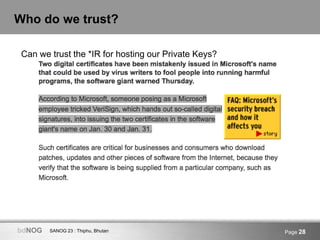
Who do we trust?
Can we trust the *IR for hosting our Private Keys?
SANOG 23 : Thiphu, BhutanbdNOG Page 29
RPKI: Further Reading
 RFC 5280: X.509 PKI Certificates
 RFC 3779: Extensions for IP Addresses and ASNs
 RFC 6481-6493: Resource Public Key Infrastructure
SANOG 23 : Thiphu, BhutanbdNOG Page 30
Demo: Two Parts
 Creating ROAs in LIR Portal
 Validating and Configuring routers to make a decision for a
prefix
 BEFORE THAT LET’s GO FOR A TEA BREAK ..
SANOG 23 : Thiphu, BhutanbdNOG Page 31
IRR Toolset, RPSL: Questions
Contact
person: Muhammad Moinur Rahman
address: The Alliance Building. (6th Floor),
address: 63 Pragati Sharani, Baridhara,
country: BD
phone: +8801977881132
e-mail: moin@1asia-ahl.com
nic-hdl: MMR13-AP
notify: moin@1asia-ahl.com
mnt-by: MAINT-BD-1ASIAAHL
changed: moin@1asia-ahl.com 20121128
source: APNIC

RPKI with rpki.net Tools

  • 1.
    RPKI with rpki.netToolS bdNOG 1 22nd May 20143, Dhaka, Bangladesh Muhammad Moinur Rahman, bdNOG
  • 2.
    SANOG 23 :Thiphu, BhutanbdNOG Page 2 RPKI: Introduction Tutorial Target audience - Knowledge of Internet Routing(specially BGP) - Familiar with any IRR Database - No need to know Cryptography - Basic knowledge of PKI(Public Key Infrastructure) Layout - Theory - Handson Lab using rpki.net tools on Cisco IOS, Cisco IOS-XR and Juniper
  • 3.
    SANOG 23 :Thiphu, BhutanbdNOG Page 3 Historical Incident November, 2012 – Google traffic affected in AP region due to hardware failure of Moratel Pakistan Telecom and Youtube incident 7007 accident, UU/Sprint for 2 days
  • 4.
    SANOG 23 :Thiphu, BhutanbdNOG Page 4 Historical Incident (Thinks to Consider) For theory of positivity lets call all these as Mis- Origination Traffic Hijacking or Prefix Hijacking assumes Negative intent
  • 5.
    SANOG 23 :Thiphu, BhutanbdNOG Page 5 Historical Context 1986 – Bellovin & Perlman identify the vulnerability in DNS and Routing 1999 - National Academies study called it out 2000 – S-BGP – X.509 PKI to support Secure BGP - Kent, Lynn, et al. 2003 – NANOG S-BGP Workshop 2006 – RPKI.NET(for ARIN) & APNIC start work on RPKI. RIPE starts in 2008. 2009 – RPKI.NET Open Testbed and running code in test routers
  • 6.
    SANOG 23 :Thiphu, BhutanbdNOG Page 6 Current Trend Filtering limited to the edges facing the customer Filters on peering and transit sessions are often too complex or take too many resources - Do you filter? A lot depends on trusting each other - Daily examples show this is no longer enough
  • 7.
    SANOG 23 :Thiphu, BhutanbdNOG Page 7 When filtering is not enough .. A lot of different registries exist(Nearly 40), operated by a number of different parties: - Not all of them mirror the other registries - How trust worthy is the information they provide? The IRR system is far from complete (RPSL lives with RPSLNG) but no further development. Resulting filters are hard to maintain and can take a lot of router memory
  • 8.
    SANOG 23 :Thiphu, BhutanbdNOG Page 8 Goals of RPKI Running a Secured Internet for the end users Reducing routing leaks Attaching digital certificates to network resources - AS Numbers - IP Addresses Allowing ISPs to associate the two - Route Origin Authorizations (ROAs) - Can follow the address allocation chain to the top
  • 9.
    SANOG 23 :Thiphu, BhutanbdNOG Page 9 RPKI Accomplishes Allows routers or other processes to validate route origins Simplifies validation authority information - Trust Anchor Locator Distributes trusted information - Through repositories
  • 10.
    SANOG 23 :Thiphu, BhutanbdNOG Page 10 Public Key Concept Private key: This key must be known only by its owner. Public key: This key is known to everyone (it is public) Relation between both keys: What one key encrypts, the other one decrypts, and vice versa. That means that if you encrypt something with my public key (which you would know, because it's public :-), I would need my private key to decrypt the message. Same alike http with SSL aka https
  • 11.
    SANOG 23 :Thiphu, BhutanbdNOG Page 11 PKI in IRR The RIRs hold a self-signed root certificate for all the resources that they have in the registry - They are the trust anchor for the system That root certificate is used to sign a certificate that lists your resources You can issue child certificates for those resources to your customers - When making assignments or sub allocations
  • 12.
    SANOG 23 :Thiphu, BhutanbdNOG Page 12 Route Origination Authorisation (ROA) Next to the prefix and the ASN which is allowed to announce it, the ROA contains: - A minimum prefix length - A maximum prefix length - An expiry date Multiple ROAs can exist for the same prefix ROAs can overlap
  • 13.
    SANOG 23 :Thiphu, BhutanbdNOG Page 13 RPKI Protocols Certificate Authority Relying Party/Origin Validation
  • 14.
    SANOG 23 :Thiphu, BhutanbdNOG Page 14 Result of Check Valid – A matching/covering ROA was found with a matching AS number Invalid – A matching or covering ROA was found, but AS number did not match, and there was no valid one Not Found – No matching or covering ROA was found
  • 15.
    SANOG 23 :Thiphu, BhutanbdNOG Page 15 Policy Override Knobs Disable Validity Check Completely Disable Validity Check for a Peer Disable Validity Check for Prefixes When check is disabled, the result is “Not Found,” i.e. as if there was no ROA
  • 16.
    SANOG 23 :Thiphu, BhutanbdNOG Page 16 How to run CA?  Open Source Software to run a member CA - Use the LIR as parent CA (trust anchor) - Generate and publish Certificate yourself  LIR Hosted Platform - All processes are secured and automated - One click set-up of Resource Certificate - WebUI to manage Certificates in LIR Portal - All the major LIR do have RPKI/Resouce Certification configuration options in their portal
  • 17.
    SANOG 23 :Thiphu, BhutanbdNOG Page 17 How to run RP?  Rpki.net tools (Both CA and RP)  RIPE/NCC (Both CA and RP)  RTRLIB (RP Only)  APNIC (CA Only)
  • 18.
    SANOG 23 :Thiphu, BhutanbdNOG Page 18 Validation in Practice All certificates and ROAs are published in a repository and available for download Software running on your own machine will periodically retrieve and verify the information - Cryptographic tools check all the signatures The result is a list of all valid combinations of ASN and prefix, the “validated cache”
  • 19.
    SANOG 23 :Thiphu, BhutanbdNOG Page 19 RPKI Support in Routers The RPKI-RTR Protocol is an IETF Internet Draft Production Cisco Support: - ASR1000, 7600, ASR903 and ASR901 in releases 15.2(1)S or XE 3.5 - Cisco Early Field Trial (EFT): - ASR9000, CRS1, CRS3 and c12K (IOS-XR 4.3.2) Juniper has support since version 12.2 Quagga has support through BGP-SRX
  • 20.
    SANOG 23 :Thiphu, BhutanbdNOG Page 20 RPKI-Router Integration Local Validator Tool (RP) feeds RPKI capable router with processed data set - Router does not do the crypto!
  • 21.
    SANOG 23 :Thiphu, BhutanbdNOG Page 21 RPKI Workflow Creates a repository - RFC 3779 (RPKI) Certificates - ROAs - CRLs - Manifest records
  • 22.
    SANOG 23 :Thiphu, BhutanbdNOG Page 22 RTR Workflow Storing ROA cache using RTR protocol which can be downloaded from the validator and kept available in memory Validate with ROA cache data inside the router where BGP process will check each announcement and label the prefix Propagate RPKI validation result with iBGP for other router (Sending/Receiving BGP Extended Community must be enabled) to make a decision (Modify pref or filter) based on it
  • 23.
    SANOG 23 :Thiphu, BhutanbdNOG Page 23 Who is deciding what to do? The Validator is a tool which can help you making decisions about routing Using it properly can enhance the security and stability of the Internet It is your network and you make the final decision
  • 24.
    SANOG 23 :Thiphu, BhutanbdNOG Page 24 Repository View root@rpki# ls /ba/03a5be-ddf6-4340-a1f9-1ad3f2c39ee6/1: ICcaIRKhGHJ-TgUZv8GRKqkidR4.roa cKxLCU94umS-qD4DOOkAK0M2US0.cer dSmerM6uJGLWMMQTl2esy4xyUAA.crl dSmerM6uJGLWMMQTl2esy4xyUAA.mnf nB0gDFtWffKk4VWgln-12pdFtE8.roa  A Repository Directory containing an RFC3779 Certificate, two ROAs, a CRL, and a manifest
  • 25.
    SANOG 23 :Thiphu, BhutanbdNOG Page 25 Using a Repository Pull down these files using a manifest-validating mechanism Validate the ROAs contained in the repository Communicate with the router marking routes “valid”, “invalid”, “unknown” Up to ISP to use local policy on how to route
  • 26.
    SANOG 23 :Thiphu, BhutanbdNOG Page 26 RPKI Workflow  RPKI Web interface -> Repository  Repository aggregator -> Validator  Validated entries -> Route Checking  Route checking results -> local routing decisions (based on local policy)
  • 27.
    SANOG 23 :Thiphu, BhutanbdNOG Page 27 RPKI Caveats  When RTR session goes down, the RPKI status will be not found for all the bgp route after a while - Invalid => not found - we need several RTR sessions or care your filtering policy  In case of the router reload, which one is faster, receiving ROAs or receiving BGP routes? - If receiving BGP is match faster than ROA, the router propagate the invalid route to others - We need to put our Cache validator within our IGP scope
  • 28.
    SANOG 23 :Thiphu, BhutanbdNOG Page 28 Who do we trust? Can we trust the *IR for hosting our Private Keys?
  • 29.
    SANOG 23 :Thiphu, BhutanbdNOG Page 29 RPKI: Further Reading  RFC 5280: X.509 PKI Certificates  RFC 3779: Extensions for IP Addresses and ASNs  RFC 6481-6493: Resource Public Key Infrastructure
  • 30.
    SANOG 23 :Thiphu, BhutanbdNOG Page 30 Demo: Two Parts  Creating ROAs in LIR Portal  Validating and Configuring routers to make a decision for a prefix  BEFORE THAT LET’s GO FOR A TEA BREAK ..
  • 31.
    SANOG 23 :Thiphu, BhutanbdNOG Page 31 IRR Toolset, RPSL: Questions Contact person: Muhammad Moinur Rahman address: The Alliance Building. (6th Floor), address: 63 Pragati Sharani, Baridhara, country: BD phone: +8801977881132 e-mail: moin@1asia-ahl.com nic-hdl: MMR13-AP notify: moin@1asia-ahl.com mnt-by: MAINT-BD-1ASIAAHL changed: moin@1asia-ahl.com 20121128 source: APNIC