Rootless Containers
Akihiro Suda (NTT)
akihiro.suda.cz@hco.ntt.co.jp
HPC Containers Advisory Council Meeting (Feb 1, 2024)
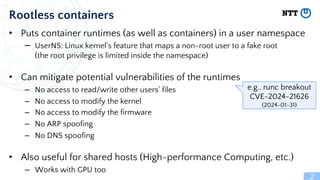
• Puts container runtimes (as well as containers) in a user namespace
– UserNS: Linux kernel’s feature that maps a non-root user to a fake root
(the root privilege is limited inside the namespace)
• Can mitigate potential vulnerabilities of the runtimes
– No access to read/write other users’ files
– No access to modify the kernel
– No access to modify the firmware
– No ARP spoofing
– No DNS spoofing
• Also useful for shared hosts (High-performance Computing, etc.)
– Works with GPU too
2
Rootless containers
e.g., runc breakout
CVE-2024-21626
(2024-01-31)
• 2014: LXC v1.0 introduced support for Rootless containers
(called “unprivileged containers” at that time)
– Networking depends on a SETUID binary, which is hard to configure and also is insecure
• 2016: Singularity v2.2 gained initial support for Rootless
• 2017: runc v1.0-rc4 gained initial support for Rootless
• 2018: Several works has begun to support Rootless in containerd, BuildKit,
Docker, Podman, etc.
– slirp4netns (usermode TCP/IP) eliminated the need to use a SETUID binary for bringing up
container-to-container networks
• 2019: Docker v19.03 was released with an experimental Rootless support
• 2020: Docker v20.10 was released with general availability of Rootless
3
History
• Linux kernel’s feature to remap UIDs and GIDs
– UID=1000 gains fake root privileges (UID=0) that are enough to create containers
– The privileges are limited inside the namespace
• Typically at least 65,536 subuids have to be allocated for containers
– Static configuration (/etc/subuid):
most common, but can be a mess for shared computing
– Dynamic configuration (nsswitch):
more preferrable for shared computing
• e.g., via FreeIPA https://freeipa.readthedocs.io/en/latest/designs/subordinate-ids.html
4
User namespaces
# /etc/subuid
1000:100000:65536
0 1 65536
0 1000 100000 165535
• POC of subuid-less rootless containers is also available, but not
ready to be used yet
https://github.com/rootless-containers/subuidless
– Emulates UID-related syscalls such as chown(2) using
seccomp_unotify(2) and xattr(7)
– More syscalls have to be emulated
5
User namespaces
6
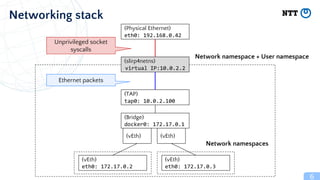
Networking stack
(vEth)
eth0: 172.17.0.2
(Bridge)
docker0: 172.17.0.1
(TAP)
tap0: 10.0.2.100
(vEth) (vEth)
Network namespaces
(vEth)
eth0: 172.17.0.3
(Physical Ethernet)
eth0: 192.168.0.42
(slirp4netns)
virtual IP:10.0.2.2
Network namespace + User namespace
Ethernet packets
Unprivileged socket
syscalls
• Rootless Docker daemon is executed in slirp4netns’s NetNS too,
for ease of implementation
– Slow pull/push
– No direct access to localhost registries
– No support for --net=host
• Docker v26 (or later) may execute the daemon outside slirp4netns’s NetNS
to eliminate the restrictions 🎉
https://github.com/moby/moby/pull/47103 (WIP)
• The same technique has been used by Podman and nerdctl
(contaiNERD CTL) v2 too
7
Faster networking (for runtimes)
8
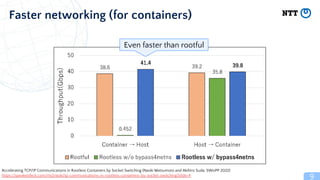
Faster networking (for containers)
• Bypass4netns allows bypassing slirp4netns
https://github.com/rootless-containers/bypass4netns
• Captures socket syscalls inside the NetNS, reconstructs the FDs
outside the NetNS, and replaces the FDs inside the NetNS
• Integrated into nerdctl (opt-in)
• Can be used with Docker and Podman too
9
Faster networking (for containers)
Accelerating TCP/IP Communications in Rootless Containers by Socket Switching (Naoki Matsumoto and Akihiro Suda, SWoPP 2022)
https://speakerdeck.com/mt2naoki/ip-communications-in-rootless-containers-by-socket-switching?slide=4
Even faster than rootful
10
• It is controversial whether non-root users should be allowed to
create user namespaces
• Yes, for container users, because rootless containers are much safer
than running everything as the root
• No, for others, because it can be rather an attack surface
CVE-2023-32233: Privilege escalation in Linux Kernel due to a Netfilter
nf_tables vulnerability
• Several mechanisms are being worked on to conditionally enable
unprivileged user namespaces
Criticisms against Rootless containers (and solutions)
11
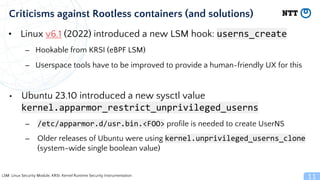
• Linux v6.1 (2022) introduced a new LSM hook: userns_create
– Hookable from KRSI (eBPF LSM)
– Userspace tools have to be improved to provide a human-friendly UX for this
• Ubuntu 23.10 introduced a new sysctl value
kernel.apparmor_restrict_unprivileged_userns
– /etc/apparmor.d/usr.bin.<FOO> profile is needed to create UserNS
– Older releases of Ubuntu were using kernel.unprivileged_userns_clone
(system-wide single boolean value)
Criticisms against Rootless containers (and solutions)
LSM: Linux Security Module, KRSI: Kernel Runtime Security Instrumentation
Rootless Kubernetes
• Usernetes: Rootless Kubernetes
https://github.com/rootless-containers/usernetes
• The current version is implemented by running Kubernetes inside
Rootless Docker/Podman/nerdctl
• Multi-node networking is possible with VXLAN (Flannel)
13
Rootless Kubernetes
• Began in 2018
– As old as Rootless Docker (pre-release at that time) and Rootless Podman
• The changes to Kubernetes was merged in Kubernetes v1.22
(Aug 2021)
– Feature gate: KubeletInUsernameSpace (Alpha)
• The feature gate is also adopted by:
– kind (with Rootless Docker or Rootless Podman)
– Minikube (with Rootless Docker or Rootless Podman)
– k3s
14
History
Gen 1 (2018-2023) Gen 2 (2023-)
Host dependency RootlessKit Rootless Docker,
Rootless Podman, or
Rootless nerdctl
(contaiNERD CTL)
Supports kubeadm No Yes
Supports multi-node Yes, but practically No,
due to complexity
Yes
Supports hostPath
volumes
Yes Yes, for most paths,
but needs an extra config
15
Usernetes Gen 1 vs Gen 2
”The hard way”
Similar to `kind` and minikube,
but supports real multi-node
16
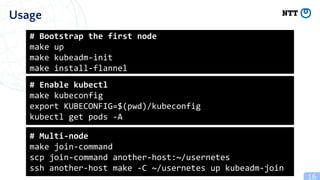
Usage
# Bootstrap the first node
make up
make kubeadm-init
make install-flannel
# Enable kubectl
make kubeconfig
export KUBECONFIG=$(pwd)/kubeconfig
kubectl get pods -A
# Multi-node
make join-command
scp join-command another-host:~/usernetes
ssh another-host make -C ~/usernetes up kubeadm-join

20240201 [HPC Containers] Rootless Containers.pdf

  • 1.
    Rootless Containers Akihiro Suda(NTT) akihiro.suda.cz@hco.ntt.co.jp HPC Containers Advisory Council Meeting (Feb 1, 2024)
  • 2.
    • Puts containerruntimes (as well as containers) in a user namespace – UserNS: Linux kernel’s feature that maps a non-root user to a fake root (the root privilege is limited inside the namespace) • Can mitigate potential vulnerabilities of the runtimes – No access to read/write other users’ files – No access to modify the kernel – No access to modify the firmware – No ARP spoofing – No DNS spoofing • Also useful for shared hosts (High-performance Computing, etc.) – Works with GPU too 2 Rootless containers e.g., runc breakout CVE-2024-21626 (2024-01-31)
  • 3.
    • 2014: LXCv1.0 introduced support for Rootless containers (called “unprivileged containers” at that time) – Networking depends on a SETUID binary, which is hard to configure and also is insecure • 2016: Singularity v2.2 gained initial support for Rootless • 2017: runc v1.0-rc4 gained initial support for Rootless • 2018: Several works has begun to support Rootless in containerd, BuildKit, Docker, Podman, etc. – slirp4netns (usermode TCP/IP) eliminated the need to use a SETUID binary for bringing up container-to-container networks • 2019: Docker v19.03 was released with an experimental Rootless support • 2020: Docker v20.10 was released with general availability of Rootless 3 History
  • 4.
    • Linux kernel’sfeature to remap UIDs and GIDs – UID=1000 gains fake root privileges (UID=0) that are enough to create containers – The privileges are limited inside the namespace • Typically at least 65,536 subuids have to be allocated for containers – Static configuration (/etc/subuid): most common, but can be a mess for shared computing – Dynamic configuration (nsswitch): more preferrable for shared computing • e.g., via FreeIPA https://freeipa.readthedocs.io/en/latest/designs/subordinate-ids.html 4 User namespaces # /etc/subuid 1000:100000:65536 0 1 65536 0 1000 100000 165535
  • 5.
    • POC ofsubuid-less rootless containers is also available, but not ready to be used yet https://github.com/rootless-containers/subuidless – Emulates UID-related syscalls such as chown(2) using seccomp_unotify(2) and xattr(7) – More syscalls have to be emulated 5 User namespaces
  • 6.
    6 Networking stack (vEth) eth0: 172.17.0.2 (Bridge) docker0:172.17.0.1 (TAP) tap0: 10.0.2.100 (vEth) (vEth) Network namespaces (vEth) eth0: 172.17.0.3 (Physical Ethernet) eth0: 192.168.0.42 (slirp4netns) virtual IP:10.0.2.2 Network namespace + User namespace Ethernet packets Unprivileged socket syscalls
  • 7.
    • Rootless Dockerdaemon is executed in slirp4netns’s NetNS too, for ease of implementation – Slow pull/push – No direct access to localhost registries – No support for --net=host • Docker v26 (or later) may execute the daemon outside slirp4netns’s NetNS to eliminate the restrictions 🎉 https://github.com/moby/moby/pull/47103 (WIP) • The same technique has been used by Podman and nerdctl (contaiNERD CTL) v2 too 7 Faster networking (for runtimes)
  • 8.
    8 Faster networking (forcontainers) • Bypass4netns allows bypassing slirp4netns https://github.com/rootless-containers/bypass4netns • Captures socket syscalls inside the NetNS, reconstructs the FDs outside the NetNS, and replaces the FDs inside the NetNS • Integrated into nerdctl (opt-in) • Can be used with Docker and Podman too
  • 9.
    9 Faster networking (forcontainers) Accelerating TCP/IP Communications in Rootless Containers by Socket Switching (Naoki Matsumoto and Akihiro Suda, SWoPP 2022) https://speakerdeck.com/mt2naoki/ip-communications-in-rootless-containers-by-socket-switching?slide=4 Even faster than rootful
  • 10.
    10 • It iscontroversial whether non-root users should be allowed to create user namespaces • Yes, for container users, because rootless containers are much safer than running everything as the root • No, for others, because it can be rather an attack surface CVE-2023-32233: Privilege escalation in Linux Kernel due to a Netfilter nf_tables vulnerability • Several mechanisms are being worked on to conditionally enable unprivileged user namespaces Criticisms against Rootless containers (and solutions)
  • 11.
    11 • Linux v6.1(2022) introduced a new LSM hook: userns_create – Hookable from KRSI (eBPF LSM) – Userspace tools have to be improved to provide a human-friendly UX for this • Ubuntu 23.10 introduced a new sysctl value kernel.apparmor_restrict_unprivileged_userns – /etc/apparmor.d/usr.bin.<FOO> profile is needed to create UserNS – Older releases of Ubuntu were using kernel.unprivileged_userns_clone (system-wide single boolean value) Criticisms against Rootless containers (and solutions) LSM: Linux Security Module, KRSI: Kernel Runtime Security Instrumentation
  • 12.
  • 13.
    • Usernetes: RootlessKubernetes https://github.com/rootless-containers/usernetes • The current version is implemented by running Kubernetes inside Rootless Docker/Podman/nerdctl • Multi-node networking is possible with VXLAN (Flannel) 13 Rootless Kubernetes
  • 14.
    • Began in2018 – As old as Rootless Docker (pre-release at that time) and Rootless Podman • The changes to Kubernetes was merged in Kubernetes v1.22 (Aug 2021) – Feature gate: KubeletInUsernameSpace (Alpha) • The feature gate is also adopted by: – kind (with Rootless Docker or Rootless Podman) – Minikube (with Rootless Docker or Rootless Podman) – k3s 14 History
  • 15.
    Gen 1 (2018-2023)Gen 2 (2023-) Host dependency RootlessKit Rootless Docker, Rootless Podman, or Rootless nerdctl (contaiNERD CTL) Supports kubeadm No Yes Supports multi-node Yes, but practically No, due to complexity Yes Supports hostPath volumes Yes Yes, for most paths, but needs an extra config 15 Usernetes Gen 1 vs Gen 2 ”The hard way” Similar to `kind` and minikube, but supports real multi-node
  • 16.
    16 Usage # Bootstrap thefirst node make up make kubeadm-init make install-flannel # Enable kubectl make kubeconfig export KUBECONFIG=$(pwd)/kubeconfig kubectl get pods -A # Multi-node make join-command scp join-command another-host:~/usernetes ssh another-host make -C ~/usernetes up kubeadm-join