Pratyush Anand
kdump: usage and internals
CFP, #LinuxCon, Beijing, June 19-20, 2017
Pratyush Anand(panand@redhat.com)
Pratyush Anand
Agenda
● kdump from user perspective
● Kernel system calls
● When Kernel crashes…
● vmcore structure
● makedumpfile
● kdump: The Fedora way
● Debugging kdump issues
● What next
Pratyush Anand
kdump from user perspective
Pratyush Anand
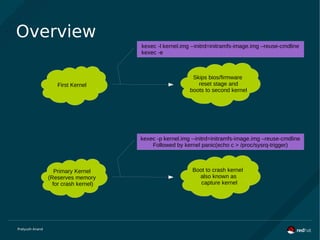
Overview
First Kernel
Skips bios/firmware
reset stage and
boots to second kernel
kexec -l kernel.img --initrd=initramfs-image.img –reuse-cmdline
kexec -e
Primary Kernel
(Reserves memory
for crash kernel)
Boot to crash kernel
also known as
capture kernel
kexec -p kernel.img --initrd=initramfs-image.img –reuse-cmdline
Followed by kernel panic(echo c > /proc/sysrq-trigger)
Pratyush Anand
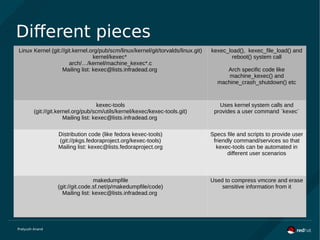
Different pieces
Linux Kernel (git://git.kernel.org/pub/scm/linux/kernel/git/torvalds/linux.git)
kernel/kexec*
arch/…/kernel/machine_kexec*.c
Mailing list: kexec@lists.infradead.org
kexec_load(), kexec_file_load() and
reboot() system call
Arch specific code like
machine_kexec() and
machine_crash_shutdown() etc
kexec-tools
(git://git.kernel.org/pub/scm/utils/kernel/kexec/kexec-tools.git)
Mailing list: kexec@lists.infradead.org
Uses kernel system calls and
provides a user command `kexec`
Distribution code (like fedora kexec-tools)
(git://pkgs.fedoraproject.org/kexec-tools)
Mailing list: kexec@lists.fedoraproject.org
Specs file and scripts to provide user
friendly command/services so that
kexec-tools can be automated in
different user scenarios
makedumpfile
(git://git.code.sf.net/p/makedumpfile/code)
Mailing list: kexec@lists.infradead.org
Used to compress vmcore and erase
sensitive information from it
Pratyush Anand
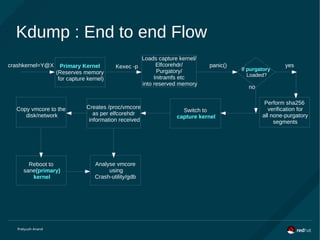
Kdump : End to end Flow
crashkernel=Y@X
Perform sha256
verification for
all none-purgatory
segments
Copy vmcore to the
disk/network
Analyse vmcore
using
Crash-utility/gdb
Reboot to
sane(primary)
kernel
panic()
If purgatory
Loaded?
yes
no
Primary Kernel
(Reserves memory
for capture kernel)
Loads capture kernel/
Elfcorehdr/
Purgatory/
Initramfs etc
into reserved memory
Kexec -p
Switch to
capture kernel
Creates /proc/vmcore
as per elfcorehdr
information received
Pratyush Anand
Demo
https://www.youtube.com/watch?v=iOq_rJhrKhA
Pratyush Anand
Kernel system calls
Pratyush Anand
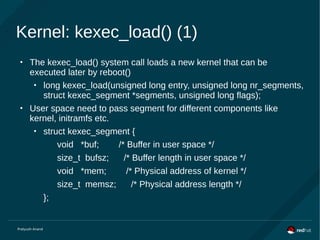
Kernel: kexec_load() (1)
• The kexec_load() system call loads a new kernel that can be
executed later by reboot()
• long kexec_load(unsigned long entry, unsigned long nr_segments,
struct kexec_segment *segments, unsigned long flags);
• User space need to pass segment for different components like
kernel, initramfs etc.
• struct kexec_segment {
void *buf; /* Buffer in user space */
size_t bufsz; /* Buffer length in user space */
void *mem; /* Physical address of kernel */
size_t memsz; /* Physical address length */
};
Pratyush Anand
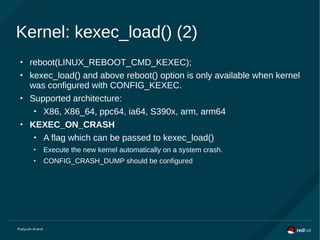
Kernel: kexec_load() (2)
• reboot(LINUX_REBOOT_CMD_KEXEC);
• kexec_load() and above reboot() option is only available when kernel
was configured with CONFIG_KEXEC.
• Supported architecture:
• X86, X86_64, ppc64, ia64, S390x, arm, arm64
• KEXEC_ON_CRASH
• A flag which can be passed to kexec_load()
• Execute the new kernel automatically on a system crash.
• CONFIG_CRASH_DUMP should be configured
Pratyush Anand
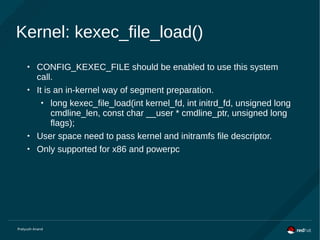
Kernel: kexec_file_load()
• CONFIG_KEXEC_FILE should be enabled to use this system
call.
• It is an in-kernel way of segment preparation.
• long kexec_file_load(int kernel_fd, int initrd_fd, unsigned long
cmdline_len, const char __user * cmdline_ptr, unsigned long
flags);
• User space need to pass kernel and initramfs file descriptor.
• Only supported for x86 and powerpc
Pratyush Anand
When Kernel crashes...
Pratyush Anand
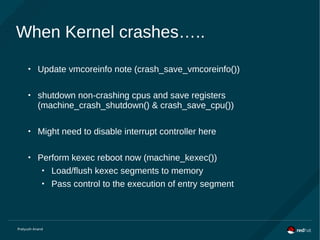
When Kernel crashes…..
• Update vmcoreinfo note (crash_save_vmcoreinfo())
• shutdown non-crashing cpus and save registers
(machine_crash_shutdown() & crash_save_cpu())
• Might need to disable interrupt controller here
• Perform kexec reboot now (machine_kexec())
• Load/flush kexec segments to memory
• Pass control to the execution of entry segment
Pratyush Anand
vmcore structure
Pratyush Anand
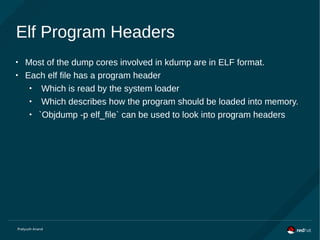
Elf Program Headers
• Most of the dump cores involved in kdump are in ELF format.
• Each elf file has a program header
• Which is read by the system loader
• Which describes how the program should be loaded into memory.
• `Objdump -p elf_file` can be used to look into program headers
Pratyush Anand
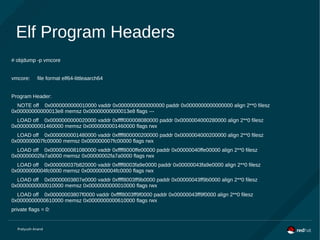
Elf Program Headers
# objdump -p vmcore
vmcore: file format elf64-littleaarch64
Program Header:
NOTE off 0x0000000000010000 vaddr 0x0000000000000000 paddr 0x0000000000000000 align 2**0 filesz
0x00000000000013e8 memsz 0x00000000000013e8 flags ---
LOAD off 0x0000000000020000 vaddr 0xffff000008080000 paddr 0x0000004000280000 align 2**0 filesz
0x0000000001460000 memsz 0x0000000001460000 flags rwx
LOAD off 0x0000000001480000 vaddr 0xffff800000200000 paddr 0x0000004000200000 align 2**0 filesz
0x000000007fc00000 memsz 0x000000007fc00000 flags rwx
LOAD off 0x0000000081080000 vaddr 0xffff8000ffe00000 paddr 0x00000040ffe00000 align 2**0 filesz
0x00000002fa7a0000 memsz 0x00000002fa7a0000 flags rwx
LOAD off 0x000000037b820000 vaddr 0xffff8003fa9e0000 paddr 0x00000043fa9e0000 align 2**0 filesz
0x0000000004fc0000 memsz 0x0000000004fc0000 flags rwx
LOAD off 0x00000003807e0000 vaddr 0xffff8003ff9b0000 paddr 0x00000043ff9b0000 align 2**0 filesz
0x0000000000010000 memsz 0x0000000000010000 flags rwx
LOAD off 0x00000003807f0000 vaddr 0xffff8003ff9f0000 paddr 0x00000043ff9f0000 align 2**0 filesz
0x0000000000610000 memsz 0x0000000000610000 flags rwx
private flags = 0:
Pratyush Anand
elfcorehdr
EHDR PHDR(CPUp0 PT_NOTE)
..
PHDR(CPUpn PT_NOTE)
PHDR
(vmcoreinfo PT_NOTE)
[optional]
PHDR
(Kernel Text PT_LOAD)
[optional]
PHDR(RAM0 PT_LOAD)
..
PHDR(RAMn PT_LOAD)
- Entry point virtual address
- Program header table file offset
- Section header table file offset
-Segment virtual address
-Segment size in memory
/sys/devices/system/cpu/cpu%d/crash_notes CPU PT_NOTE
/sys/kernel/vmcoreinfo vmcoreinfo
PT_NOTE
/proc/iomem Mem PT_LOAD
Pratyush Anand
Notes
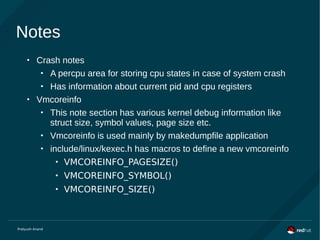
• Crash notes
• A percpu area for storing cpu states in case of system crash
• Has information about current pid and cpu registers
• Vmcoreinfo
• This note section has various kernel debug information like
struct size, symbol values, page size etc.
• Vmcoreinfo is used mainly by makedumpfile application
• include/linux/kexec.h has macros to define a new vmcoreinfo
• VMCOREINFO_PAGESIZE()
• VMCOREINFO_SYMBOL()
• VMCOREINFO_SIZE()
Pratyush Anand
makedumpfile
Pratyush Anand
makedumpfile
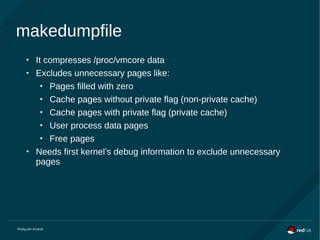
• It compresses /proc/vmcore data
• Excludes unnecessary pages like:
• Pages filled with zero
• Cache pages without private flag (non-private cache)
• Cache pages with private flag (private cache)
• User process data pages
• Free pages
• Needs first kernel’s debug information to exclude unnecessary
pages
Pratyush Anand
makedumpfile
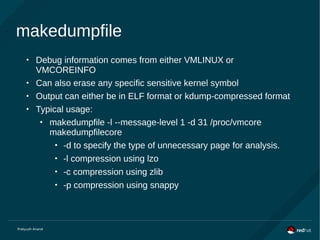
• Debug information comes from either VMLINUX or
VMCOREINFO
• Can also erase any specific sensitive kernel symbol
• Output can either be in ELF format or kdump-compressed format
• Typical usage:
• makedumpfile -l --message-level 1 -d 31 /proc/vmcore
makedumpfilecore
• -d to specify the type of unnecessary page for analysis.
• -l compression using lzo
• -c compression using zlib
• -p compression using snappy
Pratyush Anand
Kdump: The Fedora way
Pratyush Anand
Kdump: The Fedora way
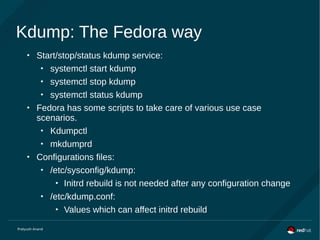
• Start/stop/status kdump service:
• systemctl start kdump
• systemctl stop kdump
• systemctl status kdump
• Fedora has some scripts to take care of various use case
scenarios.
• Kdumpctl
• mkdumprd
• Configurations files:
• /etc/sysconfig/kdump:
• Initrd rebuild is not needed after any configuration change
• /etc/kdump.conf:
• Values which can affect initrd rebuild
Pratyush Anand
Debugging Kdump issues
Pratyush Anand
Debugging Kdump issues
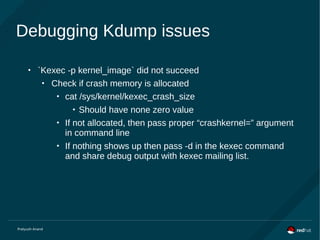
• `Kexec -p kernel_image` did not succeed
• Check if crash memory is allocated
• cat /sys/kernel/kexec_crash_size
• Should have none zero value
• If not allocated, then pass proper “crashkernel=” argument
in command line
• If nothing shows up then pass -d in the kexec command
and share debug output with kexec mailing list.
Pratyush Anand
Debugging Kdump issues
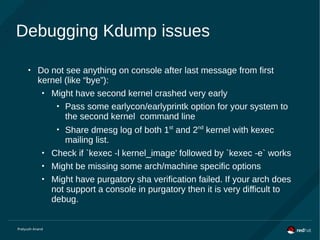
• Do not see anything on console after last message from first
kernel (like “bye”):
• Might have second kernel crashed very early
• Pass some earlycon/earlyprintk option for your system to
the second kernel command line
• Share dmesg log of both 1st
and 2nd
kernel with kexec
mailing list.
• Check if `kexec -l kernel_image’ followed by `kexec -e` works
• Might be missing some arch/machine specific options
• Might have purgatory sha verification failed. If your arch does
not support a console in purgatory then it is very difficult to
debug.
Pratyush Anand
What Next
Pratyush Anand
What next
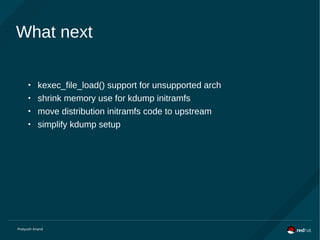
• kexec_file_load() support for unsupported arch
• shrink memory use for kdump initramfs
• move distribution initramfs code to upstream
• simplify kdump setup
THANK YOU
plus.google.com/+RedHat
linkedin.com/company/red-hat
youtube.com/user/RedHatVideos
facebook.com/redhatinc
twitter.com/RedHatNews

kdump: usage and_internals

  • 1.
    Pratyush Anand kdump: usageand internals CFP, #LinuxCon, Beijing, June 19-20, 2017 Pratyush Anand(panand@redhat.com)
  • 2.
    Pratyush Anand Agenda ● kdumpfrom user perspective ● Kernel system calls ● When Kernel crashes… ● vmcore structure ● makedumpfile ● kdump: The Fedora way ● Debugging kdump issues ● What next
  • 3.
    Pratyush Anand kdump fromuser perspective
  • 4.
    Pratyush Anand Overview First Kernel Skipsbios/firmware reset stage and boots to second kernel kexec -l kernel.img --initrd=initramfs-image.img –reuse-cmdline kexec -e Primary Kernel (Reserves memory for crash kernel) Boot to crash kernel also known as capture kernel kexec -p kernel.img --initrd=initramfs-image.img –reuse-cmdline Followed by kernel panic(echo c > /proc/sysrq-trigger)
  • 5.
    Pratyush Anand Different pieces LinuxKernel (git://git.kernel.org/pub/scm/linux/kernel/git/torvalds/linux.git) kernel/kexec* arch/…/kernel/machine_kexec*.c Mailing list: kexec@lists.infradead.org kexec_load(), kexec_file_load() and reboot() system call Arch specific code like machine_kexec() and machine_crash_shutdown() etc kexec-tools (git://git.kernel.org/pub/scm/utils/kernel/kexec/kexec-tools.git) Mailing list: kexec@lists.infradead.org Uses kernel system calls and provides a user command `kexec` Distribution code (like fedora kexec-tools) (git://pkgs.fedoraproject.org/kexec-tools) Mailing list: kexec@lists.fedoraproject.org Specs file and scripts to provide user friendly command/services so that kexec-tools can be automated in different user scenarios makedumpfile (git://git.code.sf.net/p/makedumpfile/code) Mailing list: kexec@lists.infradead.org Used to compress vmcore and erase sensitive information from it
  • 6.
    Pratyush Anand Kdump :End to end Flow crashkernel=Y@X Perform sha256 verification for all none-purgatory segments Copy vmcore to the disk/network Analyse vmcore using Crash-utility/gdb Reboot to sane(primary) kernel panic() If purgatory Loaded? yes no Primary Kernel (Reserves memory for capture kernel) Loads capture kernel/ Elfcorehdr/ Purgatory/ Initramfs etc into reserved memory Kexec -p Switch to capture kernel Creates /proc/vmcore as per elfcorehdr information received
  • 7.
  • 8.
  • 9.
    Pratyush Anand Kernel: kexec_load()(1) • The kexec_load() system call loads a new kernel that can be executed later by reboot() • long kexec_load(unsigned long entry, unsigned long nr_segments, struct kexec_segment *segments, unsigned long flags); • User space need to pass segment for different components like kernel, initramfs etc. • struct kexec_segment { void *buf; /* Buffer in user space */ size_t bufsz; /* Buffer length in user space */ void *mem; /* Physical address of kernel */ size_t memsz; /* Physical address length */ };
  • 10.
    Pratyush Anand Kernel: kexec_load()(2) • reboot(LINUX_REBOOT_CMD_KEXEC); • kexec_load() and above reboot() option is only available when kernel was configured with CONFIG_KEXEC. • Supported architecture: • X86, X86_64, ppc64, ia64, S390x, arm, arm64 • KEXEC_ON_CRASH • A flag which can be passed to kexec_load() • Execute the new kernel automatically on a system crash. • CONFIG_CRASH_DUMP should be configured
  • 11.
    Pratyush Anand Kernel: kexec_file_load() •CONFIG_KEXEC_FILE should be enabled to use this system call. • It is an in-kernel way of segment preparation. • long kexec_file_load(int kernel_fd, int initrd_fd, unsigned long cmdline_len, const char __user * cmdline_ptr, unsigned long flags); • User space need to pass kernel and initramfs file descriptor. • Only supported for x86 and powerpc
  • 12.
  • 13.
    Pratyush Anand When Kernelcrashes….. • Update vmcoreinfo note (crash_save_vmcoreinfo()) • shutdown non-crashing cpus and save registers (machine_crash_shutdown() & crash_save_cpu()) • Might need to disable interrupt controller here • Perform kexec reboot now (machine_kexec()) • Load/flush kexec segments to memory • Pass control to the execution of entry segment
  • 14.
  • 15.
    Pratyush Anand Elf ProgramHeaders • Most of the dump cores involved in kdump are in ELF format. • Each elf file has a program header • Which is read by the system loader • Which describes how the program should be loaded into memory. • `Objdump -p elf_file` can be used to look into program headers
  • 16.
    Pratyush Anand Elf ProgramHeaders # objdump -p vmcore vmcore: file format elf64-littleaarch64 Program Header: NOTE off 0x0000000000010000 vaddr 0x0000000000000000 paddr 0x0000000000000000 align 2**0 filesz 0x00000000000013e8 memsz 0x00000000000013e8 flags --- LOAD off 0x0000000000020000 vaddr 0xffff000008080000 paddr 0x0000004000280000 align 2**0 filesz 0x0000000001460000 memsz 0x0000000001460000 flags rwx LOAD off 0x0000000001480000 vaddr 0xffff800000200000 paddr 0x0000004000200000 align 2**0 filesz 0x000000007fc00000 memsz 0x000000007fc00000 flags rwx LOAD off 0x0000000081080000 vaddr 0xffff8000ffe00000 paddr 0x00000040ffe00000 align 2**0 filesz 0x00000002fa7a0000 memsz 0x00000002fa7a0000 flags rwx LOAD off 0x000000037b820000 vaddr 0xffff8003fa9e0000 paddr 0x00000043fa9e0000 align 2**0 filesz 0x0000000004fc0000 memsz 0x0000000004fc0000 flags rwx LOAD off 0x00000003807e0000 vaddr 0xffff8003ff9b0000 paddr 0x00000043ff9b0000 align 2**0 filesz 0x0000000000010000 memsz 0x0000000000010000 flags rwx LOAD off 0x00000003807f0000 vaddr 0xffff8003ff9f0000 paddr 0x00000043ff9f0000 align 2**0 filesz 0x0000000000610000 memsz 0x0000000000610000 flags rwx private flags = 0:
  • 17.
    Pratyush Anand elfcorehdr EHDR PHDR(CPUp0PT_NOTE) .. PHDR(CPUpn PT_NOTE) PHDR (vmcoreinfo PT_NOTE) [optional] PHDR (Kernel Text PT_LOAD) [optional] PHDR(RAM0 PT_LOAD) .. PHDR(RAMn PT_LOAD) - Entry point virtual address - Program header table file offset - Section header table file offset -Segment virtual address -Segment size in memory /sys/devices/system/cpu/cpu%d/crash_notes CPU PT_NOTE /sys/kernel/vmcoreinfo vmcoreinfo PT_NOTE /proc/iomem Mem PT_LOAD
  • 18.
    Pratyush Anand Notes • Crashnotes • A percpu area for storing cpu states in case of system crash • Has information about current pid and cpu registers • Vmcoreinfo • This note section has various kernel debug information like struct size, symbol values, page size etc. • Vmcoreinfo is used mainly by makedumpfile application • include/linux/kexec.h has macros to define a new vmcoreinfo • VMCOREINFO_PAGESIZE() • VMCOREINFO_SYMBOL() • VMCOREINFO_SIZE()
  • 19.
  • 20.
    Pratyush Anand makedumpfile • Itcompresses /proc/vmcore data • Excludes unnecessary pages like: • Pages filled with zero • Cache pages without private flag (non-private cache) • Cache pages with private flag (private cache) • User process data pages • Free pages • Needs first kernel’s debug information to exclude unnecessary pages
  • 21.
    Pratyush Anand makedumpfile • Debuginformation comes from either VMLINUX or VMCOREINFO • Can also erase any specific sensitive kernel symbol • Output can either be in ELF format or kdump-compressed format • Typical usage: • makedumpfile -l --message-level 1 -d 31 /proc/vmcore makedumpfilecore • -d to specify the type of unnecessary page for analysis. • -l compression using lzo • -c compression using zlib • -p compression using snappy
  • 22.
  • 23.
    Pratyush Anand Kdump: TheFedora way • Start/stop/status kdump service: • systemctl start kdump • systemctl stop kdump • systemctl status kdump • Fedora has some scripts to take care of various use case scenarios. • Kdumpctl • mkdumprd • Configurations files: • /etc/sysconfig/kdump: • Initrd rebuild is not needed after any configuration change • /etc/kdump.conf: • Values which can affect initrd rebuild
  • 24.
  • 25.
    Pratyush Anand Debugging Kdumpissues • `Kexec -p kernel_image` did not succeed • Check if crash memory is allocated • cat /sys/kernel/kexec_crash_size • Should have none zero value • If not allocated, then pass proper “crashkernel=” argument in command line • If nothing shows up then pass -d in the kexec command and share debug output with kexec mailing list.
  • 26.
    Pratyush Anand Debugging Kdumpissues • Do not see anything on console after last message from first kernel (like “bye”): • Might have second kernel crashed very early • Pass some earlycon/earlyprintk option for your system to the second kernel command line • Share dmesg log of both 1st and 2nd kernel with kexec mailing list. • Check if `kexec -l kernel_image’ followed by `kexec -e` works • Might be missing some arch/machine specific options • Might have purgatory sha verification failed. If your arch does not support a console in purgatory then it is very difficult to debug.
  • 27.
  • 28.
    Pratyush Anand What next •kexec_file_load() support for unsupported arch • shrink memory use for kdump initramfs • move distribution initramfs code to upstream • simplify kdump setup
  • 29.