Ratio Analysis


  B.V.Raghunandan,
    SVS College,
       Bantwal       Page 1
Definition


Ratio Analysis is a financial technique of
measuring the strength and weakness of
an organisation out of information
available from financial reports
specifically from the Balance Sheet and
Income Statement
                                      Page 2
Advantages
• Measuring the efficiency of organisations
• Measuring the liquidity position of the companies
• Measuring the capacity of companies to borrow in the
  future
• Understanding the overall financial position of
  organisations
• Estimating the solvency of the companies
• Helping in forecasting                            Page 3
Disadvantages
• Only quantitative tools
• Manipulation of accounting
  figures
• Too many analytical tools lead to
  varied interpretation
• Based on past data
• Same data may be interpreted in
  different ways
• Vested interests
• Measuring the changes in price
  levels
• Accounting policies have the
  impact
• Only symptoms and not cure
                                      Page 4
A] Liquidity Ratios
                   B] Solvency Ratios
                   C] Activity Ratios
                   D] Profitability Ratios
Different Ratios   E] Shareholders’Page 5
                                      Ratios
A] Liquidity Ratio


                   CurrentAssets
• Current Ratio =
                  CurrentLiabilities

                   CurrentAss ets Clo sin gStock
• Acid Test Ratio=
                         CurrentLia bility
                                         Sales
• Working Capital Turnover Ratio =
                                     WorkingCapital

                                                 Page 6
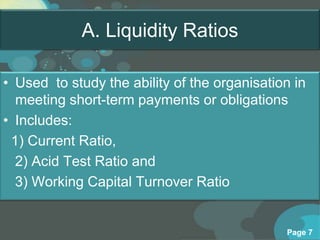
A. Liquidity Ratios

• Used to study the ability of the organisation in
  meeting short-term payments or obligations
• Includes:
 1) Current Ratio,
  2) Acid Test Ratio and
  3) Working Capital Turnover Ratio


                                              Page 7
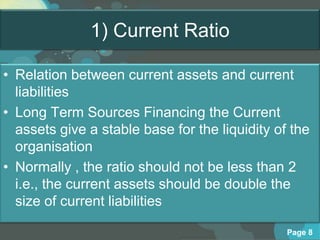
1) Current Ratio

• Relation between current assets and current
  liabilities
• Long Term Sources Financing the Current
  assets give a stable base for the liquidity of the
  organisation
• Normally , the ratio should not be less than 2
  i.e., the current assets should be double the
  size of current liabilities

                                                Page 8
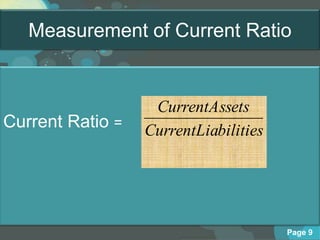
Measurement of Current Ratio


                   CurrentAssets
Current Ratio =   CurrentLiabilities


                                       Page 9
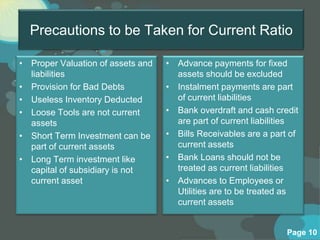
Precautions to be Taken for Current Ratio

• Proper Valuation of assets and   • Advance payments for fixed
  liabilities                        assets should be excluded
• Provision for Bad Debts          • Instalment payments are part
• Useless Inventory Deducted         of current liabilities
• Loose Tools are not current      • Bank overdraft and cash credit
  assets                             are part of current liabilities
• Short Term Investment can be     • Bills Receivables are a part of
  part of current assets             current assets
• Long Term investment like        • Bank Loans should not be
  capital of subsidiary is not       treated as current liabilities
  current asset                    • Advances to Employees or
                                     Utilities are to be treated as
                                     current assets


                                                                 Page 10
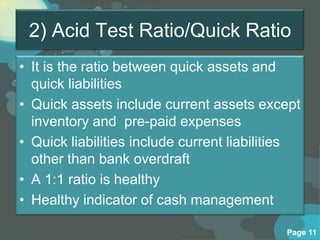
2) Acid Test Ratio/Quick Ratio
• It is the ratio between quick assets and
  quick liabilities
• Quick assets include current assets except
  inventory and pre-paid expenses
• Quick liabilities include current liabilities
  other than bank overdraft
• A 1:1 ratio is healthy
• Healthy indicator of cash management

                                            Page 11
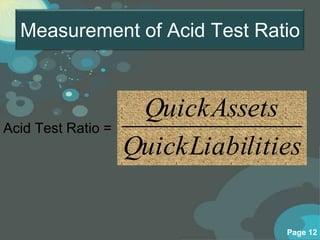
Measurement of Acid Test Ratio


                     QuickAssets
Acid Test Ratio =
                    QuickLiabilities

                                  Page 12
3) Working Capital Turn-over Ratio

 • Shows the efficiency of usage of working
   capital
 • Relation between Sales and Working
   Capital
 • Determination of number of times the
   working capital is turned over to achieve
   the maximum profit


                                           Page 13
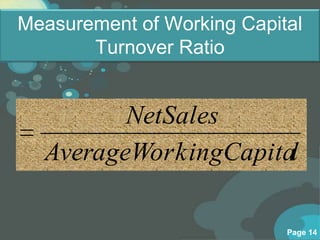
Measurement of Working Capital
       Turnover Ratio


         NetSales
  AverageWor kingCapital

                            Page 14
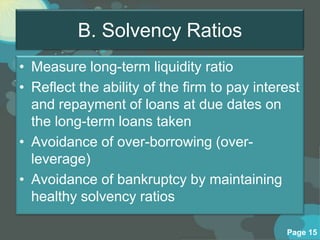
B. Solvency Ratios
• Measure long-term liquidity ratio
• Reflect the ability of the firm to pay interest
  and repayment of loans at due dates on
  the long-term loans taken
• Avoidance of over-borrowing (over-
  leverage)
• Avoidance of bankruptcy by maintaining
  healthy solvency ratios

                                              Page 15
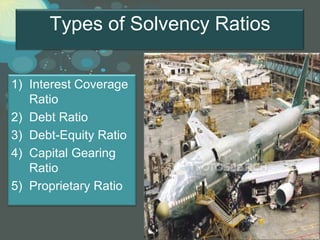
Types of Solvency Ratios

1) Interest Coverage
   Ratio
2) Debt Ratio
3) Debt-Equity Ratio
4) Capital Gearing
   Ratio
5) Proprietary Ratio


                                 Page 16
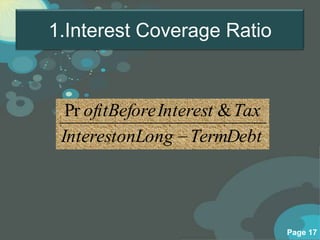
1.Interest Coverage Ratio


  Pr ofitBefore Interest & Tax
 InterestonLong TermDebt


                                 Page 17
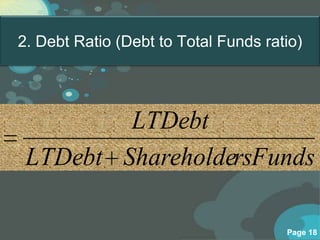
2. Debt Ratio (Debt to Total Funds ratio)


         LTDebt
 LTDebt ShareholdersFunds

                                      Page 18
3) Debt-Equity Ratio


  LongTermDebt
ShareholdersFunds


                       Page 19
4) Capital Gearing Ratio


FixedIncomeBearingSecurities
   EquityShareholdersFund


                            Page 20
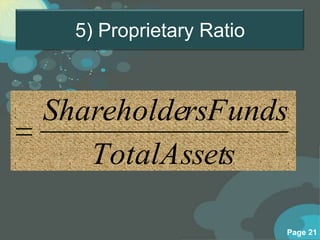
5) Proprietary Ratio


ShareholdersFunds
   TotalAssets

                         Page 21
C] Activity Ratios


1)   Inventory Turnover Ratio
2)   Debtors Turnover Ratio
3)   Average Collection Period
4)   Fixed Assets Turnover Ratio
5)   Total Assets Turnover Ratio
6)   Capital Turnover Ratio

                                   Page 22
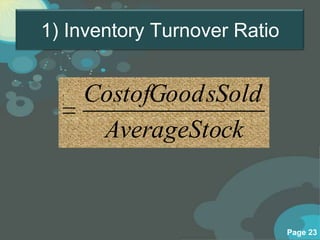
1) Inventory Turnover Ratio


    CostofGood sSold
           CostofGood sSold


     AverageStock
            AverageStock


                              Page 23
2) Debtor Turnover Ratio


  CreditSales
AverageDebtors
                           Page 24
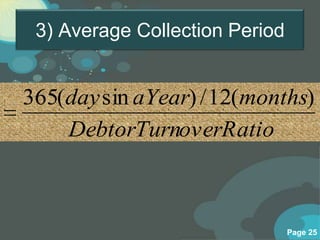
3) Average Collection Period


365(day sin aYear) / 12(months)
    DebtorTurnoverRatio


                                Page 25
4) Fixed Assets Turnover Ratio


      NetSales
   NetFixedAssets
                             Page 26
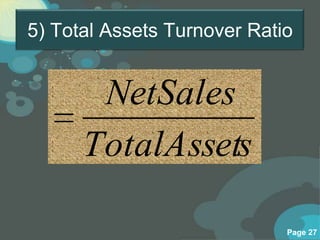
5) Total Assets Turnover Ratio


       NetSales
      TotalAssets

                             Page 27
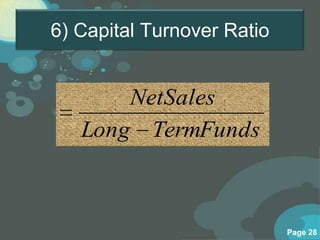
6) Capital Turnover Ratio


       NetSales
   Long TermFunds


                            Page 28
D] Profitability Ratios

1) Net Profit Ratio

2) Gross Profit
 Ratio

3) Return on Total
 Assets

4) Return on Equity
                                   Page 29
1) Net Profit Ratio


Pr ofitAfterTax
                X 100
   NetSales


                        Page 30
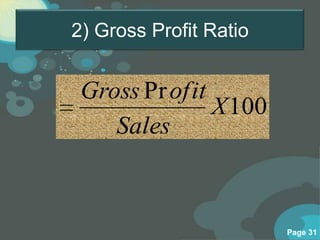
2) Gross Profit Ratio


 Gross Pr ofit
               X 100
    Sales


                        Page 31
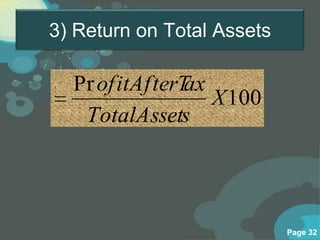
3) Return on Total Assets

  Pr ofitAfterTax
                  X 100
   TotalAssets


                            Page 32
4) Return on Equity


  Pr ofitAfterT ax
                     X 100
Shareholders ' Funds


                         Page 33
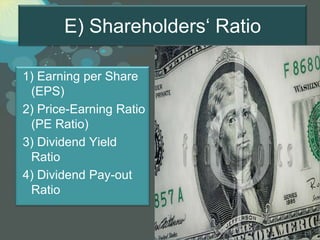
E) Shareholders‘ Ratio

1) Earning per Share
 (EPS)
2) Price-Earning Ratio
 (PE Ratio)
3) Dividend Yield
 Ratio
4) Dividend Pay-out
 Ratio


                                Page 34
1) Earning per Share


   Pr ofitAfterT ax
NumberofEq uityShares


                        Page 35
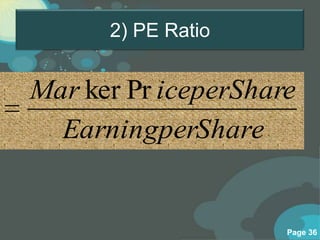
2) PE Ratio


Mar ker Pr iceperShare
  EarningperShare


                     Page 36
3) Dividend Yield Ratio


 DividendperShare
                      X 100
Market Pr iceperShare


                             Page 37
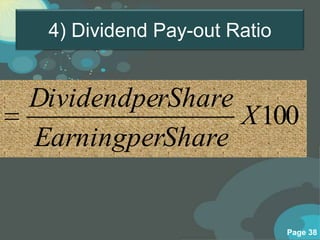
4) Dividend Pay-out Ratio


DividendperShare
                 X 100
EarningperShare


                             Page 38
THANK YOU


        Page 39

Ratio analysis enlarged version-b.v.raghunandan

  • 1.
    Ratio Analysis B.V.Raghunandan, SVS College, Bantwal Page 1
  • 2.
    Definition Ratio Analysis isa financial technique of measuring the strength and weakness of an organisation out of information available from financial reports specifically from the Balance Sheet and Income Statement Page 2
  • 3.
    Advantages • Measuring theefficiency of organisations • Measuring the liquidity position of the companies • Measuring the capacity of companies to borrow in the future • Understanding the overall financial position of organisations • Estimating the solvency of the companies • Helping in forecasting Page 3
  • 4.
    Disadvantages • Only quantitativetools • Manipulation of accounting figures • Too many analytical tools lead to varied interpretation • Based on past data • Same data may be interpreted in different ways • Vested interests • Measuring the changes in price levels • Accounting policies have the impact • Only symptoms and not cure Page 4
  • 5.
    A] Liquidity Ratios B] Solvency Ratios C] Activity Ratios D] Profitability Ratios Different Ratios E] Shareholders’Page 5 Ratios
  • 6.
    A] Liquidity Ratio CurrentAssets • Current Ratio = CurrentLiabilities CurrentAss ets Clo sin gStock • Acid Test Ratio= CurrentLia bility Sales • Working Capital Turnover Ratio = WorkingCapital Page 6
  • 7.
    A. Liquidity Ratios •Used to study the ability of the organisation in meeting short-term payments or obligations • Includes: 1) Current Ratio, 2) Acid Test Ratio and 3) Working Capital Turnover Ratio Page 7
  • 8.
    1) Current Ratio •Relation between current assets and current liabilities • Long Term Sources Financing the Current assets give a stable base for the liquidity of the organisation • Normally , the ratio should not be less than 2 i.e., the current assets should be double the size of current liabilities Page 8
  • 9.
    Measurement of CurrentRatio CurrentAssets Current Ratio = CurrentLiabilities Page 9
  • 10.
    Precautions to beTaken for Current Ratio • Proper Valuation of assets and • Advance payments for fixed liabilities assets should be excluded • Provision for Bad Debts • Instalment payments are part • Useless Inventory Deducted of current liabilities • Loose Tools are not current • Bank overdraft and cash credit assets are part of current liabilities • Short Term Investment can be • Bills Receivables are a part of part of current assets current assets • Long Term investment like • Bank Loans should not be capital of subsidiary is not treated as current liabilities current asset • Advances to Employees or Utilities are to be treated as current assets Page 10
  • 11.
    2) Acid TestRatio/Quick Ratio • It is the ratio between quick assets and quick liabilities • Quick assets include current assets except inventory and pre-paid expenses • Quick liabilities include current liabilities other than bank overdraft • A 1:1 ratio is healthy • Healthy indicator of cash management Page 11
  • 12.
    Measurement of AcidTest Ratio QuickAssets Acid Test Ratio = QuickLiabilities Page 12
  • 13.
    3) Working CapitalTurn-over Ratio • Shows the efficiency of usage of working capital • Relation between Sales and Working Capital • Determination of number of times the working capital is turned over to achieve the maximum profit Page 13
  • 14.
    Measurement of WorkingCapital Turnover Ratio NetSales AverageWor kingCapital Page 14
  • 15.
    B. Solvency Ratios •Measure long-term liquidity ratio • Reflect the ability of the firm to pay interest and repayment of loans at due dates on the long-term loans taken • Avoidance of over-borrowing (over- leverage) • Avoidance of bankruptcy by maintaining healthy solvency ratios Page 15
  • 16.
    Types of SolvencyRatios 1) Interest Coverage Ratio 2) Debt Ratio 3) Debt-Equity Ratio 4) Capital Gearing Ratio 5) Proprietary Ratio Page 16
  • 17.
    1.Interest Coverage Ratio Pr ofitBefore Interest & Tax InterestonLong TermDebt Page 17
  • 18.
    2. Debt Ratio(Debt to Total Funds ratio) LTDebt LTDebt ShareholdersFunds Page 18
  • 19.
    3) Debt-Equity Ratio LongTermDebt ShareholdersFunds Page 19
  • 20.
    4) Capital GearingRatio FixedIncomeBearingSecurities EquityShareholdersFund Page 20
  • 21.
  • 22.
    C] Activity Ratios 1) Inventory Turnover Ratio 2) Debtors Turnover Ratio 3) Average Collection Period 4) Fixed Assets Turnover Ratio 5) Total Assets Turnover Ratio 6) Capital Turnover Ratio Page 22
  • 23.
    1) Inventory TurnoverRatio CostofGood sSold CostofGood sSold AverageStock AverageStock Page 23
  • 24.
    2) Debtor TurnoverRatio CreditSales AverageDebtors Page 24
  • 25.
    3) Average CollectionPeriod 365(day sin aYear) / 12(months) DebtorTurnoverRatio Page 25
  • 26.
    4) Fixed AssetsTurnover Ratio NetSales NetFixedAssets Page 26
  • 27.
    5) Total AssetsTurnover Ratio NetSales TotalAssets Page 27
  • 28.
    6) Capital TurnoverRatio NetSales Long TermFunds Page 28
  • 29.
    D] Profitability Ratios 1)Net Profit Ratio 2) Gross Profit Ratio 3) Return on Total Assets 4) Return on Equity Page 29
  • 30.
    1) Net ProfitRatio Pr ofitAfterTax X 100 NetSales Page 30
  • 31.
    2) Gross ProfitRatio Gross Pr ofit X 100 Sales Page 31
  • 32.
    3) Return onTotal Assets Pr ofitAfterTax X 100 TotalAssets Page 32
  • 33.
    4) Return onEquity Pr ofitAfterT ax X 100 Shareholders ' Funds Page 33
  • 34.
    E) Shareholders‘ Ratio 1)Earning per Share (EPS) 2) Price-Earning Ratio (PE Ratio) 3) Dividend Yield Ratio 4) Dividend Pay-out Ratio Page 34
  • 35.
    1) Earning perShare Pr ofitAfterT ax NumberofEq uityShares Page 35
  • 36.
    2) PE Ratio Marker Pr iceperShare EarningperShare Page 36
  • 37.
    3) Dividend YieldRatio DividendperShare X 100 Market Pr iceperShare Page 37
  • 38.
    4) Dividend Pay-outRatio DividendperShare X 100 EarningperShare Page 38
  • 39.
    THANK YOU Page 39