ORGANIZATIONAL
BEHAVIOUR (OB)
UNIT I
What is OB?
• A field of study that investigates the impact that
individuals, groups, and structure have on behaviour
within organizations, for the purpose of applying such
knowledge toward improving an organization's
effectiveness
• OB "studies three determinants of behaviour in
organizations: INDIVIDUALS, GROUPS, AND STRUCTURE
• OB applies the knowledge gained about individuals,
groups, and the effect of structure on behavior in order
to make organizations work more effectively"
Contributing Disciplines
• Organizational Behaviour is an applied
behavioural science that is built upon
contributions from a number of behavioural
disciplines
– Behavioural science is the systematic analysis and
investigation of human and animal behaviour
through controlled and naturalistic observation,
and disciplined scientific experimentation.
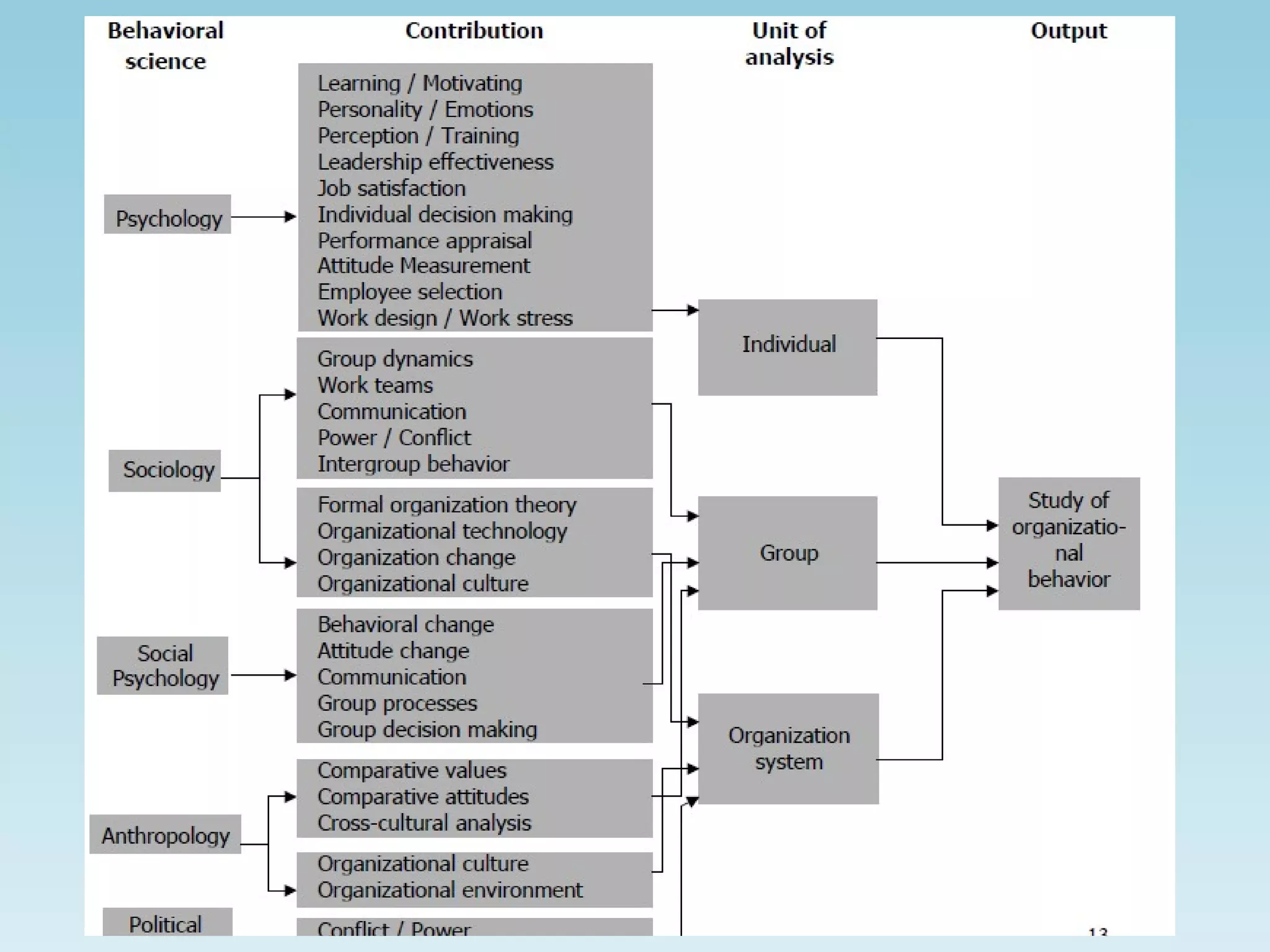
• The predominant areas are psychology,
sociology, social psychology, anthropology,
and political science
Contribution of Psychology
• The Science that seeks to measure, explain, and
sometimes change the behaviour of humans and
other animals
• Psychologists concern themselves with studying
and attempting to understand individual
behaviour
• Those who have contributed and continue to
add to the knowledge of OB are learning
theorists, personality theorists, counselling
psychologists, and, most important, industrial
and organizational psychologists
Contribution of Sociology
• The study of people in relation to their fellow
human beings
• Whereas psychologists focus their attention
on the individual, sociologists study the
social system in which individuals fill their
roles
– Sociology studies people in relation to their
fellow human beings
Contribution of Social Psychology
• An area within psychology that blends
concepts from psychology and sociology and
that focuses on the influence of people on
one another
• An area within psychology, blending
concepts from both psychology and sociology
Contribution of Anthropology
• The study of societies to learn about human
beings and their activities
• Anthropologists’ work on cultures and
environments, has helped to understand
differences in fundamental values, attitudes,
and behaviour among people in different
countries and within different organizations
Contribution of Political Science
• The study of the behaviour of individuals and
groups within a political environment
– Areas of concern here include structuring of
conflict, allocation of power, and how people
manipulate power for individual self-interest
Challenges for OB
• Responding to Globalization
• Managing Workforce Diversity
• Improving Quality and Productivity
– Re-engineering
– Total Quality Management
• Improving People Skills
• Empowering People
• Coping with temporariness
• Stimulating Innovation and Change
• Inculcating an Ethical Code of Conduct &
Improving Ethical Behaviour
Employee Characteristics affecting
Behaviour
– Age
– Gender
– Marital Status
– Tenure (Duration of stay in an organization)
– Ability (Capacity)
– Intellectual Abilities (number aptitude, verbal
comprehension, perceptual speed, inductive reasoning,
deductive reasoning, spatial visualization, and Memory)
– Physical Abilities (specially for successfully doing less skilled
and more standardized jobs)
– Ability-Job Fit (Directing attention at interaction of both -
the employee's abilities and the ability requirements of the
job)

Introduction to Organization Behaviour

  • 1.
  • 2.
    What is OB? •A field of study that investigates the impact that individuals, groups, and structure have on behaviour within organizations, for the purpose of applying such knowledge toward improving an organization's effectiveness • OB "studies three determinants of behaviour in organizations: INDIVIDUALS, GROUPS, AND STRUCTURE • OB applies the knowledge gained about individuals, groups, and the effect of structure on behavior in order to make organizations work more effectively"
  • 3.
    Contributing Disciplines • OrganizationalBehaviour is an applied behavioural science that is built upon contributions from a number of behavioural disciplines – Behavioural science is the systematic analysis and investigation of human and animal behaviour through controlled and naturalistic observation, and disciplined scientific experimentation. • The predominant areas are psychology, sociology, social psychology, anthropology, and political science
  • 5.
    Contribution of Psychology •The Science that seeks to measure, explain, and sometimes change the behaviour of humans and other animals • Psychologists concern themselves with studying and attempting to understand individual behaviour • Those who have contributed and continue to add to the knowledge of OB are learning theorists, personality theorists, counselling psychologists, and, most important, industrial and organizational psychologists
  • 6.
    Contribution of Sociology •The study of people in relation to their fellow human beings • Whereas psychologists focus their attention on the individual, sociologists study the social system in which individuals fill their roles – Sociology studies people in relation to their fellow human beings
  • 7.
    Contribution of SocialPsychology • An area within psychology that blends concepts from psychology and sociology and that focuses on the influence of people on one another • An area within psychology, blending concepts from both psychology and sociology
  • 8.
    Contribution of Anthropology •The study of societies to learn about human beings and their activities • Anthropologists’ work on cultures and environments, has helped to understand differences in fundamental values, attitudes, and behaviour among people in different countries and within different organizations
  • 9.
    Contribution of PoliticalScience • The study of the behaviour of individuals and groups within a political environment – Areas of concern here include structuring of conflict, allocation of power, and how people manipulate power for individual self-interest
  • 10.
    Challenges for OB •Responding to Globalization • Managing Workforce Diversity • Improving Quality and Productivity – Re-engineering – Total Quality Management • Improving People Skills • Empowering People • Coping with temporariness • Stimulating Innovation and Change • Inculcating an Ethical Code of Conduct & Improving Ethical Behaviour
  • 11.
    Employee Characteristics affecting Behaviour –Age – Gender – Marital Status – Tenure (Duration of stay in an organization) – Ability (Capacity) – Intellectual Abilities (number aptitude, verbal comprehension, perceptual speed, inductive reasoning, deductive reasoning, spatial visualization, and Memory) – Physical Abilities (specially for successfully doing less skilled and more standardized jobs) – Ability-Job Fit (Directing attention at interaction of both - the employee's abilities and the ability requirements of the job)