Unit-4
ORGANISATIONAL BEHAVIOR
Definitions:
• “Organizational behavior is a subset of
management activities concerned with
understanding, predicting and influencing
individual behavior in organizational
setting.”—Callahan, Fleenor and Kudson.
• In short, organizational behavior revolves
around two fundamental components:
• The nature of the man.
• The nature of the organisation.
Characteristics of Organizational
Behavior:
• Behavioural Approach to Management:
Organisational behavior is that part of whole management which
represents the behavioural approach to management
• Cause and Effect Relationship:
Human behaviour is generally taken in terms of cause and effect
relationship and not in philosophical terms
• Organizational Behavior is a Branch of Social Sciences:
Organizational behavior is heavily influenced by several other social
sciences viz. psychology, sociology and anthropology.
• Three Levels of Analysis:
Organizational behavior encompasses the study of three levels of
analysis namely individual behavior, inter-individual behavior and
the behavior of organisations themselves.
• A Science as well as an Art:
Organizational behavior is a science as well as an art. The systematic
knowledge about human behavior is a science and the application
of behavioral knowledge and skills is an art.
• A Body of Theory, Research and Application:
Organizational behavior consists of a body of theory, research and
application which helps in understanding the human behavior in
organisation
• Beneficial to both Organisation and Individuals:
Organizational behavior creates an atmosphere whereby both
organisation and individuals are benefitted by each other.
• Rational Thinking:
Organizational behavior provides a rational thinking about people
and their behavior.
CULTURE AND DIVERSITY
• Organizational culture:
• Culture is the single most important factor
accounting for the success or failure of an
organization".
— Deal and Kennedy
• Organizational culture is defined as the set of
assumptions, beliefs, values and norms that are
shared by members of an organization.
Characteristics of Organizational Culture
BEHAVIORAL REGULARITIES
• When organizational members interact with 'one another, they use common
technology, language and rituals related to respect and behavior,
NORMS
• These include behavioral standards including guidelines on how much to work.
VALUES
• Every organization advocates and expects its employees to share values. Some
examples are, high product quality, low absenteeism and high efficiency.
PHILOSOPHIES
• These are some policies that an organization believes regarding how to treat its
customers and employees
RULES
• These are some guidelines to get along in the organization. New employees should
learn them to be treated as a member of the organization.
ORGANIZATIONAL CLIMATE
• This refers to the physical layout, the way the participants interact, the way in
which the members of the organization behave with customers, outsiders etc.
Factors Shaping the Organizational Culture
Characteristics of People in an Organization
• Human resources of an organization are the most important source of the
organizational culture. The culture of an organization differs from one organization
to another organization, due to the presence of different members.
Ethics of an Organisation:
• Few organisations creates an ethical environment in order to monitor their
members behavior The most important set values are the organizational ethics
which includes the moral values, beliefs and rules that create the adequate way for
an organisation and its members to behave with each other and also with the
outside people.
Employment Relationship
It is the third factor which shapes up the organizational culture where in
thecompany creates an employment relatiationship with its employees through its
human resource policies and practices.
Organizational design
• The last important factor shaping the organizational culture is the organizational
structure. Organizational structure is the formal way of task and reporting
relationships which an organization creates 'order to encourage and coordinate its
employees
ELEMENTS OF ORGANISATIONAL CULTURE
Organizational Identity, Image and Mission
• In general, organizational identity, image and mission is the way an organization projects itself to both the society and
customers.
Organizational Space and Scope
• The manner in which an organization specifies its own organizational space in society in terms of both i.e. psychological and
physical.
Organizational Attitudes, Beliefs and Myths
• The success or failure of an organization is the most important part which depends on its belief system, attitudes and myths.
Organizational Processes and Learning
• The enterprise usually uses the processes for the purpose of manufacturing, reasoning, technology, development and
human relations.
Organizational Relationship
• Usually, culture has its special attitudes towards different types of relationships between members.
Organizational Communication and Language
• In whole enterprise or within its divisions a unique terminology or acronyms or codes are used widely. Even human systems
may have a particular gestures, process and jargons.
Organizational Personal Recognitions and Rewards
• The organization always tries to look for and strengthens some type of persons. Recognition and rewards will be based on
some kind of achievements.
Organizational Rituals and Ceremonies
• The rituals and ceremonies in an organization reflect the organizational culture.
Organizational Values and Norms
• The values and norms followed in an organization decide the organizational culture.
Organizational Look, Style and Reputation
• The organization look, style and reputation is judged by its products and services, buildings and
equipments, dress of its employees, external vitality, its reports and publications.
Process of Creating an Organizational Culture
1. Establishment of values
2. Creation of vision
3. Operational sing values and vision
4. Socialization of employees
1. Establishment of Values
• Establishment of the values that govern the members OF the organization is the first
step in creatin g organizational Culture
2. Creation of Vision
• Vision is the projection about what should be done in the future to achieve the stated
goals. It is derived from the values created in the first step.
• A visionary company holds a distinctive set of values
from which it does not deviate.
3. Operational zing Values and Vision
• Values and vision created in first two steps are put into action in this step. This can be
done by undertaking the following activities.
4. Socialization of employees
• In an organizational context socialization is a adaptive process that takes place as new
employees attempt to learn and inculcate values and norms that are a part of
organizational culture.
Diversity with reference to demographic characteristics, levels of diversity and
discrimination
Diversity
• Diversity refers to, the difference among people/employees/workforce with regard to factors like Age, Gender,
Ethnicity, Race or Physical ability. According to on line Dictionary of Webster, diversity is "the condition of ‘being
different or diverse, variety”.
The Concept of 'Diversity further explained, with reference to,
• Demographic characteristics
• Levels of Diversity
• Discrimination.
(a) Demographic Characteristics
• Demographic characteristics includes Age, Race, Ethnicity, Sex, National-origin, Physical status and sexual
orientation. Demographic diversity is the mixture of above demographic characteristics.
(b) Levels of Diversity
• There are two levels in the diversity they are,
• Surface-level diversity
• Deep-level diversity.
Surface-level Diversity
• Surface level diversity refers to the. Difference between the perceived characteristics of individual like gender,
race, ethnicity, .age or disability which does not influence thinking and feeling of individual but may activate
certain. Stereo types.
2. Deep-level Diversity
• Deep level diversity refers to the difference between the individual's, beliefs,
values, norms, personality And work preferences which play a crucial role while
understanding and determining similarity in each other.
(c) Discrimination
• Discrimination means differentiating people/employees by highlighting differences
among them One employee is more educated or qualified than other
PERSONALITY
• The word personality is derived from a Greek word “persona” which means “to speak through.” Personality is the
combination of characteristics or qualities that forms a person’s
Determinants of Personality in Organizational behavior
Biological determinants of Personality Development
• The biological determinants of personality development are
Biological Factors
The study of the biological contributions to personality may be studied under three heads:
Heredity: Heredity refers to those factors that were determined at conception.
Physical stature, facial attractiveness, sex, temperament, muscle composition and reflexes, energy level, and
biological rhythms are characteristics that are considered to be inherent from one’s parents
Brain: The second biological approach is to concentrate on the role that the brain plays in personality. Though
researchers make some promising inroads, the psychologists are unable to prove empirically the contribution of
human brain in influencing personality
Biofeedback: Until recently, physiologists and psychologists felt that certain biological functions such as brainwave
patterns, gastric secretions, and fluctuations in blood pressure and skin temperature were beyond conscious
control.
Physical features: A vital ingredient of the personality, an individual's external appearance, is biologically determined.
The fact that a person is tall or short, fat or skinny, black or white will influence the person's effect on others and
this in turn, will affect the self-concept
• Cultural Factors
• Among the factors that exert pressures on our personality formation are the culture in which
we are raised, our early conditioning, the norms among our family, friends and social groups
and other influences we experience
• Family Factors
• Whereas the culture generally prescribes and limits what a person can be taught, it is the
family, and later the social group, which selects, interprets and dispenses the culture. Thus,
the family probably has the most significant impact on early personality development.
• Social Factors
• There is increasing recognition given to the role of other relevant persons, groups and
especially organizations, which greatly influence an individual's personality. This is commonly
called the socialization process. Socialization involves the process by which a person acquires,
from the enormously wide range of behavioural potentialities that are open to him or her.
• Situational Factors
• Human personality is also influenced by situational factors. The effect of environment is quite
strong. Knowledge, skill and language are obviously acquired and represent important
modifications of behaviour
Theories of personality
• Type theory of personality
Individual personality was determined by the amount of each of the four humors.
Hippocrates' system remained influential in Western Europe throughout the medieval and
Renaissance periods. Abundant references to the four humors can be found in the plays of
Shakespeare, and the terms with which Hippocrates labeled the four personality types are
still in common use today.
• Trait theory of personality
A major weakness of Sheldon's morphological classification system and other type theories
in general is the element of oversimplification inherent in placing individuals into a single
category, which ignores the fact that every personality represents a unique combination of
qualities. Systems that address personality as a combination of qualities or dimensions are
called trait theories.
• Psychodynamic theory of personality
• Twentieth-century views on personality have been heavily influenced by the psychodynamic
approach of Sigmund Freud. Freud proposed a three-part personality structure consisting of
the id (concerned with the gratification of basic instincts), the ego (which mediates between
the demands of the id and the constraints of society), and the superego (through which
parental and social values are internalized). In contrast to type or trait theories of personality,
the dynamic model proposed by Freud involved an ongoing element of conflict, and it was
these conflicts that Freud saw as the primary determinant of personality. His psychoanalytic
method was designed to help patients resolve their conflicts by exploring unconscious
thoughts, motivations, and conflicts through the use of free association and other
techniques. Another distinctive feature of Freudian psychoanalysis is its emphasis on the
importance of childhood experiences in personality formation. Other psychodynamic models
were later developed by colleagues and followers of Freud, including Carl Jung, Alfred Adler,
and Otto Rank (1884-1939), as well as other neo-Freudians such as Erich Fromm, Karen
Horney, Harry Stack Sullivan (1892-1949), and Erik Erikson.
• Psychoanalytic Perspective
• The psychoanalytic perspective of personality emphasizes the importance of early childhood
experiences and the unconscious mind. This perspective on personality was created by
psychiatrist Sigmund Freud who believed that things hidden in the unconscious could be revealed
in a number of different ways, including through dreams, free association, and slips of the tongue.
• Neo-Freudian theorists, including Erik Erikson, Carl Jung, Alfred Adler, and Karen Horney, believed
in the importance of the unconscious but disagreed with other aspects of Freud's theories.
• Humanistic Perspective
• The humanistic perspective of personality focuses on psychological growth, free
will, and personal awareness. It takes a more positive outlook on human nature
and is centered on how each person can achieve their individual potential.
• Trait Perspective
• The trait perspective of personality is centered on identifying, describing, and
measuring the specific traits that make up human personality. By understanding
these traits, researchers believe they can better comprehend the differences
between individuals.
• Social Cognitive Perspective
• The social cognitive perspective of personality emphasizes the importance
of observational learning, self-efficacy, situational influences, and cognitive
processes.
• Big Five personality test traits
• the Big Five traits of personality are five broad domains which define human
personality and account for individual differences
• Openness - People who like to learn new things and enjoy new experiences usually
score high in openness. Openness includes traits like being insightful and
imaginative and having a wide variety of interests.
• Conscientiousness - People that have a high degree of conscientiousness are
reliable and prompt. Traits include being organized, methodic, and thorough.
• Extraversion - Extraverts get their energy from interacting with others, while
introverts get their energy from within themselves. Extraversion includes the traits
of energetic, talkative, and assertive.
• Agreeableness - These individuals are friendly, cooperative, and compassionate.
People with low agreeableness may be more distant. Traits include being kind,
affectionate, and sympathetic.
• Neuroticism - Neuroticism is also sometimes called Emotional Stability. This
dimension relates to one’s emotional stability and degree of negative emotions.
People that score high on neuroticism often experience emotional instability and
negative emotions. Traits include being moody and tense.
PERCEPTION
• Definition of perception
• Perception means perceiving, i.e., giving meaning to the environment around us. It can be defined
as a process which involves seeing, receiving, selecting, organising, interpreting and giving meaning
to the environment.
It can be divided into six types −
• Of sound − The ability to receive sound by identifying vibrations.
• Of speech − The competence of interpreting and understanding the sounds of language heard.
• Touch − Identifying objects through patterns of its surface by touching it.
• Taste − The ability to receive flavor of substances by tasting it through sensory organs known as
taste buds.
• Other senses − They approve perception through body, like balance, acceleration, pain, time,
sensation felt in throat and lungs etc.
• Of the social world − It permits people to understand other individuals and groups of their social
world. Example − Priya goes to a restaurant and likes their customer service, so she will perceive
that it is a good place to hang out and will recommend it to her friends, who may or may not like it.
Priya’s perception about the restaurant is good.
Perceptual Process
• Perception is a process of receiving, selecting, organising, interpreting, checking and reacting to stimuli.
This is like an input-through put-output process in which the stimuli can be considered as 'inputs'
transformation of 'input' through selection,
• Receiving Stimuli: The first process in the perception is the presence of stimuli. The stimuli are received
from the various sources. Through the five organs.
• Selection of Stimuli : After receiving the stimuli or data, some are selected. Others are screened out. Two
types of factors affect selection of stimuli for processing : external and internal factors.
• External factors relate to stimuli such as intensity of stimuli, its size, movement, repetition, etc.
• Internal factors, relate to the perceiver such as his/her age, learning, interest, etc.
• Organizing
• Keeping things in order or say in a synchronized way is organizing. In order to make sense of the data
received, it is important to organize them. We can organize the data by −
• Grouping them on the basis of their similarity, proximity, closure, continuity.
• Establishing a figure ground is the basic process in perception. Here by figure we mean what is kept as
main focus and by ground we mean background stimuli, which are not given attention.
• Perceptual constancy that is the tendency to stabilize perception so that contextual changes don’t affect
them.
• Interpreting
• Finally, we have the process of interpreting which means forming an idea about a particular object
depending upon the need or interest. Interpretation means that the information we have sensed and
organized, is finally given a meaning by turning it into something that can be categorized. It includes
stereotyping, halo effect etc.
Factors Influencing Perceptual Set External Factors
• Size : Bigger size attracts the attention of the perceiver
• Intensity : A loud sound, strong odor or bright light is noticed more as compared to a soft sound, weak
odour or dimlight.
• Repetition : A repeated external stimulus is more attention getting than a single one. Advertisers use this
principle.
• Novelty and Familiarity : A novel or a familiar external situation can serve as attention getter.
• Contrast : It is a kind of uniqueness which can be used for attention getting. Letters of bold types, persons
dressed differently than others, etc., get more attention.
• Motion : A moving object draws more attention as compared to a stationary object. Advertisers use this
principle.
• Internal Factors
• Self-concept : The way a person views the world depends a great deal on the concept or image he has
about himself. The concept plays an internal role in perceptual selectivity.
• Beliefs : A person's beliefs have profound influence on his perception. Thus, a fact is conceived not on
what it is but what a person believes it to be.
.
GROUP BEHAVIOUR
• Meaning of Group Behaviour:
• M.E. Shaw defined a group “as two or more people who interact and influence one another.” Viewers in a
theatre, passengers in a train are not a group unless they interact for long and exert some influence on
each other. Such people’s gatherings are referred to as collection
Formation of Groups
• The 5 Stages of Group Formation
• Tuckman was responsible for coining the 5 main stages in the process of group discussion. They are also
known as Tuckman’s 5 stages of group development. Moreover, these stages of group formation are
meant to be followed in the exact sequence as they are below:
• Forming
• This is a beginning stage and lasts only a few days (or weeks). Members begin by planning their work and
their new roles. Moreover, the emotions here are positive. The groups should begin by learning about
team processes in preparation for the rough times ahead.
• However, it is crucial for them to learn the aspects of conflict resolution, communication, group decision-
making and time management.
• Storming
• There exists a considerable amount of fights and arguments in this stage. People begin to feel the stress of
frustration, resentment, and anger. Moreover, as the problem festers, the job remains undone.
• Managers also experience frustration and are worried about the situation, thereby, are tempted to
intervene. Members experience a drastic emotional roller coaster from elation to depression.
• Moreover, the situation seems bleak. Usually, the storming period may last 1-2 months. Also, without
effective training and support, the team may experience retarded growth.
• Norming
• In the norming stage, the group works through individual and social issues. The group establishes its own
norms of behaviour and begin to trust each other. Moreover, as the group develops interpersonal skills, it
becomes all the more skilled.
• Members begin the art and knack of problem-solving. They also cross-train and learn new and adequate
job skills. This stage usually lasts for 4-12 months.
• Performing
• In this stage, the group is ready to begin performing its respective task and assigned jobs. In this stage, the
group has become well acquainted with one another and has clarity with regard to what needs to and has
to be done. The performing stage begins when the group is comfortable to work and ends when the job is
completed.
• Adjourning
• Post the performing stage, the group is adjourned. The adjourning stage ends the process of group
formation. Because the group is adjourned once the task that is assigned to the group is complete
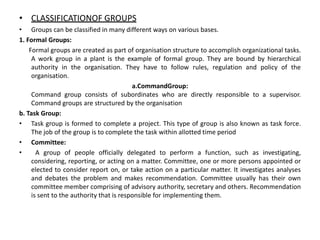
• CLASSIFICATIONOF GROUPS
• Groups can be classified in many different ways on various bases.
1. Formal Groups:
Formal groups are created as part of organisation structure to accomplish organizational tasks.
A work group in a plant is the example of formal group. They are bound by hierarchical
authority in the organisation. They have to follow rules, regulation and policy of the
organisation.
a.CommandGroup:
Command group consists of subordinates who are directly responsible to a supervisor.
Command groups are structured by the organisation
b. Task Group:
• Task group is formed to complete a project. This type of group is also known as task force.
The job of the group is to complete the task within allotted time period
• Committee:
• A group of people officially delegated to perform a function, such as investigating,
considering, reporting, or acting on a matter. Committee, one or more persons appointed or
elected to consider report on, or take action on a particular matter. It investigates analyses
and debates the problem and makes recommendation. Committee usually has their own
committee member comprising of advisory authority, secretary and others. Recommendation
is sent to the authority that is responsible for implementing them.
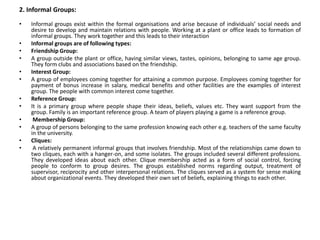
2. Informal Groups:
• Informal groups exist within the formal organisations and arise because of individuals’ social needs and
desire to develop and maintain relations with people. Working at a plant or office leads to formation of
informal groups. They work together and this leads to their interaction
• Informal groups are of following types:
• Friendship Group:
• A group outside the plant or office, having similar views, tastes, opinions, belonging to same age group.
They form clubs and associations based on the friendship.
• Interest Group:
• A group of employees coming together for attaining a common purpose. Employees coming together for
payment of bonus increase in salary, medical benefits and other facilities are the examples of interest
group. The people with common interest come together.
• Reference Group:
• It is a primary group where people shape their ideas, beliefs, values etc. They want support from the
group. Family is an important reference group. A team of players playing a game is a reference group.
• Membership Group:
• A group of persons belonging to the same profession knowing each other e.g. teachers of the same faculty
in the university.
• Cliques:
• A relatively permanent informal groups that involves friendship. Most of the relationships came down to
two cliques, each with a hanger-on, and some isolates. The groups included several different professions.
They developed ideas about each other. Clique membership acted as a form of social control, forcing
people to conform to group desires. The groups established norms regarding output, treatment of
supervisor, reciprocity and other interpersonal relations. The cliques served as a system for sense making
about organizational events. They developed their own set of beliefs, explaining things to each other.
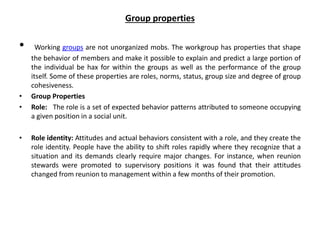
Group properties
• Working groups are not unorganized mobs. The workgroup has properties that shape
the behavior of members and make it possible to explain and predict a large portion of
the individual be hax for within the groups as well as the performance of the group
itself. Some of these properties are roles, norms, status, group size and degree of group
cohesiveness.
• Group Properties
• Role: The role is a set of expected behavior patterns attributed to someone occupying
a given position in a social unit.
• Role identity: Attitudes and actual behaviors consistent with a role, and they create the
role identity. People have the ability to shift roles rapidly where they recognize that a
situation and its demands clearly require major changes. For instance, when reunion
stewards were promoted to supervisory positions it was found that their attitudes
changed from reunion to management within a few months of their promotion.
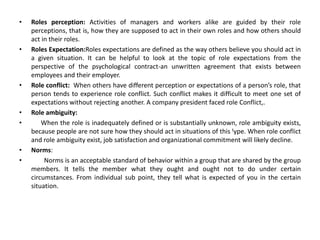
• Roles perception: Activities of managers and workers alike are guided by their role
perceptions, that is, how they are supposed to act in their own roles and how others should
act in their roles.
• Roles Expectation:Roles expectations are defined as the way others believe you should act in
a given situation. It can be helpful to look at the topic of role expectations from the
perspective of the psychological contract-an unwritten agreement that exists between
employees and their employer.
• Role conflict: When others have different perception or expectations of a person’s role, that
person tends to experience role conflict. Such conflict makes it difficult to meet one set of
expectations without rejecting another. A company president faced role Conflict,.
• Role ambiguity:
• When the role is inadequately defined or is substantially unknown, role ambiguity exists,
because people are not sure how they should act in situations of this type. When role conflict
and role ambiguity exist, job satisfaction and organizational commitment will likely decline.
• Norms:
• Norms is an acceptable standard of behavior within a group that are shared by the group
members. It tells the member what they ought and ought not to do under certain
circumstances. From individual sub point, they tell what is expected of you in the certain
situation.
• Common Classes of norms: There are some common classes of norms that appear in the most workgroup.
Such as:
Performance norms: Here workgroups typically provide their members with explicit cues on how hard they
should work. how to get the job done.
Appearance norms: A second category encompasses appearance norms. This includes things like appropriate
dress. loyalty to the workgroup or organization, when to look busy, and when it is acceptable
Arrangement norms: These norms come from informal work groups and primarily regulate social interactions
within the group.
Resources norms: A final category relates to allocation of resources norms. These norms can originate in the
group or in the organizational and cover things like pay’. assignment of difficult jobs, and allocation of new
tools and equipment.
• Status:
• The status that is, a socially defined position or rank is given to group or group’s member by others
permeates every society. Evan the smallest group will develop roles, rights, and rituals to differentiate its
members. Status is an important factor in understanding human behavior because it is a significant
motivator and has major behavioral consequences when individuals perceive a. the disparity between
what they believe their status to be what others perceive it to be.
• Size:
• The size of a group affects the group’s overall behavior. The impact of size on a group’s performance
depends on the type of task in which the group is engaged. In an organization, the group can be formed
either large or smaller.
• Smaller group: In smaller groups- those are faster at completing tasks that are large ones and that
individuals perform better in smaller groups than in large ones. Those are better at doing
something productive with that input.
• Large group: Large groups- those with a dozen or more members- are good for gaining diverse
input. So if the goal of the group is fact-finding, large groups should be more effective. However, for
groups engaged in problem-solving, large groups consistently get better marks than their smaller
counterparts.
• Cohesiveness:
• Group differs in their cohesiveness- that is, the degree to which members are attracted to
each other and are motivated to stay in the groups. For instances, some work groups are cohesive
because the members have spent a great deal of time together, or the group’s small size facilities
high interaction, or the group has experienced external threats that have brought members closer
together. Cohesiveness is important because it has been found to be related to group productivity.
• Make the group smaller.
• Encourage agreement with group goals.
• Increase the time members spend together.
• Increase the status of the group and the perceived difficulty of attaining membership in the group.
• Stimulate competition with other groups.
• Give a reward to the group rather than to individual member.
• Physically isolated the group.
Group Cohesiveness
• Cohesiveness is an important characteristic of group. Rensis Likert has defined cohesiveness as “the
attractiveness of the members to the group or resistance of the members to leaving it.” It refers to the
attachment of the members with the group.
• Factors affecting cohesiveness:
• There are some factors that affect cohesiveness of group.
• They are as under:
• Group Formation Factors:
• The factors which are responsible for group formation such as common interests, shared goals, etc. serve
as the base for cohesiveness.
• Interaction:
Interaction between the group members makes the group more cohesive.
• Difficulty in Membership:
• Some groups take great care in selecting their members and making admission to them very difficult.
Difficulty in getting membership increases cohesiveness of group. Such groups are valued by members and
feel proud of being members.
• Success:
• Success of individual or shared objectives by the members feels pride about the success resulting in
greater cohesion of the group.
• Threat:
• When members of group feel threatened from any source, external in particular
increases cohesiveness.
• Size of Group:
• Size of the group affects its cohesiveness. Increased size of group decreases its
cohesiveness and vice versa. Small size of group facilitates more interaction among
the group members, hence more cohesiveness.
• Continued Membership:
• Membership of the group is continued by its members for a longer period of time
increases cohesiveness of group. New members do not get membership easily
because of opposition from the old members.
• Attitude and Values:
• Cohesiveness of group increases because of shared attitude and values. Everyone
gets attracted towards the people having identical attitudes, values and beliefs.
The sense of security and safety develops with the likeminded people.
Building an effective team
• Building a high performance team involves more than just randomly assembling a group of
talented individuals. For a team to be truly effective, its members must unite with the same
vision and be motivated to bring that vision to life. They must share clear, measurable goals,
and be committed to each play their part in the overall success of the group.
• Define the purpose
• Clearly define the purpose of the team, including the overall outcome it has been brought
together to achieve.
• 2. Assemble the team
• High performance teams are comprised of individuals that passionately embrace the vision,
believe their contribution is meaningful and are motivated to give their best effort. All team
members should trust, respect and support each other.
• 3. Determine the goals
• Once the team is established and united behind a shared, compelling purpose, the next step
is to break the vision down into smaller, manageable goals and tasks. Outline the required
tasks in a schedule, with agreed deadlines, milestones and responsibilities.
• 4. Set expectations
• To ensure that each member understands what is expected of them, define a standard
of conduct for the team. Will communication be frequent, open, honest and
transparent? Will contributions be encouraged, valued and recognised? Will conflict be
handled in a constructive way? Will team decisions and feedback be respected? Setting
clear standards from the outset will ensure that each member’s conduct and
contributions are appropriate.
• 5. Monitor and review
• Regularly review the group’s performance through team meetings and one-on-one
catch ups to ensure that progress is being made. Good questions to ask are: how are we
doing? What have we achieved so far? What have we learned? What isn’t working so
well? How can we improve? Monitoring and reviewing progress allows for adjustments
and improvements to be incorporated along the way.
• 6. Celebrate and reward
• Make the time to regularly recognize, reward and celebrate both team and individual
performance. This will help to build morale and bolster the motivation of the group to
continue their hard work. Find the most appropriate way to celebrate team milestones,
such as a personal ‘thank you’ at a team meeting, an email copied to senior managers,
or a team lunch. Ensure that recognition is consistent, and that the method you choose
inspires and reinforces the team members to continue their positive contribution to the
team’s progress.

mob-ppt-UNIT-IV.pptx MBA MANAGEMENT ORGANIZATIONAL BEHAVIOUR

  • 1.
  • 2.
    Definitions: • “Organizational behavioris a subset of management activities concerned with understanding, predicting and influencing individual behavior in organizational setting.”—Callahan, Fleenor and Kudson. • In short, organizational behavior revolves around two fundamental components: • The nature of the man. • The nature of the organisation.
  • 3.
    Characteristics of Organizational Behavior: •Behavioural Approach to Management: Organisational behavior is that part of whole management which represents the behavioural approach to management • Cause and Effect Relationship: Human behaviour is generally taken in terms of cause and effect relationship and not in philosophical terms • Organizational Behavior is a Branch of Social Sciences: Organizational behavior is heavily influenced by several other social sciences viz. psychology, sociology and anthropology. • Three Levels of Analysis: Organizational behavior encompasses the study of three levels of analysis namely individual behavior, inter-individual behavior and the behavior of organisations themselves.
  • 4.
    • A Scienceas well as an Art: Organizational behavior is a science as well as an art. The systematic knowledge about human behavior is a science and the application of behavioral knowledge and skills is an art. • A Body of Theory, Research and Application: Organizational behavior consists of a body of theory, research and application which helps in understanding the human behavior in organisation • Beneficial to both Organisation and Individuals: Organizational behavior creates an atmosphere whereby both organisation and individuals are benefitted by each other. • Rational Thinking: Organizational behavior provides a rational thinking about people and their behavior.
  • 5.
    CULTURE AND DIVERSITY •Organizational culture: • Culture is the single most important factor accounting for the success or failure of an organization". — Deal and Kennedy • Organizational culture is defined as the set of assumptions, beliefs, values and norms that are shared by members of an organization.
  • 6.
    Characteristics of OrganizationalCulture BEHAVIORAL REGULARITIES • When organizational members interact with 'one another, they use common technology, language and rituals related to respect and behavior, NORMS • These include behavioral standards including guidelines on how much to work. VALUES • Every organization advocates and expects its employees to share values. Some examples are, high product quality, low absenteeism and high efficiency. PHILOSOPHIES • These are some policies that an organization believes regarding how to treat its customers and employees RULES • These are some guidelines to get along in the organization. New employees should learn them to be treated as a member of the organization. ORGANIZATIONAL CLIMATE • This refers to the physical layout, the way the participants interact, the way in which the members of the organization behave with customers, outsiders etc.
  • 7.
    Factors Shaping theOrganizational Culture Characteristics of People in an Organization • Human resources of an organization are the most important source of the organizational culture. The culture of an organization differs from one organization to another organization, due to the presence of different members. Ethics of an Organisation: • Few organisations creates an ethical environment in order to monitor their members behavior The most important set values are the organizational ethics which includes the moral values, beliefs and rules that create the adequate way for an organisation and its members to behave with each other and also with the outside people. Employment Relationship It is the third factor which shapes up the organizational culture where in thecompany creates an employment relatiationship with its employees through its human resource policies and practices. Organizational design • The last important factor shaping the organizational culture is the organizational structure. Organizational structure is the formal way of task and reporting relationships which an organization creates 'order to encourage and coordinate its employees
  • 8.
    ELEMENTS OF ORGANISATIONALCULTURE Organizational Identity, Image and Mission • In general, organizational identity, image and mission is the way an organization projects itself to both the society and customers. Organizational Space and Scope • The manner in which an organization specifies its own organizational space in society in terms of both i.e. psychological and physical. Organizational Attitudes, Beliefs and Myths • The success or failure of an organization is the most important part which depends on its belief system, attitudes and myths. Organizational Processes and Learning • The enterprise usually uses the processes for the purpose of manufacturing, reasoning, technology, development and human relations. Organizational Relationship • Usually, culture has its special attitudes towards different types of relationships between members. Organizational Communication and Language • In whole enterprise or within its divisions a unique terminology or acronyms or codes are used widely. Even human systems may have a particular gestures, process and jargons. Organizational Personal Recognitions and Rewards • The organization always tries to look for and strengthens some type of persons. Recognition and rewards will be based on some kind of achievements. Organizational Rituals and Ceremonies • The rituals and ceremonies in an organization reflect the organizational culture.
  • 9.
    Organizational Values andNorms • The values and norms followed in an organization decide the organizational culture. Organizational Look, Style and Reputation • The organization look, style and reputation is judged by its products and services, buildings and equipments, dress of its employees, external vitality, its reports and publications. Process of Creating an Organizational Culture 1. Establishment of values 2. Creation of vision 3. Operational sing values and vision 4. Socialization of employees
  • 10.
    1. Establishment ofValues • Establishment of the values that govern the members OF the organization is the first step in creatin g organizational Culture 2. Creation of Vision • Vision is the projection about what should be done in the future to achieve the stated goals. It is derived from the values created in the first step. • A visionary company holds a distinctive set of values from which it does not deviate. 3. Operational zing Values and Vision • Values and vision created in first two steps are put into action in this step. This can be done by undertaking the following activities. 4. Socialization of employees • In an organizational context socialization is a adaptive process that takes place as new employees attempt to learn and inculcate values and norms that are a part of organizational culture.
  • 11.
    Diversity with referenceto demographic characteristics, levels of diversity and discrimination Diversity • Diversity refers to, the difference among people/employees/workforce with regard to factors like Age, Gender, Ethnicity, Race or Physical ability. According to on line Dictionary of Webster, diversity is "the condition of ‘being different or diverse, variety”. The Concept of 'Diversity further explained, with reference to, • Demographic characteristics • Levels of Diversity • Discrimination. (a) Demographic Characteristics • Demographic characteristics includes Age, Race, Ethnicity, Sex, National-origin, Physical status and sexual orientation. Demographic diversity is the mixture of above demographic characteristics. (b) Levels of Diversity • There are two levels in the diversity they are, • Surface-level diversity • Deep-level diversity. Surface-level Diversity • Surface level diversity refers to the. Difference between the perceived characteristics of individual like gender, race, ethnicity, .age or disability which does not influence thinking and feeling of individual but may activate certain. Stereo types.
  • 12.
    2. Deep-level Diversity •Deep level diversity refers to the difference between the individual's, beliefs, values, norms, personality And work preferences which play a crucial role while understanding and determining similarity in each other. (c) Discrimination • Discrimination means differentiating people/employees by highlighting differences among them One employee is more educated or qualified than other
  • 13.
    PERSONALITY • The wordpersonality is derived from a Greek word “persona” which means “to speak through.” Personality is the combination of characteristics or qualities that forms a person’s Determinants of Personality in Organizational behavior Biological determinants of Personality Development • The biological determinants of personality development are Biological Factors The study of the biological contributions to personality may be studied under three heads: Heredity: Heredity refers to those factors that were determined at conception. Physical stature, facial attractiveness, sex, temperament, muscle composition and reflexes, energy level, and biological rhythms are characteristics that are considered to be inherent from one’s parents Brain: The second biological approach is to concentrate on the role that the brain plays in personality. Though researchers make some promising inroads, the psychologists are unable to prove empirically the contribution of human brain in influencing personality Biofeedback: Until recently, physiologists and psychologists felt that certain biological functions such as brainwave patterns, gastric secretions, and fluctuations in blood pressure and skin temperature were beyond conscious control. Physical features: A vital ingredient of the personality, an individual's external appearance, is biologically determined. The fact that a person is tall or short, fat or skinny, black or white will influence the person's effect on others and this in turn, will affect the self-concept
  • 14.
    • Cultural Factors •Among the factors that exert pressures on our personality formation are the culture in which we are raised, our early conditioning, the norms among our family, friends and social groups and other influences we experience • Family Factors • Whereas the culture generally prescribes and limits what a person can be taught, it is the family, and later the social group, which selects, interprets and dispenses the culture. Thus, the family probably has the most significant impact on early personality development. • Social Factors • There is increasing recognition given to the role of other relevant persons, groups and especially organizations, which greatly influence an individual's personality. This is commonly called the socialization process. Socialization involves the process by which a person acquires, from the enormously wide range of behavioural potentialities that are open to him or her. • Situational Factors • Human personality is also influenced by situational factors. The effect of environment is quite strong. Knowledge, skill and language are obviously acquired and represent important modifications of behaviour
  • 15.
    Theories of personality •Type theory of personality Individual personality was determined by the amount of each of the four humors. Hippocrates' system remained influential in Western Europe throughout the medieval and Renaissance periods. Abundant references to the four humors can be found in the plays of Shakespeare, and the terms with which Hippocrates labeled the four personality types are still in common use today. • Trait theory of personality A major weakness of Sheldon's morphological classification system and other type theories in general is the element of oversimplification inherent in placing individuals into a single category, which ignores the fact that every personality represents a unique combination of qualities. Systems that address personality as a combination of qualities or dimensions are called trait theories.
  • 16.
    • Psychodynamic theoryof personality • Twentieth-century views on personality have been heavily influenced by the psychodynamic approach of Sigmund Freud. Freud proposed a three-part personality structure consisting of the id (concerned with the gratification of basic instincts), the ego (which mediates between the demands of the id and the constraints of society), and the superego (through which parental and social values are internalized). In contrast to type or trait theories of personality, the dynamic model proposed by Freud involved an ongoing element of conflict, and it was these conflicts that Freud saw as the primary determinant of personality. His psychoanalytic method was designed to help patients resolve their conflicts by exploring unconscious thoughts, motivations, and conflicts through the use of free association and other techniques. Another distinctive feature of Freudian psychoanalysis is its emphasis on the importance of childhood experiences in personality formation. Other psychodynamic models were later developed by colleagues and followers of Freud, including Carl Jung, Alfred Adler, and Otto Rank (1884-1939), as well as other neo-Freudians such as Erich Fromm, Karen Horney, Harry Stack Sullivan (1892-1949), and Erik Erikson. • Psychoanalytic Perspective • The psychoanalytic perspective of personality emphasizes the importance of early childhood experiences and the unconscious mind. This perspective on personality was created by psychiatrist Sigmund Freud who believed that things hidden in the unconscious could be revealed in a number of different ways, including through dreams, free association, and slips of the tongue. • Neo-Freudian theorists, including Erik Erikson, Carl Jung, Alfred Adler, and Karen Horney, believed in the importance of the unconscious but disagreed with other aspects of Freud's theories.
  • 17.
    • Humanistic Perspective •The humanistic perspective of personality focuses on psychological growth, free will, and personal awareness. It takes a more positive outlook on human nature and is centered on how each person can achieve their individual potential. • Trait Perspective • The trait perspective of personality is centered on identifying, describing, and measuring the specific traits that make up human personality. By understanding these traits, researchers believe they can better comprehend the differences between individuals. • Social Cognitive Perspective • The social cognitive perspective of personality emphasizes the importance of observational learning, self-efficacy, situational influences, and cognitive processes.
  • 18.
    • Big Fivepersonality test traits • the Big Five traits of personality are five broad domains which define human personality and account for individual differences • Openness - People who like to learn new things and enjoy new experiences usually score high in openness. Openness includes traits like being insightful and imaginative and having a wide variety of interests. • Conscientiousness - People that have a high degree of conscientiousness are reliable and prompt. Traits include being organized, methodic, and thorough. • Extraversion - Extraverts get their energy from interacting with others, while introverts get their energy from within themselves. Extraversion includes the traits of energetic, talkative, and assertive. • Agreeableness - These individuals are friendly, cooperative, and compassionate. People with low agreeableness may be more distant. Traits include being kind, affectionate, and sympathetic. • Neuroticism - Neuroticism is also sometimes called Emotional Stability. This dimension relates to one’s emotional stability and degree of negative emotions. People that score high on neuroticism often experience emotional instability and negative emotions. Traits include being moody and tense.
  • 19.
    PERCEPTION • Definition ofperception • Perception means perceiving, i.e., giving meaning to the environment around us. It can be defined as a process which involves seeing, receiving, selecting, organising, interpreting and giving meaning to the environment. It can be divided into six types − • Of sound − The ability to receive sound by identifying vibrations. • Of speech − The competence of interpreting and understanding the sounds of language heard. • Touch − Identifying objects through patterns of its surface by touching it. • Taste − The ability to receive flavor of substances by tasting it through sensory organs known as taste buds. • Other senses − They approve perception through body, like balance, acceleration, pain, time, sensation felt in throat and lungs etc. • Of the social world − It permits people to understand other individuals and groups of their social world. Example − Priya goes to a restaurant and likes their customer service, so she will perceive that it is a good place to hang out and will recommend it to her friends, who may or may not like it. Priya’s perception about the restaurant is good.
  • 20.
    Perceptual Process • Perceptionis a process of receiving, selecting, organising, interpreting, checking and reacting to stimuli. This is like an input-through put-output process in which the stimuli can be considered as 'inputs' transformation of 'input' through selection, • Receiving Stimuli: The first process in the perception is the presence of stimuli. The stimuli are received from the various sources. Through the five organs. • Selection of Stimuli : After receiving the stimuli or data, some are selected. Others are screened out. Two types of factors affect selection of stimuli for processing : external and internal factors. • External factors relate to stimuli such as intensity of stimuli, its size, movement, repetition, etc. • Internal factors, relate to the perceiver such as his/her age, learning, interest, etc. • Organizing • Keeping things in order or say in a synchronized way is organizing. In order to make sense of the data received, it is important to organize them. We can organize the data by − • Grouping them on the basis of their similarity, proximity, closure, continuity. • Establishing a figure ground is the basic process in perception. Here by figure we mean what is kept as main focus and by ground we mean background stimuli, which are not given attention. • Perceptual constancy that is the tendency to stabilize perception so that contextual changes don’t affect them. • Interpreting • Finally, we have the process of interpreting which means forming an idea about a particular object depending upon the need or interest. Interpretation means that the information we have sensed and organized, is finally given a meaning by turning it into something that can be categorized. It includes stereotyping, halo effect etc.
  • 21.
    Factors Influencing PerceptualSet External Factors • Size : Bigger size attracts the attention of the perceiver • Intensity : A loud sound, strong odor or bright light is noticed more as compared to a soft sound, weak odour or dimlight. • Repetition : A repeated external stimulus is more attention getting than a single one. Advertisers use this principle. • Novelty and Familiarity : A novel or a familiar external situation can serve as attention getter. • Contrast : It is a kind of uniqueness which can be used for attention getting. Letters of bold types, persons dressed differently than others, etc., get more attention. • Motion : A moving object draws more attention as compared to a stationary object. Advertisers use this principle. • Internal Factors • Self-concept : The way a person views the world depends a great deal on the concept or image he has about himself. The concept plays an internal role in perceptual selectivity. • Beliefs : A person's beliefs have profound influence on his perception. Thus, a fact is conceived not on what it is but what a person believes it to be. .
  • 22.
    GROUP BEHAVIOUR • Meaningof Group Behaviour: • M.E. Shaw defined a group “as two or more people who interact and influence one another.” Viewers in a theatre, passengers in a train are not a group unless they interact for long and exert some influence on each other. Such people’s gatherings are referred to as collection Formation of Groups • The 5 Stages of Group Formation • Tuckman was responsible for coining the 5 main stages in the process of group discussion. They are also known as Tuckman’s 5 stages of group development. Moreover, these stages of group formation are meant to be followed in the exact sequence as they are below: • Forming • This is a beginning stage and lasts only a few days (or weeks). Members begin by planning their work and their new roles. Moreover, the emotions here are positive. The groups should begin by learning about team processes in preparation for the rough times ahead. • However, it is crucial for them to learn the aspects of conflict resolution, communication, group decision- making and time management.
  • 23.
    • Storming • Thereexists a considerable amount of fights and arguments in this stage. People begin to feel the stress of frustration, resentment, and anger. Moreover, as the problem festers, the job remains undone. • Managers also experience frustration and are worried about the situation, thereby, are tempted to intervene. Members experience a drastic emotional roller coaster from elation to depression. • Moreover, the situation seems bleak. Usually, the storming period may last 1-2 months. Also, without effective training and support, the team may experience retarded growth. • Norming • In the norming stage, the group works through individual and social issues. The group establishes its own norms of behaviour and begin to trust each other. Moreover, as the group develops interpersonal skills, it becomes all the more skilled. • Members begin the art and knack of problem-solving. They also cross-train and learn new and adequate job skills. This stage usually lasts for 4-12 months. • Performing • In this stage, the group is ready to begin performing its respective task and assigned jobs. In this stage, the group has become well acquainted with one another and has clarity with regard to what needs to and has to be done. The performing stage begins when the group is comfortable to work and ends when the job is completed. • Adjourning • Post the performing stage, the group is adjourned. The adjourning stage ends the process of group formation. Because the group is adjourned once the task that is assigned to the group is complete
  • 24.
    • CLASSIFICATIONOF GROUPS •Groups can be classified in many different ways on various bases. 1. Formal Groups: Formal groups are created as part of organisation structure to accomplish organizational tasks. A work group in a plant is the example of formal group. They are bound by hierarchical authority in the organisation. They have to follow rules, regulation and policy of the organisation. a.CommandGroup: Command group consists of subordinates who are directly responsible to a supervisor. Command groups are structured by the organisation b. Task Group: • Task group is formed to complete a project. This type of group is also known as task force. The job of the group is to complete the task within allotted time period • Committee: • A group of people officially delegated to perform a function, such as investigating, considering, reporting, or acting on a matter. Committee, one or more persons appointed or elected to consider report on, or take action on a particular matter. It investigates analyses and debates the problem and makes recommendation. Committee usually has their own committee member comprising of advisory authority, secretary and others. Recommendation is sent to the authority that is responsible for implementing them.
  • 25.
    2. Informal Groups: •Informal groups exist within the formal organisations and arise because of individuals’ social needs and desire to develop and maintain relations with people. Working at a plant or office leads to formation of informal groups. They work together and this leads to their interaction • Informal groups are of following types: • Friendship Group: • A group outside the plant or office, having similar views, tastes, opinions, belonging to same age group. They form clubs and associations based on the friendship. • Interest Group: • A group of employees coming together for attaining a common purpose. Employees coming together for payment of bonus increase in salary, medical benefits and other facilities are the examples of interest group. The people with common interest come together. • Reference Group: • It is a primary group where people shape their ideas, beliefs, values etc. They want support from the group. Family is an important reference group. A team of players playing a game is a reference group. • Membership Group: • A group of persons belonging to the same profession knowing each other e.g. teachers of the same faculty in the university. • Cliques: • A relatively permanent informal groups that involves friendship. Most of the relationships came down to two cliques, each with a hanger-on, and some isolates. The groups included several different professions. They developed ideas about each other. Clique membership acted as a form of social control, forcing people to conform to group desires. The groups established norms regarding output, treatment of supervisor, reciprocity and other interpersonal relations. The cliques served as a system for sense making about organizational events. They developed their own set of beliefs, explaining things to each other.
  • 26.
    Group properties • Workinggroups are not unorganized mobs. The workgroup has properties that shape the behavior of members and make it possible to explain and predict a large portion of the individual be hax for within the groups as well as the performance of the group itself. Some of these properties are roles, norms, status, group size and degree of group cohesiveness. • Group Properties • Role: The role is a set of expected behavior patterns attributed to someone occupying a given position in a social unit. • Role identity: Attitudes and actual behaviors consistent with a role, and they create the role identity. People have the ability to shift roles rapidly where they recognize that a situation and its demands clearly require major changes. For instance, when reunion stewards were promoted to supervisory positions it was found that their attitudes changed from reunion to management within a few months of their promotion.
  • 27.
    • Roles perception:Activities of managers and workers alike are guided by their role perceptions, that is, how they are supposed to act in their own roles and how others should act in their roles. • Roles Expectation:Roles expectations are defined as the way others believe you should act in a given situation. It can be helpful to look at the topic of role expectations from the perspective of the psychological contract-an unwritten agreement that exists between employees and their employer. • Role conflict: When others have different perception or expectations of a person’s role, that person tends to experience role conflict. Such conflict makes it difficult to meet one set of expectations without rejecting another. A company president faced role Conflict,. • Role ambiguity: • When the role is inadequately defined or is substantially unknown, role ambiguity exists, because people are not sure how they should act in situations of this type. When role conflict and role ambiguity exist, job satisfaction and organizational commitment will likely decline. • Norms: • Norms is an acceptable standard of behavior within a group that are shared by the group members. It tells the member what they ought and ought not to do under certain circumstances. From individual sub point, they tell what is expected of you in the certain situation.
  • 28.
    • Common Classesof norms: There are some common classes of norms that appear in the most workgroup. Such as: Performance norms: Here workgroups typically provide their members with explicit cues on how hard they should work. how to get the job done. Appearance norms: A second category encompasses appearance norms. This includes things like appropriate dress. loyalty to the workgroup or organization, when to look busy, and when it is acceptable Arrangement norms: These norms come from informal work groups and primarily regulate social interactions within the group. Resources norms: A final category relates to allocation of resources norms. These norms can originate in the group or in the organizational and cover things like pay’. assignment of difficult jobs, and allocation of new tools and equipment. • Status: • The status that is, a socially defined position or rank is given to group or group’s member by others permeates every society. Evan the smallest group will develop roles, rights, and rituals to differentiate its members. Status is an important factor in understanding human behavior because it is a significant motivator and has major behavioral consequences when individuals perceive a. the disparity between what they believe their status to be what others perceive it to be. • Size: • The size of a group affects the group’s overall behavior. The impact of size on a group’s performance depends on the type of task in which the group is engaged. In an organization, the group can be formed either large or smaller.
  • 29.
    • Smaller group:In smaller groups- those are faster at completing tasks that are large ones and that individuals perform better in smaller groups than in large ones. Those are better at doing something productive with that input. • Large group: Large groups- those with a dozen or more members- are good for gaining diverse input. So if the goal of the group is fact-finding, large groups should be more effective. However, for groups engaged in problem-solving, large groups consistently get better marks than their smaller counterparts. • Cohesiveness: • Group differs in their cohesiveness- that is, the degree to which members are attracted to each other and are motivated to stay in the groups. For instances, some work groups are cohesive because the members have spent a great deal of time together, or the group’s small size facilities high interaction, or the group has experienced external threats that have brought members closer together. Cohesiveness is important because it has been found to be related to group productivity. • Make the group smaller. • Encourage agreement with group goals. • Increase the time members spend together. • Increase the status of the group and the perceived difficulty of attaining membership in the group. • Stimulate competition with other groups. • Give a reward to the group rather than to individual member. • Physically isolated the group.
  • 30.
    Group Cohesiveness • Cohesivenessis an important characteristic of group. Rensis Likert has defined cohesiveness as “the attractiveness of the members to the group or resistance of the members to leaving it.” It refers to the attachment of the members with the group. • Factors affecting cohesiveness: • There are some factors that affect cohesiveness of group. • They are as under: • Group Formation Factors: • The factors which are responsible for group formation such as common interests, shared goals, etc. serve as the base for cohesiveness. • Interaction: Interaction between the group members makes the group more cohesive. • Difficulty in Membership: • Some groups take great care in selecting their members and making admission to them very difficult. Difficulty in getting membership increases cohesiveness of group. Such groups are valued by members and feel proud of being members. • Success: • Success of individual or shared objectives by the members feels pride about the success resulting in greater cohesion of the group.
  • 31.
    • Threat: • Whenmembers of group feel threatened from any source, external in particular increases cohesiveness. • Size of Group: • Size of the group affects its cohesiveness. Increased size of group decreases its cohesiveness and vice versa. Small size of group facilitates more interaction among the group members, hence more cohesiveness. • Continued Membership: • Membership of the group is continued by its members for a longer period of time increases cohesiveness of group. New members do not get membership easily because of opposition from the old members. • Attitude and Values: • Cohesiveness of group increases because of shared attitude and values. Everyone gets attracted towards the people having identical attitudes, values and beliefs. The sense of security and safety develops with the likeminded people.
  • 32.
    Building an effectiveteam • Building a high performance team involves more than just randomly assembling a group of talented individuals. For a team to be truly effective, its members must unite with the same vision and be motivated to bring that vision to life. They must share clear, measurable goals, and be committed to each play their part in the overall success of the group. • Define the purpose • Clearly define the purpose of the team, including the overall outcome it has been brought together to achieve. • 2. Assemble the team • High performance teams are comprised of individuals that passionately embrace the vision, believe their contribution is meaningful and are motivated to give their best effort. All team members should trust, respect and support each other. • 3. Determine the goals • Once the team is established and united behind a shared, compelling purpose, the next step is to break the vision down into smaller, manageable goals and tasks. Outline the required tasks in a schedule, with agreed deadlines, milestones and responsibilities.
  • 33.
    • 4. Setexpectations • To ensure that each member understands what is expected of them, define a standard of conduct for the team. Will communication be frequent, open, honest and transparent? Will contributions be encouraged, valued and recognised? Will conflict be handled in a constructive way? Will team decisions and feedback be respected? Setting clear standards from the outset will ensure that each member’s conduct and contributions are appropriate. • 5. Monitor and review • Regularly review the group’s performance through team meetings and one-on-one catch ups to ensure that progress is being made. Good questions to ask are: how are we doing? What have we achieved so far? What have we learned? What isn’t working so well? How can we improve? Monitoring and reviewing progress allows for adjustments and improvements to be incorporated along the way. • 6. Celebrate and reward • Make the time to regularly recognize, reward and celebrate both team and individual performance. This will help to build morale and bolster the motivation of the group to continue their hard work. Find the most appropriate way to celebrate team milestones, such as a personal ‘thank you’ at a team meeting, an email copied to senior managers, or a team lunch. Ensure that recognition is consistent, and that the method you choose inspires and reinforces the team members to continue their positive contribution to the team’s progress.