‘E Module on Teaching English as a
Second Language at UG Level’
(A Seminar Module)
NAME OF Module Presenter:
Dr. Uttam Baburao Parekar
(Associate Professor, Yeshwant Mahavidyalaya, Wardha
(M.S.)
Introduction of the Investigator
Name: Dr. Uttam Baburao Parekar
Date of Birth: 05-07-1959
Qualification: M.A.(English), B.Ed., M.Phil., Ph.D.
Designation: Associate Professor & HOD (Ph.D. Supervisor)
Principal Investigator of UGC’s Major Research Project
Office Address: Yeshwant Mahavidyalaya, Wardha (M.S.)
Creative Pursuits: Writing Short Stories & Plays; Drama Acting, Director;
Playing Banjo, Flute & Harmonium
Home Address: Prof. Uttam B. Parekar, Sahakar-Nagar, Near Sai-
Nagar, Wardha, Ta & Dist. Wardha (M.S.)
Mobile No. 09921436640
Email: uparekar@rediffmail.com
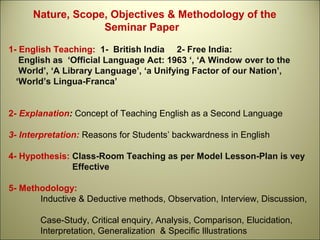
Nature, Scope, Objectives & Methodology of the
Seminar Paper
1- English Teaching: 1- British India 2- Free India:
English as ‘Official Language Act: 1963 ‘, ‘A Window over to the
World’, ‘A Library Language’, ‘a Unifying Factor of our Nation’,
‘World’s Lingua-Franca’
2- Explanation: Concept of Teaching English as a Second Language
3- Interpretation: Reasons for Students’ backwardness in English
4- Hypothesis: Class-Room Teaching as per Model Lesson-Plan is vey
Effective
5- Methodology:
Inductive & Deductive methods, Observation, Interview, Discussion,
Case-Study, Critical enquiry, Analysis, Comparison, Elucidation,
Interpretation, Generalization & Specific Illustrations
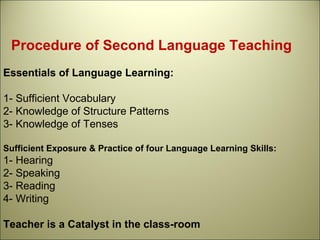
Procedure of Second Language Teaching
Essentials of Language Learning:
1- Sufficient Vocabulary
2- Knowledge of Structure Patterns
3- Knowledge of Tenses
Sufficient Exposure & Practice of four Language Learning Skills:
1- Hearing
2- Speaking
3- Reading
4- Writing
Teacher is a Catalyst in the class-room
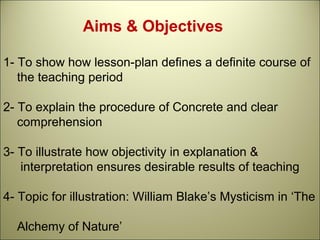
Aims & Objectives
1- To show how lesson-plan defines a definite course of
the teaching period
2- To explain the procedure of Concrete and clear
comprehension
3- To illustrate how objectivity in explanation &
interpretation ensures desirable results of teaching
4- Topic for illustration: William Blake’s Mysticism in ‘The
Alchemy of Nature’
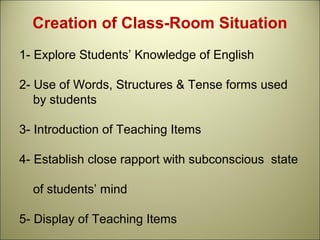
Creation of Class-Room Situation
1- Explore Students’ Knowledge of English
2- Use of Words, Structures & Tense forms used
by students
3- Introduction of Teaching Items
4- Establish close rapport with subconscious state
of students’ mind
5- Display of Teaching Items
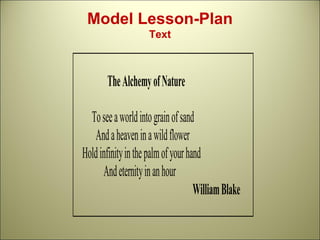
TheAlchemyofNature
Toseeaworldintograinofsand
Andaheaveninawildflower
Holdinfinityinthepalmofyourhand
Andeternityinanhour
WilliamBlake
Model Lesson-Plan
Text
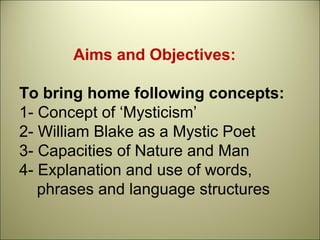
Aims and Objectives:
To bring home following concepts:
1- Concept of ‘Mysticism’
2- William Blake as a Mystic Poet
3- Capacities of Nature and Man
4- Explanation and use of words,
phrases and language structures
Creation of class-room situation
1- Enlighten students upon mysterious powers of Nature
being revealed through landscapes, water-bodies, trees,
birds, animals
2- Seed transforms a plant into a gigantic tree
3- ‘oysters’ take in a grain of sand and open with a ‘pearl’
4- earth swallows trees and transform them into coal and
diamond
5- Nature is an Alchemist
Display of teaching-items on screen or board
1- ‘world in a grain of sand’
2- ‘heaven in a flower’
3- ‘palm of your hand’
4- ‘eternity in an hour’
5- Use of the verbs ‘to see’ and ‘hold’ in
subjective position
Introduction of the subject to be taught
1- Transformative phenomena existing in Nature
2- Man’s imaginative power for effecting change
in the animate and inanimate objects
Explanation and interpretation of teaching-items
Nature is alchemist with mystic powers and Man can
assume to be alchemist with his powers such as-
1- Strong memory and imaginative reasoning
2- Perseverance
3- Team-work
4- Love of life
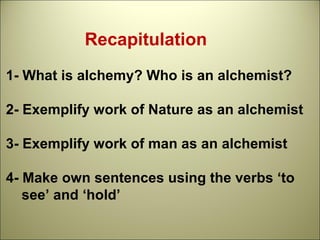
Recapitulation
1- What is alchemy? Who is an alchemist?
2- Exemplify work of Nature as an alchemist
3- Exemplify work of man as an alchemist
4- Make own sentences using the verbs ‘to
see’ and ‘hold’
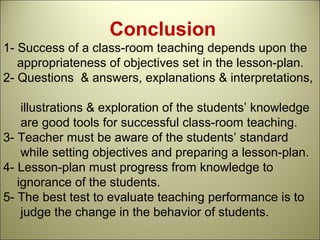
Conclusion
1- Success of a class-room teaching depends upon the
appropriateness of objectives set in the lesson-plan.
2- Questions & answers, explanations & interpretations,
illustrations & exploration of the students’ knowledge
are good tools for successful class-room teaching.
3- Teacher must be aware of the students’ standard
while setting objectives and preparing a lesson-plan.
4- Lesson-plan must progress from knowledge to
ignorance of the students.
5- The best test to evaluate teaching performance is to
judge the change in the behavior of students.
Thank You!

Ppt e module on teaching english as a second language at ug level

  • 1.
    ‘E Module onTeaching English as a Second Language at UG Level’ (A Seminar Module) NAME OF Module Presenter: Dr. Uttam Baburao Parekar (Associate Professor, Yeshwant Mahavidyalaya, Wardha (M.S.)
  • 2.
    Introduction of theInvestigator Name: Dr. Uttam Baburao Parekar Date of Birth: 05-07-1959 Qualification: M.A.(English), B.Ed., M.Phil., Ph.D. Designation: Associate Professor & HOD (Ph.D. Supervisor) Principal Investigator of UGC’s Major Research Project Office Address: Yeshwant Mahavidyalaya, Wardha (M.S.) Creative Pursuits: Writing Short Stories & Plays; Drama Acting, Director; Playing Banjo, Flute & Harmonium Home Address: Prof. Uttam B. Parekar, Sahakar-Nagar, Near Sai- Nagar, Wardha, Ta & Dist. Wardha (M.S.) Mobile No. 09921436640 Email: uparekar@rediffmail.com
  • 3.
    Nature, Scope, Objectives& Methodology of the Seminar Paper 1- English Teaching: 1- British India 2- Free India: English as ‘Official Language Act: 1963 ‘, ‘A Window over to the World’, ‘A Library Language’, ‘a Unifying Factor of our Nation’, ‘World’s Lingua-Franca’ 2- Explanation: Concept of Teaching English as a Second Language 3- Interpretation: Reasons for Students’ backwardness in English 4- Hypothesis: Class-Room Teaching as per Model Lesson-Plan is vey Effective 5- Methodology: Inductive & Deductive methods, Observation, Interview, Discussion, Case-Study, Critical enquiry, Analysis, Comparison, Elucidation, Interpretation, Generalization & Specific Illustrations
  • 4.
    Procedure of SecondLanguage Teaching Essentials of Language Learning: 1- Sufficient Vocabulary 2- Knowledge of Structure Patterns 3- Knowledge of Tenses Sufficient Exposure & Practice of four Language Learning Skills: 1- Hearing 2- Speaking 3- Reading 4- Writing Teacher is a Catalyst in the class-room
  • 5.
    Aims & Objectives 1-To show how lesson-plan defines a definite course of the teaching period 2- To explain the procedure of Concrete and clear comprehension 3- To illustrate how objectivity in explanation & interpretation ensures desirable results of teaching 4- Topic for illustration: William Blake’s Mysticism in ‘The Alchemy of Nature’
  • 6.
    Creation of Class-RoomSituation 1- Explore Students’ Knowledge of English 2- Use of Words, Structures & Tense forms used by students 3- Introduction of Teaching Items 4- Establish close rapport with subconscious state of students’ mind 5- Display of Teaching Items
  • 7.
  • 8.
    Aims and Objectives: Tobring home following concepts: 1- Concept of ‘Mysticism’ 2- William Blake as a Mystic Poet 3- Capacities of Nature and Man 4- Explanation and use of words, phrases and language structures
  • 9.
    Creation of class-roomsituation 1- Enlighten students upon mysterious powers of Nature being revealed through landscapes, water-bodies, trees, birds, animals 2- Seed transforms a plant into a gigantic tree 3- ‘oysters’ take in a grain of sand and open with a ‘pearl’ 4- earth swallows trees and transform them into coal and diamond 5- Nature is an Alchemist
  • 10.
    Display of teaching-itemson screen or board 1- ‘world in a grain of sand’ 2- ‘heaven in a flower’ 3- ‘palm of your hand’ 4- ‘eternity in an hour’ 5- Use of the verbs ‘to see’ and ‘hold’ in subjective position
  • 11.
    Introduction of thesubject to be taught 1- Transformative phenomena existing in Nature 2- Man’s imaginative power for effecting change in the animate and inanimate objects
  • 12.
    Explanation and interpretationof teaching-items Nature is alchemist with mystic powers and Man can assume to be alchemist with his powers such as- 1- Strong memory and imaginative reasoning 2- Perseverance 3- Team-work 4- Love of life
  • 13.
    Recapitulation 1- What isalchemy? Who is an alchemist? 2- Exemplify work of Nature as an alchemist 3- Exemplify work of man as an alchemist 4- Make own sentences using the verbs ‘to see’ and ‘hold’
  • 14.
    Conclusion 1- Success ofa class-room teaching depends upon the appropriateness of objectives set in the lesson-plan. 2- Questions & answers, explanations & interpretations, illustrations & exploration of the students’ knowledge are good tools for successful class-room teaching. 3- Teacher must be aware of the students’ standard while setting objectives and preparing a lesson-plan. 4- Lesson-plan must progress from knowledge to ignorance of the students. 5- The best test to evaluate teaching performance is to judge the change in the behavior of students.
  • 15.