‘Learning English Language and Job Opportunities’
A Guest Lecture
by
Dr. Uttam B. Parekar
Yeshwant Mahavidyalaya,
Wardha
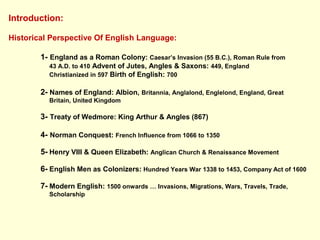
Introduction:
Historical Perspective Of English Language:
1- England as a Roman Colony: Caesar’s Invasion (55 B.C.), Roman Rule from
43 A.D. to 410 Advent of Jutes, Angles & Saxons: 449, England
Christianized in 597 Birth of English: 700
2- Names of England: Albion, Britannia, Anglalond, Englelond, England, Great
Britain, United Kingdom
3- Treaty of Wedmore: King Arthur & Angles (867)
4- Norman Conquest: French Influence from 1066 to 1350
5- Henry VIII & Queen Elizabeth: Anglican Church & Renaissance Movement
6- English Men as Colonizers: Hundred Years War 1338 to 1453, Company Act of 1600
7- Modern English: 1500 onwards … Invasions, Migrations, Wars, Travels, Trade,
Scholarship
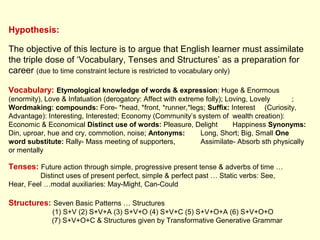
Hypothesis:
The objective of this lecture is to argue that English learner must assimilate
the triple dose of ‘Vocabulary, Tenses and Structures’ as a preparation for
career (due to time constraint lecture is restricted to vocabulary only)
Vocabulary: Etymological knowledge of words & expression: Huge & Enormous
(enormity), Love & Infatuation (derogatory: Affect with extreme folly); Loving, Lovely ;
Wordmaking: compounds: Fore- *head, *front, *runner,*legs; Suffix: Interest (Curiosity,
Advantage): Interesting, Interested; Economy (Community’s system of wealth creation):
Economic & Economical Distinct use of words: Pleasure, Delight Happiness Synonyms:
Din, uproar, hue and cry, commotion, noise; Antonyms: Long, Short; Big, Small One
word substitute: Rally- Mass meeting of supporters, Assimilate- Absorb sth physically
or mentally
Tenses: Future action through simple, progressive present tense & adverbs of time …
Distinct uses of present perfect, simple & perfect past … Static verbs: See,
Hear, Feel …modal auxiliaries: May-Might, Can-Could
Structures: Seven Basic Patterns … Structures
(1) S+V (2) S+V+A (3) S+V+O (4) S+V+C (5) S+V+O+A (6) S+V+O+O
(7) S+V+O+C & Structures given by Transformative Generative Grammar
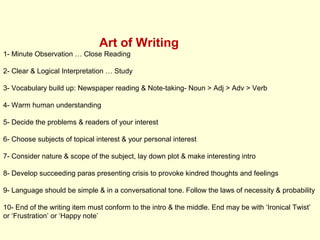
Art of Writing
1- Minute Observation … Close Reading
2- Clear & Logical Interpretation … Study
3- Vocabulary build up: Newspaper reading & Note-taking- Noun > Adj > Adv > Verb
4- Warm human understanding
5- Decide the problems & readers of your interest
6- Choose subjects of topical interest & your personal interest
7- Consider nature & scope of the subject, lay down plot & make interesting intro
8- Develop succeeding paras presenting crisis to provoke kindred thoughts and feelings
9- Language should be simple & in a conversational tone. Follow the laws of necessity & probability
10- End of the writing item must conform to the intro & the middle. End may be with ‘Ironical Twist’
or ‘Frustration’ or ‘Happy note’
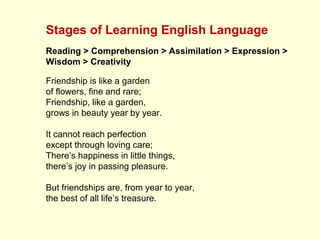
Stages of Learning English Language
Reading > Comprehension > Assimilation > Expression >
Wisdom > Creativity
Friendship is like a garden
of flowers, fine and rare;
Friendship, like a garden,
grows in beauty year by year.
It cannot reach perfection
except through loving care;
There’s happiness in little things,
there’s joy in passing pleasure.
But friendships are, from year to year,
the best of all life’s treasure.
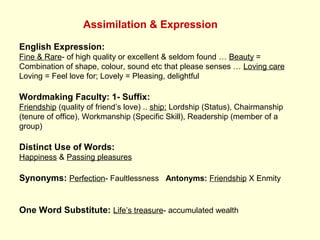
Assimilation & Expression
English Expression:
Fine & Rare- of high quality or excellent & seldom found … Beauty =
Combination of shape, colour, sound etc that please senses … Loving care
Loving = Feel love for; Lovely = Pleasing, delightful
Wordmaking Faculty: 1- Suffix:
Friendship (quality of friend’s love) .. ship: Lordship (Status), Chairmanship
(tenure of office), Workmanship (Specific Skill), Readership (member of a
group)
Distinct Use of Words:
Happiness & Passing pleasures
Synonyms: Perfection- Faultlessness Antonyms: Friendship X Enmity
One Word Substitute: Life’s treasure- accumulated wealth
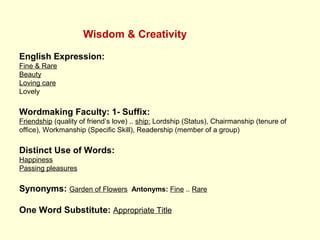
Wisdom & Creativity
English Expression:
Fine & Rare
Beauty
Loving care
Lovely
Wordmaking Faculty: 1- Suffix:
Friendship (quality of friend’s love) .. ship: Lordship (Status), Chairmanship (tenure of
office), Workmanship (Specific Skill), Readership (member of a group)
Distinct Use of Words:
Happiness
Passing pleasures
Synonyms: Garden of Flowers Antonyms: Fine .. Rare
One Word Substitute: Appropriate Title
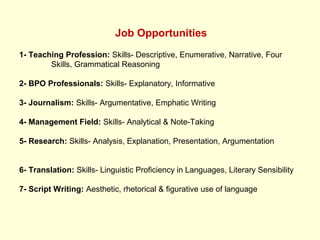
Job Opportunities
1- Teaching Profession: Skills- Descriptive, Enumerative, Narrative, Four
Skills, Grammatical Reasoning
2- BPO Professionals: Skills- Explanatory, Informative
3- Journalism: Skills- Argumentative, Emphatic Writing
4- Management Field: Skills- Analytical & Note-Taking
5- Research: Skills- Analysis, Explanation, Presentation, Argumentation
6- Translation: Skills- Linguistic Proficiency in Languages, Literary Sensibility
7- Script Writing: Aesthetic, rhetorical & figurative use of language
Thank You
Thank You

Ppt e module on 'english & job employability'

  • 1.
    ‘Learning English Languageand Job Opportunities’ A Guest Lecture by Dr. Uttam B. Parekar Yeshwant Mahavidyalaya, Wardha
  • 2.
    Introduction: Historical Perspective OfEnglish Language: 1- England as a Roman Colony: Caesar’s Invasion (55 B.C.), Roman Rule from 43 A.D. to 410 Advent of Jutes, Angles & Saxons: 449, England Christianized in 597 Birth of English: 700 2- Names of England: Albion, Britannia, Anglalond, Englelond, England, Great Britain, United Kingdom 3- Treaty of Wedmore: King Arthur & Angles (867) 4- Norman Conquest: French Influence from 1066 to 1350 5- Henry VIII & Queen Elizabeth: Anglican Church & Renaissance Movement 6- English Men as Colonizers: Hundred Years War 1338 to 1453, Company Act of 1600 7- Modern English: 1500 onwards … Invasions, Migrations, Wars, Travels, Trade, Scholarship
  • 3.
    Hypothesis: The objective ofthis lecture is to argue that English learner must assimilate the triple dose of ‘Vocabulary, Tenses and Structures’ as a preparation for career (due to time constraint lecture is restricted to vocabulary only) Vocabulary: Etymological knowledge of words & expression: Huge & Enormous (enormity), Love & Infatuation (derogatory: Affect with extreme folly); Loving, Lovely ; Wordmaking: compounds: Fore- *head, *front, *runner,*legs; Suffix: Interest (Curiosity, Advantage): Interesting, Interested; Economy (Community’s system of wealth creation): Economic & Economical Distinct use of words: Pleasure, Delight Happiness Synonyms: Din, uproar, hue and cry, commotion, noise; Antonyms: Long, Short; Big, Small One word substitute: Rally- Mass meeting of supporters, Assimilate- Absorb sth physically or mentally Tenses: Future action through simple, progressive present tense & adverbs of time … Distinct uses of present perfect, simple & perfect past … Static verbs: See, Hear, Feel …modal auxiliaries: May-Might, Can-Could Structures: Seven Basic Patterns … Structures (1) S+V (2) S+V+A (3) S+V+O (4) S+V+C (5) S+V+O+A (6) S+V+O+O (7) S+V+O+C & Structures given by Transformative Generative Grammar
  • 4.
    Art of Writing 1-Minute Observation … Close Reading 2- Clear & Logical Interpretation … Study 3- Vocabulary build up: Newspaper reading & Note-taking- Noun > Adj > Adv > Verb 4- Warm human understanding 5- Decide the problems & readers of your interest 6- Choose subjects of topical interest & your personal interest 7- Consider nature & scope of the subject, lay down plot & make interesting intro 8- Develop succeeding paras presenting crisis to provoke kindred thoughts and feelings 9- Language should be simple & in a conversational tone. Follow the laws of necessity & probability 10- End of the writing item must conform to the intro & the middle. End may be with ‘Ironical Twist’ or ‘Frustration’ or ‘Happy note’
  • 5.
    Stages of LearningEnglish Language Reading > Comprehension > Assimilation > Expression > Wisdom > Creativity Friendship is like a garden of flowers, fine and rare; Friendship, like a garden, grows in beauty year by year. It cannot reach perfection except through loving care; There’s happiness in little things, there’s joy in passing pleasure. But friendships are, from year to year, the best of all life’s treasure.
  • 6.
    Assimilation & Expression EnglishExpression: Fine & Rare- of high quality or excellent & seldom found … Beauty = Combination of shape, colour, sound etc that please senses … Loving care Loving = Feel love for; Lovely = Pleasing, delightful Wordmaking Faculty: 1- Suffix: Friendship (quality of friend’s love) .. ship: Lordship (Status), Chairmanship (tenure of office), Workmanship (Specific Skill), Readership (member of a group) Distinct Use of Words: Happiness & Passing pleasures Synonyms: Perfection- Faultlessness Antonyms: Friendship X Enmity One Word Substitute: Life’s treasure- accumulated wealth
  • 7.
    Wisdom & Creativity EnglishExpression: Fine & Rare Beauty Loving care Lovely Wordmaking Faculty: 1- Suffix: Friendship (quality of friend’s love) .. ship: Lordship (Status), Chairmanship (tenure of office), Workmanship (Specific Skill), Readership (member of a group) Distinct Use of Words: Happiness Passing pleasures Synonyms: Garden of Flowers Antonyms: Fine .. Rare One Word Substitute: Appropriate Title
  • 8.
    Job Opportunities 1- TeachingProfession: Skills- Descriptive, Enumerative, Narrative, Four Skills, Grammatical Reasoning 2- BPO Professionals: Skills- Explanatory, Informative 3- Journalism: Skills- Argumentative, Emphatic Writing 4- Management Field: Skills- Analytical & Note-Taking 5- Research: Skills- Analysis, Explanation, Presentation, Argumentation 6- Translation: Skills- Linguistic Proficiency in Languages, Literary Sensibility 7- Script Writing: Aesthetic, rhetorical & figurative use of language
  • 9.
  • 10.