Downloaded 12 times
![***********************
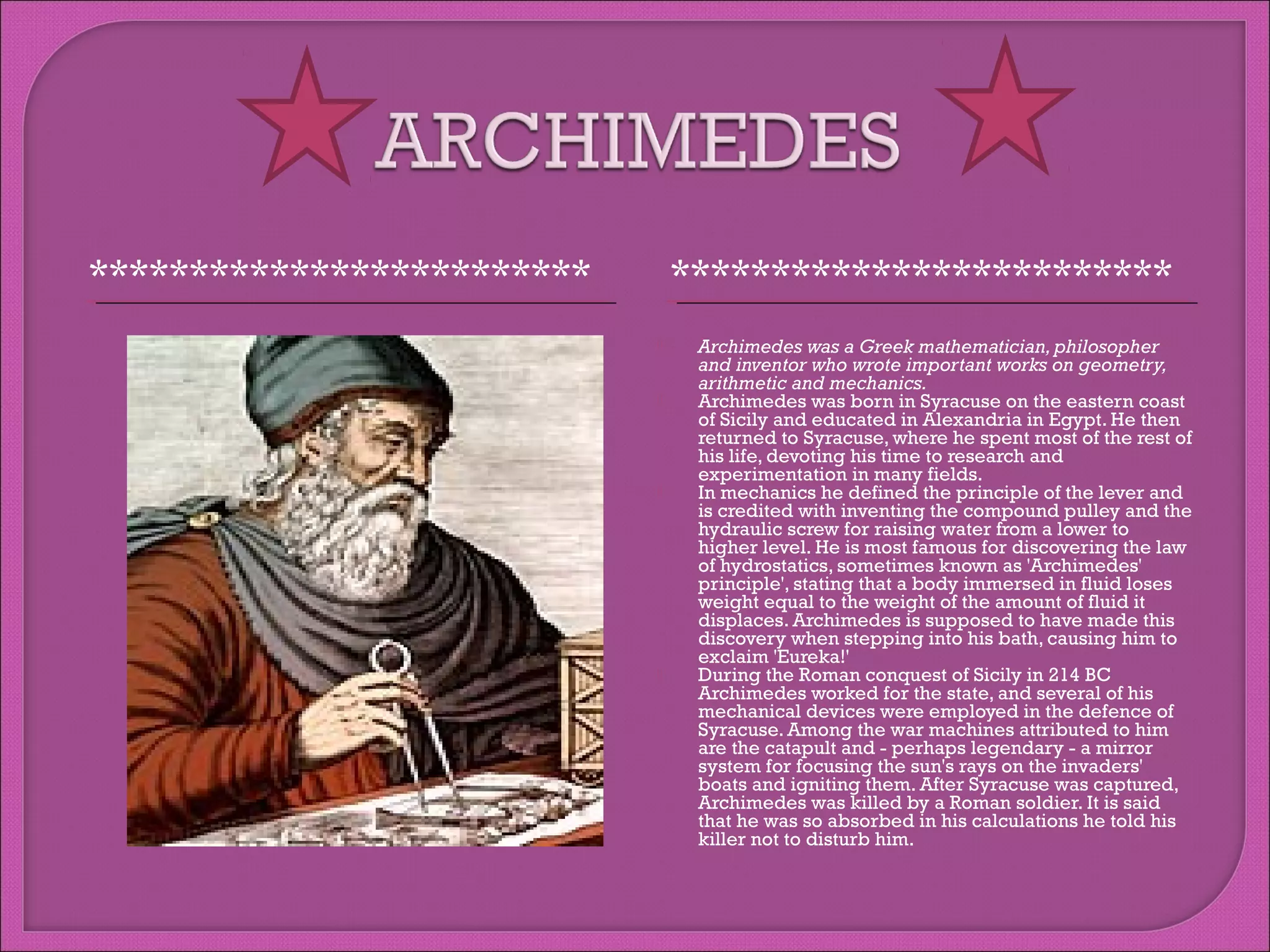
Leonhard Euler 15 April
1707 – 18 September 1783)
was a pioneering Swiss
mathematician and physicist.
He made important
discoveries in fields as
diverse as
infinitesimal calculus and
graph theory. He also
introduced much of the
modern mathematical
terminology and notation,
particularly for
mathematical analysis, such as
the notion of a
mathematical function.[3] He is
also renowned for his work in
mechanics, fluid dynamics,
optics, and astronomy.]](https://image.slidesharecdn.com/k-140107103808-phpapp02/75/ppt-6-2048.jpg)
![
Euler spent most of his adult life in St. Petersburg, Russia, and inBerlin, Prussia. He is considered to be
the pre-eminent mathematician of the 18th century, and one of the greatest mathematicians ever. He is
also one of the most prolific mathematicians ever; his collected works fill 60–80 quarto volumes.[4] A
statement attributed to Pierre-Simon Laplaceexpresses Euler's influence on mathematics: "Read Euler,
read Euler, he is the master of us all."[5] Euler was born on April 15, 1707, in Basel to Paul Euler, a pastor
of the Reformed Church, and Marguerite Brucker, a pastor's daughter. He had two younger sisters
named Anna Maria and Maria Magdalena. Soon after the birth of Leonhard, the Eulers moved from
Basel to the town of Riehen, where Euler spent most of his childhood. Paul Euler was a friend of the
Bernoulli family—Johann Bernoulli, who was then regarded as Europe's foremost mathematician, would
eventually be the most important influence on young Leonhard. Euler's early formal education started
in Basel, where he was sent to live with his maternal grandmother. At the age of thirteen he enrolled at
the University of Basel, and in 1723, received his Master of Philosophy with a dissertation that
compared the philosophies ofDescartes and Newton. At this time, he was receiving Saturday afternoon
lessons from Johann Bernoulli, who quickly discovered his new pupil's incredible talent for
mathematics.[6] Euler was at this point studying theology, Greek, and Hebrew at his father's urging, in
order to become a pastor, but Bernoulli convinced Paul Euler that Leonhard was destined to become a
great mathematician. In 1726, Euler completed a dissertation on the propagation of sound with the
title De Sono.[7] At that time, he was pursuing an (ultimately unsuccessful) attempt to obtain a position at
the University of Basel. In 1727, he first entered the Paris Academy Prize Problem competition; the
problem that year was to find the best way to place the masts on a ship. Pierre Bouguer, a man who
became known as "the father of naval architecture" won, and Euler took second place. Euler later won
this annual prize twelve times.[8](https://image.slidesharecdn.com/k-140107103808-phpapp02/75/ppt-7-2048.jpg)
![
Johann Carl Friedrich Gauss
(30 April 1777 – 23 February 1855)
was a German mathematician and
physical scientist who contributed
significantly to many fields,
including number theory, algebra,
statistics,analysis,
differential geometry, geodesy,
geophysics, electrostatics,
astronomy and optics.
Sometimes referred to as
the Princeps mathematicorum("the
Prince of Mathematicians" or "the
foremost of mathematicians") and
"greatest mathematician since
antiquity", Gauss had a remarkable
influence in many fields of
mathematics and science and is
ranked as one of history's most
influential mathematicians.[2]](https://image.slidesharecdn.com/k-140107103808-phpapp02/75/ppt-8-2048.jpg)


![
David Hilbert ( January 23, 1862 – February
14, 1943) was aGerman mathematician. He is
recognized as one of the most influential and
universal mathematicians of the 19th and early
20th centuries. Hilbert discovered and
developed a broad range of fundamental ideas
in many areas, including invariant theory and
the axiomatization of geometry. He also
formulated the theory of Hilbert spaces,[3] one
of the foundations of functional analysis.
Hilbert adopted and warmly defended
Georg Cantor's set theory and
transfinite numbers. A famous example of his
leadership in mathematics is his 1900
presentation of a collection of problems that
set the course for much of the mathematical
research of the 20th century.
Hilbert and his students contributed
significantly to establishing rigor and
developed important tools used in modern
mathematical physics. Hilbert is known as one
of the founders of proof theory and
mathematical logic, as well as for being among
the first to distinguish between mathematics
and metamathematics.](https://image.slidesharecdn.com/k-140107103808-phpapp02/75/ppt-12-2048.jpg)


![*************************
************************
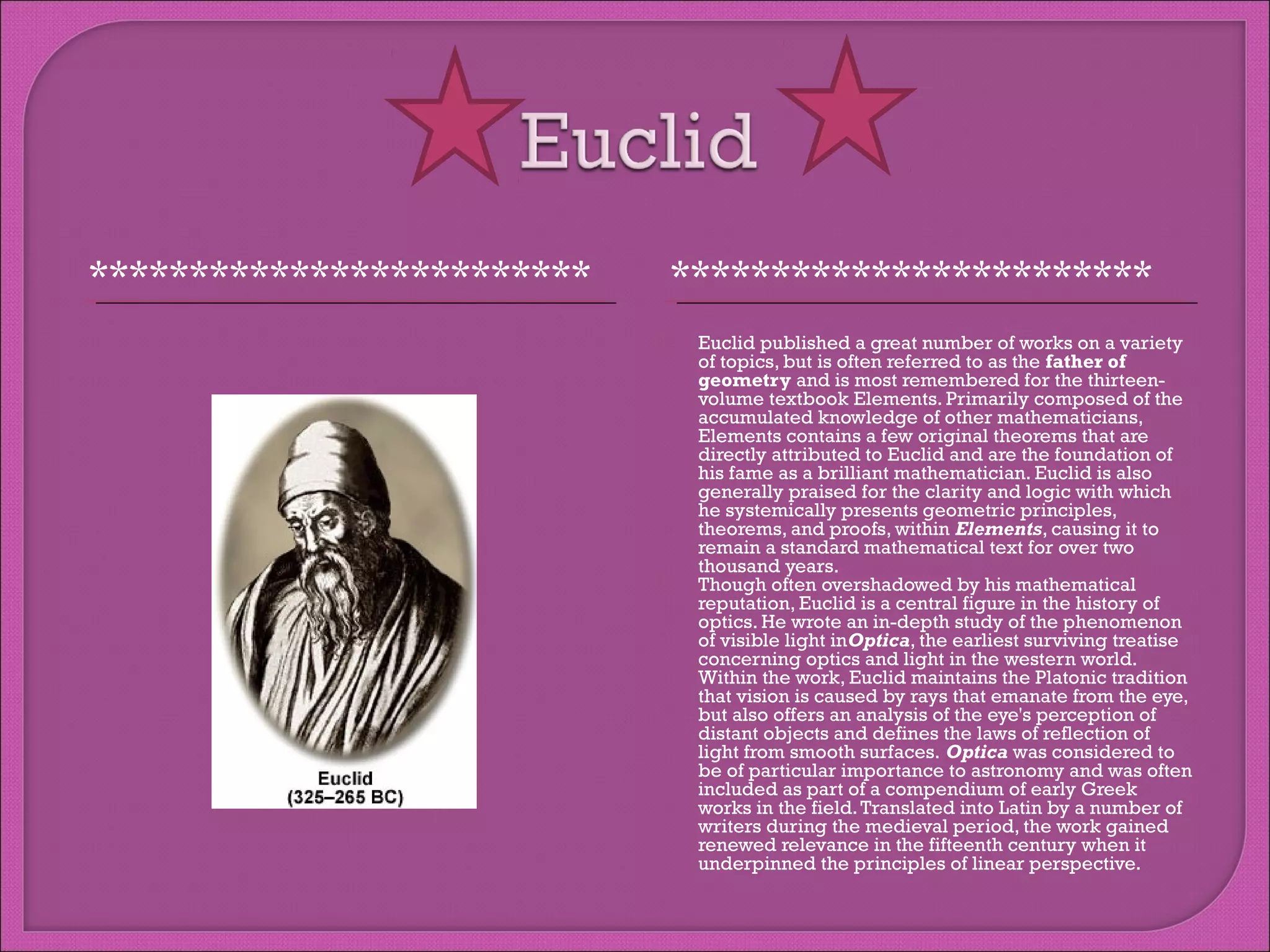
In mathematics, the Pythagorean
theorem—or Pythagoras'
theorem—is a relation in
Euclidean geometry among the
three sides of a right triangle. It
states that the square of the
hypotenuse (the side opposite the
right angle) is equal to the sum of
the squares of the other two sides.
The theorem can be written as an
equation relating the lengths of the
sides a, b and c, often called
the Pythagorean equation:[1]
where c represents the length of the
hypotenuse, and a and b represent
the lengths of the other two sides.](https://image.slidesharecdn.com/k-140107103808-phpapp02/75/ppt-16-2048.jpg)


![*************************
************************
Varahamihir's main work is the
book Pañcasiddhāntikā on the Five
[Astronomical] Canons) dated ca. 575
CE gives us information about older
Indian texts which are now lost. The work
is a treatise on
mathematical
astronomy and it summarises five
earlier astronomical treatises, namely
the Surya Siddhanta, Romaka Siddhanta,
Paulisa Siddhanta, Vasishtha Siddhanta
and Paitamaha Siddhantas. It is a
compendium of Vedanga Jyotisha as well
as Hellenistic astronomy(including
Greek, Egyptian and Roman
elements).He was the first one to
mention in his work Pancha Siddhantika
that the ayanamsa, or the shifting of the
equinox is 50.32 seconds.6655](https://image.slidesharecdn.com/k-140107103808-phpapp02/75/ppt-19-2048.jpg)

![
Brahmagupta gave the solution of the general linear equation in
chapter eighteen of Brahmasphutasiddhanta,
The difference between rupas, when inverted and divided by the
difference of the unknowns, is the unknown in the equation.
Therupas are [subtracted on the side] below that from which the
square and the unknown are to be subtracted
which is a solution for the equation equivalent to ,
where rupas refers to the constants c and e. He further gave two
equivalent solutions to the general quadratic equation
18.44. Diminish by the middle [number] the square-root of
the rupas multiplied by four times the square and increased by the
square of the middle [number]; divide the remainder by twice the
square. [The result is] the middle [number].
18.45. Whatever is the square-root of the rupas multiplied by the
square [and] increased by the square of half the unknown,
diminish that by half the unknown [and] divide [the remainder] by
its square. [The result is] the unknown.](https://image.slidesharecdn.com/k-140107103808-phpapp02/75/ppt-21-2048.jpg)

The Ishango bone, found in the Congo and potentially 20,000 years old, contains a series of tally marks that may demonstrate some of the earliest concepts of prime numbers or a lunar calendar. While prime numbers were likely not fully understood until around 500 BC, the Ishango bone and later Egyptian arithmetic incorporated some elements like multiplication by 2. Megalithic structures from 3000 BC in the UK also incorporated geometric concepts. The formal study of mathematics began in the 6th century BC with the Pythagoreans in Greece, though Chinese and Hindu-Arabic systems also made early contributions that developed over centuries and influenced Western mathematics through Islamic scholars.


![A Reviewer for Math History and Trivia [Not Updated]](https://cdn.slidesharecdn.com/ss_thumbnails/mathhistoryandtriviareviewer-240320201819-f1b01a44-thumbnail.jpg?width=640&height=640&fit=bounds)


