A Brief History of Mathematics
• Ancient Period
• Greek Period
• Hindu-Arabic Period
• Period of Transmission
• Early Modern Period
• Modern Period
A. Number Systems and Arithmetic
• Development of numeration systems.
• Creation of arithmetic techniques, lookup tables, the abacus and other
calculation tools.
B. Practical Measurement, Geometry and Astronomy
• Measurement units devised to quantify distance, area, volume, and
time.
• Geometric reasoning used to measure distances indirectly.
• Calendars invented to predict seasons, astronomical events.
• Geometrical forms and patterns appear in art and architecture.
Ancient Period (3000 B.C. to 260 A.D.)
Practical Mathematics
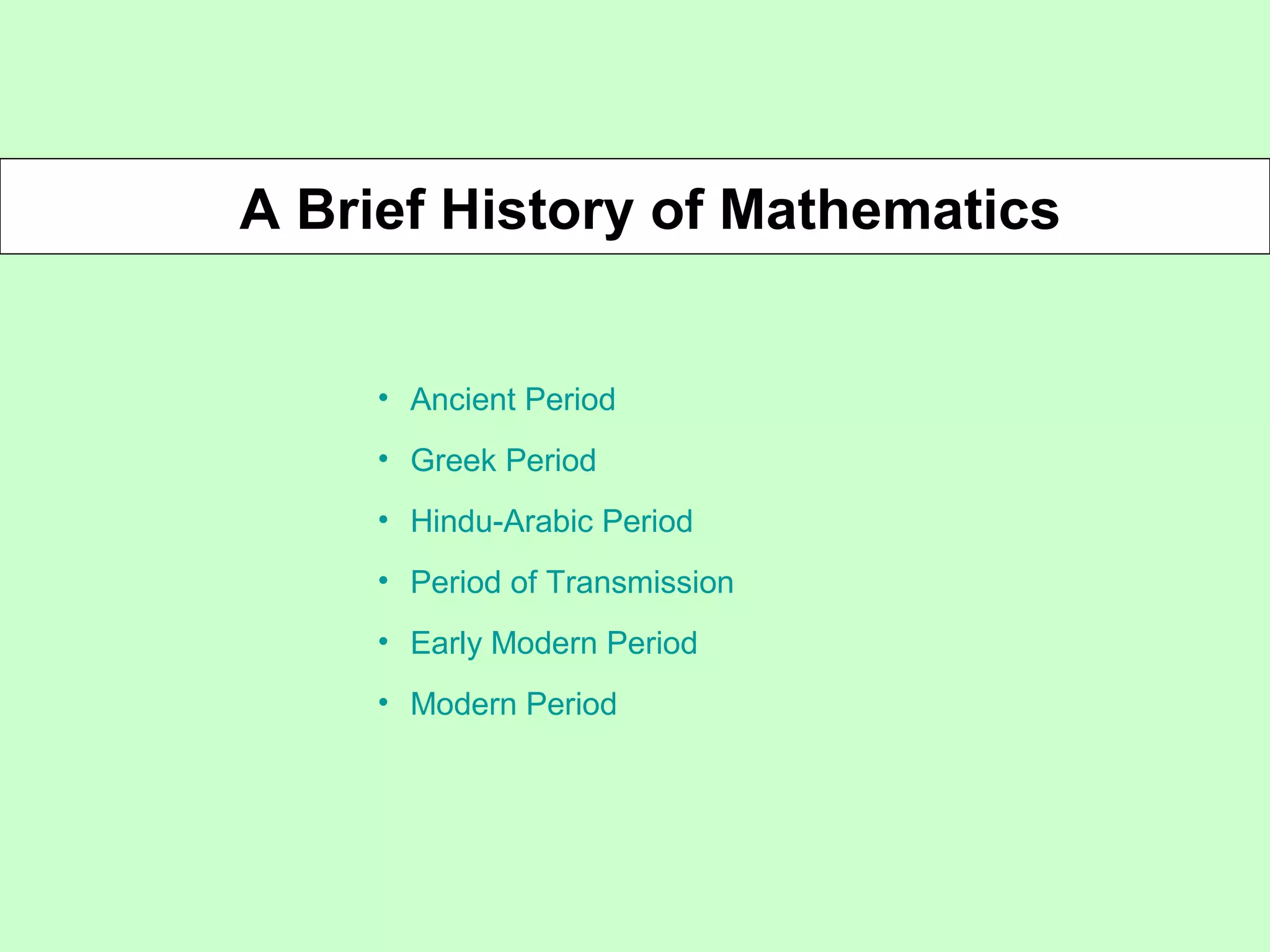
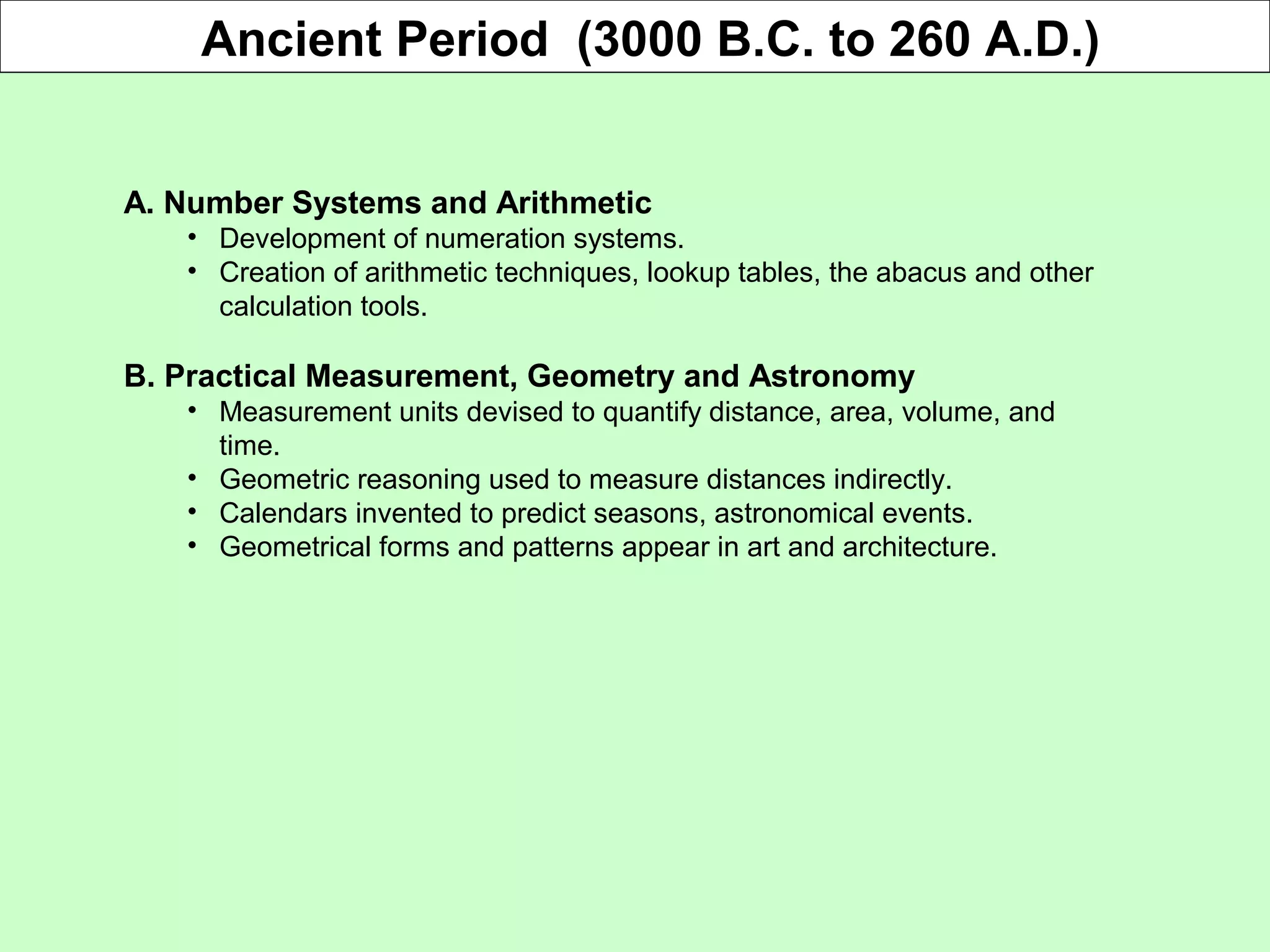
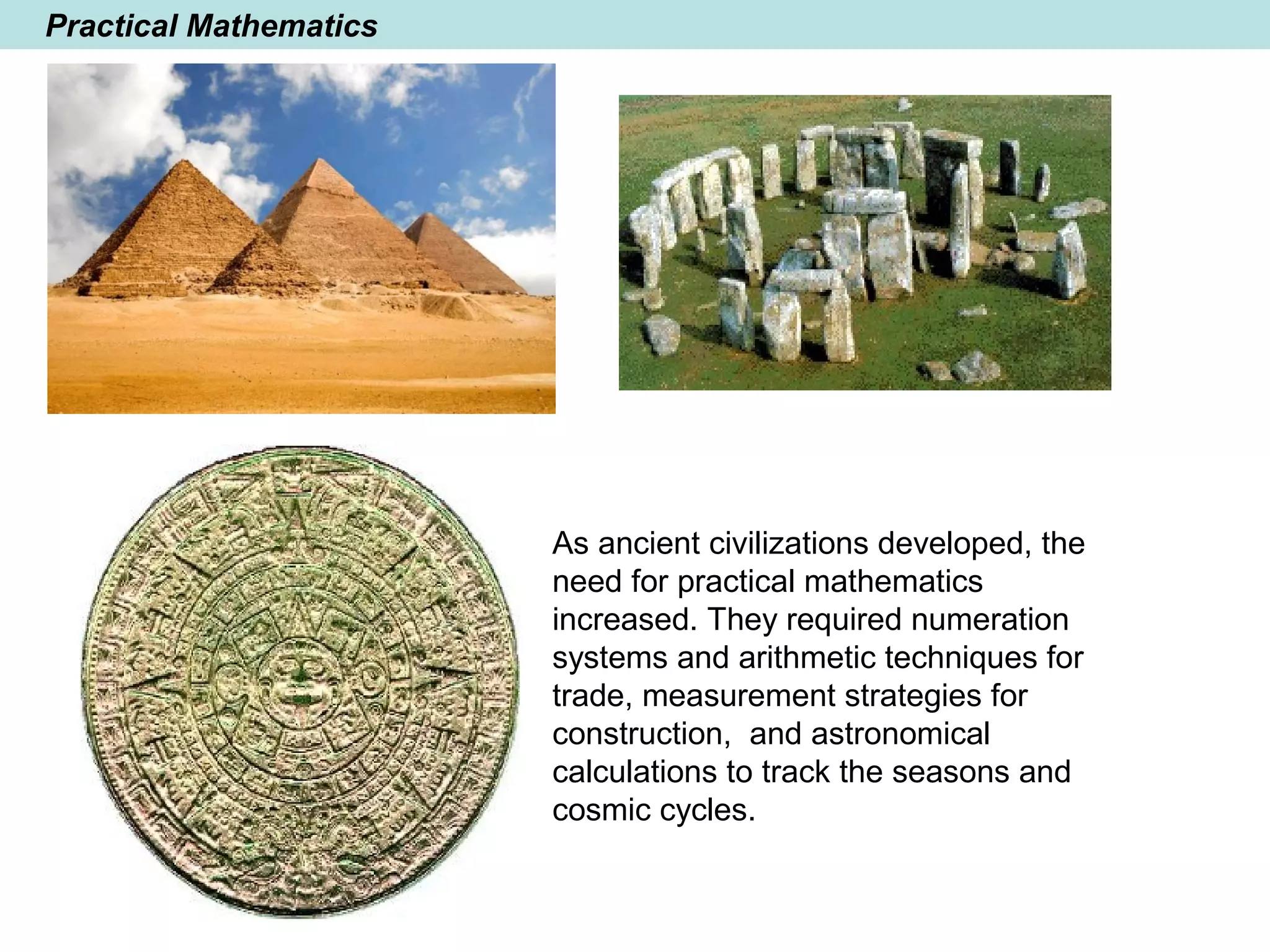
As ancient civilizations developed, the
need for practical mathematics
increased. They required numeration
systems and arithmetic techniques for
trade, measurement strategies for
construction, and astronomical
calculations to track the seasons and
cosmic cycles.
Babylonian Numerals
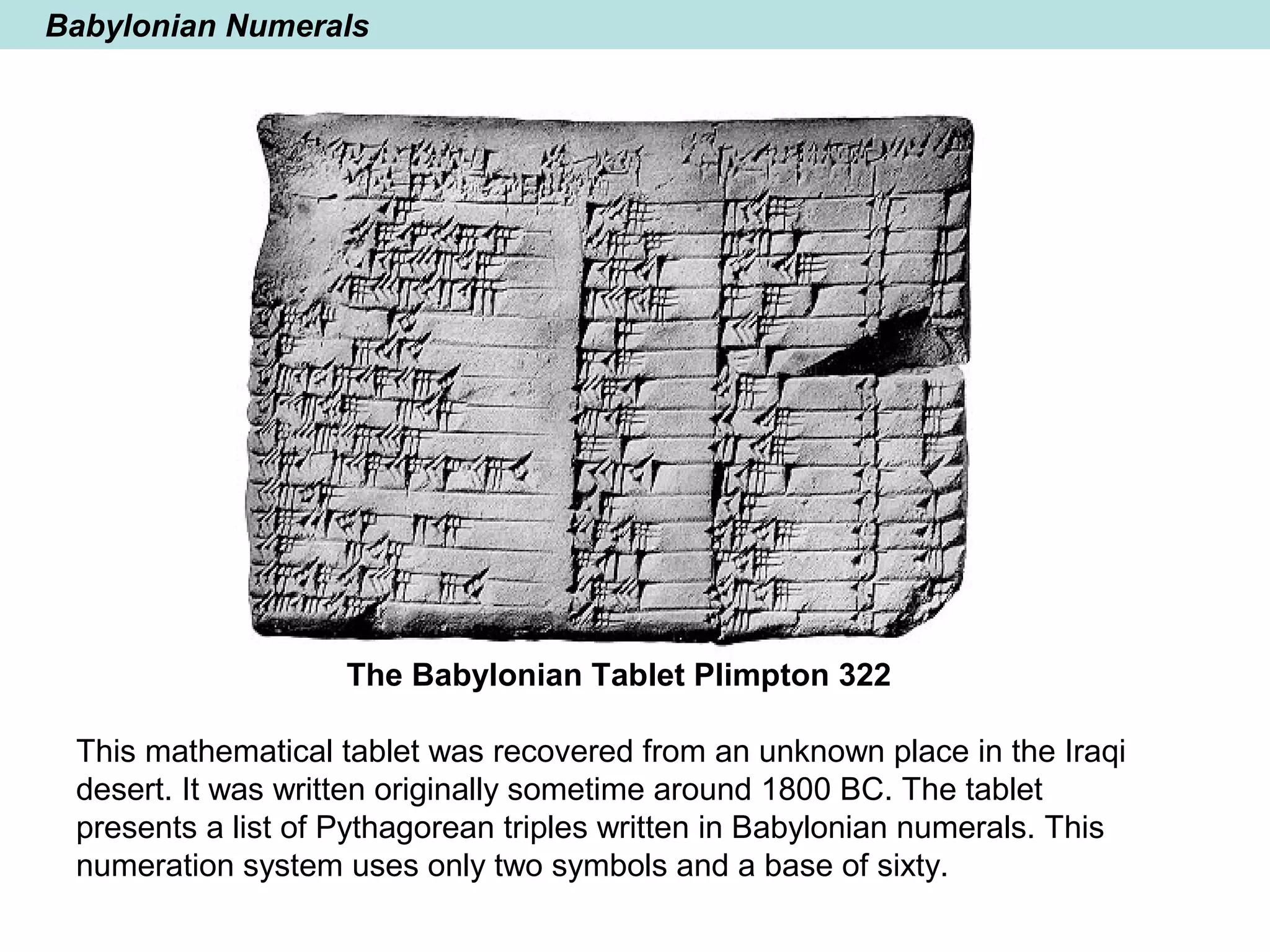
The Babylonian Tablet Plimpton 322
This mathematical tablet was recovered from an unknown place in the Iraqi
desert. It was written originally sometime around 1800 BC. The tablet
presents a list of Pythagorean triples written in Babylonian numerals. This
numeration system uses only two symbols and a base of sixty.
Chinese Mathematics
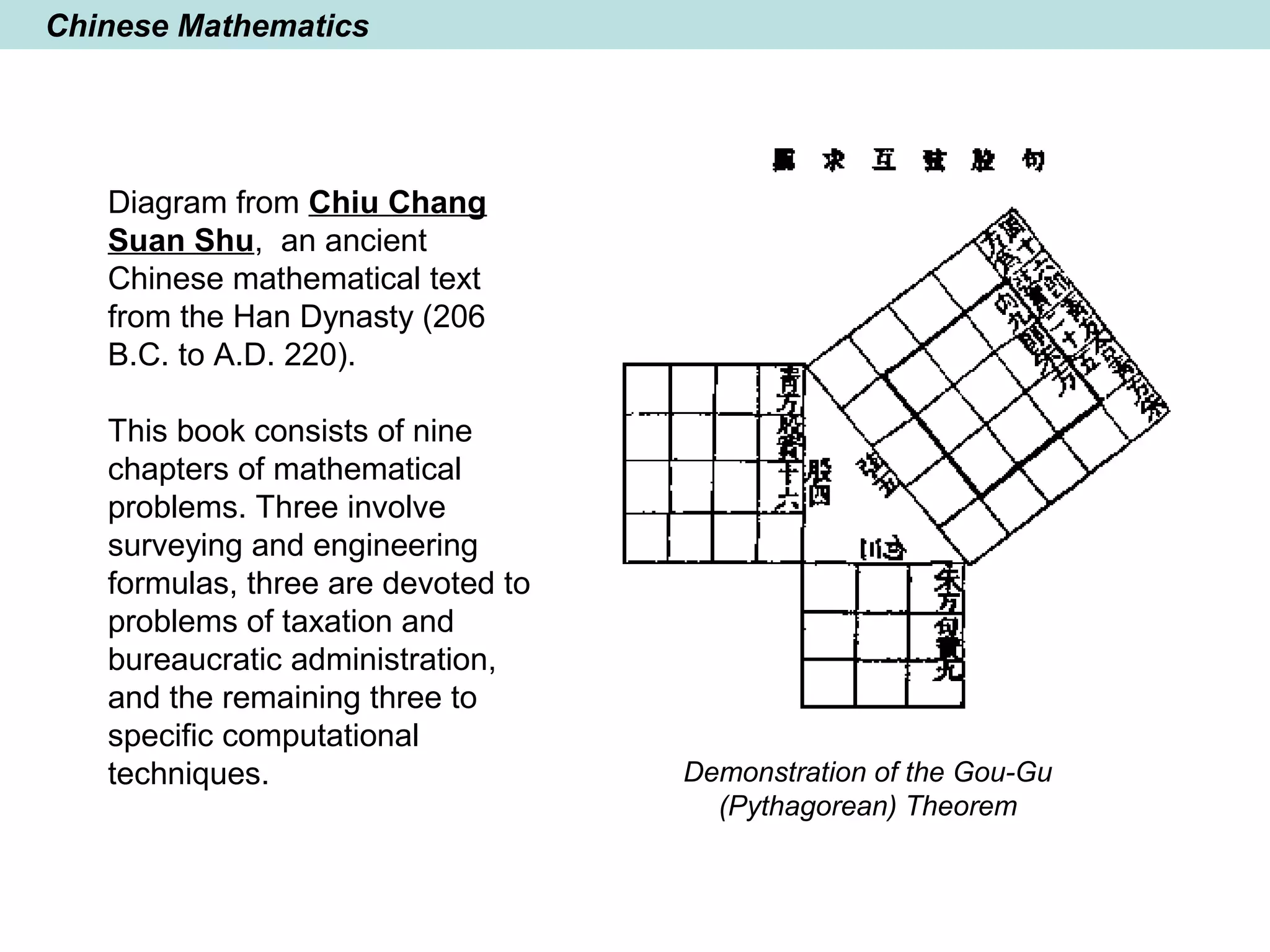
Diagram from Chiu Chang
Suan Shu, an ancient
Chinese mathematical text
from the Han Dynasty (206
B.C. to A.D. 220).
This book consists of nine
chapters of mathematical
problems. Three involve
surveying and engineering
formulas, three are devoted to
problems of taxation and
bureaucratic administration,
and the remaining three to
specific computational
techniques. Demonstration of the Gou-Gu
(Pythagorean) Theorem
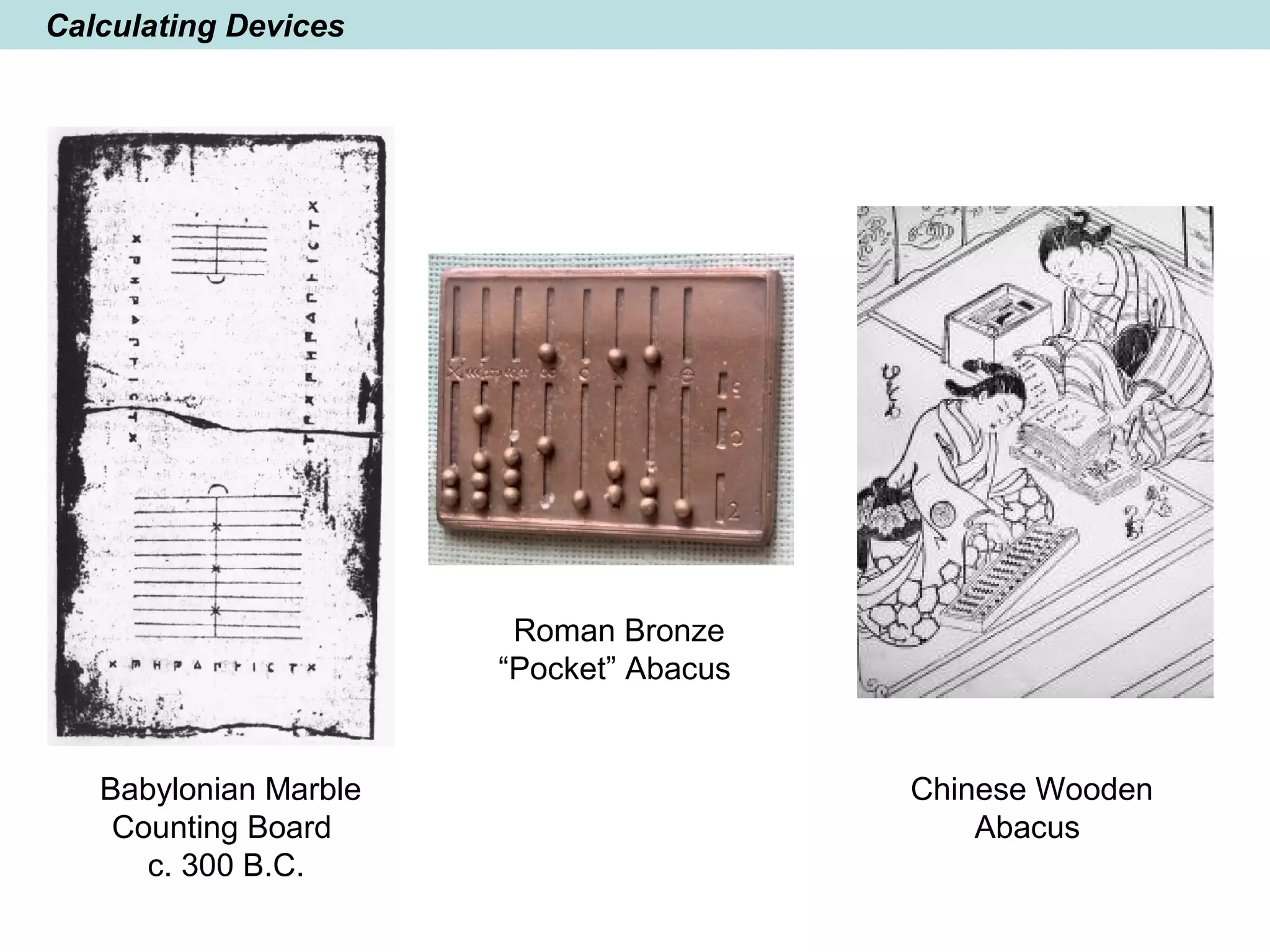
Calculating Devices
Chinese Wooden
Abacus
Roman Bronze
“Pocket” Abacus
Babylonian Marble
Counting Board
c. 300 B.C.
A. Greek Logic and Philosophy
• Greek philosophers promote logical, rational explanations of natural
phenomena.
• Schools of logic, science and mathematics are established.
• Mathematics is viewed as more than a tool to solve practical problems;
it is seen as a means to understand divine laws.
• Mathematicians achieve fame, are valued for their work.
B. Euclidean Geometry
• The first mathematical system based on postulates, theorems and
proofs appears in Euclid's Elements.
Greek Period (600 B.C. to 450 A.D.)
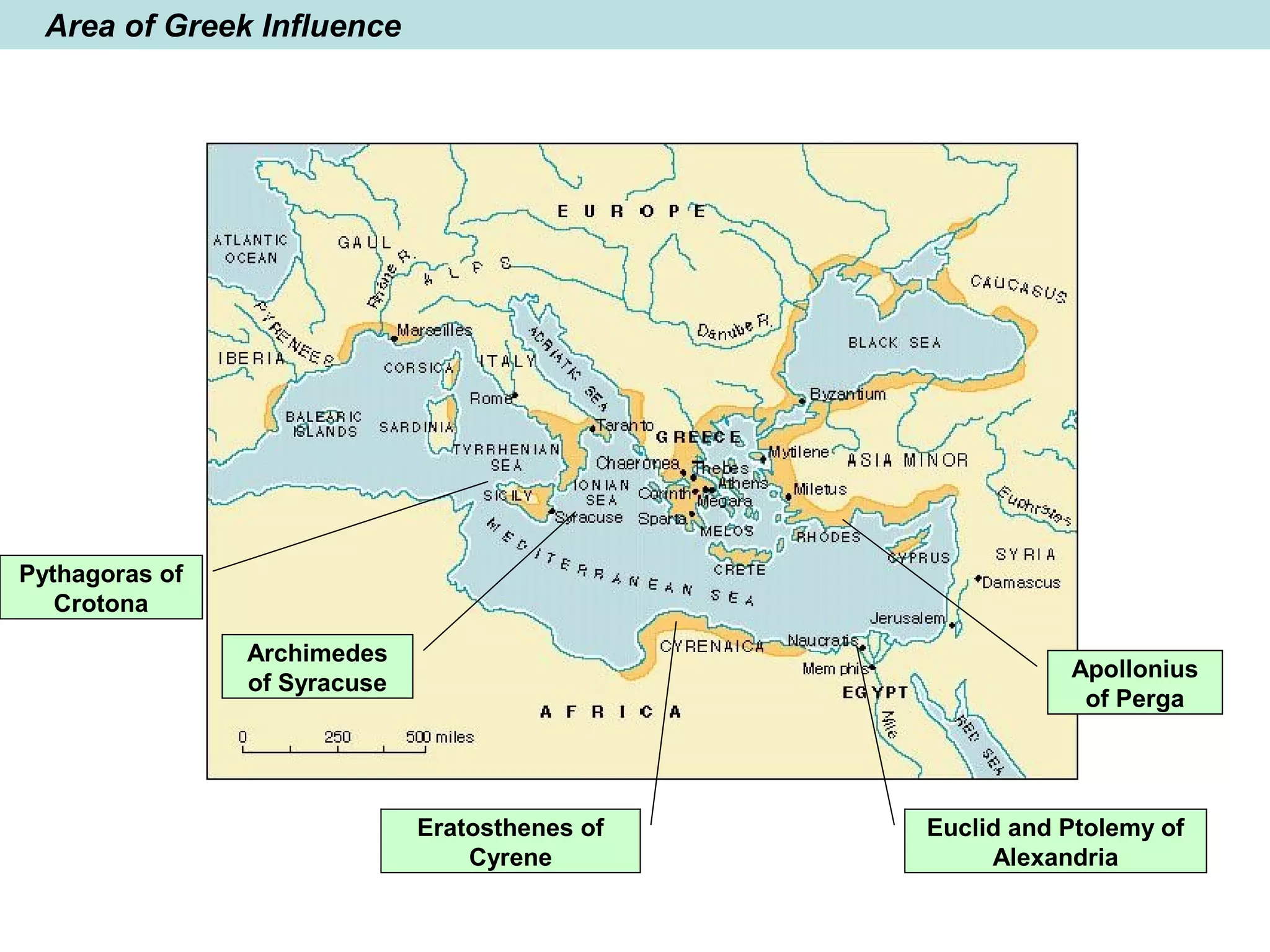
Area of Greek Influence
Archimedes
of Syracuse
Euclid and Ptolemy of
Alexandria
Pythagoras of
Crotona
Apollonius
of Perga
Eratosthenes of
Cyrene
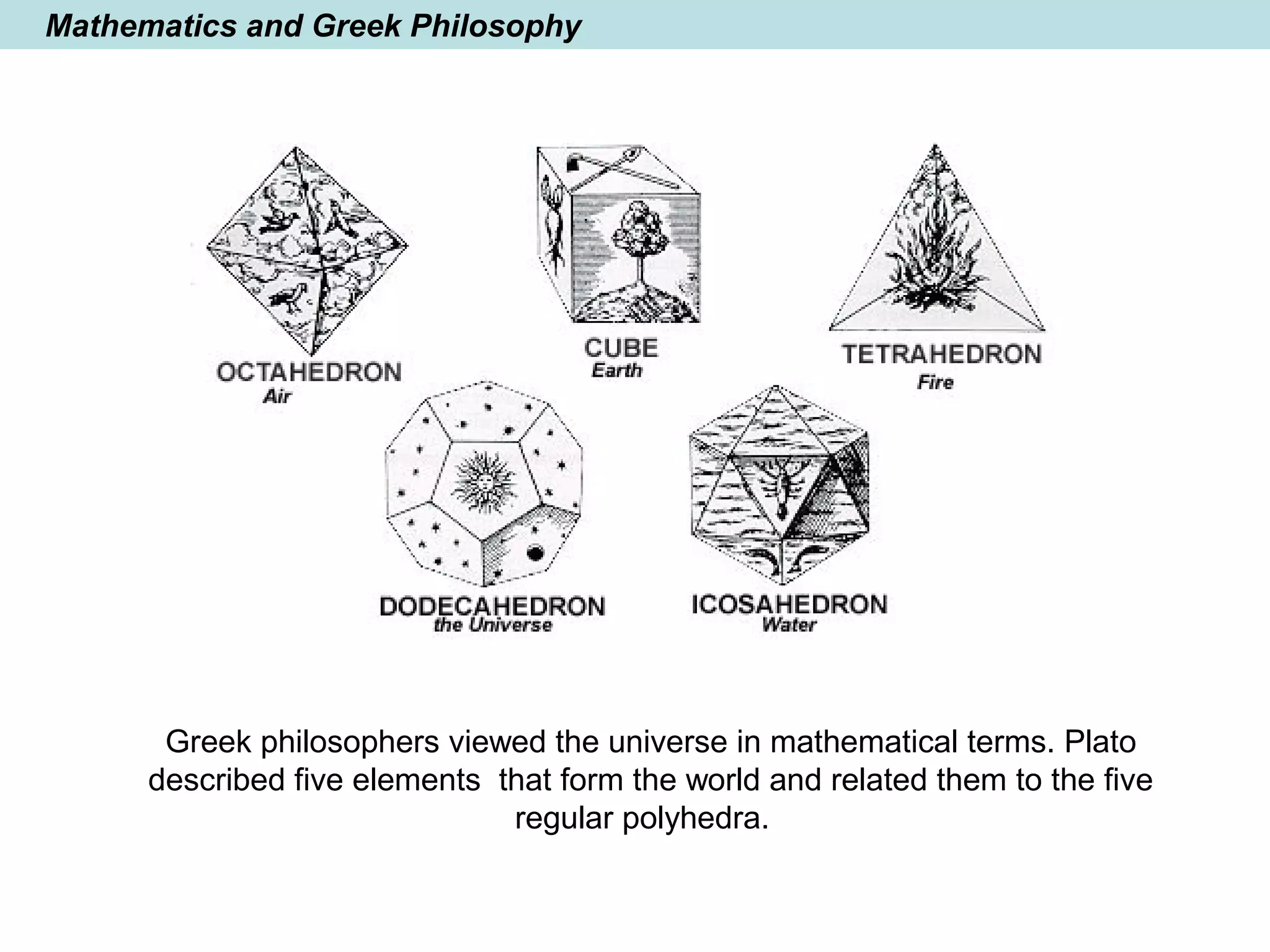
Mathematics and Greek Philosophy
Greek philosophers viewed the universe in mathematical terms. Plato
described five elements that form the world and related them to the five
regular polyhedra.
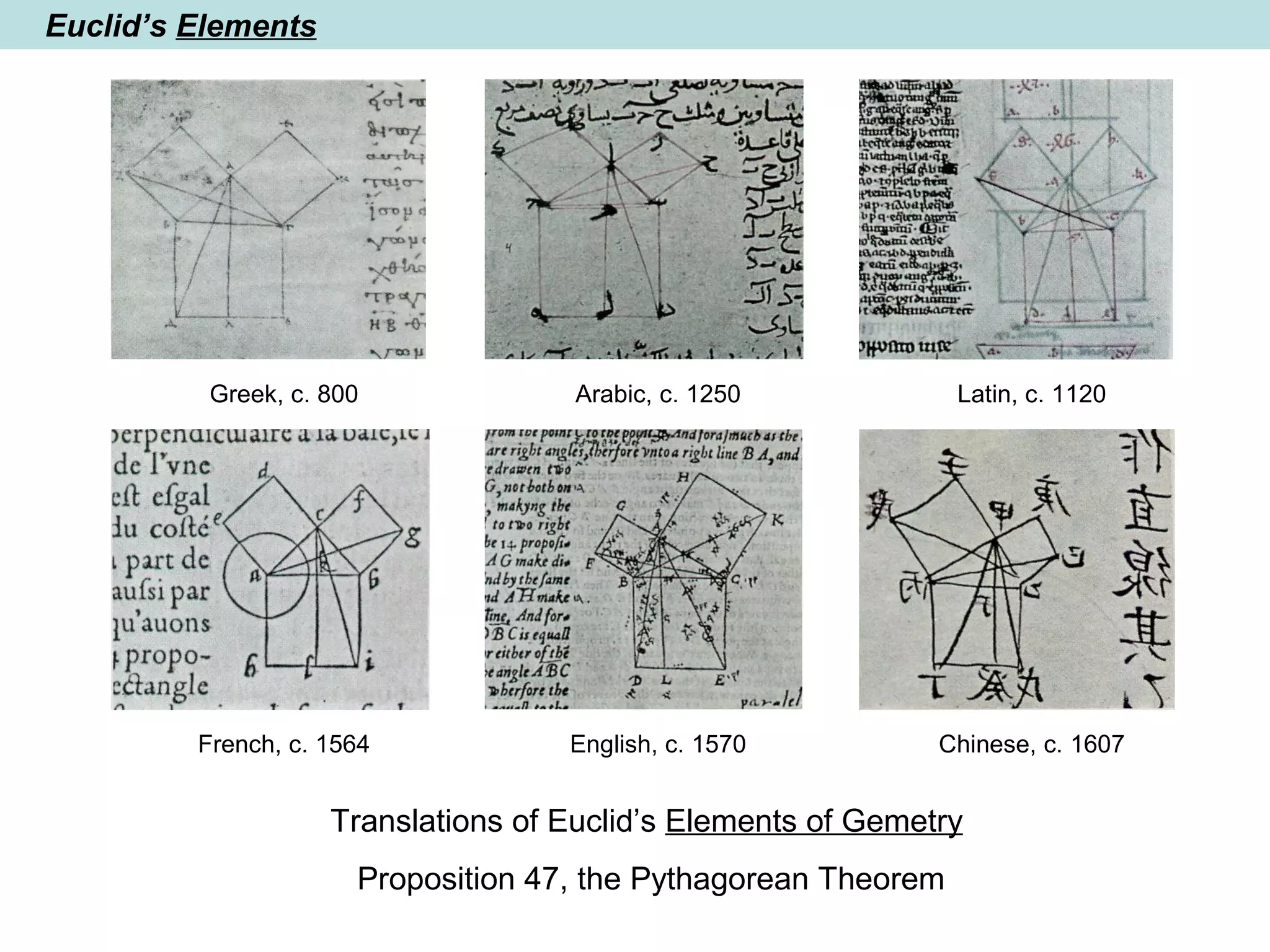
Euclid’s Elements
Greek, c. 800 Arabic, c. 1250 Latin, c. 1120
French, c. 1564 English, c. 1570 Chinese, c. 1607
Translations of Euclid’s Elements of Gemetry
Proposition 47, the Pythagorean Theorem
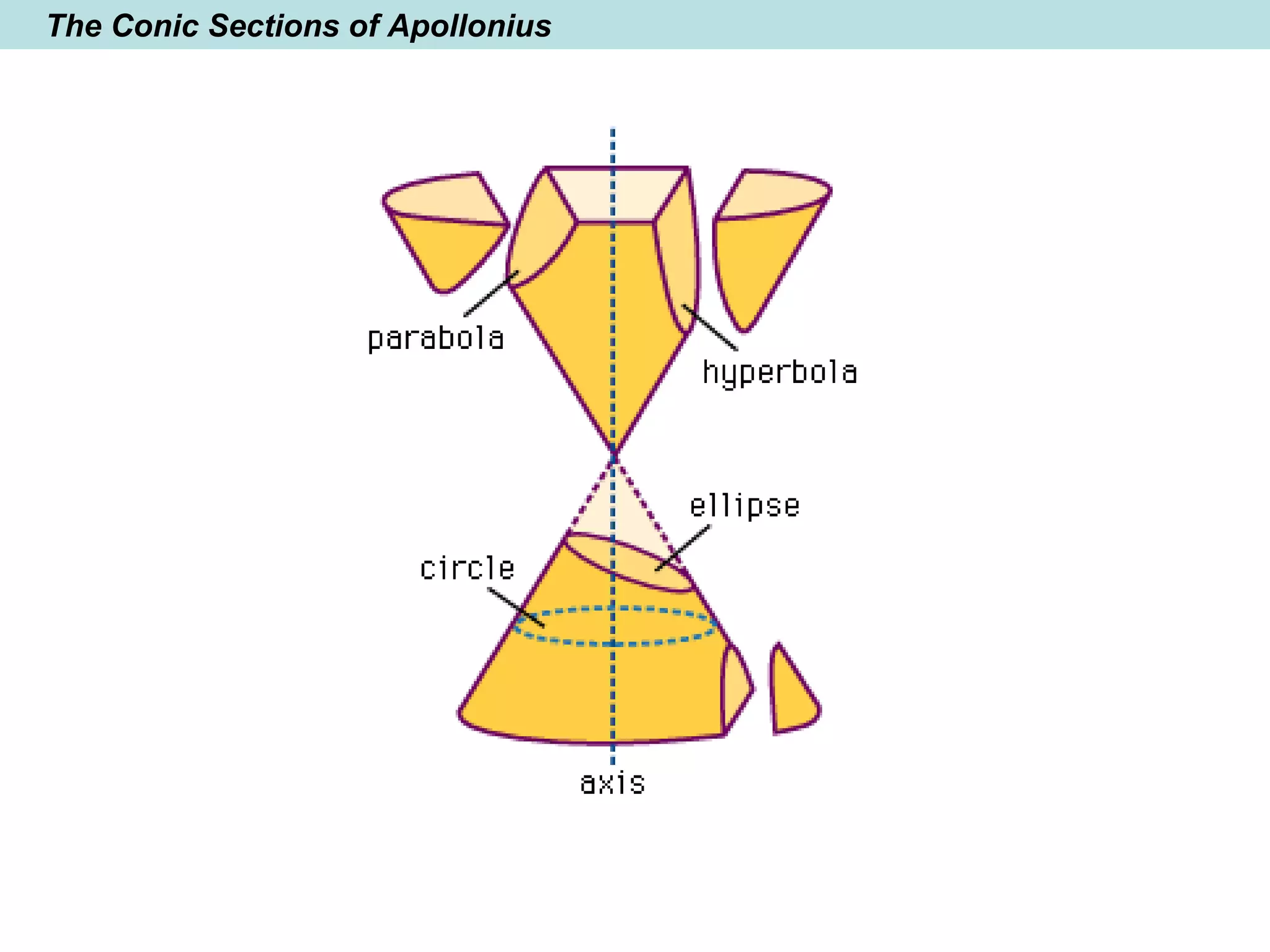
The Conic Sections of Apollonius
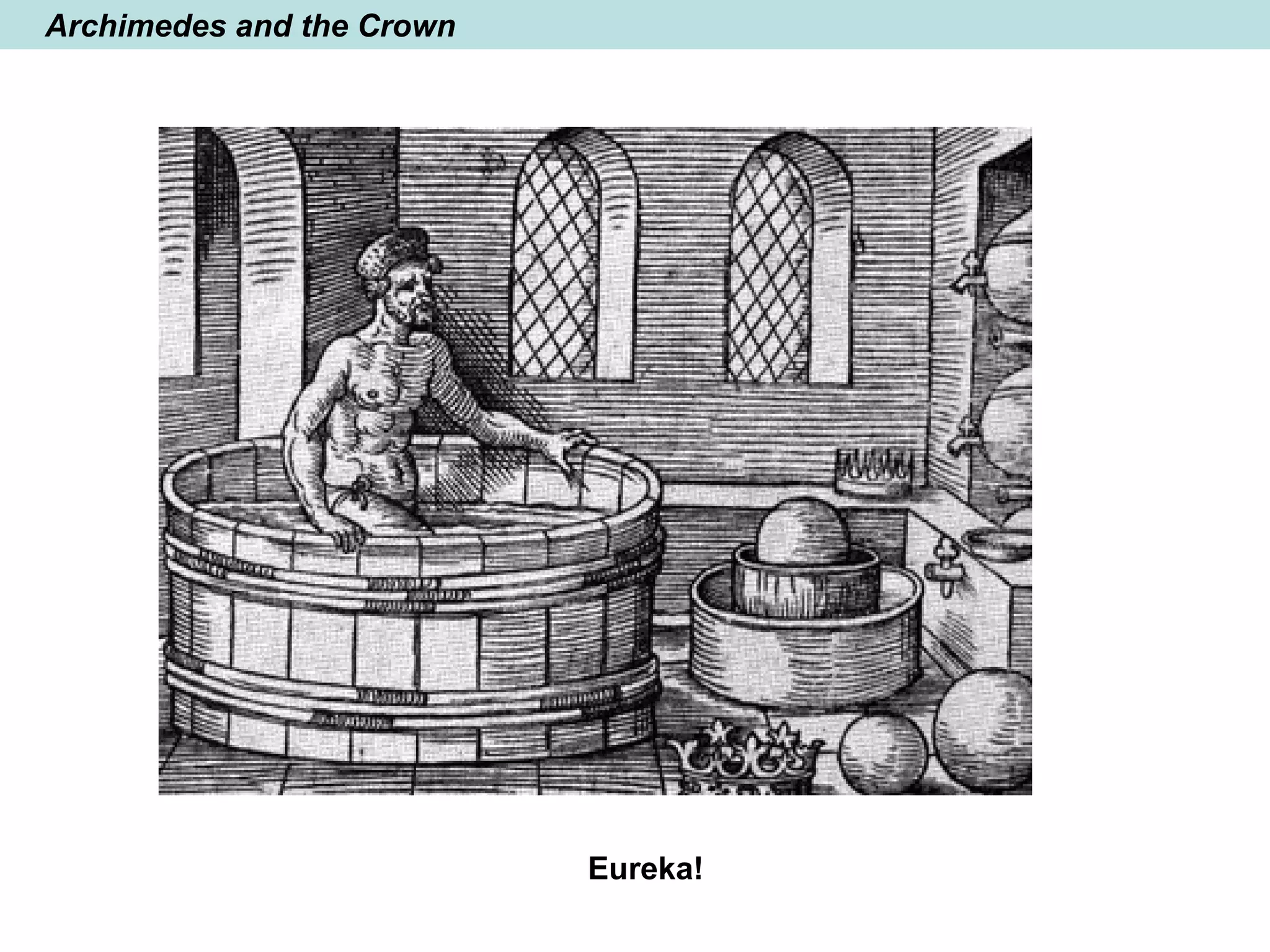
Archimedes and the Crown
Eureka!
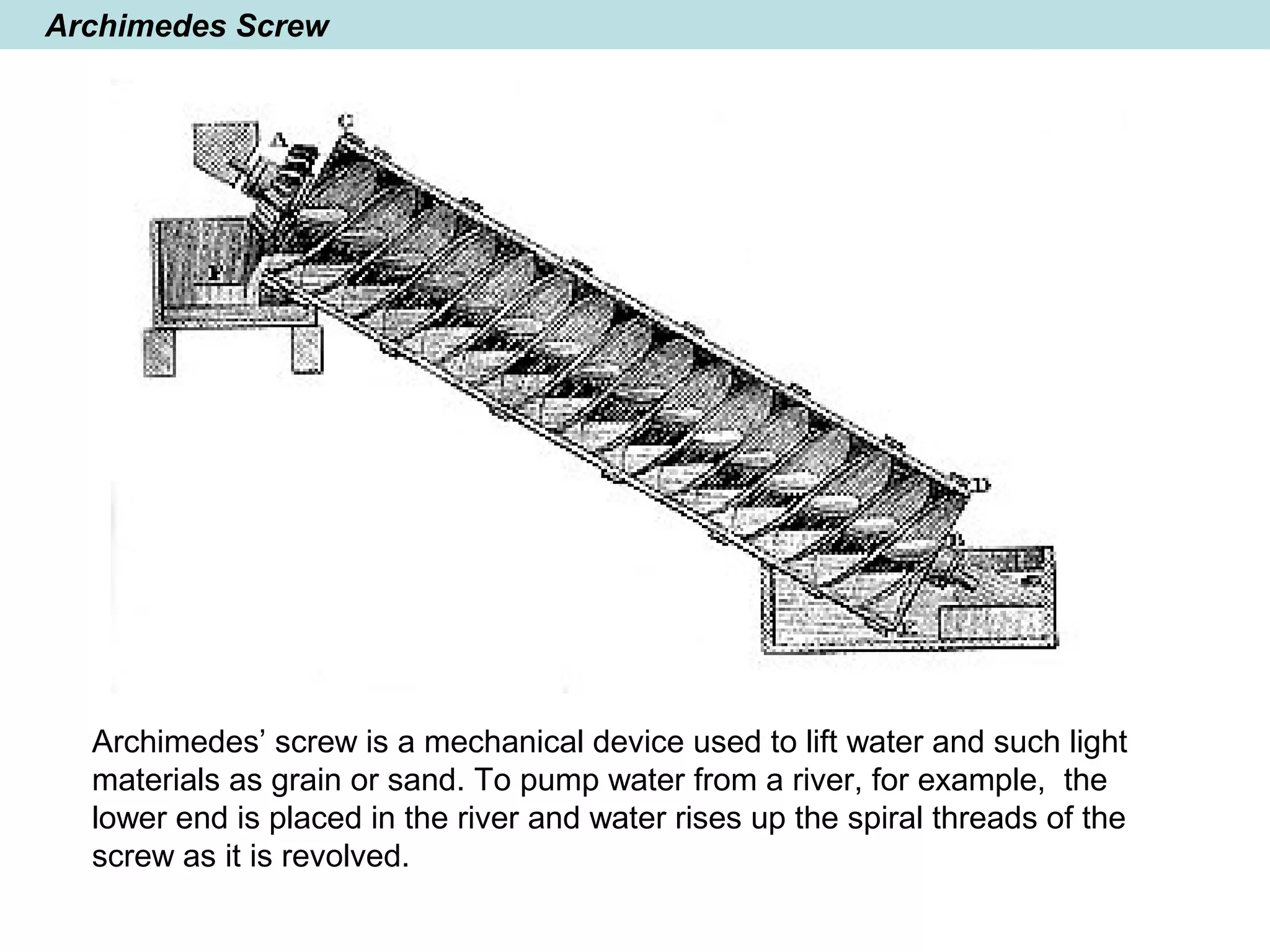
Archimedes Screw
Archimedes’ screw is a mechanical device used to lift water and such light
materials as grain or sand. To pump water from a river, for example, the
lower end is placed in the river and water rises up the spiral threads of the
screw as it is revolved.
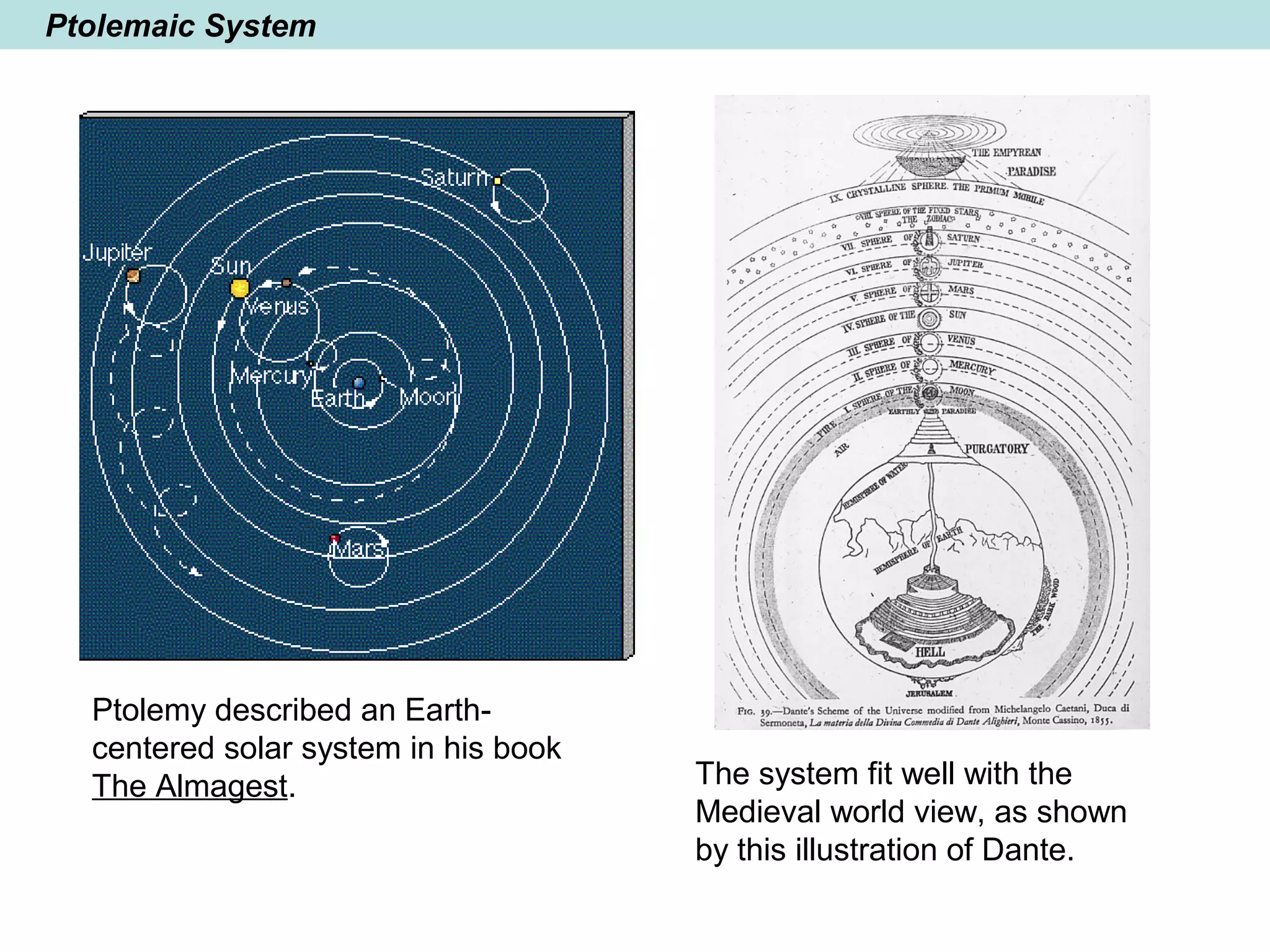
Ptolemaic System
Ptolemy described an Earth-
centered solar system in his book
The Almagest. The system fit well with the
Medieval world view, as shown
by this illustration of Dante.
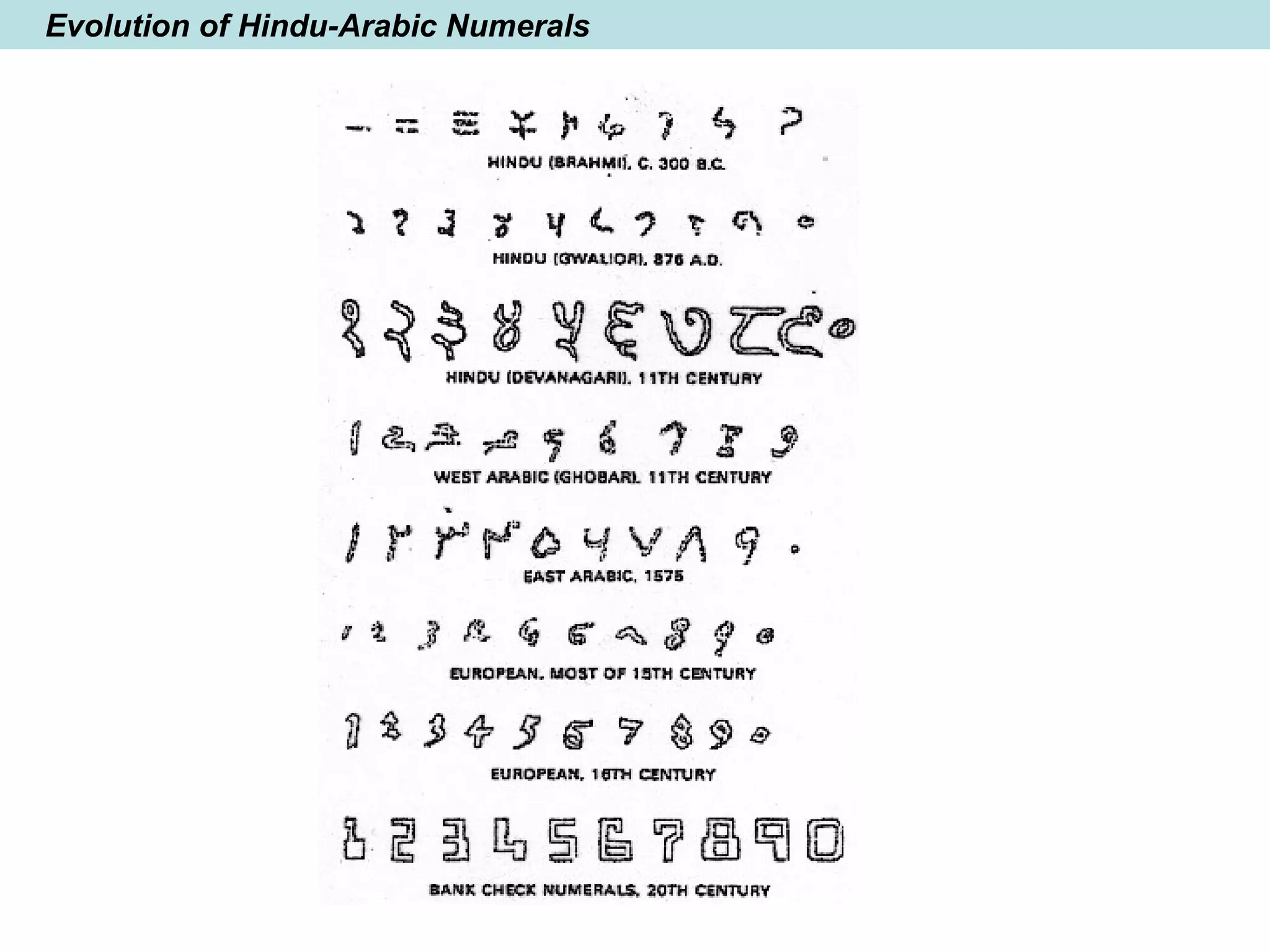
Hindu-Arabian Period (200 B.C. to 1250 A.D. )
A. Development and Spread of Hindu-Arabic Numbers
• A numeration system using base 10, positional notation, the zero symbol
and powerful arithmetic techniques is developed by the Hindus, approx.
150 B.C. to 800 A.D..
• The Hindu numeration system is adopted by the Arabs and spread
throughout their sphere of influence (approx. 700 A.D. to 1250 A.D.).
B. Preservation of Greek Mathematics
• Arab scholars copied and studied Greek mathematical works, principally
in Baghdad.
C. Development of Algebra and Trigonometry
• Arab mathematicians find methods of solution for quadratic, cubic and
higher degree polynomial equations. The English word “algebra” is
derived from the title of an Arabic book describing these methods.
• Hindu trigonometry, especially sine tables, is improved and advanced by
Arab mathematicians
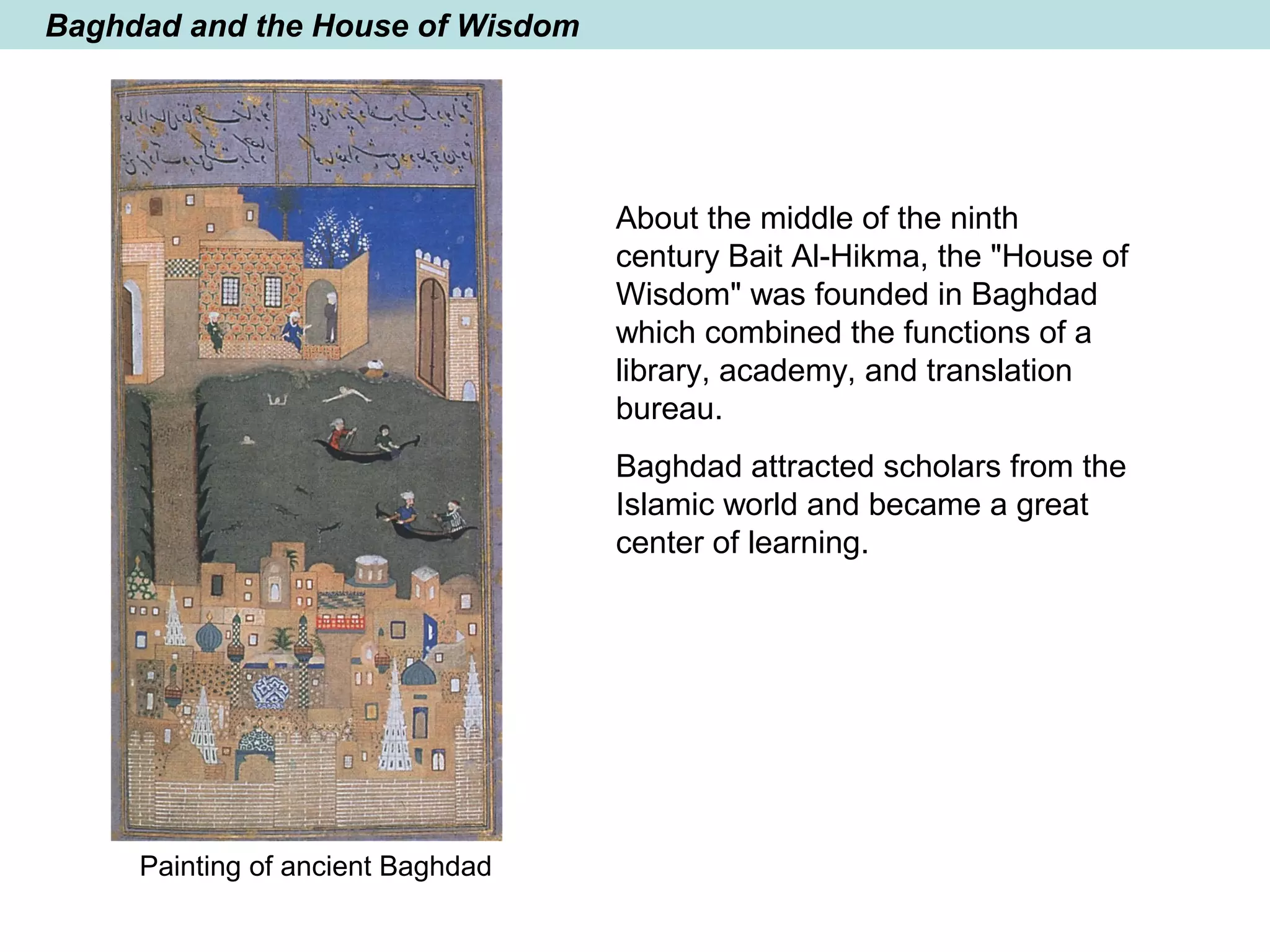
Baghdad and the House of Wisdom
About the middle of the ninth
century Bait Al-Hikma, the "House of
Wisdom" was founded in Baghdad
which combined the functions of a
library, academy, and translation
bureau.
Baghdad attracted scholars from the
Islamic world and became a great
center of learning.
Painting of ancient Baghdad
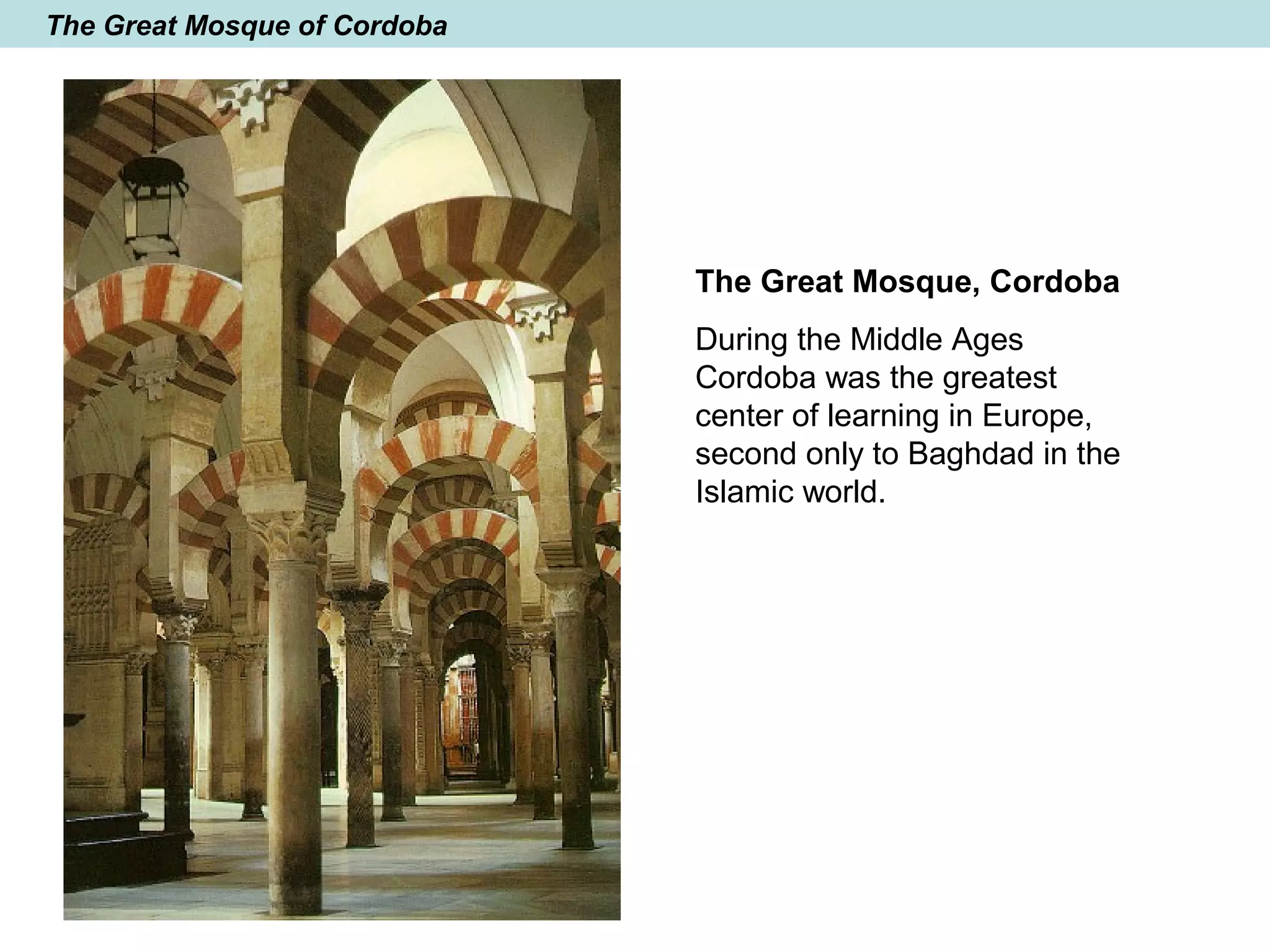
The Great Mosque of Cordoba
The Great Mosque, Cordoba
During the Middle Ages
Cordoba was the greatest
center of learning in Europe,
second only to Baghdad in the
Islamic world.
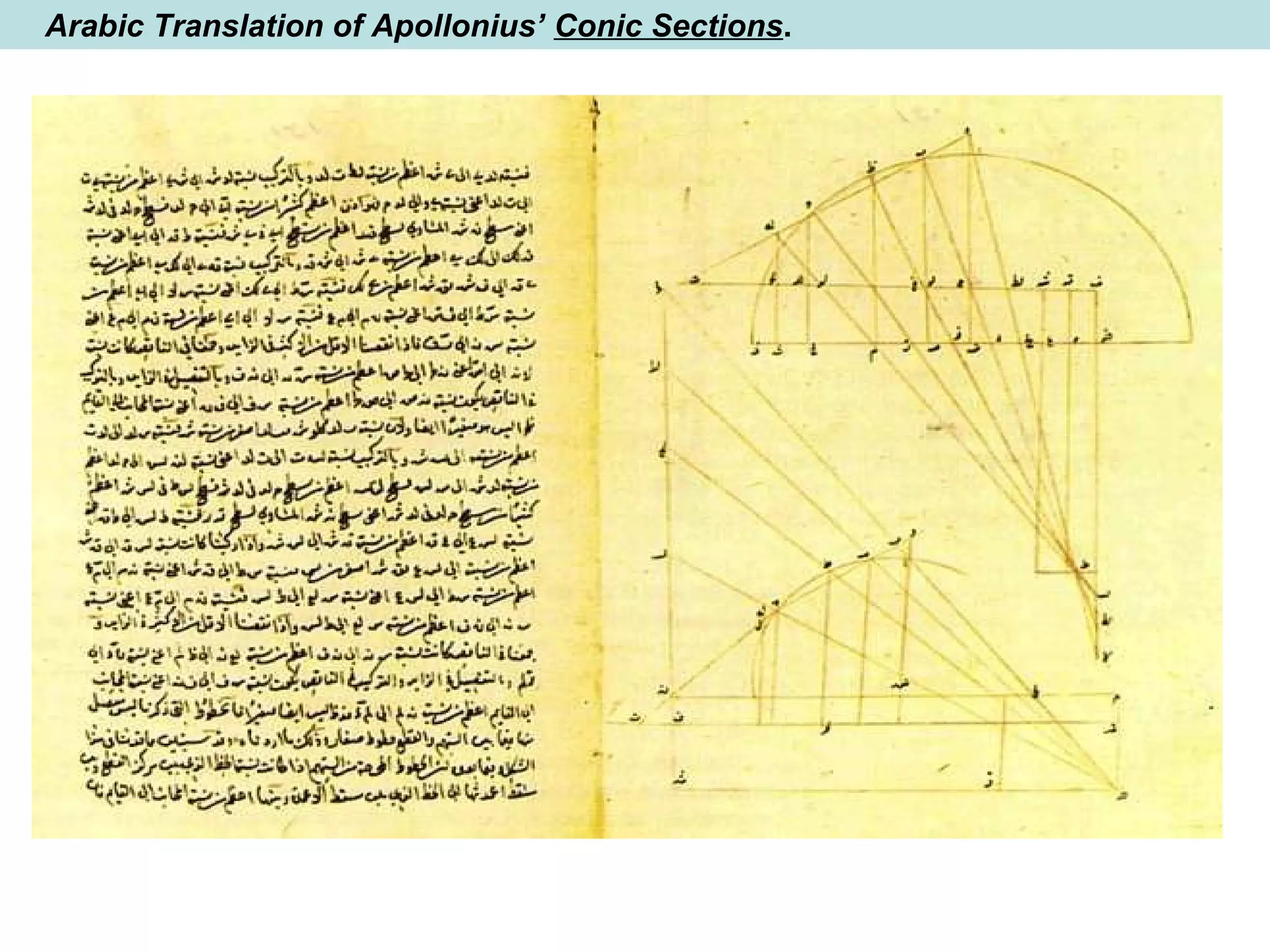
Arabic Translation of Apollonius’ Conic Sections.
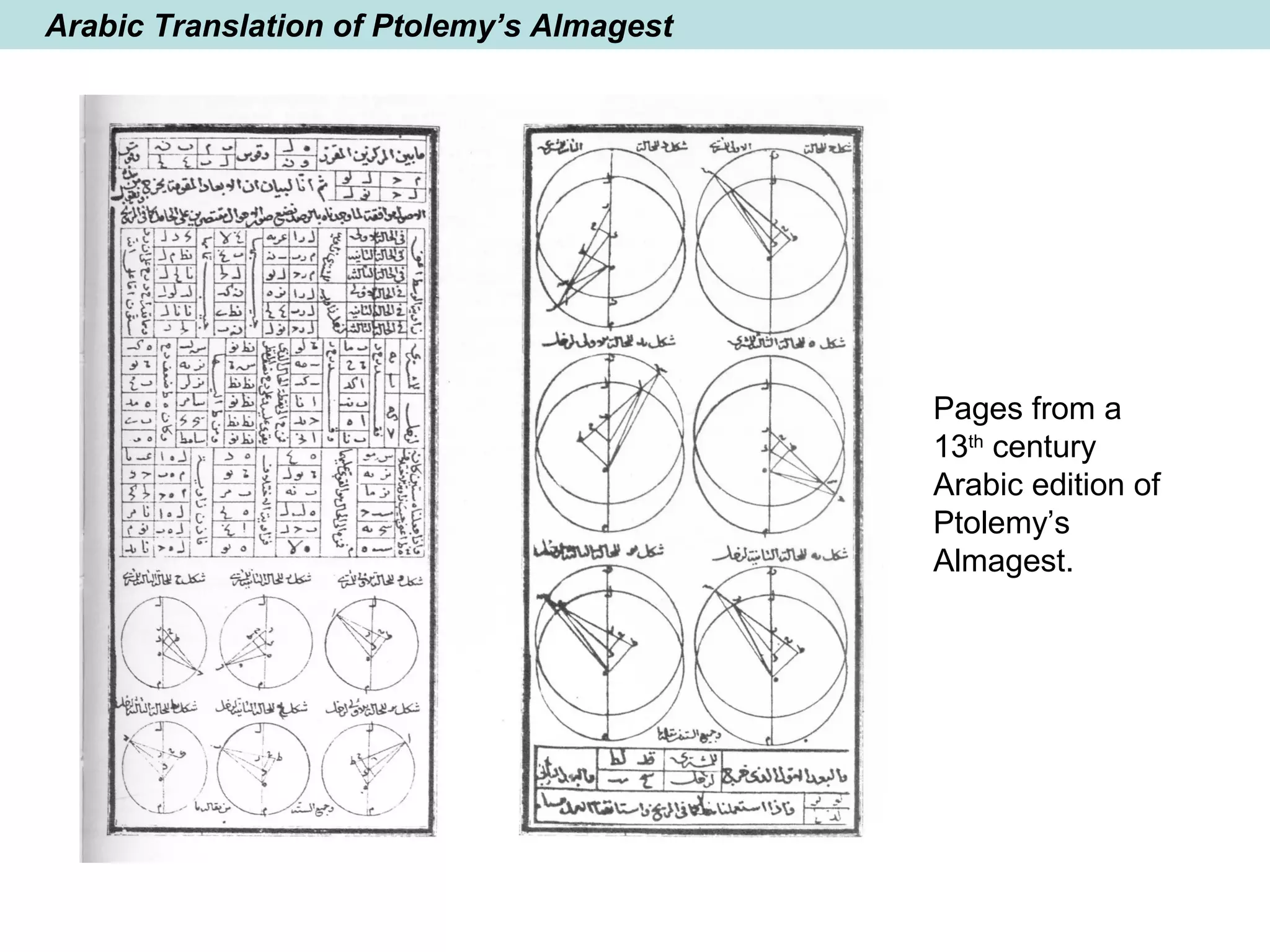
Arabic Translation of Ptolemy’s Almagest
Pages from a
13th
century
Arabic edition of
Ptolemy’s
Almagest.
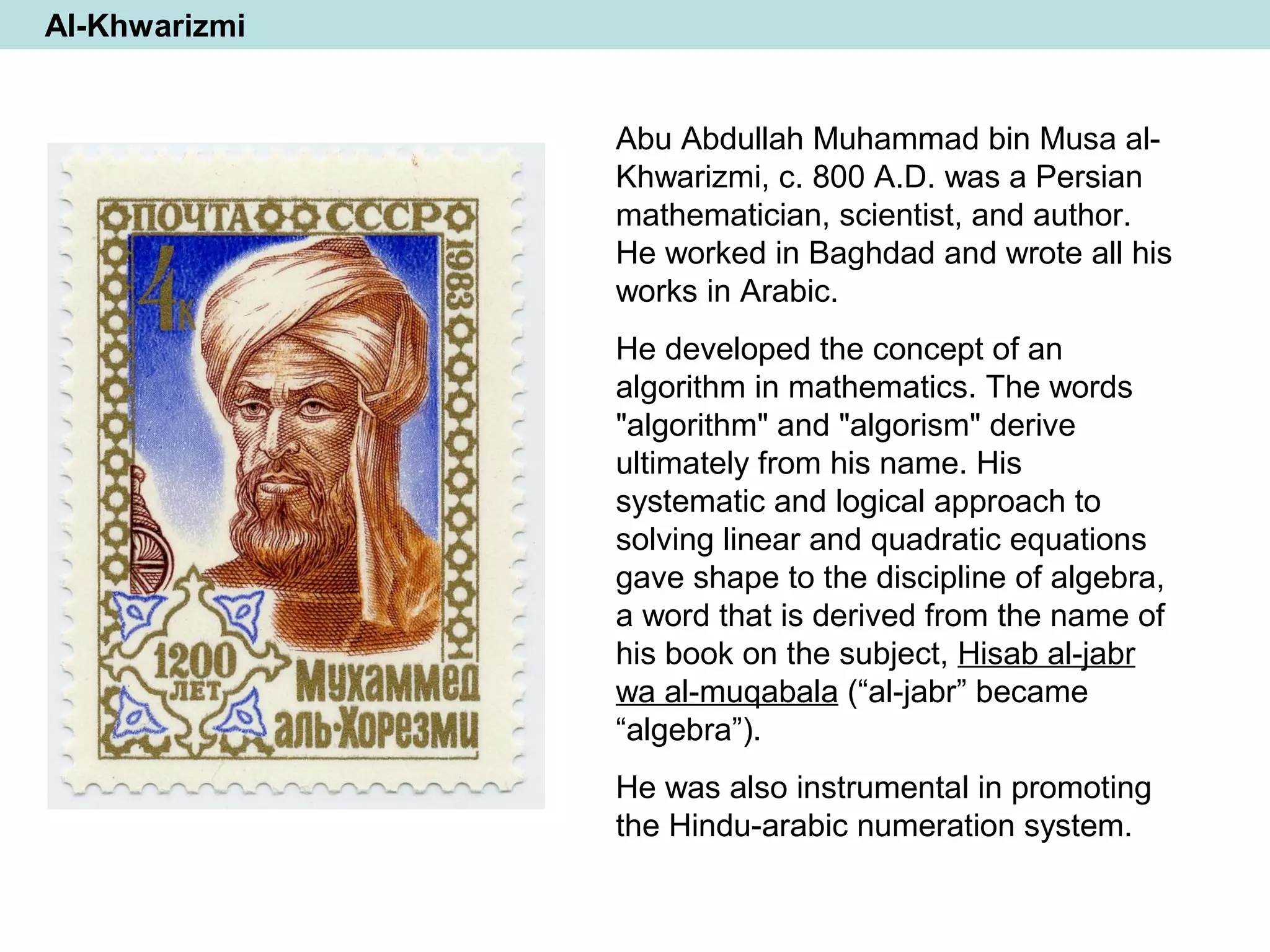
Al-Khwarizmi
Abu Abdullah Muhammad bin Musa al-
Khwarizmi, c. 800 A.D. was a Persian
mathematician, scientist, and author.
He worked in Baghdad and wrote all his
works in Arabic.
He developed the concept of an
algorithm in mathematics. The words
"algorithm" and "algorism" derive
ultimately from his name. His
systematic and logical approach to
solving linear and quadratic equations
gave shape to the discipline of algebra,
a word that is derived from the name of
his book on the subject, Hisab al-jabr
wa al-muqabala (“al-jabr” became
“algebra”).
He was also instrumental in promoting
the Hindu-arabic numeration system.
Evolution of Hindu-Arabic Numerals
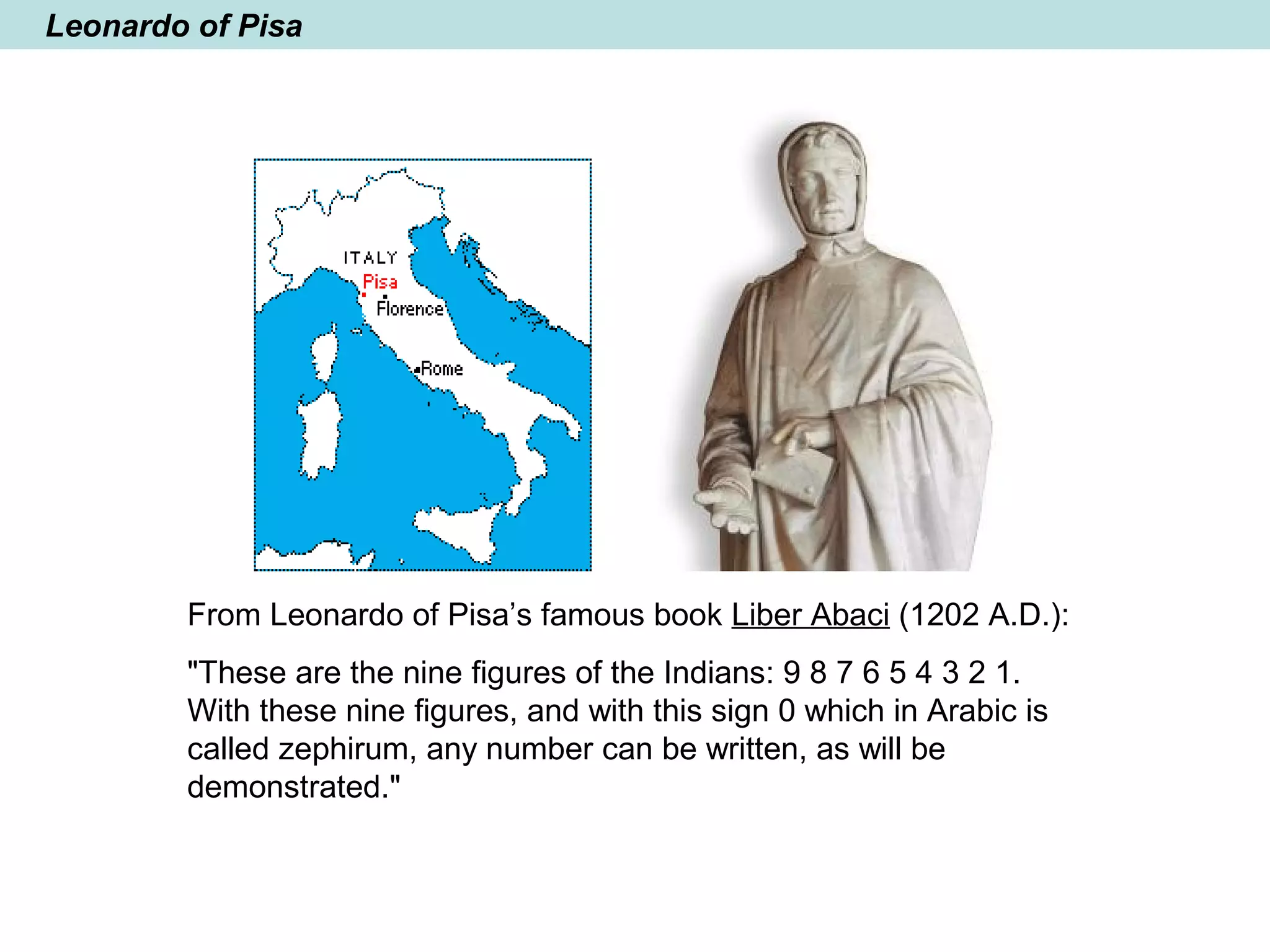
Leonardo of Pisa
From Leonardo of Pisa’s famous book Liber Abaci (1202 A.D.):
"These are the nine figures of the Indians: 9 8 7 6 5 4 3 2 1.
With these nine figures, and with this sign 0 which in Arabic is
called zephirum, any number can be written, as will be
demonstrated."
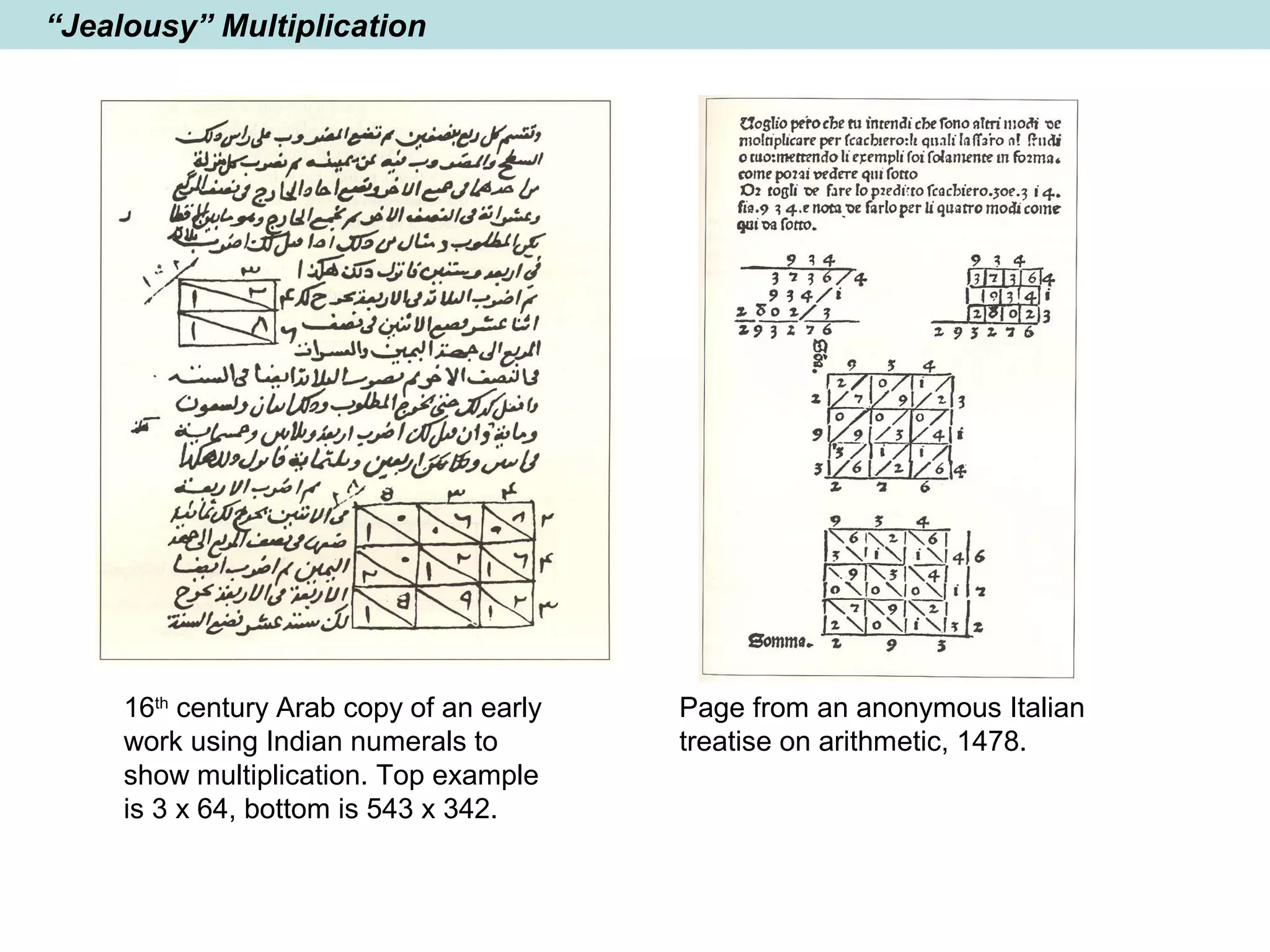
“Jealousy” Multiplication
Page from an anonymous Italian
treatise on arithmetic, 1478.
16th
century Arab copy of an early
work using Indian numerals to
show multiplication. Top example
is 3 x 64, bottom is 543 x 342.
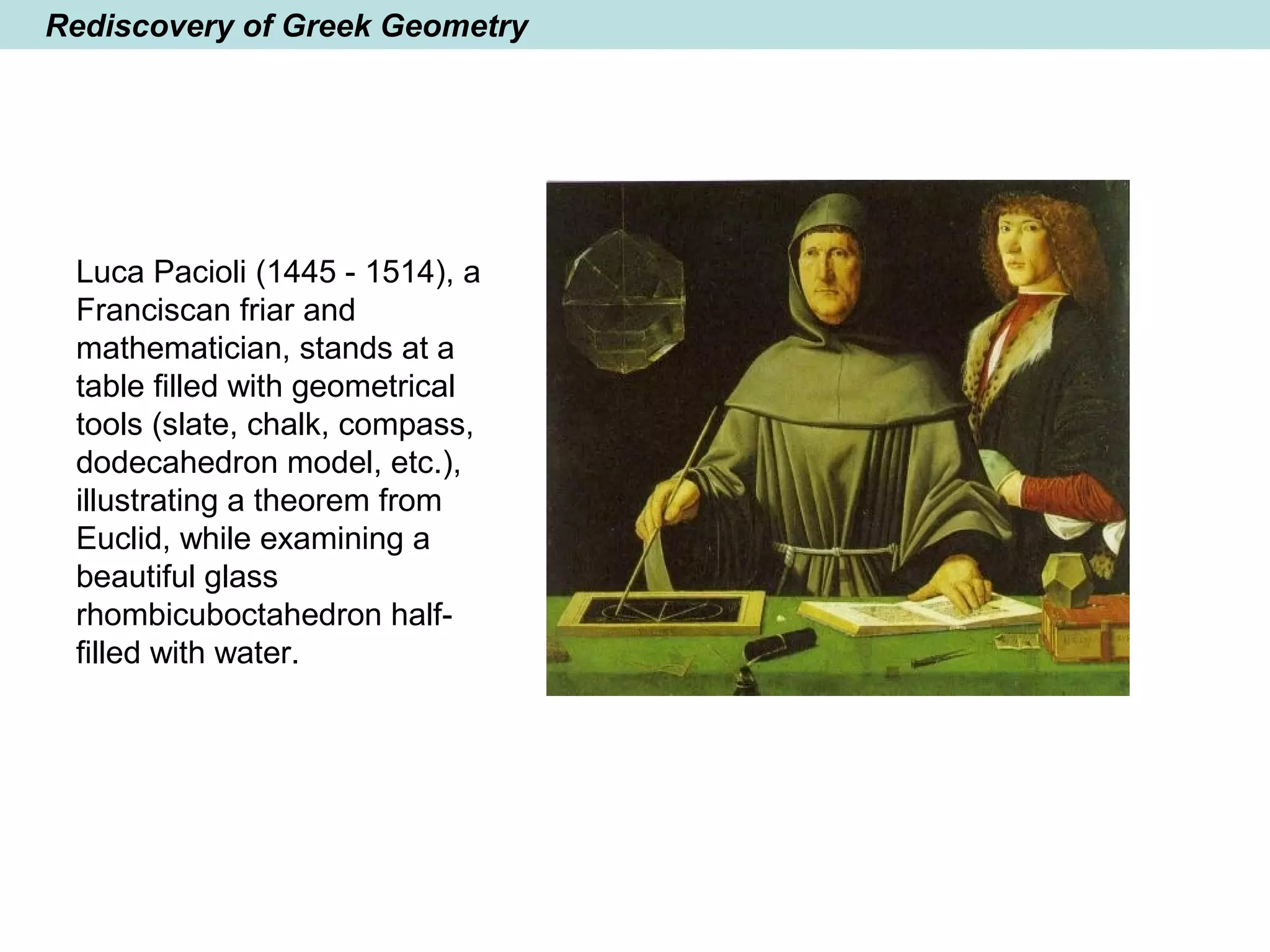
Rediscovery of Greek Geometry
Luca Pacioli (1445 - 1514), a
Franciscan friar and
mathematician, stands at a
table filled with geometrical
tools (slate, chalk, compass,
dodecahedron model, etc.),
illustrating a theorem from
Euclid, while examining a
beautiful glass
rhombicuboctahedron half-
filled with water.
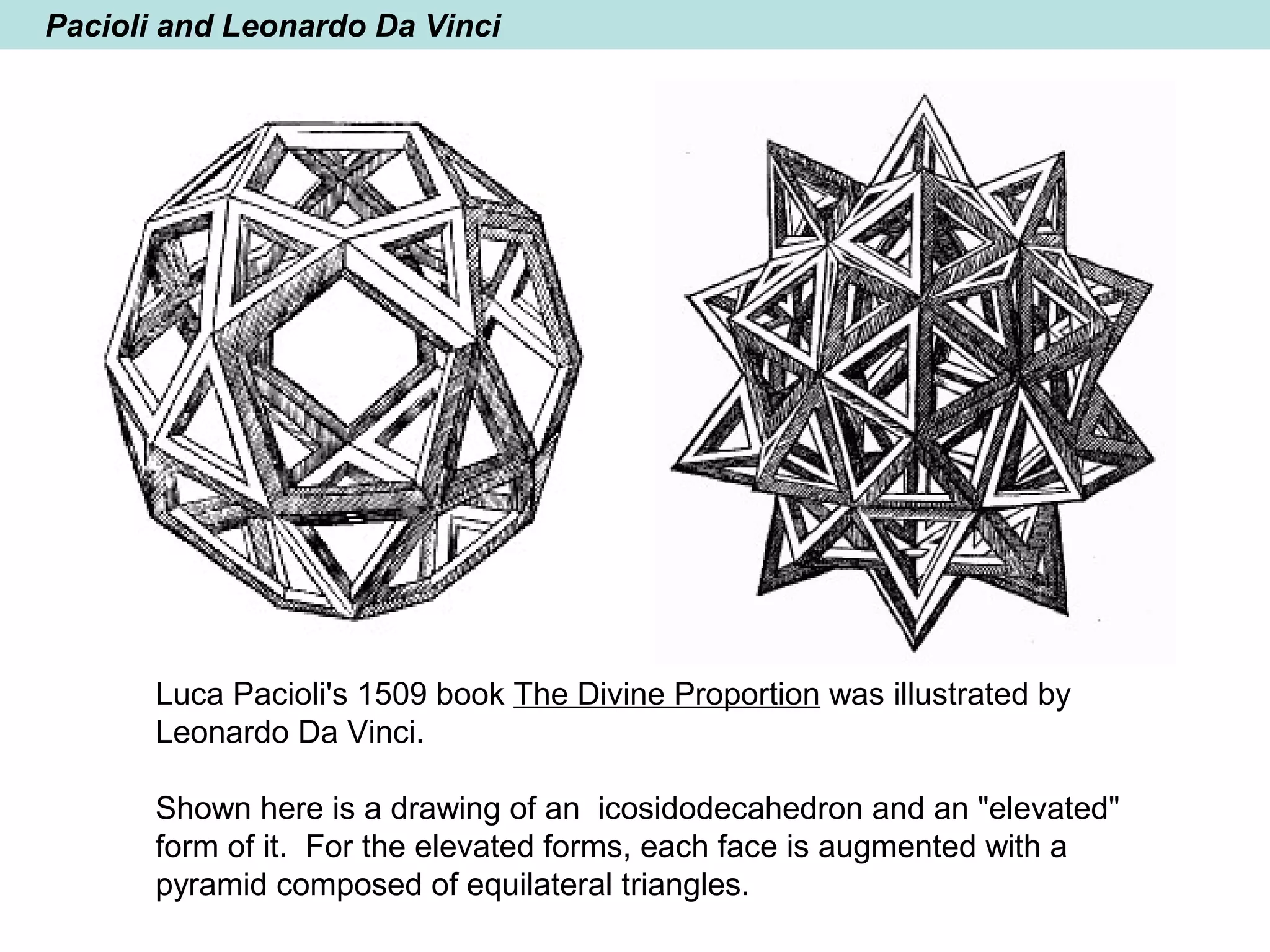
Pacioli and Leonardo Da Vinci
Luca Pacioli's 1509 book The Divine Proportion was illustrated by
Leonardo Da Vinci.
Shown here is a drawing of an icosidodecahedron and an "elevated"
form of it. For the elevated forms, each face is augmented with a
pyramid composed of equilateral triangles.
Early Modern Period (1450 A.D. – 1800 A.D.)
A. Trigonometry and Logarithms
• Publication of precise trigonometry tables, improvement of surveying
methods using trigonometry, and mathematical analysis of
trigonometric relationships. (approx. 1530 – 1600)
• Logarithms introduced by Napier in 1614 as a calculation aid. This
advances science in a manner similar to the introduction of the
computer.
B. Symbolic Algebra and Analytic Geometry
• Development of symbolic algebra, principally by the French
mathematicians Viete and Descartes
• The cartesian coordinate system and analytic geometry developed by
Rene Descartes and Pierre Fermat (1630 – 1640)
C. Creation of the Calculus
• Calculus co-invented by Isaac Newton and Gottfried Leibniz. Major
ideas of the calculus expanded and refined by others, especially the
Bernoulli family and Leonhard Euler. (approx. 1660 – 1750).
• A powerful tool to solve scientific and engineering problems, it opened
the door to a scientific and mathematical revolution.
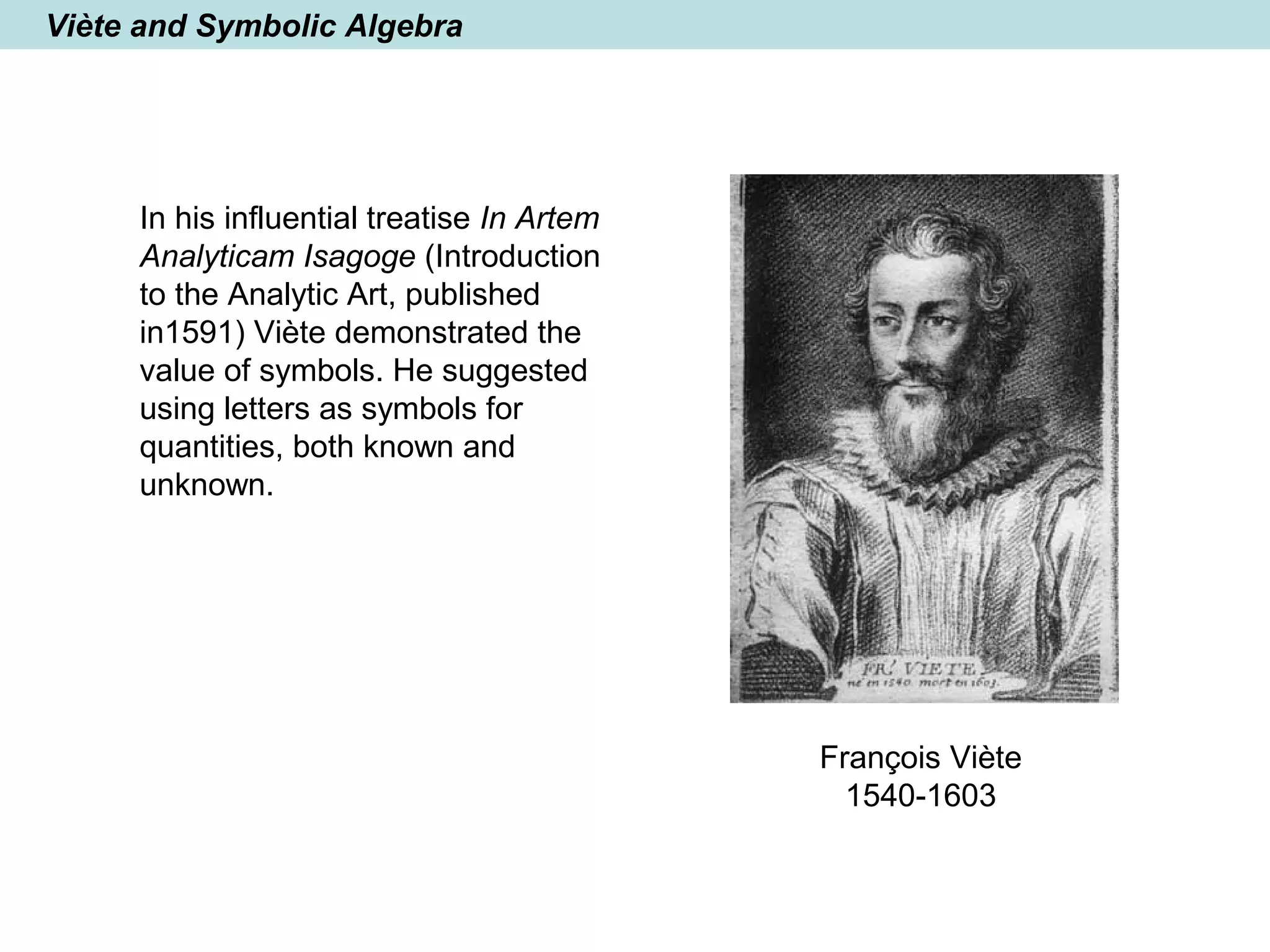
Viète and Symbolic Algebra
In his influential treatise In Artem
Analyticam Isagoge (Introduction
to the Analytic Art, published
in1591) Viète demonstrated the
value of symbols. He suggested
using letters as symbols for
quantities, both known and
unknown.
François Viète
1540-1603
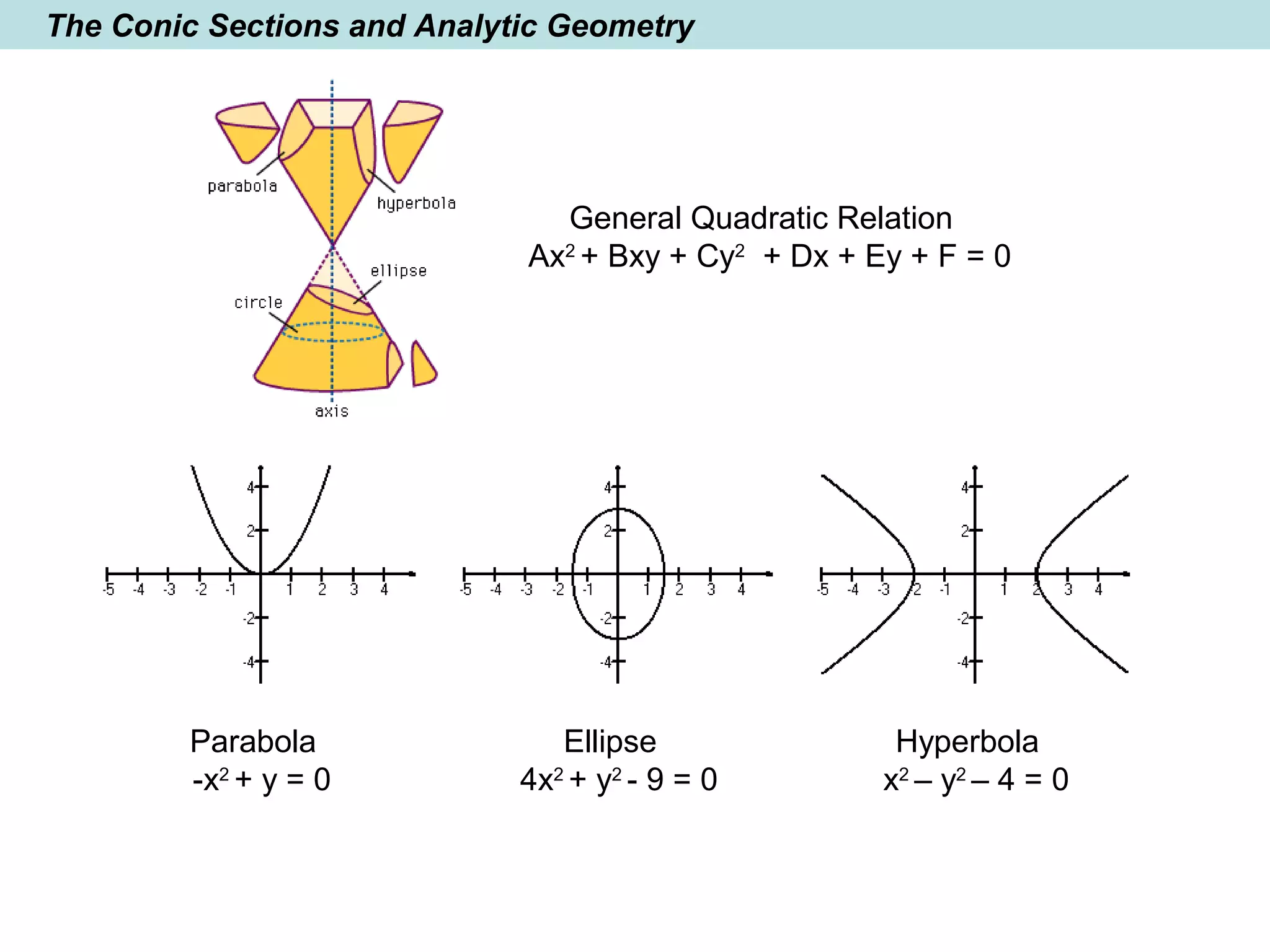
The Conic Sections and Analytic Geometry
General Quadratic Relation
Ax2
+ Bxy + Cy2
+ Dx + Ey + F = 0
Parabola
-x2
+ y = 0
Ellipse
4x2
+ y2
- 9 = 0
Hyperbola
x2
– y2
– 4 = 0
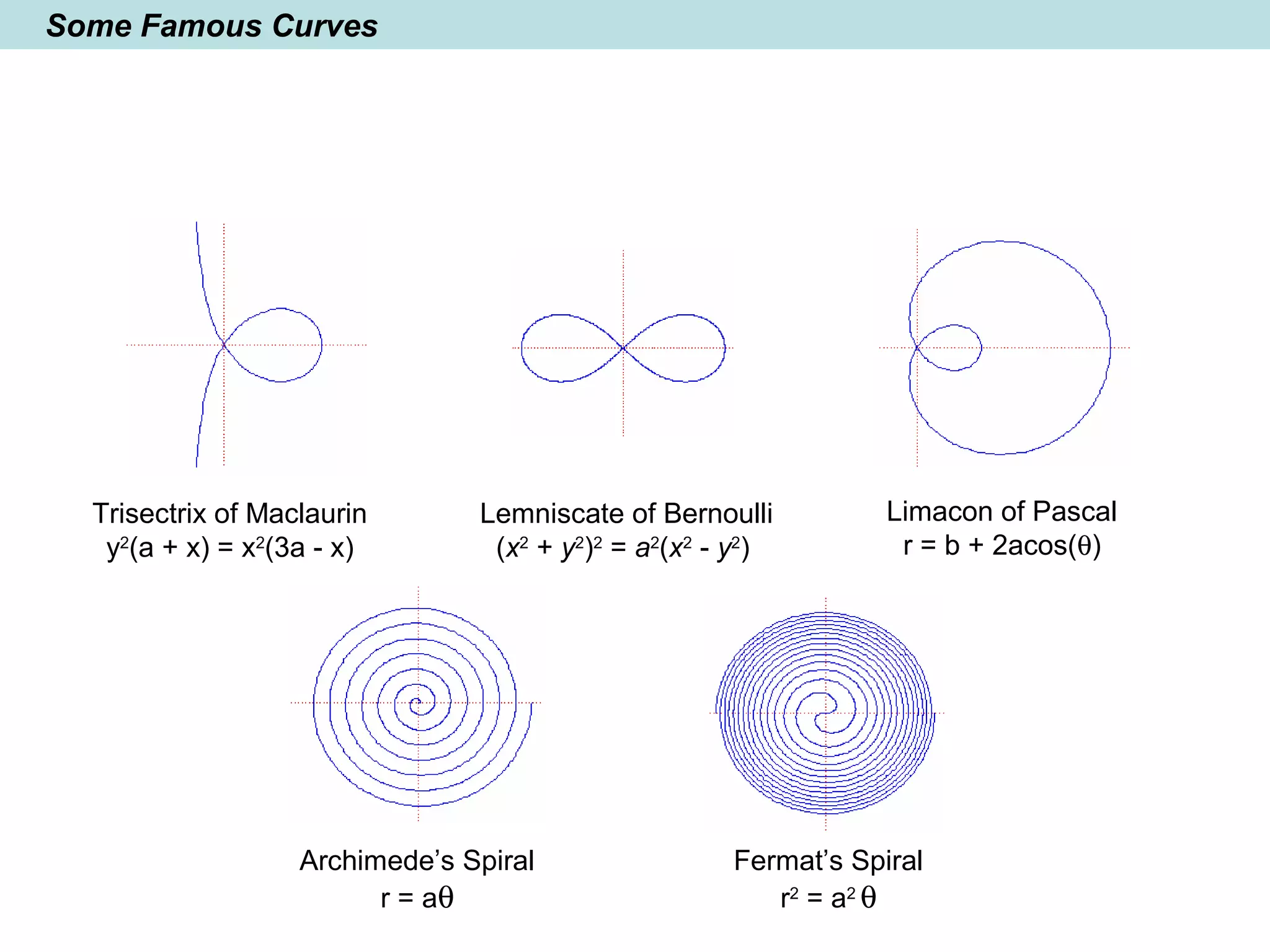
Some Famous Curves
Fermat’s Spiral
r2
= a2
θ
Archimede’s Spiral
r = aθ
Trisectrix of Maclaurin
y2
(a + x) = x2
(3a - x)
Lemniscate of Bernoulli
(x2
+ y2
)2
= a2
(x2
- y2
)
Limacon of Pascal
r = b + 2acos(θ)
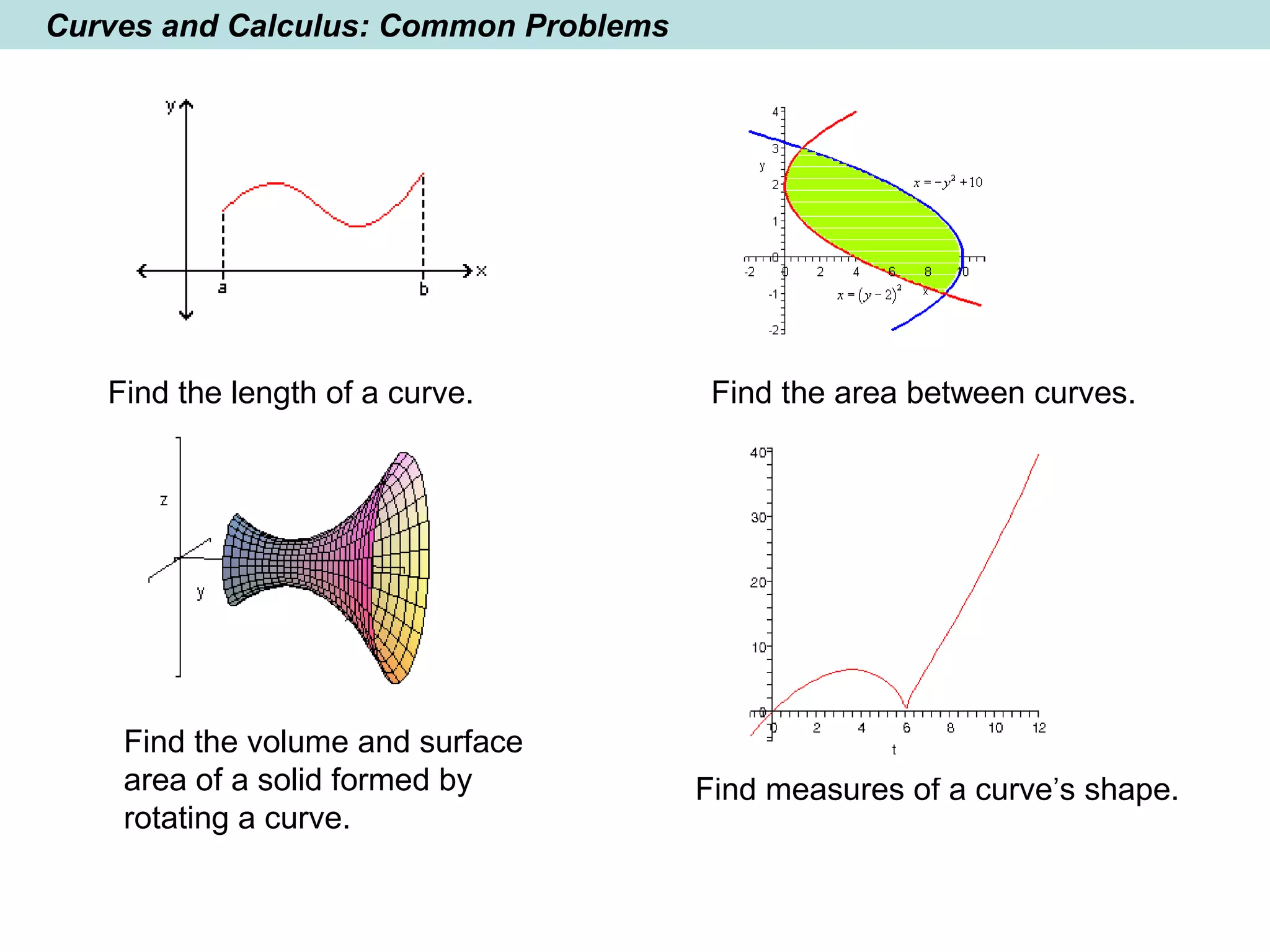
Curves and Calculus: Common Problems
Find the area between curves.
Find the volume and surface
area of a solid formed by
rotating a curve.
Find the length of a curve.
Find measures of a curve’s shape.
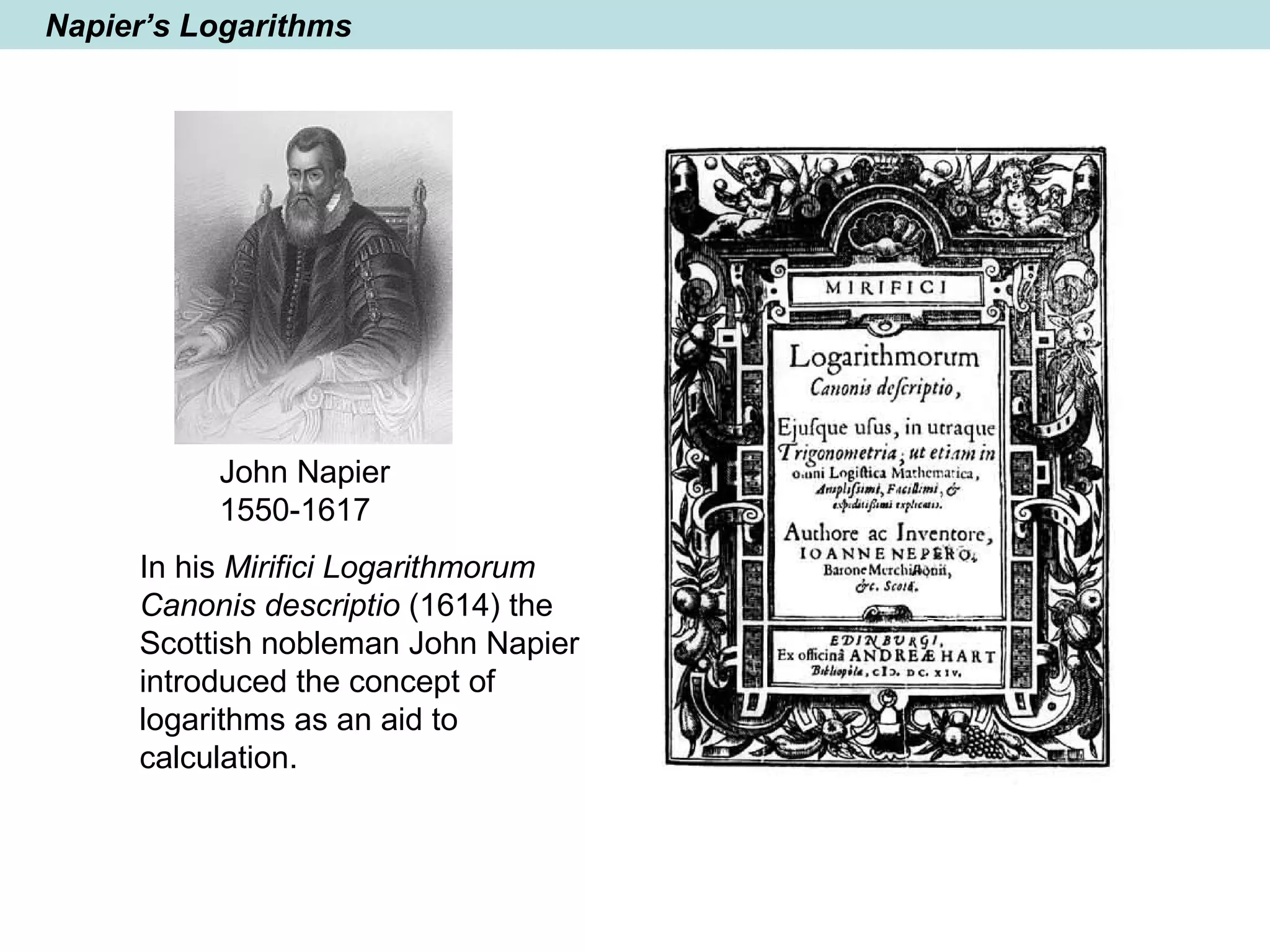
Napier’s Logarithms
In his Mirifici Logarithmorum
Canonis descriptio (1614) the
Scottish nobleman John Napier
introduced the concept of
logarithms as an aid to
calculation.
John Napier
1550-1617
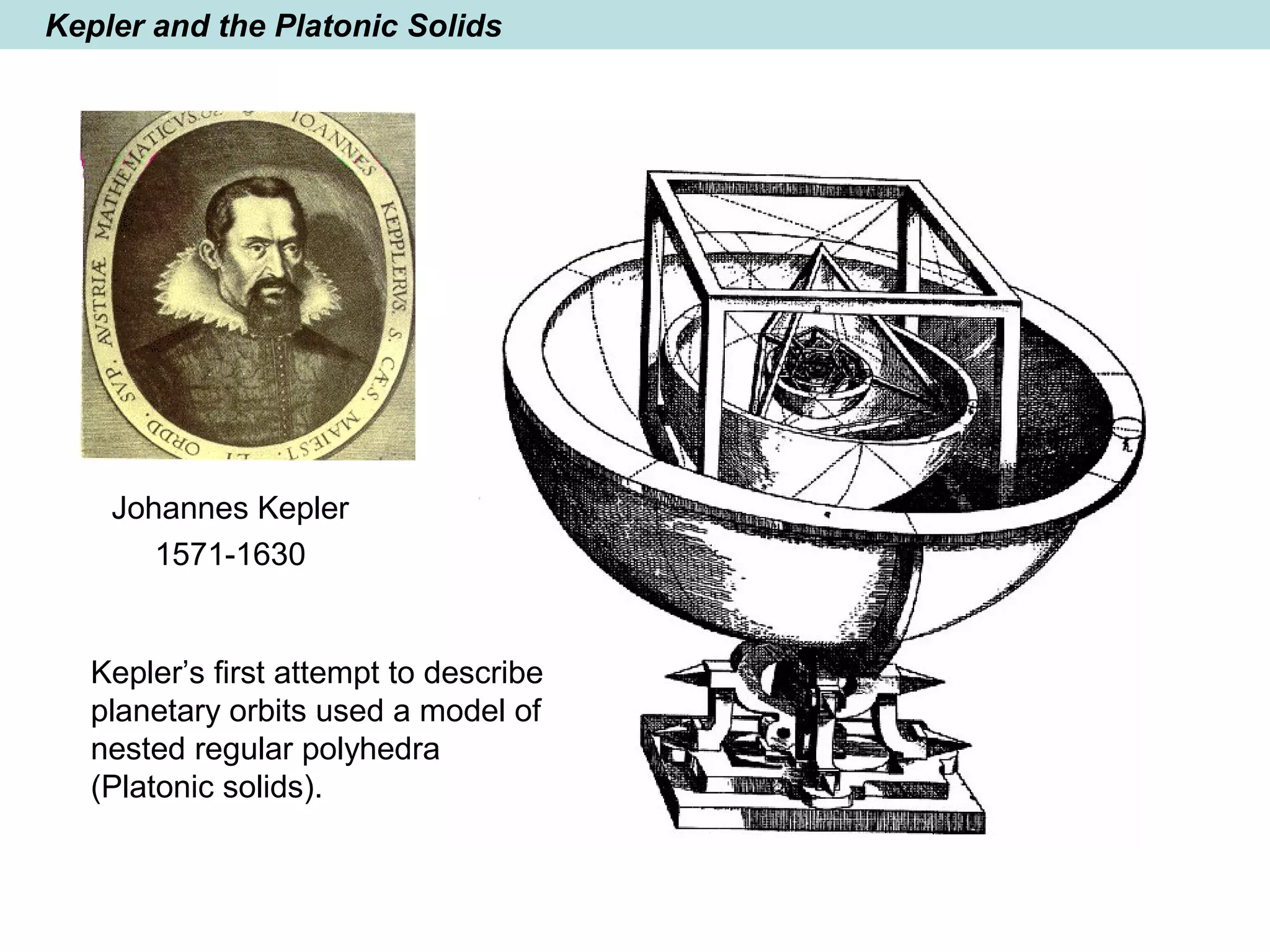
Kepler and the Platonic Solids
Johannes Kepler
1571-1630
Kepler’s first attempt to describe
planetary orbits used a model of
nested regular polyhedra
(Platonic solids).
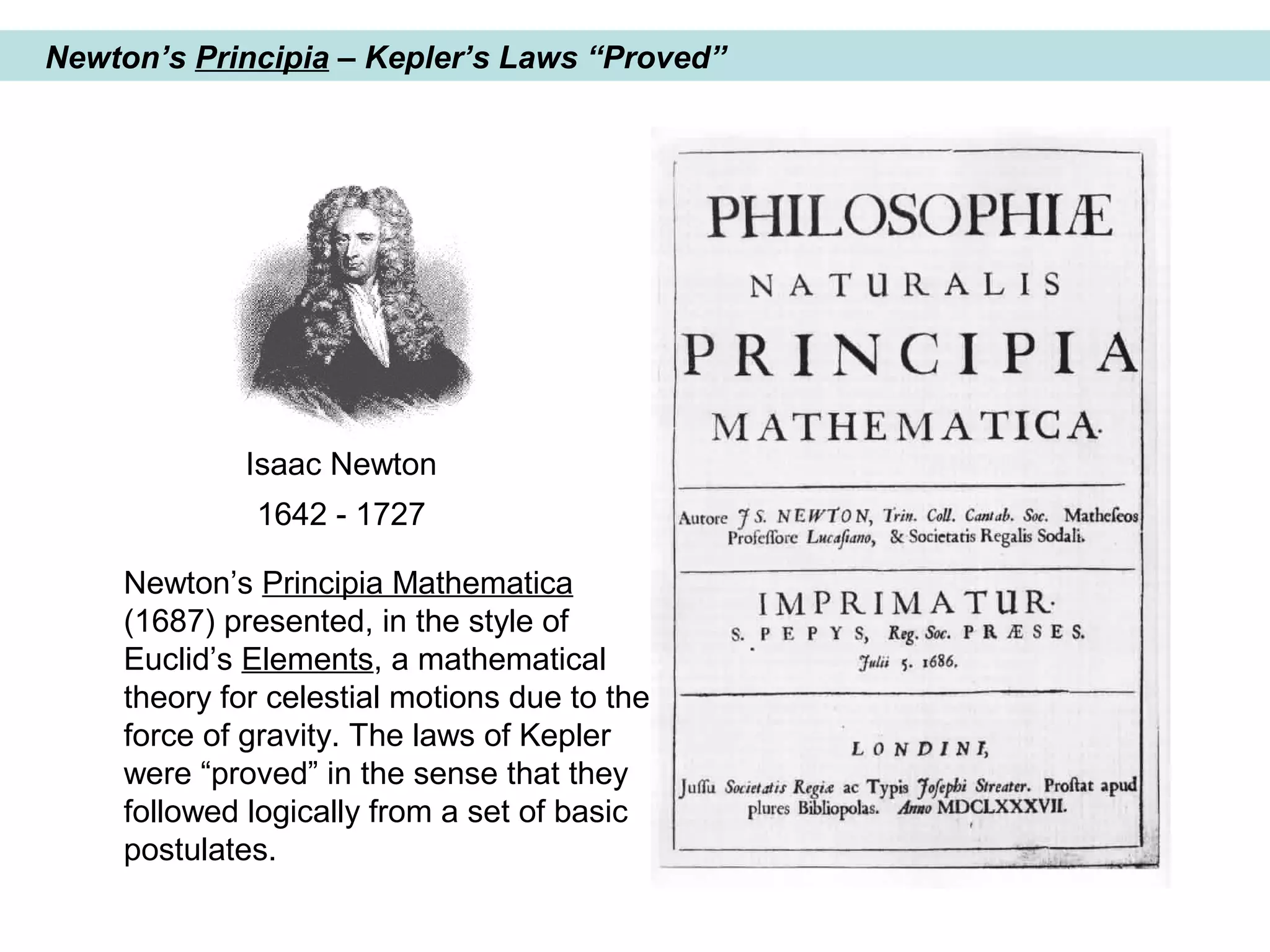
Newton’s Principia – Kepler’s Laws “Proved”
Isaac Newton
1642 - 1727
Newton’s Principia Mathematica
(1687) presented, in the style of
Euclid’s Elements, a mathematical
theory for celestial motions due to the
force of gravity. The laws of Kepler
were “proved” in the sense that they
followed logically from a set of basic
postulates.
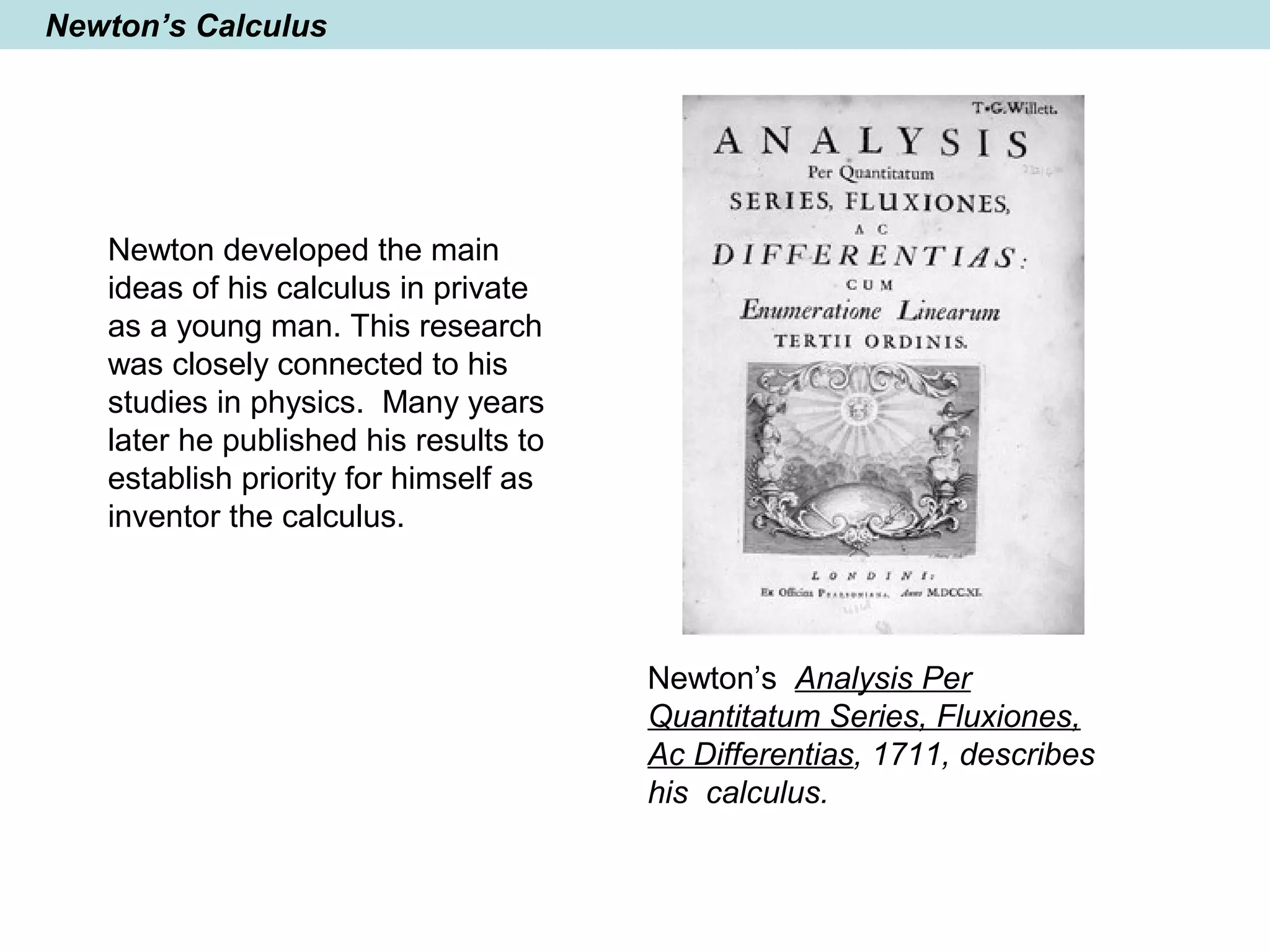
Newton’s Calculus
Newton developed the main
ideas of his calculus in private
as a young man. This research
was closely connected to his
studies in physics. Many years
later he published his results to
establish priority for himself as
inventor the calculus.
Newton’s Analysis Per
Quantitatum Series, Fluxiones,
Ac Differentias, 1711, describes
his calculus.
Leibniz’s Calculus
Leibniz and Newton independently
developed the calculus during the
same time period. Although Newton’s
version of the calculus led him to his
great discoveries, Leibniz’s concepts
and his style of notation form the
basis of modern calculus.
Gottfied Leibniz
1646 - 1716
A diagram from Leibniz's famous
1684 article in the journal Acta
eruditorum.
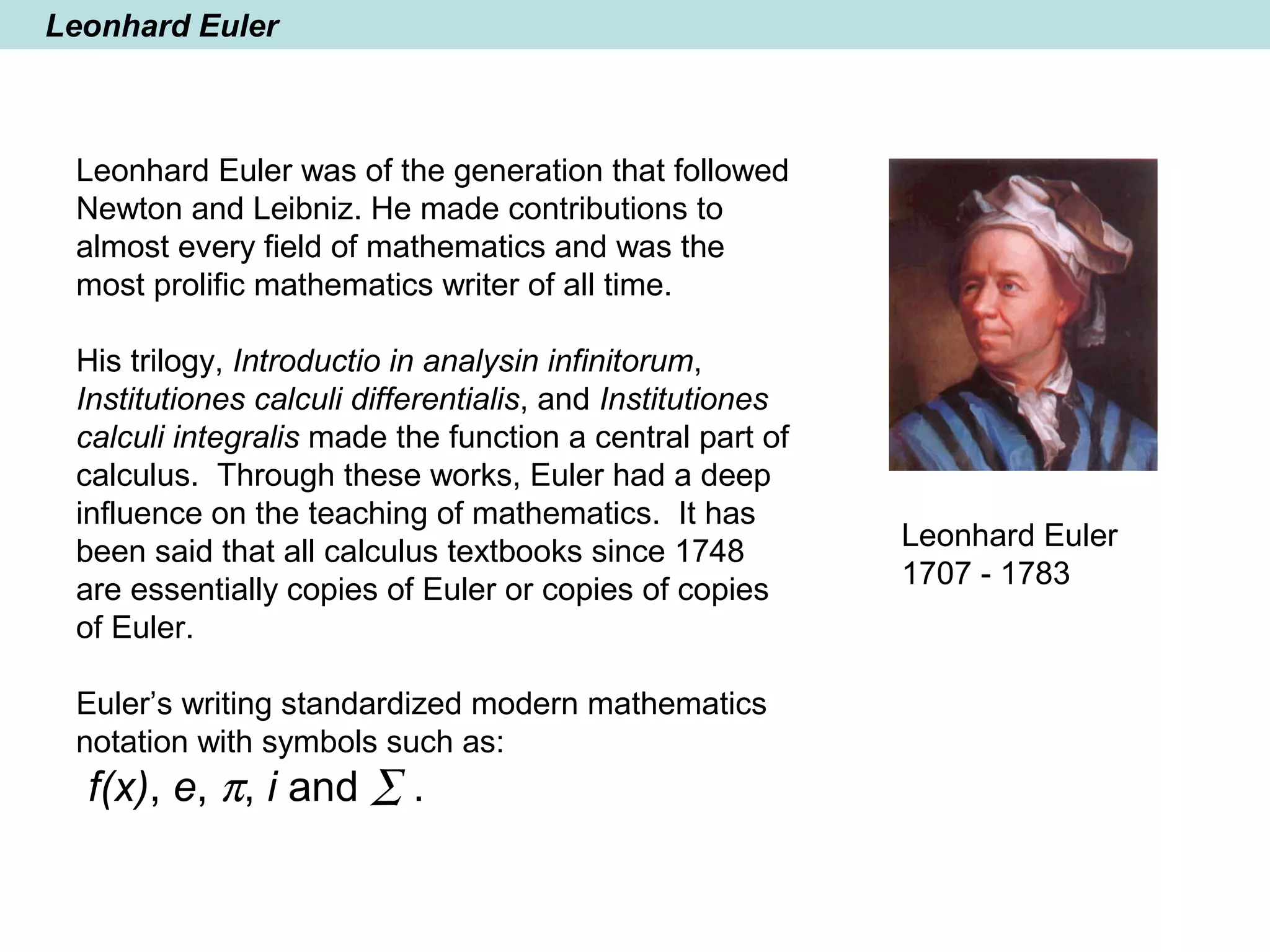
Leonhard Euler
Leonhard Euler was of the generation that followed
Newton and Leibniz. He made contributions to
almost every field of mathematics and was the
most prolific mathematics writer of all time.
His trilogy, Introductio in analysin infinitorum,
Institutiones calculi differentialis, and Institutiones
calculi integralis made the function a central part of
calculus. Through these works, Euler had a deep
influence on the teaching of mathematics. It has
been said that all calculus textbooks since 1748
are essentially copies of Euler or copies of copies
of Euler.
Euler’s writing standardized modern mathematics
notation with symbols such as:
f(x), e, π, i and ∑ .
Leonhard Euler
1707 - 1783
Modern Period (1800 A.D. – Present)
A. Non-Euclidean Geometry
• Gauss, Lobachevsky, Riemann and others develop alternatives to Euclidean geometry
in the 19th century.
• The new geometries inspire modern theories of higher dimensional spaces, gravitation,
space curvature and nuclear physics.
B. Set Theory
• Cantor studies infinite sets and defines transfinite numbers
• Set theory used as a theoretical foundation for all of mathematics
C. Statistics and Probability
• Theories of probability and statistics are developed to solve numerous practical
applications, such as weather prediction, polls, medical studies etc.; they are also used
as a basis for nuclear physics
D. Computers
• Development of electronic computer hardware and software solves many previously
unsolvable problems; opens new fields of mathematical research.
E. Mathematics as a World-Wide Language
• The Hindu-Arabic numeration system and a common set of mathematical symbols are
used and understood throughout the world.
• Mathematics expands into many branches and is created and shared world-wide at an
ever-expanding pace; it is now too large to be mastered by a single mathematician
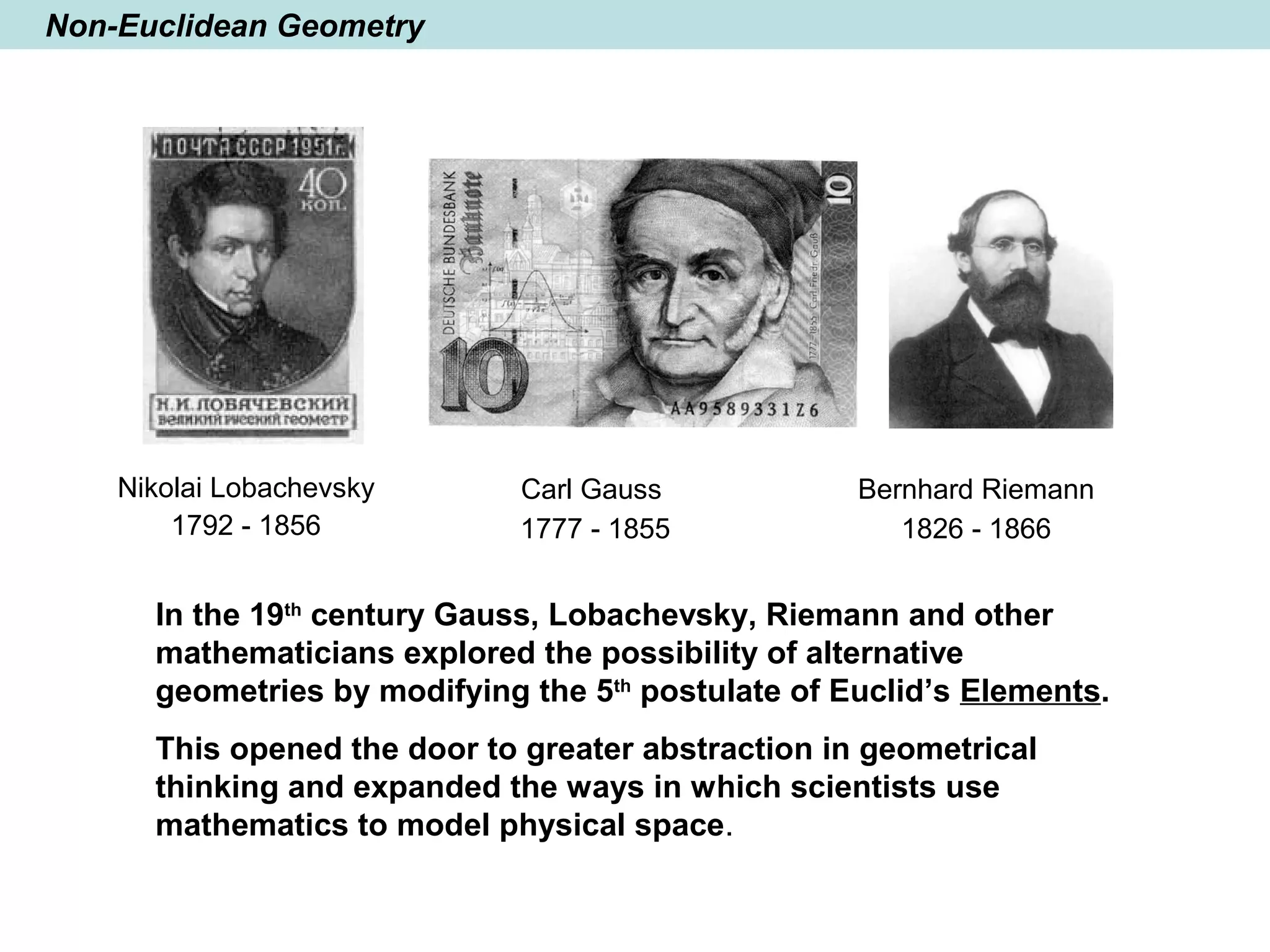
Non-Euclidean Geometry
In the 19th
century Gauss, Lobachevsky, Riemann and other
mathematicians explored the possibility of alternative
geometries by modifying the 5th
postulate of Euclid’s Elements.
This opened the door to greater abstraction in geometrical
thinking and expanded the ways in which scientists use
mathematics to model physical space.
Bernhard Riemann
1826 - 1866
Nikolai Lobachevsky
1792 - 1856
Carl Gauss
1777 - 1855
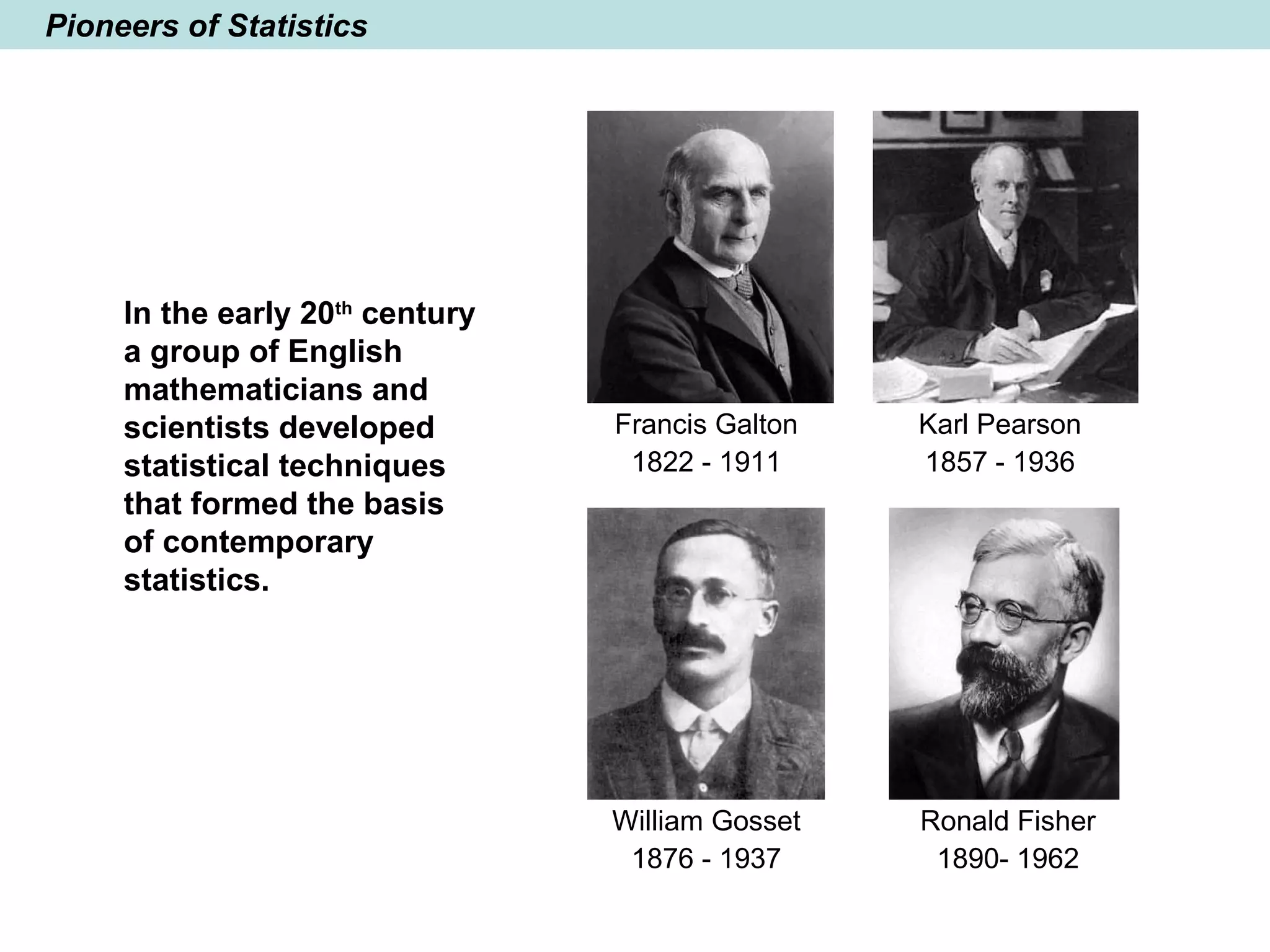
Pioneers of Statistics
In the early 20th
century
a group of English
mathematicians and
scientists developed
statistical techniques
that formed the basis
of contemporary
statistics.
William Gosset
1876 - 1937
Francis Galton
1822 - 1911
Karl Pearson
1857 - 1936
Ronald Fisher
1890- 1962
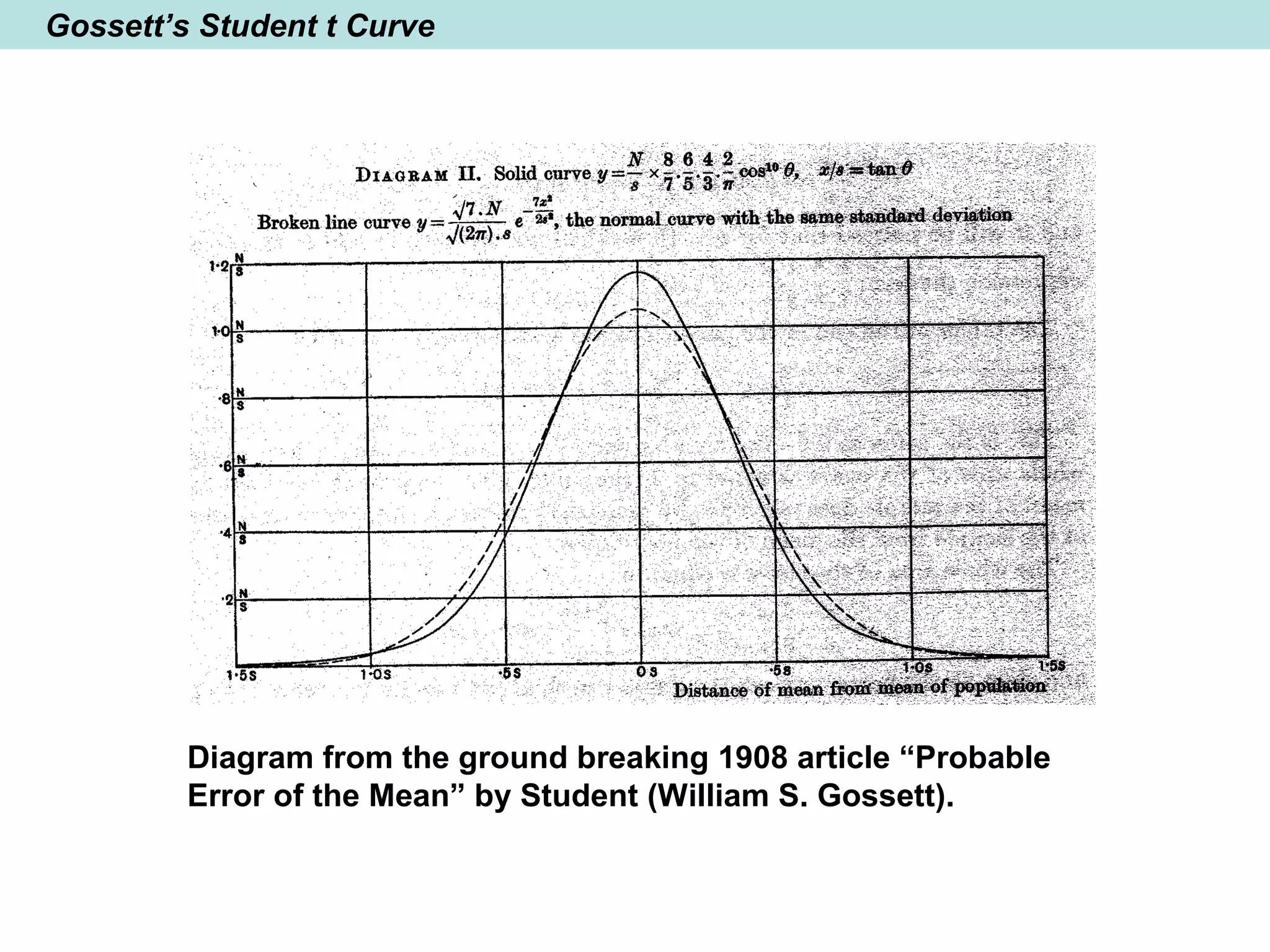
Gossett’s Student t Curve
Diagram from the ground breaking 1908 article “Probable
Error of the Mean” by Student (William S. Gossett).
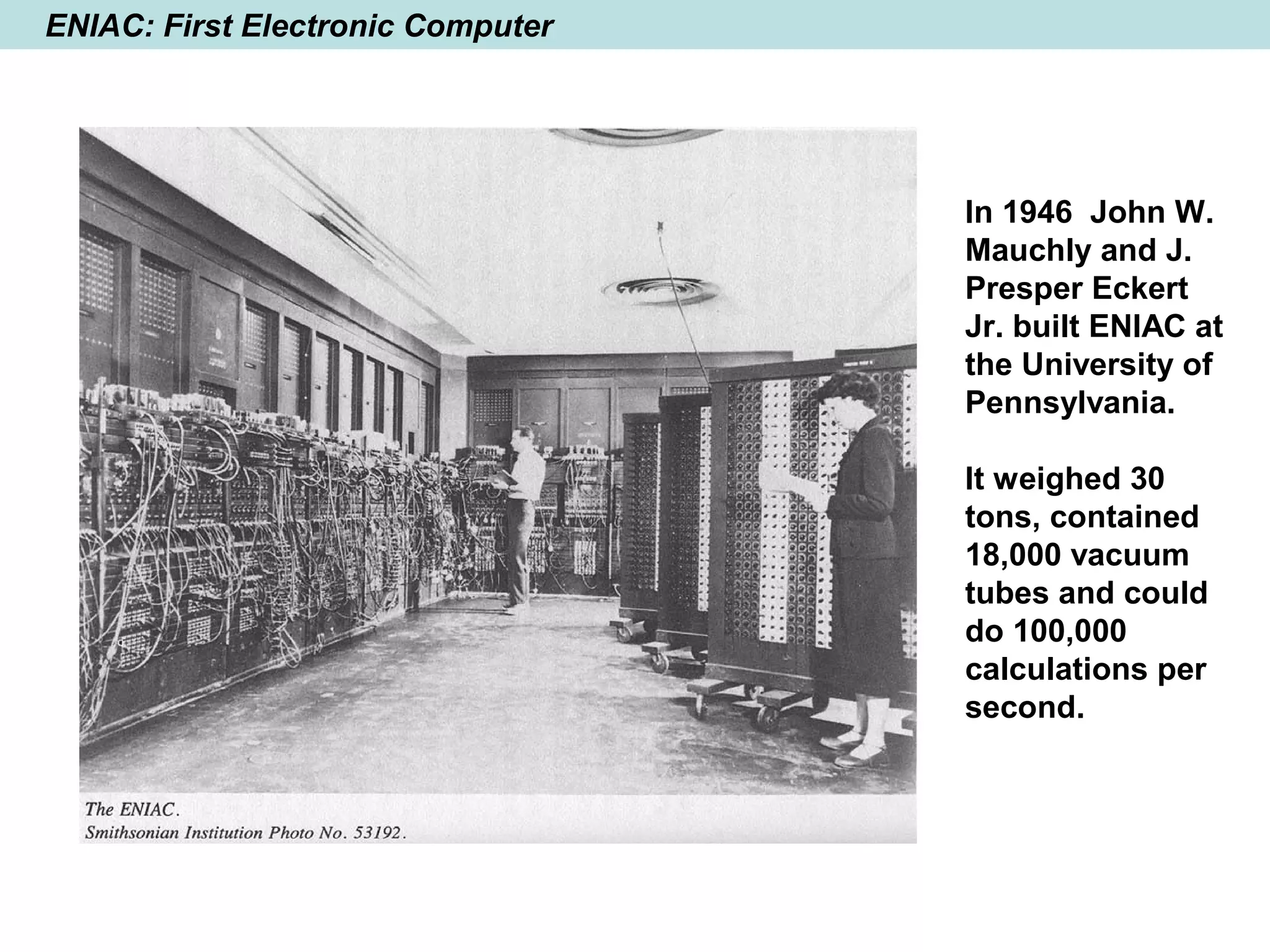
ENIAC: First Electronic Computer
In 1946 John W.
Mauchly and J.
Presper Eckert
Jr. built ENIAC at
the University of
Pennsylvania.
It weighed 30
tons, contained
18,000 vacuum
tubes and could
do 100,000
calculations per
second.
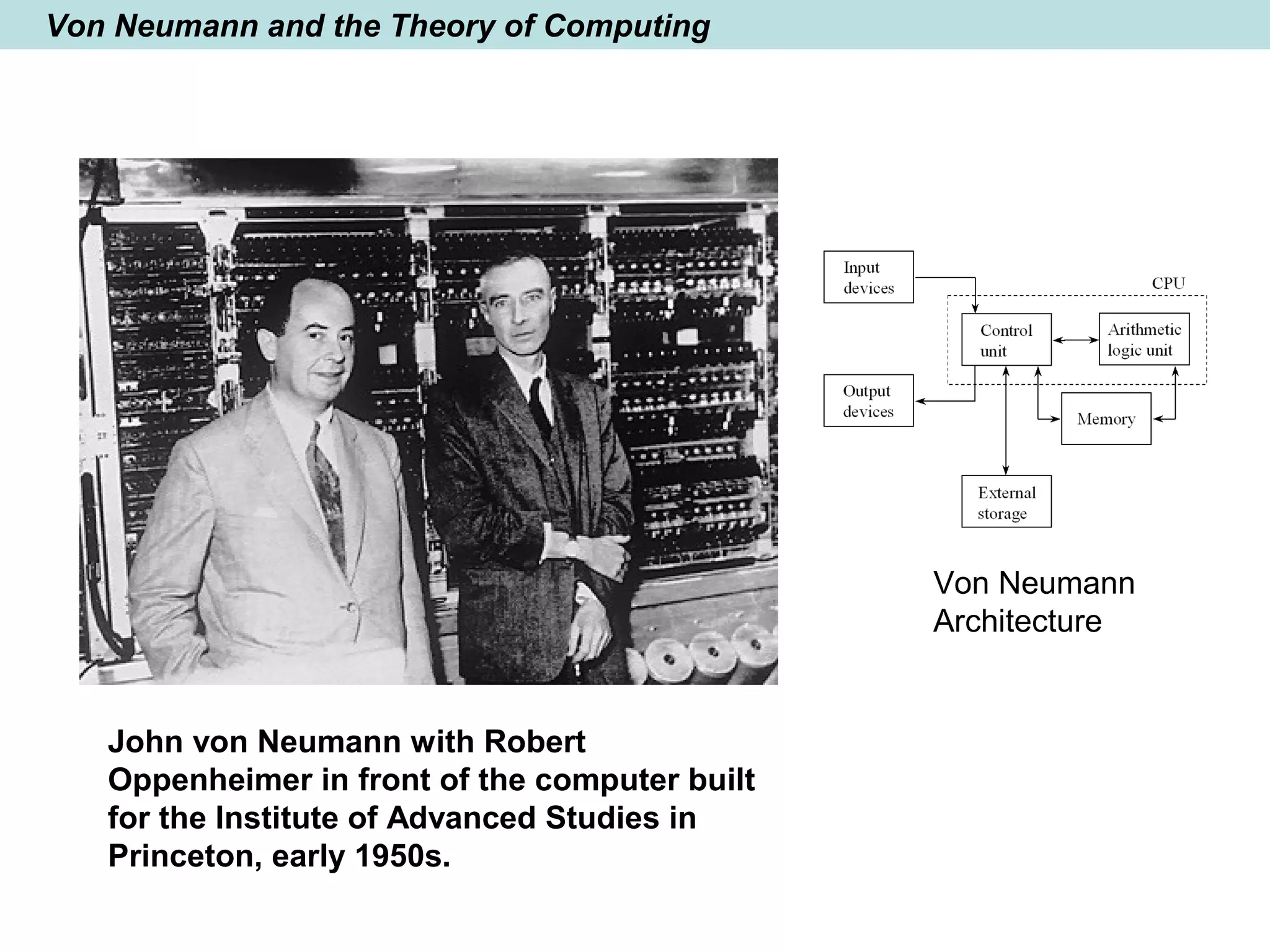
Von Neumann and the Theory of Computing
John von Neumann with Robert
Oppenheimer in front of the computer built
for the Institute of Advanced Studies in
Princeton, early 1950s.
Von Neumann
Architecture
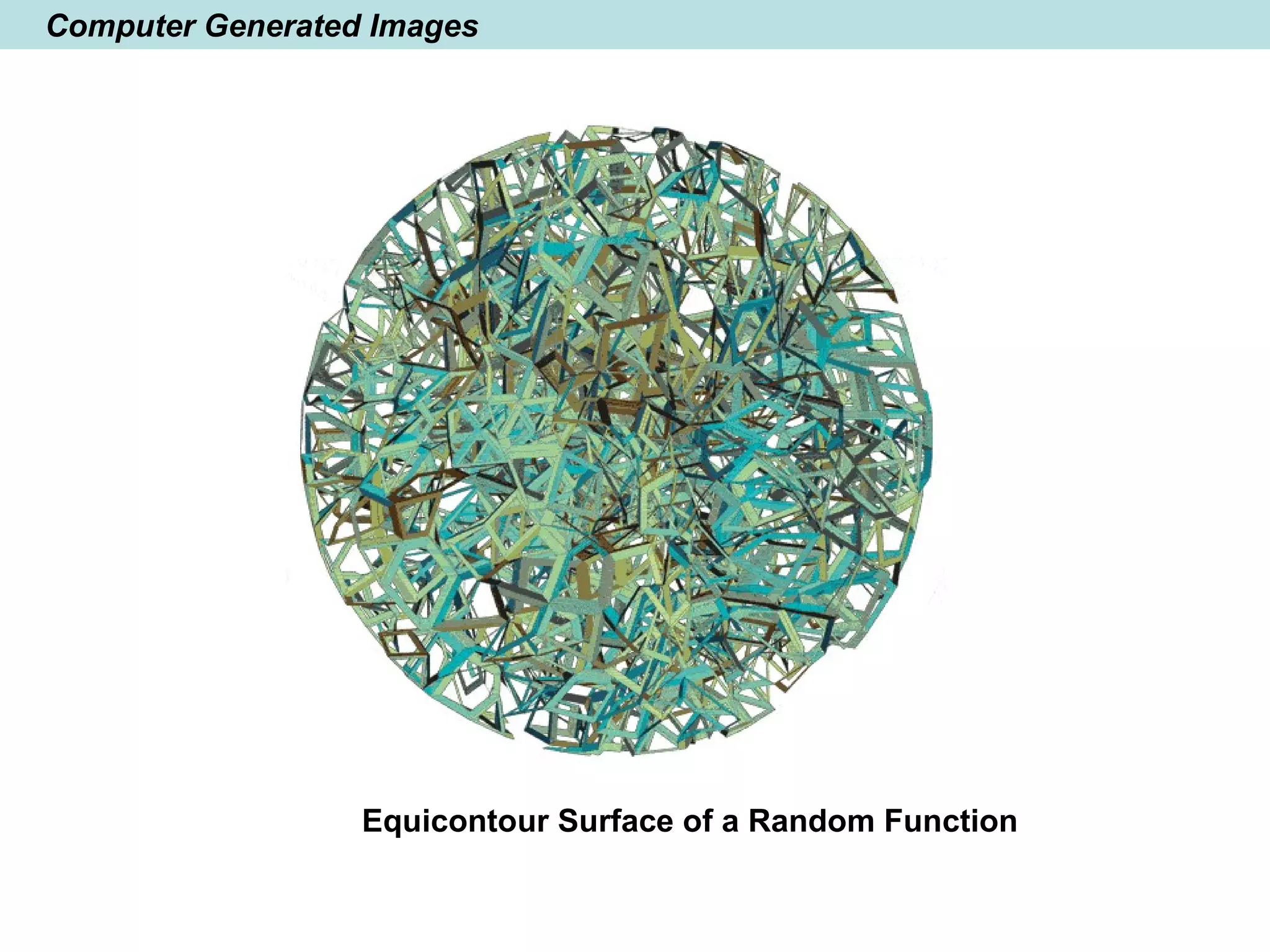
Computer Generated Images
Equicontour Surface of a Random Function
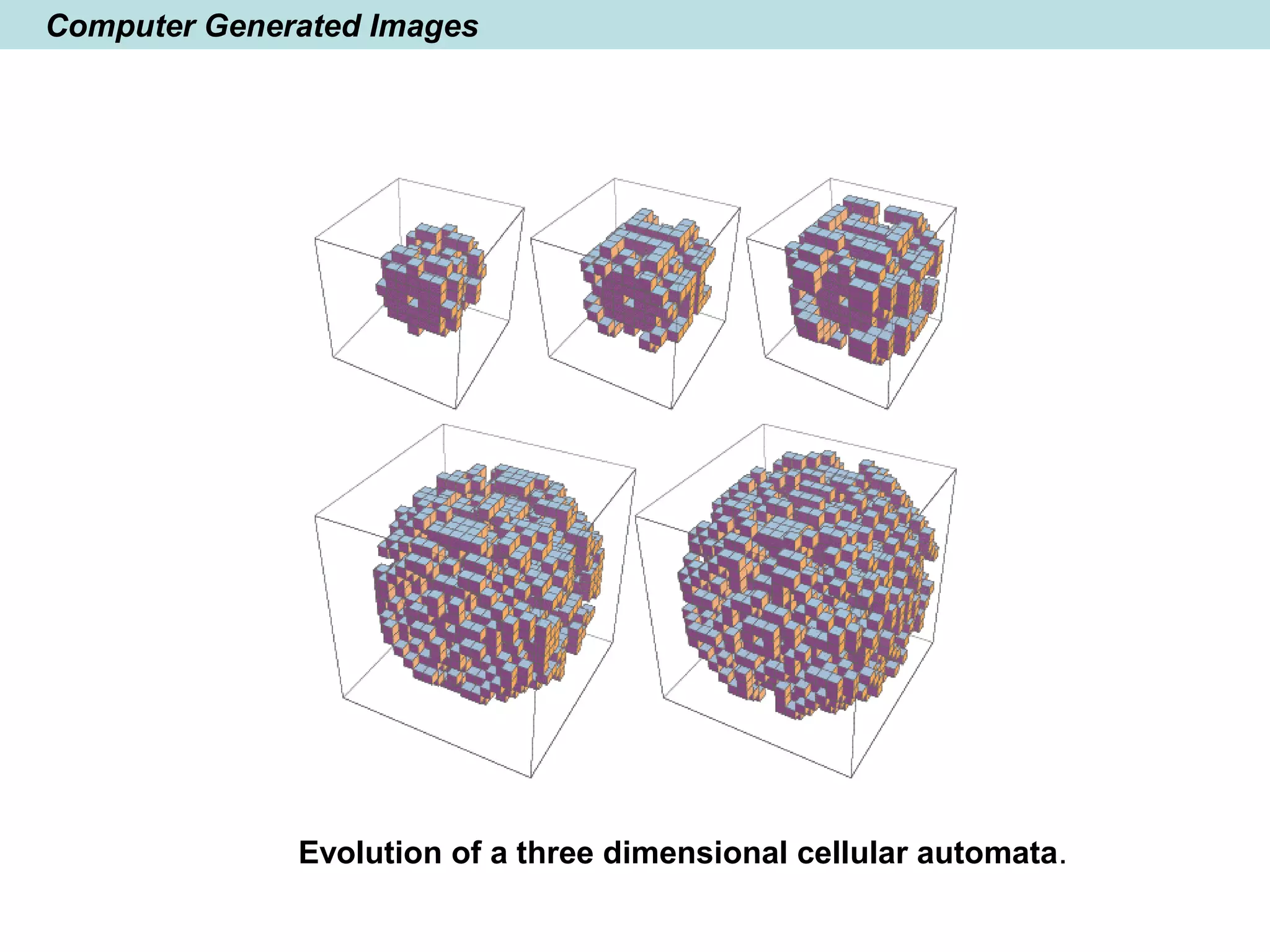
Computer Generated Images
Evolution of a three dimensional cellular automata.

History of math powerpoint

  • 1.
    A Brief Historyof Mathematics • Ancient Period • Greek Period • Hindu-Arabic Period • Period of Transmission • Early Modern Period • Modern Period
  • 2.
    A. Number Systemsand Arithmetic • Development of numeration systems. • Creation of arithmetic techniques, lookup tables, the abacus and other calculation tools. B. Practical Measurement, Geometry and Astronomy • Measurement units devised to quantify distance, area, volume, and time. • Geometric reasoning used to measure distances indirectly. • Calendars invented to predict seasons, astronomical events. • Geometrical forms and patterns appear in art and architecture. Ancient Period (3000 B.C. to 260 A.D.)
  • 3.
    Practical Mathematics As ancientcivilizations developed, the need for practical mathematics increased. They required numeration systems and arithmetic techniques for trade, measurement strategies for construction, and astronomical calculations to track the seasons and cosmic cycles.
  • 4.
    Babylonian Numerals The BabylonianTablet Plimpton 322 This mathematical tablet was recovered from an unknown place in the Iraqi desert. It was written originally sometime around 1800 BC. The tablet presents a list of Pythagorean triples written in Babylonian numerals. This numeration system uses only two symbols and a base of sixty.
  • 5.
    Chinese Mathematics Diagram fromChiu Chang Suan Shu, an ancient Chinese mathematical text from the Han Dynasty (206 B.C. to A.D. 220). This book consists of nine chapters of mathematical problems. Three involve surveying and engineering formulas, three are devoted to problems of taxation and bureaucratic administration, and the remaining three to specific computational techniques. Demonstration of the Gou-Gu (Pythagorean) Theorem
  • 6.
    Calculating Devices Chinese Wooden Abacus RomanBronze “Pocket” Abacus Babylonian Marble Counting Board c. 300 B.C.
  • 7.
    A. Greek Logicand Philosophy • Greek philosophers promote logical, rational explanations of natural phenomena. • Schools of logic, science and mathematics are established. • Mathematics is viewed as more than a tool to solve practical problems; it is seen as a means to understand divine laws. • Mathematicians achieve fame, are valued for their work. B. Euclidean Geometry • The first mathematical system based on postulates, theorems and proofs appears in Euclid's Elements. Greek Period (600 B.C. to 450 A.D.)
  • 8.
    Area of GreekInfluence Archimedes of Syracuse Euclid and Ptolemy of Alexandria Pythagoras of Crotona Apollonius of Perga Eratosthenes of Cyrene
  • 9.
    Mathematics and GreekPhilosophy Greek philosophers viewed the universe in mathematical terms. Plato described five elements that form the world and related them to the five regular polyhedra.
  • 10.
    Euclid’s Elements Greek, c.800 Arabic, c. 1250 Latin, c. 1120 French, c. 1564 English, c. 1570 Chinese, c. 1607 Translations of Euclid’s Elements of Gemetry Proposition 47, the Pythagorean Theorem
  • 11.
    The Conic Sectionsof Apollonius
  • 12.
    Archimedes and theCrown Eureka!
  • 13.
    Archimedes Screw Archimedes’ screwis a mechanical device used to lift water and such light materials as grain or sand. To pump water from a river, for example, the lower end is placed in the river and water rises up the spiral threads of the screw as it is revolved.
  • 14.
    Ptolemaic System Ptolemy describedan Earth- centered solar system in his book The Almagest. The system fit well with the Medieval world view, as shown by this illustration of Dante.
  • 15.
    Hindu-Arabian Period (200B.C. to 1250 A.D. ) A. Development and Spread of Hindu-Arabic Numbers • A numeration system using base 10, positional notation, the zero symbol and powerful arithmetic techniques is developed by the Hindus, approx. 150 B.C. to 800 A.D.. • The Hindu numeration system is adopted by the Arabs and spread throughout their sphere of influence (approx. 700 A.D. to 1250 A.D.). B. Preservation of Greek Mathematics • Arab scholars copied and studied Greek mathematical works, principally in Baghdad. C. Development of Algebra and Trigonometry • Arab mathematicians find methods of solution for quadratic, cubic and higher degree polynomial equations. The English word “algebra” is derived from the title of an Arabic book describing these methods. • Hindu trigonometry, especially sine tables, is improved and advanced by Arab mathematicians
  • 16.
    Baghdad and theHouse of Wisdom About the middle of the ninth century Bait Al-Hikma, the "House of Wisdom" was founded in Baghdad which combined the functions of a library, academy, and translation bureau. Baghdad attracted scholars from the Islamic world and became a great center of learning. Painting of ancient Baghdad
  • 17.
    The Great Mosqueof Cordoba The Great Mosque, Cordoba During the Middle Ages Cordoba was the greatest center of learning in Europe, second only to Baghdad in the Islamic world.
  • 18.
    Arabic Translation ofApollonius’ Conic Sections.
  • 19.
    Arabic Translation ofPtolemy’s Almagest Pages from a 13th century Arabic edition of Ptolemy’s Almagest.
  • 20.
    Al-Khwarizmi Abu Abdullah Muhammadbin Musa al- Khwarizmi, c. 800 A.D. was a Persian mathematician, scientist, and author. He worked in Baghdad and wrote all his works in Arabic. He developed the concept of an algorithm in mathematics. The words "algorithm" and "algorism" derive ultimately from his name. His systematic and logical approach to solving linear and quadratic equations gave shape to the discipline of algebra, a word that is derived from the name of his book on the subject, Hisab al-jabr wa al-muqabala (“al-jabr” became “algebra”). He was also instrumental in promoting the Hindu-arabic numeration system.
  • 21.
  • 22.
    Leonardo of Pisa FromLeonardo of Pisa’s famous book Liber Abaci (1202 A.D.): "These are the nine figures of the Indians: 9 8 7 6 5 4 3 2 1. With these nine figures, and with this sign 0 which in Arabic is called zephirum, any number can be written, as will be demonstrated."
  • 23.
    “Jealousy” Multiplication Page froman anonymous Italian treatise on arithmetic, 1478. 16th century Arab copy of an early work using Indian numerals to show multiplication. Top example is 3 x 64, bottom is 543 x 342.
  • 24.
    Rediscovery of GreekGeometry Luca Pacioli (1445 - 1514), a Franciscan friar and mathematician, stands at a table filled with geometrical tools (slate, chalk, compass, dodecahedron model, etc.), illustrating a theorem from Euclid, while examining a beautiful glass rhombicuboctahedron half- filled with water.
  • 25.
    Pacioli and LeonardoDa Vinci Luca Pacioli's 1509 book The Divine Proportion was illustrated by Leonardo Da Vinci. Shown here is a drawing of an icosidodecahedron and an "elevated" form of it. For the elevated forms, each face is augmented with a pyramid composed of equilateral triangles.
  • 26.
    Early Modern Period(1450 A.D. – 1800 A.D.) A. Trigonometry and Logarithms • Publication of precise trigonometry tables, improvement of surveying methods using trigonometry, and mathematical analysis of trigonometric relationships. (approx. 1530 – 1600) • Logarithms introduced by Napier in 1614 as a calculation aid. This advances science in a manner similar to the introduction of the computer. B. Symbolic Algebra and Analytic Geometry • Development of symbolic algebra, principally by the French mathematicians Viete and Descartes • The cartesian coordinate system and analytic geometry developed by Rene Descartes and Pierre Fermat (1630 – 1640) C. Creation of the Calculus • Calculus co-invented by Isaac Newton and Gottfried Leibniz. Major ideas of the calculus expanded and refined by others, especially the Bernoulli family and Leonhard Euler. (approx. 1660 – 1750). • A powerful tool to solve scientific and engineering problems, it opened the door to a scientific and mathematical revolution.
  • 27.
    Viète and SymbolicAlgebra In his influential treatise In Artem Analyticam Isagoge (Introduction to the Analytic Art, published in1591) Viète demonstrated the value of symbols. He suggested using letters as symbols for quantities, both known and unknown. François Viète 1540-1603
  • 28.
    The Conic Sectionsand Analytic Geometry General Quadratic Relation Ax2 + Bxy + Cy2 + Dx + Ey + F = 0 Parabola -x2 + y = 0 Ellipse 4x2 + y2 - 9 = 0 Hyperbola x2 – y2 – 4 = 0
  • 29.
    Some Famous Curves Fermat’sSpiral r2 = a2 θ Archimede’s Spiral r = aθ Trisectrix of Maclaurin y2 (a + x) = x2 (3a - x) Lemniscate of Bernoulli (x2 + y2 )2 = a2 (x2 - y2 ) Limacon of Pascal r = b + 2acos(θ)
  • 30.
    Curves and Calculus:Common Problems Find the area between curves. Find the volume and surface area of a solid formed by rotating a curve. Find the length of a curve. Find measures of a curve’s shape.
  • 31.
    Napier’s Logarithms In hisMirifici Logarithmorum Canonis descriptio (1614) the Scottish nobleman John Napier introduced the concept of logarithms as an aid to calculation. John Napier 1550-1617
  • 32.
    Kepler and thePlatonic Solids Johannes Kepler 1571-1630 Kepler’s first attempt to describe planetary orbits used a model of nested regular polyhedra (Platonic solids).
  • 33.
    Newton’s Principia –Kepler’s Laws “Proved” Isaac Newton 1642 - 1727 Newton’s Principia Mathematica (1687) presented, in the style of Euclid’s Elements, a mathematical theory for celestial motions due to the force of gravity. The laws of Kepler were “proved” in the sense that they followed logically from a set of basic postulates.
  • 34.
    Newton’s Calculus Newton developedthe main ideas of his calculus in private as a young man. This research was closely connected to his studies in physics. Many years later he published his results to establish priority for himself as inventor the calculus. Newton’s Analysis Per Quantitatum Series, Fluxiones, Ac Differentias, 1711, describes his calculus.
  • 35.
    Leibniz’s Calculus Leibniz andNewton independently developed the calculus during the same time period. Although Newton’s version of the calculus led him to his great discoveries, Leibniz’s concepts and his style of notation form the basis of modern calculus. Gottfied Leibniz 1646 - 1716 A diagram from Leibniz's famous 1684 article in the journal Acta eruditorum.
  • 36.
    Leonhard Euler Leonhard Eulerwas of the generation that followed Newton and Leibniz. He made contributions to almost every field of mathematics and was the most prolific mathematics writer of all time. His trilogy, Introductio in analysin infinitorum, Institutiones calculi differentialis, and Institutiones calculi integralis made the function a central part of calculus. Through these works, Euler had a deep influence on the teaching of mathematics. It has been said that all calculus textbooks since 1748 are essentially copies of Euler or copies of copies of Euler. Euler’s writing standardized modern mathematics notation with symbols such as: f(x), e, π, i and ∑ . Leonhard Euler 1707 - 1783
  • 37.
    Modern Period (1800A.D. – Present) A. Non-Euclidean Geometry • Gauss, Lobachevsky, Riemann and others develop alternatives to Euclidean geometry in the 19th century. • The new geometries inspire modern theories of higher dimensional spaces, gravitation, space curvature and nuclear physics. B. Set Theory • Cantor studies infinite sets and defines transfinite numbers • Set theory used as a theoretical foundation for all of mathematics C. Statistics and Probability • Theories of probability and statistics are developed to solve numerous practical applications, such as weather prediction, polls, medical studies etc.; they are also used as a basis for nuclear physics D. Computers • Development of electronic computer hardware and software solves many previously unsolvable problems; opens new fields of mathematical research. E. Mathematics as a World-Wide Language • The Hindu-Arabic numeration system and a common set of mathematical symbols are used and understood throughout the world. • Mathematics expands into many branches and is created and shared world-wide at an ever-expanding pace; it is now too large to be mastered by a single mathematician
  • 38.
    Non-Euclidean Geometry In the19th century Gauss, Lobachevsky, Riemann and other mathematicians explored the possibility of alternative geometries by modifying the 5th postulate of Euclid’s Elements. This opened the door to greater abstraction in geometrical thinking and expanded the ways in which scientists use mathematics to model physical space. Bernhard Riemann 1826 - 1866 Nikolai Lobachevsky 1792 - 1856 Carl Gauss 1777 - 1855
  • 39.
    Pioneers of Statistics Inthe early 20th century a group of English mathematicians and scientists developed statistical techniques that formed the basis of contemporary statistics. William Gosset 1876 - 1937 Francis Galton 1822 - 1911 Karl Pearson 1857 - 1936 Ronald Fisher 1890- 1962
  • 40.
    Gossett’s Student tCurve Diagram from the ground breaking 1908 article “Probable Error of the Mean” by Student (William S. Gossett).
  • 41.
    ENIAC: First ElectronicComputer In 1946 John W. Mauchly and J. Presper Eckert Jr. built ENIAC at the University of Pennsylvania. It weighed 30 tons, contained 18,000 vacuum tubes and could do 100,000 calculations per second.
  • 42.
    Von Neumann andthe Theory of Computing John von Neumann with Robert Oppenheimer in front of the computer built for the Institute of Advanced Studies in Princeton, early 1950s. Von Neumann Architecture
  • 43.
    Computer Generated Images EquicontourSurface of a Random Function
  • 44.
    Computer Generated Images Evolutionof a three dimensional cellular automata.